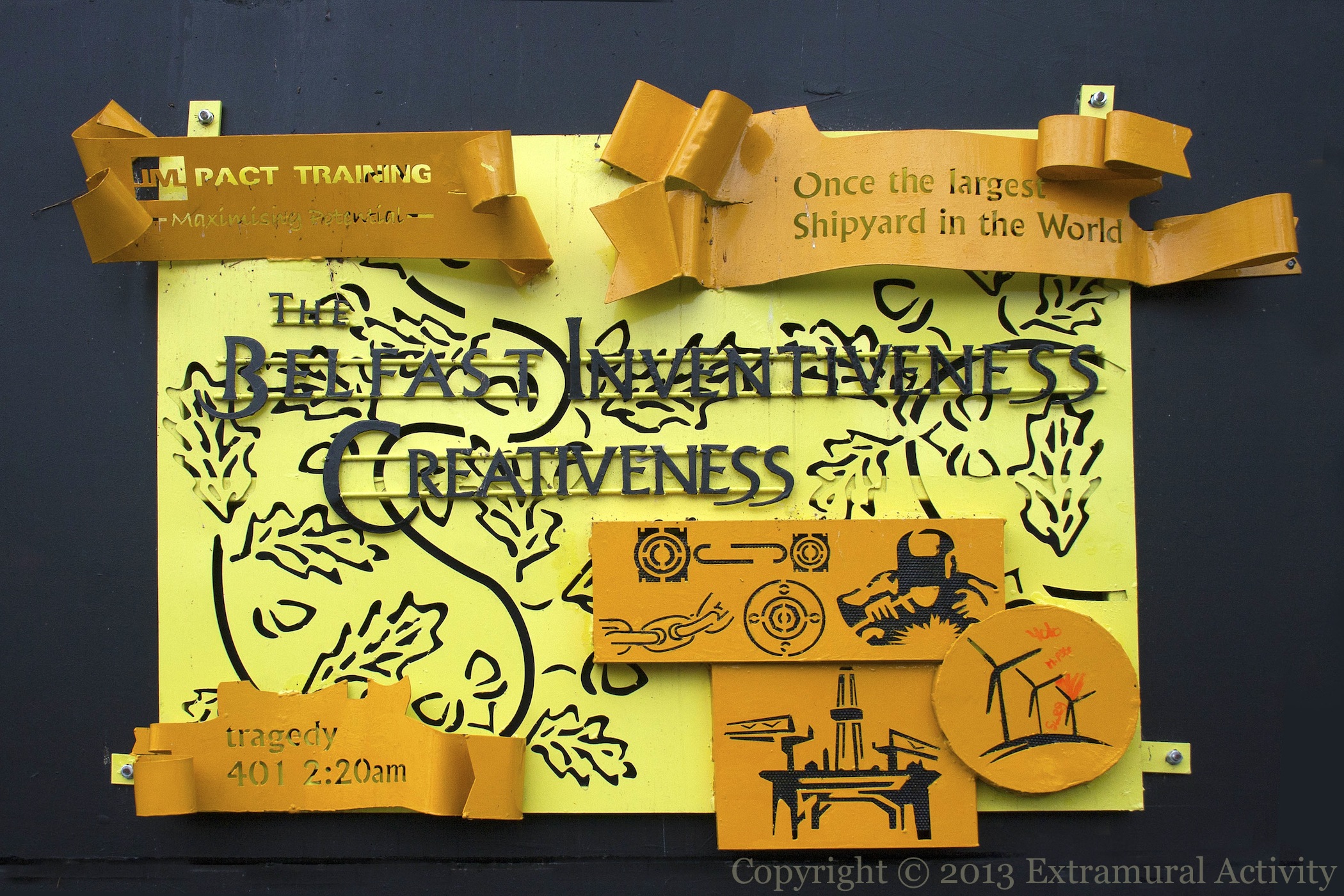
Titanic was hull number “401” at Harland & Wolff, and, after hitting an iceberg at 11:40 p.m. on April 14th, 1912, sank at 2:20 a.m. (WP). Above is another (see also Hope Lost, Identity) metal-work piece on the Cupar Way “peace” line, with images of a boat dock, solderers, and wind turbines.
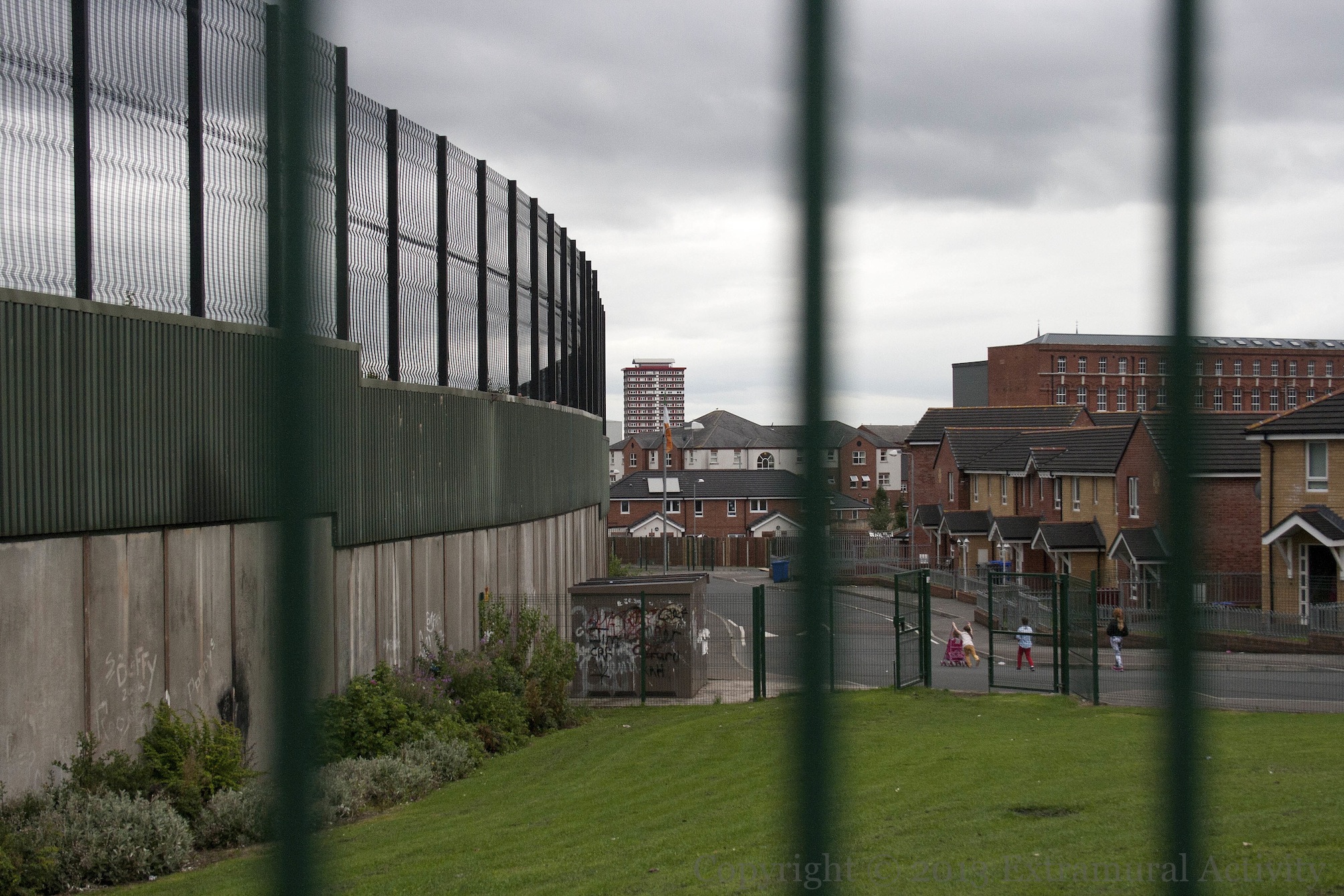
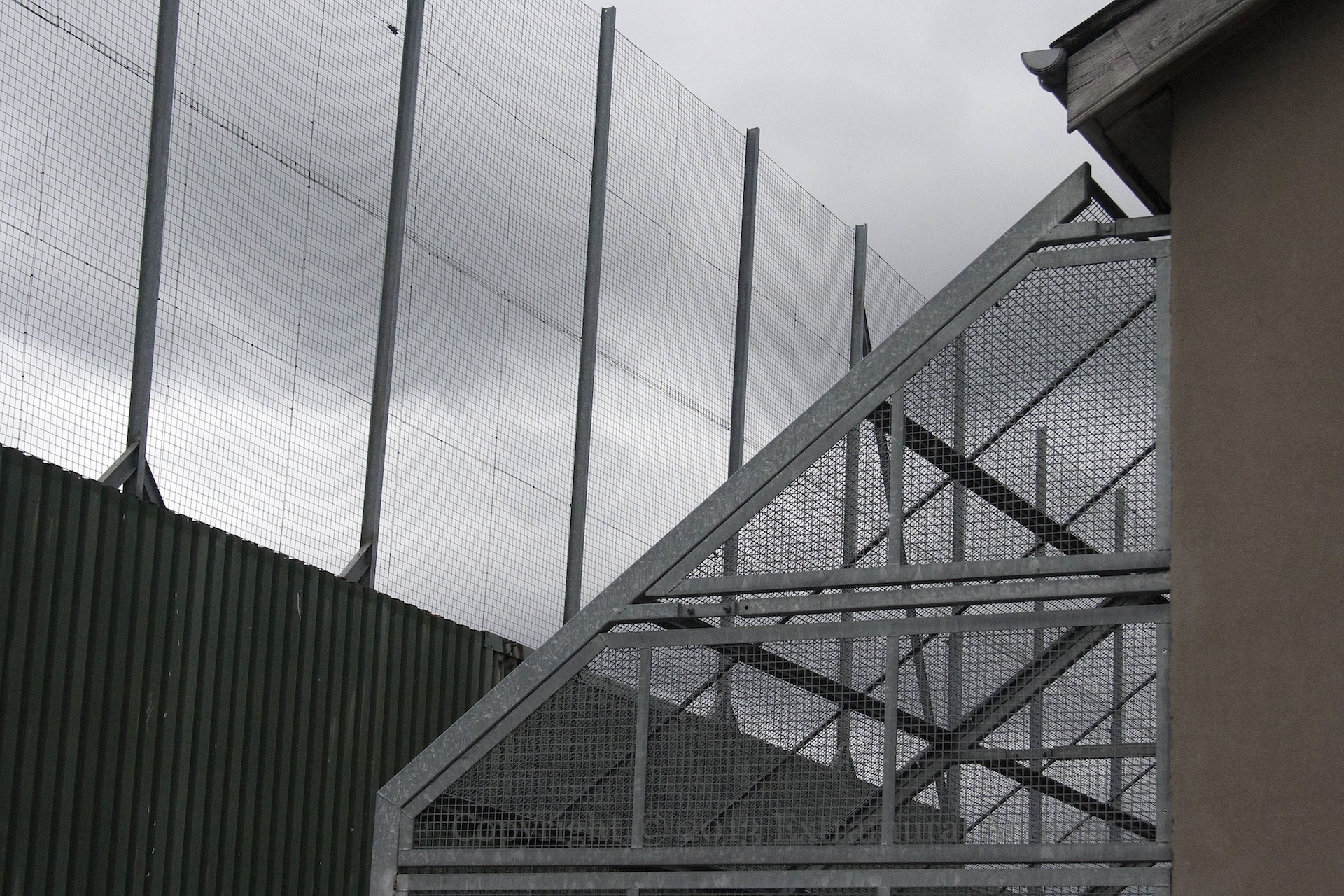
Previously we featured an image from the north (loyalist) side of the Cupar Way “peace” line, a.k.a. “war wall” or “wall of hostility” – the wall/fence separating neighbourhoods along the Shankill from those along the Falls. Here are two shots from the south (republican) side of the line, in Bombay Street. Divis tower is visible in the distance in the first. The second, below, shows the additional fencing that covers the backs of some houses.
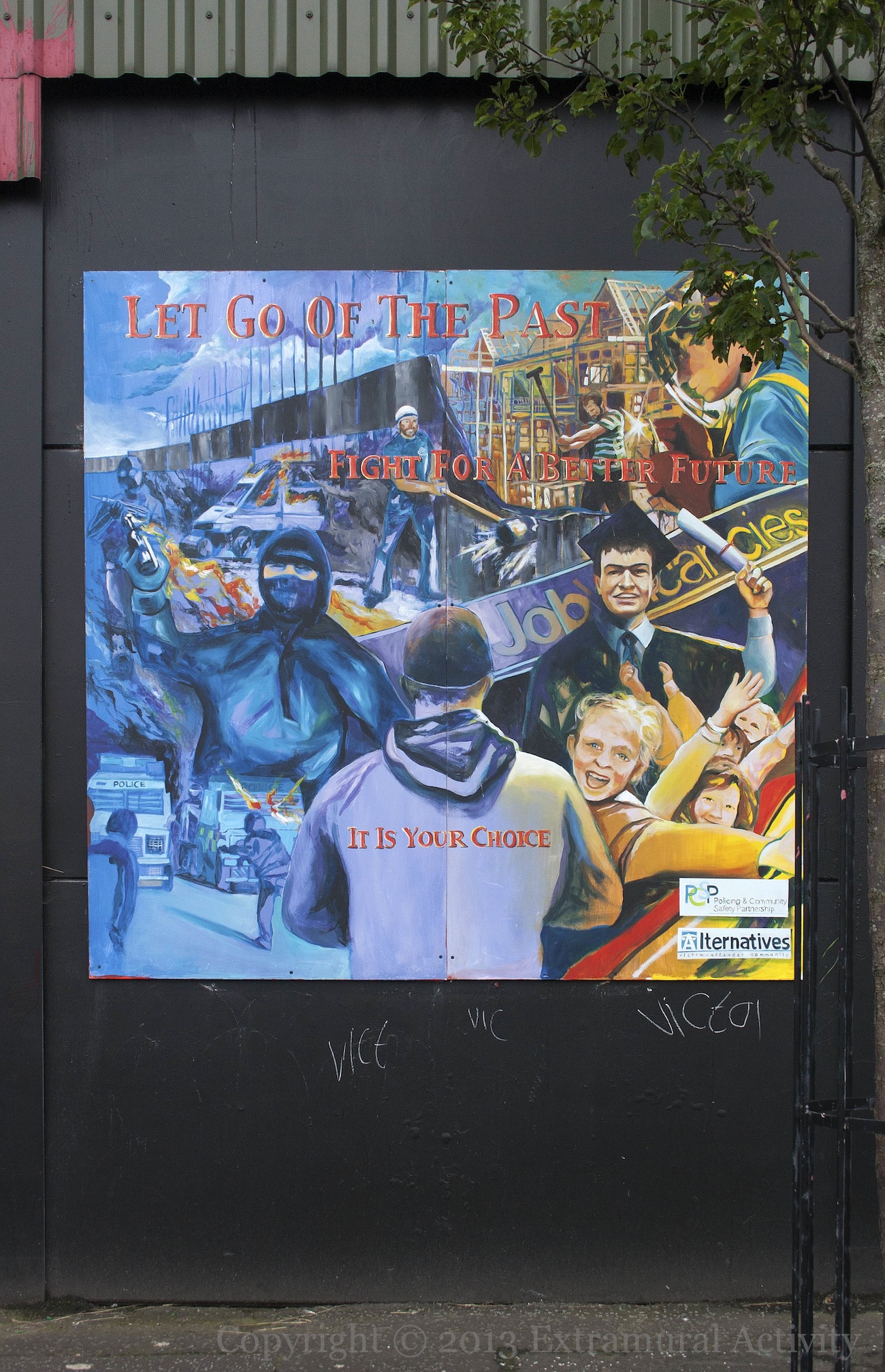
Board on the Cupar Way side of the “peace” line showing, on the left hand side, rioters with petrol bombs attacking the police, the “peace” line, and a burning vehicle, and, on the right, construction workers, university graduates, and happy children. “Fight for a better future. It is your choice.” For more information, see Daniela Balmaverde.
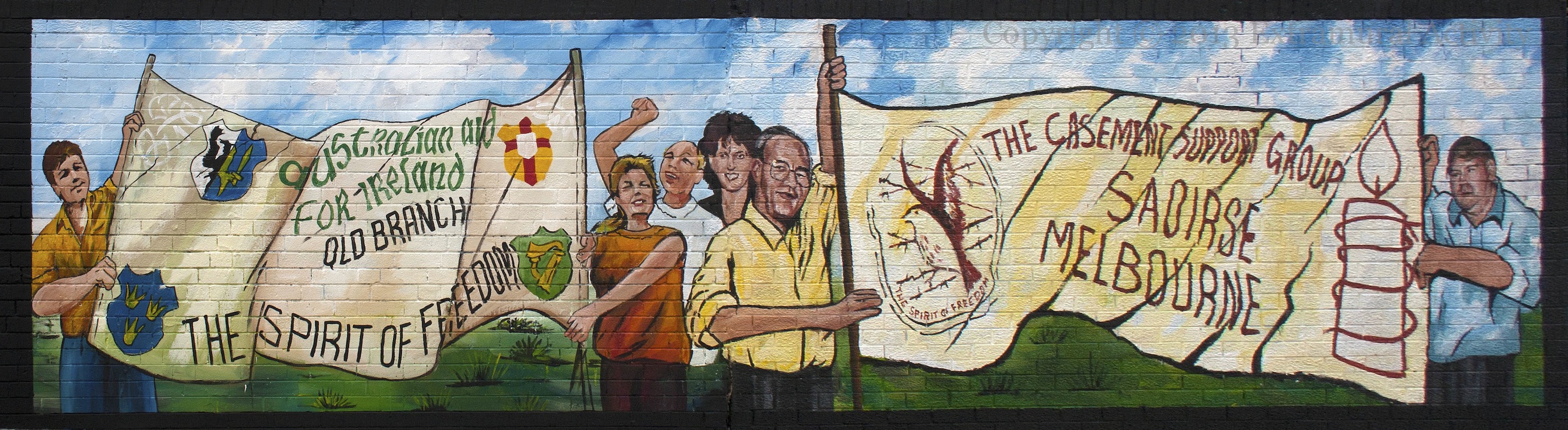
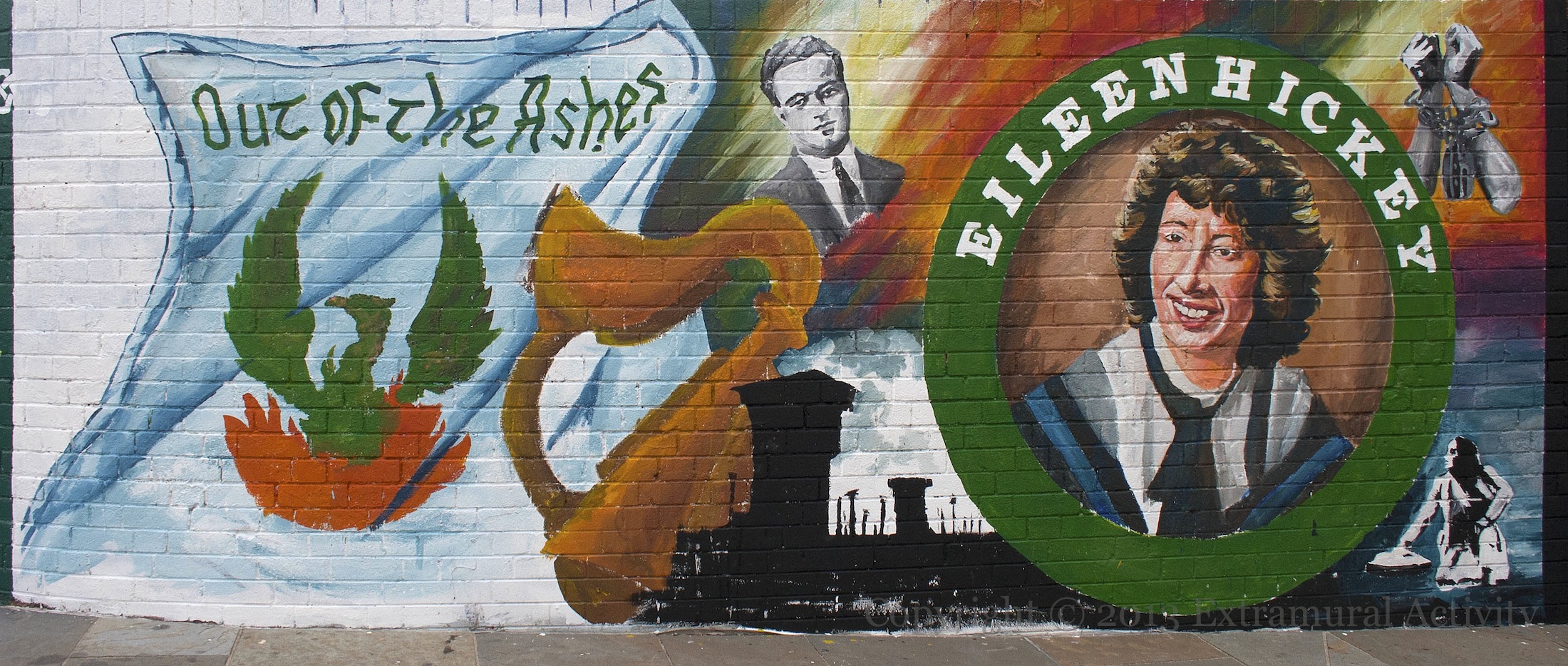
Above is an extra-wide shot (2700 pixels) of another panel from the wall next to the Republican Museum on Conway Street (next to the previously featured Eileen Hickey). The mural features banners of two Australian Republican support-groups, holding banners reading “Australian Aid for Ireland QLD [Queensland] Branch – The Spirit of Freedom” and “The Casement Support Group – Saoirse Melbourne”.
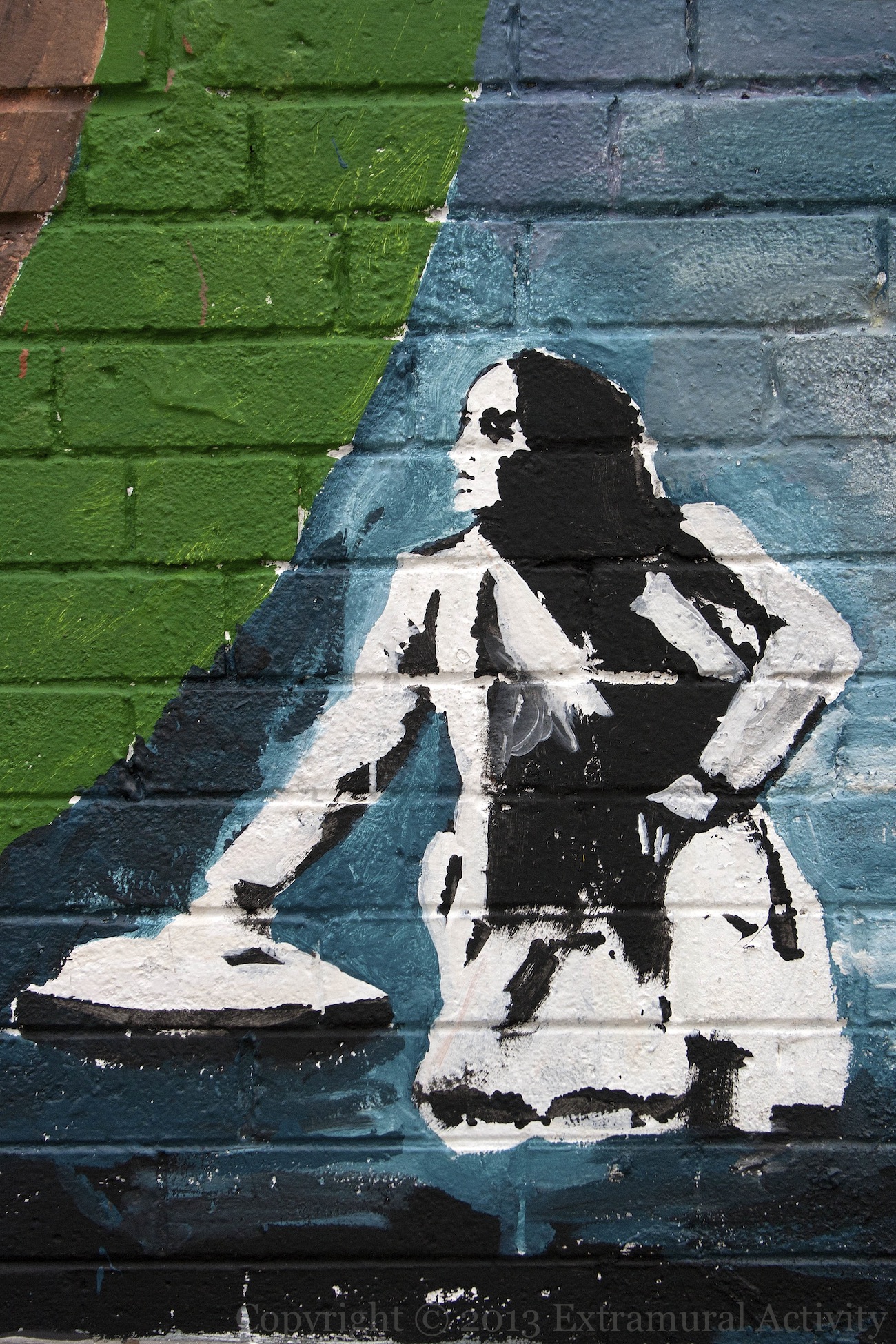
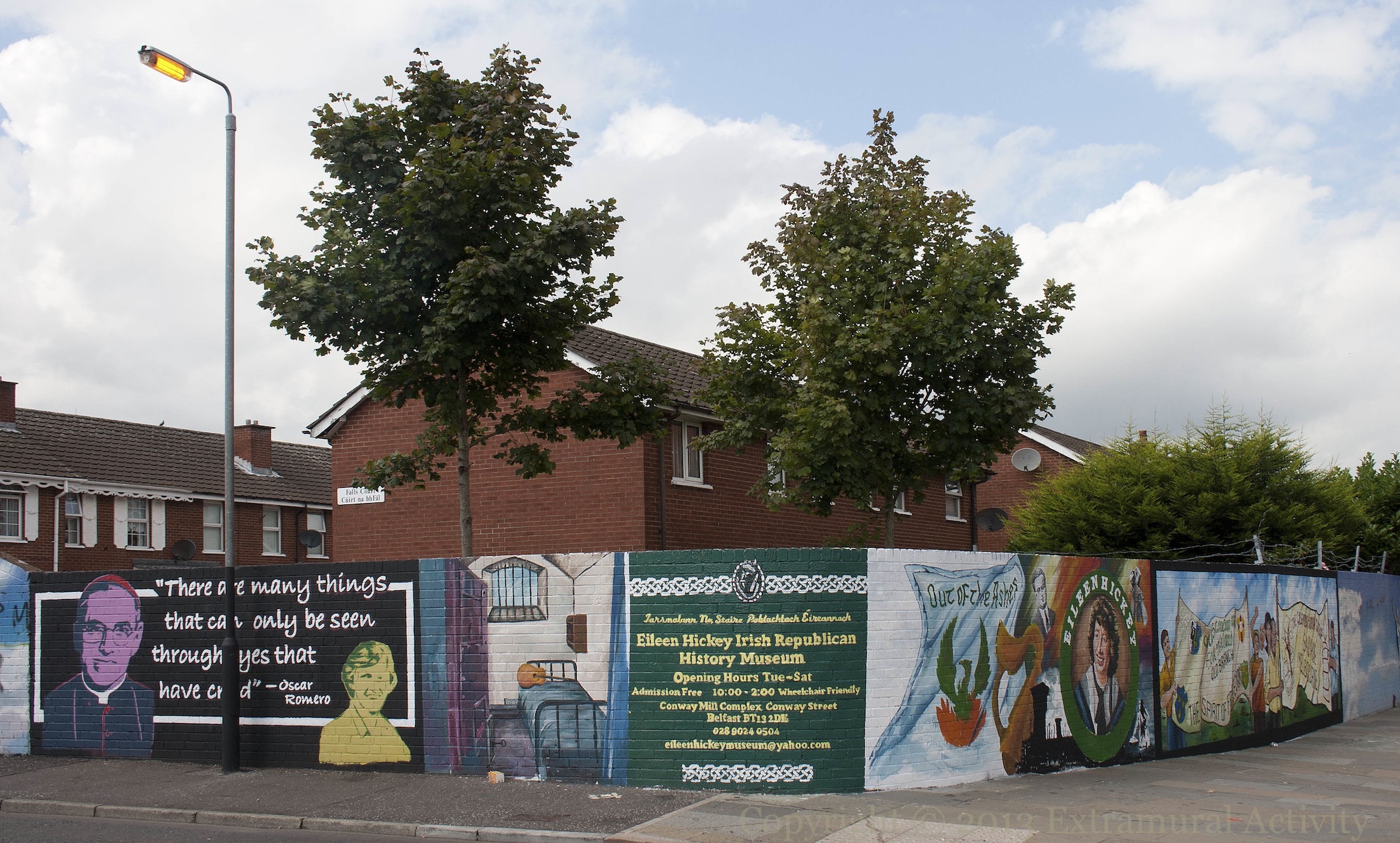
The ‘Eileen Hickey Irish Republican History Museum‘ — which is across the street behind the Conway Mill — is named for Eileen Hickey, a Provisional IRA member who served time in Armagh prison; she died in 2006, one year before the opening of the museum (obituary at An Phoblacht). A close-up of the woman with a bin lid, in the lower right-hand corner, can be found below.
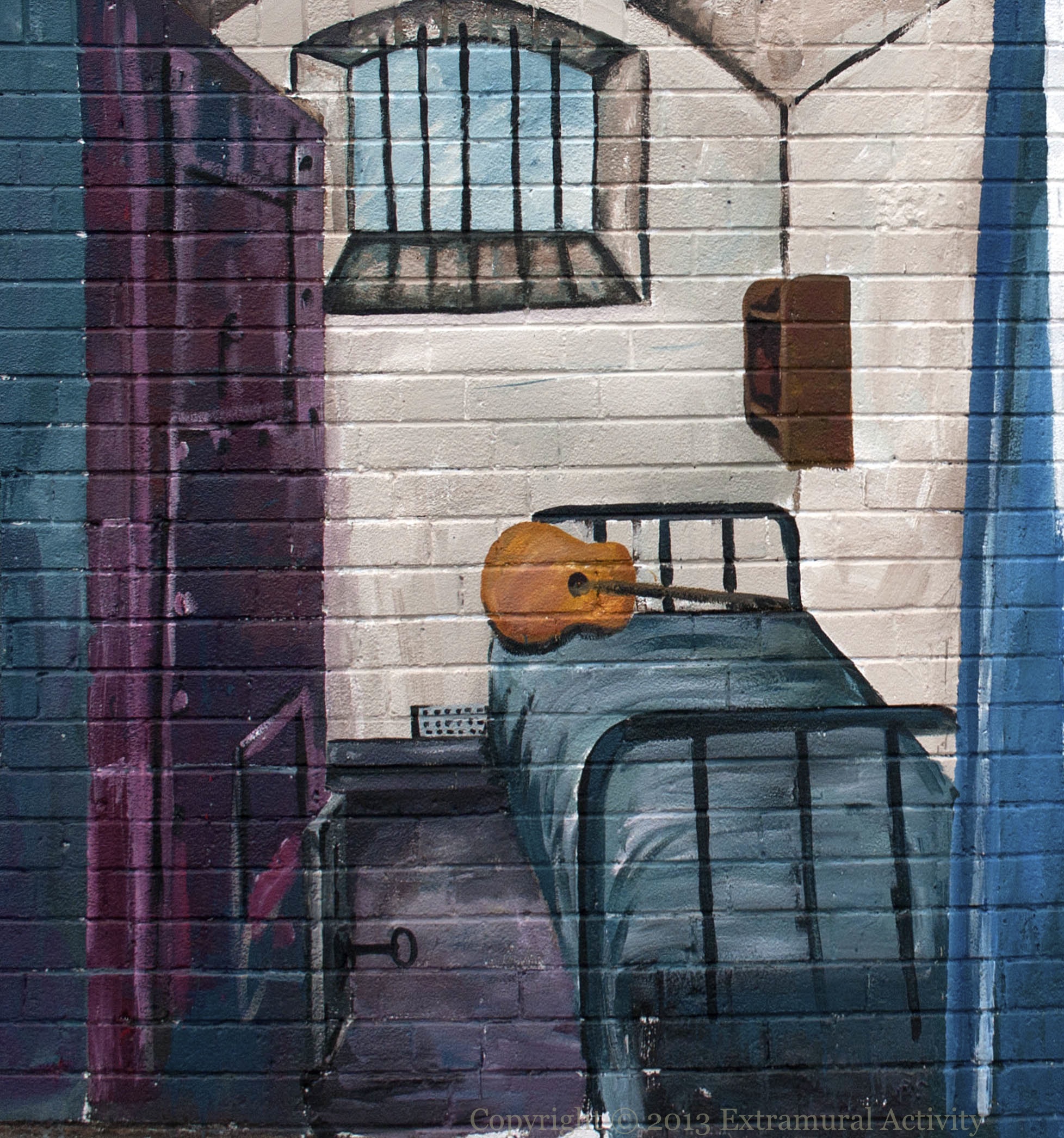
Next to the opening hours is an image of a prison cell in the Armagh women’s prison. The museum itself contains a cell door and a bed from the prison.
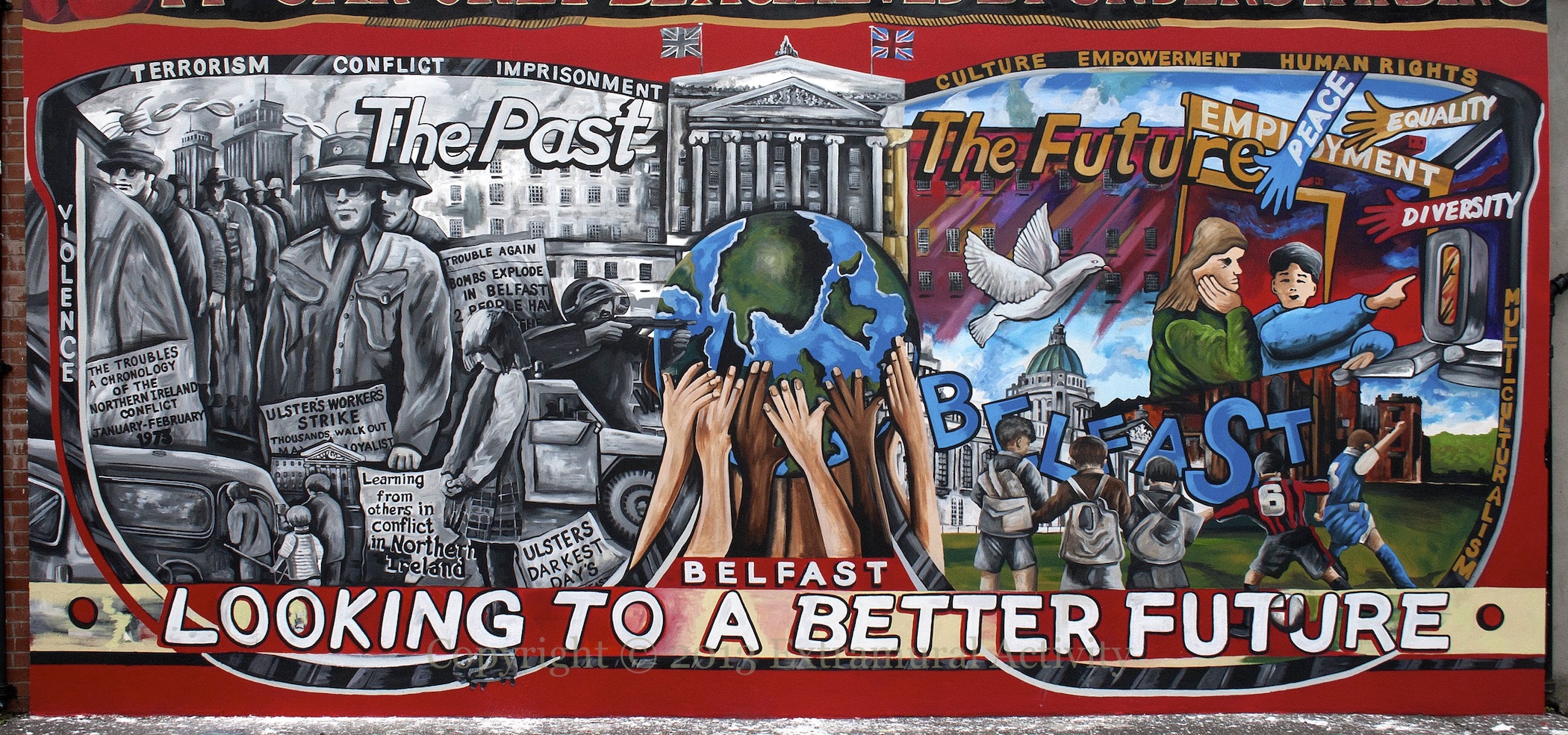
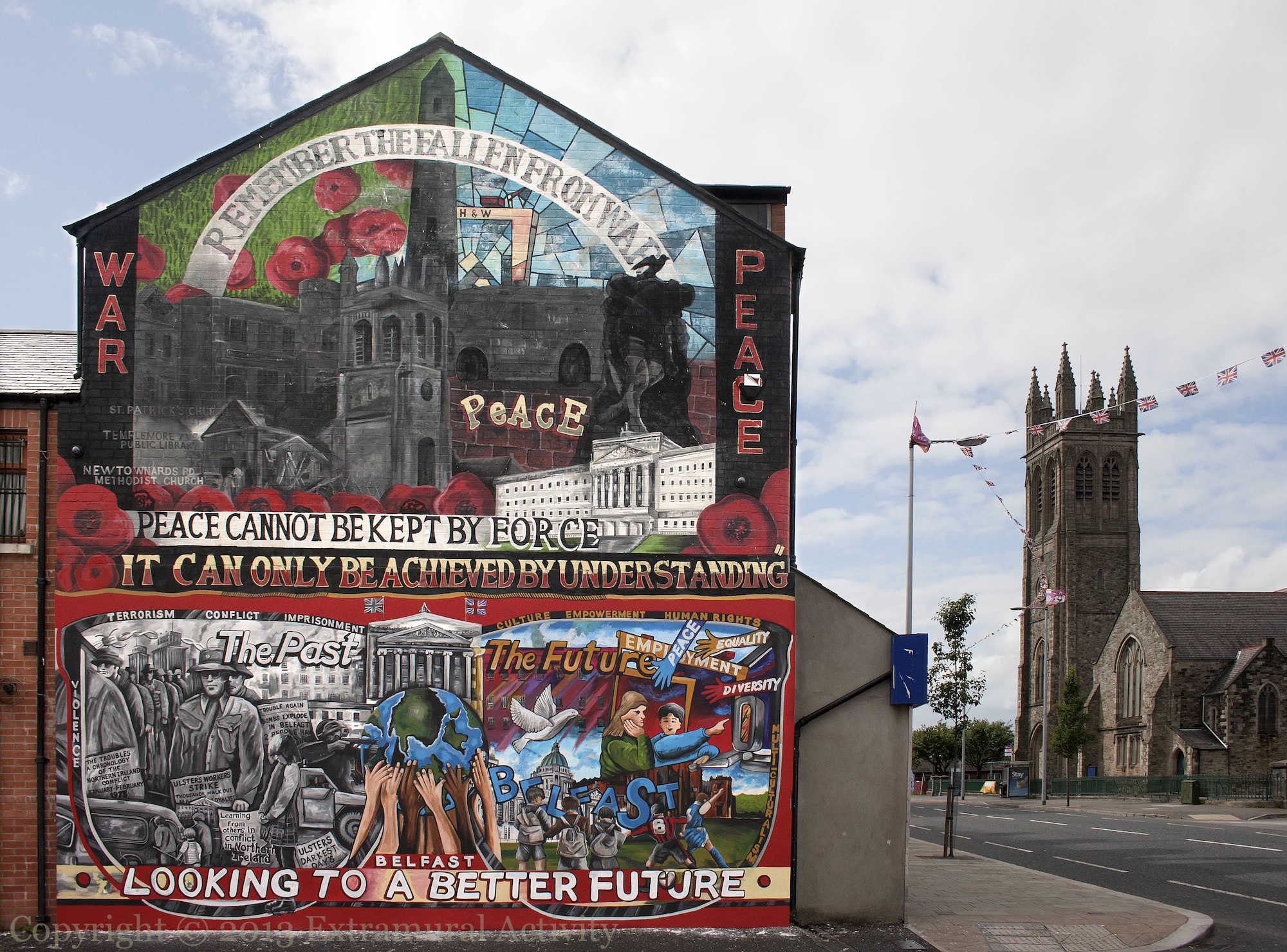
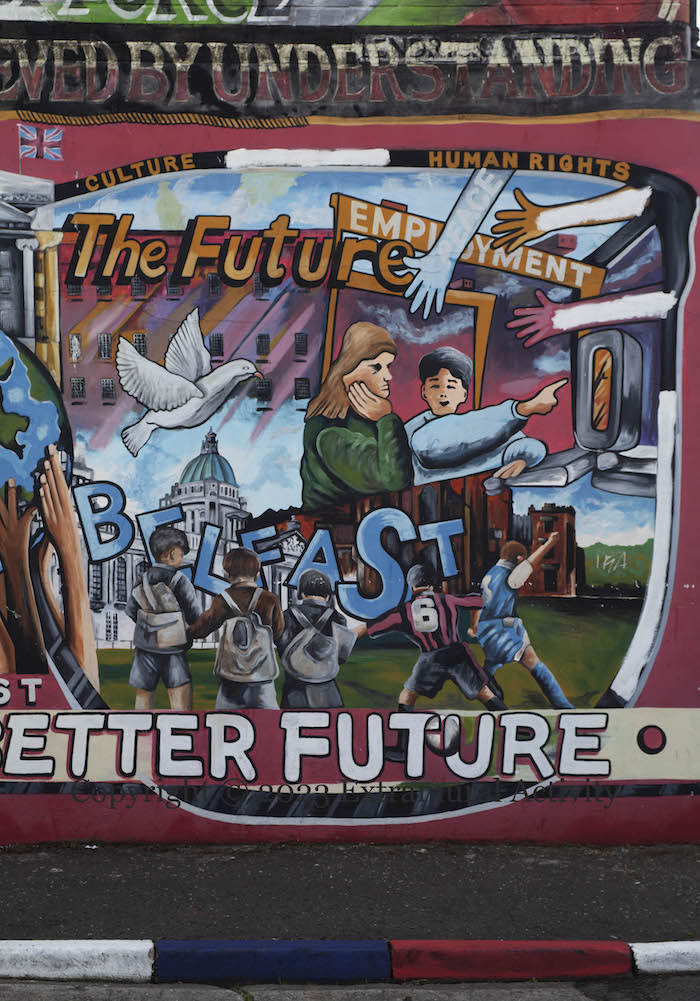
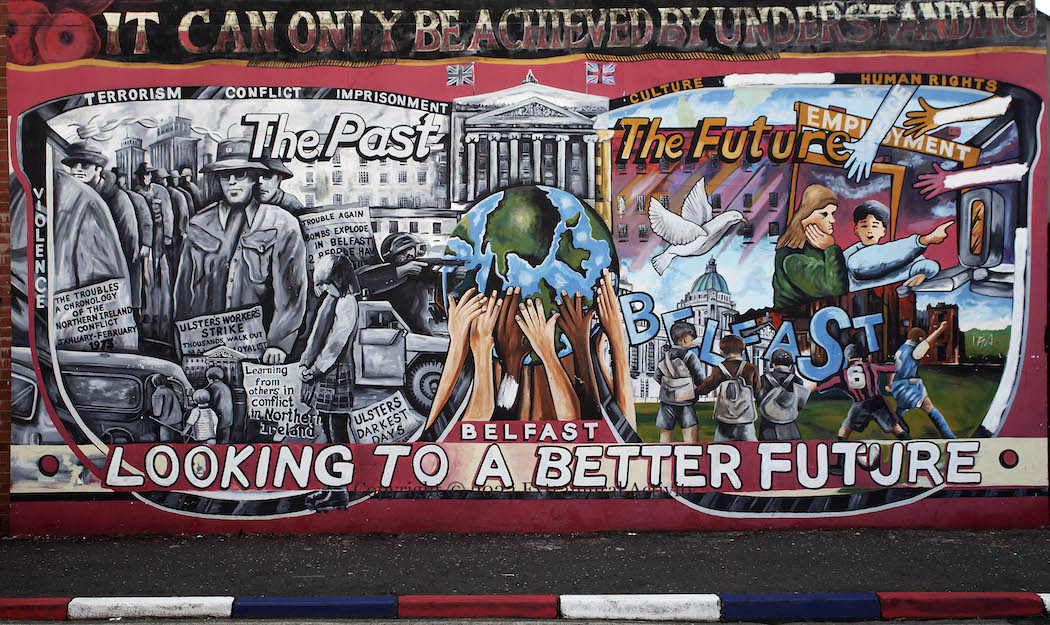
In this new east Belfast mural, we move from a part of “violence – terrorism – conflict – imprisonment’ to a future of ‘culture – empowerment – human rights – multiculturalism’. The mural is black-and-white on one side and colour on the other. On the left we have watchtowers and paramilitaries in hats and sunglasses; on the right schoolchildren in front of city hall, working on a computer and playing football.
The mural was defaced immediately after it was finished (roughly the end of July), indicating dissatisfaction with the current direction of ‘the future’, but quickly repaired. There is a mural directly above this one. A wide shot of them both can be found below.
Update: Spring 2022 – some of the words on the colourful ‘future’ side of the mural have been painted over: “empowerment”, “equality”, “diversity”, “multiculturalism”. There is also a streak of white paint on the arm of a black person in the centre of the mural. See the final two images.
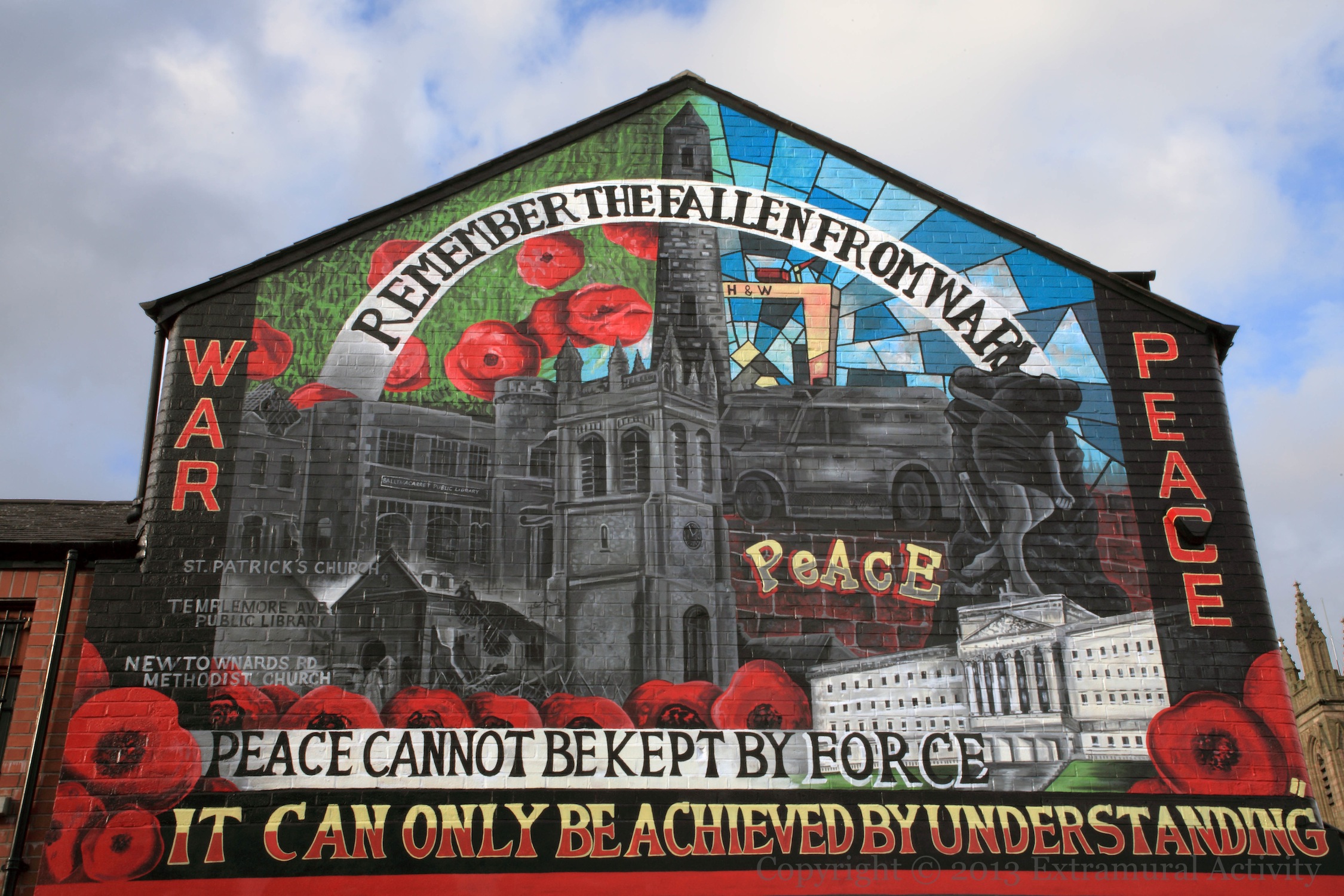
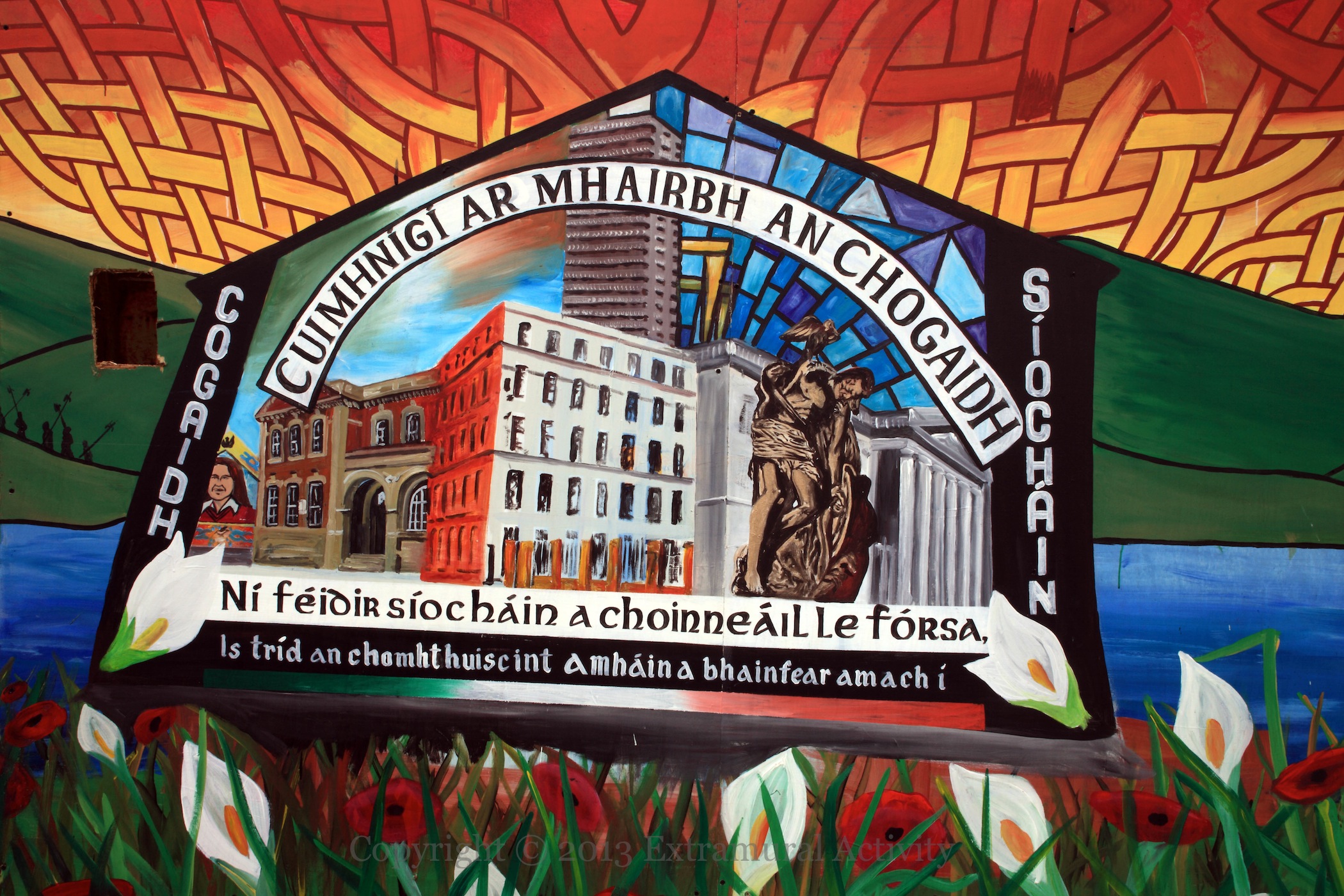
The mural above is on the Newtownards Road at Lendrick Street and shows a bombed-out Ballymacarrett library, St. Patrick’s church (the church itself is visible in the lower right-hand corner) – both were hit by the blitz in 1942 – a police land rover (perhaps representing the “fallen” during the Troubles), and Cuchulainn (perhaps representing the IRA, though Cuchulainn is also a UDA icon – see the bottom of the Visual History page on Cú Chulaınn), and Stormont (representing … peace???). Poppies in a field and a H&W crane against stained glass provide a background.
We are supposed to remember the dead because (perhaps) their deaths were unnecessary and misguided as means to peace, at least according to the saying along the bottom (sometimes attributed to Einstein): “Peace cannot be kept by force; it can only be achieved by understanding” – understanding of the Nazis during the blitz, it seems, and of loyalists and republicans during the Troubles. (If you have a better interpretation, please leave a comment.)
The mural was imitated on the hoarding around An Chultúrlann on the Falls Road during its renovation (shown below): the left hand side of the side was replaced with images of the Falls library and Bobby Sands mural and Divis tower, and Cú Chulaınn on the right was placed in front of the GPO, and the poppies were joined by lilies, and the words translated into Irish. The message here seems clearer, lamenting the CNR dead and calling for understanding of the CNR community (sc. by Britain and the Orange state) though the poppies below include the dead of WWI.
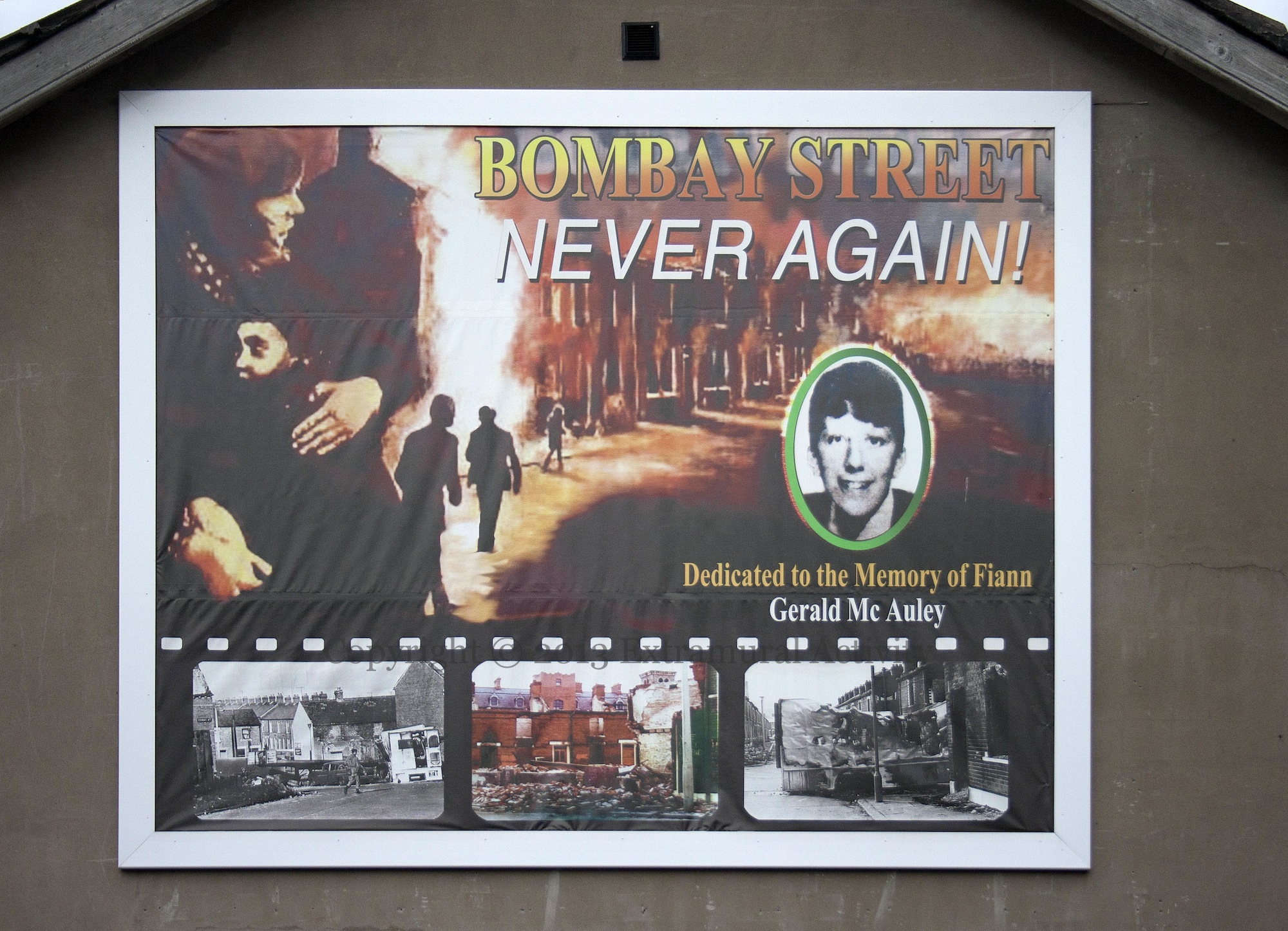
Printed and framed tarp in Bombay Street, commemorating the burning of Bombay Street during the August 1969 Belfast riots and the death Gerald McAuley, a young IRA member (Fian, not “Fiann” as written here) killed by a sniper during the trouble. Three photographs from the street at the time are reproduced in the bottom third of the board.
Ten years ago, an earlier incarnation of this board could be found on the other side of the street, connected to the issue of the day: No (Decom)mission.

 Seosamh Mac Coille Collection