Lifford Remembers The Hunger Strikers

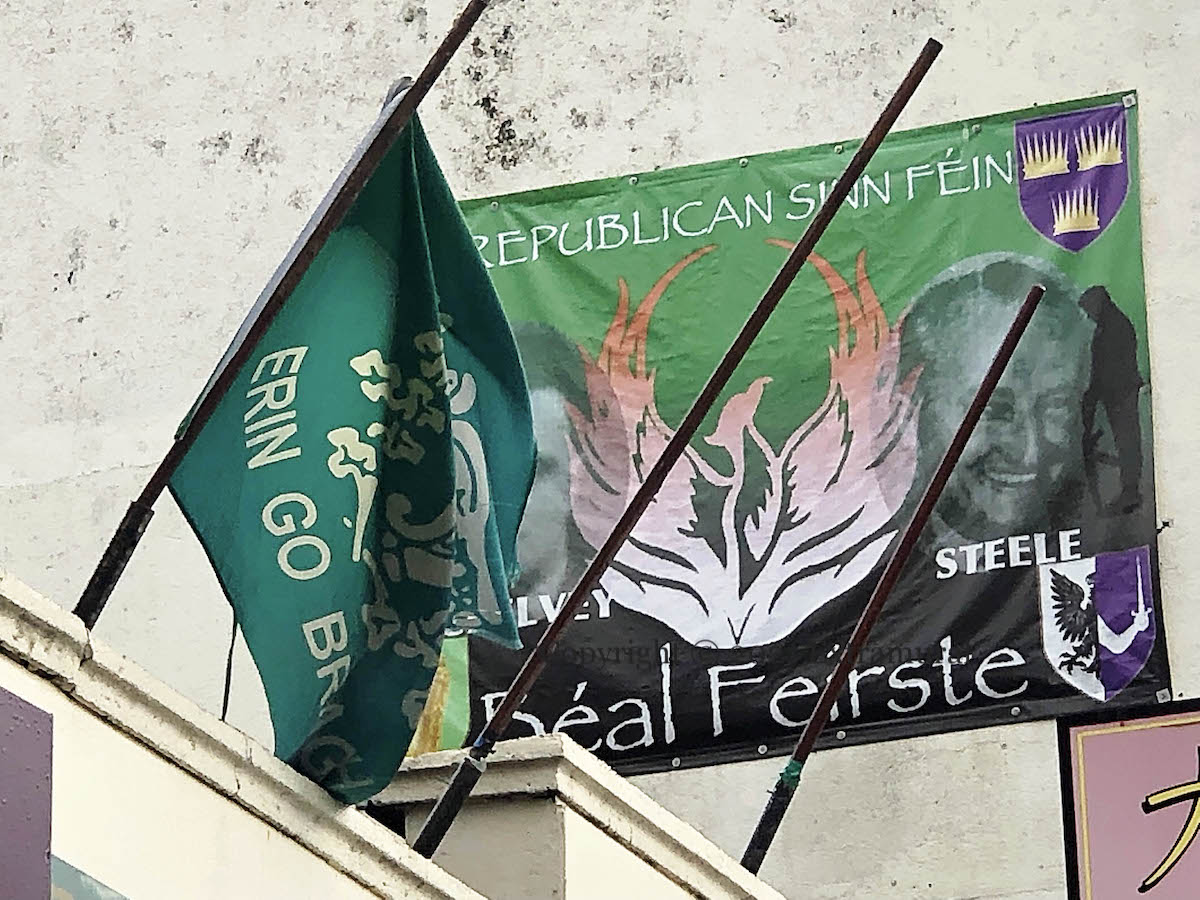
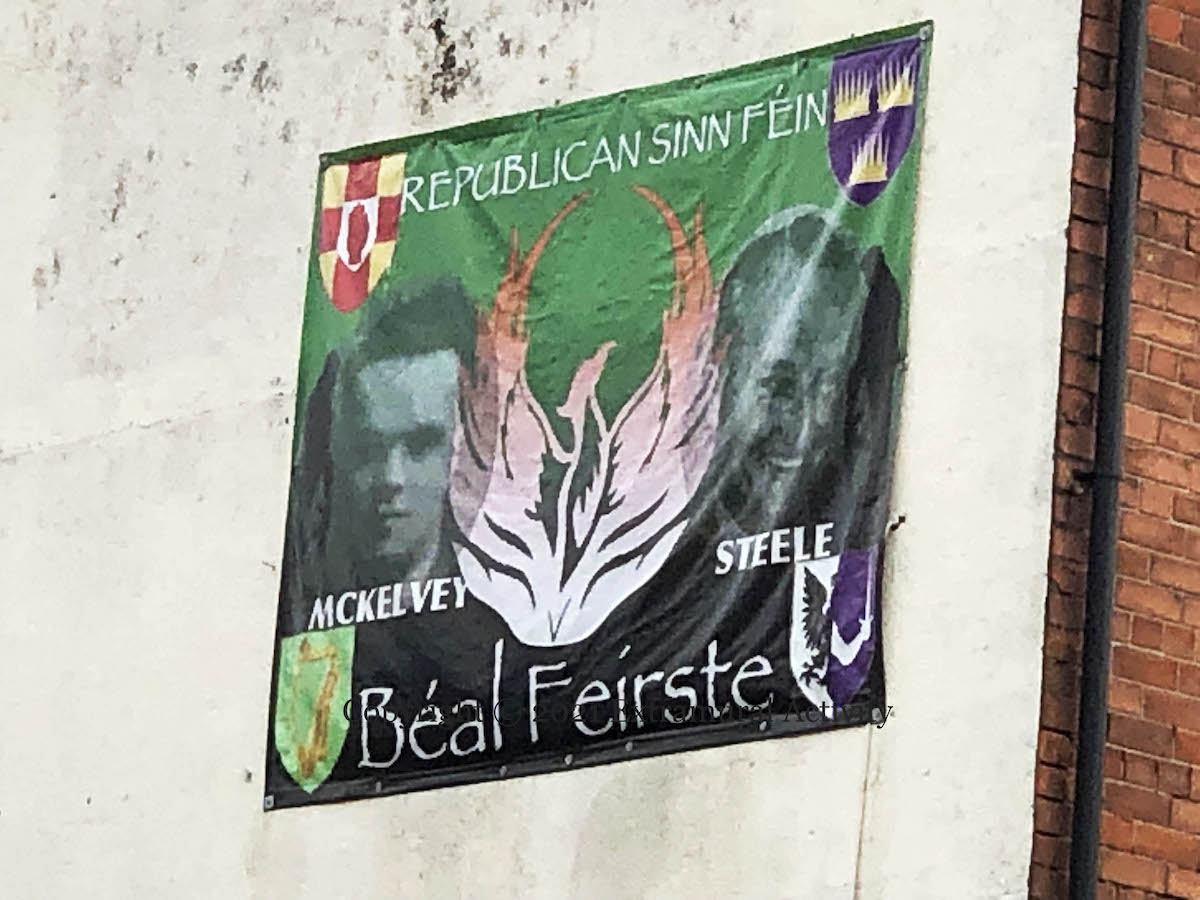
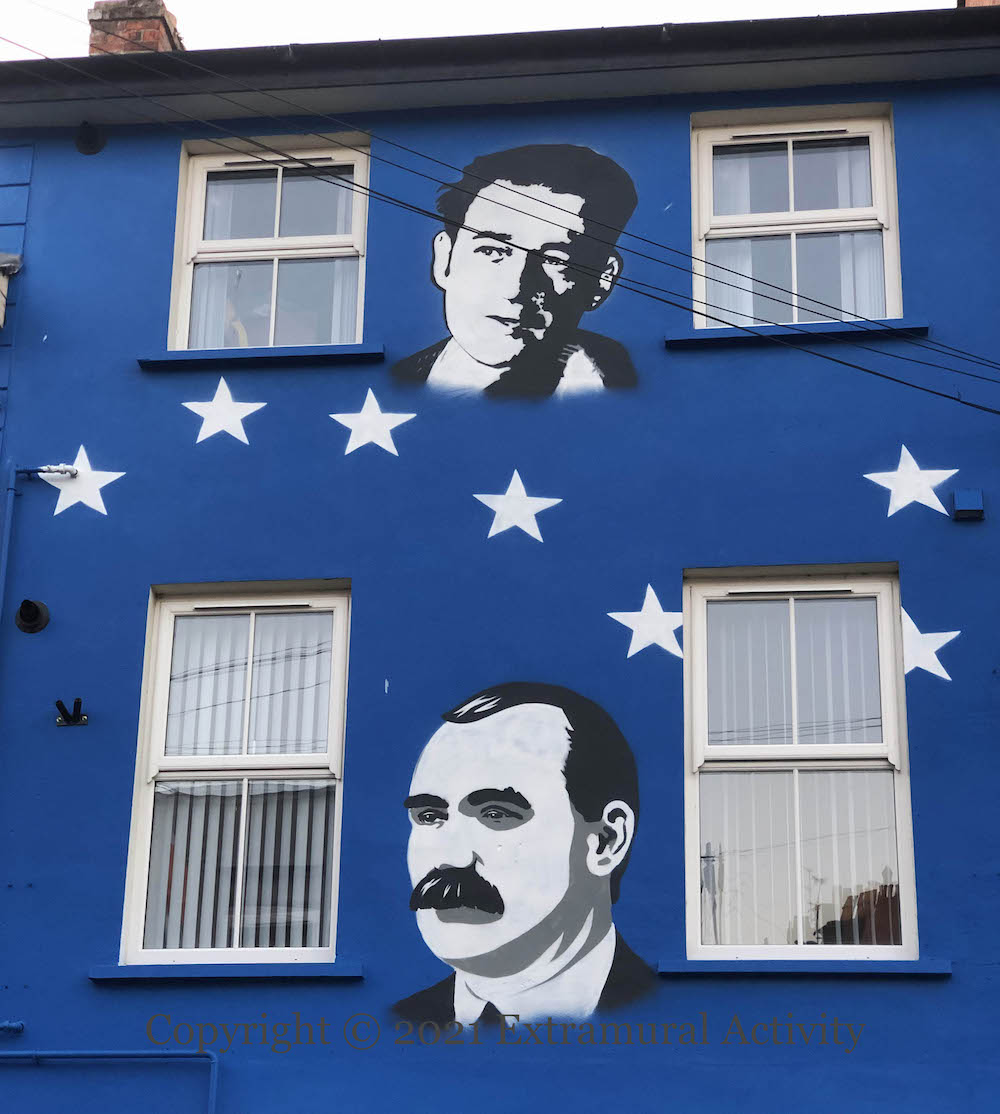
“Fuaır sıad bás ar son saoırse na hÉıreann” [they died for Ireland’s freedom] Although it’s the 40th anniversary of the 1981 hunger strike, this Lifford (Co. Donegal) board includes Michael Gaughan and Frank Stagg who died in English prisons in the 1970s.

If you can explain the flag in the centre, please get in touch. The wide shot, below, includes a call to rally for 100% Redress, No Less.

Click image to enlarge
Copyright © 2021 Seosamh Mac Coılle
X08446 X08447

Just Park Jesus

Four appearances of Jesus in Belfast in 2021: the sacred heart of Jesus on a parking meter; Jesus (previously seen in Glengormley – Nearer My God To Thee – and explained in This Image Is Blessed); and two stickers from the Hightown Road: “In case no one told you today, Jesus loves you” and “Repent – Luke 13:3, Matthew 4:17”.

Click image to enlarge
Copyright © 2021 Seosamh Mac Coılle
X08423 X07819 X08673 X08672

Who Should Put Away Their Guns

Norah McCabe was shot in the back of the head by a plastic bullet fired from an RUC land rover at around 7:45 a.m. on July 9th, 1981, the day after hunger striker Joe McDonnell died. (Danny Barrett would be killed by a British Army sniper in the evening.) The new boards were mounted to coincide with the fortieth anniversary of McCabe’s death. In 1981, a mural was painted at the same spot (in the old Linden Street) to protest the use of plastic bullets: see Plastic Death.

“Norah McCabe, 1947-1981, murdered by an RUC plastic bullet on 9th July 1981, aged 33 years.” With a poem “Peace” by daughter Áıne McCabe, who was three months old when her mother was killed (Irish News).

Click image to enlarge
Copyright © 2021 Seosamh Mac Coılle
X08368 X08369

Their Blood Our Cause Has Sanctified

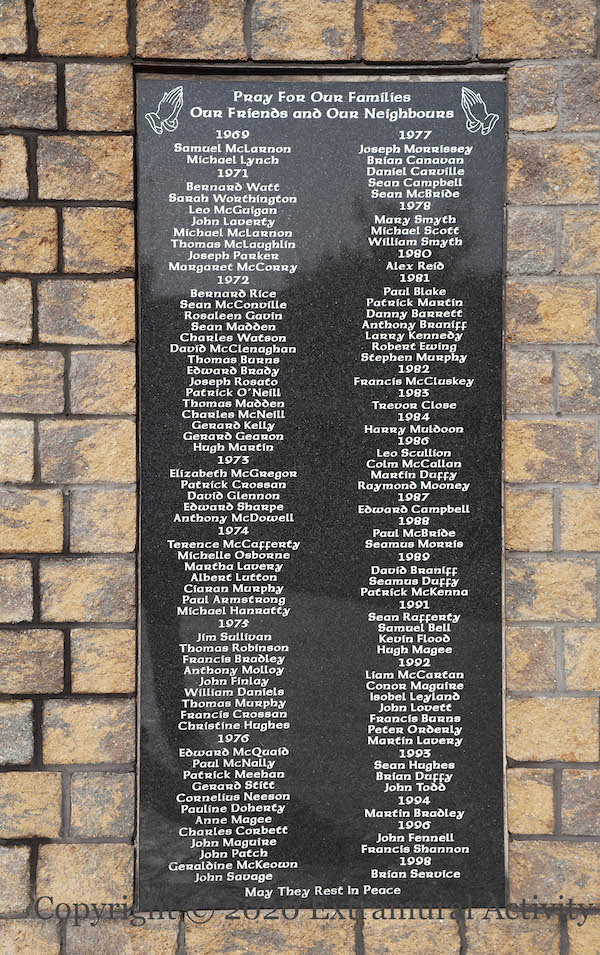
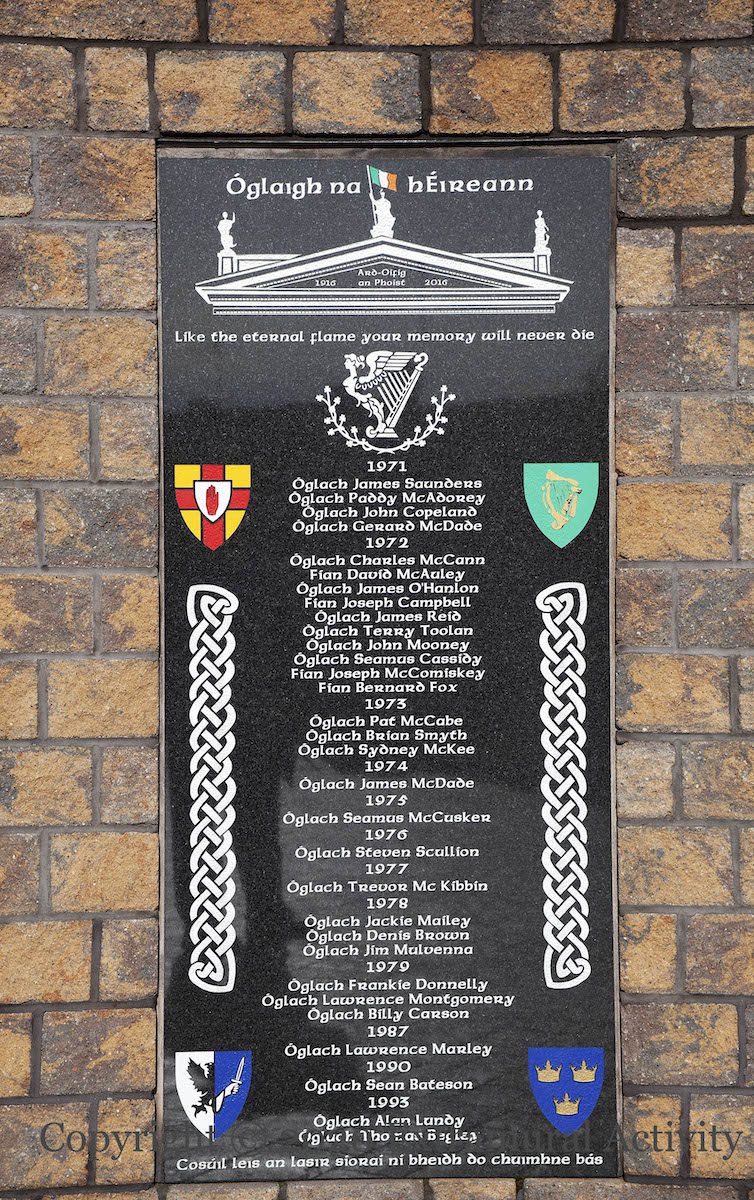
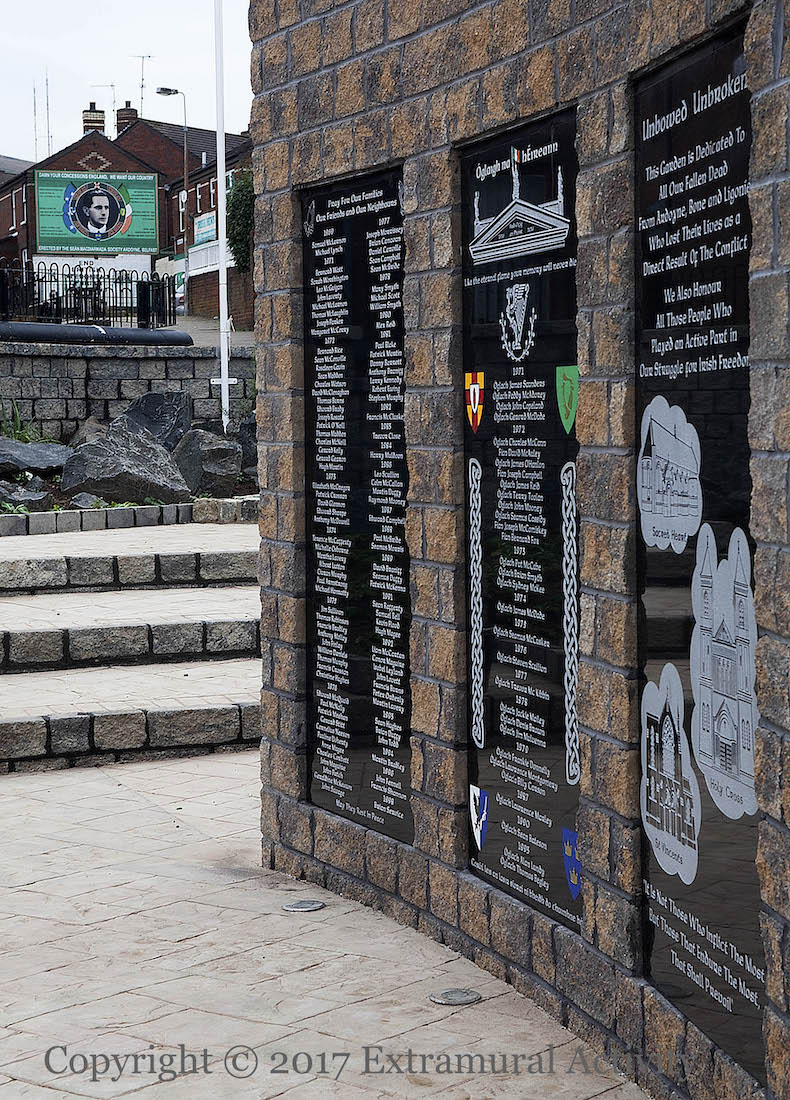
For the 40th anniversary of the 1981 Hunger Strike, portraits of the deceased ten (plus Frank Stagg and Michael Gaughan from the 1970s) were placed on the railings of the Ballymurphy memorial garden. There is a new (compared to 2006 and 2008) set of plaques, erected in 2017:

“A Letter To The 22: You have not gone away, you are in the hearts and on the lips of your people. The old speak of you with knowing tongue. The middle aged, as those who worked beside you. The young men and women with a passion not unlike your own. Your names can be heard on the wind taken from the mouths of men who tend their flocks on Slieve Gullion, Cnoc Phadraıg, Glenshane. They echo in the small graveyards in Cork, Kerry, Galway, Mayo, Tyrone, Antrim, Derry and Armagh. They are heard among your people at the mass gate on Sunday in the crowd at the hurling game, around the hearth when the bottle is cracked and song is sung. Your image can be seen on the faces of happy smiling children for whose freedom you gave your all. You are in our prayers you have not gone away, you never will. Mıse le meas Colm Mac Gıolla Bheın 2006. This monument was erected by the Ballymurphy Ex POWs in memory of the 22 hunger strikers who died for the cause of Irish freedom. It was unveiled on the hundredth anniversary of Thomas Ash[e] who was the first republican to die on hunger strike in 1917. He died after five days while being force fed. Thomas Ash[e] an these 21 brave Irish men stood by their beliefs and refused to be criminalised. Fuaır sıad bás ar son shaoırse na hÉıreann. I measc laochra na nGael go raıbh sıad.”

For the mural, with NHS board, see Pray For Us.

Click image to enlarge
Copyright © 2021 Seosamh Mac Coılle
X08385 [X08383] [X08384] X08382 X08386 X08387 X083088 X08389 Divismore Way

Fire In The Sky

The Bogside bonfire was set ablaze on Sunday night. It has long been put about that the occasion for the Derry bonfire is the feast of the Assumption (which newspapers and radio stations have repeated, e.g. BBC | RTÉ | Irish Independent). This is an attempt to provide some cover for the “dissident” republican nature of the event, as evidenced by the King Billy, UDA, UVF, RUC and Israeli Star Of David flags on the bonfire, shown above. The triggering event is rather the introduction of internment on August 9th, 1971. (Sunday was also the same day as the ‘Fire In The Sky’ fireworks to mark the end of Féile (Derry Journal). The local féilte in Belfast – which in time became Féıle An Phobaıl – were introduced as alternatives to the rioting that traditionally took place to protest the introduction of internment; the origins of Derry’s Gasyard Féıle, which began much later (1993) but takes place in the same August weeks, are unclear – please comment if you know.)

Before it was lit the banner in the lower left of the image above – “Ronann [sic] Kerr first, Lee Anderson your [sic] next” – was removed; the other flags and banners remained (BBC). The banner had drawn criticism as Kerr, a Catholic PSNI officer, was killed by a car bomb just north of Omagh in 2011 (BBC | BelTel).

William Glasgow – see the image below – was the British Army soldier who shot and killed 15-year old Manus Deery in 1972 near the spot of the bonfire. His killing was ruled “unjustified” in 2017 (Irish Times); Glasgow died in 2001 (BBC). There are two plaques to Deery’s memory and he is included in the mural The Runner.

Click image to enlarge
Copyright © 2021 Andy McDonagh/Eclipso Pictures (ig | Fb)
X08351 [X08352] [X08353] X08354 [X08355] X08356

Unrepentant Republicans

These two new boards along the Falls Road were mounted by Belfast RNU (tw), commemorating the actions of Billy McKee, Alec Murphy, and Brendan Hughes in 1969 at the onset of the Troubles, and of Máıre Drumm and “the brave women of Belfast who stood up against the might of the British” in bringing the Falls Curfew to an end. (This board was previously a mural on Divis Street.)

McKee and Hughes are profiled in a D Company mural in the number one spot of the International Wall. Murphy died in 2019 “unrepentant” of his republicanism (which was prompted by the Falls Curfew) and in particular his conviction along with Harry Maguire for the Corporal Killings (Irish News | BelTel). For a personal obituary, see The Pensive Quill.

For the plaque and board to the left of the wide shot below, see The Falls Road Massacre.

Click image to enlarge
Copyright © 2021 Seosamh Mac Coılle
X08366 [X11832] [X15342]
X08364 [X08365] [X15340] [X15341]
X08367 [X11831] [X15343]
launched June 17, 2021

Genocide In Ireland

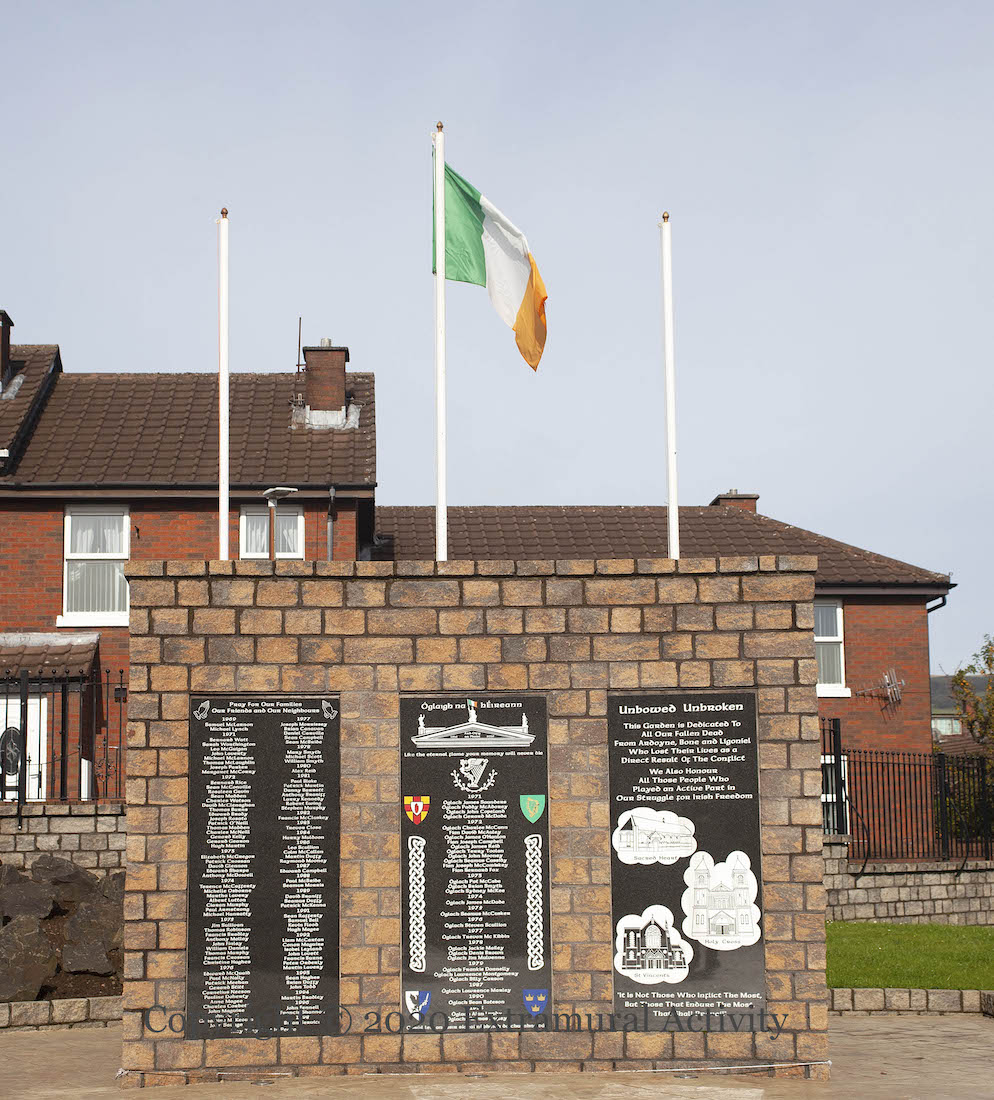
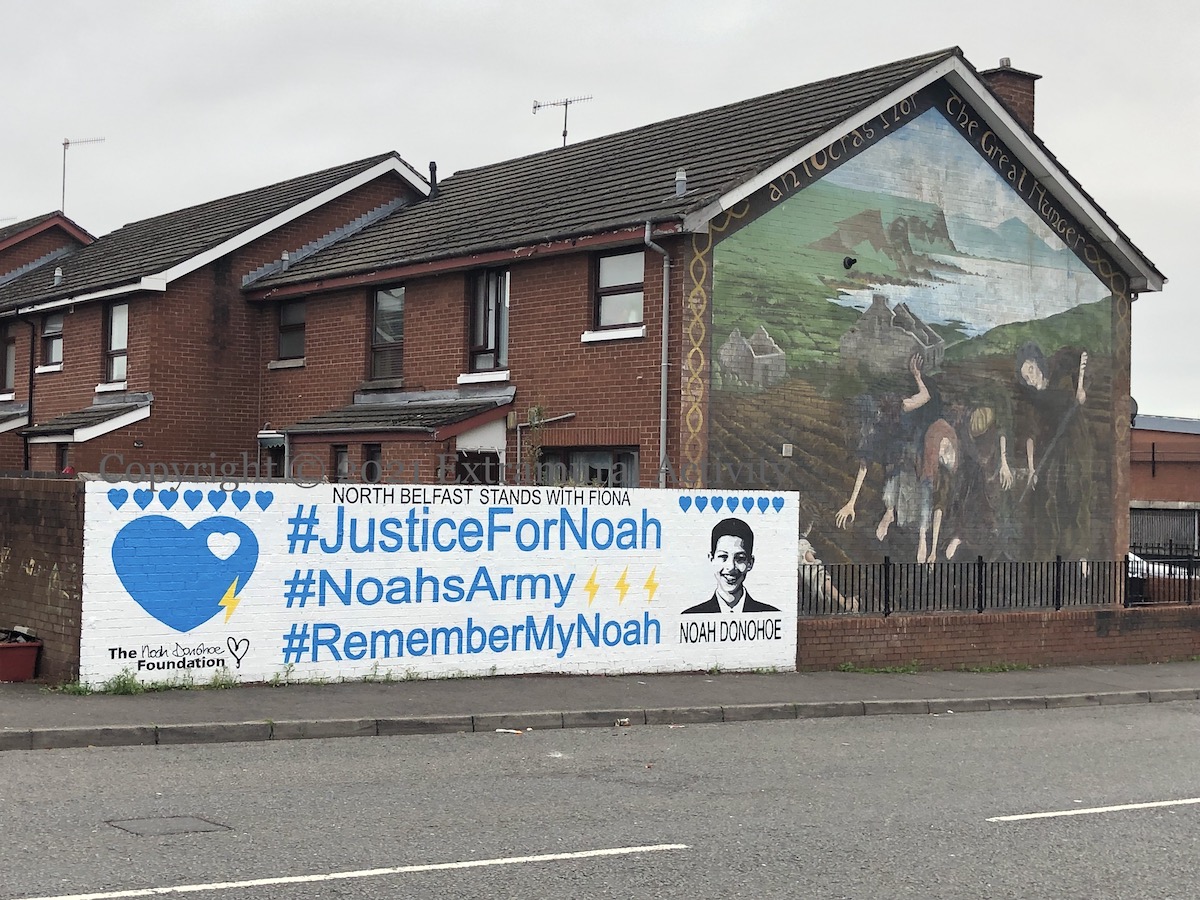
Photography was still in its infancy in 1850 and would not appear in newspapers until the 1880s (LoC). Instead, newspapers used illustrations to bring their stories to life. This board in Ard An Lao (Ardoyne/Bone) – “An Gorta Mór [The Great Hunger] 1845-1851 – The Great Irish Famine” – combines three of them to serve as a background for other images and information.

On the left is Family Being Evicted From Their Home In Rural Ireland.

At the centre is Searching For Potatoes In A Stubble Field from the Illustrated London News. ILN images are a staple of Belfast muraling on the Great Hunger: they were previously used in 1995 (An tOcras Mór in the New Lodge), 1999 (Ireland’s Holocaust on the Whiterock Rd), 2002 (An Gorta Mór in Ardoyne). (Here is a list, with links, of all of the illustrations of Ireland in ILN from the period 1845-1852.)

On the right is food arriving from the USA in the famine of 1879-1880.

See also The Mass Graves Of Ireland.

See also the Visual History page on the Great Hunger in muraling.

Click image to enlarge
Copyright © 2021 Seosamh Mac Coılle
X08360

Continuing Their Legacy

“This plaque commemorates the centenary of the Easter Rising and the sacrifice of all those men and women who took part. We will remember their unwavering stance against British imperialism and its rule. We will acknowledge their influence on following generations to continue their legacy. In particular we remember all those old republicans from within this area, the Bone, who campaigned through the decades to fulfill the aspirations of the 1916 combatants. (Con Colbert) An Irish martyr who came to be defined by his favourite phrase “For my God and my country” fought on Marrowbone Lane [Dublin], 1916″.

Click image to enlarge
Copyright © 2021 Seosamh Mac Coılle
X08361