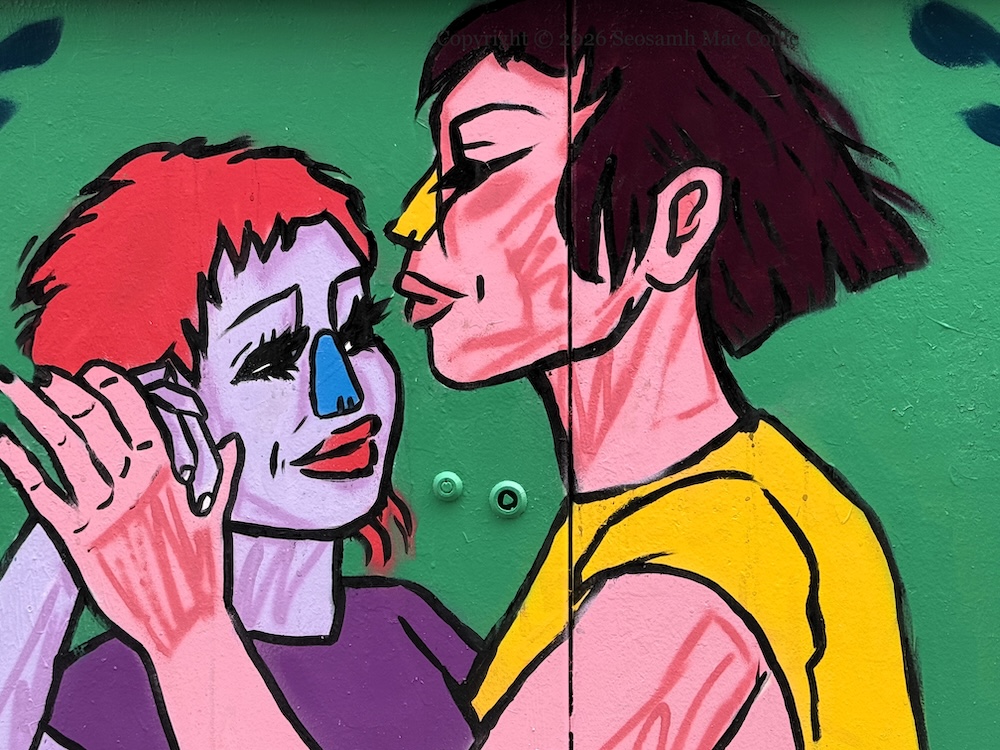
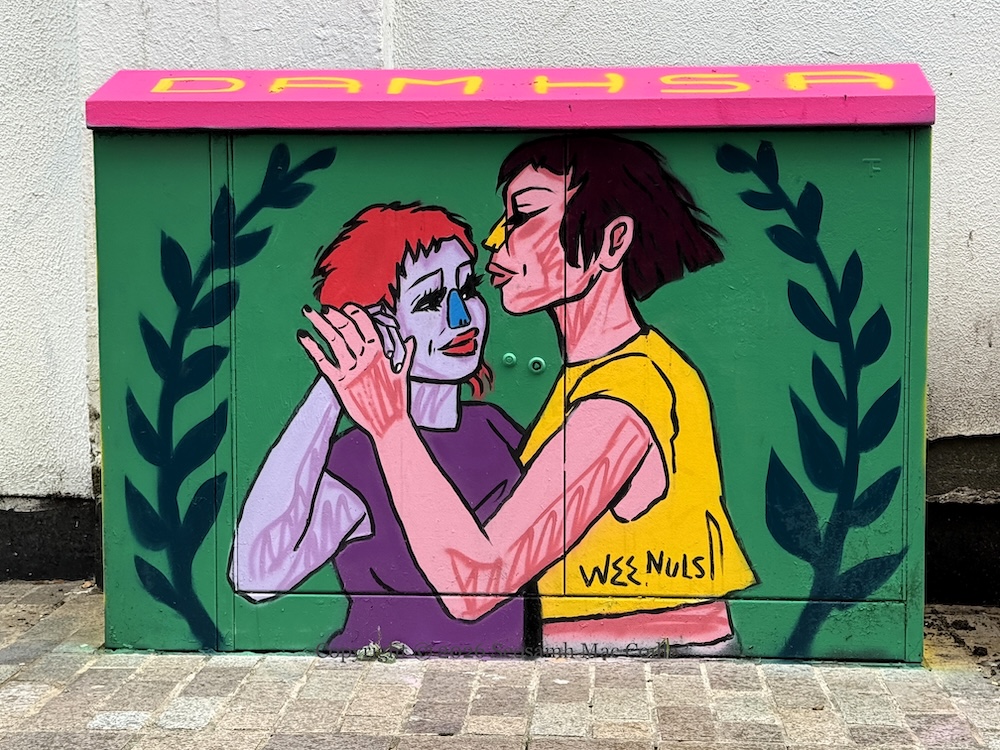
This junction box painted by Wee Nuls (web) during Fleadh Cheoıl Na hÉıreann is a tribute to céılí dancing and in particular to queer set dancing in the MAC.
Berry Street, just off Royal Avenue, Belfast city centre
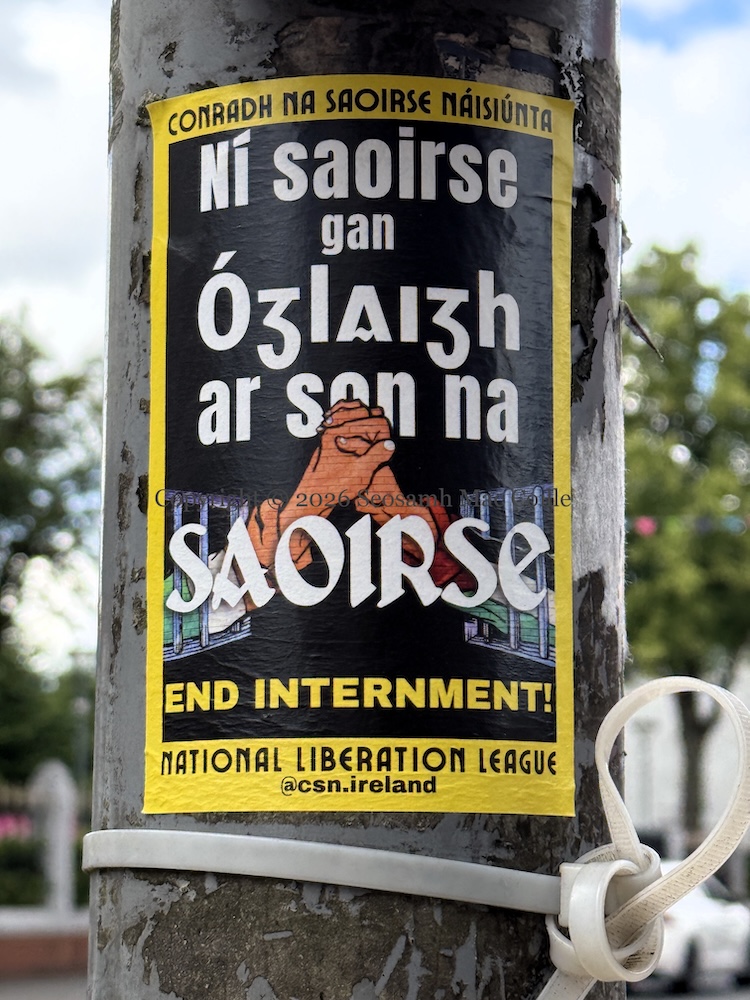
“Ní saoırse gan óglaıgh ar son na saoırse [there is no freedom without warriors for freedom] – End internment!”, “Conradh Na Saoırse Náısıúnta – National Liberation League [ig charter]. CSN/NLL is an off-shoot of the Connolly Youth Movement.
In the background is an image of solidarity between Irish and Palestinian political prisoners by Carlos Latuff, which has been a mural on Northumberland Street (Visual History) since 2012.
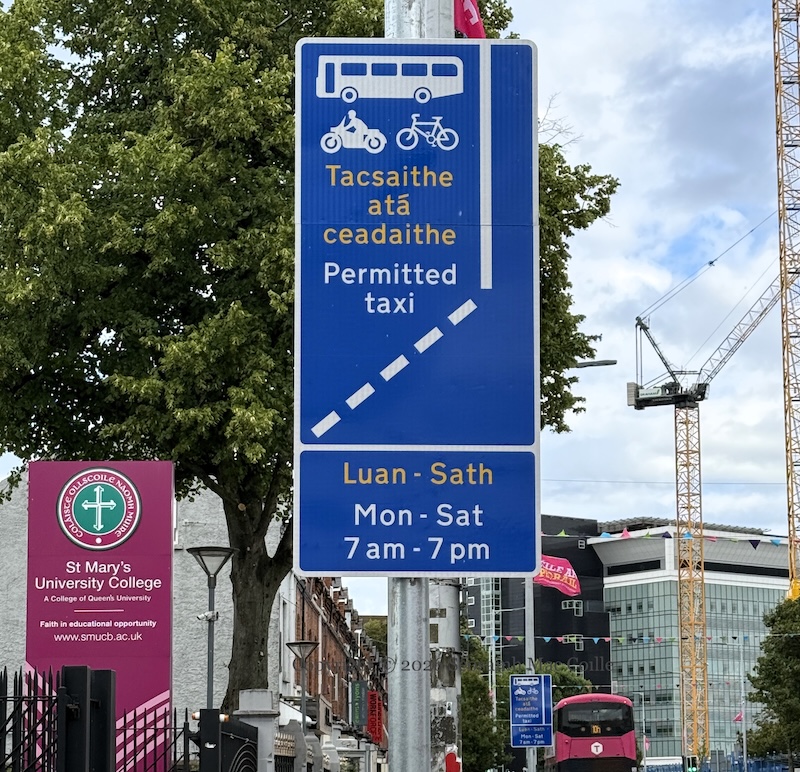
Dual-language (Irish and English) traffic signs and road-markings have been mounted/painted on the Falls Road in the Gaeltacht Quarter (specifically, between Springfield Road and Whiterock Road) by the Department Of Infrastructure/An Roinn Bonneagaır.
For other signs and markings – “Lána bus”, “Glanbhealach uırbeach, Luan go hAoıne [agus] ın am ar bıth ar an chosán”, “Deıreadh an lána bhus”, “Coınnıgh saor”, “Ceamaraí lána bus” – see the Paddy Duffy Collection.
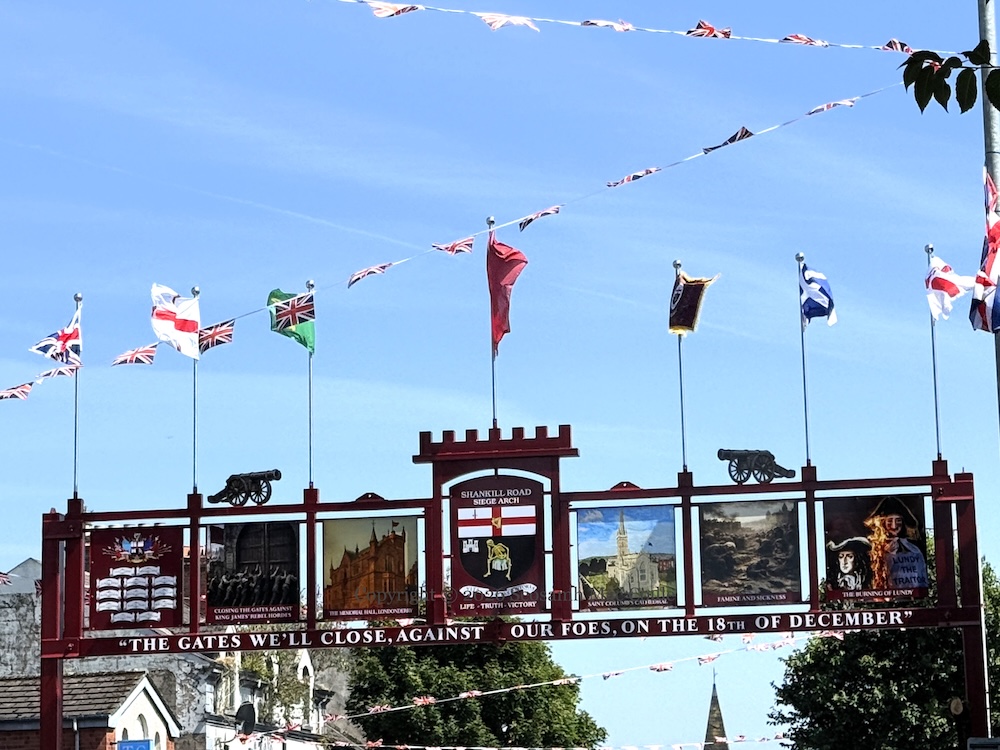
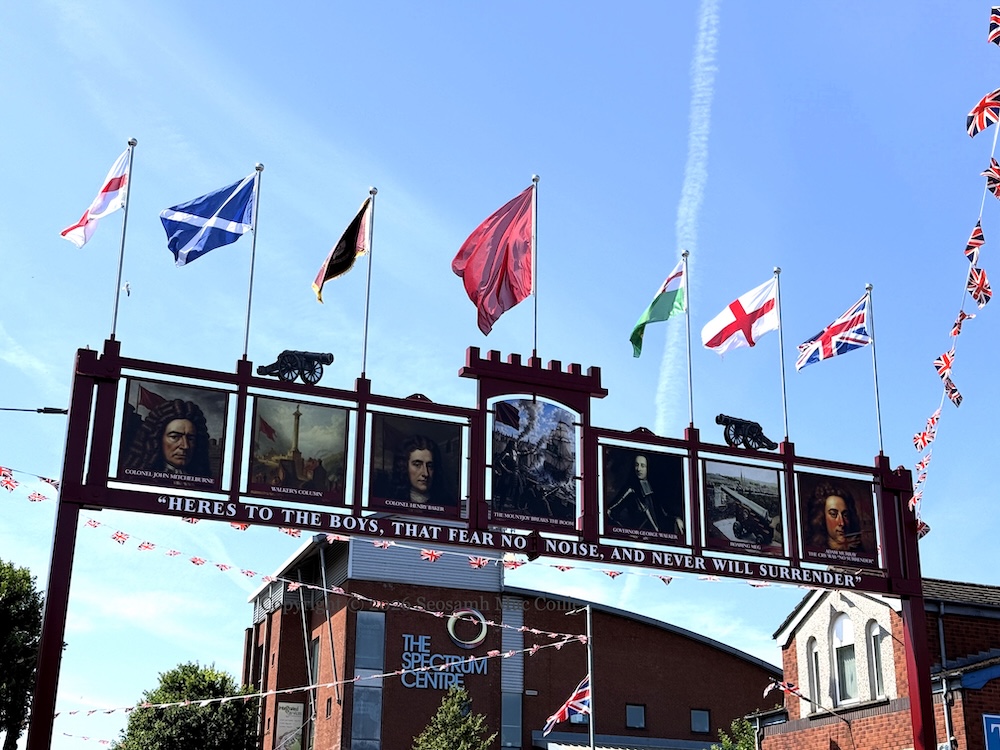
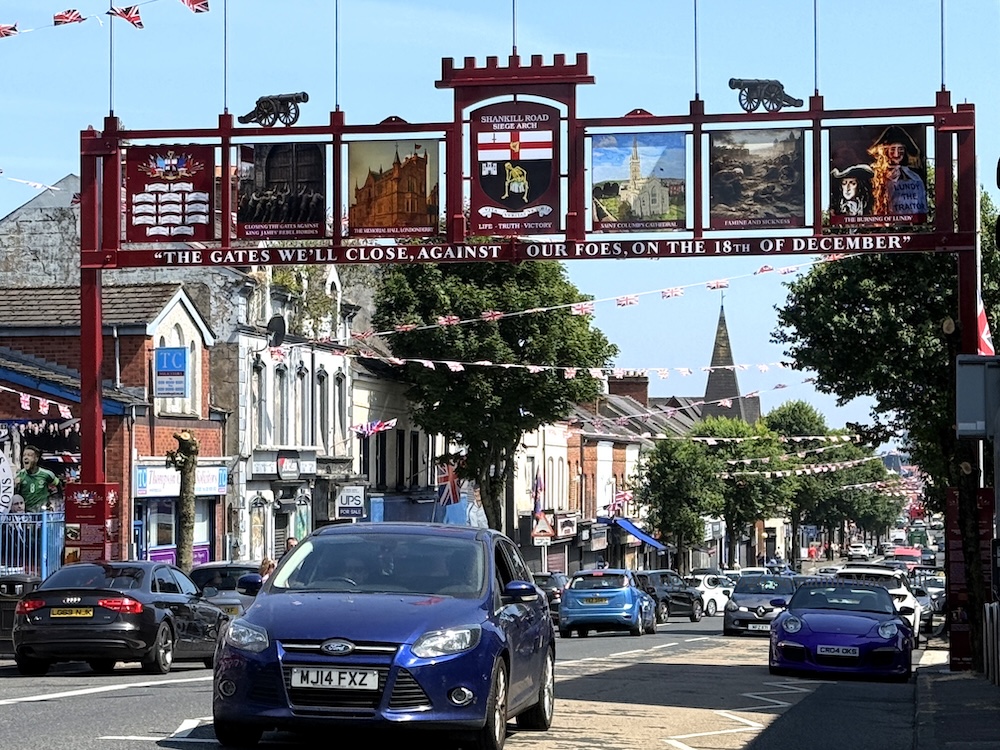
The line “The gates we’ll close against our foes on the 18th of December” comes from the song ‘The Crimson Banner’ (lyrics | youtube).
The panels on either side depict … “Closing the gates against King James’ rebel hordes”, “the Memorial Hall, Londonderry”, Saint Columb’s Cathedral”, “famine and sickness”, “the burning of Lundy” … and … “Colonel John Mitchelburne”, “Walker’s column”, “Colonel Henry Baker”, “the Mountjoy breaks the boom”, “Governor George Walker”, “Roaring Meg”, “Ada Murray – the cry was “No surrender””
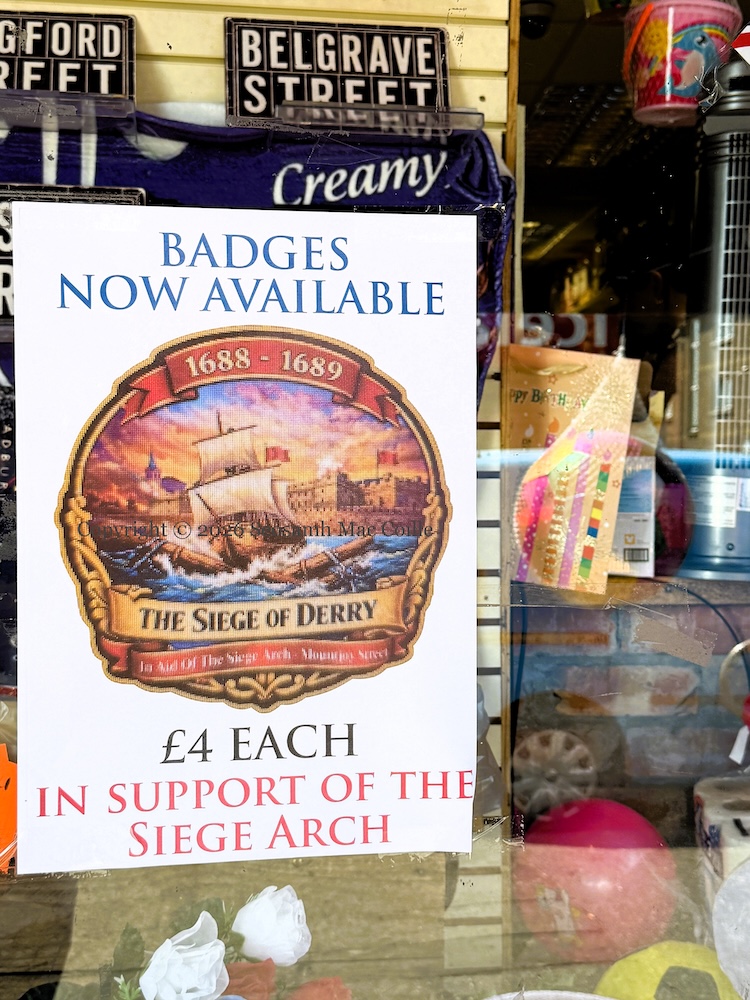
Shankill Road at Mountjoy Street, upper Shankill, west Belfast
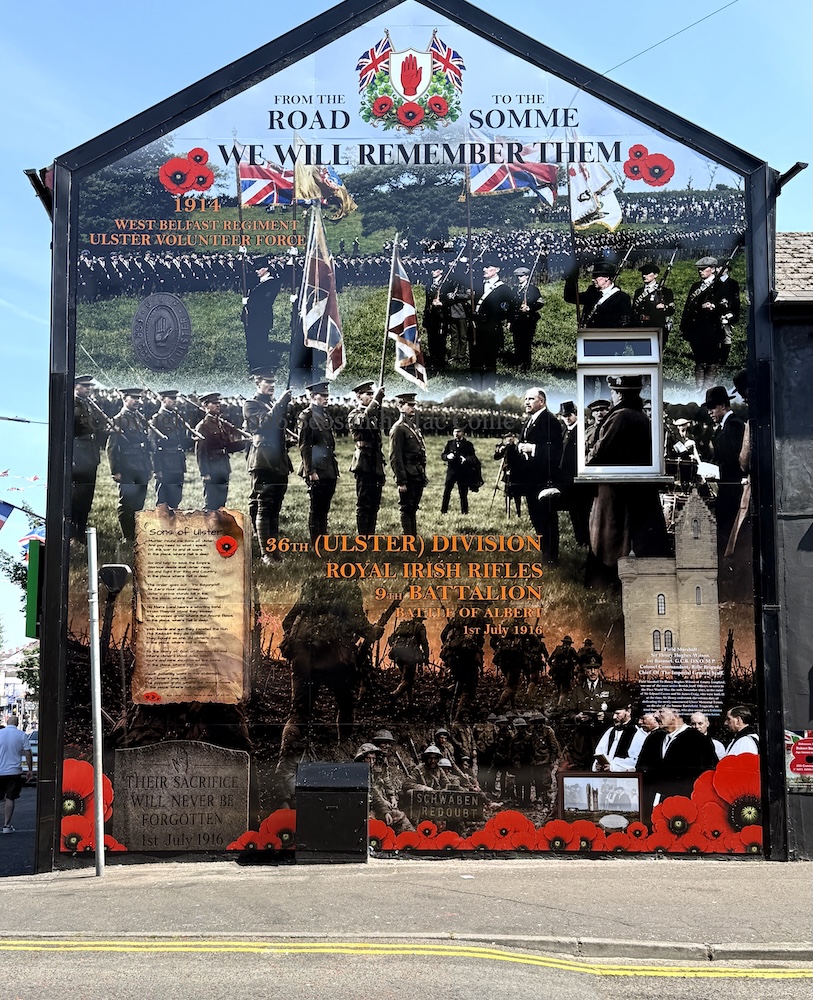
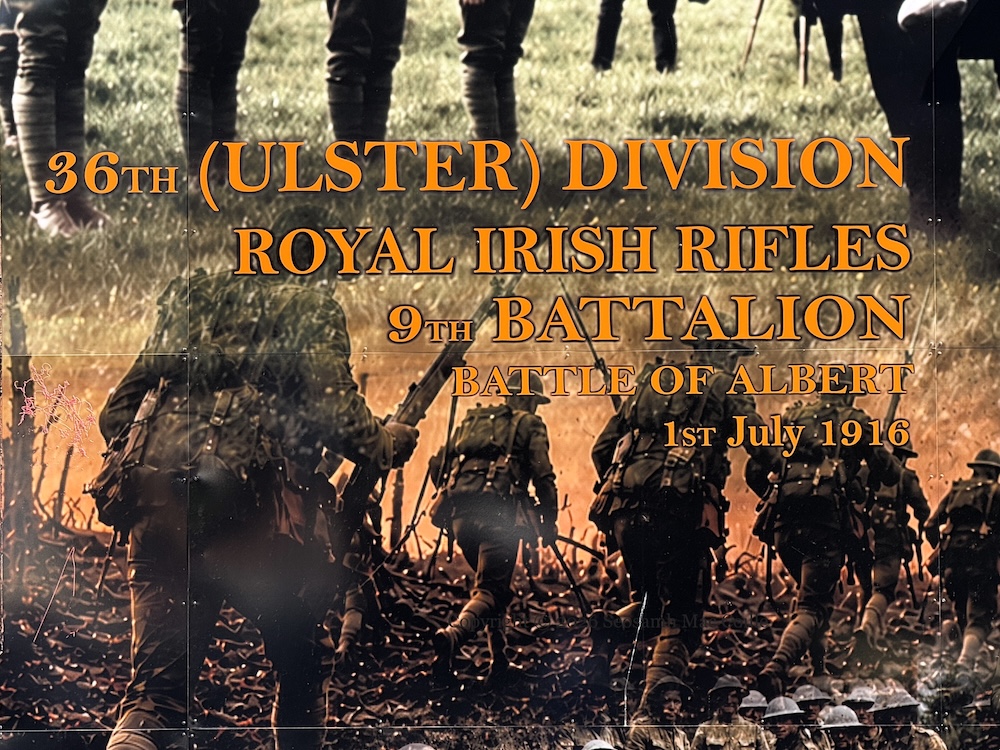
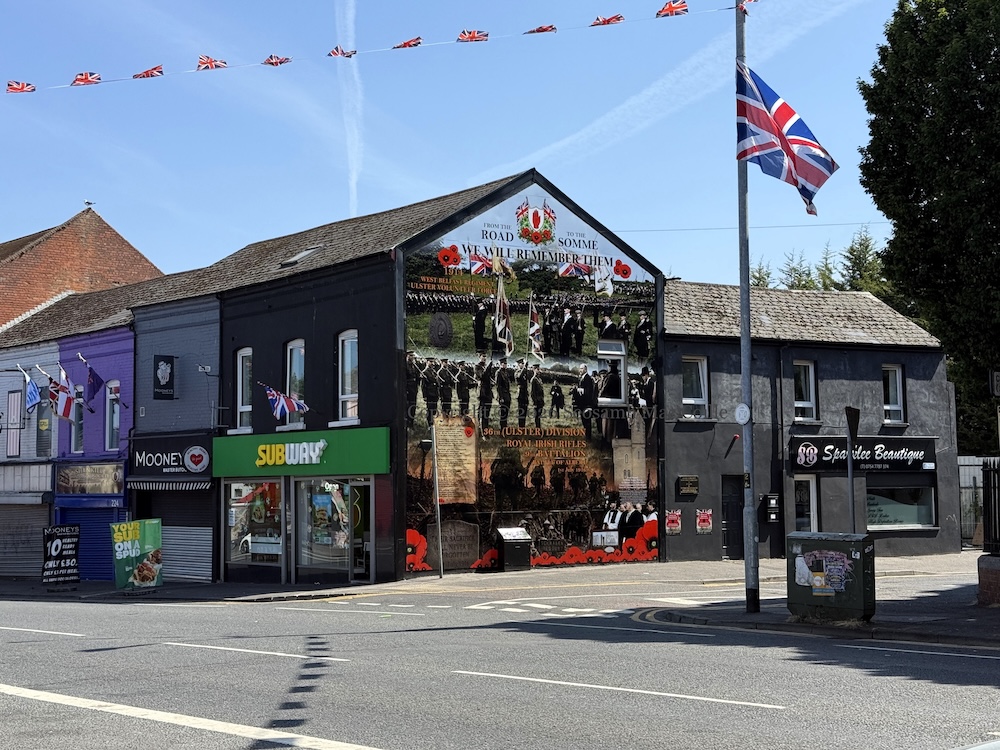
“1914 West Belfast regiment, Ulster Volunteer Force – 36th (Ulster) division, Royal Irish Rifles.” Men from the West Belfast Ulster Volunteers – which included the Shankill and Woodvale areas – joined the 9th battalion of the Royal Irish Rifles, which became part of the 107th brigade of the 36th division.
The main part of this new gable-sized board places two colourised photographs on top of each other. The first (upper) photo shows shows the first and second battalions of the West Down regiment being presented with their colours in May, 1914 (CyberProd). The second (lower) photo shows the first and second battalions of the West Belfast regiment receiving the Kings colours in May, 1914 (CyberProd).
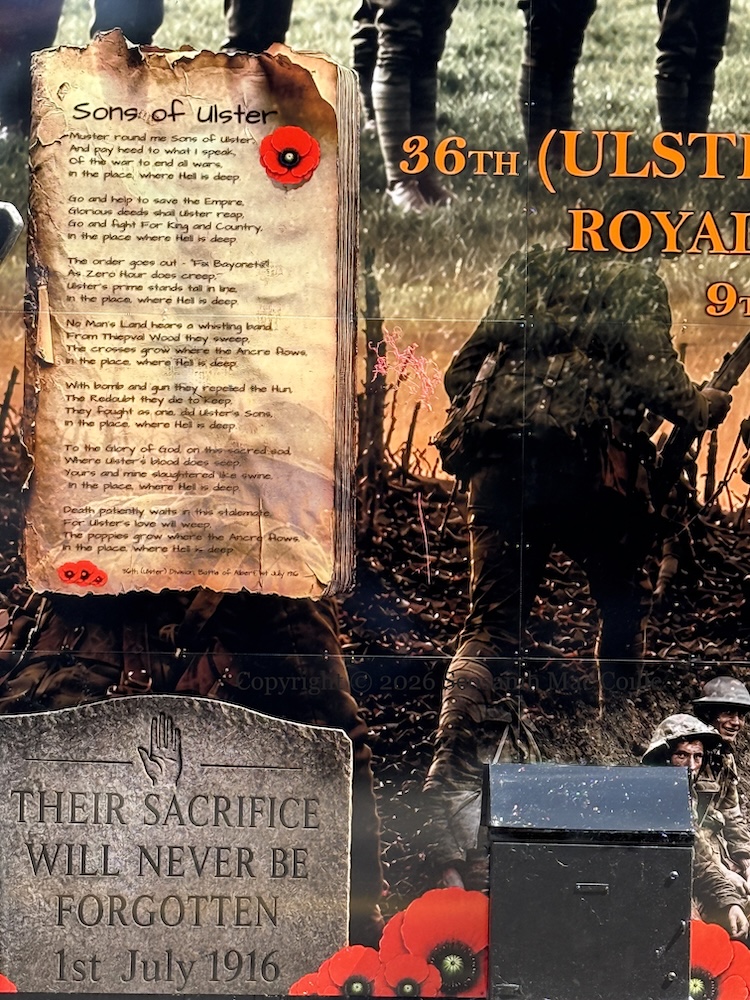
In the bottom left corner is a poem called “Sons of Ulster” written on a scroll: “Muster round me Sons of Ulster,/And pay heed to what I speak,/Of the war to end all wars,/In the place where hell is deep.//Go and help to save the Empire,/Glorious deeds shall Ulster reap./Go and fight for King and Country,/In the place where hell is deep.//The order goes out – “Fix Bayonets!”/As Zero Hour does creep,/Ulster’s prime stands tall in line,/In the place where hell is deep.//No-Man’s Land hears a whistling band,/From Thiepval Wood they sweep./The crosses grow where the Ancre flows,/In the place where hell is deep.//With bomb and gun they repelled the Hun,/The Redoubt they die to keep./They fought as one did Ulster’s Sons,/In the place where hell is deep.//To the Glory of God on this sacred sod,/Where Ulster’s Blood does seep,/Yours and mine slaughtered like swine,/In the place where hell is deep.//Death patiently waits in this stalemate,/For Ulster’s love will weep,/The poppies grow where the Ancre flows,/In the place where hell is deep.”
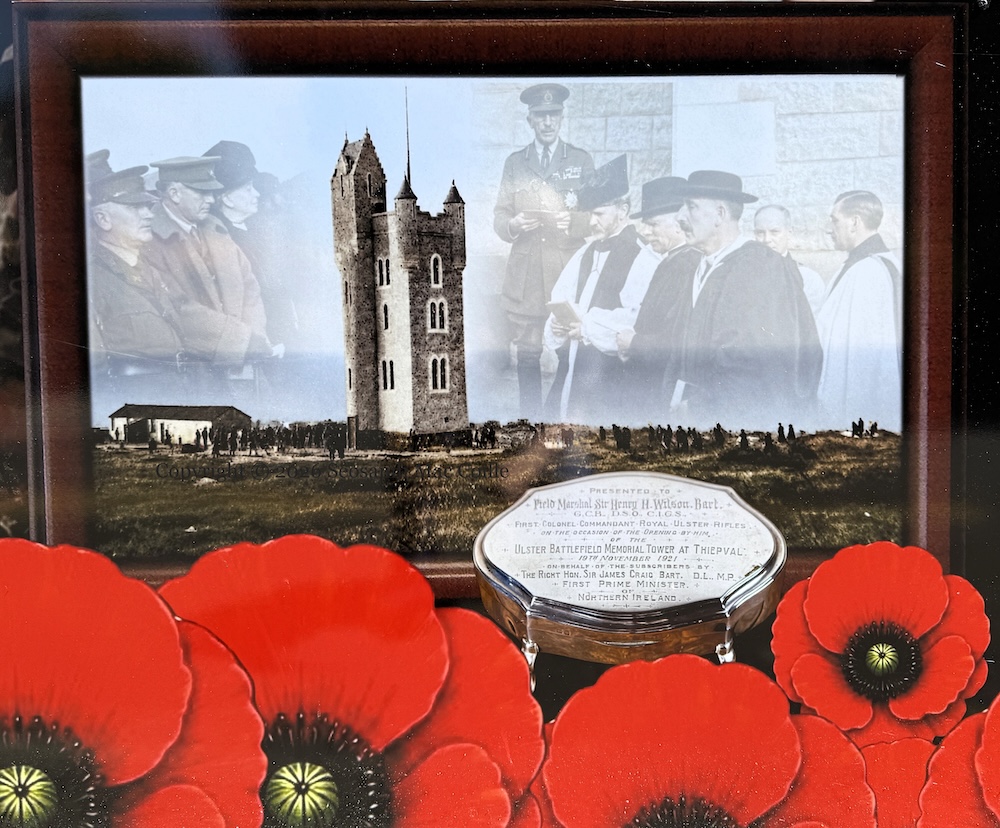
In the bottom right, the Ulster Tower is dedicated: “‘Field Marshall Sir Henry Hughes Wilson, 1st Baronet, GCB, DSO, MP, Colonel Commandant, Rifle Brigade, Chief Of The Imperial General Staff. Field Marshall Sir Henry Hughes Wilson of County Longford, was one of the most senior British Staff Officers to serve int he First World War. On 18th November 1921, in the stead of Sir Edward Carson and Sir James Craig, who were both ill at the time, Sir Henry undertook the solemn duty of dedicating the newly constructed Ulster Memorial Tower, on the site of the Somme battlefield. Tragically, on 22nd June 1922, Sir Henry, who also served as a Unionist politician, was assassinated outside his London home.”
Conway Street, Shankill, west Belfast, replacing Ulster Tower.
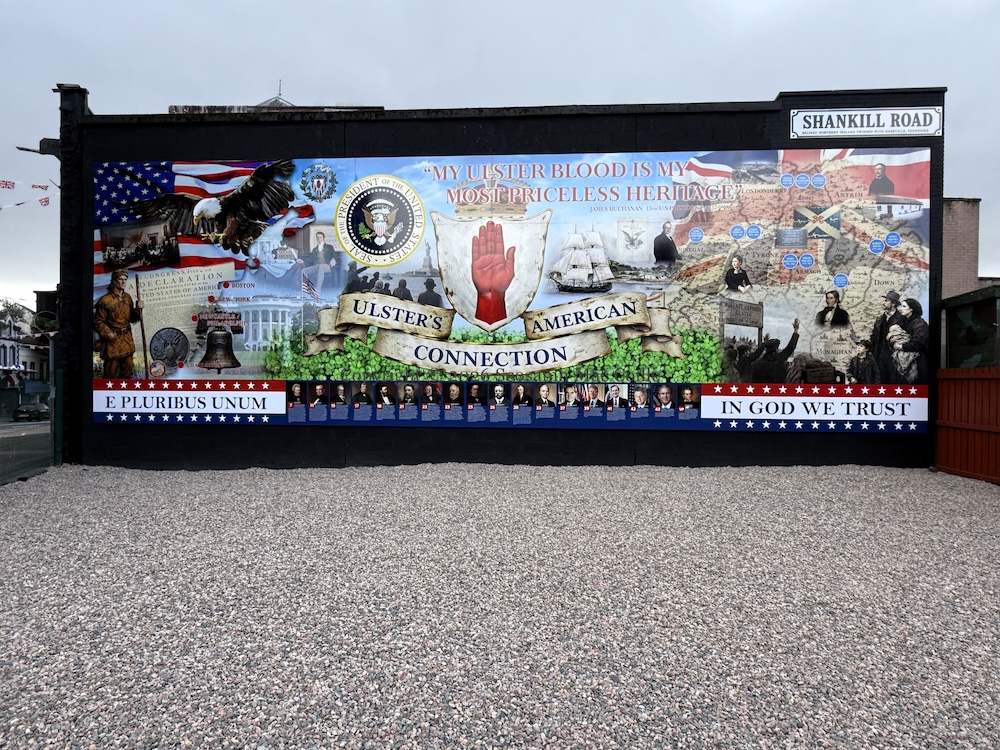
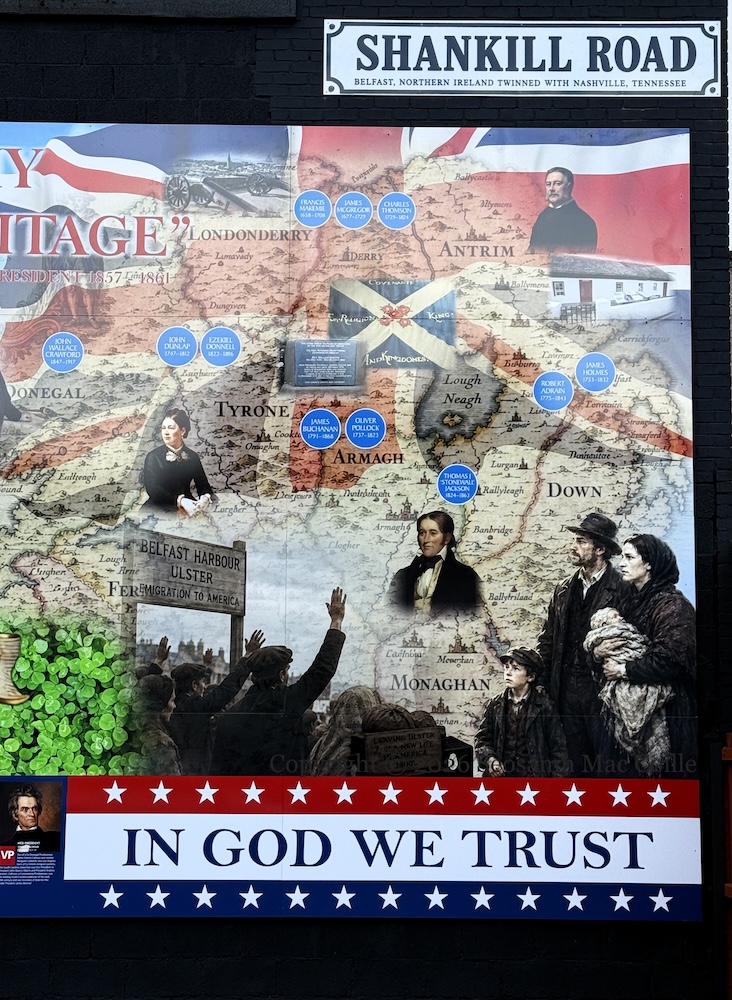
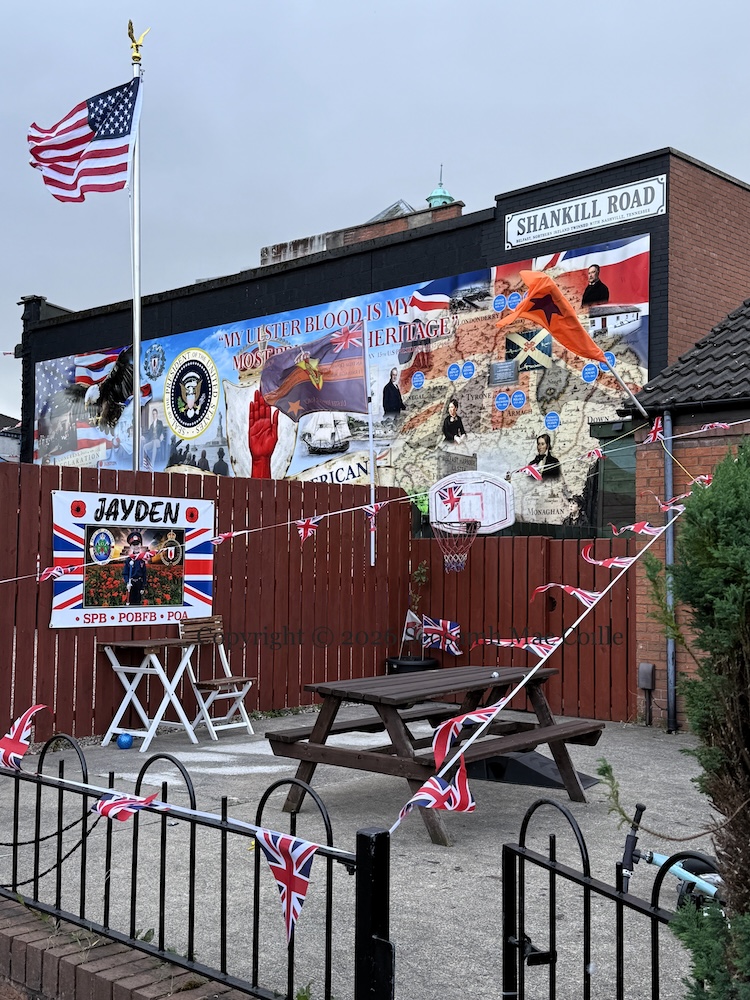
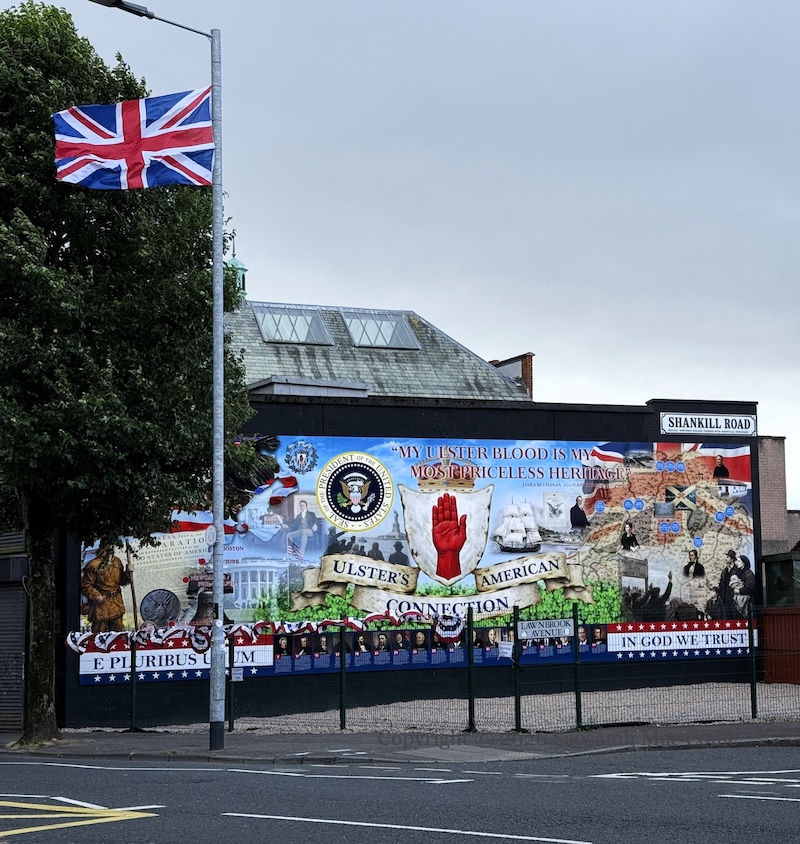
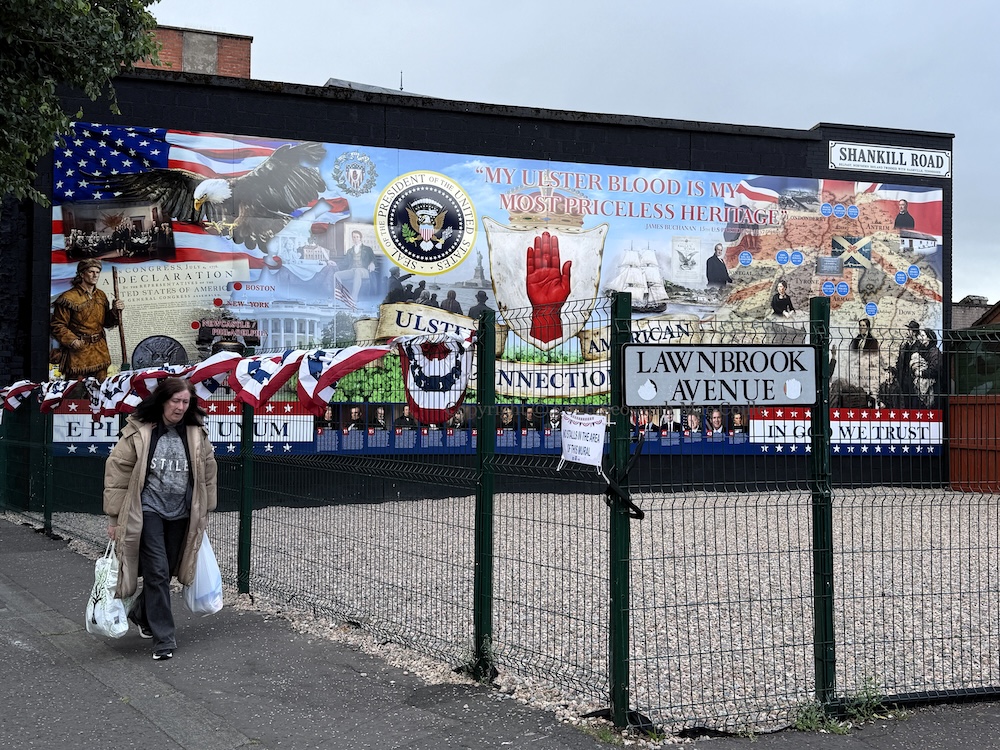
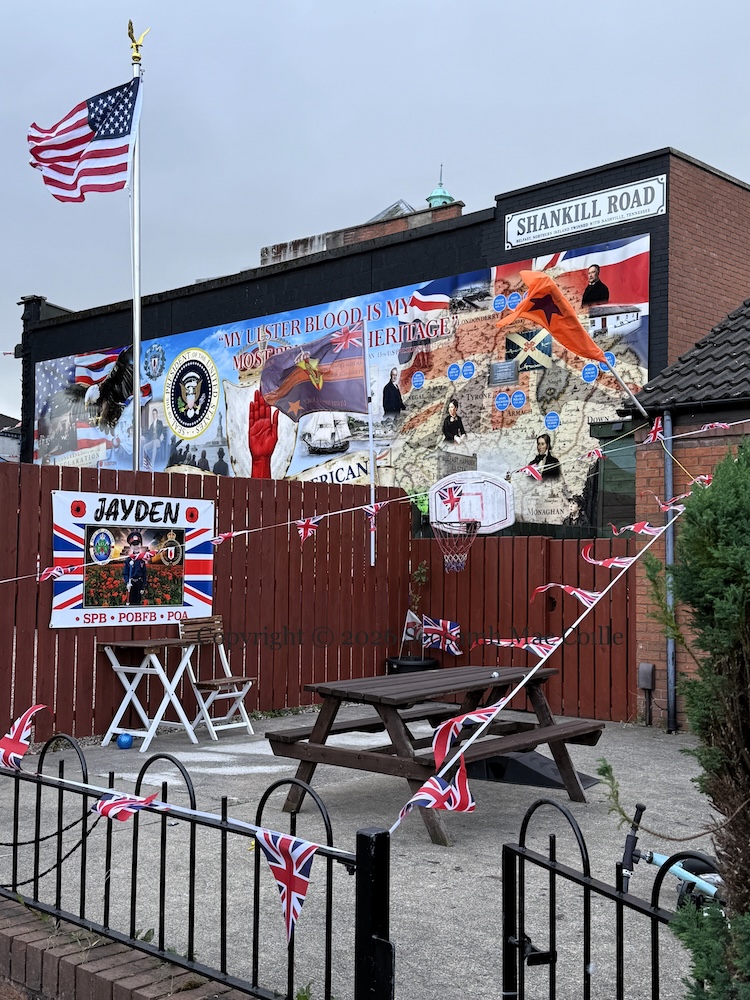
The United States Of America celebrates the 250th anniversary of its adoption of the Declaration Of Independence today, July 4th, 2026. In the Declaration, delegates from the thirteen (former) colonies set out their reasons for voting to overthrow British rule on July 2nd, noting twenty-seven grievances against the reigning monarch, George III of Great Britain And Ireland. At the time, the American Revolution was ongoing, and the Continental Congress meeting this time in Philadelphia was soon compelled to move to Baltimore, Maryland; the permanent Congress was not established until 1781.
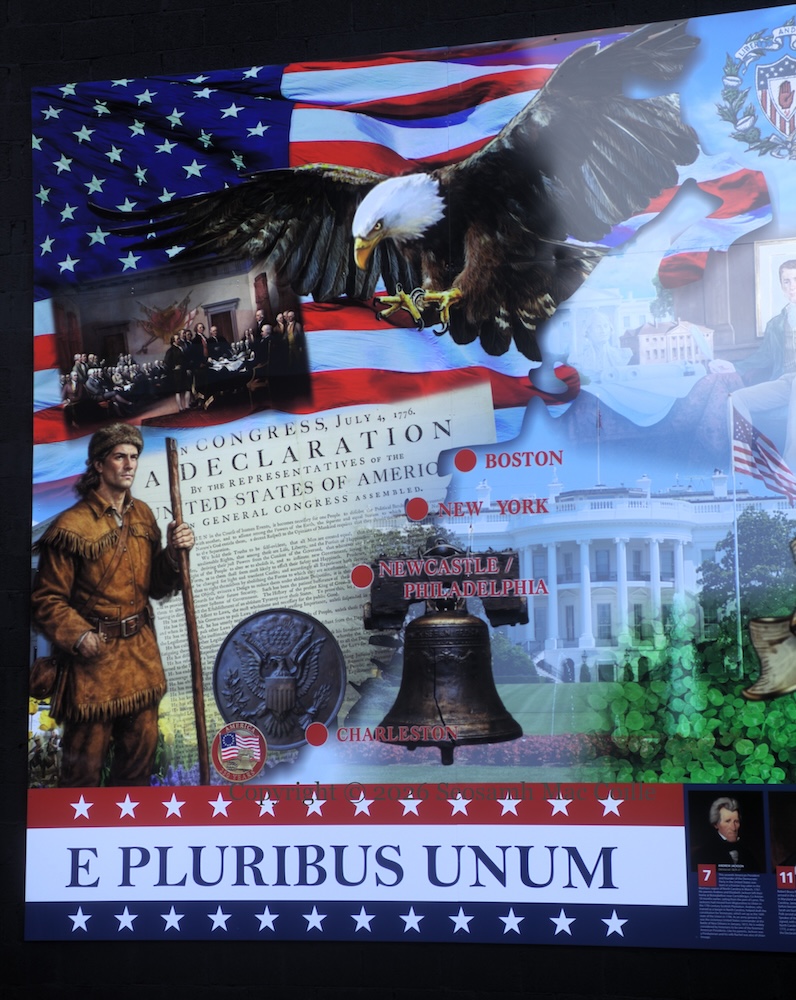
On the left of the board, various symbols of the eventual United States Of America – John Trumbull’s painting ‘Declaration Of Independence’ (image at WP) and a bald eagle upon a Stars And Stripes formed by an outline of the eastern sea-board (which for an unknown reason lists New Castle (not “Newcastle”) alongside Philadelphia), the Liberty Bell, an “America 250 years” pin, the Seal, the Declaration, and a trapper or frontiersman who represents the westward expansion of European Americans – including the Scotch-Irish (Ulster Sails West) – across the continent.
The “liberty and law” emblem, with the red hand against the stars and stripes, surrounded by a garland of thistle and shamrock, is unknown.
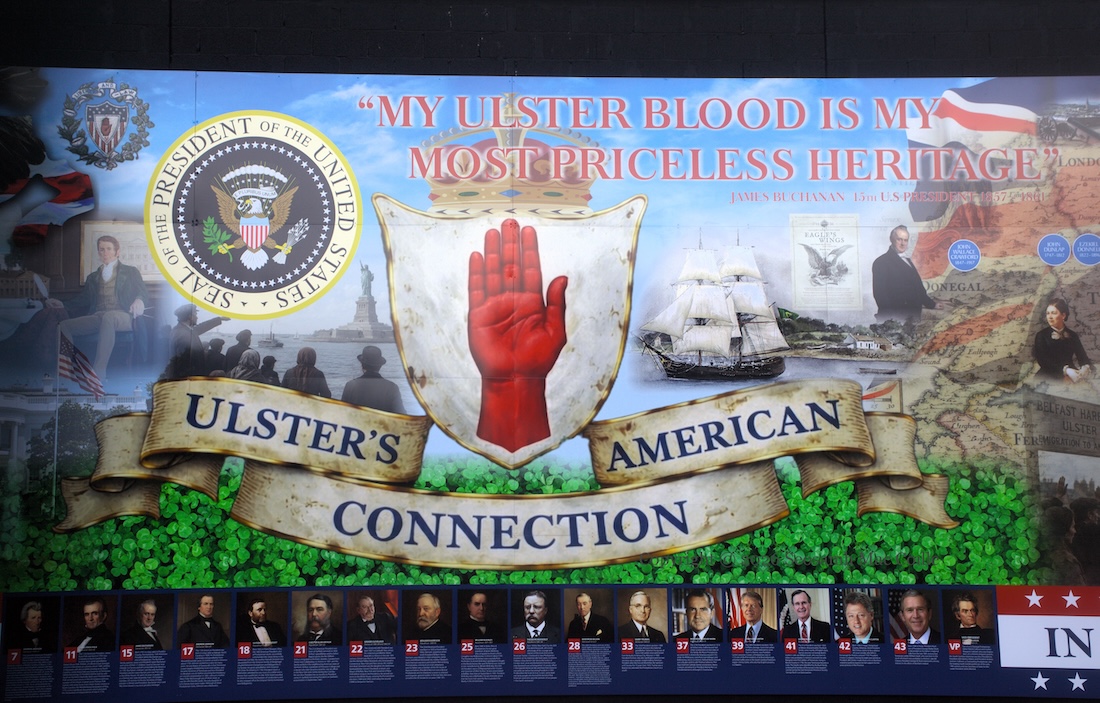
The seated gentleman is James Hoban, a Catholic from Co Kilkenny, who studied architecture in Dublin and (after emigrating in 1878) designed the White House – a three-storey model (later reduced to two) is on the desk behind his quill – and (in the framed picture behind him) the Charleston (South Carolina) court-house.
In the centre is a quote attributed to James Buchanan, “My Ulster blood is my most priceless heritage”; for confusion over the quote see James Buchanan. Buchanan is also pictured (next to the word “Donegal”). The Great Seal was designed by Charles Thomson, originally from Maghera. He was also a signatory to the Declaration.
The crown above the red hand is probably the Tudor Crown, destroyed in 1649 (WP). A bed of shamrock supports the title banner.
The Ulster-Scots lineage of seventeen presidents (plus vice-president Andrew Calhoun) is presented along the bottom between the mottos “E pluribus unum” and “In God we trust”. (The Ulster-Scots Agency has a pdf of the Presidents.)
On the right, the poster marked “Eagle’s Wings”, under the Buchanan quote, also appears to come from the Ulster-Scots Agency. It is actually about the Eagle Wing, the ship pictured to the poster’s left (as imagined by water-colour painter Dan Parsons) that undertook the first voyage of Scots-Irish to North America in 1636. The journey was not a success: the roughly 140 dissenters returned to Ireland and some went to Scotland to avoid continued persecution (Presbyterian History.)
The ‘Blue Plaques’ of various notable figures are superimposed upon a period map: John Wallace Crawford, Francis Makemie, James McGregor, Charles Thomson, John Dunlap, Ezekiel Donnell, James Buchanan, Oliver Pollock, Thomas J ‘Stonewall’ Jackson, Robert Adrain, James Holmes. The portraits are of James Buchanan, Teddy Roosevelt (above Andrew Jackson’s ancestral cottage in Carrickfergus), Davey Crockett, and an unknown female figure (comment/get in touch if you can identify her).
The gravestone is to the Rev William Martin, a Reformed Presbyterian (Covenanter) minister, who led a contingent of 1,000 people in five ships in 1772 to Charlestown, South Carolina (Reformation History | History Ireland). The flag is the flag of the Covenanters (WP).
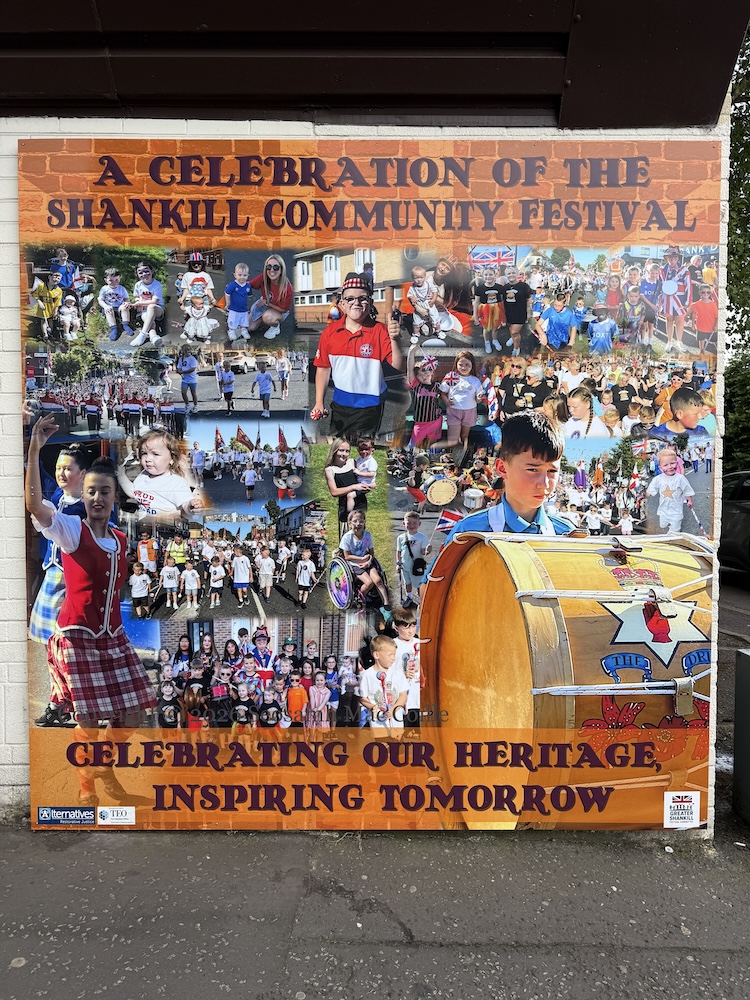
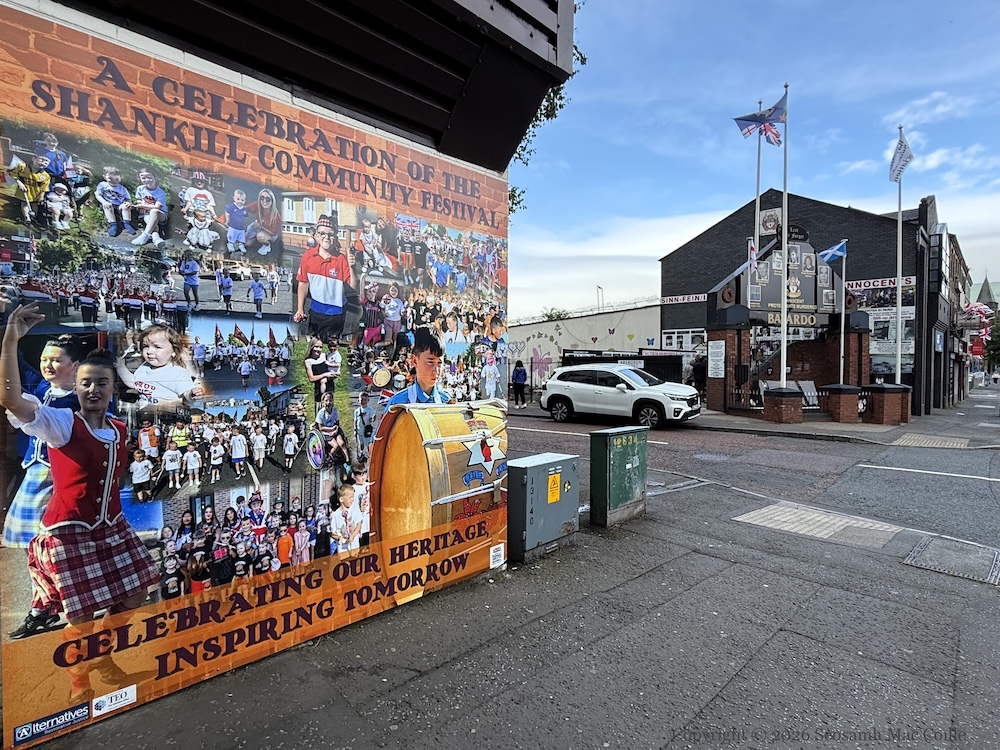
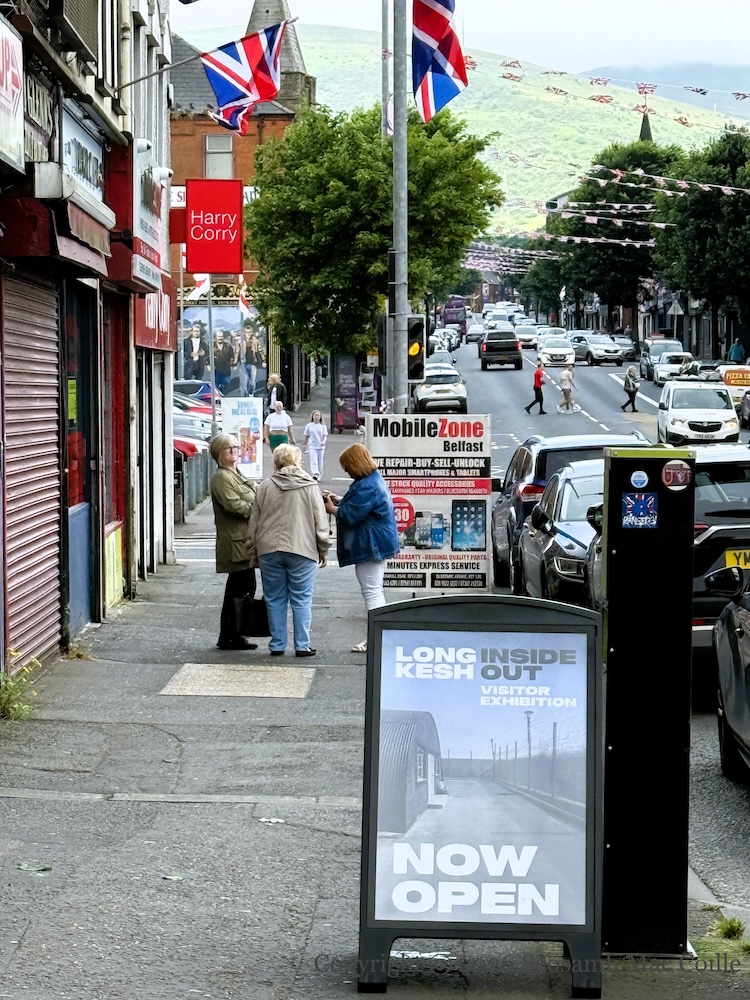
“Celebrating our heritage, inspiring tomorrow.” This year’s Greater Shankill Community Festival began on June 30th with the launch of Ulster’s American Connection and will end with a Siege Of Derry re-enactment on July 11th – the full programme can be found on Fb. One event included in the festival is the “Long Kesh Inside Out” exhibition in the Shankill ACT, which opened on June 1st.
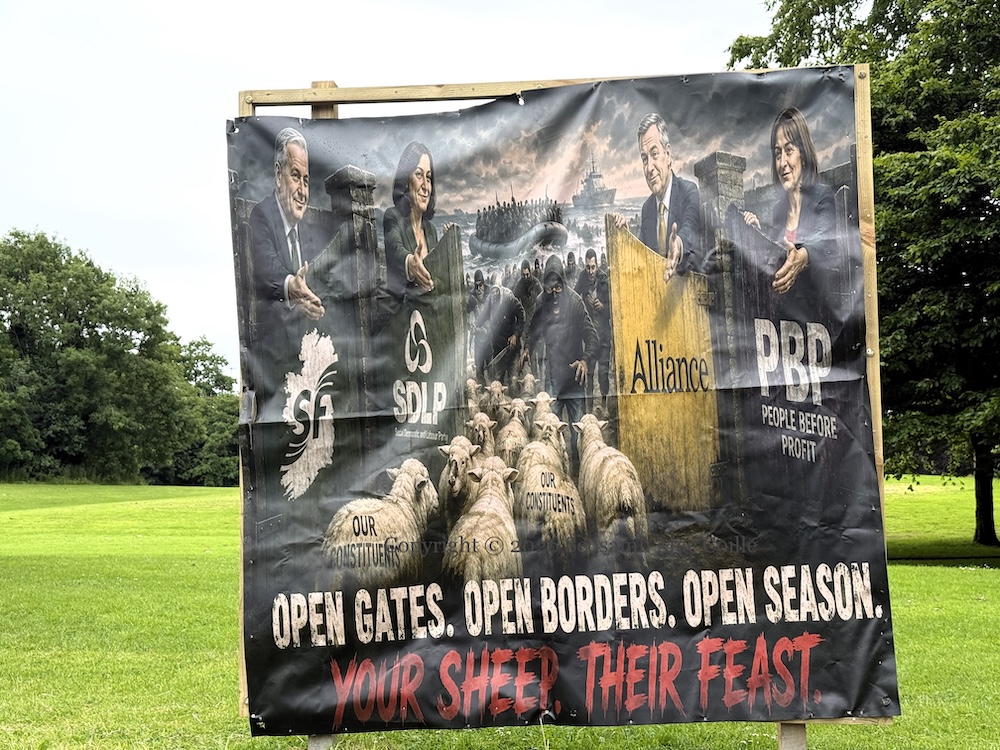
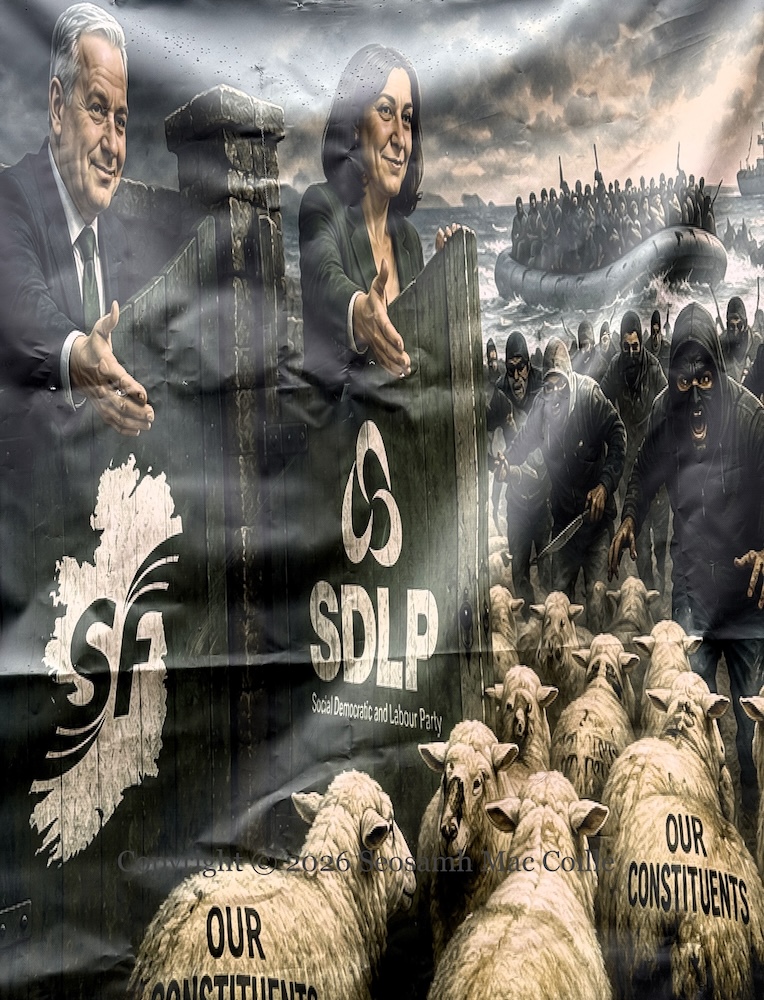
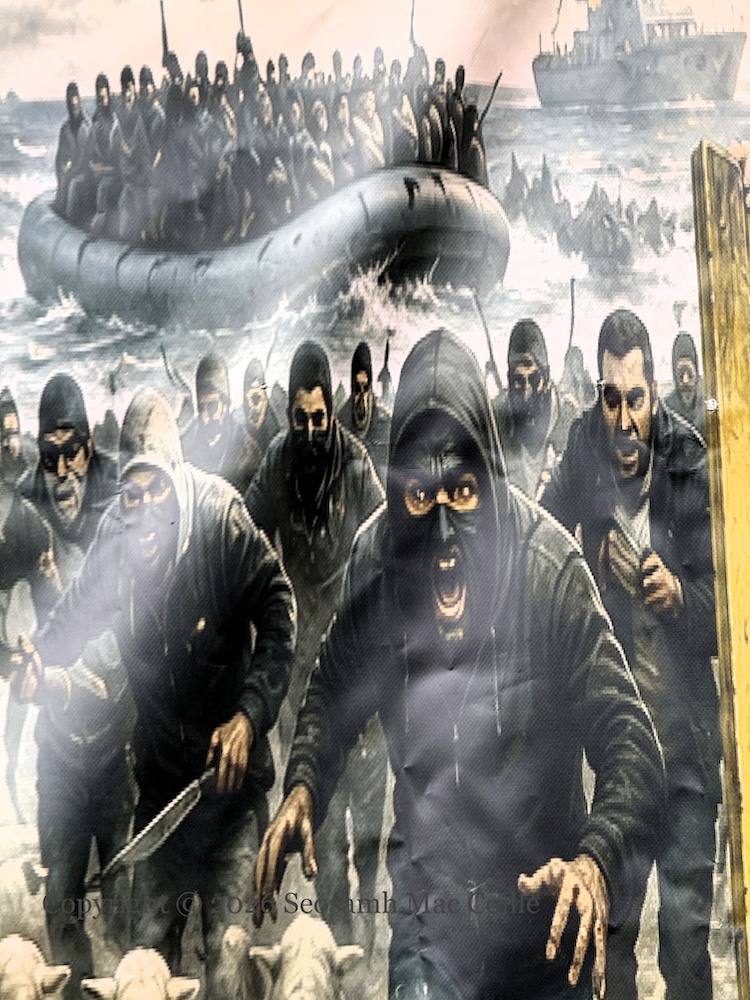
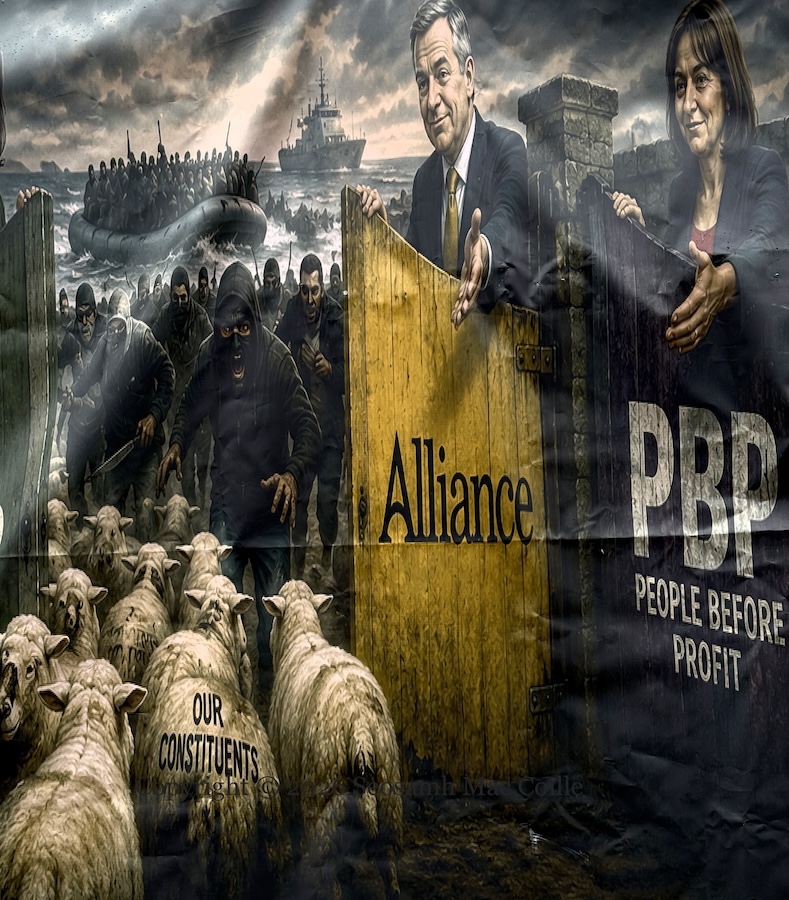
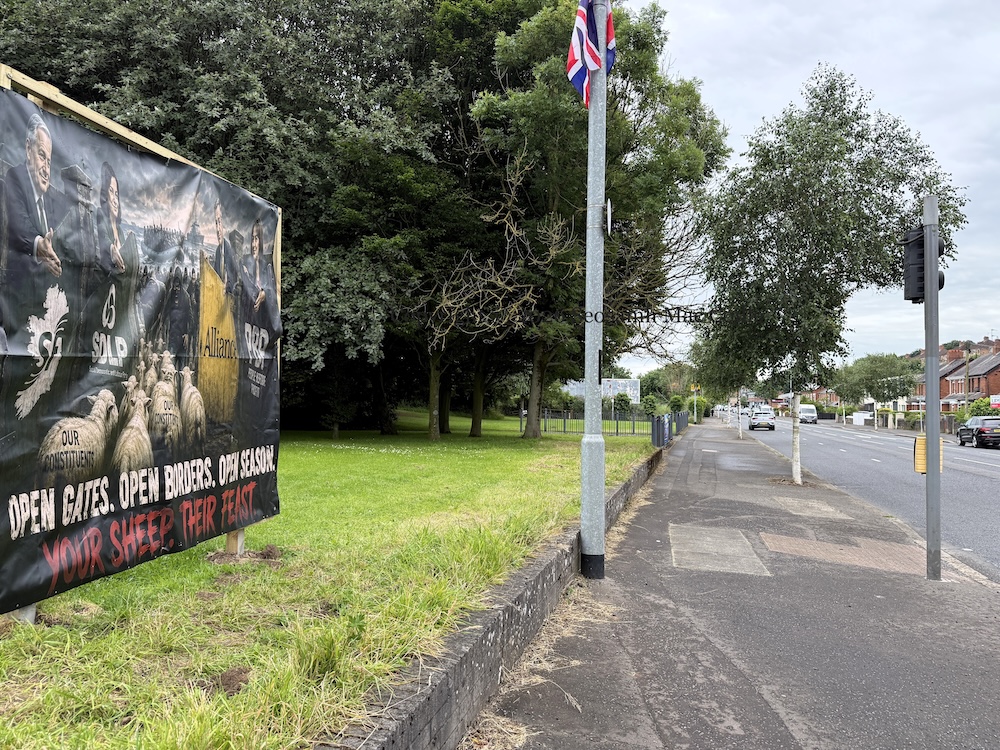
“Open gates. Open borders. Open season. Your sheep. Their feast.” Politicians from Sınn Féın, the SDLP, Alliance, and People Before Profit are shown opening the gates for masked and armed men who are coming from the sea and bidding them to enter a sheepfold of “our constituents”.
The PSNI are investigating the banner as a “hate incident” (rather than a “hate crime” – see A New Evil for the difference) (BelTel). On July first, it was reported that the banner had been removed and replaced with Union Flags and an Ulster Banner (Belfast Media | News Letter). Belfast City Council denied that it was involved in the removal (BelTel) – Loughside Park is council property. And as these pictures show, by July third it had been reinstated and the removal was only “temporary” and “tactical” (BelTel | Fb).
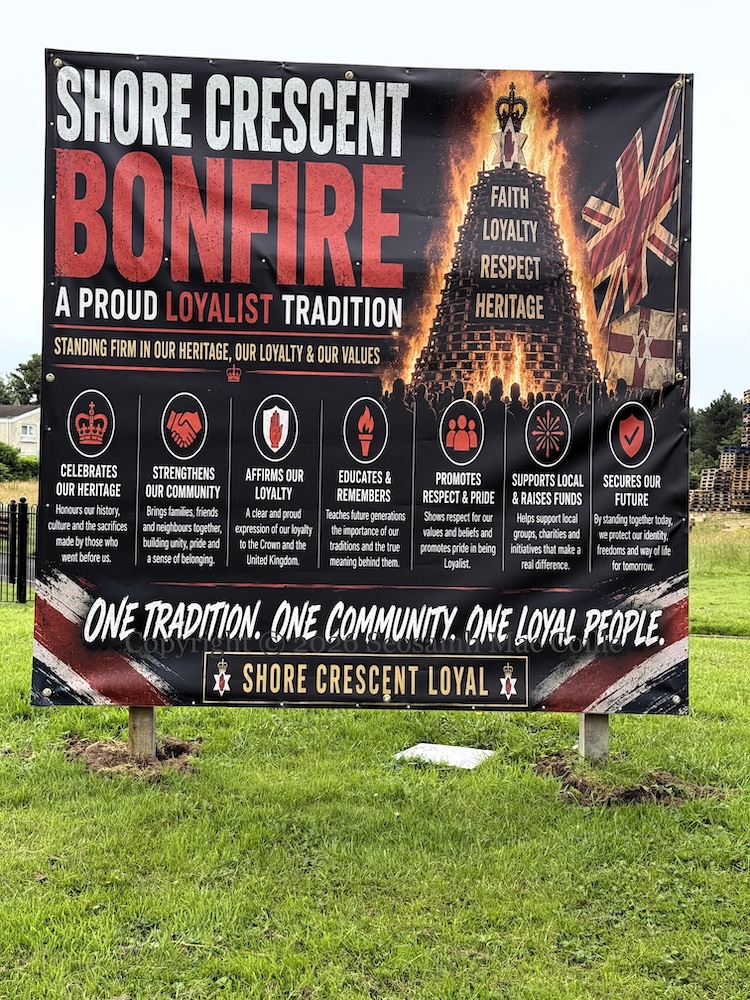
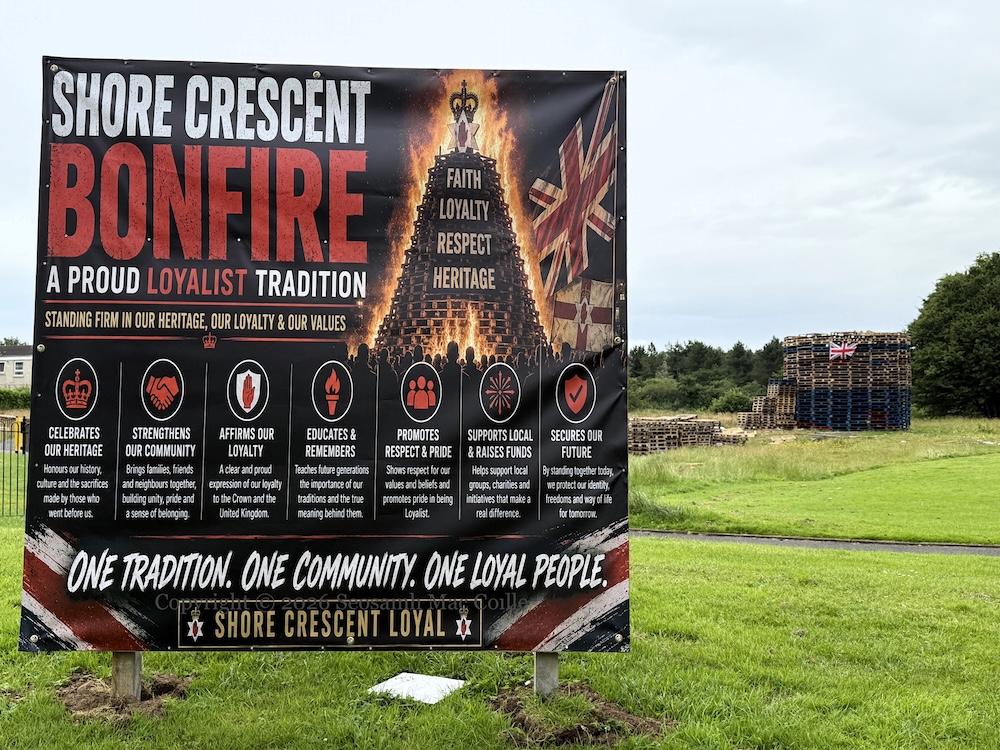
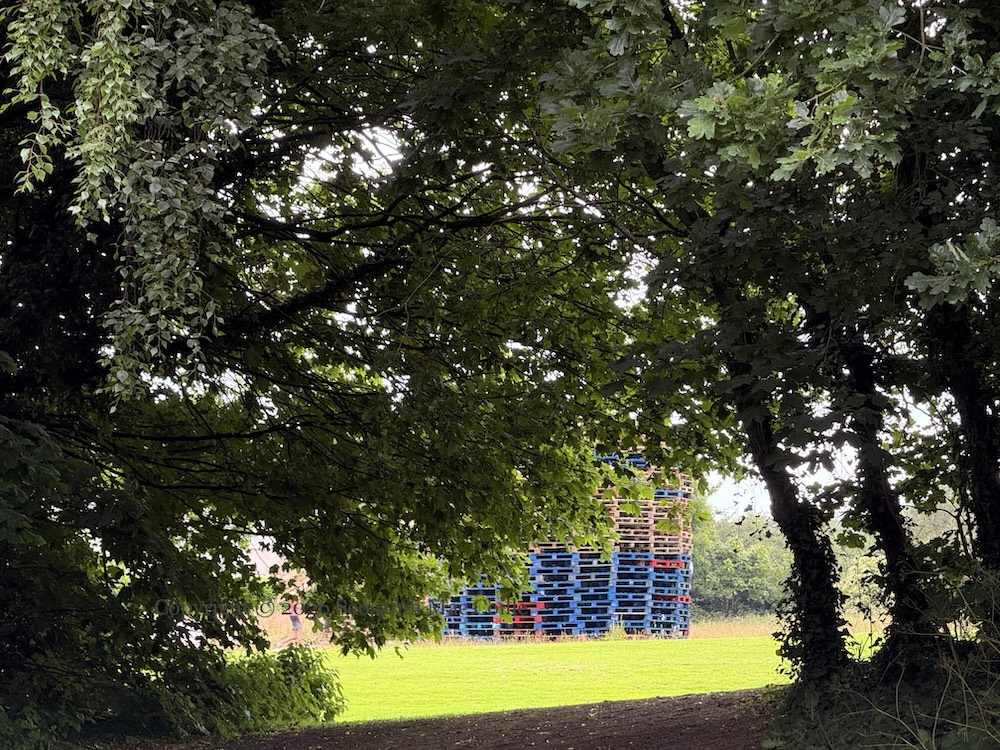
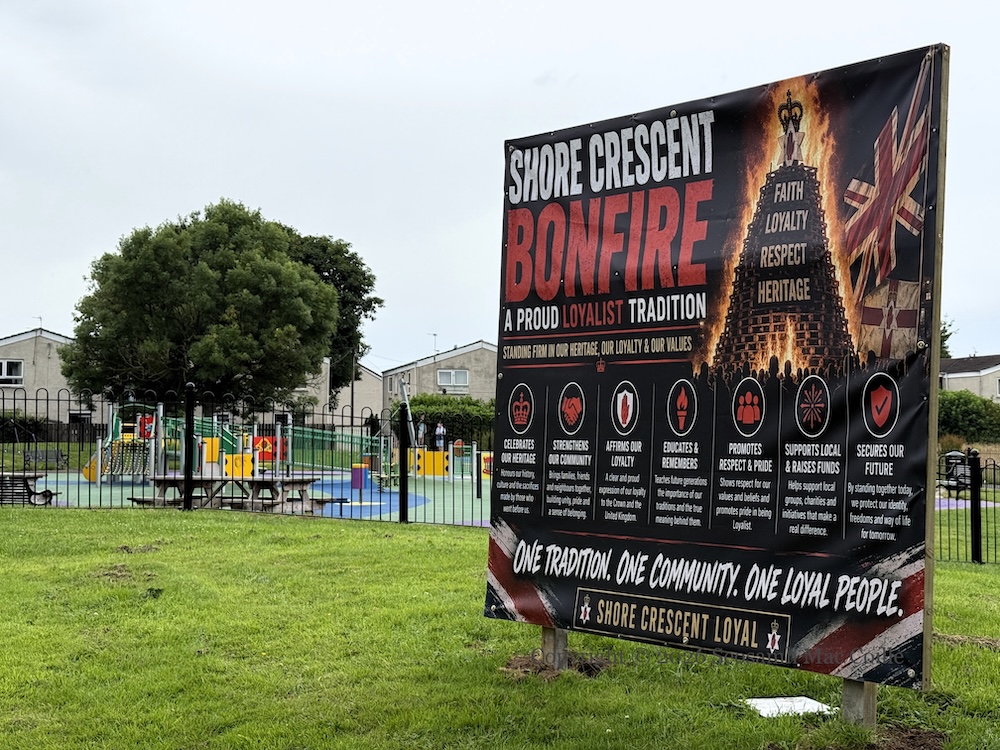
Shore Crescent prepares for Eleventh Night with a bonfire and a large sign explaining the positive impact of the tradition:
“Shore Crescent bonfire – a proud loyalist tradition. Standing firm in our heritage, our loyalty & our values. Faith – loyalty – respect – heritage. [The bonfire …] Celebrates our heritage – honours our history, culture and the sacrifices made by those who went before us; strengthens our community – brings families, friends and neighbours together, building unity, pride and a sense of belonging; affirms our loyalty – a clear and proud expression of our loyalty to the Crown and the United Kingdom; educates & remembers – teaches future generations the importance of our traditions and the true meaning behind them; promotes respect & pride – shows respect for our values and beliefs and promotes pride in being Loyalist; supports local [groups] & raises funds – helps support local groups, charities and initiatives that make a real difference; secures our future – by standing together today, we protect our identity, freedom and way of life for tomorrow. One tradition. One community. One loyal people. Shore Crescent loyal.”
Next to Loughside Playground, Shore Road, north Belfast
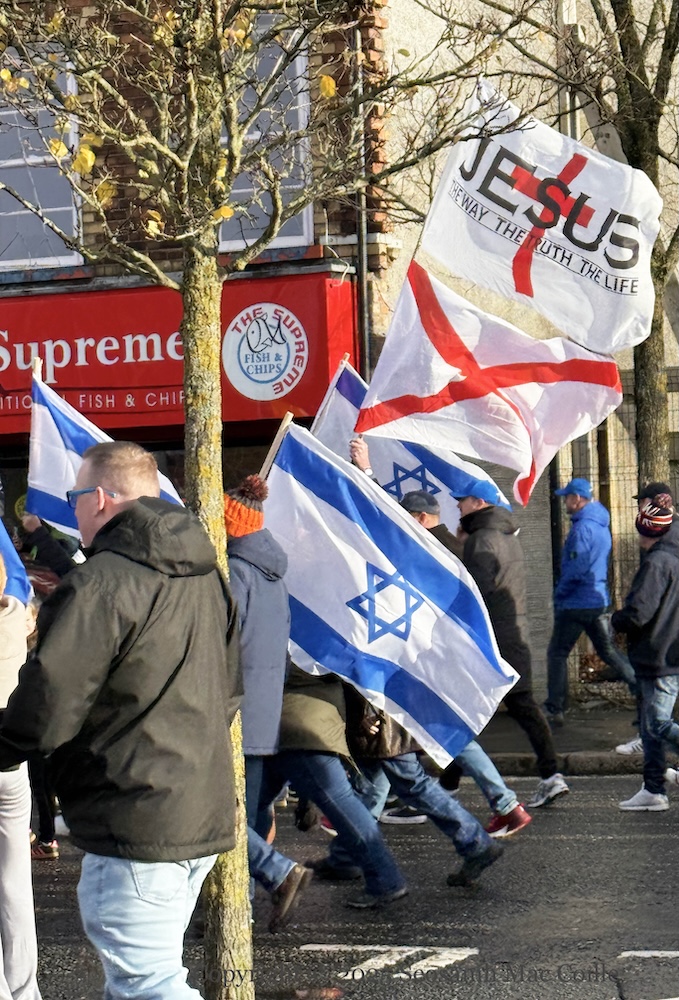
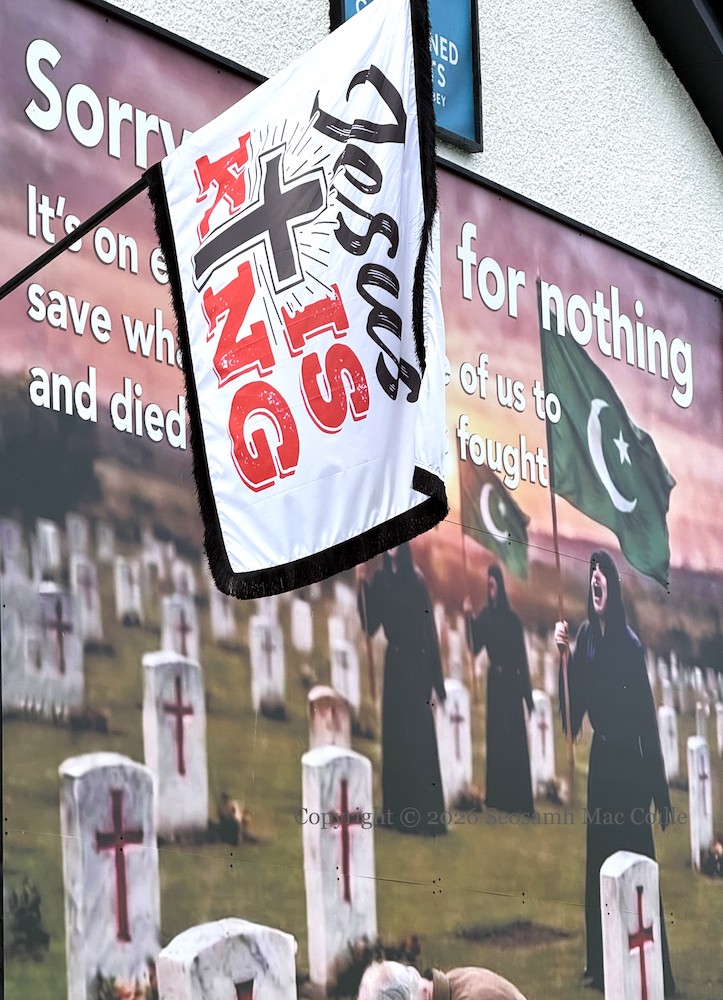
A feature of recent (anti-immigration) protests is the presence of Christian flags, not marked with any particular denomination or with Orange Order symbols but appealing to “Jesus”. These are a new addition alongside the other flags and imagery of loyalism – the Union Flag, Ulster Banner, Israeli flag – and the recent anti-immigrant boards and banners.
The image above shows a rally in Sandy Row, south Belfast, (from late November, 2025) in which a flag reading “Jesus – the way, the truth, the life” flies above a St Patrick’s Saltire and in the midst of a number of Flags Of Zion. (For a bizarre conjunction of Nazi and Israeli iconography, see I Never Felt More Like Singing The Blues.)
The second image comes from the large painted board seen in Sorry It Was All For Nothing, where a pair of ‘Jesus is king’ flags fly on either side of the board, in opposition to the “Islamic” flags carried by the cloaked invaders.
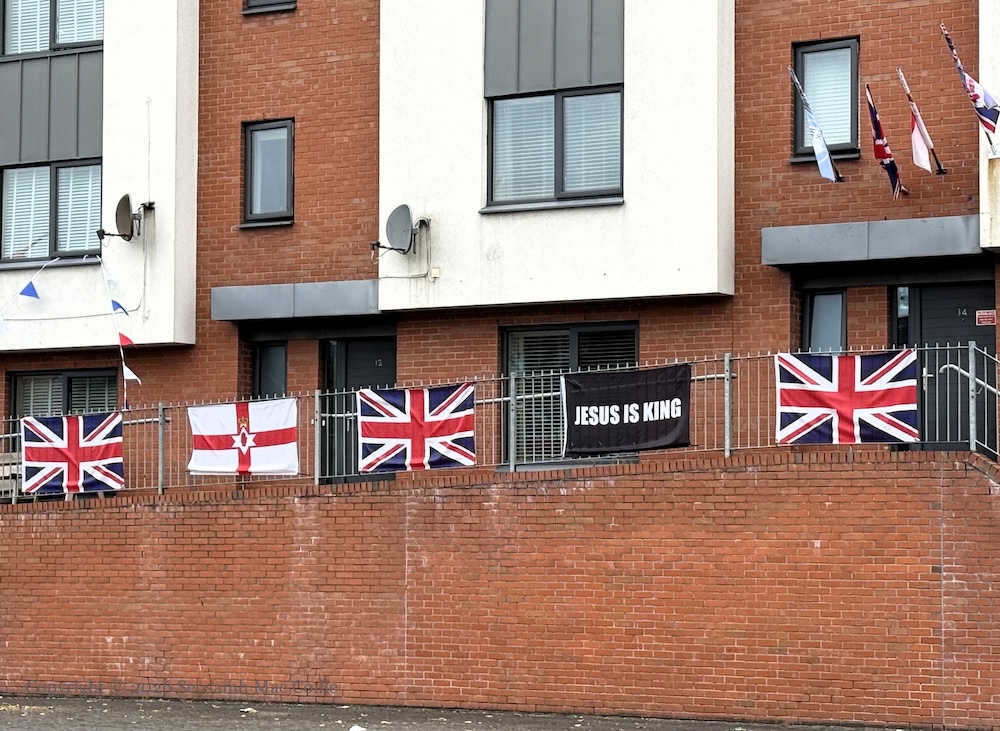
The third image – a simple “Jesus is king” on a black background – is from the flats on the Shore Road in north Belfast, which was the site, in late 2024, of flags supporting Donald Trump – see Take America Back and I Never Felt More Like Singing The Blues.
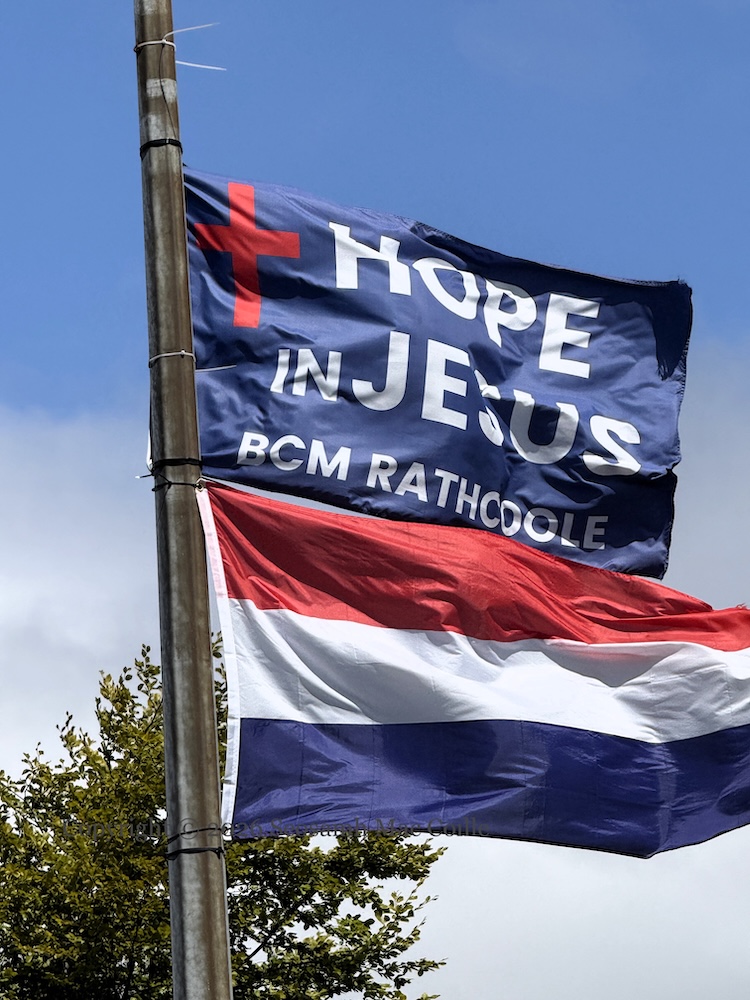
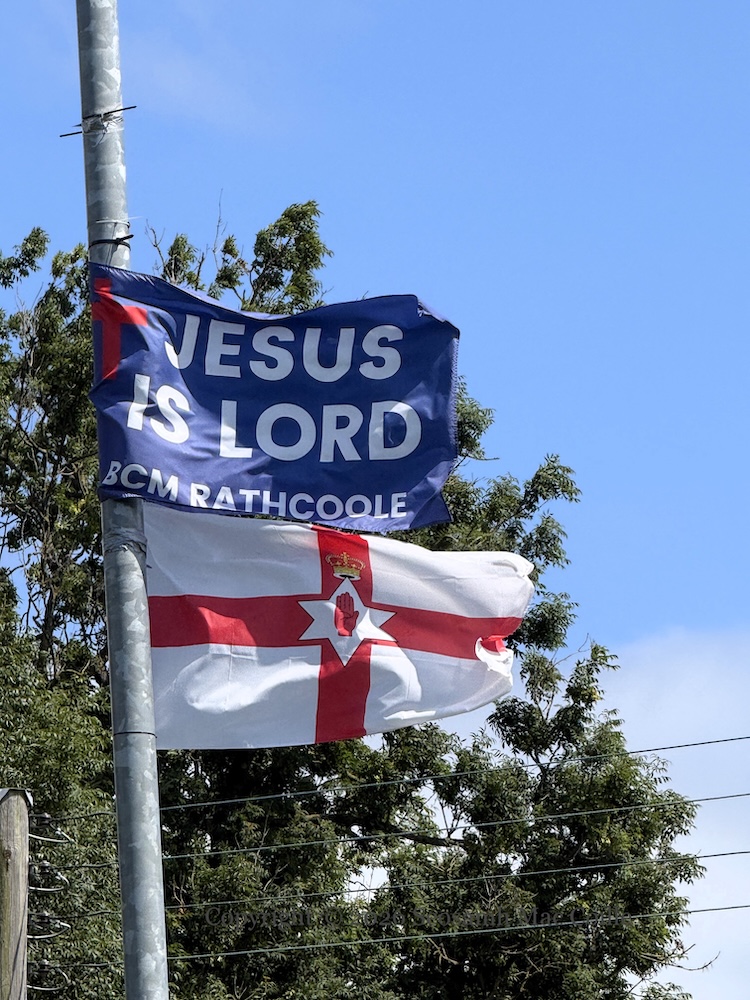
The final pair of images show BCM Rathcoole [the Rathcoole branch of Belfast Christian Ministry] flags flying in Rathcoole, Newtownabbey. As one would expect in Rathcoole, the BCM Fb page is strongly PUL-coded, but is free from anti-immigrant or Islamophobic content. It is possible that either the group’s flags have been mounted by a subset of anti-immigrant members (or outsiders) or that the group is taking advantage of the up-surge of interest in Christianity generated by the anti-Islam protests (and of the practice of flying flags from light-poles) in order to advertise itself. In these two images, the flags fly next to the national flag of the Netherlands (for King Billy/Orangism) and the Ulster Banner.