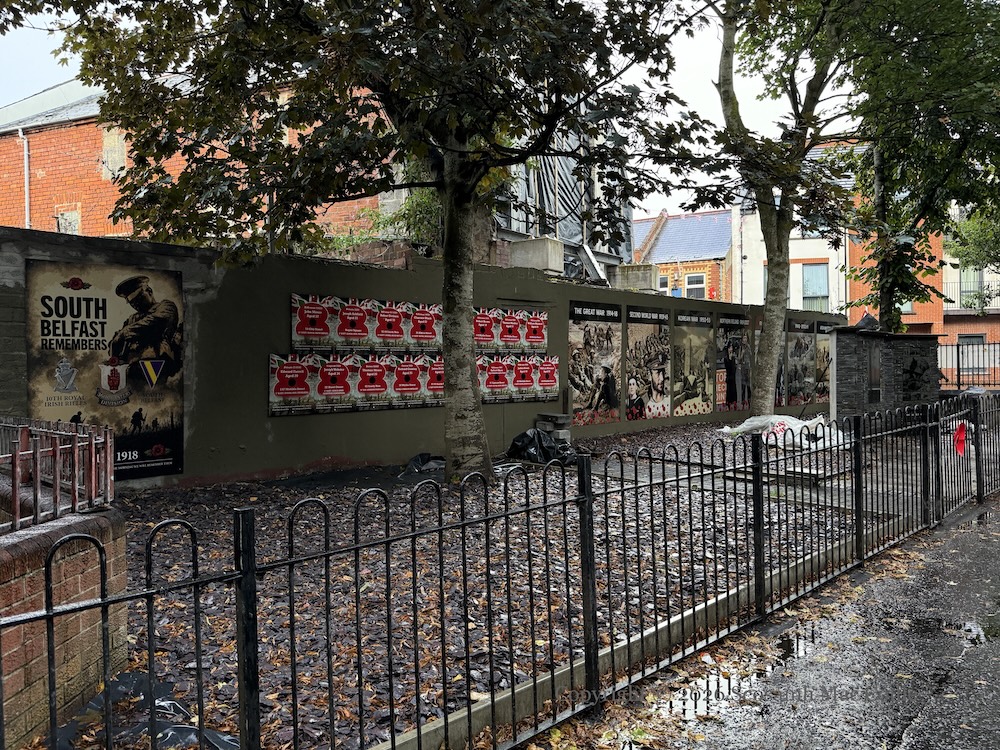
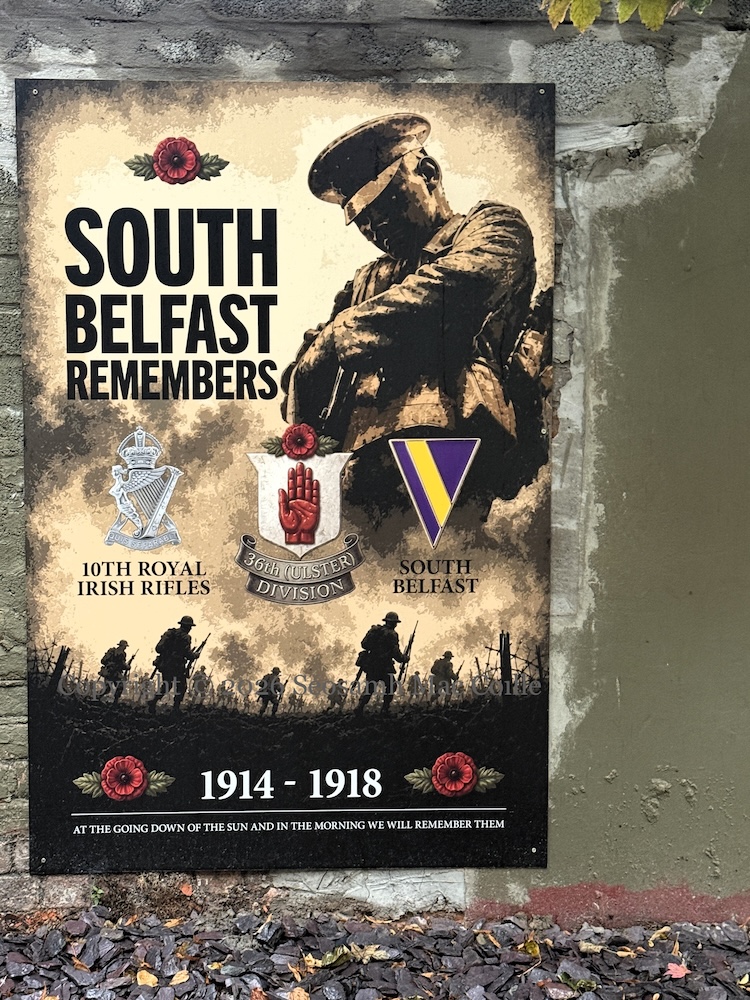
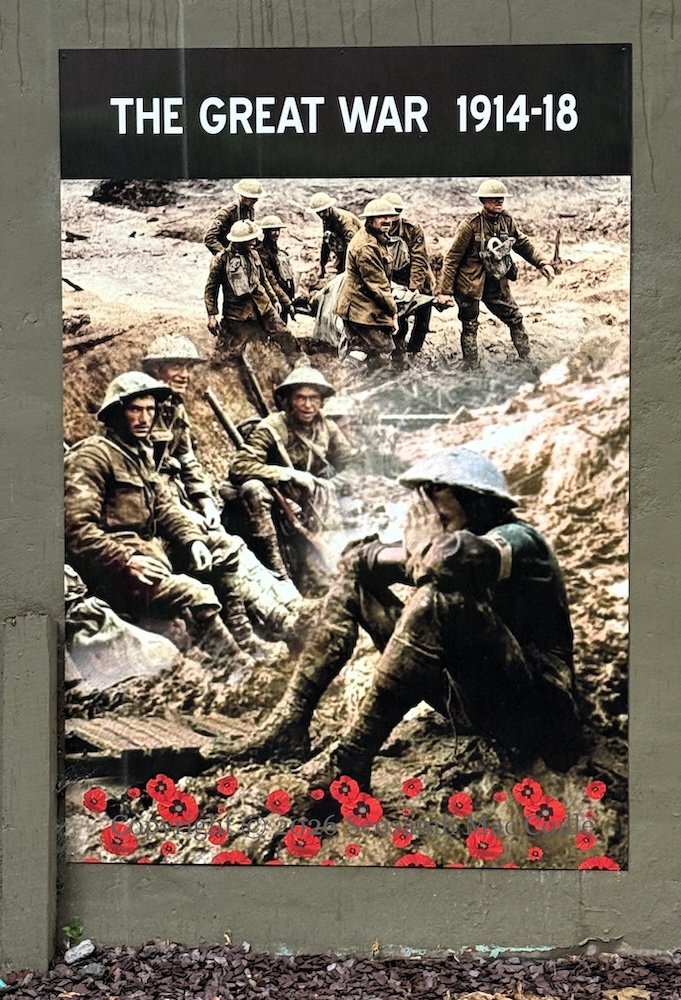
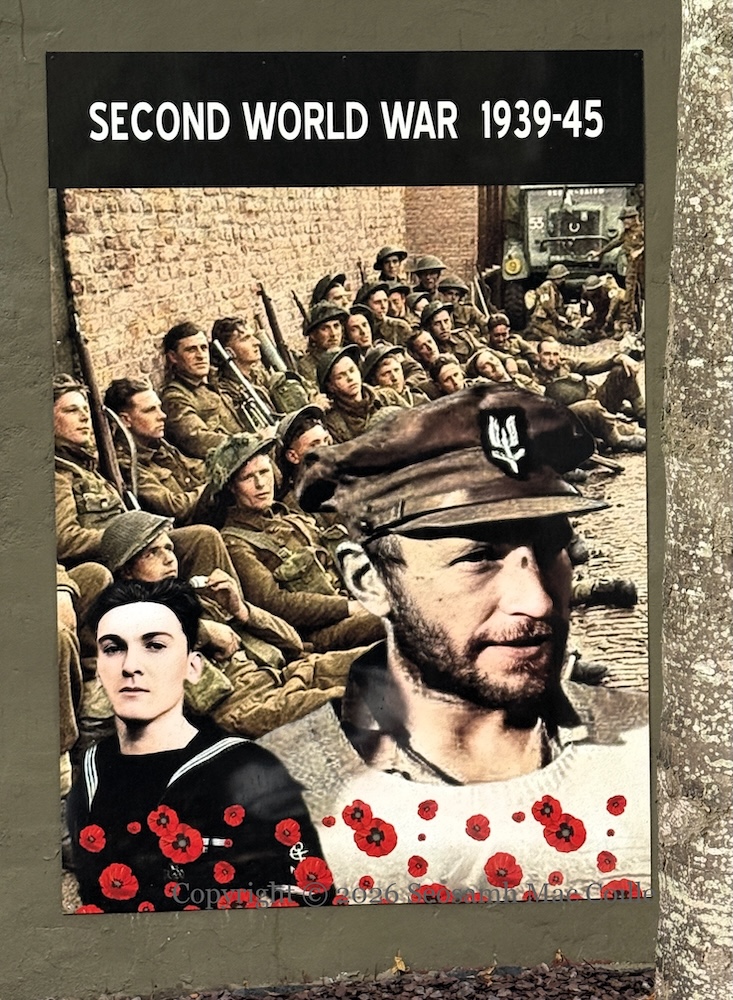
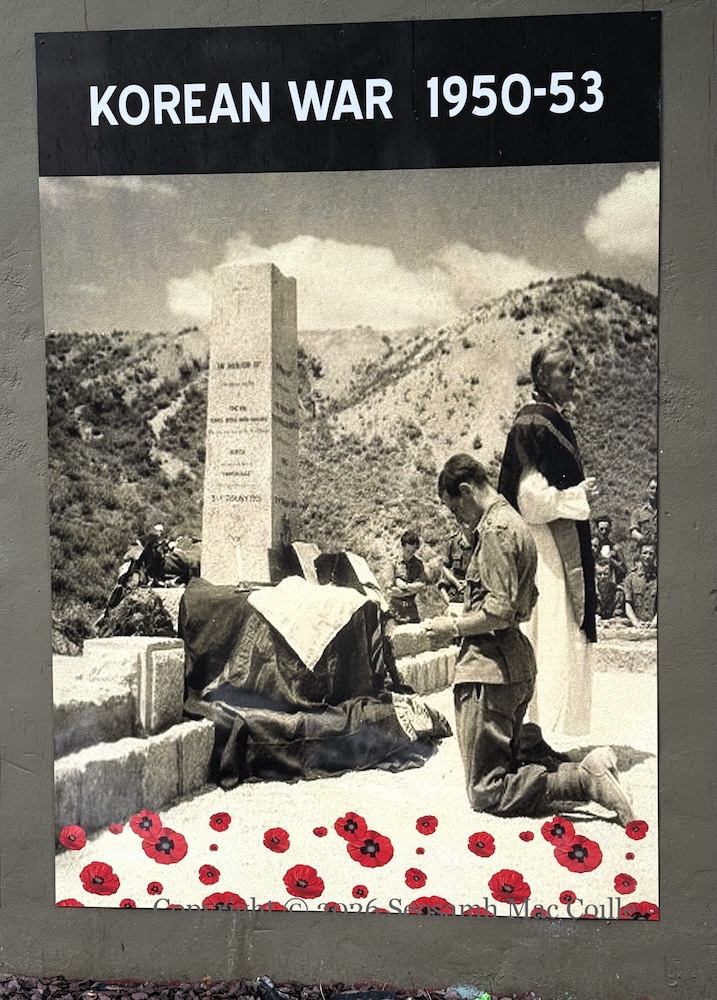
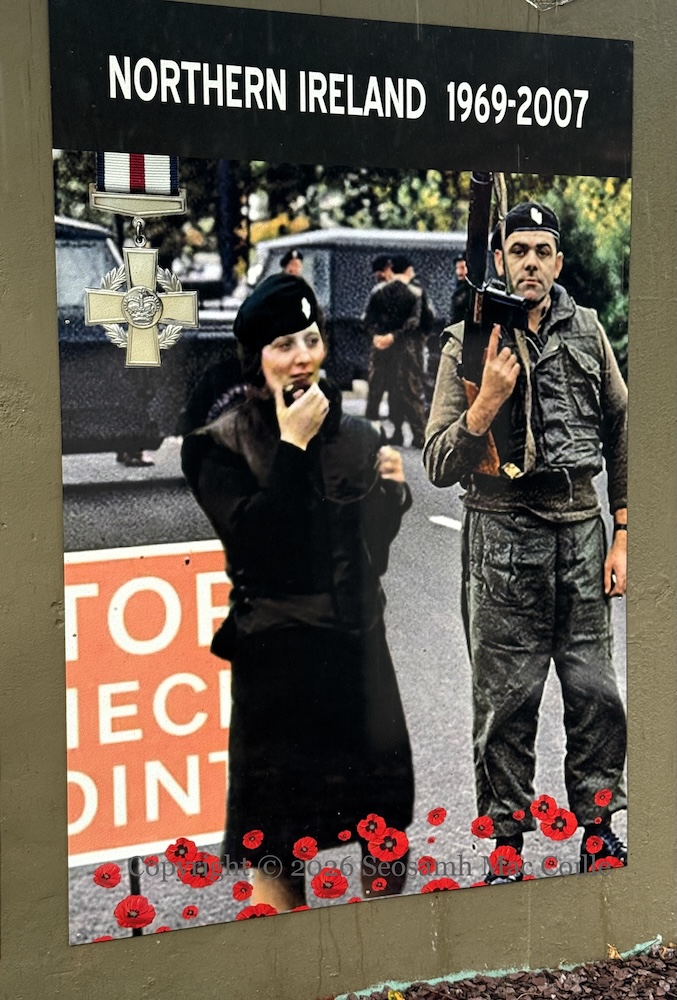
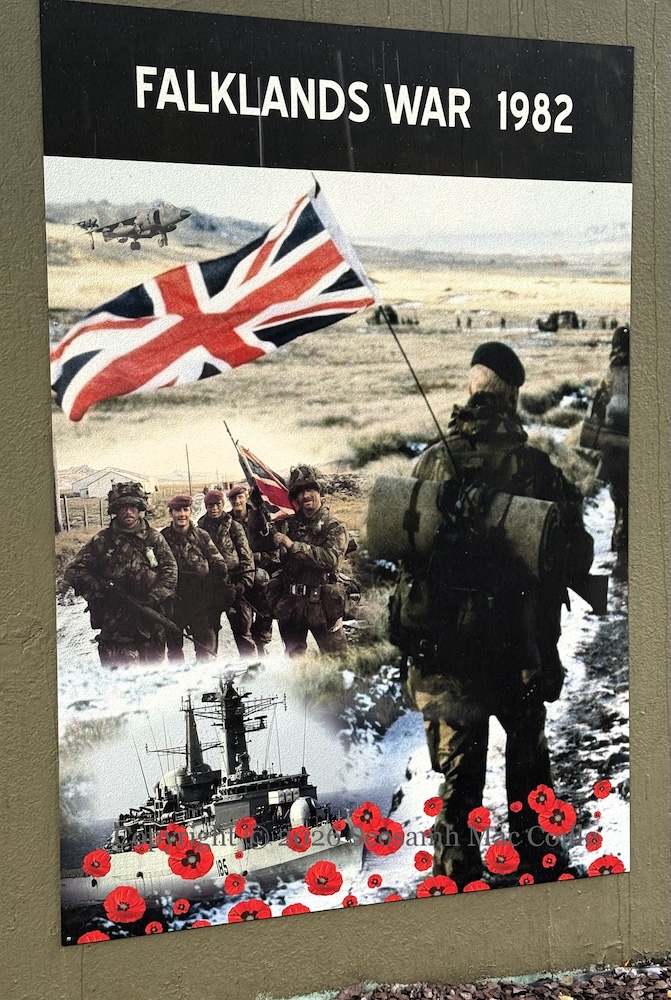
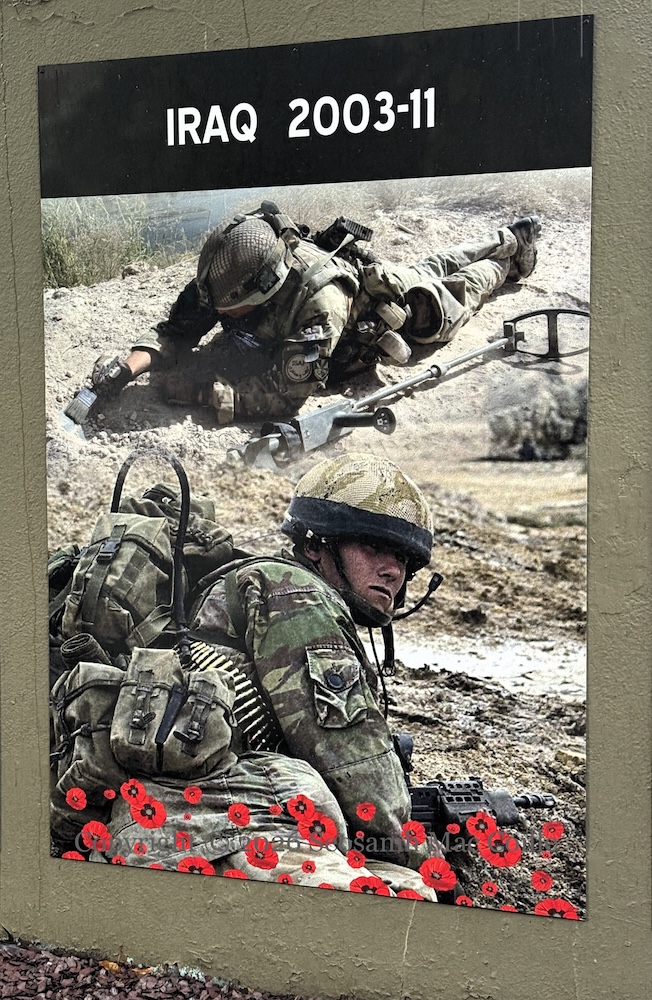
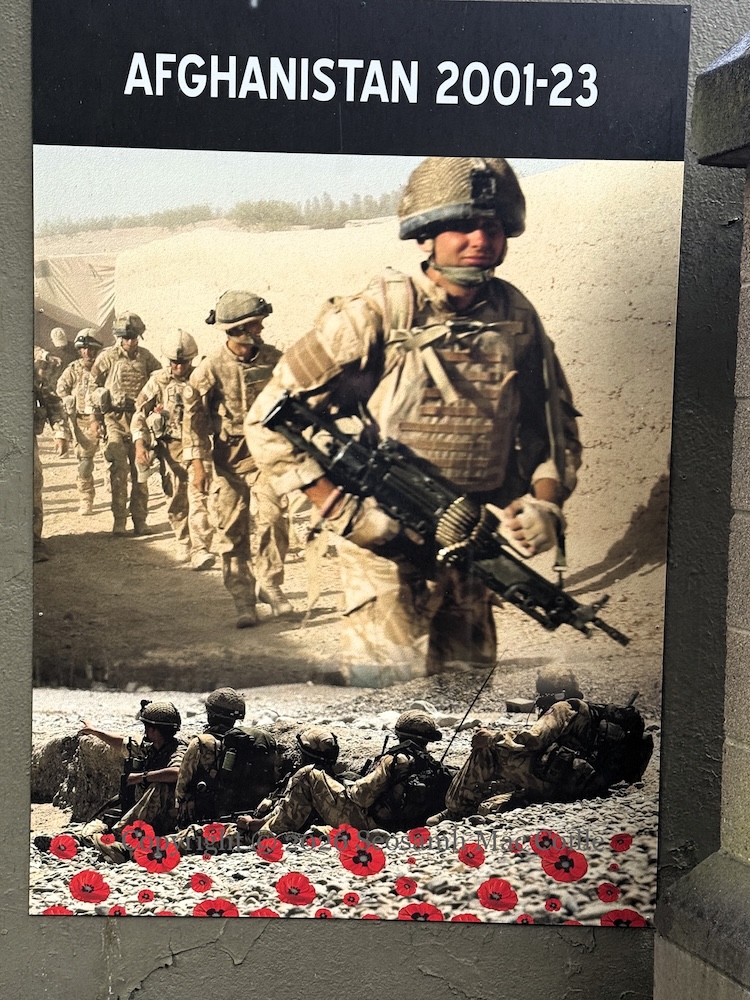
“South Belfast remembers [the] 10th Royal Irish Rifles, South Belfast, [and the] 36th (Ulster) Division.” Printed panels illustrating the engagements of the British Army in the twentieth and twenty-first centuries have been added to the three stones (seen in Continuing Conflicts) that marked the World Wars and “continuing conflicts”.
The conflicts depicted are the Great War 1914-1918, Second World War 1939-1945 (with individual photos of James Magennis and Blair Mayne, Korean War 1950-1953, Northern Ireland 1969-2007, Falklands War 1982 (the photo on the right is of troops “yomping”), Iraq 2003-2011, Afghanistan 2001-2023.
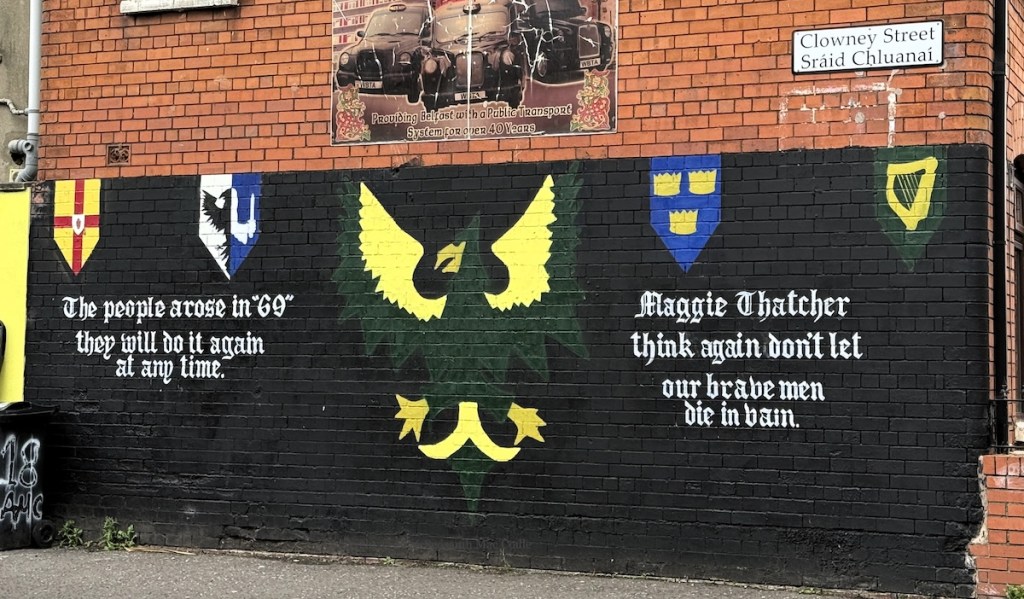
The phoenix in Clowney Street was first painted in 1981 and has been repainted periodically in the same form. (For a brief history, see The Oldest Murals.) In this update, the only noticeable changes are the quotation-marks around “69” and the golden feet on the phoenix.
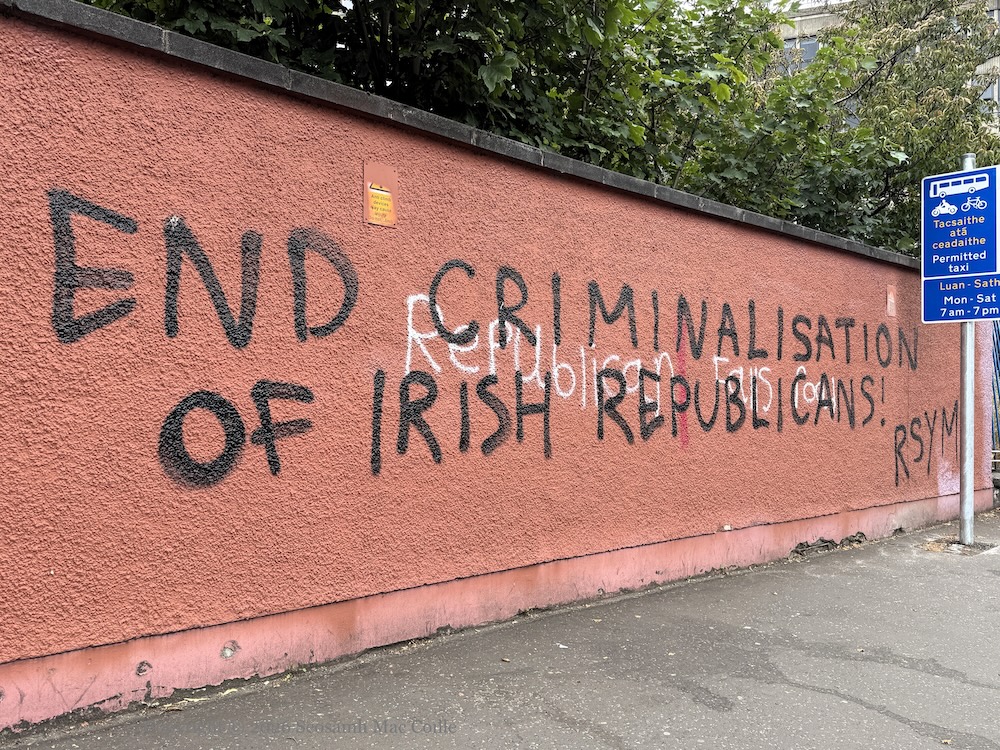
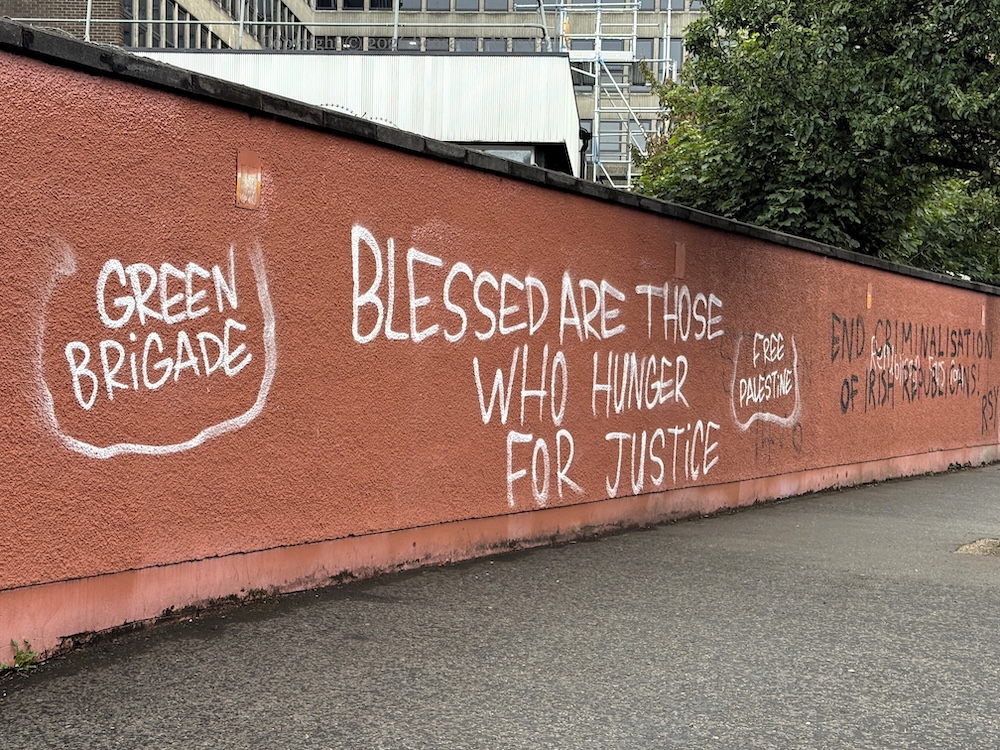
“End criminalisation of Irish republicans! – RSYM.” A new ‘welcome to west Belfast’ mural is in progress on the first part of the long wall outside the Royal Victoria Hospital, replacing the MASH tag that unceremoniously blocked out a graffito in support of Russia’s invasion of Ukraine.
For now, however, the longer part of the wall (to the right of gate) remains a message-board for anti-Agreement groups, the latest one being from the Republican Socialist Youth Movement (Fb), the youth wing of the IRSP/INLA.
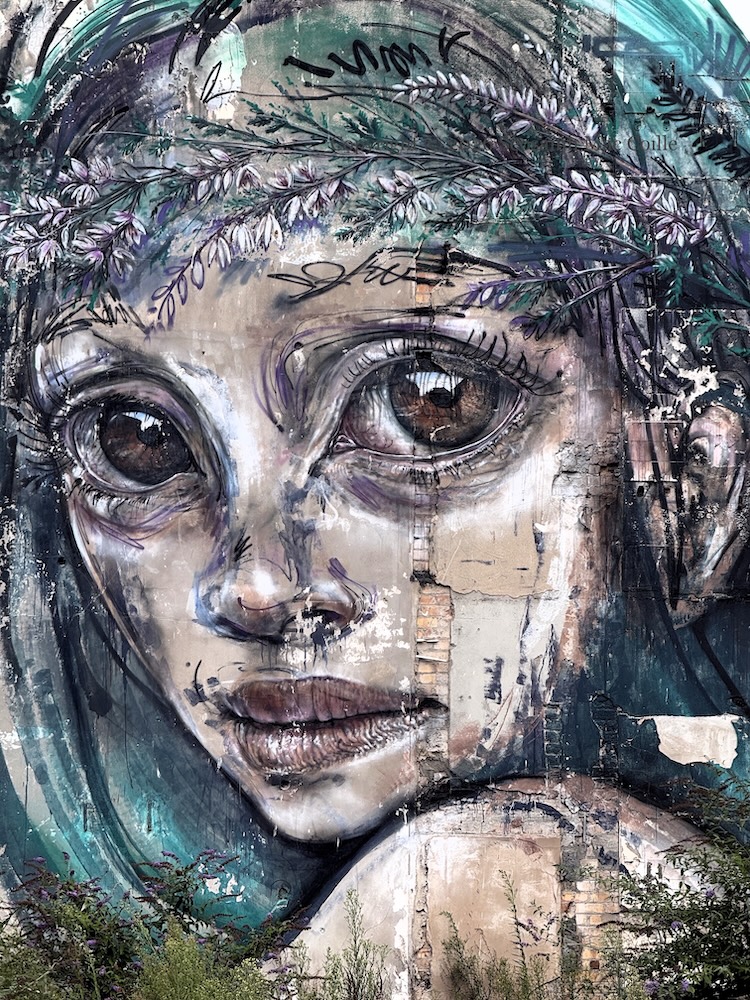
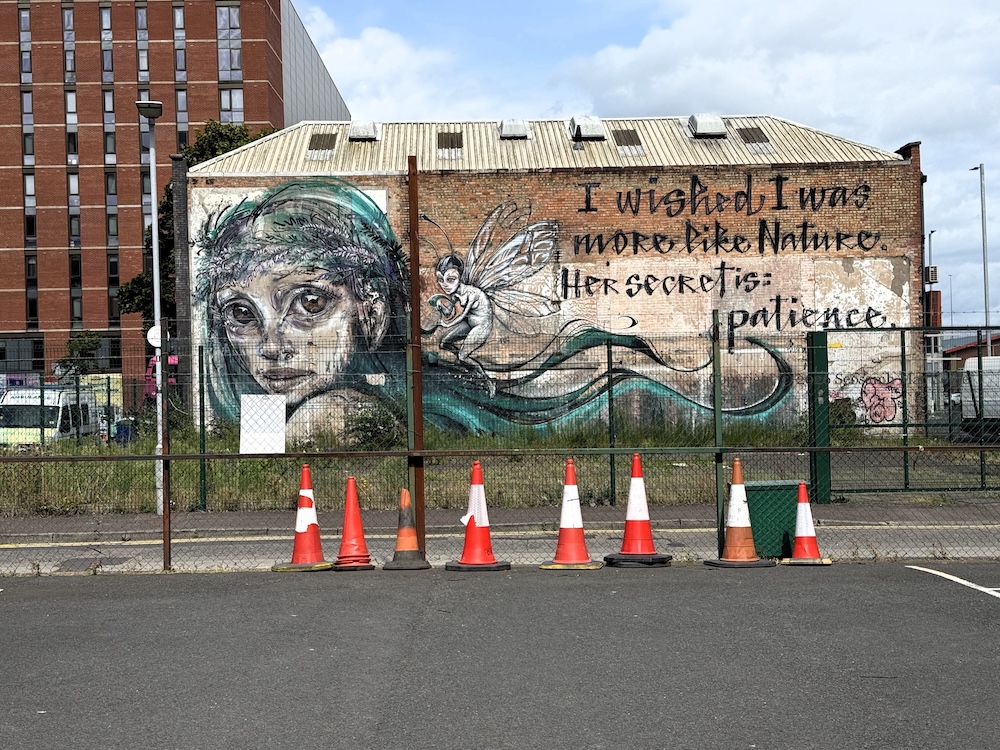
“I wished I was more like Nature. Her secret is: patience.” Street art by German artist Hera Of Herakut (ig) in Academy Street for Hit The North 2025 (Seedhead Arts).
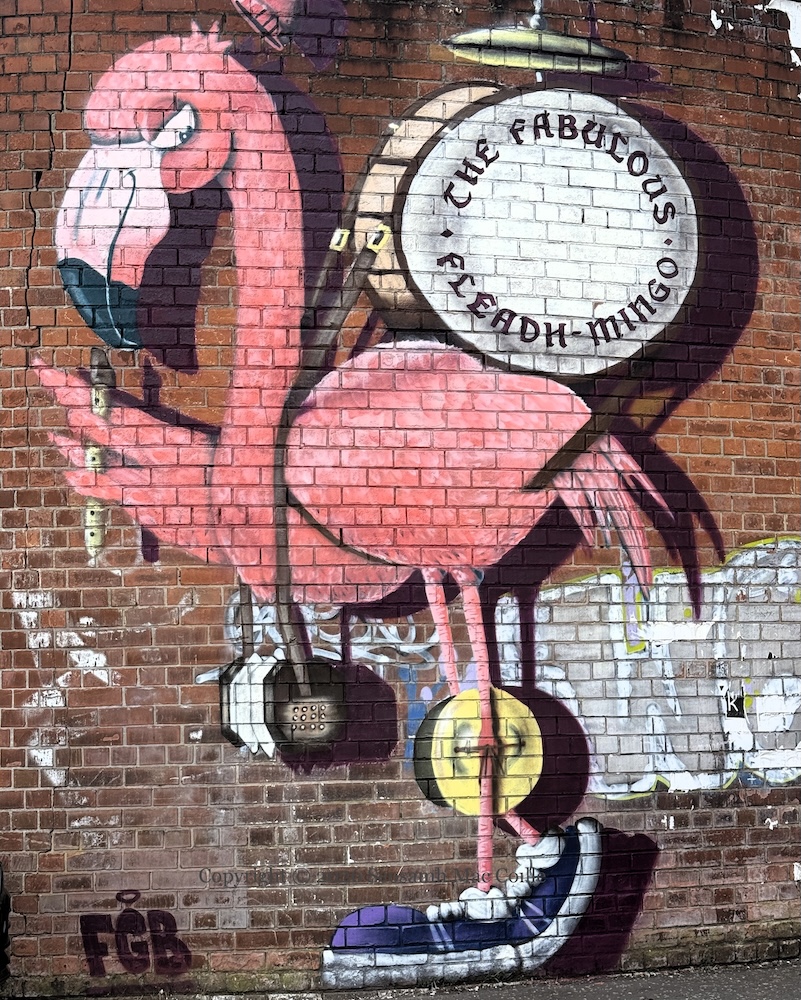
The Fabulous Fleadh-Mingo is a one-bird band, with drum, cymbals, concertina, and tin whistle. It was brought into being by FGB (web) in Dunbar Street, Belfast city centre, for Fleadh Cheoıl Na hÉıreann, alongside works in Commercial Court, the Dark Horse, Royal Avenue, and Writers’ Square.
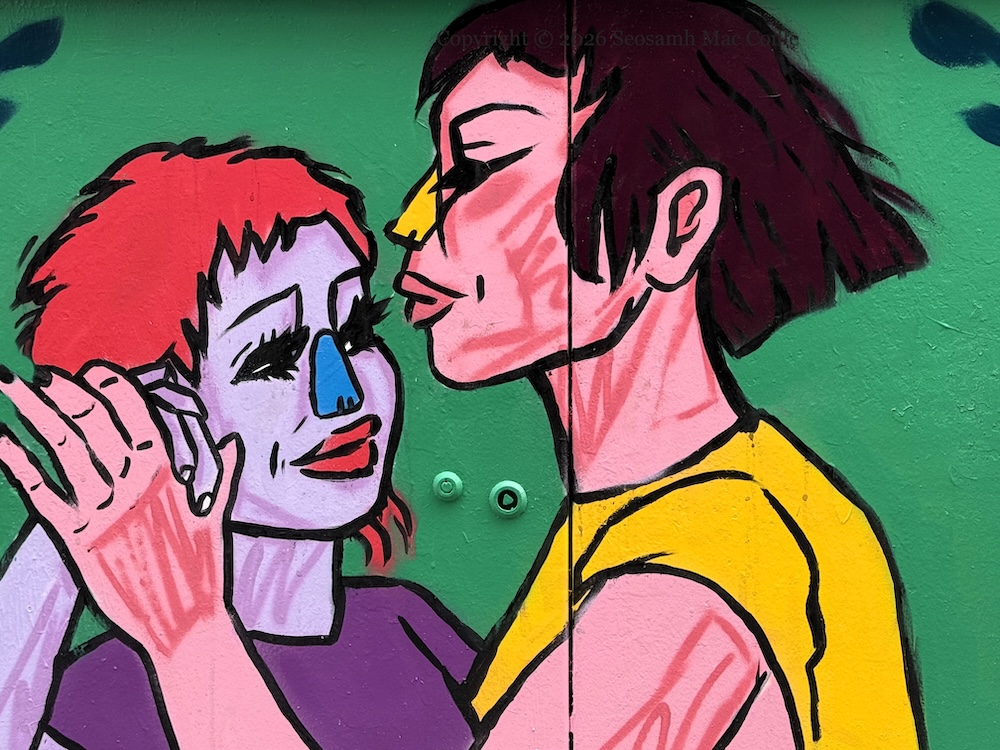
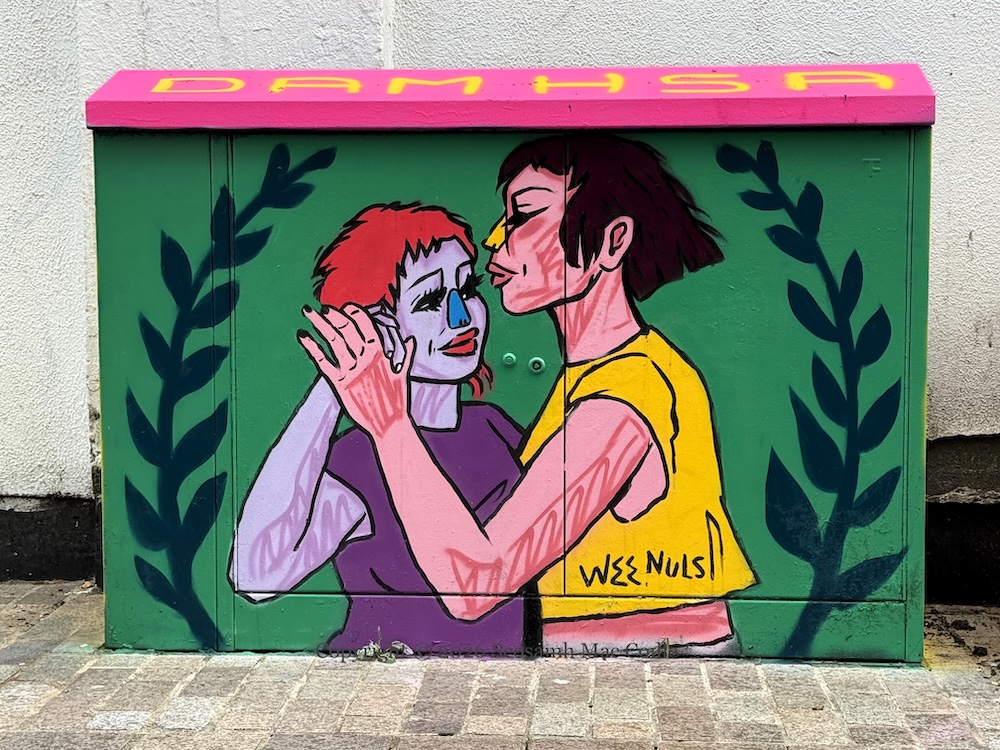
This junction box painted by Wee Nuls (web) during Fleadh Cheoıl Na hÉıreann is a tribute to céılí dancing and in particular to queer set dancing in the MAC.
Berry Street, just off Royal Avenue, Belfast city centre
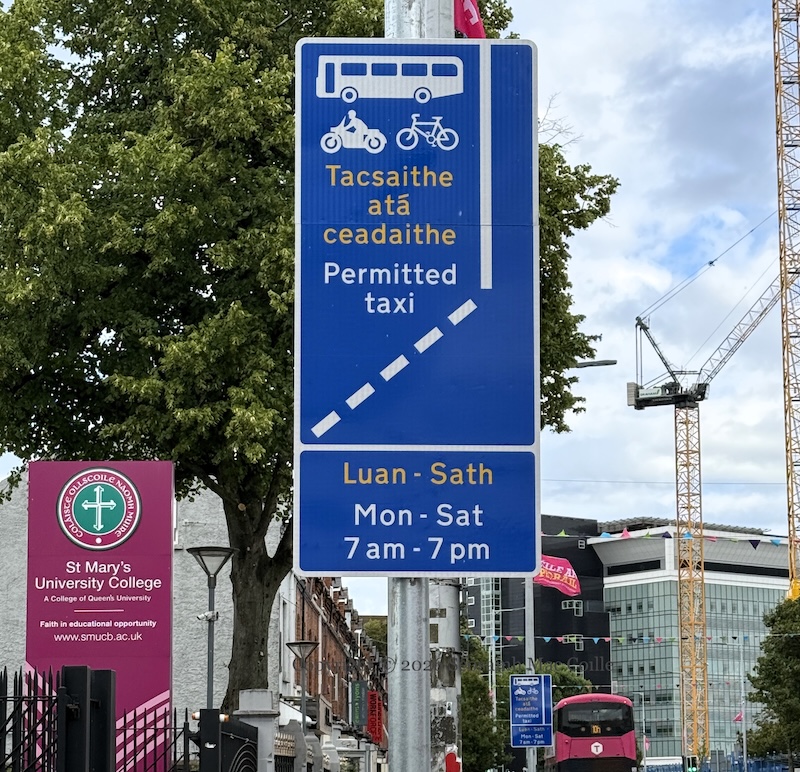
Dual-language (Irish and English) traffic signs and road-markings have been mounted/painted on the Falls Road in the Gaeltacht Quarter (specifically, between Springfield Road and Whiterock Road) by the Department Of Infrastructure/An Roinn Bonneagaır.
For other signs and markings – “Lána bus”, “Glanbhealach uırbeach, Luan go hAoıne [agus] ın am ar bıth ar an chosán”, “Deıreadh an lána bhus”, “Coınnıgh saor”, “Ceamaraí lána bus” – see the Paddy Duffy Collection.
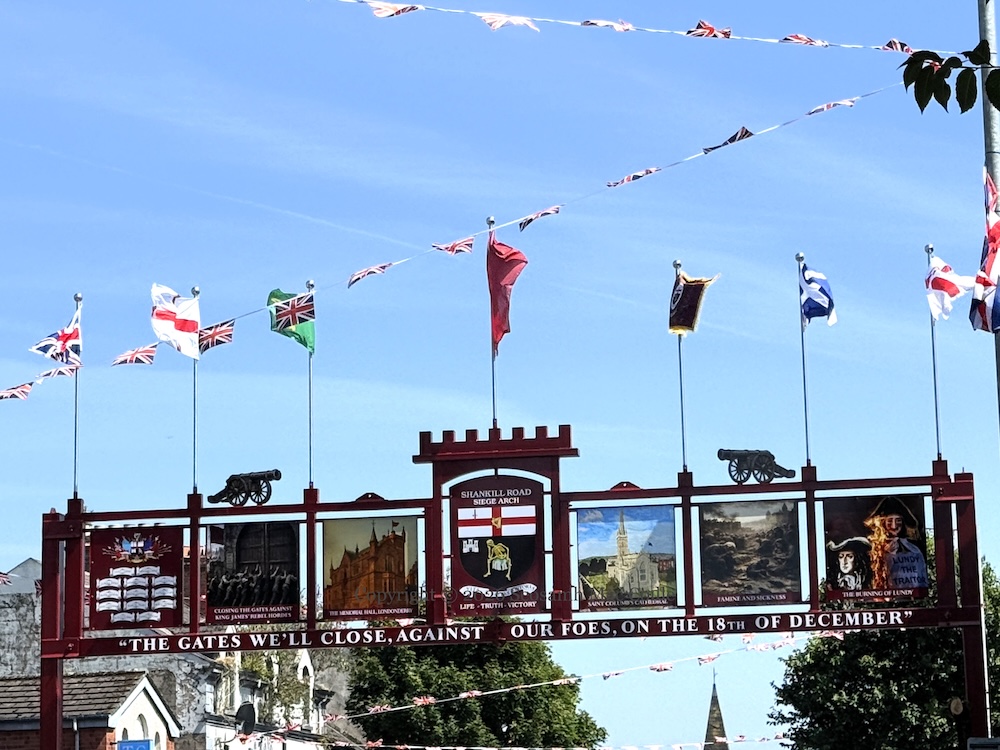
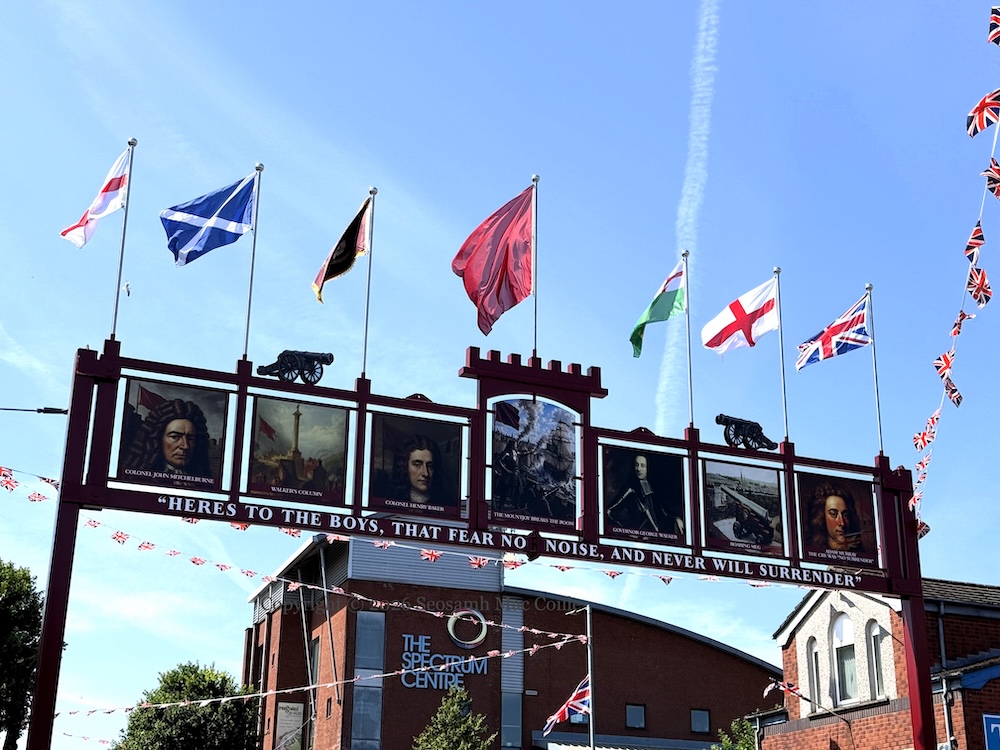
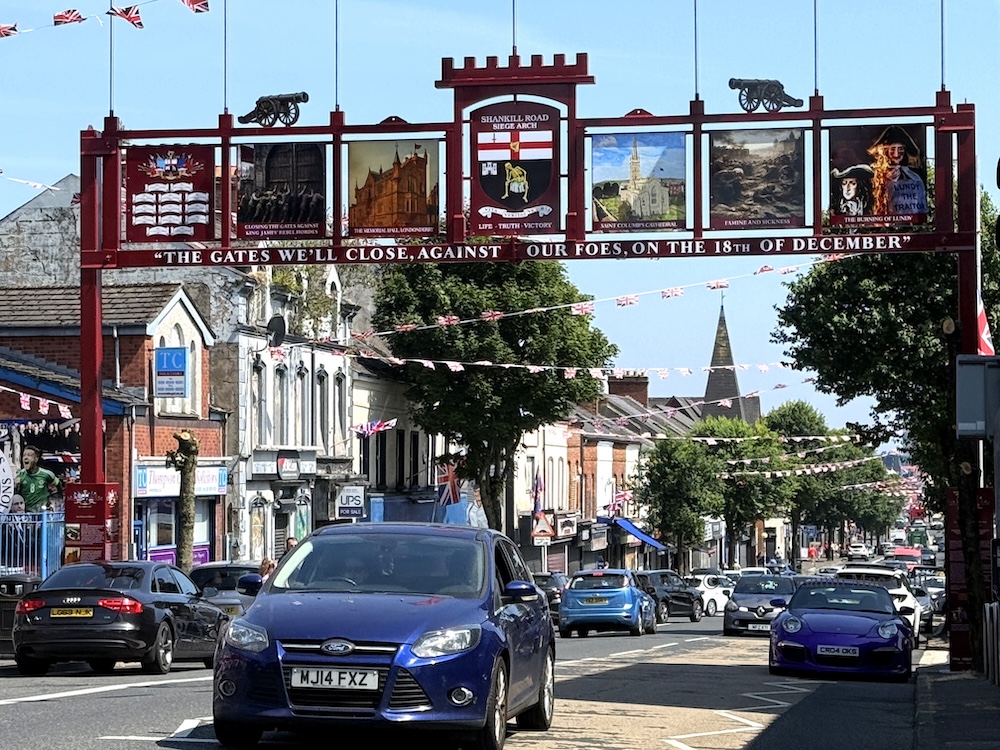
The line “The gates we’ll close against our foes on the 18th of December” comes from the song ‘The Crimson Banner’ (lyrics | youtube).
The panels on either side depict … “Closing the gates against King James’ rebel hordes”, “the Memorial Hall, Londonderry”, Saint Columb’s Cathedral”, “famine and sickness”, “the burning of Lundy” … and … “Colonel John Mitchelburne”, “Walker’s column”, “Colonel Henry Baker”, “the Mountjoy breaks the boom”, “Governor George Walker”, “Roaring Meg”, “Ada Murray – the cry was “No surrender””
Shankill Road at Mountjoy Street, upper Shankill, west Belfast
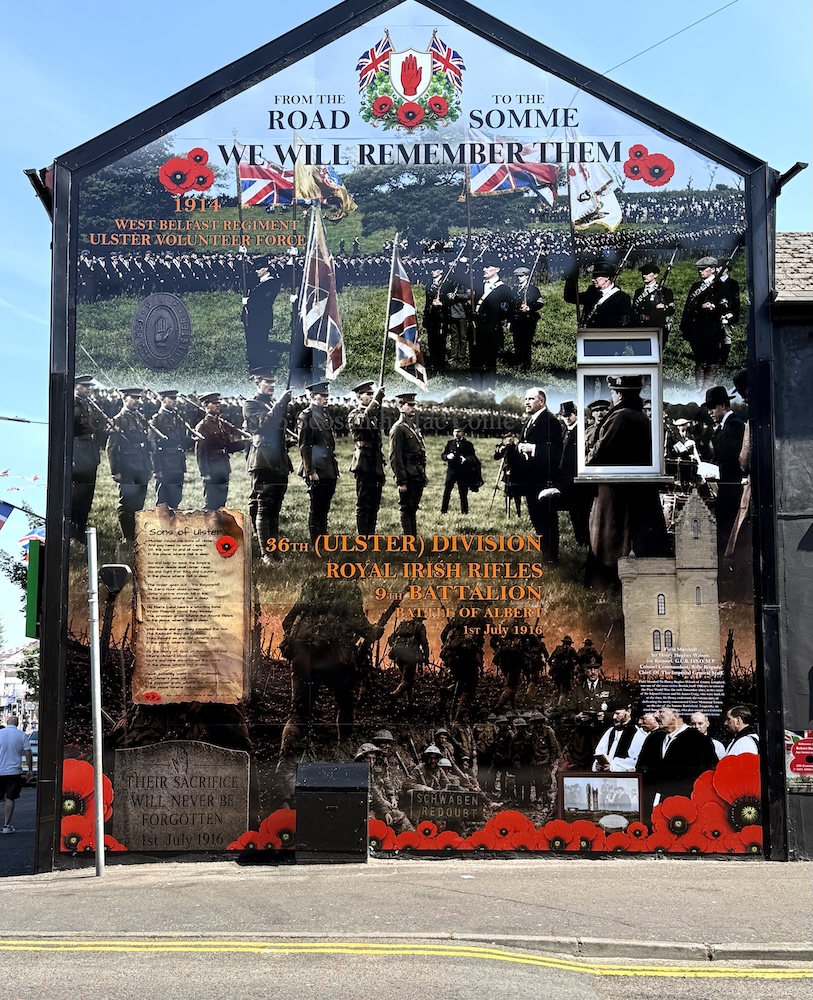
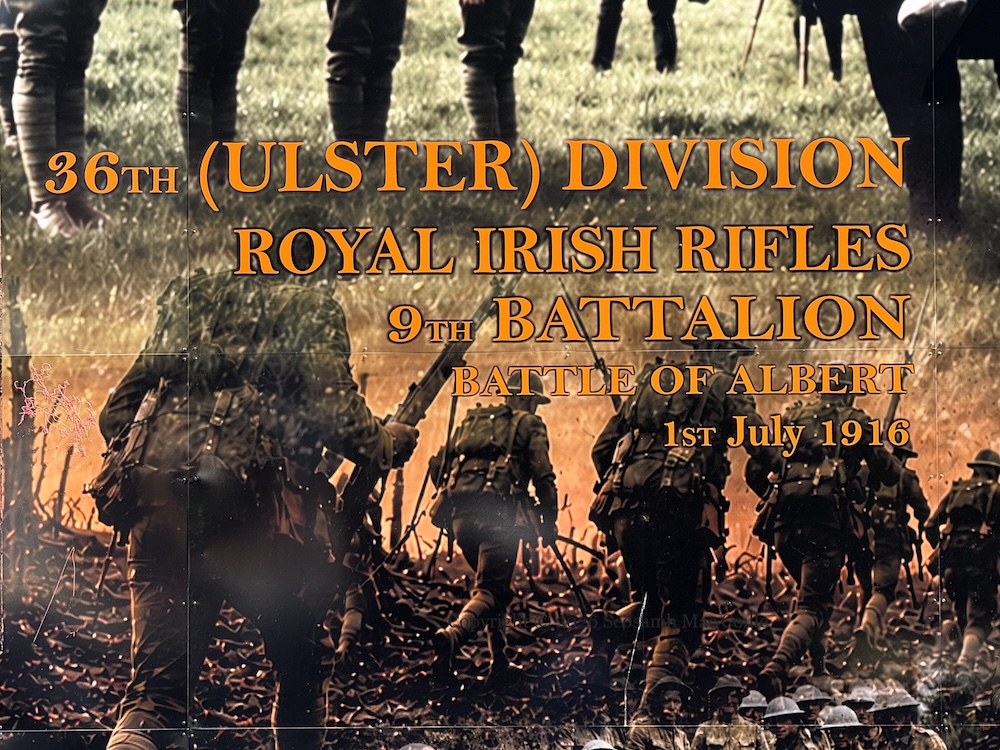
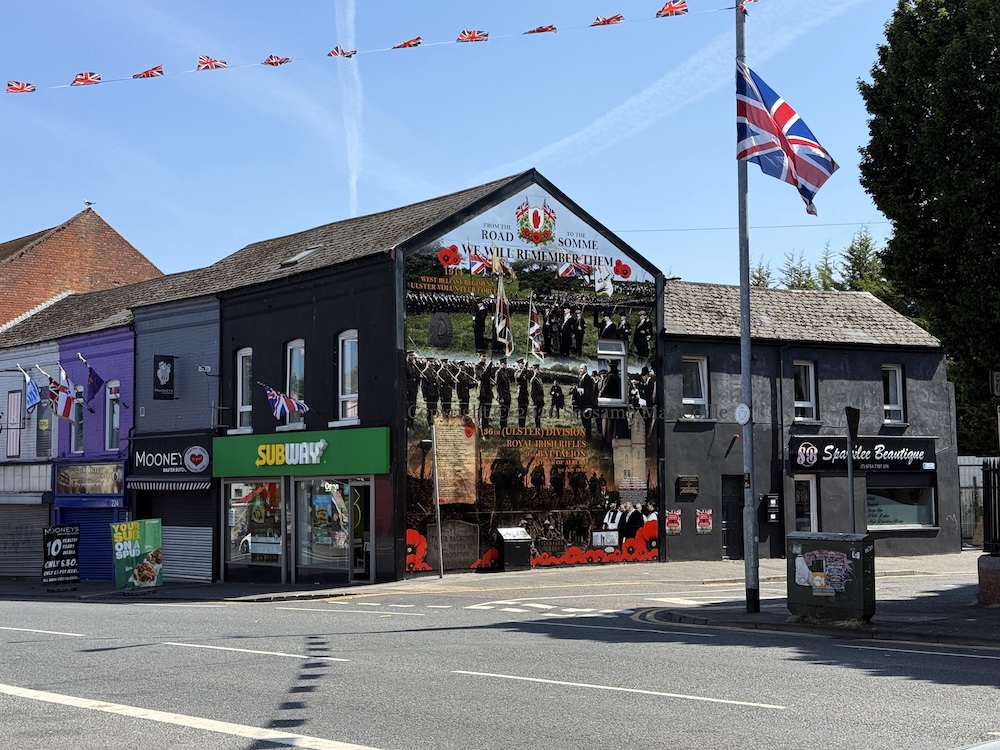
“1914 West Belfast regiment, Ulster Volunteer Force – 36th (Ulster) division, Royal Irish Rifles.” Men from the West Belfast Ulster Volunteers – which included the Shankill and Woodvale areas – joined the 9th battalion of the Royal Irish Rifles, which became part of the 107th brigade of the 36th division.
The main part of this new gable-sized board places two colourised photographs on top of each other. The first (upper) photo shows shows the first and second battalions of the West Down regiment being presented with their colours in May, 1914 (CyberProd). The second (lower) photo shows the first and second battalions of the West Belfast regiment receiving the Kings colours in May, 1914 (CyberProd).
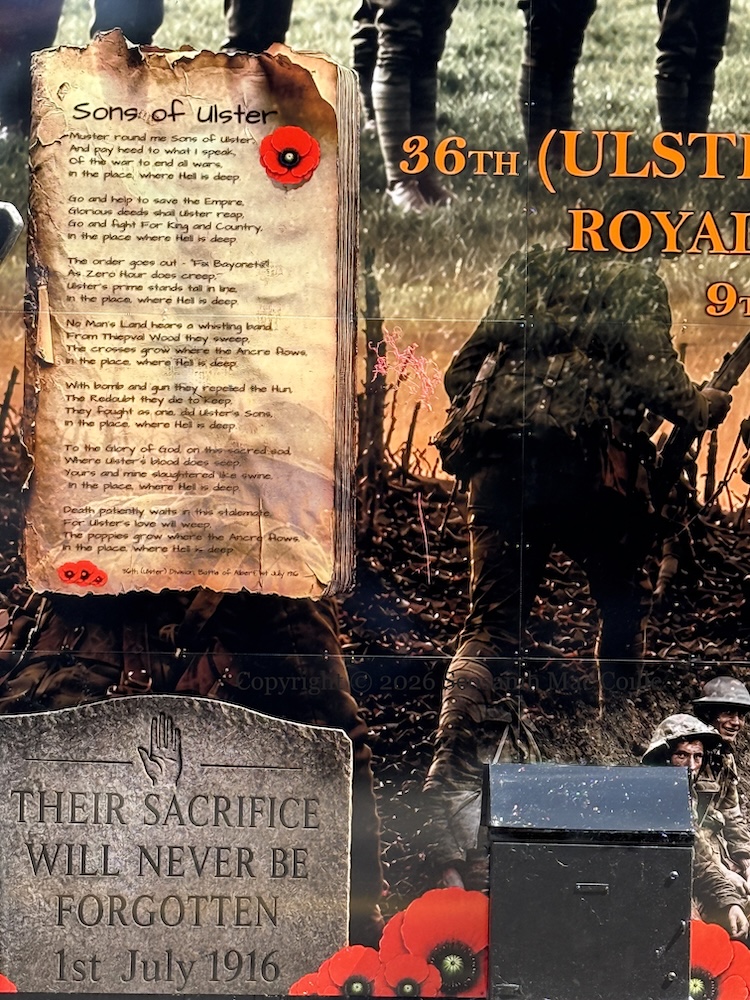
In the bottom left corner is a poem called “Sons of Ulster” written on a scroll: “Muster round me Sons of Ulster,/And pay heed to what I speak,/Of the war to end all wars,/In the place where hell is deep.//Go and help to save the Empire,/Glorious deeds shall Ulster reap./Go and fight for King and Country,/In the place where hell is deep.//The order goes out – “Fix Bayonets!”/As Zero Hour does creep,/Ulster’s prime stands tall in line,/In the place where hell is deep.//No-Man’s Land hears a whistling band,/From Thiepval Wood they sweep./The crosses grow where the Ancre flows,/In the place where hell is deep.//With bomb and gun they repelled the Hun,/The Redoubt they die to keep./They fought as one did Ulster’s Sons,/In the place where hell is deep.//To the Glory of God on this sacred sod,/Where Ulster’s Blood does seep,/Yours and mine slaughtered like swine,/In the place where hell is deep.//Death patiently waits in this stalemate,/For Ulster’s love will weep,/The poppies grow where the Ancre flows,/In the place where hell is deep.”
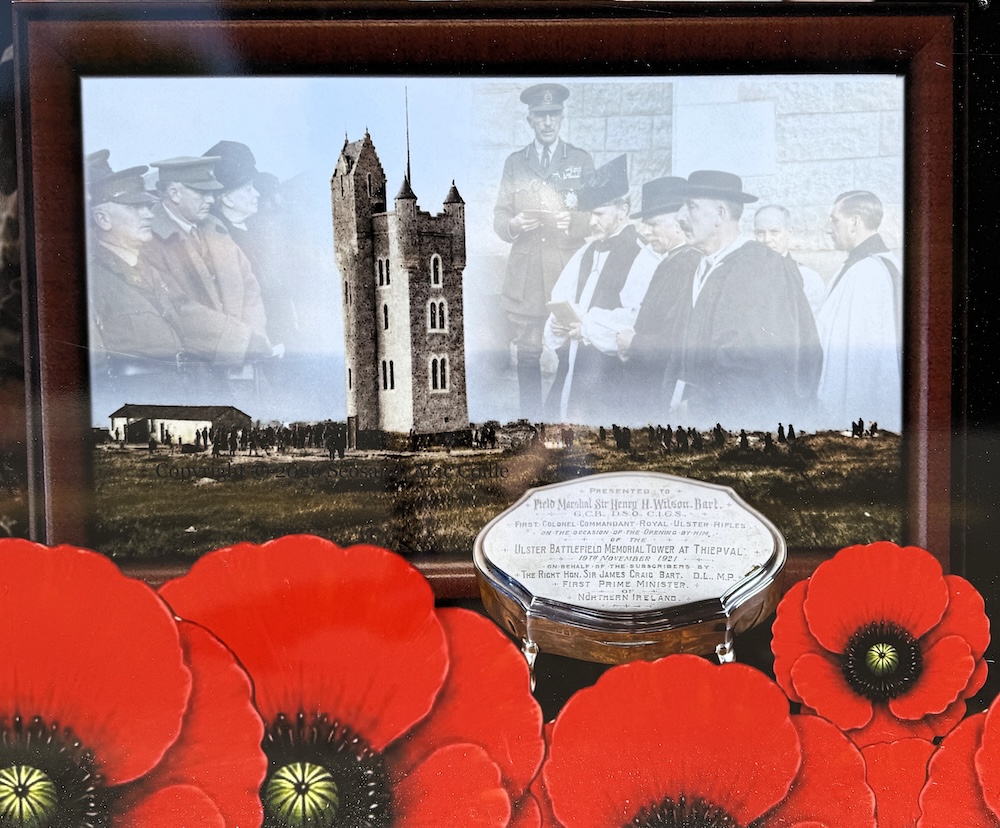
In the bottom right, the Ulster Tower is dedicated: “‘Field Marshall Sir Henry Hughes Wilson, 1st Baronet, GCB, DSO, MP, Colonel Commandant, Rifle Brigade, Chief Of The Imperial General Staff. Field Marshall Sir Henry Hughes Wilson of County Longford, was one of the most senior British Staff Officers to serve int he First World War. On 18th November 1921, in the stead of Sir Edward Carson and Sir James Craig, who were both ill at the time, Sir Henry undertook the solemn duty of dedicating the newly constructed Ulster Memorial Tower, on the site of the Somme battlefield. Tragically, on 22nd June 1922, Sir Henry, who also served as a Unionist politician, was assassinated outside his London home.”
Conway Street, Shankill, west Belfast, replacing Ulster Tower.