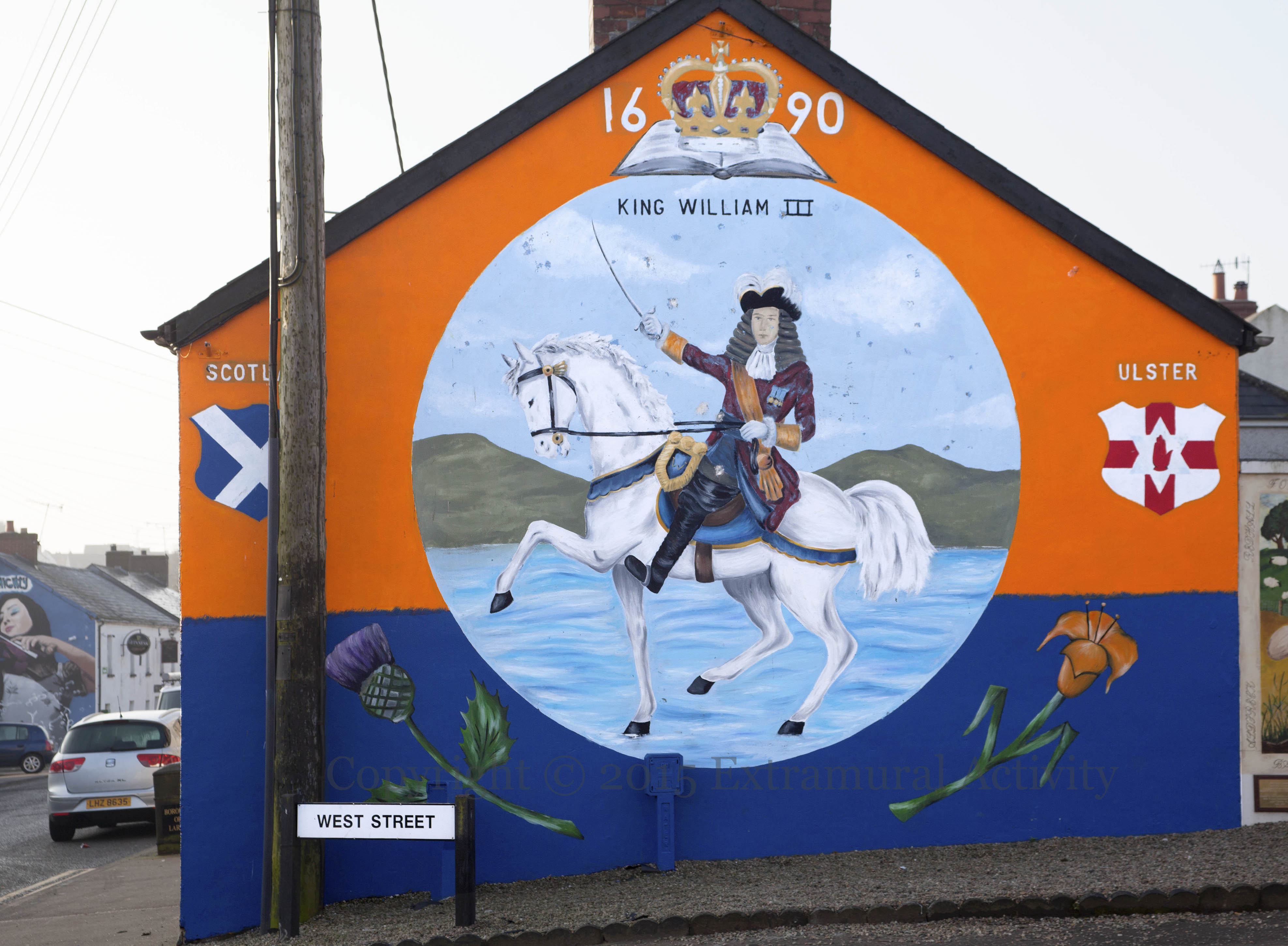
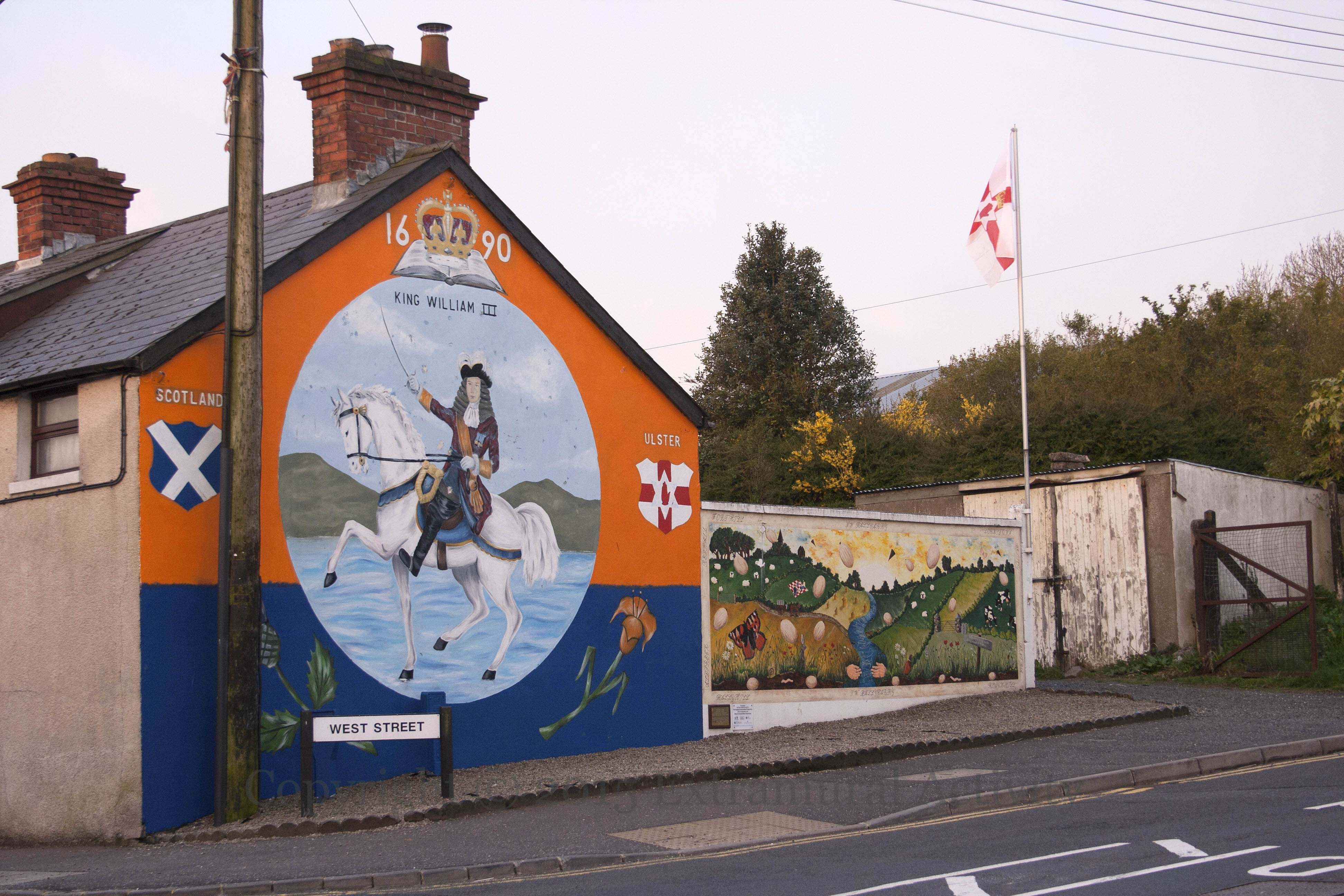
Here’s a PUL mural in classic style, though not seen much of late: King William “Billy” III of Orange crosses the Boyne, sword drawn, on a white steed that walks on water. The crests of Scotland and Northern Ireland (labelled as “Ulster”) and the Scottish thistle and orange lily of the Orange Order fill out the quadrants.
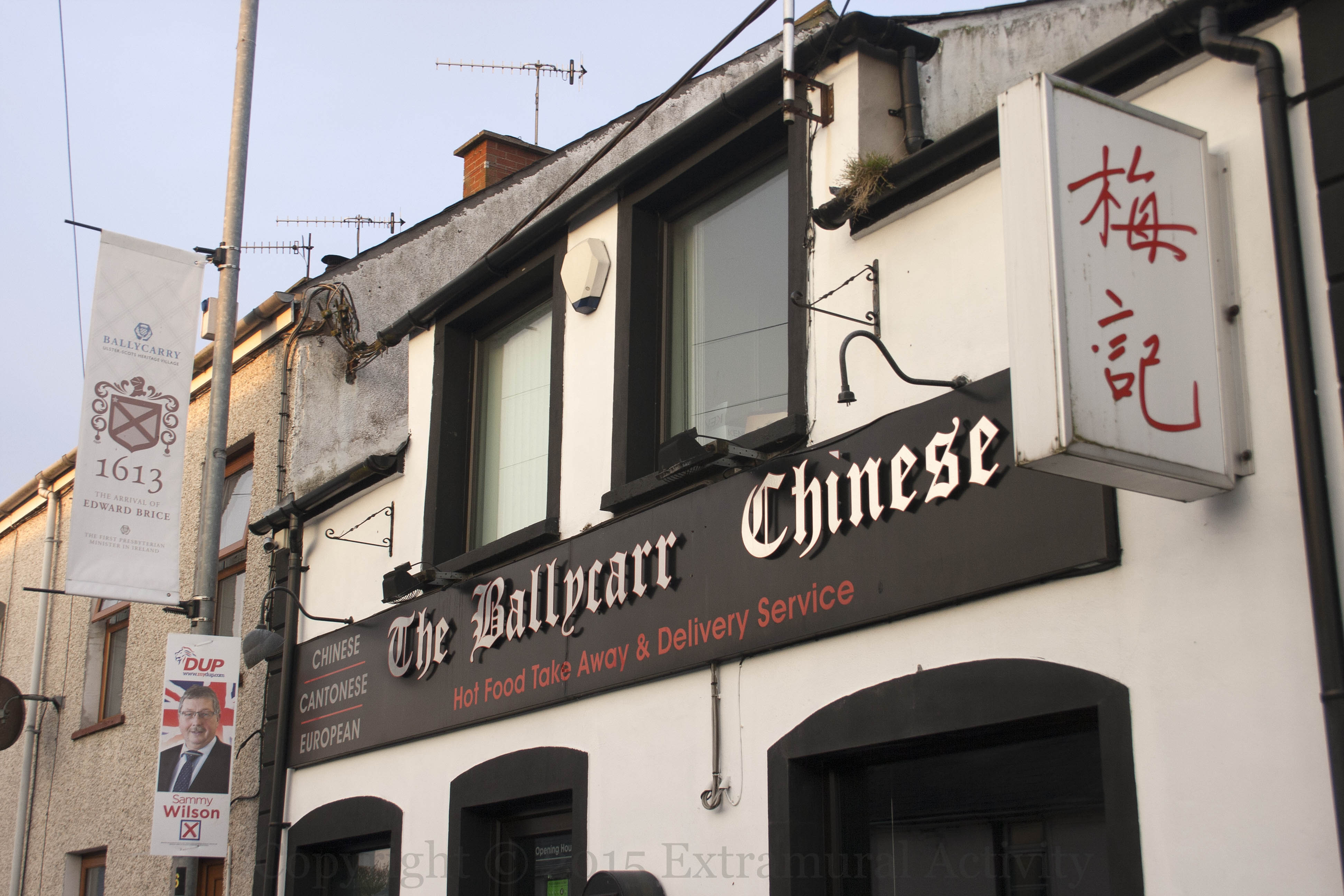
Chinese, Cantonese, European, and Presbyterian. Three signs outside the Chinese take-away in Ballycarry: the Chinese lettering for the restaurant, a DUP poster supporting Sammy Wilson, and an Ulster-Scots heritage banner: “1613 The Arrival of Edward Brice – The first presbyterian minister in Ireland”.
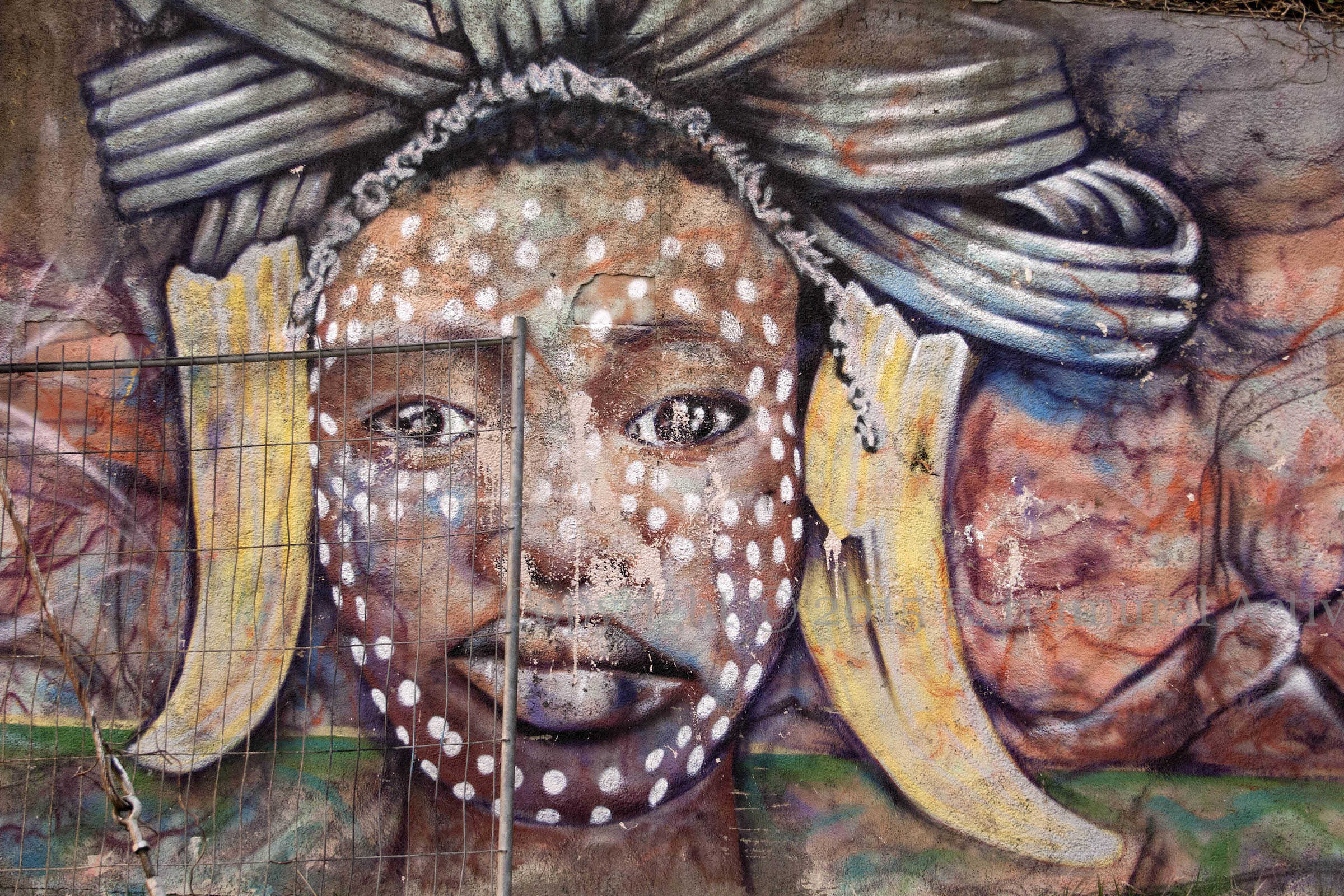
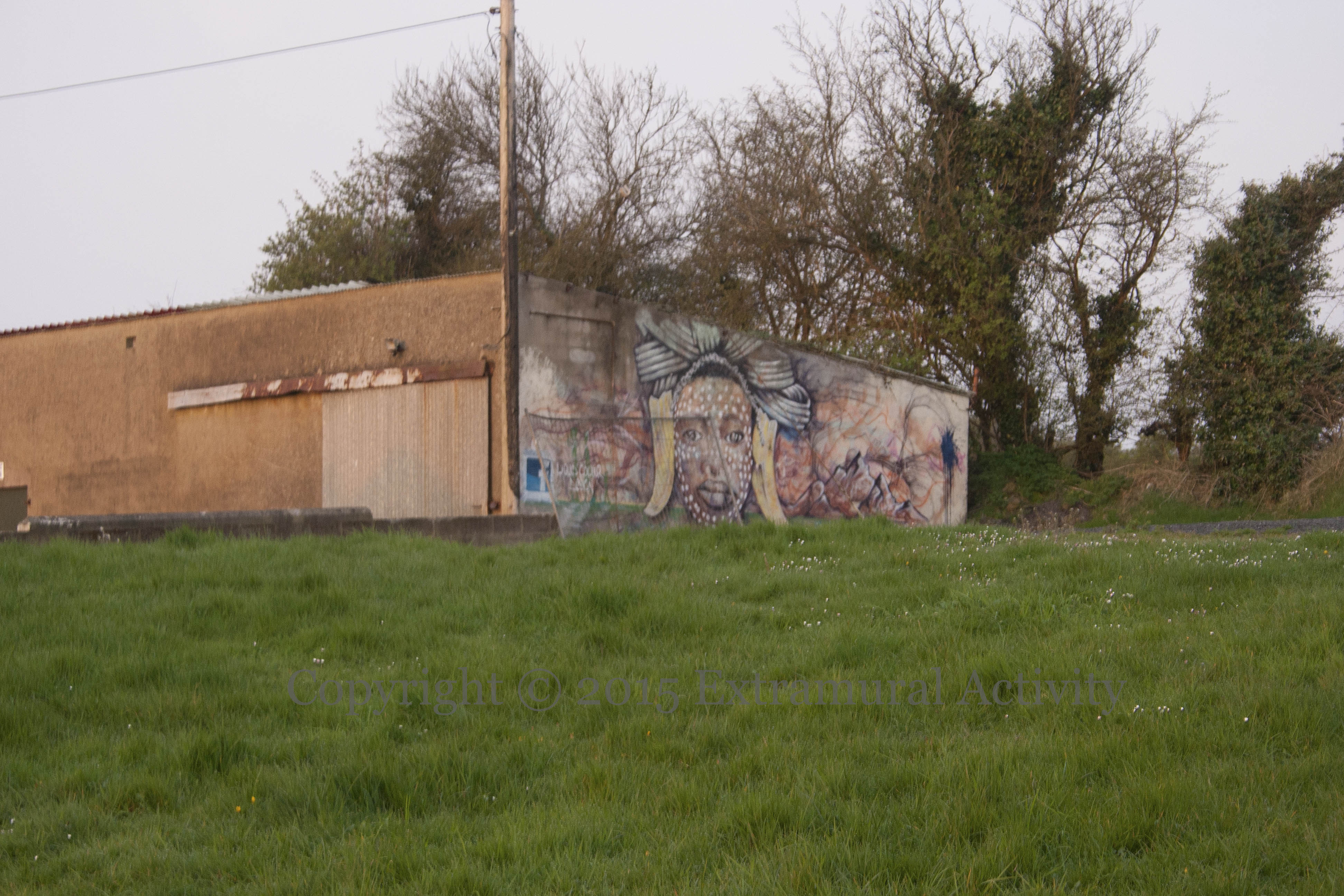
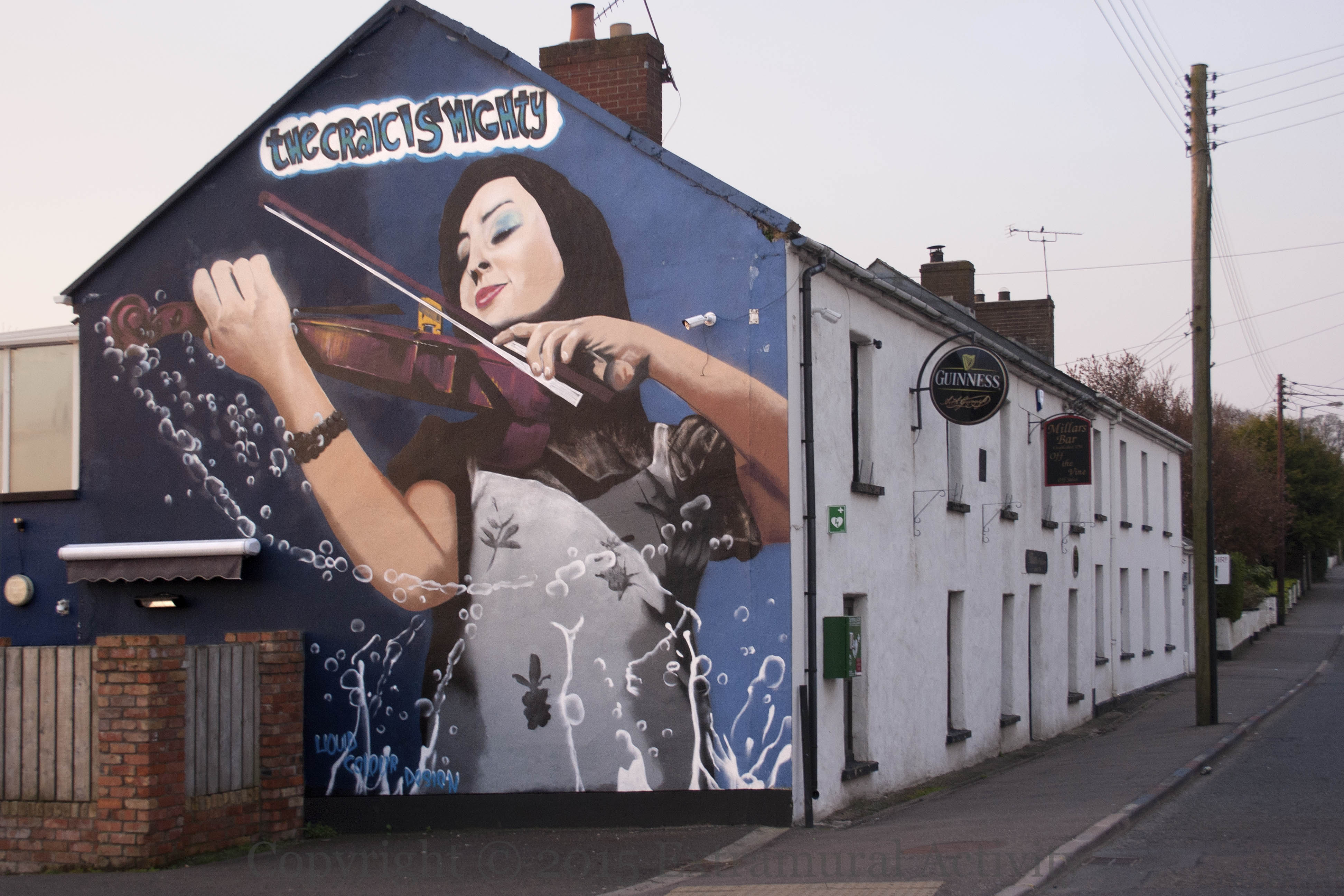
On a barn wall in Ballycarry, County Antrim: a African youth (perhaps Ethiopian Mursi tribe) with painted face and a headdress of warthog tusk and aluminium coils. (By Liquid Colour Design – see also The Craic Is Mighty.)
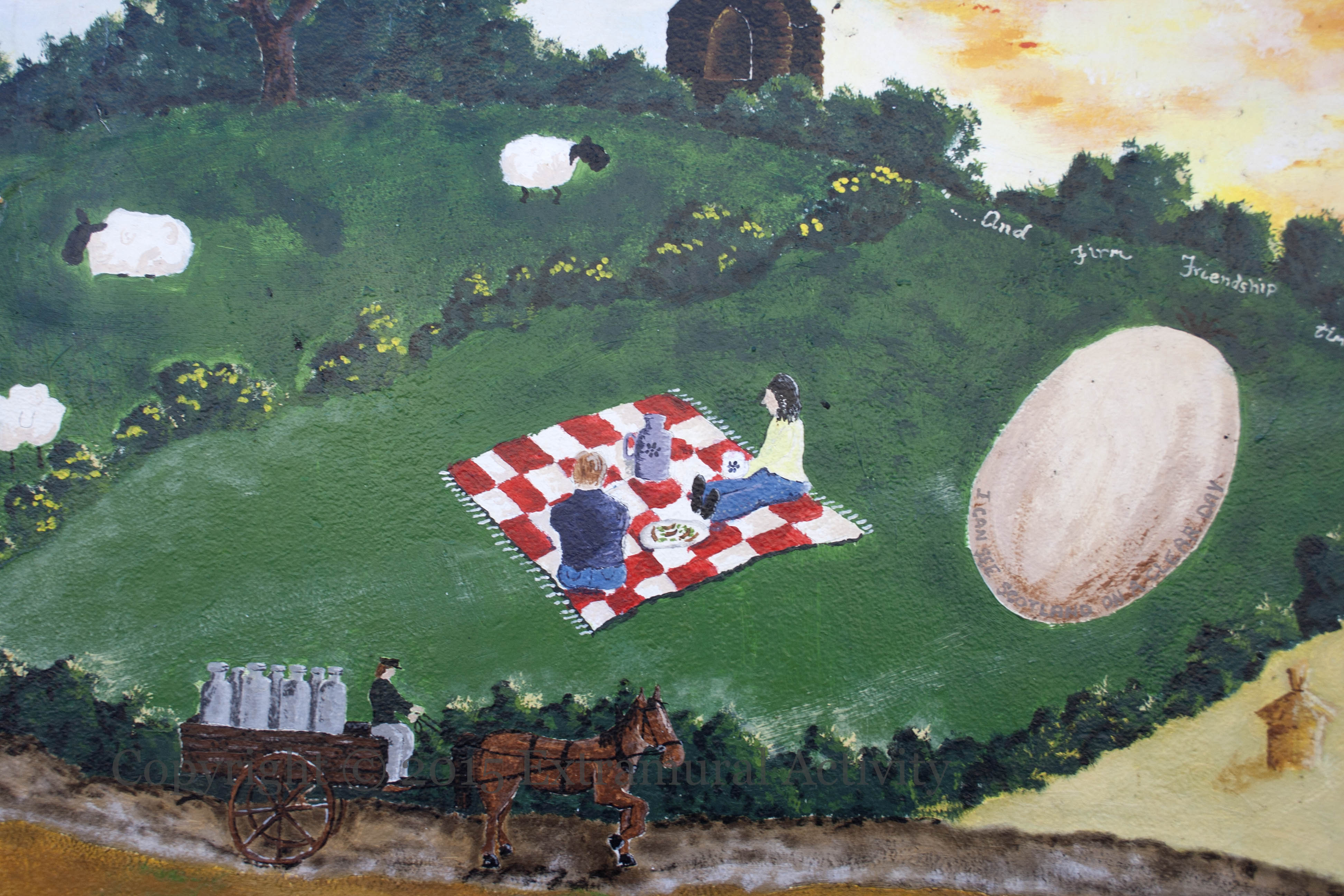
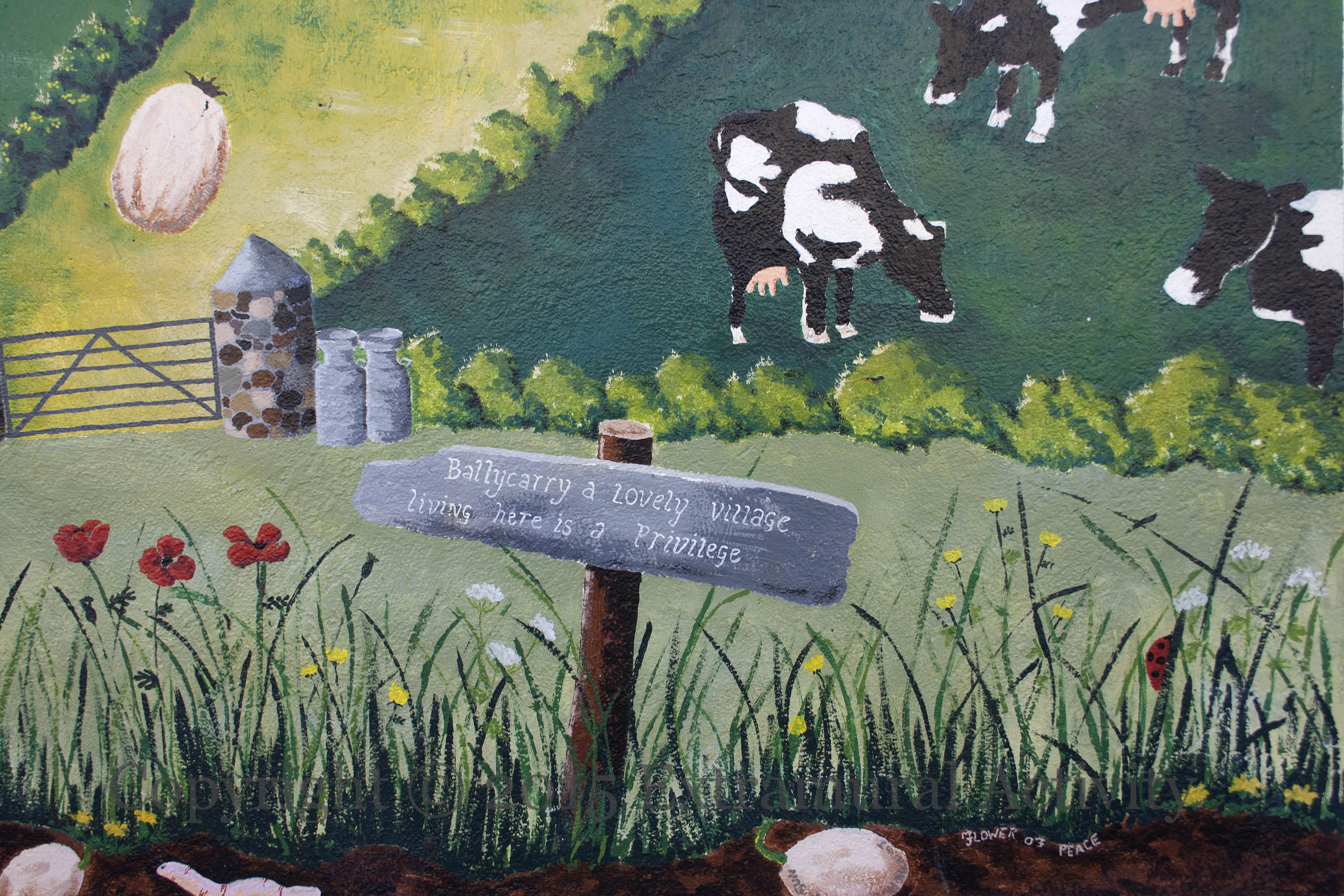
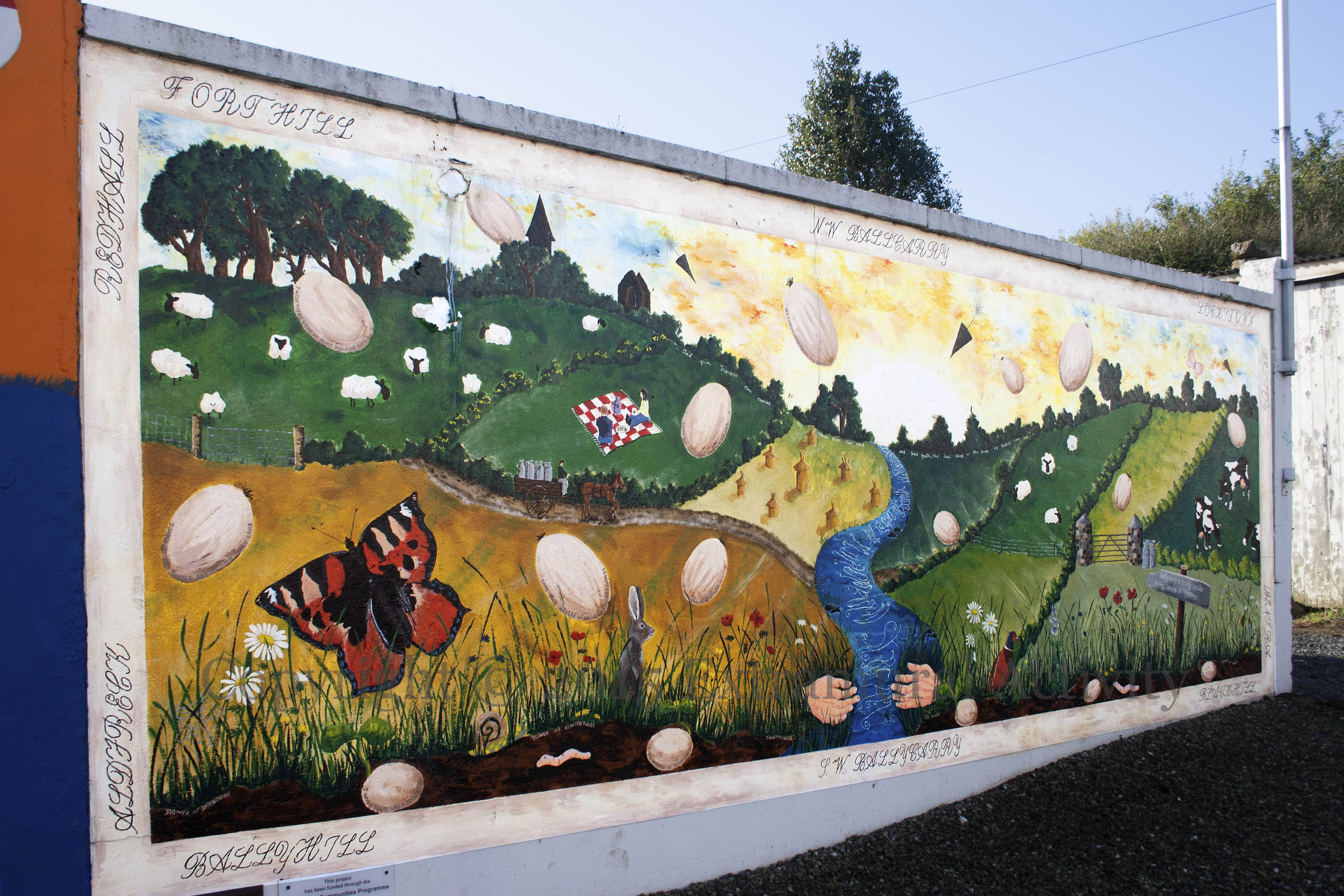
Ballycarry village sits in County Antrim countryside surrounded by the townlands of Ballyhill, Redhall, Forthill, Blackhill, Aldfreck, Lochstown, Beltoy, Bentra. The large pale oval to the right of the picnickers is one of many “seeds” falling from the sky and settling into the earth, which by growing make Ballycarry a pleasant place: “I can see Scotland on a clear day”. The Mutton Burn Stream (lyrics | music from the Ulster-Scots agency) is a song written by Ballycarry resident William Hume (QUB) about the river to the north-west of the village (WP). More about Ballycarry from the BBC’s Ulster-Scots page.
Fiddling in the north of Ireland is common to both Nationalist and Unionist communities and the “old Antrim” style is influenced by Scottish playing (USFO).
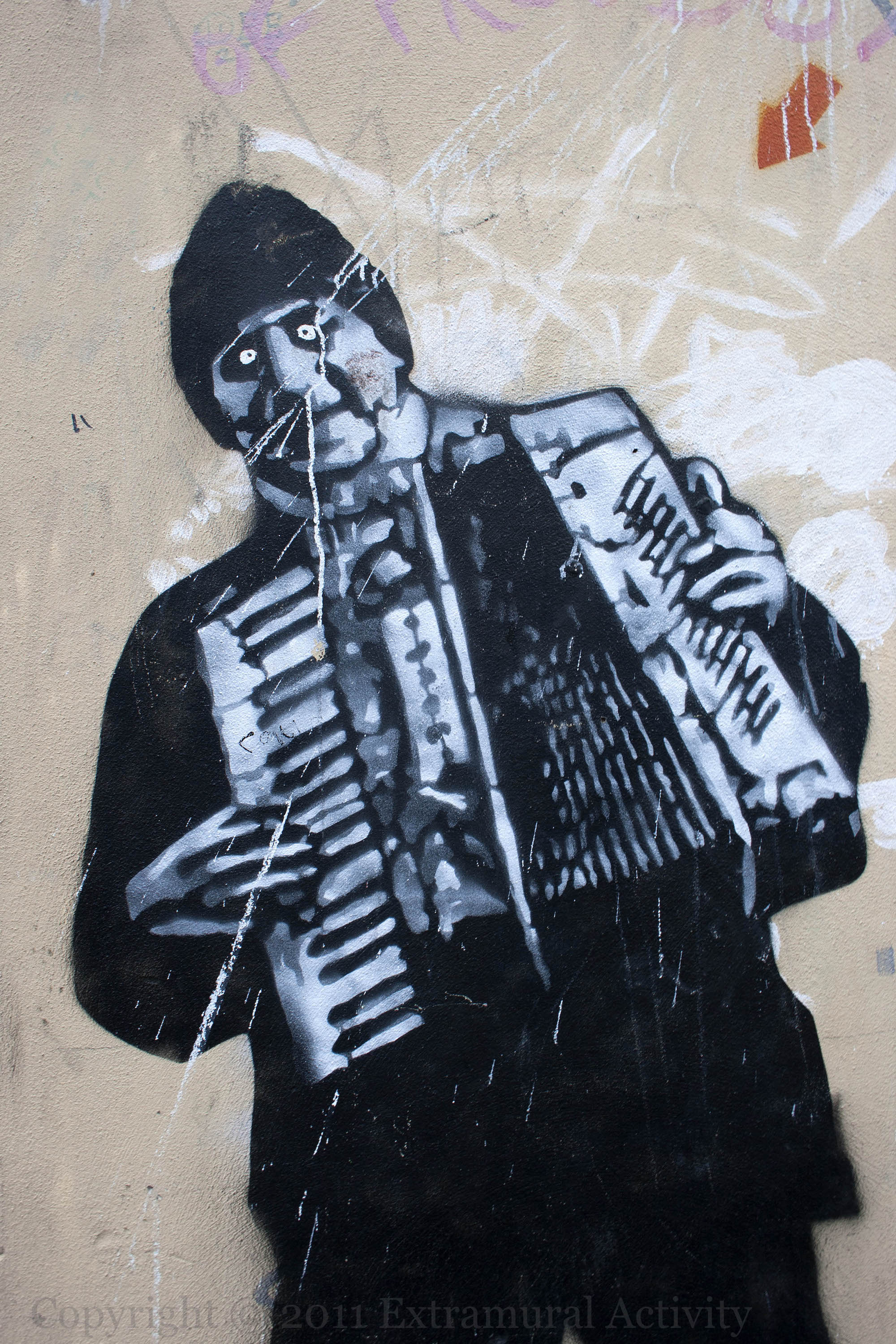
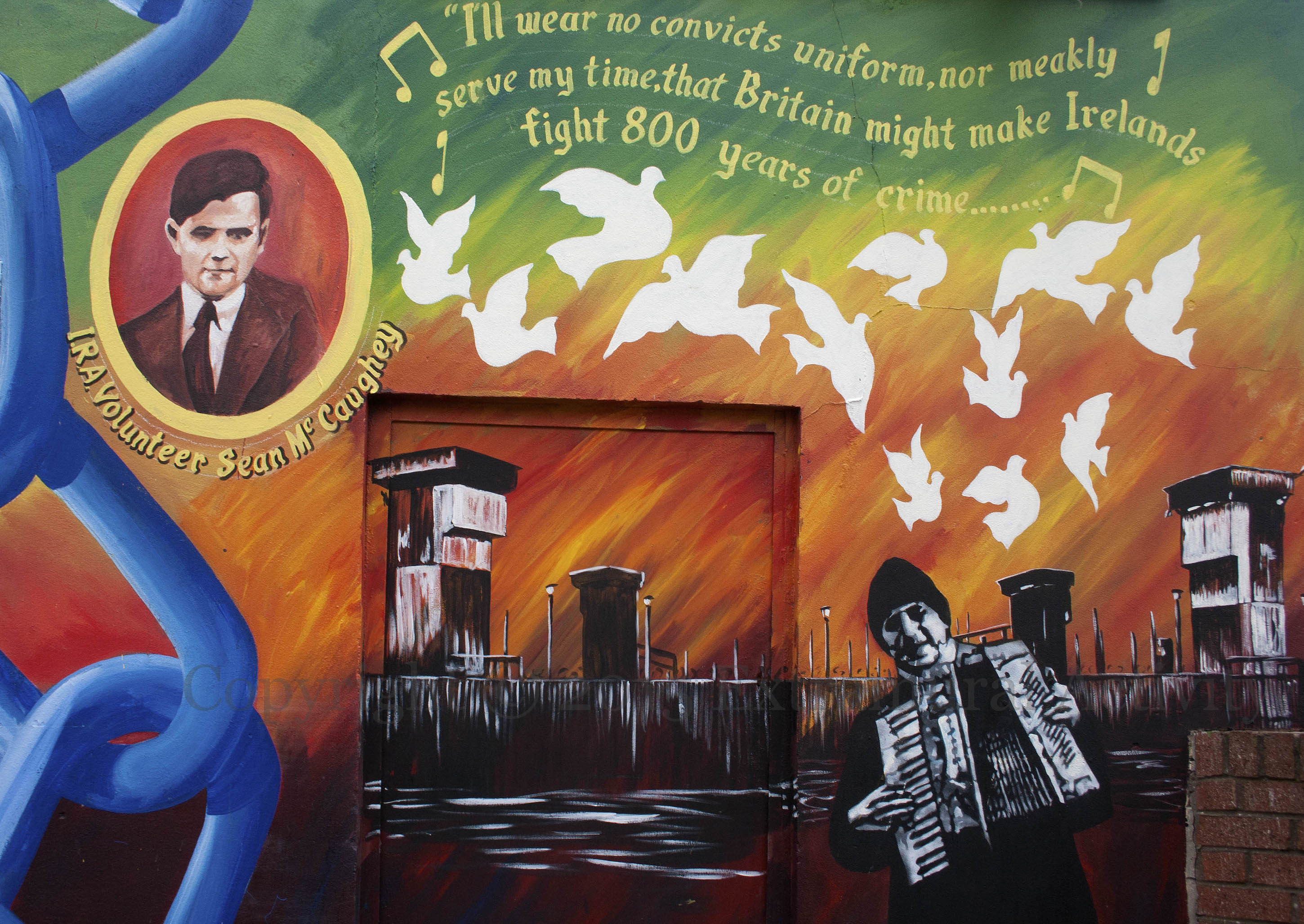
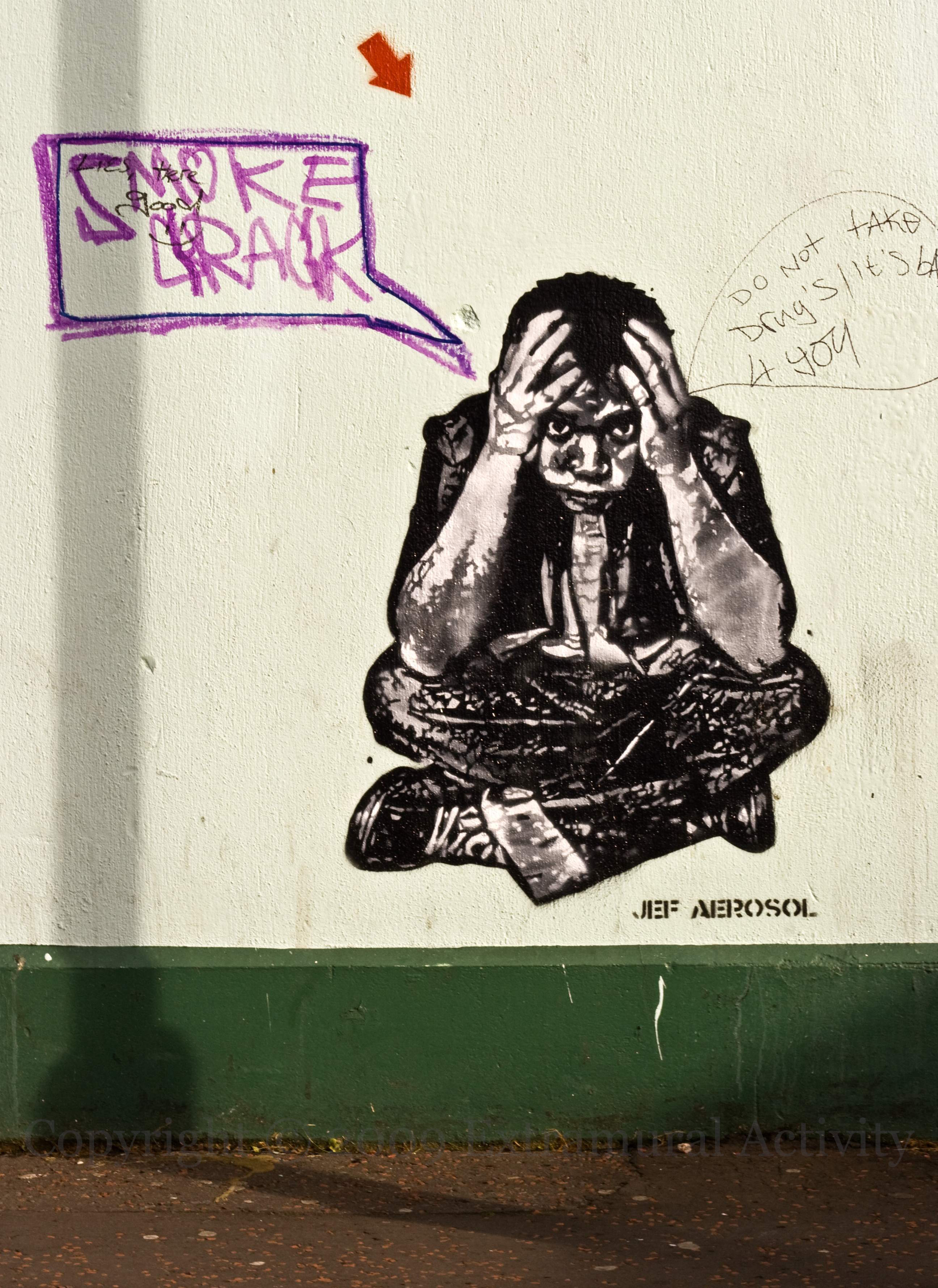
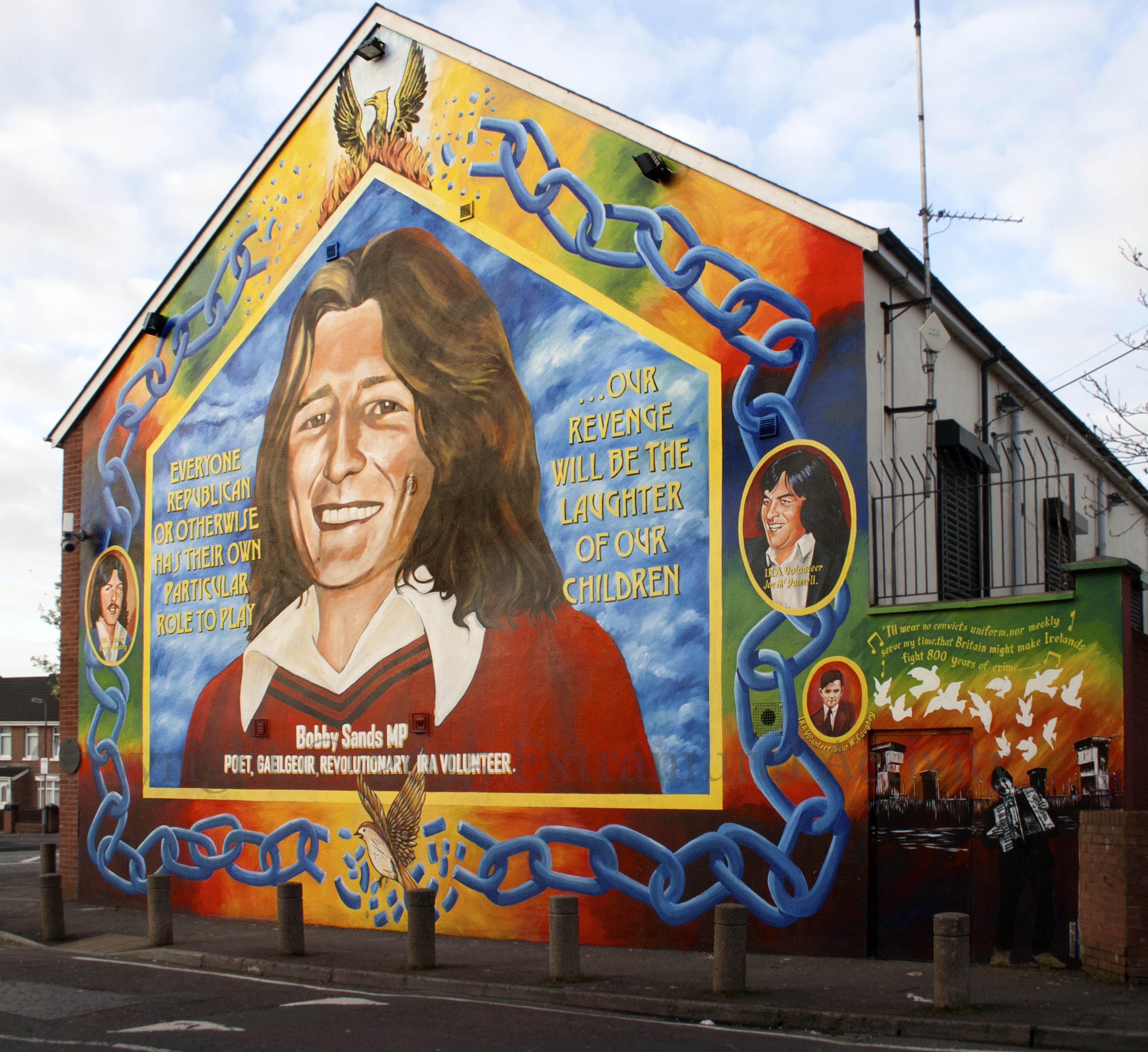
The Bobby Sands mural in Sevastopol Street has been given a facelift, including the blocking-up of a vent on Sands’s left cheek. Kieran Doherty and Joe McDonnell have been added in place of the 1798 medallions on each side. On the side-wall are Sean McCaughey, ten doves representing the 1981 hunger-strikers, and Long Kesh. Aerosol‘s accordion-player stencil has been also been retained.
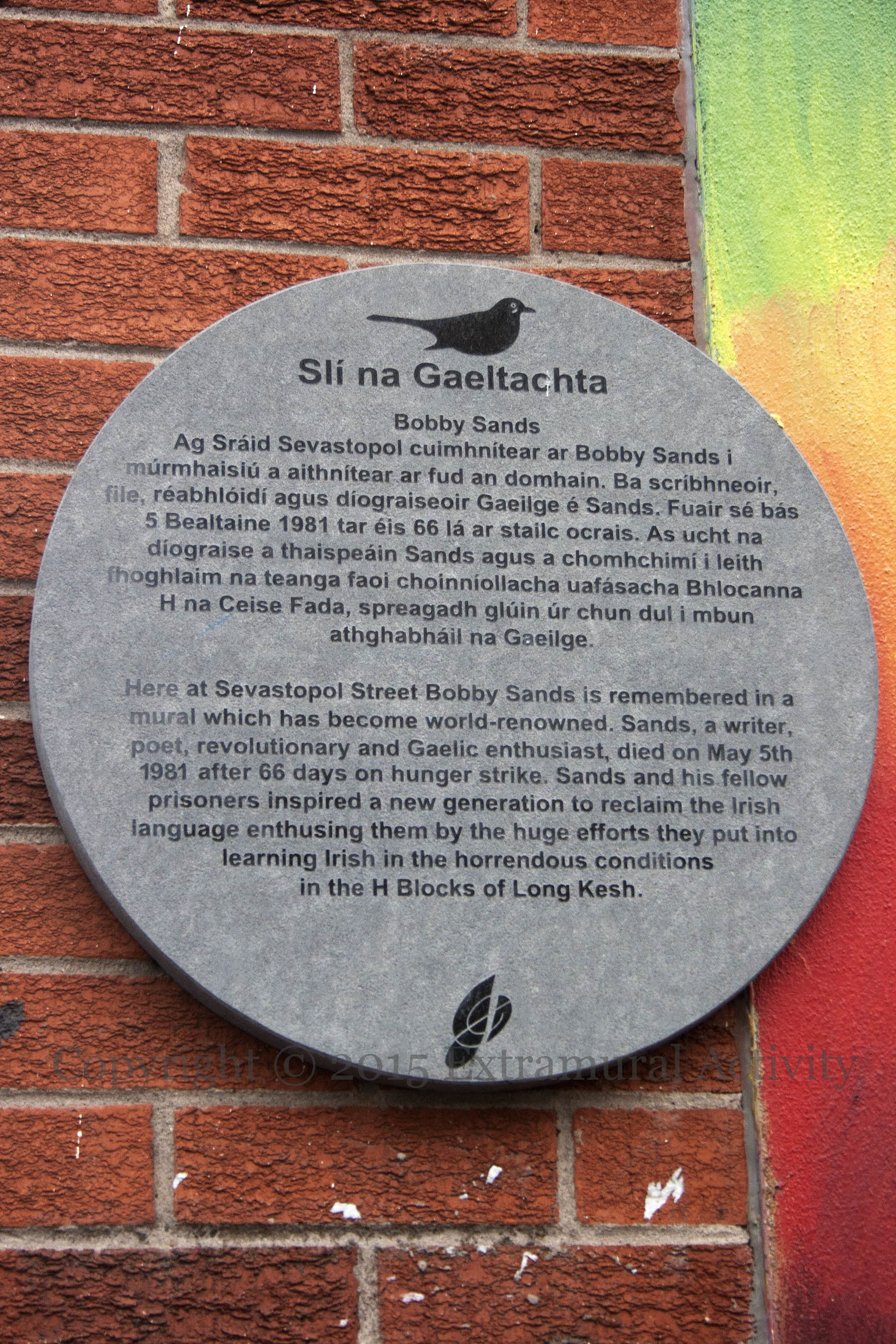
Ag sráıd Sevastopol cuımhnıtear ar Bobby Sands ı múrmhaısıú a aithnıtear ar fud an domhaın. Ba scrıbhneoır, file, réabhlóıdí agus díograıseoır Gaeılge é Sands. Fuaır sé bas 5 Bealtaıne 1981 tar éıs 66 lá ar stailc ocraıs. As ucht na dıograıse a thaıspeáın Sands agus a chomhchımí ı leıth fhoglaım na teanga faoı choınníollacha uafásacha Bhlocanna H na Ceıse Fada, spreagadh glúın úr chun dul ı mbun athghabháıl na Gaeılge.
Here at Sevastopol Street Bobby Sands is remembered in a mural which has become world-renowned. Sands, a writer, poet, revolutionary and Gaelic enthusiast, died on May 5th 1981 after 66 days on hunger strike. Sands and his fellow prisoners inspired a new generation to reclaim the Irish language enthusing them by the huge efforts they put into learning Irish in the horrendous conditions on the H Blocks of Long Kesh.
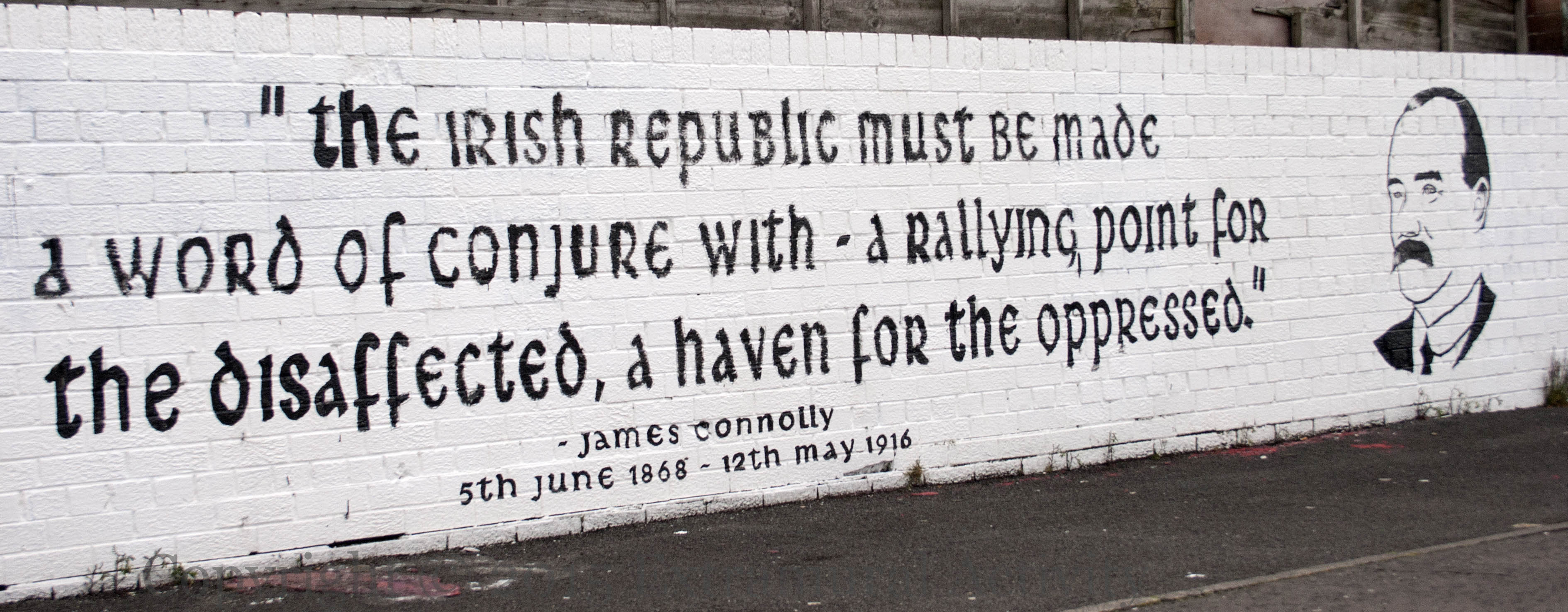
James Connolly was concerned not just with the political independence of Ireland but its economic independence: both political and economic liberty were required in order for the human being to live freely. The quote in the image above comes from Connolly’s 1897 essay “Socialism & Nationalism”. The economic context is clear when we read a little more broadly:
“To the tenant farmer, ground between landlordism on the one hand and American competition on the other, as between the upper and the nether millstone; to the wage-workers in the towns, suffering from the exactions of the slave-driving capitalist to the agricultural labourer, toiling away his life for a wage barely sufficient to keep body and soul together; in fact to every one of the toiling millions upon whose misery the outwardly-splendid fabric of our modern civilisation is reared, the Irish Republic might be made a word to conjure with – a rallying point for the disaffected, a haven for the oppressed, a point of departure for the Socialist, enthusiastic in the cause of human freedom.” (marxists.org)
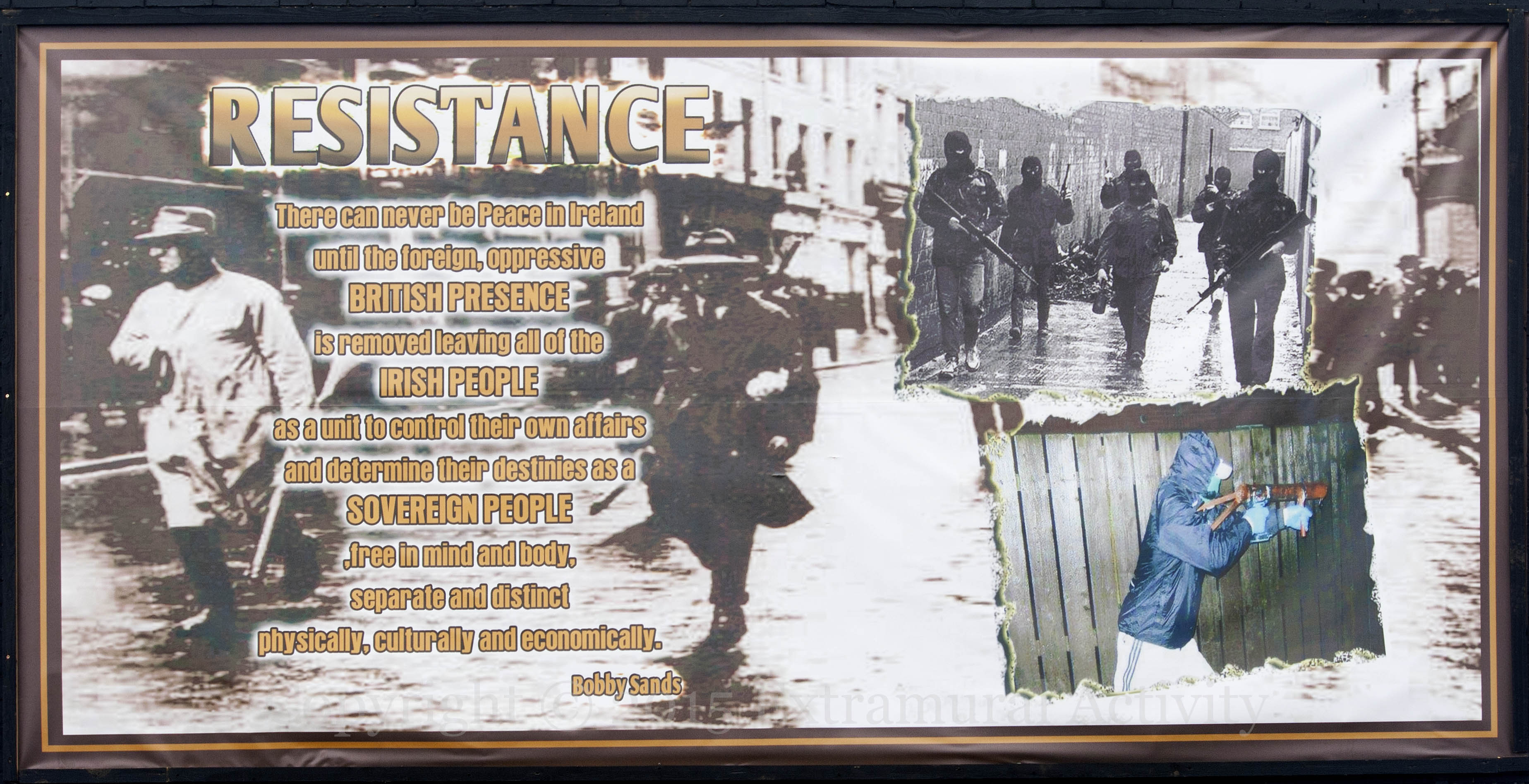
This is a new (2015-04-04) tarp on Ardoyne Avenue showing a scene from Grafton Street in the Battle Of Dublin in the civil war (1922) (irishhistory.blogspot.com), with in-sets featuring PIRA volunteers on patrol in 1987 (BelTel), and a home-made rocket-launcher used in a 2014 attack on police (see, e.g. irishmirror.ie).
“There can never be peace in Ireland until the foreign, oppressive British presence is removed leaving all of the Irish people as a unit to control their own affairs and determine their destinies as a sovereign people, free in mind and body, separate and distinct physically, culturally and economically.” Bobby Sands (Prison Diary May 1st)
 Seosamh Mac Coille Collection