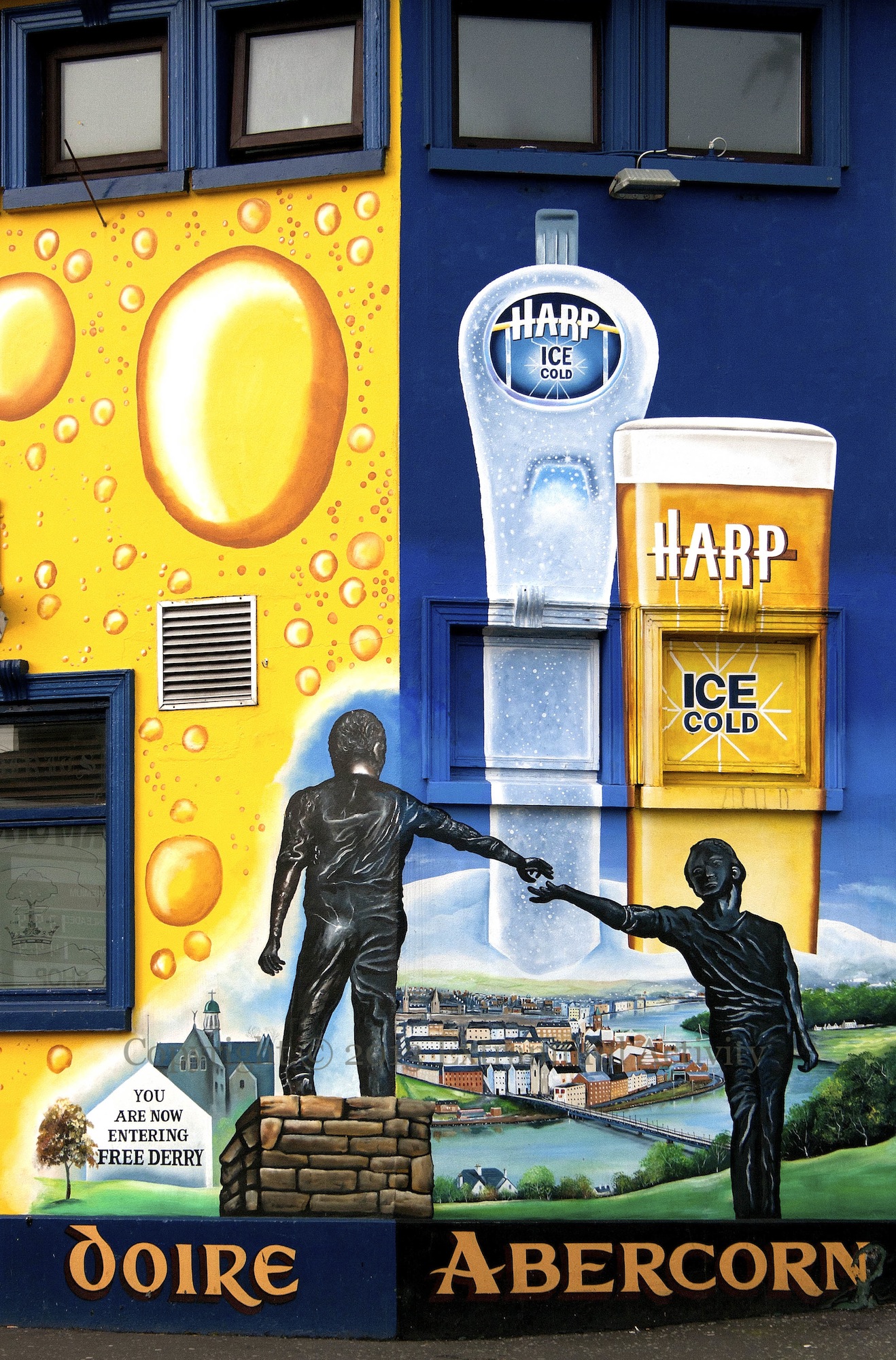
A partly commercial, partly political, mural on the Abercorn Bar, Abercorn Road, London-/Derry/Doire. The figures with outstretched hands are a copy of Maurice Harron’s ‘Hands of Peace’ statue, which is at the roundabout roughly 250m away (where the bridge in the picture lands on the city-side of the Foyle river; the location of the pub is up the hill to the left). He has made a great deal of other interesting work too – check out the video of him at work on his web site.
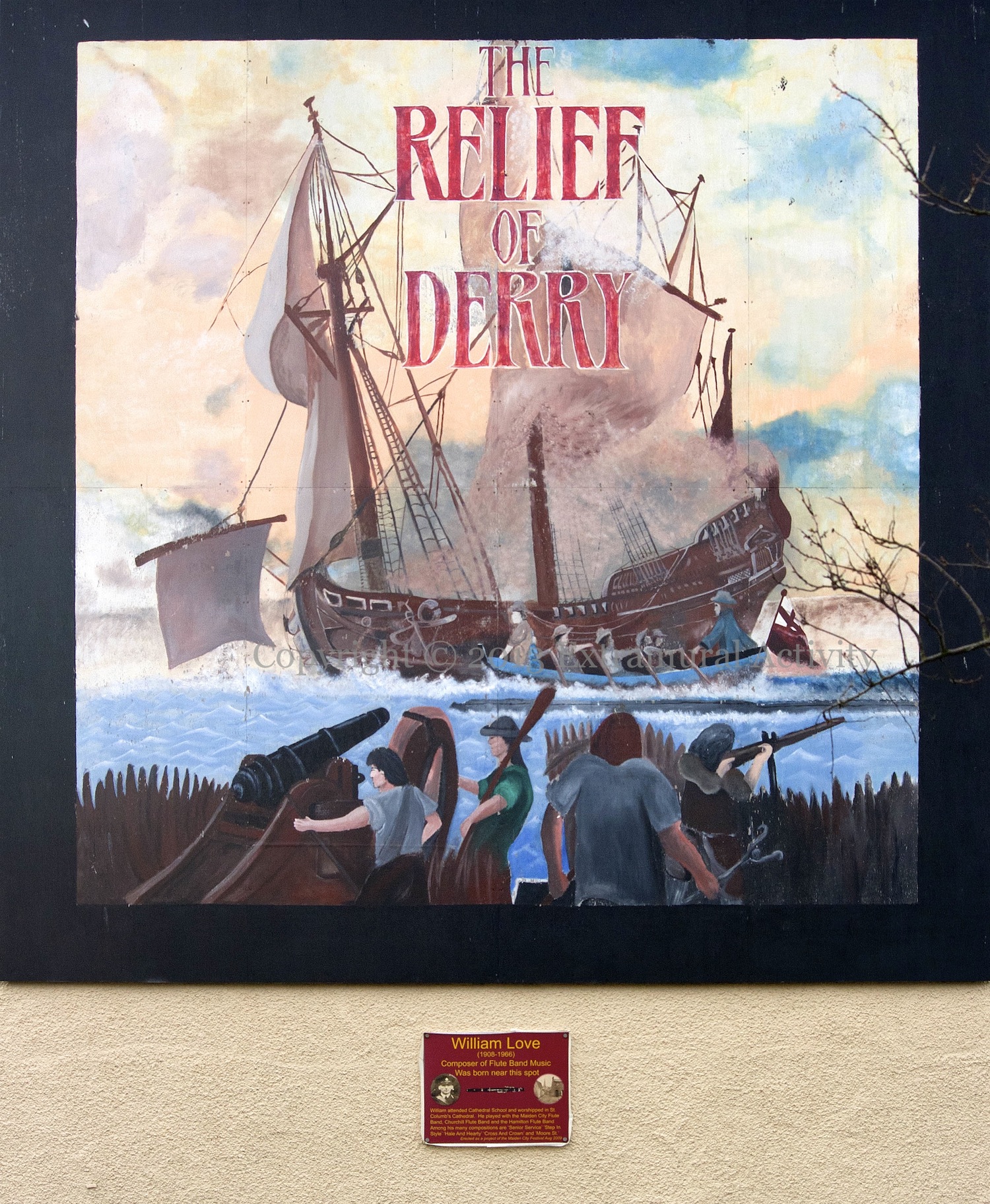
“Derry” became “Londonderry” in 1613, but in 1689 at the time of the siege, as now, it was commonly referred to as “Derry”. The slogan of the defenders was “No Surrender” and the successful resistance to penetration gave rise to the epithet “The Maiden City” (WP).
Pictures of the unveiling of the plaque in 2009, which commemorates William Love, can be seen here.
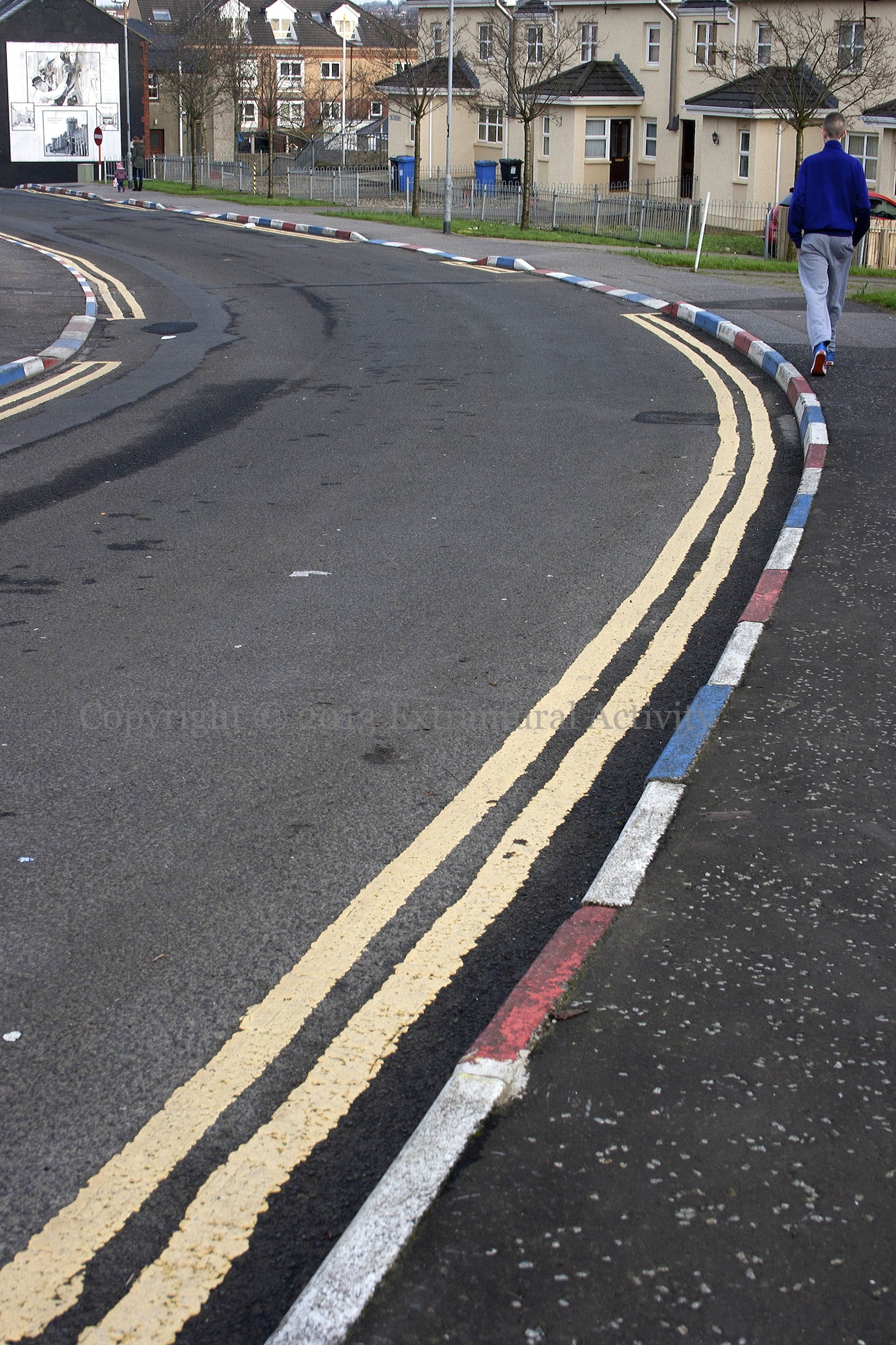
A pedestrian’s gutties (sneakers) and jacket match the red, white and blue of the kerbstones on The Fountain, a street at the heart of the Fountain, a Protestant enclave on the west side of the Foyle in Londonderry
Kerb painting has largely ceased in Belfast (there might have been some kind of unofficial agreement circa the Good Friday agreement (WP) to phase it out through non-renewal of existing painted kerbs – please dis/confirm in the comments if you can) but the ancient practice is still alive and well in The Fountain.
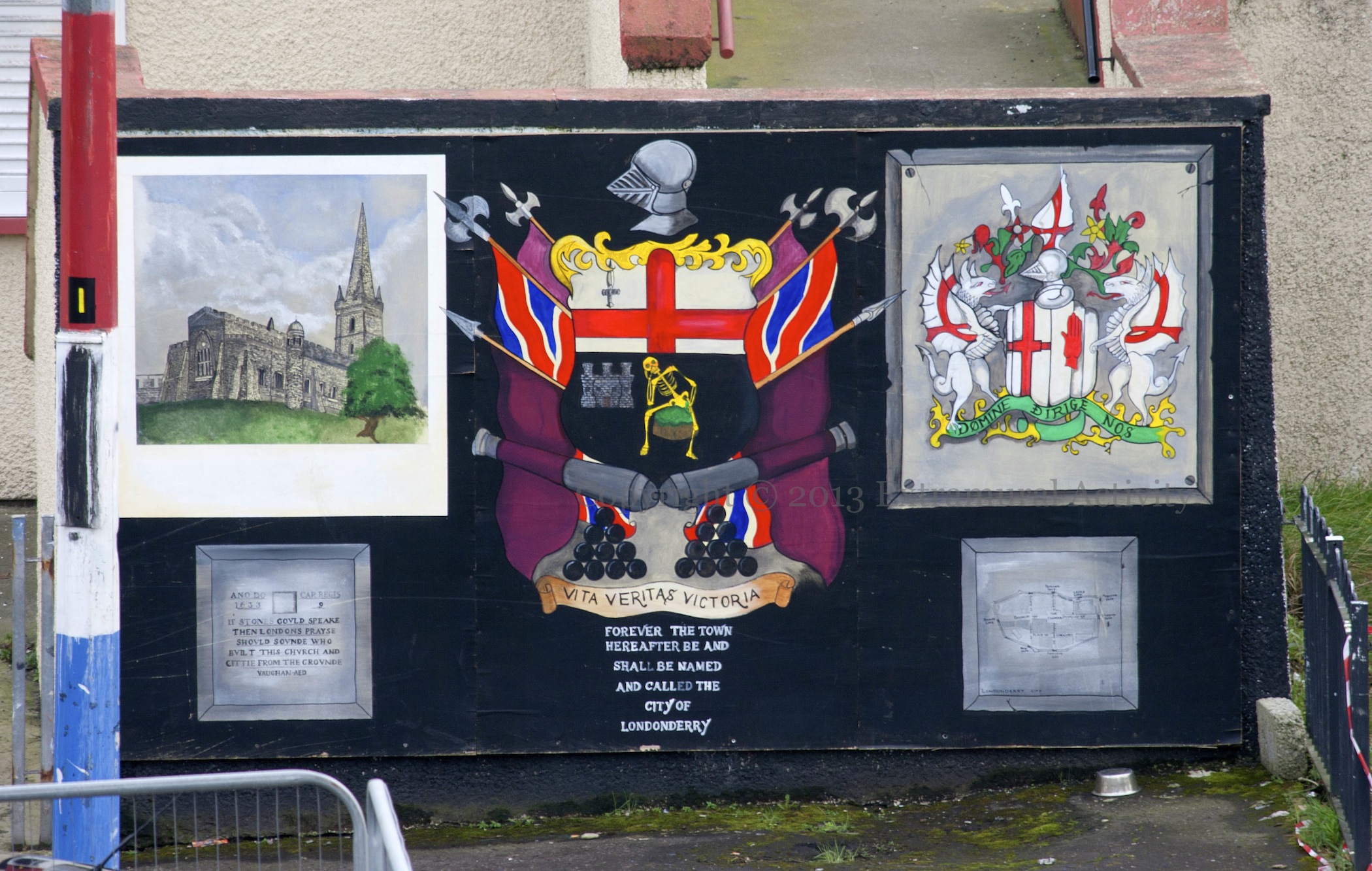
“Life, Truth, Victory.” A new (within the last 12 months) board just outside the walls of Londonderry, in the Fountain area. (The Fountain area is a small Unionist area on the west bank of the Foyle river; the larger unionist population is in the Waterside on the east side of the river.)
The city’s coat of arms is featured in the centre – there are various interpretations of its elements, including the skeleton (WP). St. Columb’s cathedral (WP) is top left and a map of the wall bottom right. In the top right is the coat of arms of the city of London (whose flag is the top part of the coat of arms) – “Lord, Direct Us.”
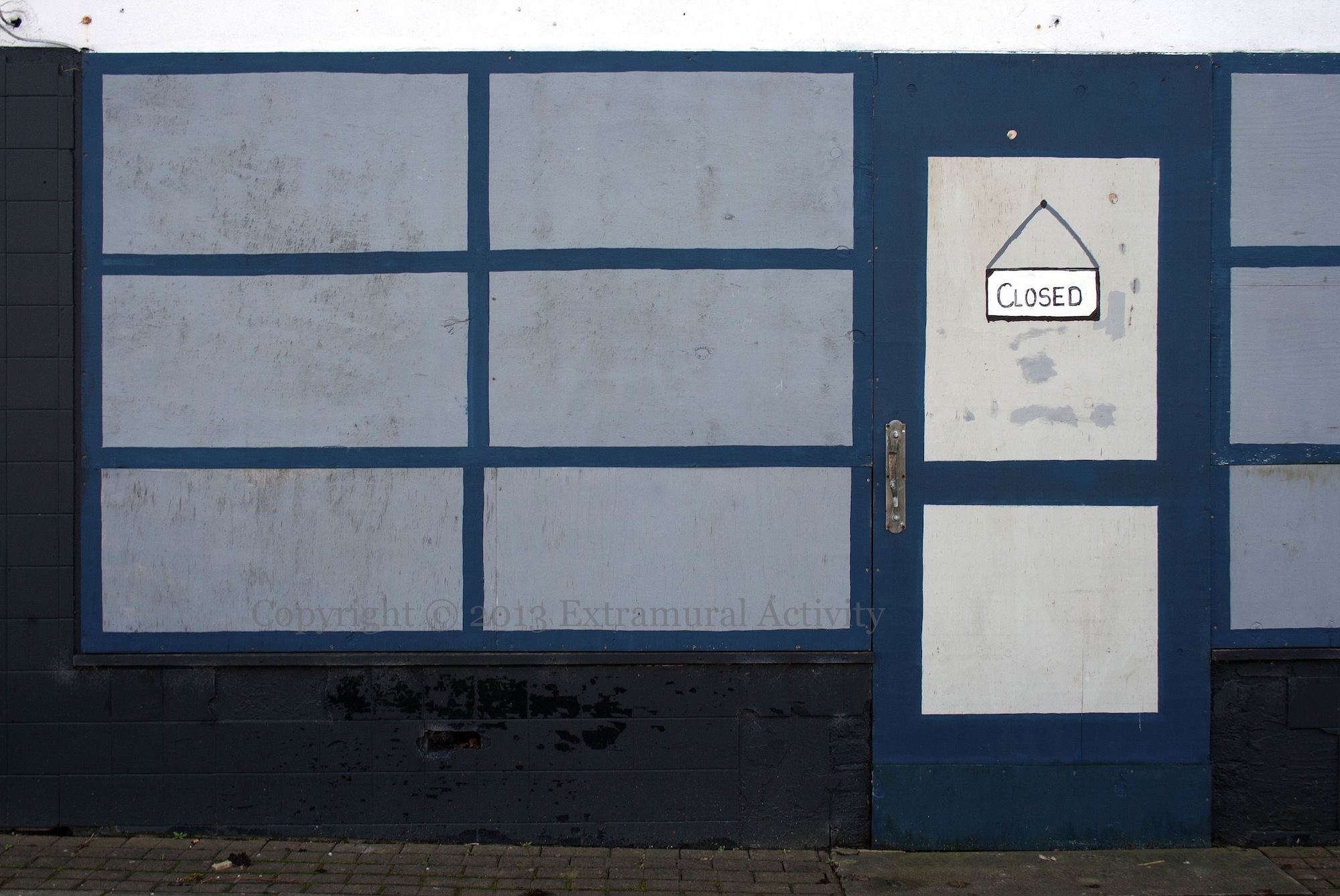
One of four consecutive buildings with fake storefronts in Dún Geimhin/Dungiven. Painted boards have been placed over the windows and door (and the handle put back on the door?). The helpful “closed” sign prevents confusion!
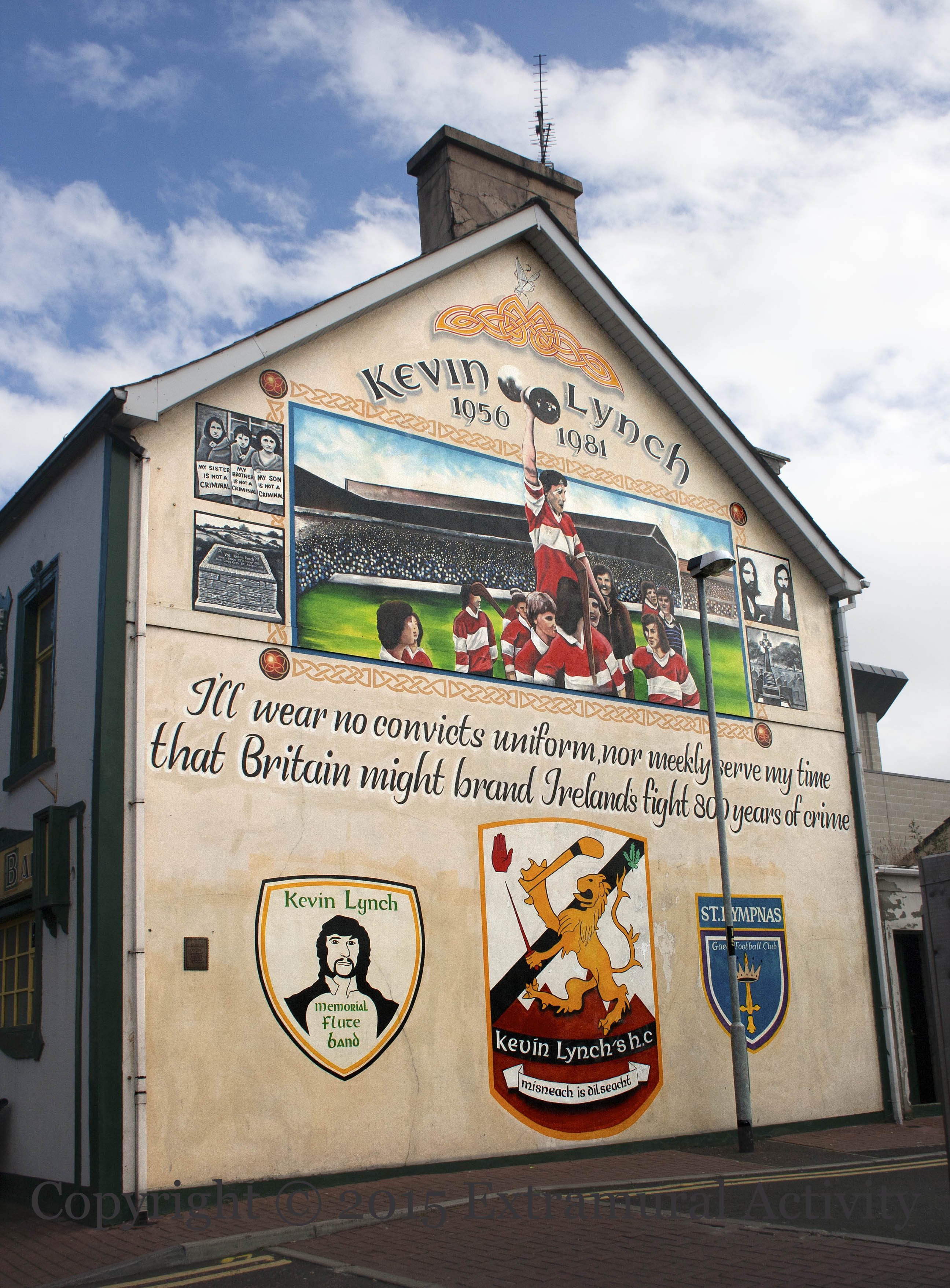
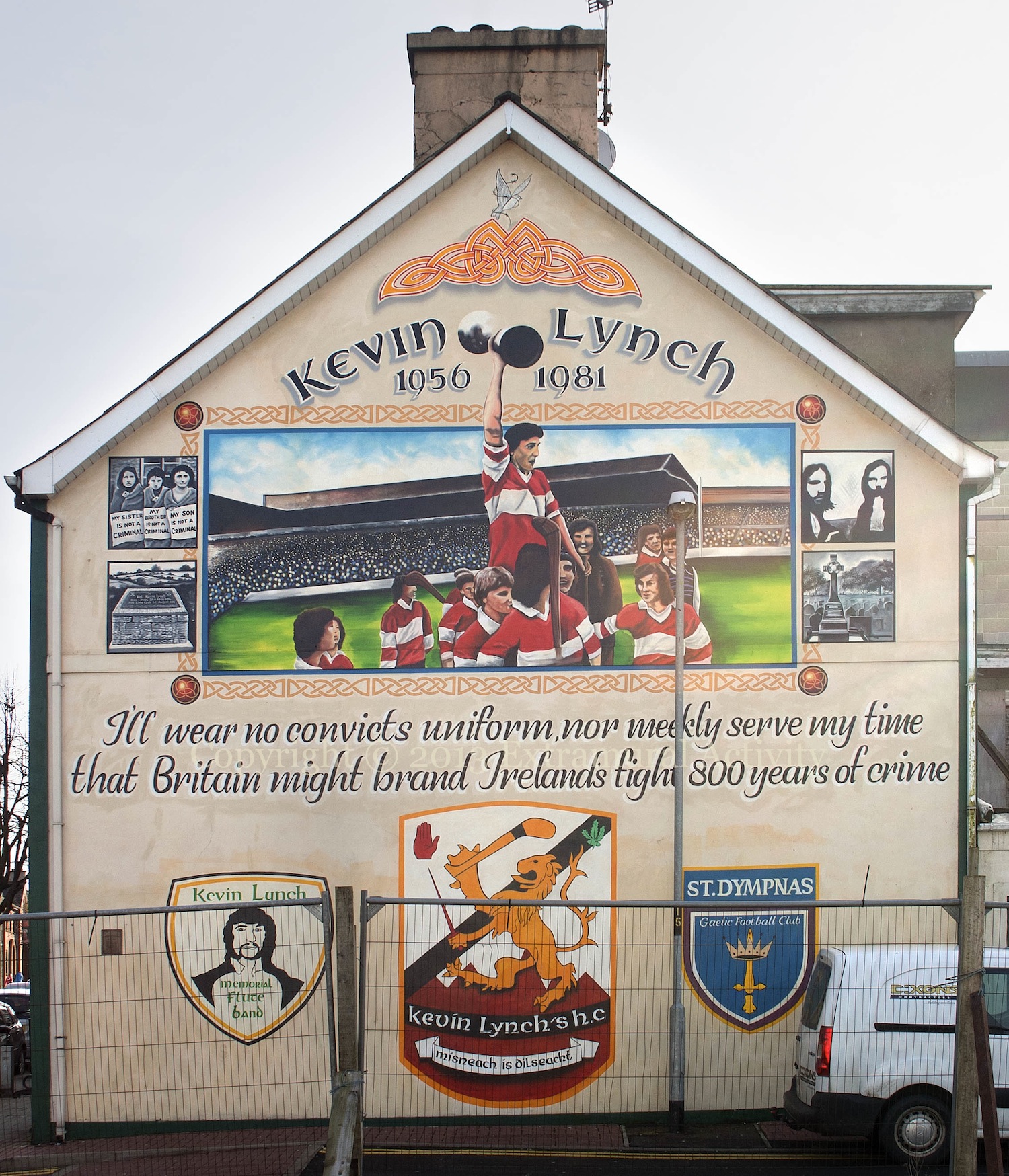
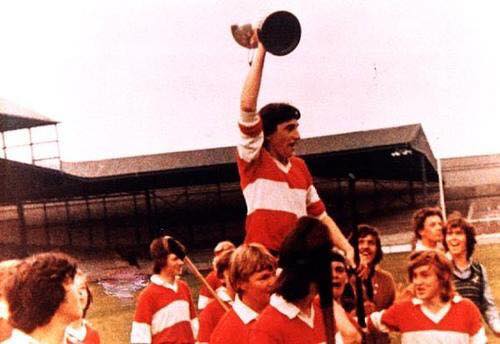
Mural to Kevin Lynch (WP) in Dún Geımhın/Dungiven. Lynch died after 71 days on hunger strike – the longest-surviving striker – in Long Kesh/the Maze prison.
Along the bottom are the emblems of Kevin Lynch Memorial flute band (Fb), Kevin Lynch’s hurling club (“mısneach ‘s dílseacht”), and St Dympna’s football club, Luton (Fb).
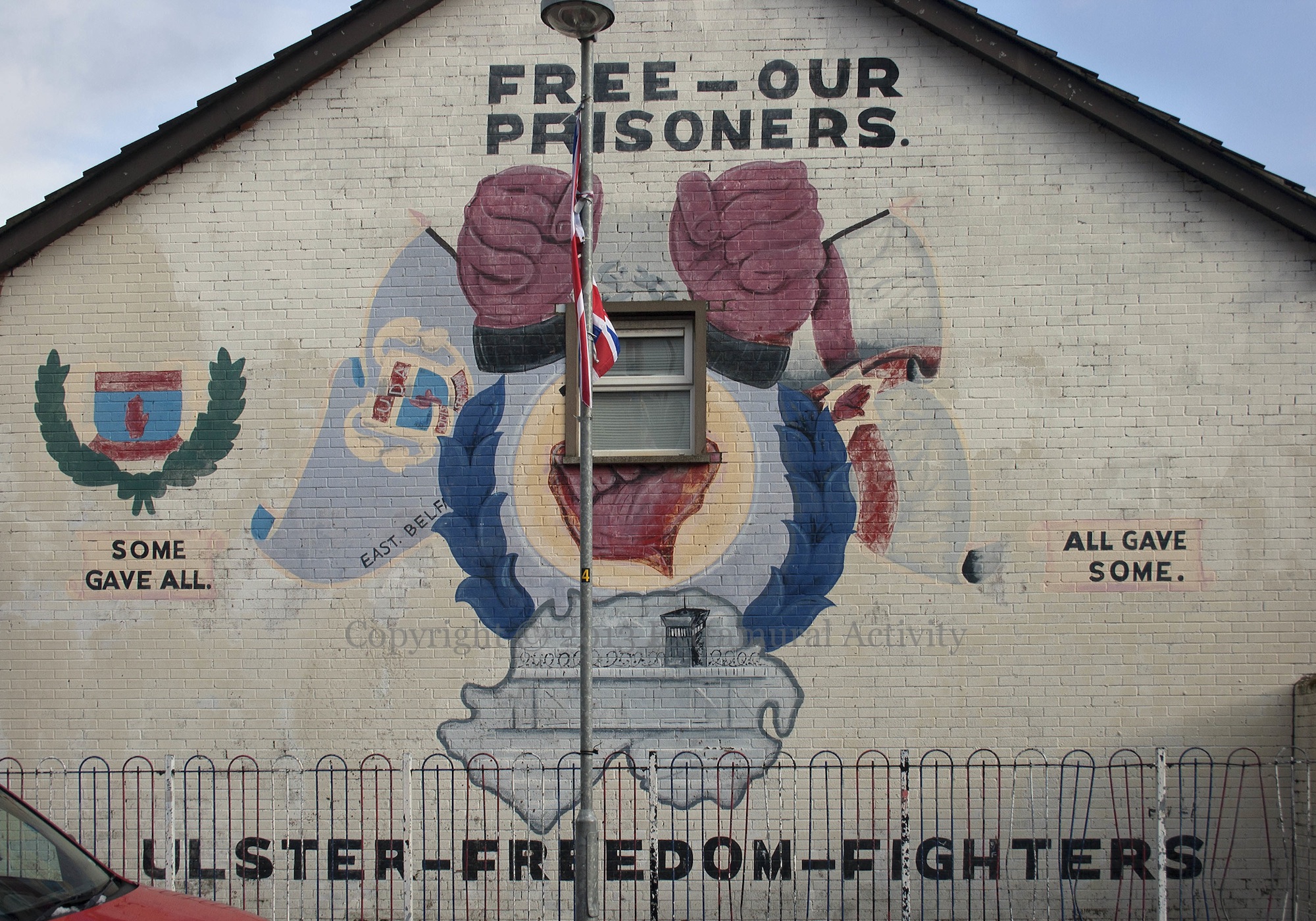
Here is a close-up of the UFF mural which can be seen in the background of the Feriens Tego entry, in Lord St. A pair of red hands are in shackles and the fences of the Maze are superimposed on an outline of Northern Ireland. (Very similar to the ‘For Peace’ mural on the Shankill in 1995.)
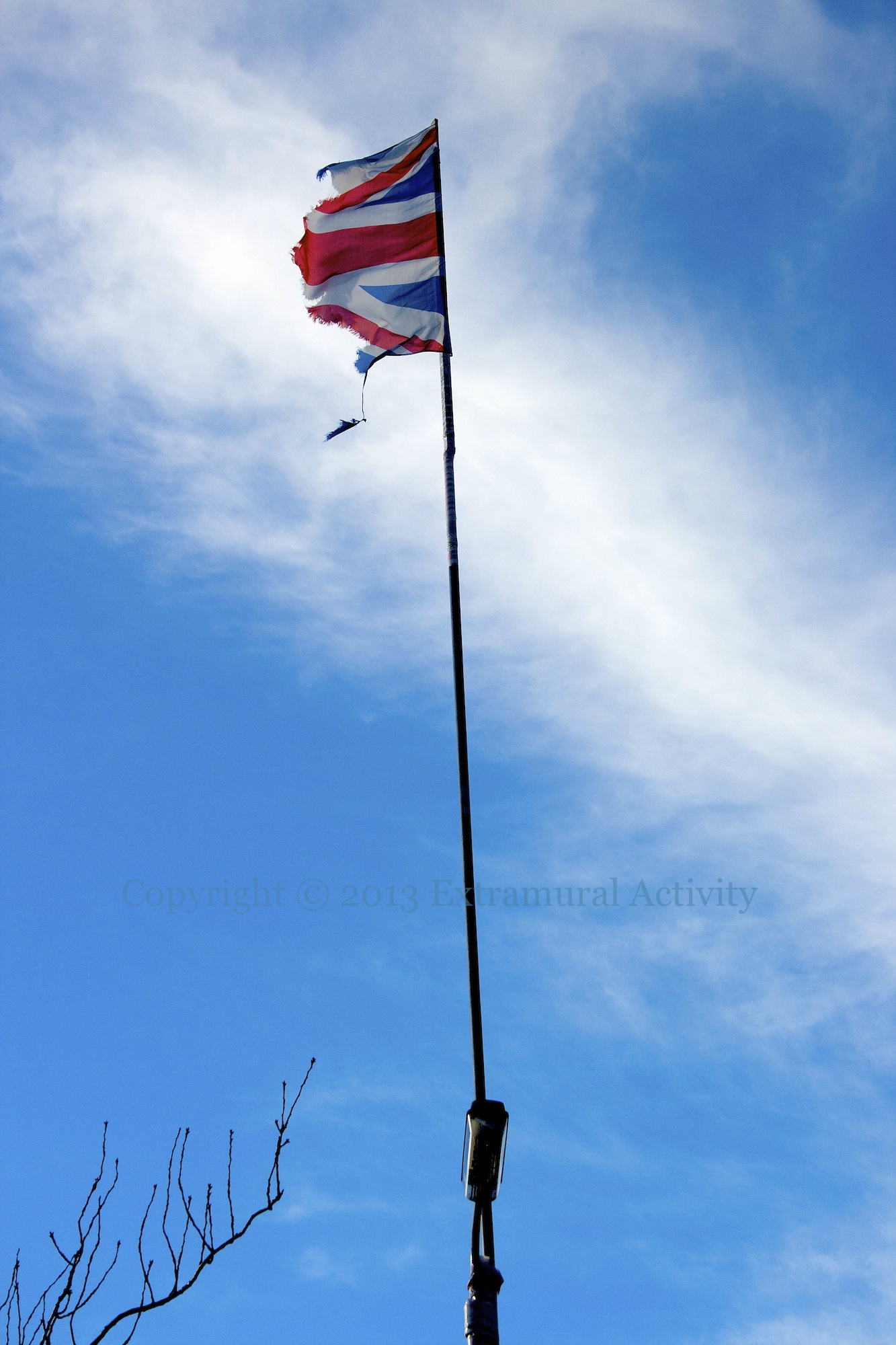
A tattered Union Flag on the Hightown Road/Bóthar Bhaile na hAirde in Glengormley/Gleann Gormliath (just north of Belfast). The title comes from the U.S. anthem “The Star-Spangled Banner”: “the rockets’ red glare, the bombs bursting in air, gave proof through the night that our flag was still there” (WP).
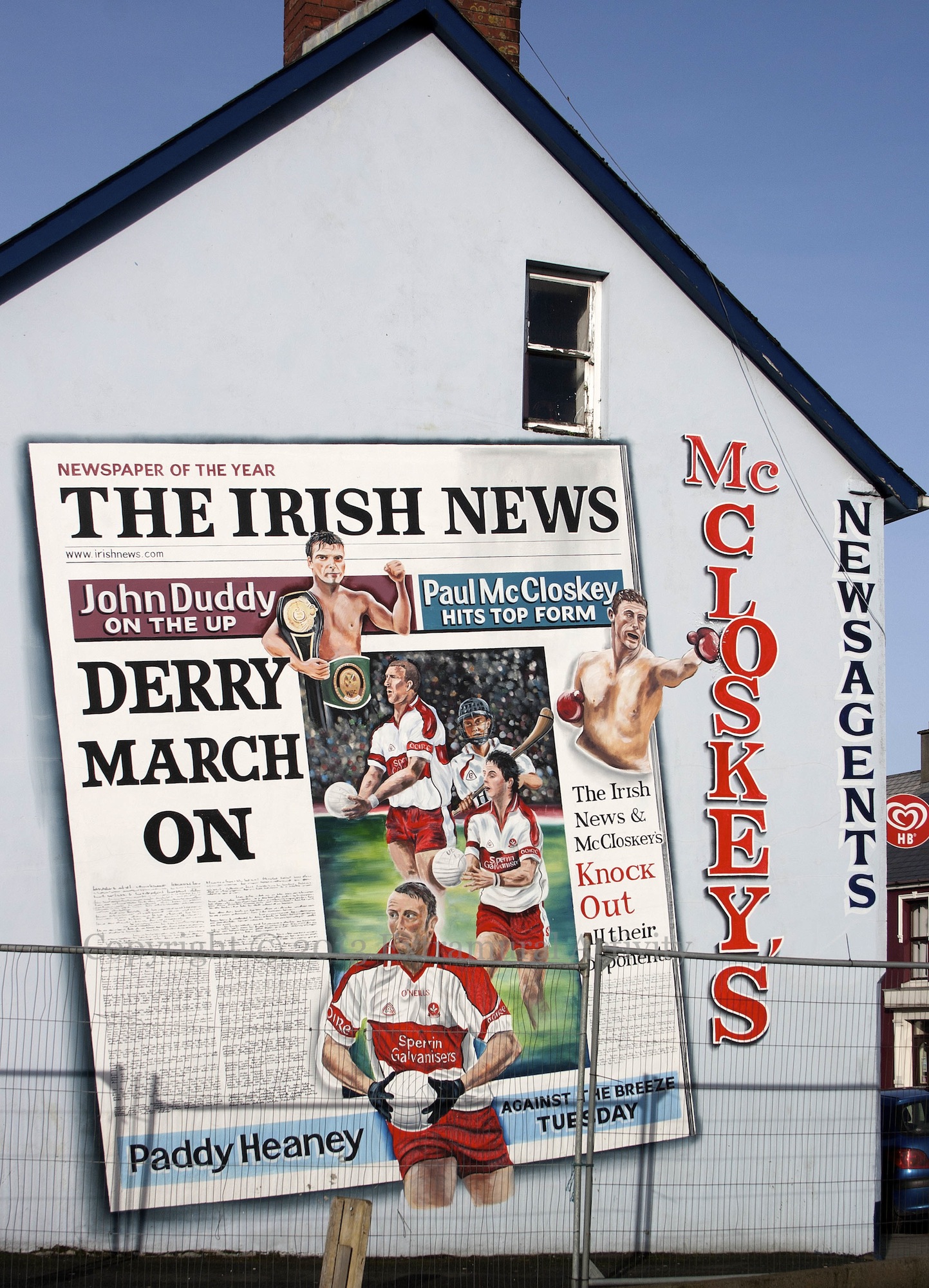
A commercial mural in Dún Geımhın/Dungiven promoting McCloskey’s newsagents and the Irish News by association with Derry (Gaelic) footballers (and a hurler in the background) and local boxers John Duddy (from Derry) and Paul McCloskey (WP) who was born in Dungiven (and is presumably related to the shop owners??).
 Seosamh Mac Coille Collection