A New Breed Of Ulster Defender

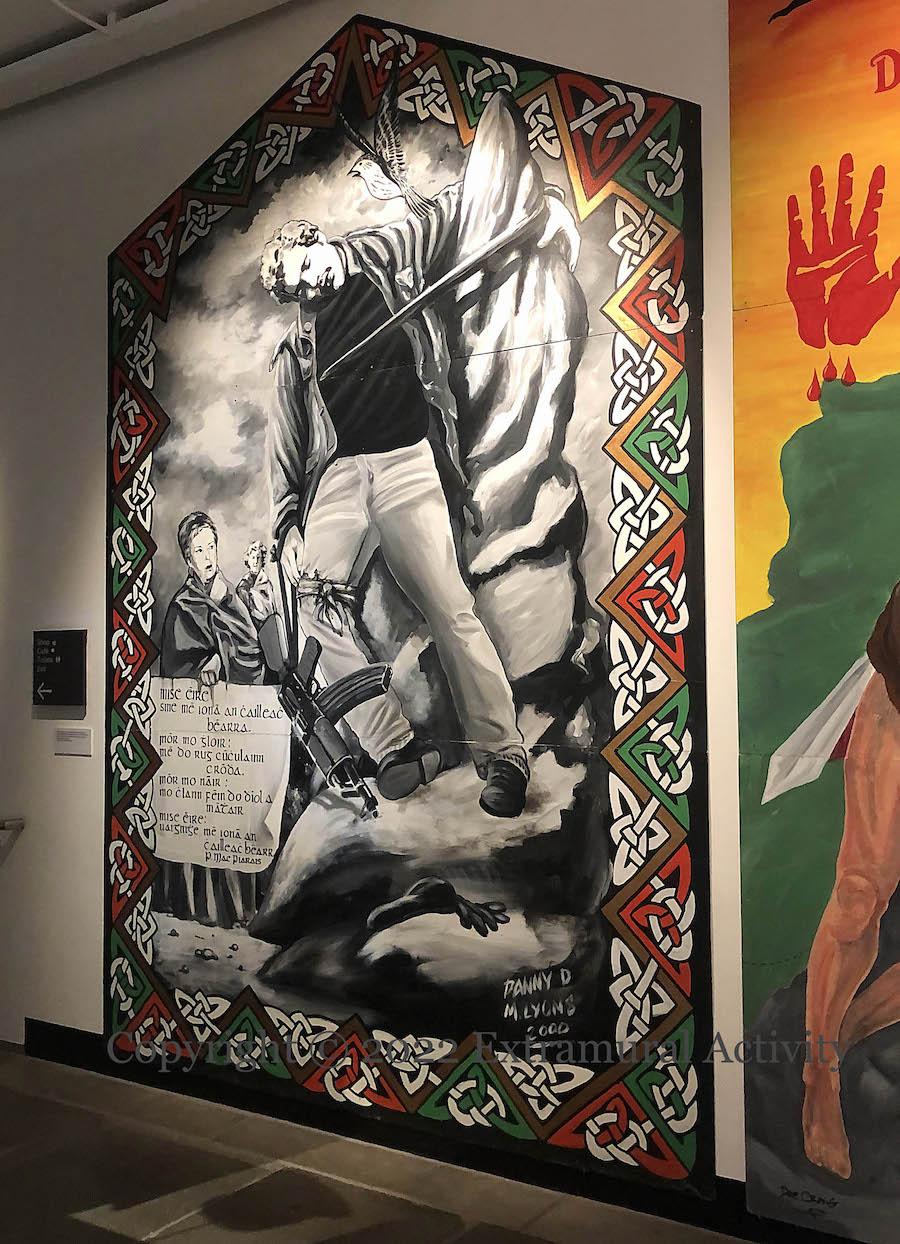
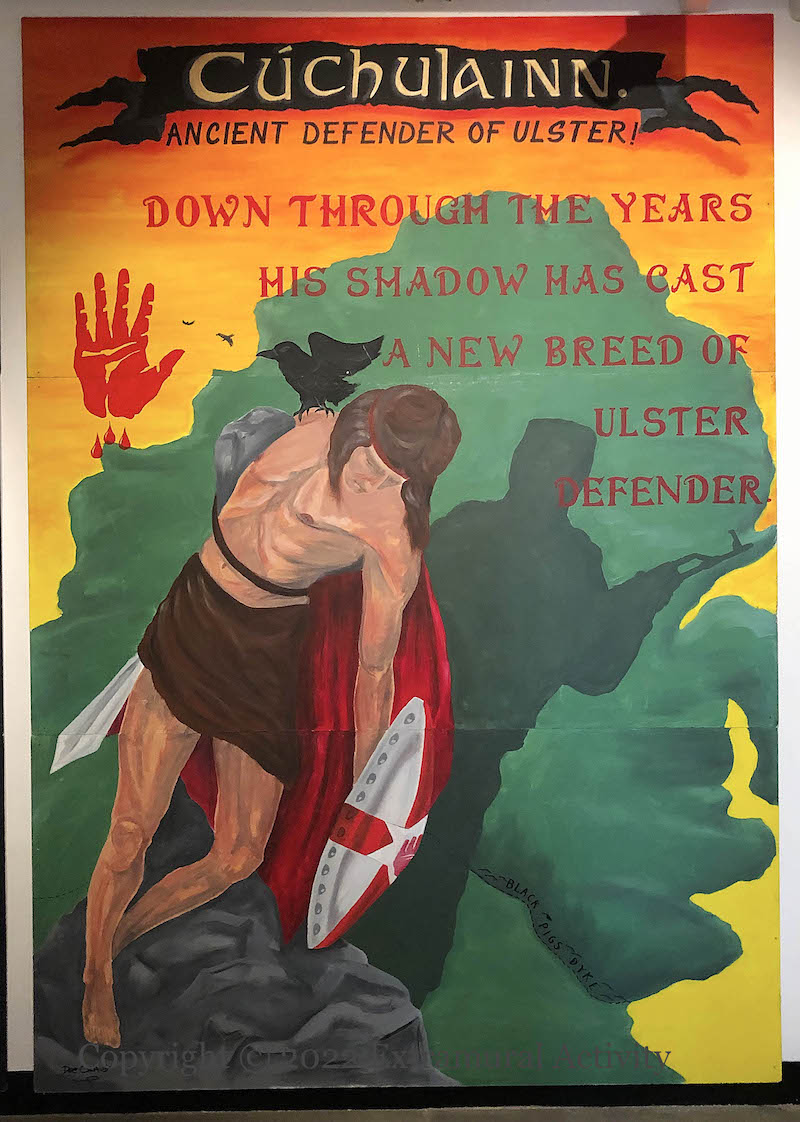
Here are a pair of large boards in the Ulster Museum on the theme of Cú Chulainn, one from each sect.

In the left-hand painting – the CNR piece, by Marty Lyons and a Short Strand artist – Francis Hughes of the IRA – in what we think is a unique break with tradition – takes the place of Cú Chulaınn, who became a symbol of the 1916 Easter Rising when Oliver Sheppard’s statue of Cú Chulaınn’s death was placed in the re-built GPO. Hughes has a tourniquet on his right leg, an assault rifle dangling from his wrist, and instead of the raven that signified Cú Chulaınn’s death there is the symbol of republican political prisoner, the lark, which appears in the apex of many other republican murals.

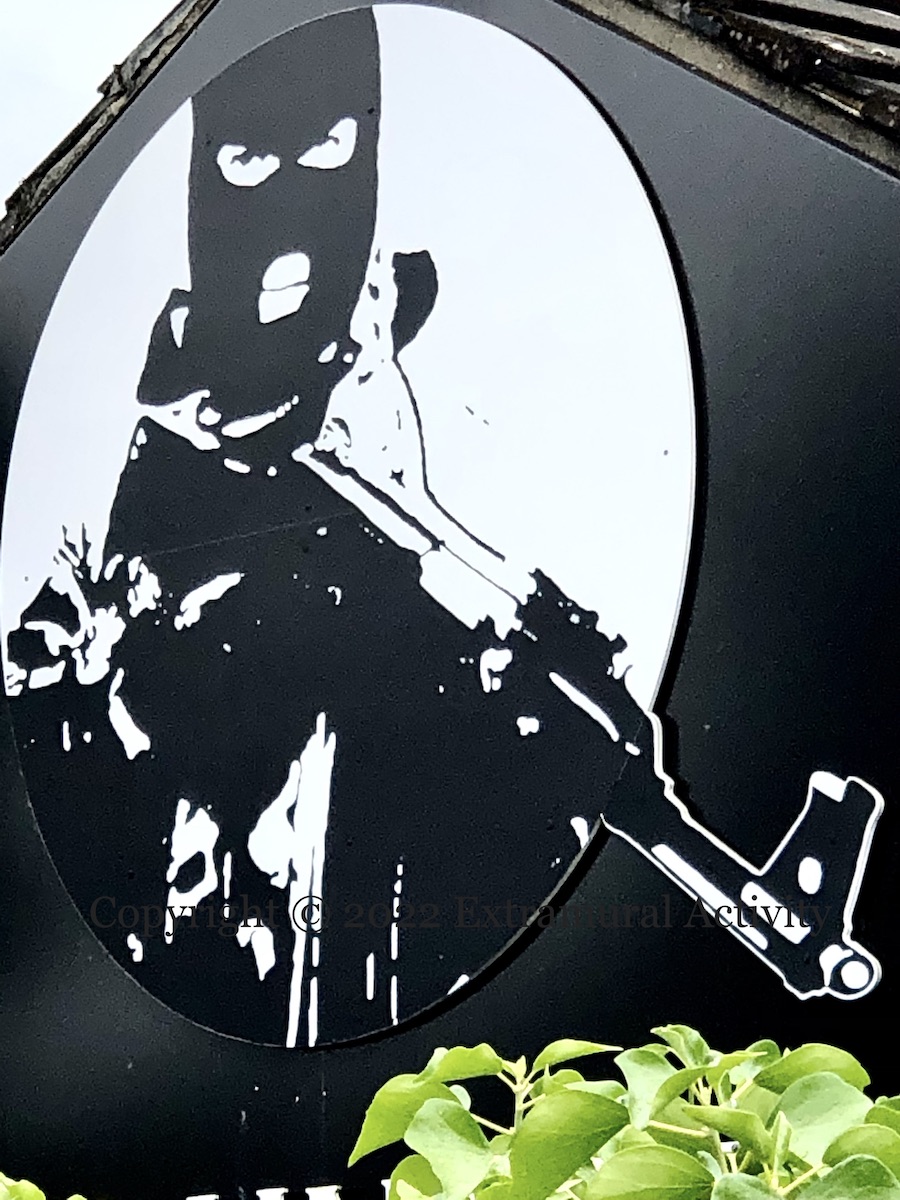
In the second of the pieces – the PUL piece, painted by Dee Craig – the raven sits on the shoulder of a Cú Chulainn who has a red cloak and carries a Northern Ireland shield. “Down through the years, his shadow has cast a new breed of Ulster defender”: a (loyalist) hooded gunman. Thus while Cú Chulaınn is the (surprising) “Ancient defender of Ulster!”, the UVF and UDA are its modern defenders, now that the B Specials and UDR are gone.

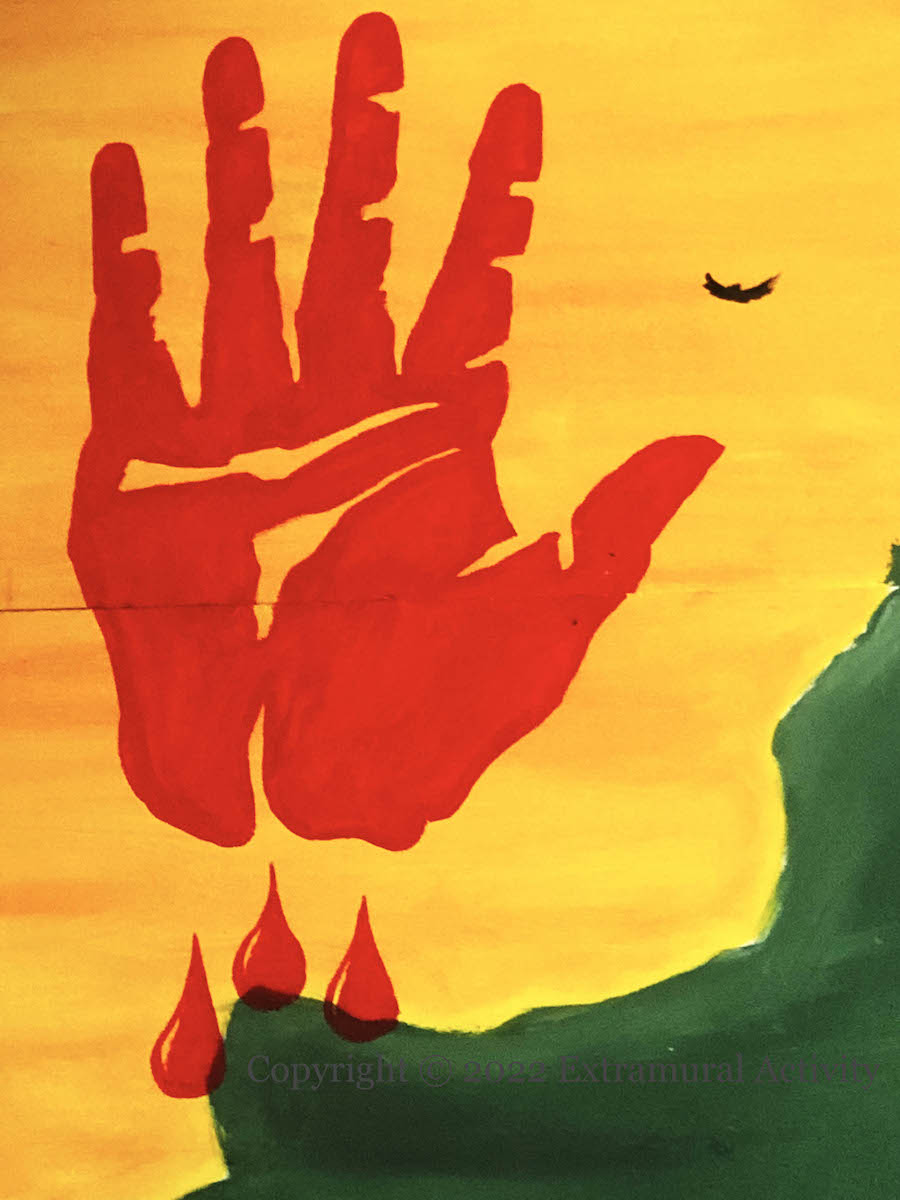
The dripping red hand in the top left is the ‘red hand of Ulster’; one version of the origin-story for the red hand is that the man who avenged Cú Chulaınn’s death made a bloody hand-print to indicate his completion of the deed. Most people, however, will think of the legend that in a race to be first to touch the land of Ulster one contestant (perhaps Érımón Uí Néıll) cut off his hand and threw it ahead of the others. (This legend was depicted in a lower Shankill mural and narrated in an east Belfast mural: The Strangest Victory In All History.)

The Black Pig’s Dyke is the collective name for a number of ditches built around 400 BCE, perhaps to prevent cattle-raiding. They share a common mythology: that they were created by huge black boar; they are on the Ulster-Connacht border, rather than the Ulster-Leinster border as shown in the painting, though there are similar earthworks in Down, Armagh (and Cork) (WP).
Click image to enlarge
Copyright © 2022 Seosamh Mac Coılle
X10386 X10387 X10385
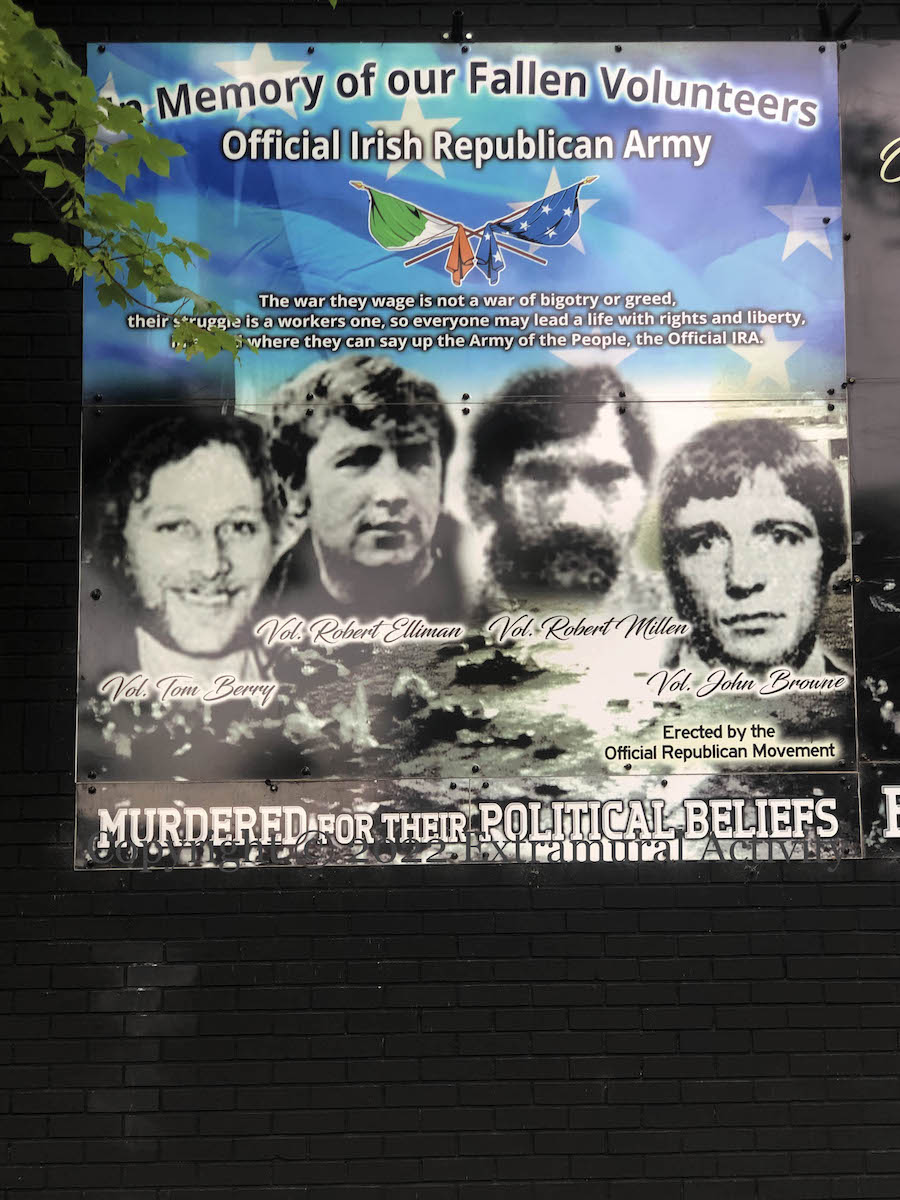
Their Struggle Is A Workers’ One

“Murdered for their political beliefs: Tom Berry, Robert Elliman, Robert Millen, John Browne”. All four had a connection Markets or Ormeau area of south Belfast. Millen, from the Ormeau area, was shot in 1973 by the UVF; he played on the same soccer team (Bankmore Star) as Thomas Berry, who was shot in a Short Strand GAA club; Elliman was shot in a Markets pub; John Brown (without the “e”) was shot in his Cooke Street home in front of his family. The first three were all Protestants; the latter three were among 11 people who died in the 1975 feud between the Officials and the Provisionals. (Lost Lives)

“The war they wage is not a war of bigotry or greed, their struggle is a workers one, so everyone may lead a life with rights and liberty, in a land where they can say “Up the Army of the people, the Official IRA”.” “Erected by the Official Republican Movement.”

Click image to enlarge
Copyright © 2022 Seosamh Mac Coılle
X10390 Stewart St

The Industrial Revolution

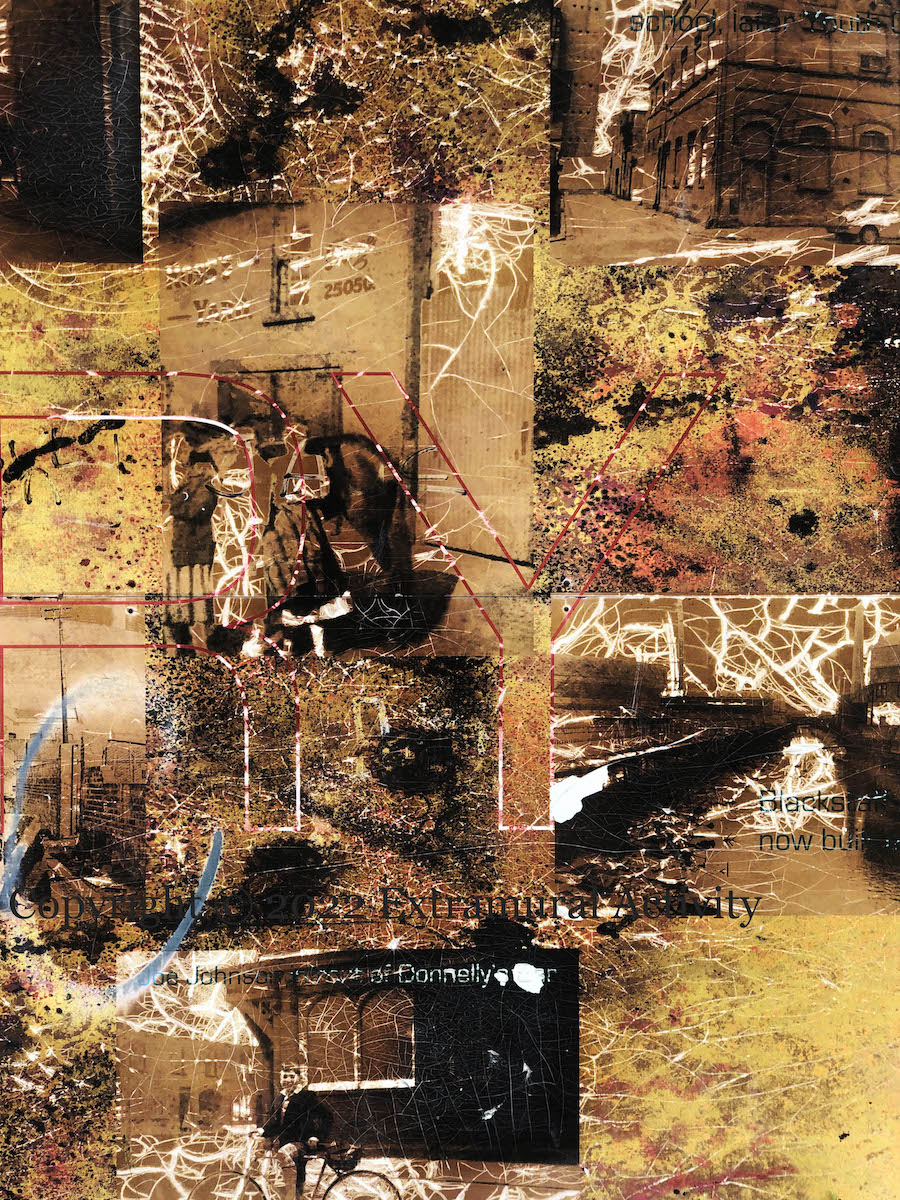
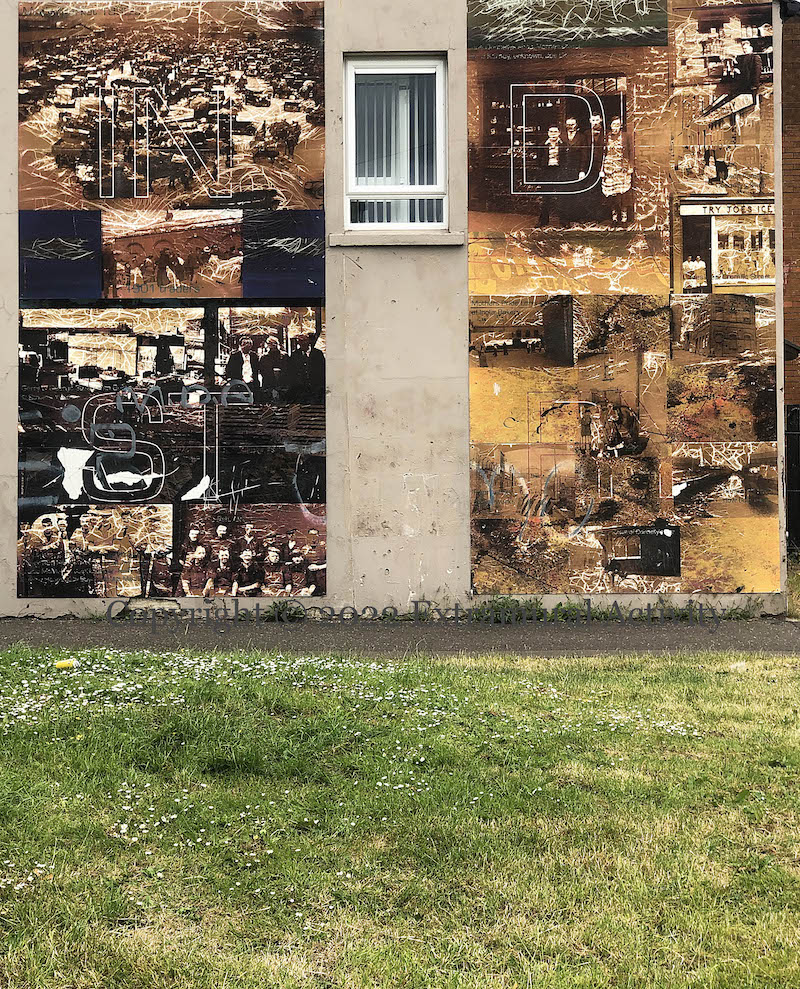
Artist Raymond Henshaw produced a series of Markets-related boards in 2008-2009 with support from the Arts Council and despite being printed on laminates they are not indestructible; there is crazing – as well as human-caused damage – on some of them, the worst of which is the ‘Industry’ board in Upper Stanfield Street.

There were six boards in total: Portraits | Social | Social History | Sport & Culture | Bars | Industry

Click image to enlarge
Copyright © 2022 Seosamh Mac Coılle
X10389 X10388

Soldier Of Ireland

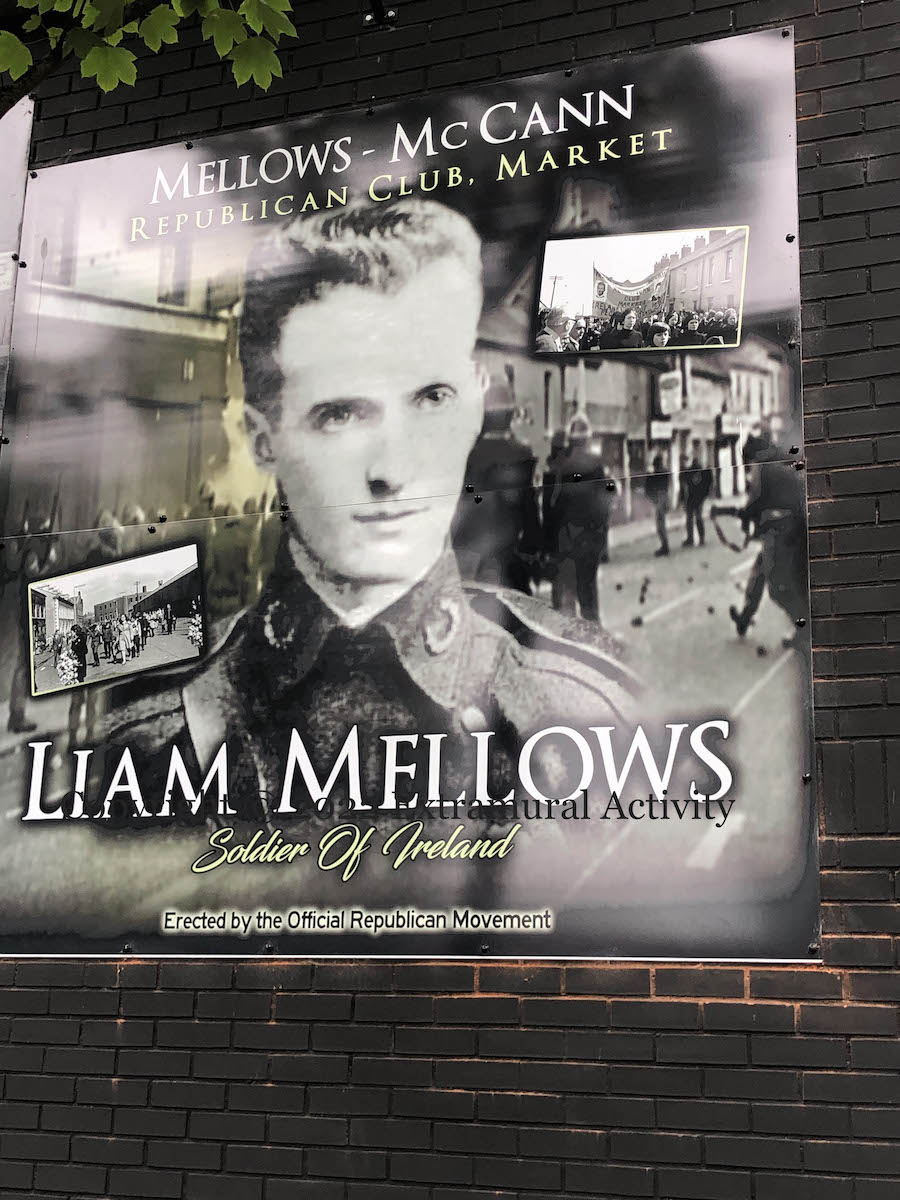
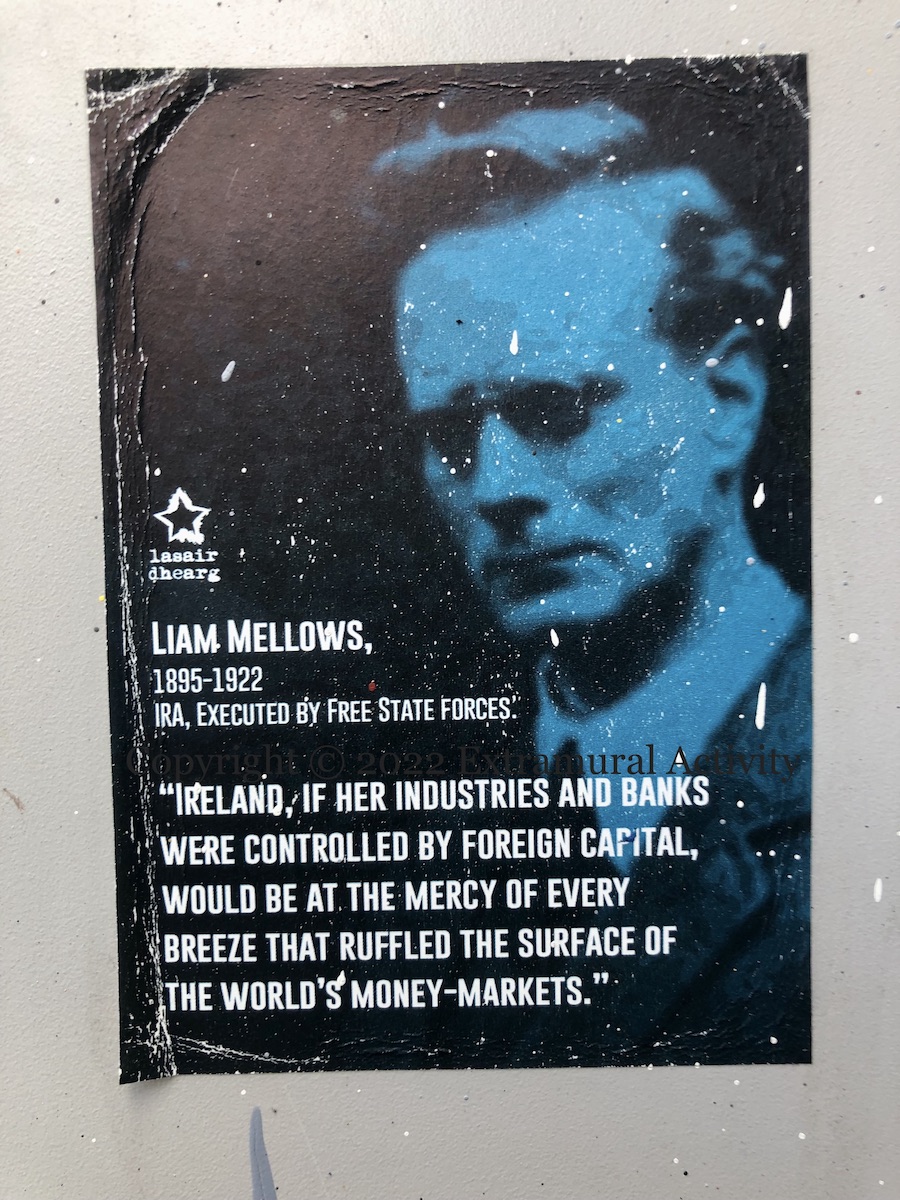
After serving in the IRA in the War Of Independence, Liam Mellows was elected to the First Dáil and as a member of the second Dáil voted against the Treaty in January 1922 (his speech is recorded in Oireachtas.ie under the name “Liam Mellowes”). In the Civil War that followed, he served as IRA quartermaster in the force in the Four Courts that surrendered to Free State forces on June 30th, 1922. He was imprisoned in Mountjoy and executed in December, in reprisal for the killing of Seán Hayes (see Executed). (WP | An Phoblacht) His proposals for government were published posthumously as ‘Mellows Testament’ (NLI) and include state ownership of heavy industry, large estates, the transport system, and the banks. The sticker below quotes from that document: “Ireland, if her industries and banks were controlled by foreign capital, would be at the mercy of every breeze that ruffled the surface of the world’s money-markets.”

Stewart Street, south Belfast

Click image to enlarge
Copyright © 2022 Seosamh Mac Coılle
X10392 X10413 erected by the official republican movement

Legends Last Forever

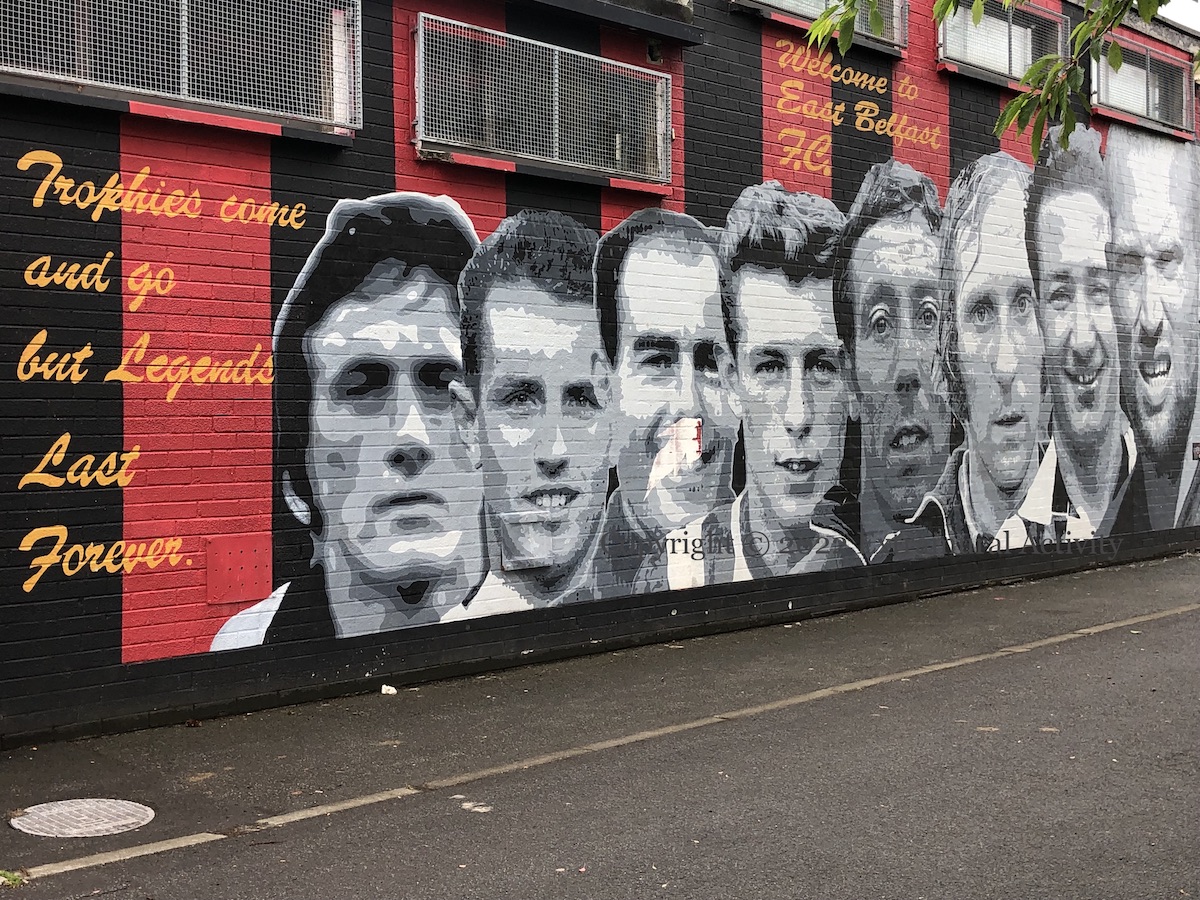
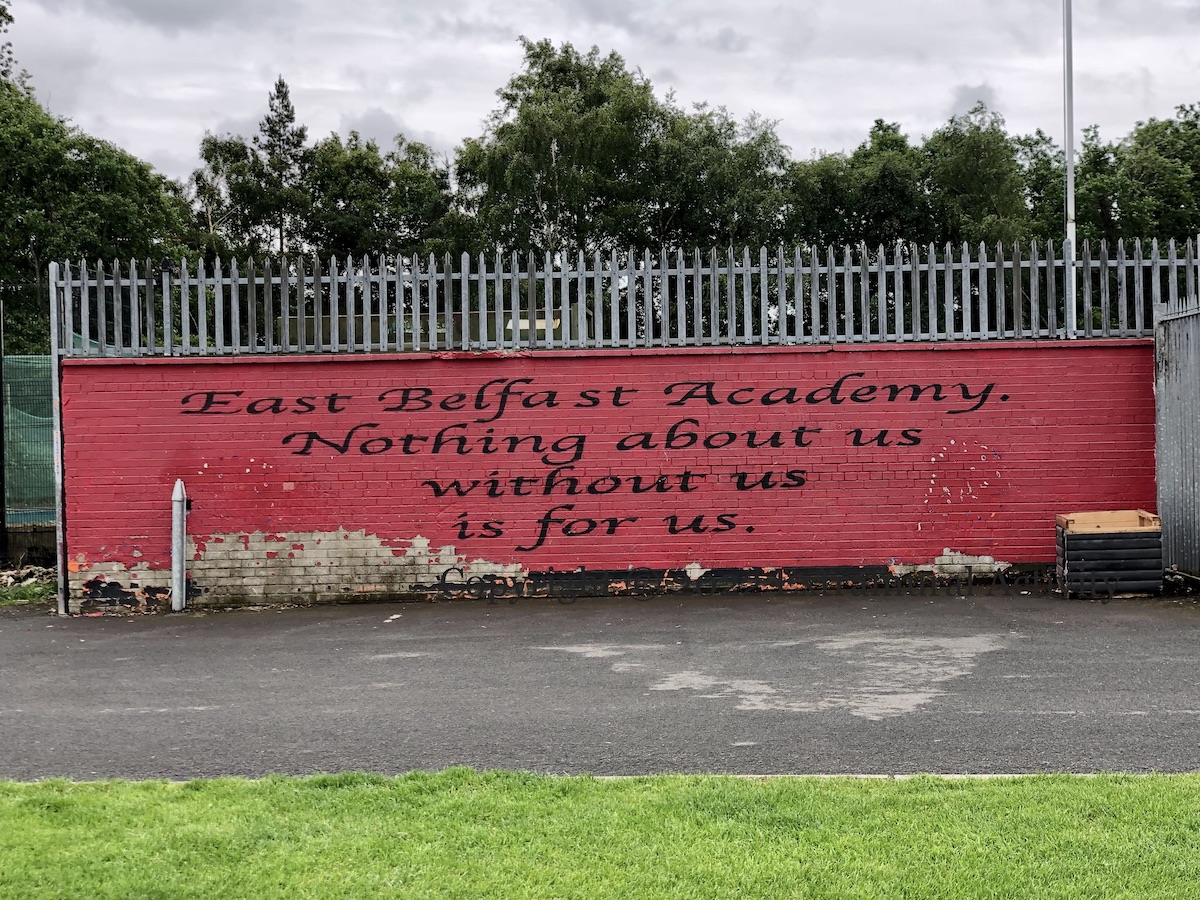
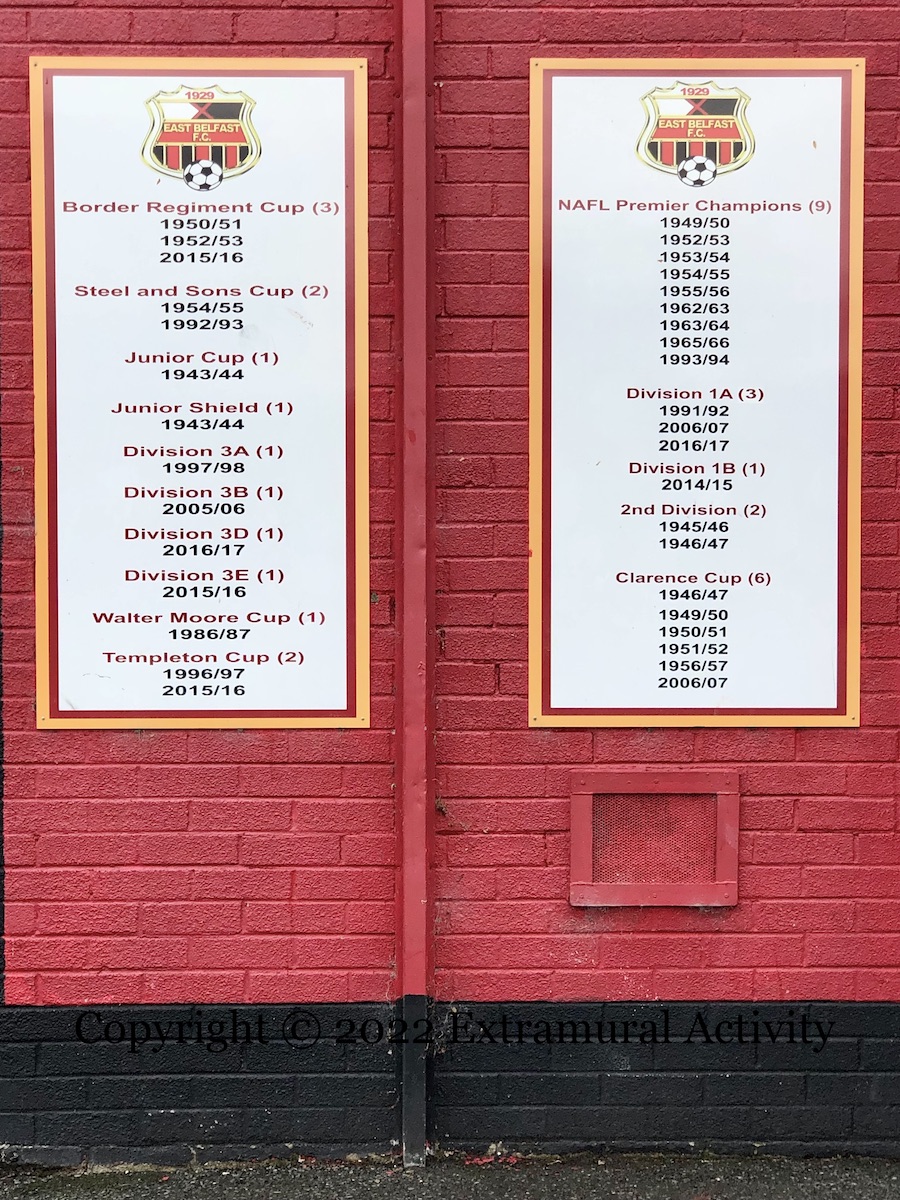
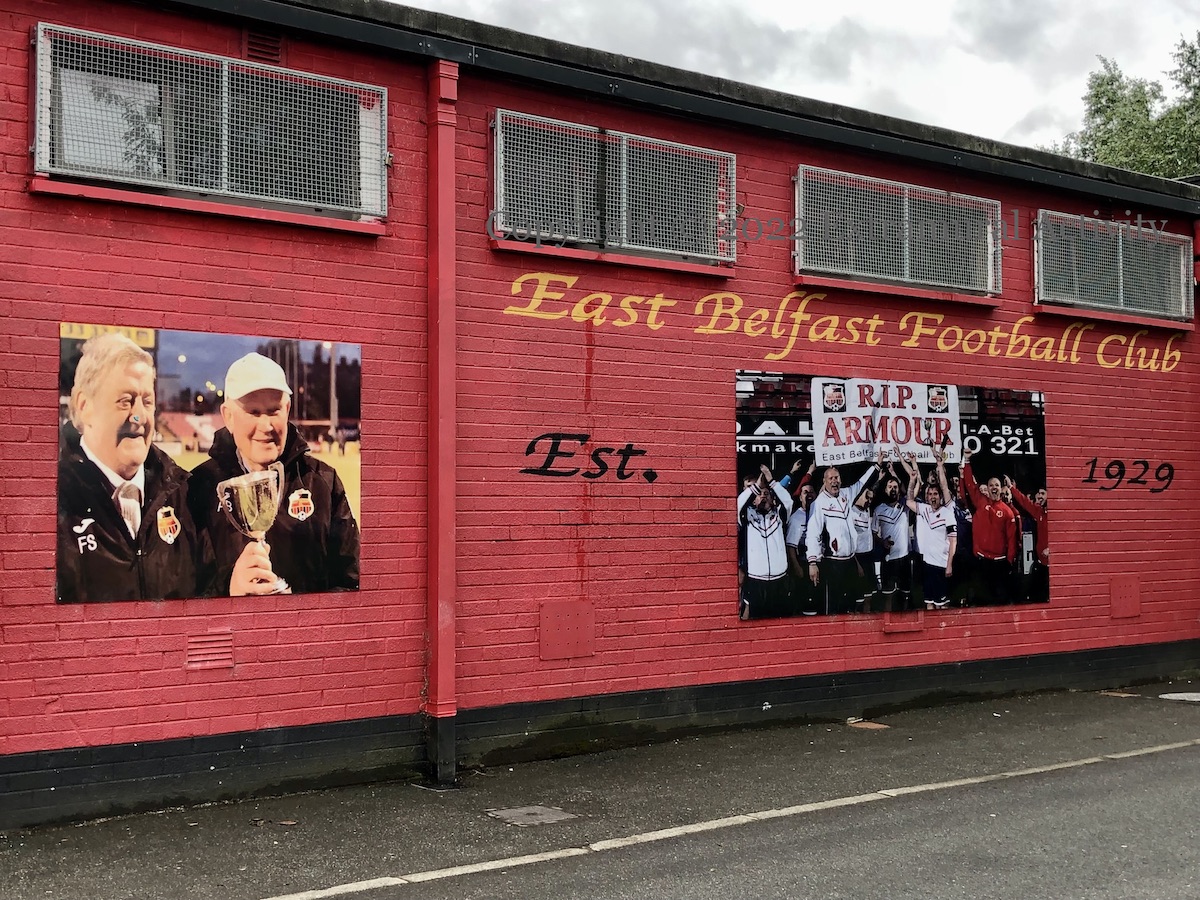
“Trophies come and go but legends last forever.” Scott Harvey and Lee Findlay have taken over as the management team of Northern Amateur Football League premier division team East Belfast FC (Fb) (Belfast Live) due to sequestration in connection with the UVF show of strength in Pitt Park in February, 2021 (Belfast Live). The club’s home field is East Park where the mural above stands to former greats (from left to right) Billy Caskey, Billy Humphries, Sammy McCrory, Ian Lawther, Walter Bruce, Roy Coyle, Tom Casey, and Warren Feeney.

Previously at EB FC: The Back Of The Net | Give Sectarianism The Boot

Click image to enlarge
Copyright © 2022 Seosamh Mac Coılle
X10326 X10323 X10324 X10325 [X10327]
Nothing about us without us is for us est. 1929

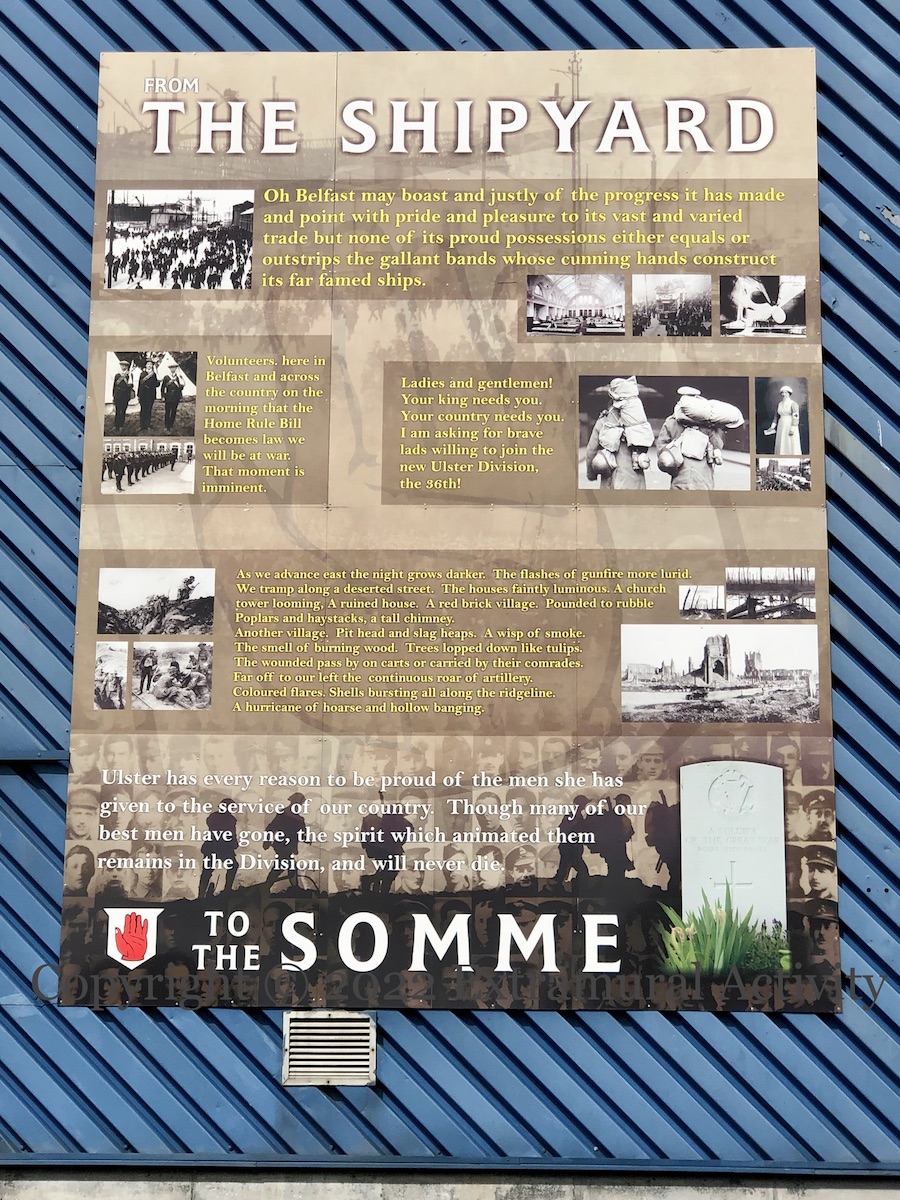
From The Shipyard To The Somme

The 36th (Ulster) Division Memorial Association (Fb) put on a play called From The Shipyard To The Somme (Fb | watch on youtube) in Connswater Community Centre in 2013. It follows a group of men from east Belfast who joined the Ulster Volunteers in Belfast but are now training at Abercorn barracks in Ballykinlar (later an internment camp) as members of the 36th Division, before going to the Battle Of The Somme in France.

Belfast – with one tenth of the population – provided about a third of the Irish soldier to participate in WWI. In the shipyards, Harland & Wolff responded to the slow-down in production not by putting everyone on short time but by letting go of employees, particularly unskilled employees, for whom the wages of soldiering were competitive (particularly if married), while skilled men were reclassified as “munitions workers” needed to fulfill war contracts (History Ireland | Long Kesh Inside Out).

The Somme board, which dates to about 2015, is above Connswater Commemorates and The Glorious Dead.

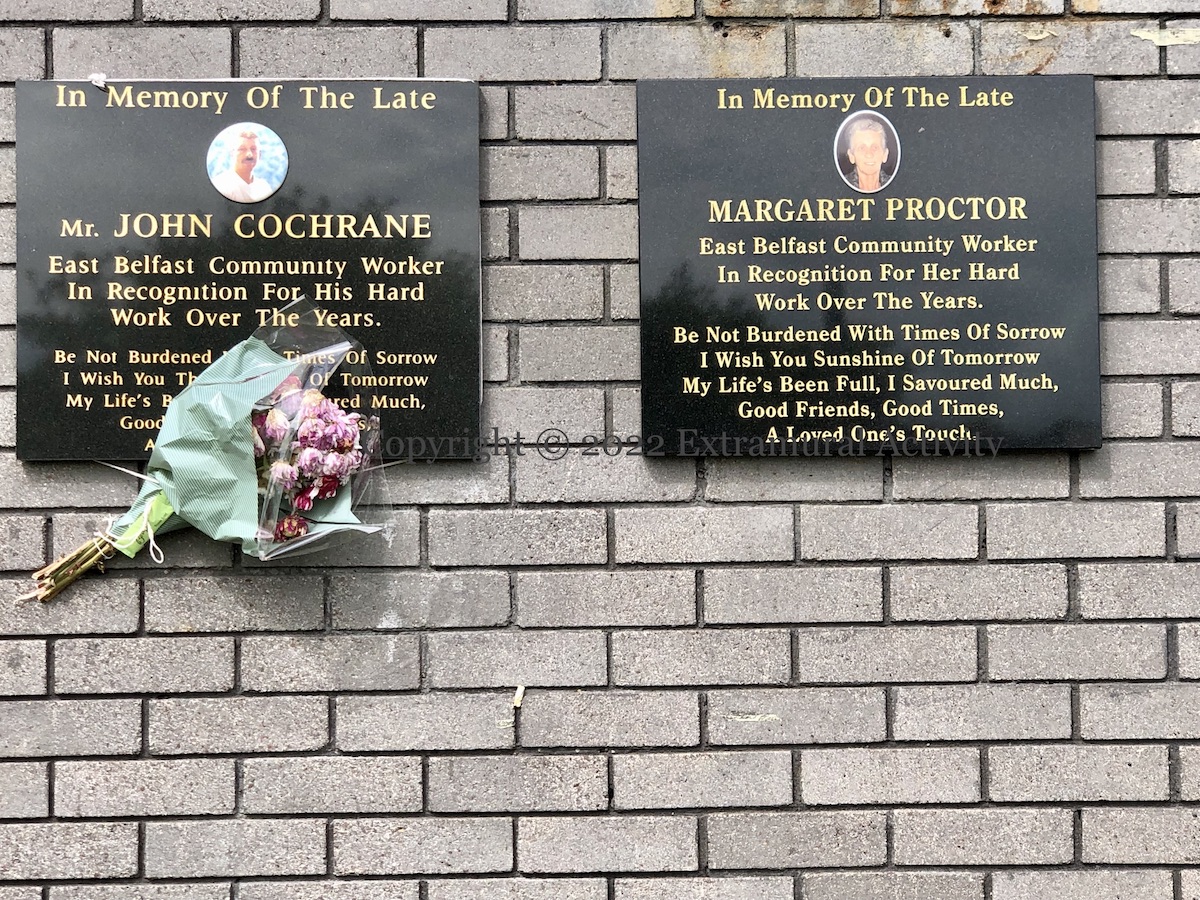
The plaques are to John Cochrane of the Mersey Street Area Residents Association and Margaret Proctor ?of the Connswater Community Centre?

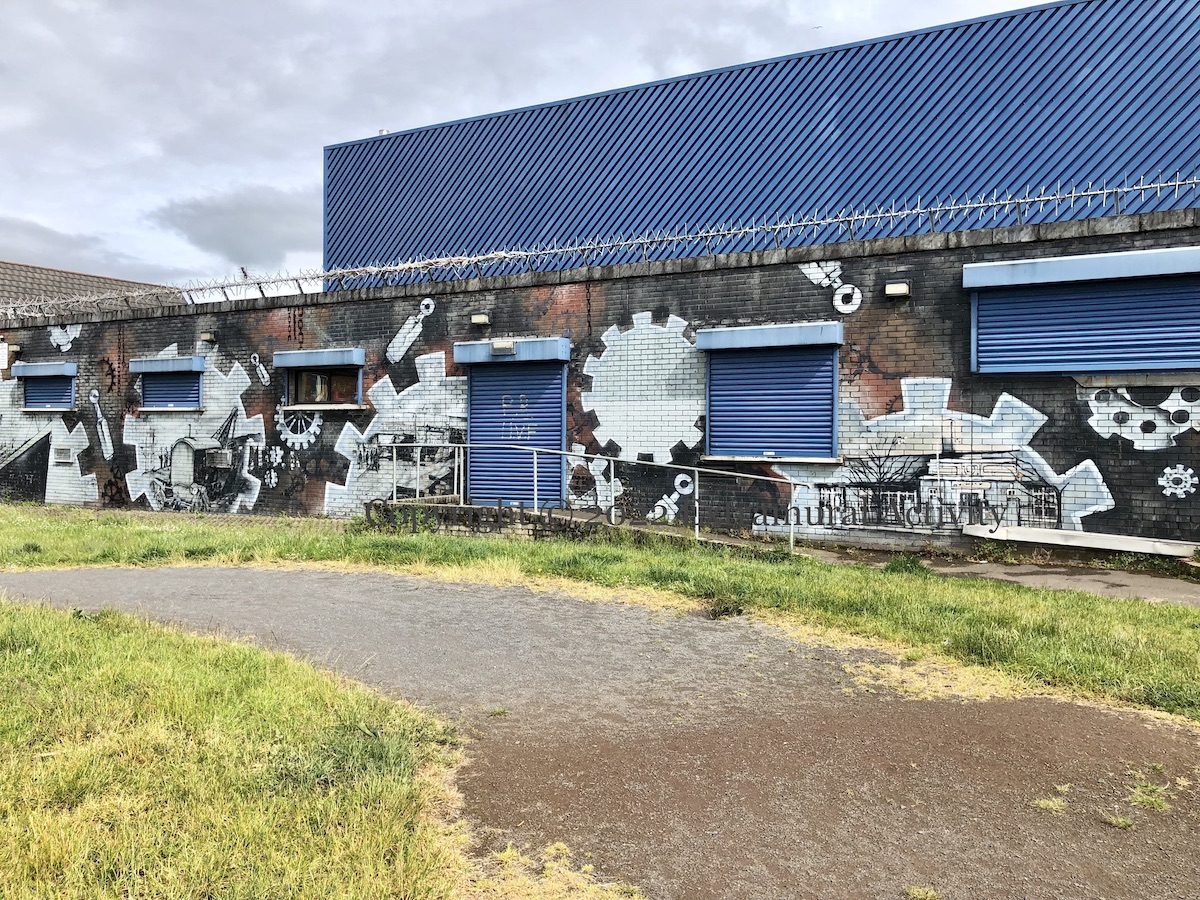
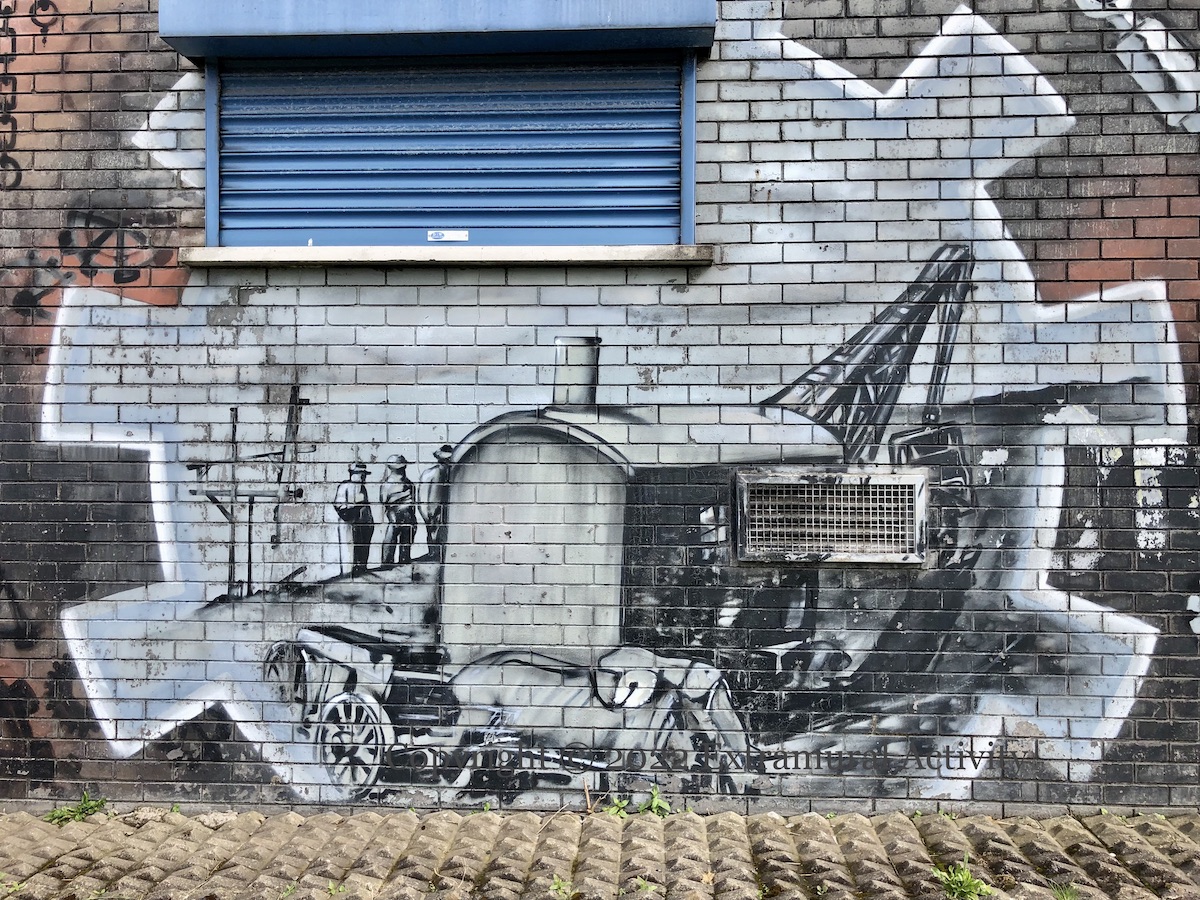
The industrial mural on the side perhaps features the Ballymacarrett rail crash of 1945, described previously in Step Back In Time.

Click image to enlarge
Copyright © 2022 Seosamh Mac Coılle
X10347 X10346 X10344 X10345 Oh, Belfast may boast and justly to the progress it has made and point with pride and pleasure to its vast and varied trade Your king needs you country 36th division ulster

The Six Counties

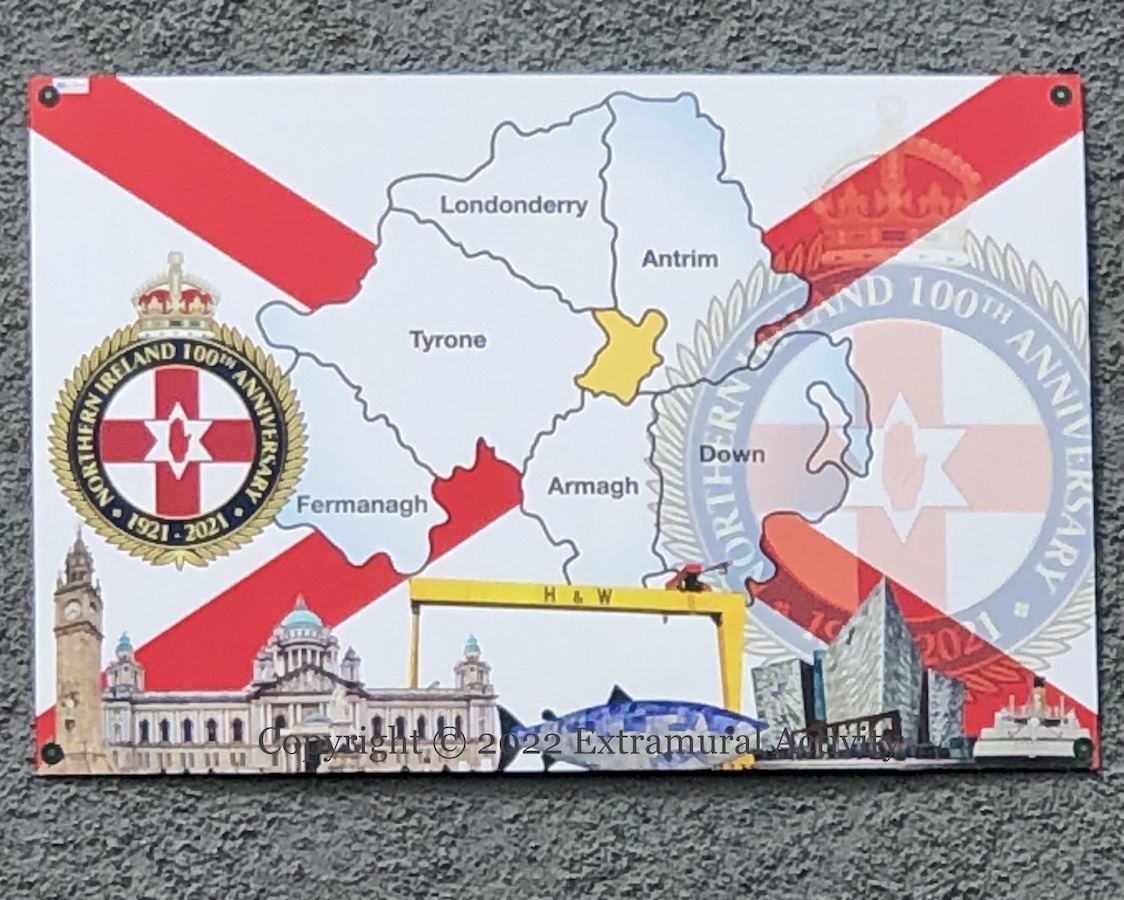
Of some interest in this Mersey Street NI Centenary board is the use of St Patrick’s saltire (in the background). The saltire is an anglo symbol of Ireland and was included in the Union Flag when the union was between Britain and Ireland and thus – like the word “Ulster” – has been reduced to meaning Northern Ireland after partition.

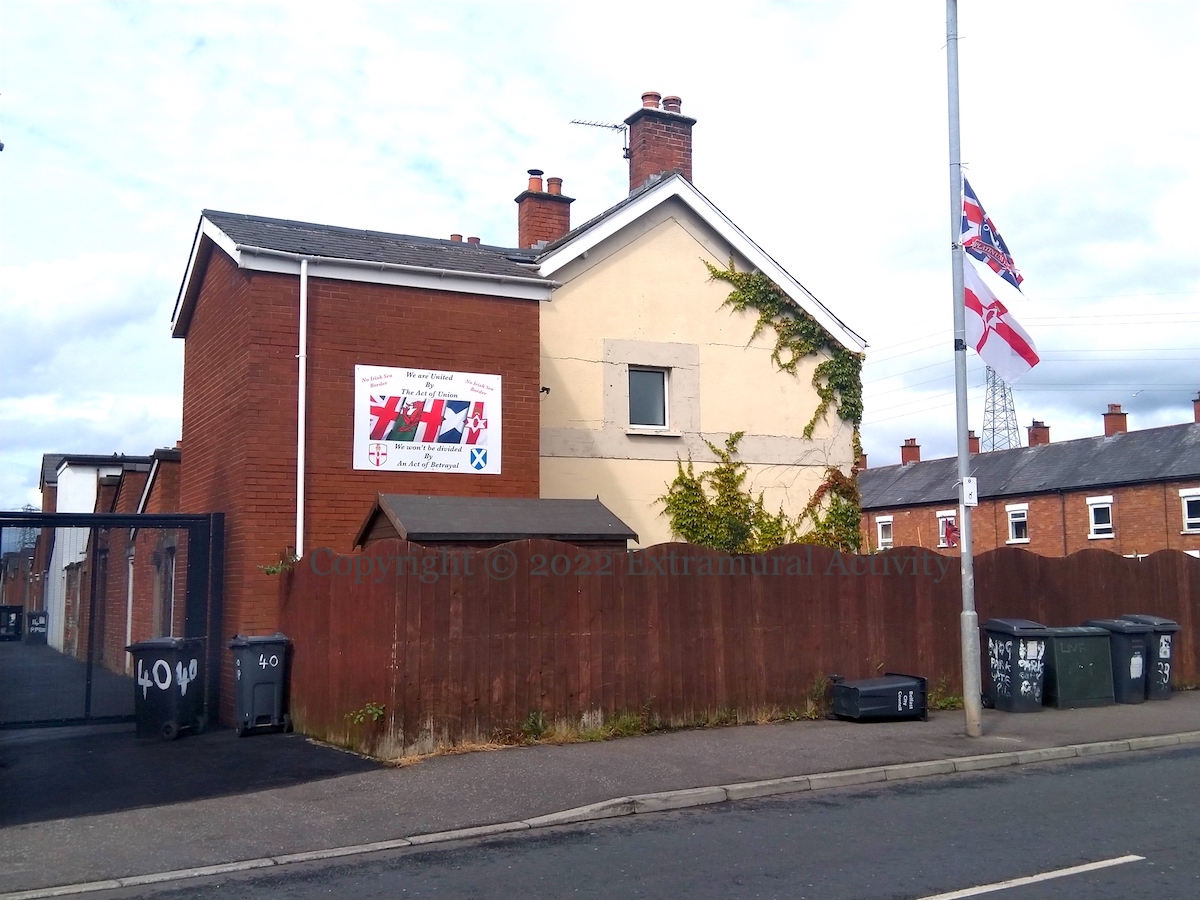
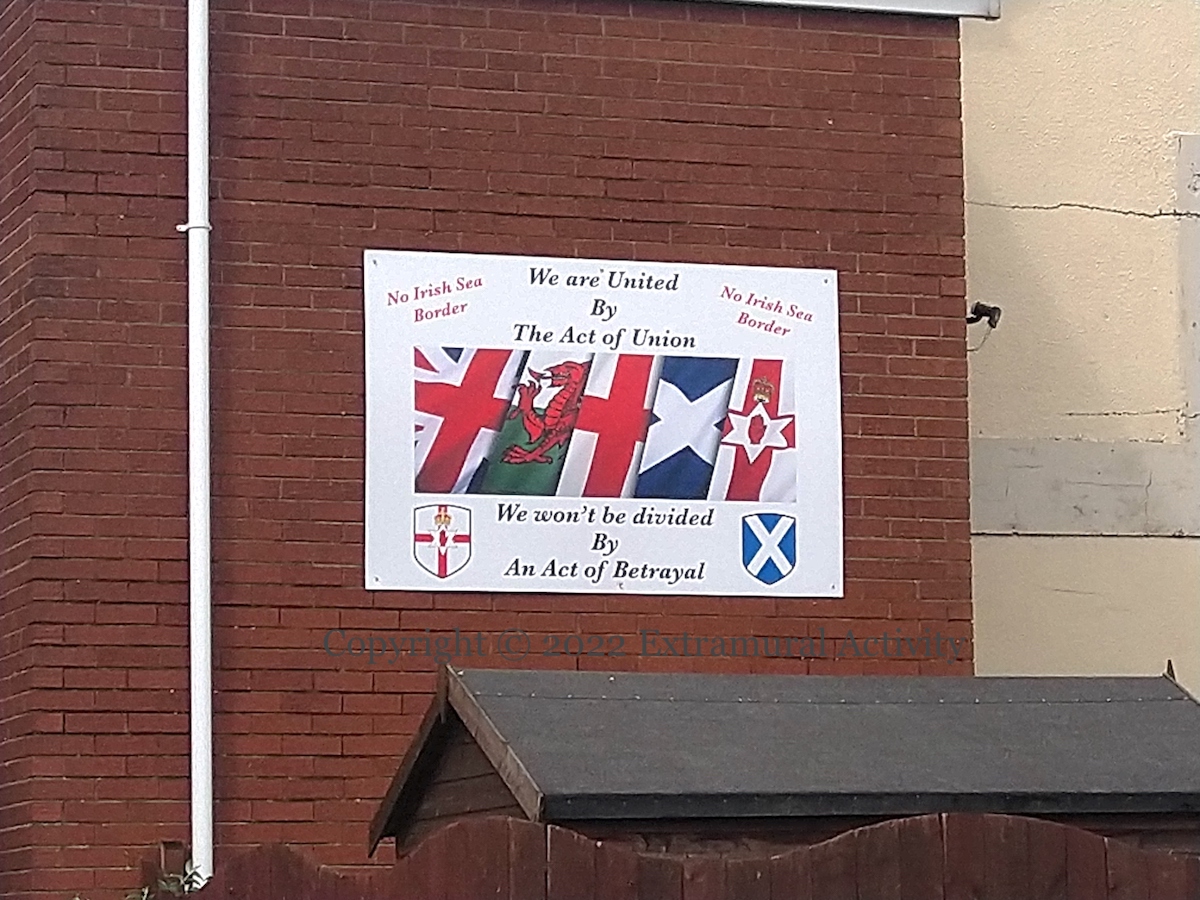
There is also an anti-Irish Sea border board on the next house along – see An Act Of Betrayal. This features the Union Flag together with flags representing the “home countries”: the Welsh dragon, the English St George’s Cross, the Scots St Andrew’s Saltire, and the Northern Irish Ulster Banner.

Click image to enlarge
Copyright © 2022 Seosamh Mac Coılle
X10358 X10356 X10357

Multicultural East Belfast

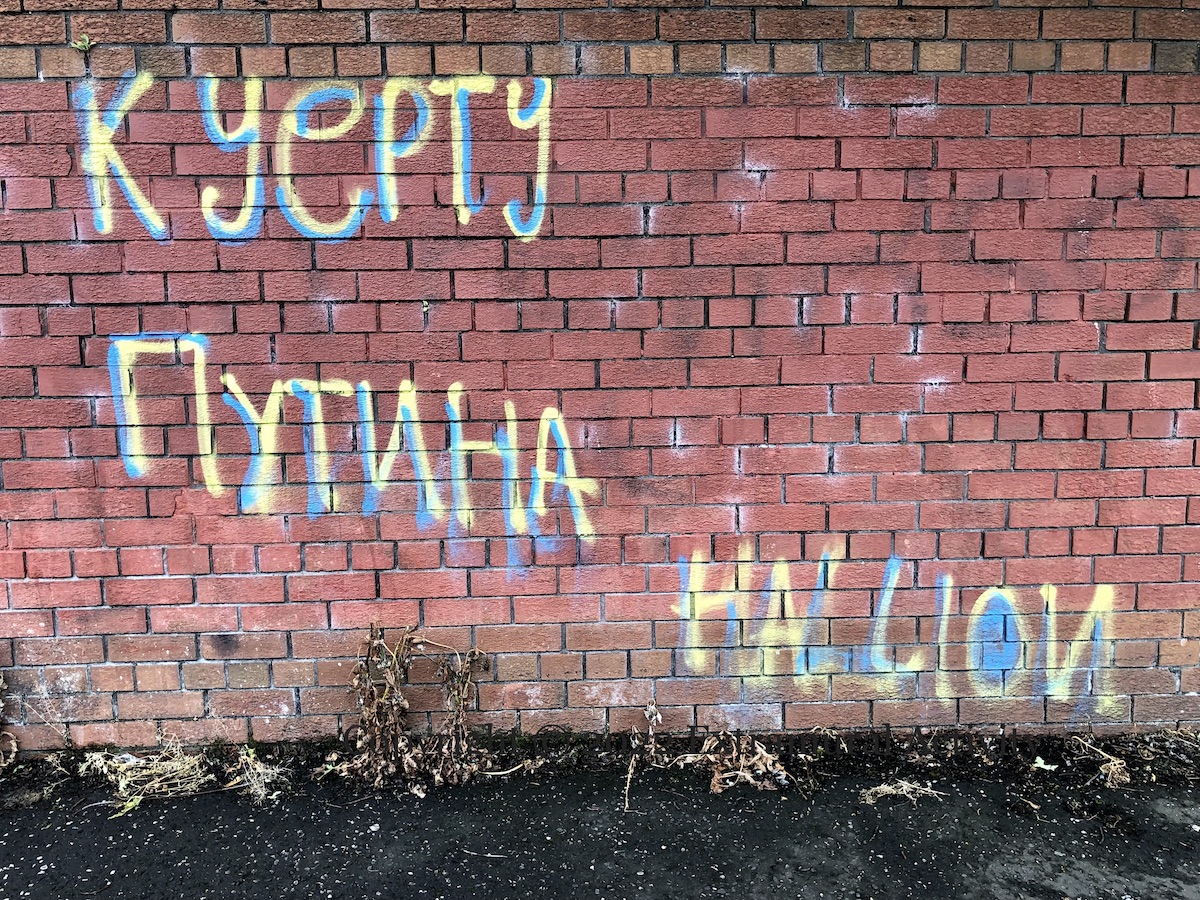
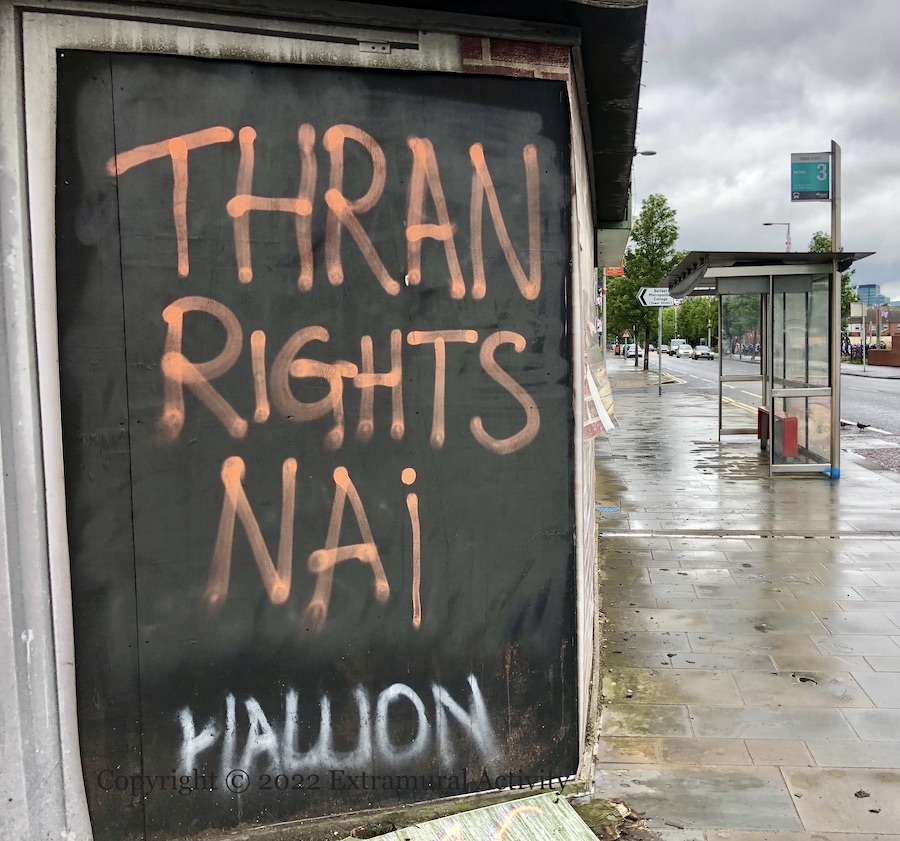
Topical commentary from East Belfast graffitist Hallion: Above, “к черту Путина”, in the blue-and-yellow of Ukraine, is Russian for “To hell with Putin” (or something a bit stronger); below, “Thran rights nai” – “thran” is an Ulster-Scots word meaning “stubborn” or “contrary” (entry for thra – the related verb – at Hamely Tongue) but perhaps here standing for Ulster-Scots in general and commenting on the tortured history of what is now (as of May 2022) the ‘Identity & Language’ bill (BBC) covering Irish/Gaeilge and Ulster-Scots/Ulstèr-Scotch in Northern Ireland. “Hallion” is itself is a Scots/north England word, meaning a scoundrel or rapscallion (MW | etymonline).

Previous Covid pandemic commentary from Hallion:
2020: Wash Your Hawnds | It Hasn’t Gone Away
2021: Wear A Mask Or The Easter Bunny Gets It

Click image to enlarge
Copyright © 2022 Seosamh Mac Coılle
X10311 [X10310] X10304 Tower St, Newtownards Rd

Children In Crossfire

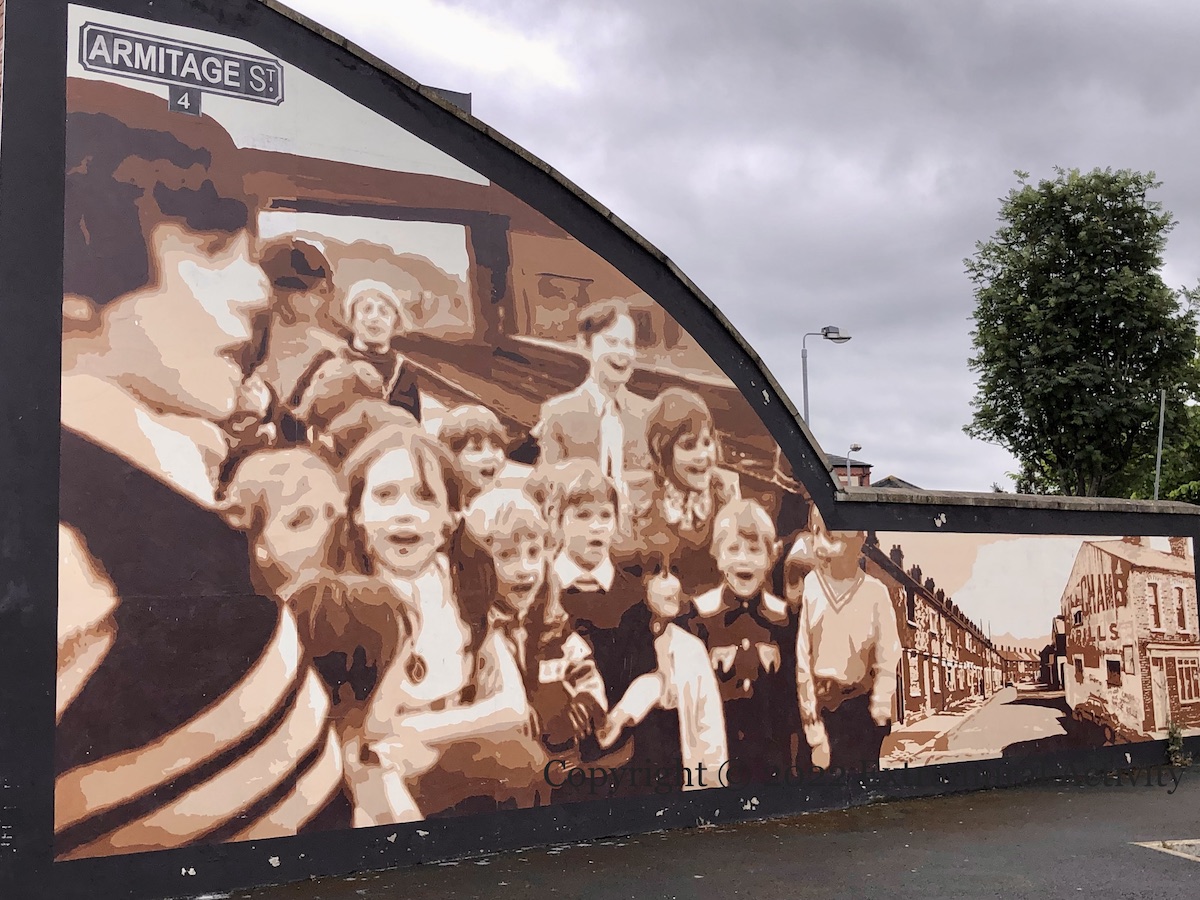
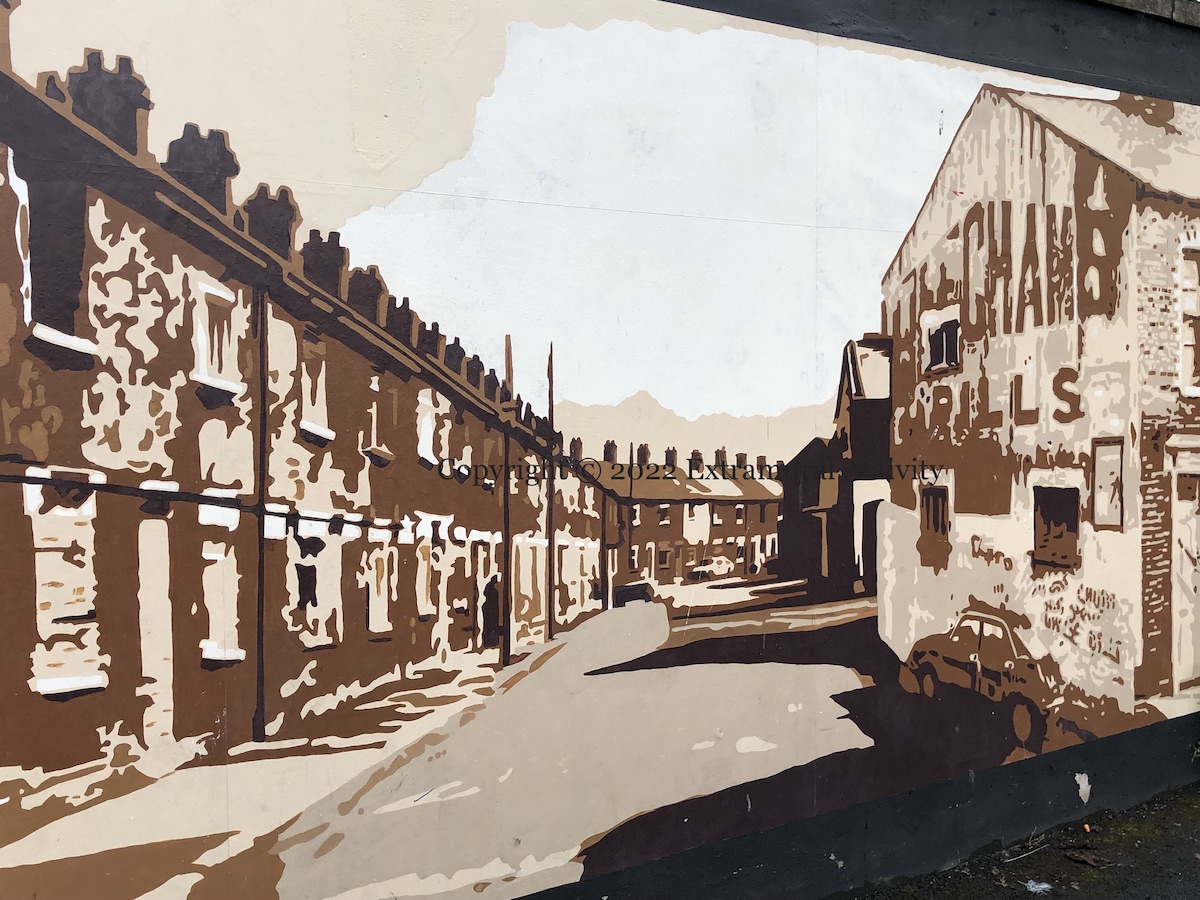
Michael Blakstad’s Children In Crossfire is a justly famous documentary portraying the lives of children in Creggan (Derry) and various areas of Belfast, such as Ballymurphy & Springmartin, Divis, and the area around Gawn St in east Belfast. The documentary is on youtube and an image from it (c. 28m 13s) is depicted in this mural (Connswater Chronicle) at the foot of the Dee Street overpass into what is now the “Titanic Quarter”.

The panel to the right shows the original Armitage Street; the area has been redeveloped and the street was built over with a cluster of houses named Armitage Close.

By Dee Craig with support from the Housing Executive, City Council, and Connswater Homes.

Click image to enlarge
Copyright © 2022 Seosamh Mac Coılle
X10317 X10318