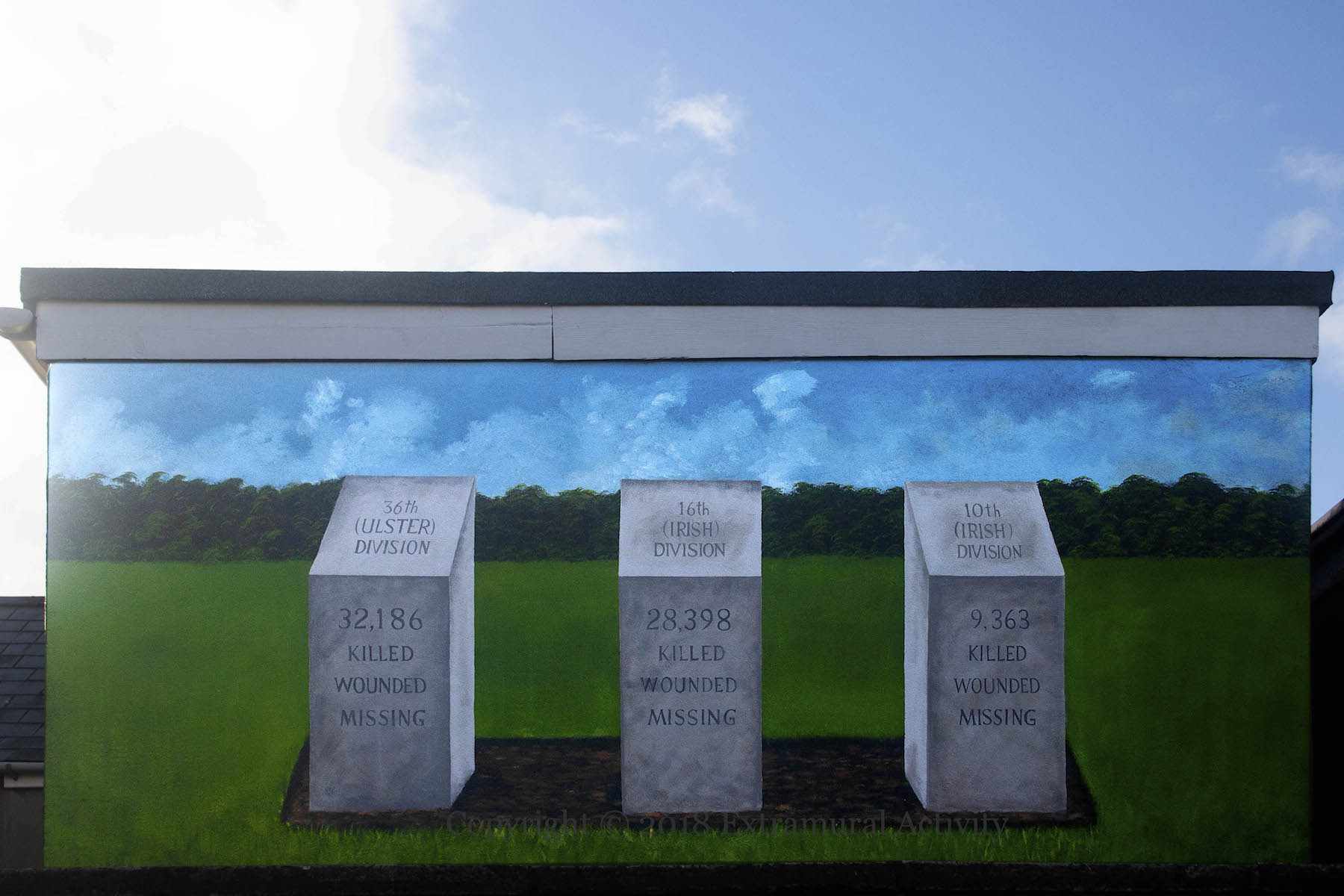
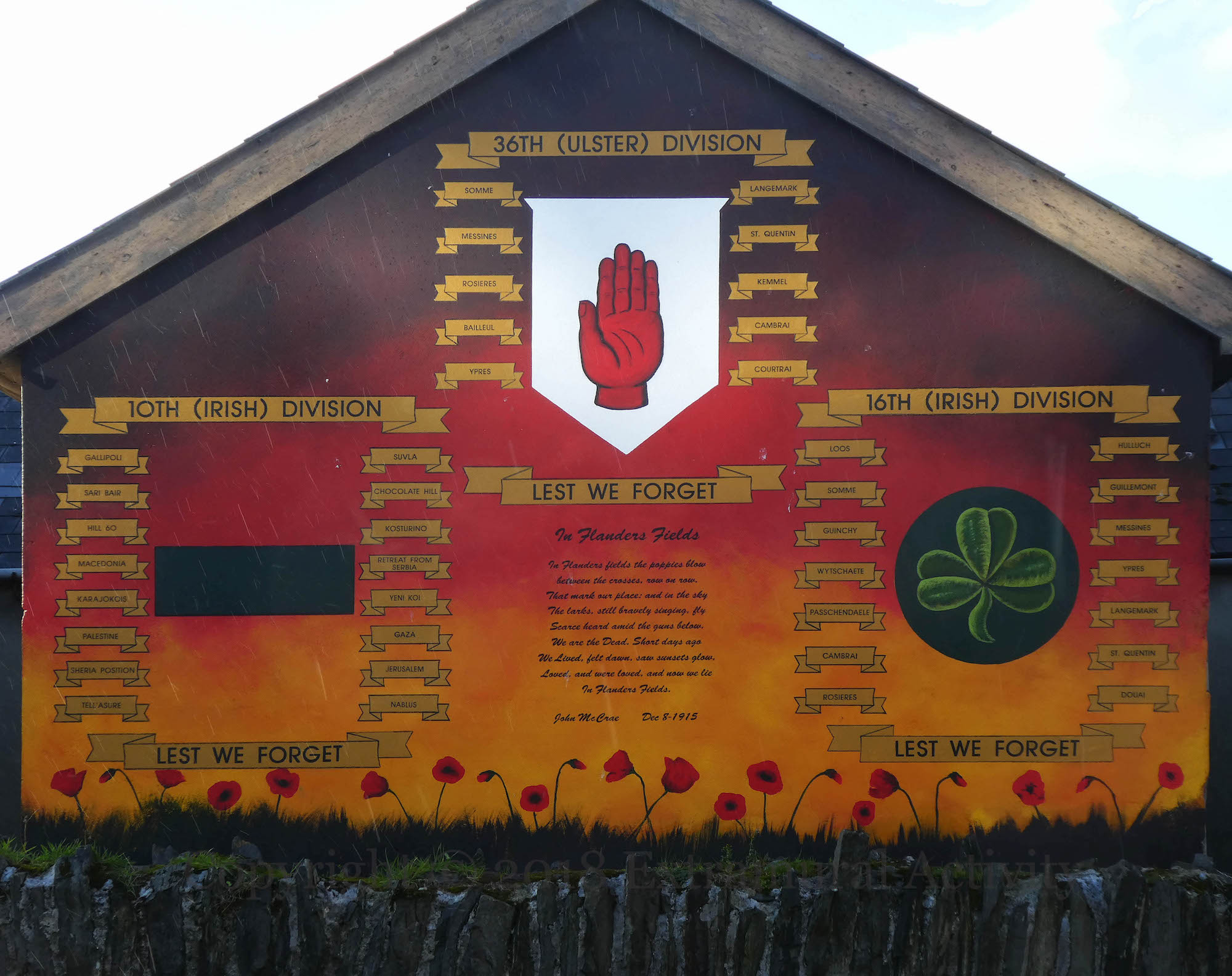
This small mural in the car-park of the Waterside Arts Centre, a companion piece to We Are The Dead which lists their battles, gives casualty totals for the 10th (Irish), 36th (Ulster), and 16th (Irish) divisions of the British Army in WWI .
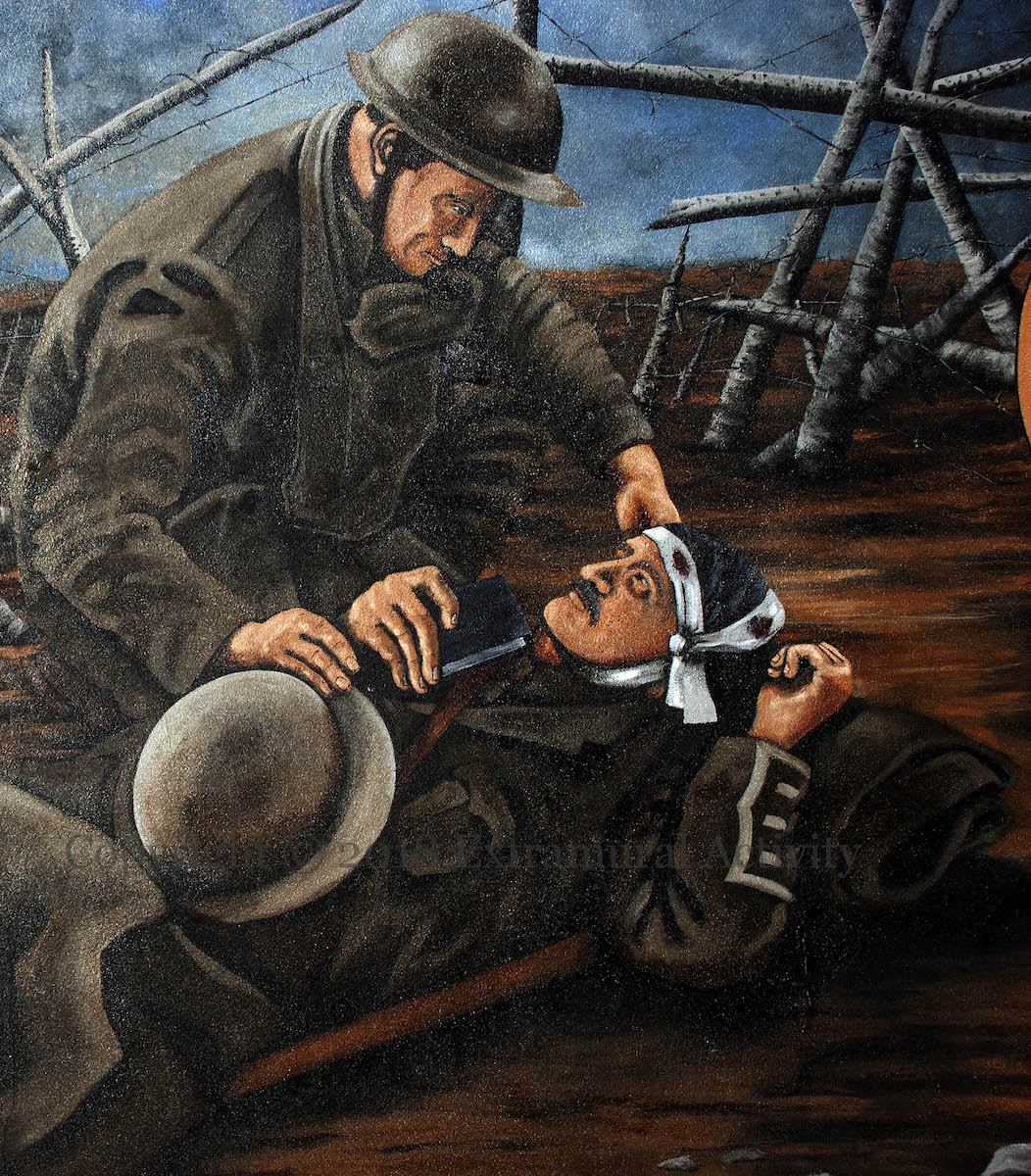
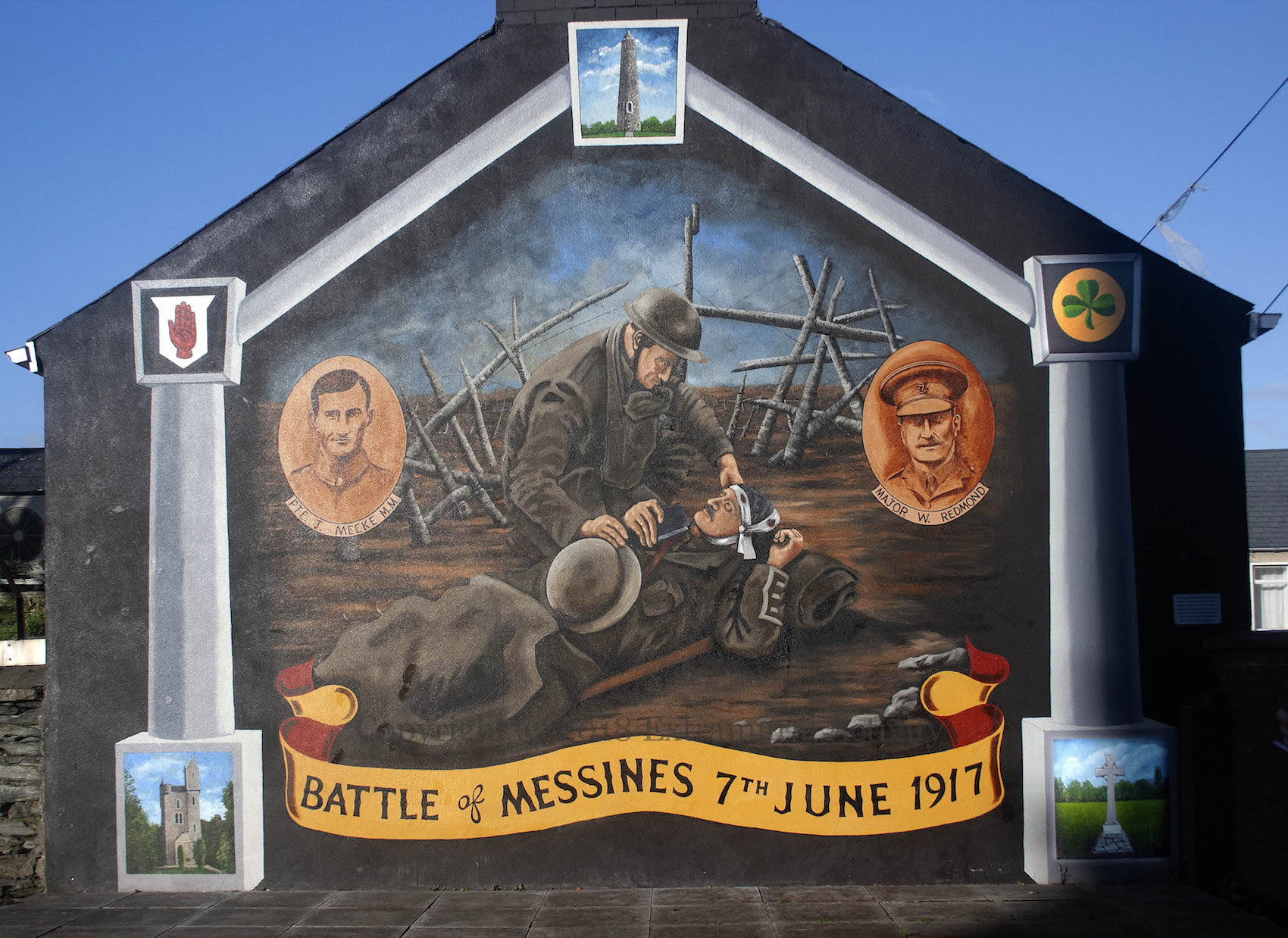
John Meeke signed the Ulster Covenant in Dervock Orange Hall in 1912 and went to war with the Ulster Volunteers. Willie Redmond, brother of John Redmond, had been jailed three times and was a nationalist MP at Westminster when, at age 53, he signed up for service.
Major Redmond went over the top with the 16th (Irish) Division at Messines Ridge and was hit by machine-gun fire. Private Meeke, a stretcher-bearer with the Royal Inniskilling Fusiliers in the 36th (Ulster) Division, found and stayed with Redmond under heavy fire, taking two bullets himself.
Redmond would die that night. He was awarded the Legion Of Honour by the French. His East Clare seat was taken by Éamon de Valera. Meeke survived after several surgeries. He was awarded the Military Medal by the British. After the World War, he joined the Specials and LOL 1001 in Benvarden before dying of TB in 1923 (NALIL | Irish Times | WP | BelTel).
The 10th (Irish) Division fought only briefly “in Flanders fields”, towards the very end of the war, having spent most of its time in Gallipoli (in the Ottoman Empire), Macedonia, Egypt, and Palestine. The 16th took part in the Somme, especially at “Guinchy” [Ginchy] and Guillemont, while the 36th were deployed on the first day (the Battle Of Albert).
The poem in the middle is the first half of John McCrae’s In Flanders Fields: “In Flanders fields the poppies blow/Between the crosses, row on row/That mark our place, and in the sky/The larks, still bravely singing, fly/Scarce heard amid the guns below.//We are the dead; short days ago/We lived, felt dawn, saw sunset glow/Loved and were loved, and now we lie/In Flanders fields.”
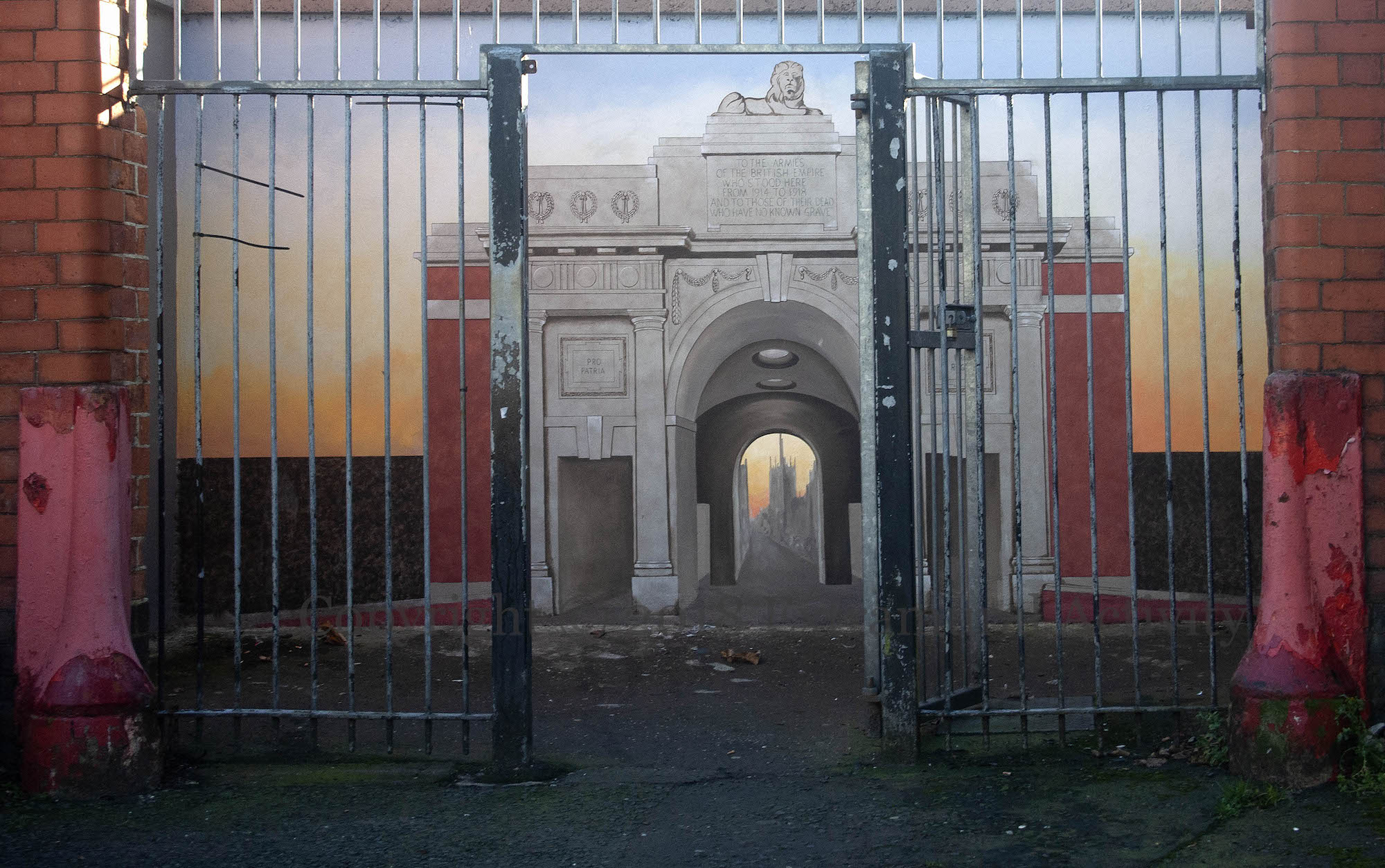
The Menin Gate memorial, at the eastern edge of Ypres, Belgium, commemorates 54,896 Commonwealth soldiers who died in the area during WWI and whose bodies were not recovered. “To the armies of the British Empire who stood here from 1914 to 1918 and to those of their dead who have no known grave.” The gates in the image above are off Bond’s Street, Londonderry, leading to the Ebrington Centre car park.
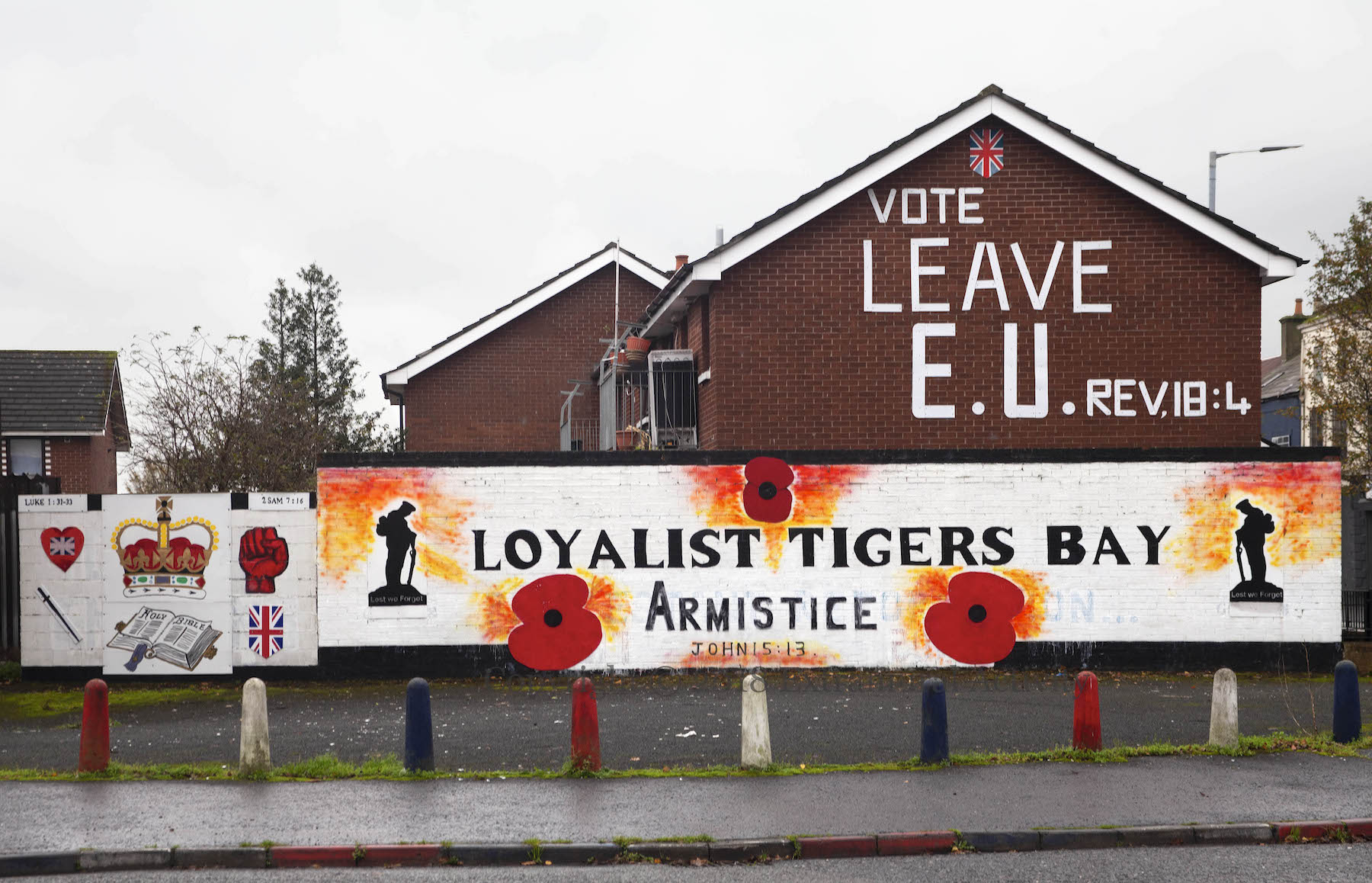
John 15:13 reads “Greater love hath no man than this: to lay down his life for his friends.” Fighting in the Great War ceased at 11 a.m. on November 11th, 1918, after approximately 10 million military deaths, 10 million civilian deaths, and another 20 million injured.
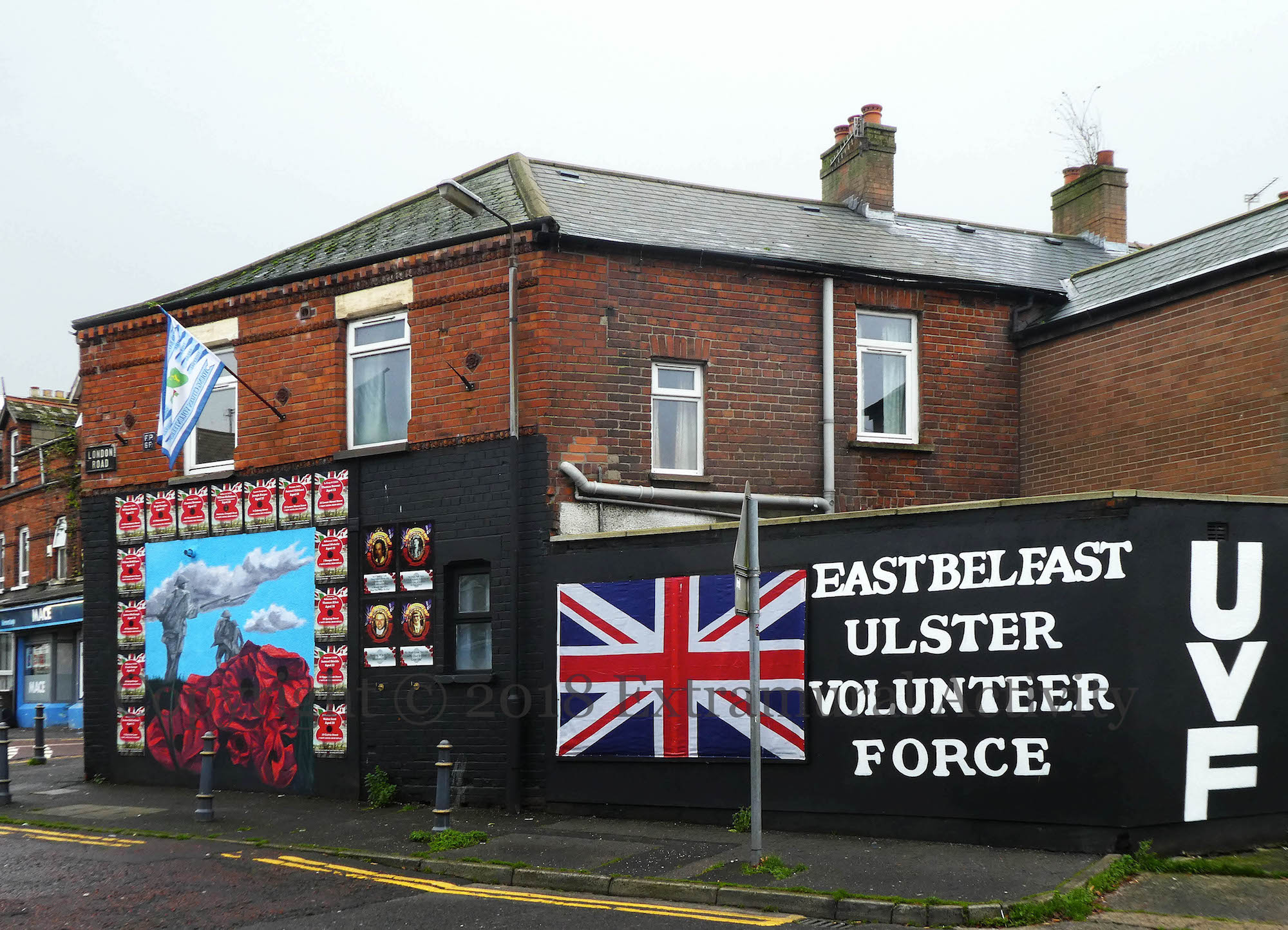
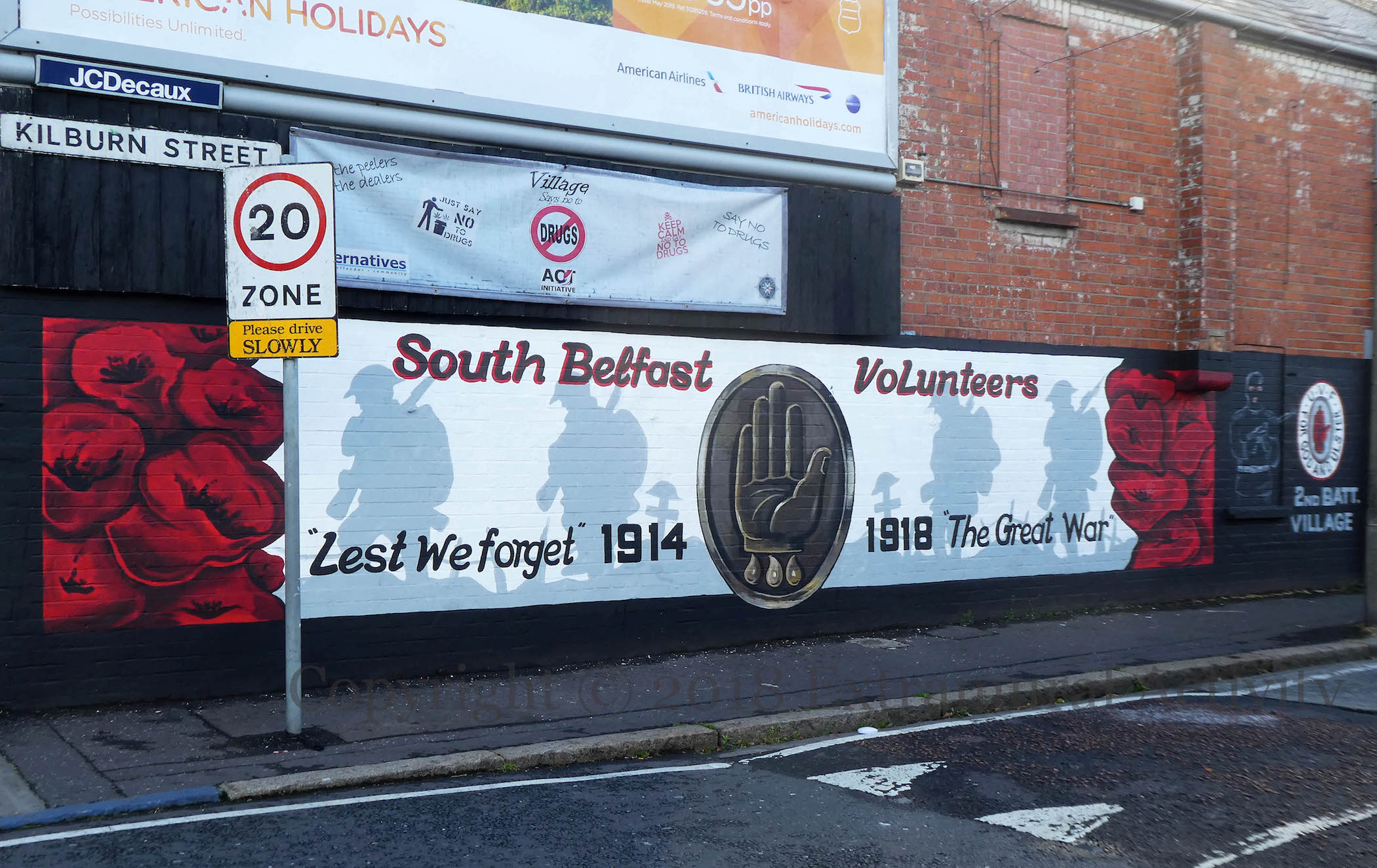
The Union Flag/UVF side-wall is a new addition to the Ulster Volunteers/UVF memorial in London Road, east Belfast. The main panel shows WWI soldiers going over the top (see Between The Crosses) while the four portraits to its right are of deceased UVF volunteers of the 70s and 80s – Seymour, Long, Cordner, and Bennett – (see Ulster’s Brave).
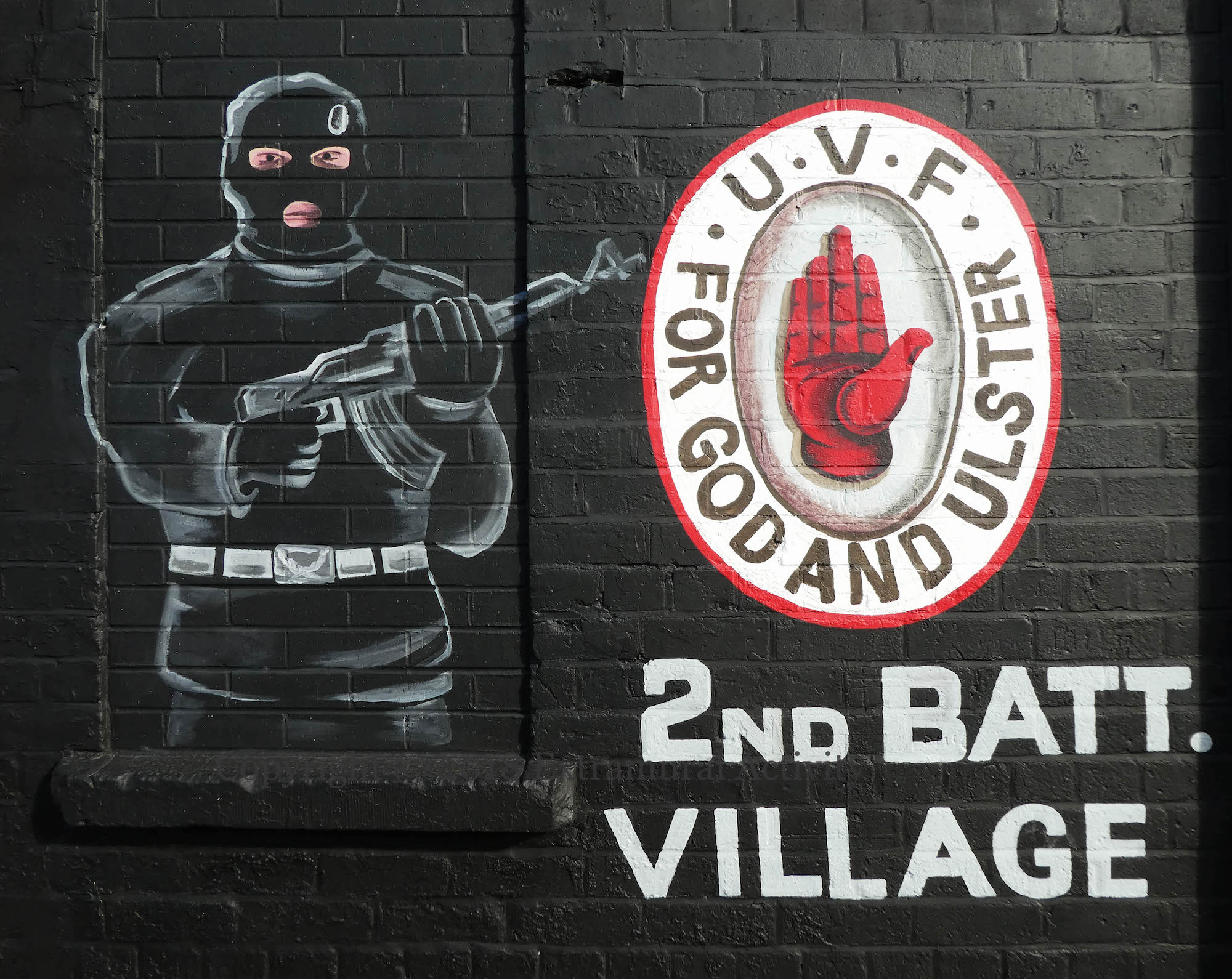
The main panel (shown below) is a tribute to soldiers in the Great War (1914-1918), with a border of poppies and silhouetted soldiers reflecting over helmets on crosses. To the side, however, is the modern UVF volunteer (shown above), with balaclava and assault rifle.
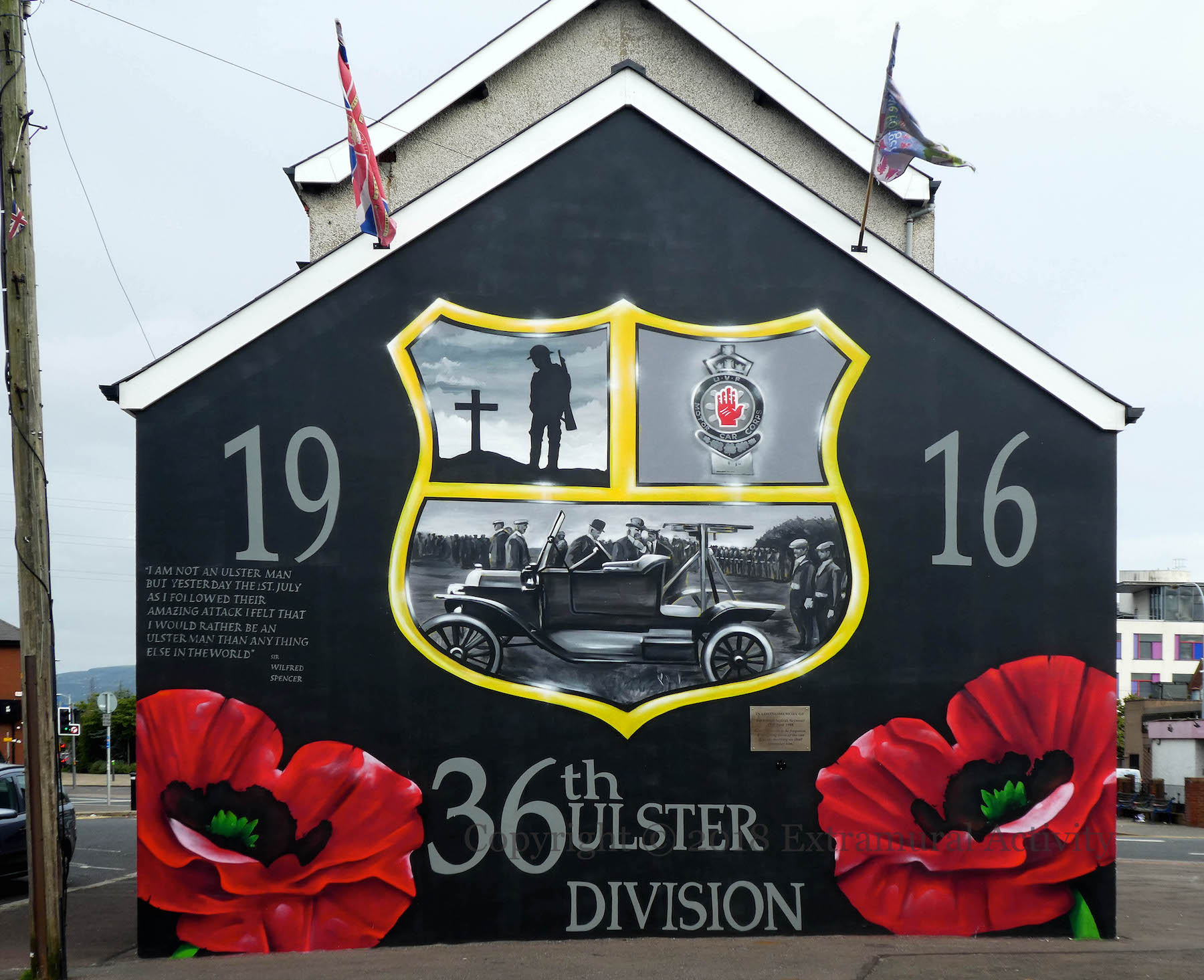
The first time that the horseless carriage was used in a military operation was the Ulster Volunteers’ “Larne Gunrunning” of April 1914. By this time, there are thought to have been 350 vehicles in the Corps (Angelsey). It’s not clear whether the cars were later used by the 36th (Ulster) Division – please comment/get in touch if you can shed light on this. (For Spencer’s quote on the left, see I am not an Ulsterman.) The plaque is to (modern) UVF volunteer ‘Squeak’ Seymour.
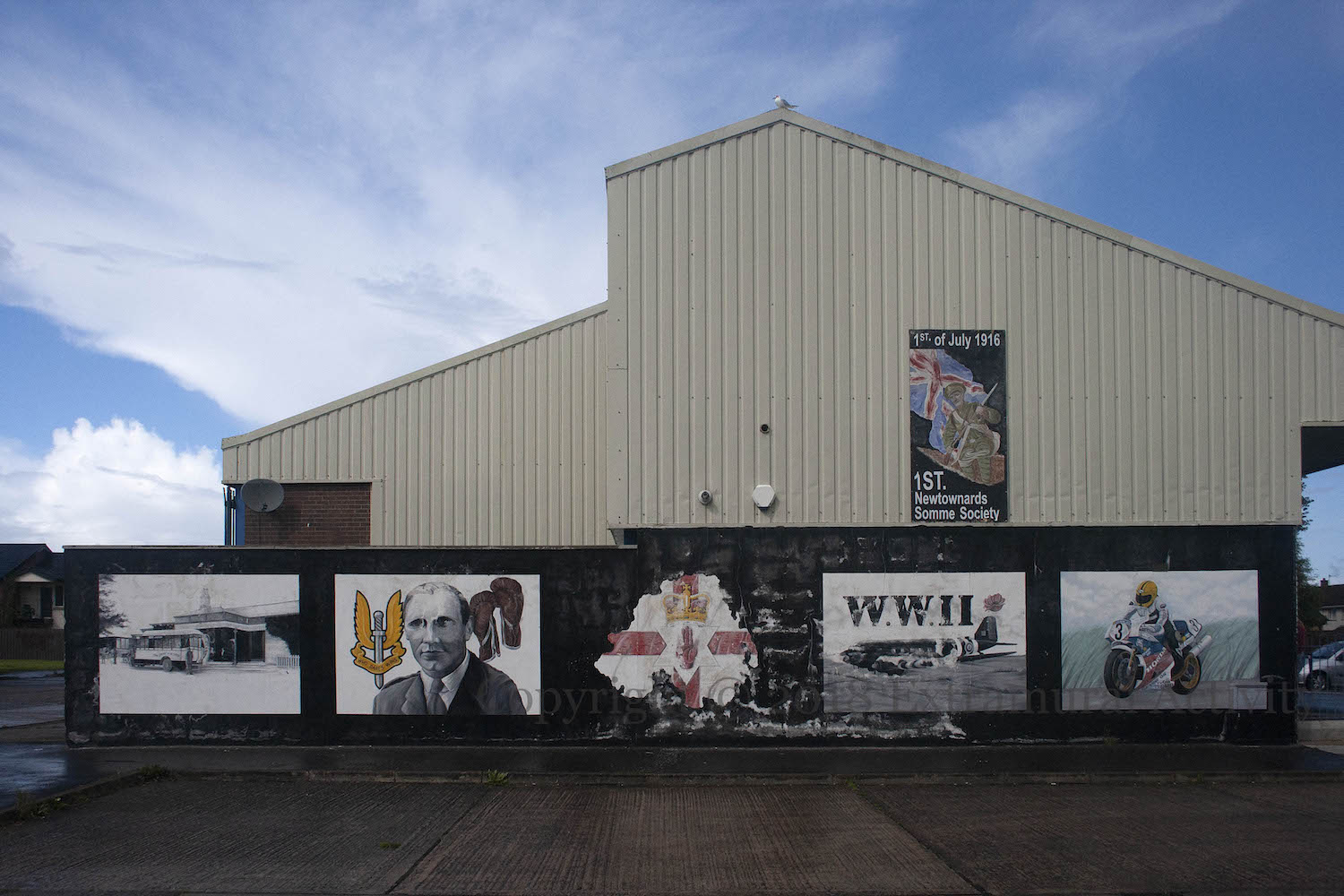
Here are six panels from the shops in the Westwinds estate in Newtownards, which have replaced a UVF mural (Help Us To Help You).
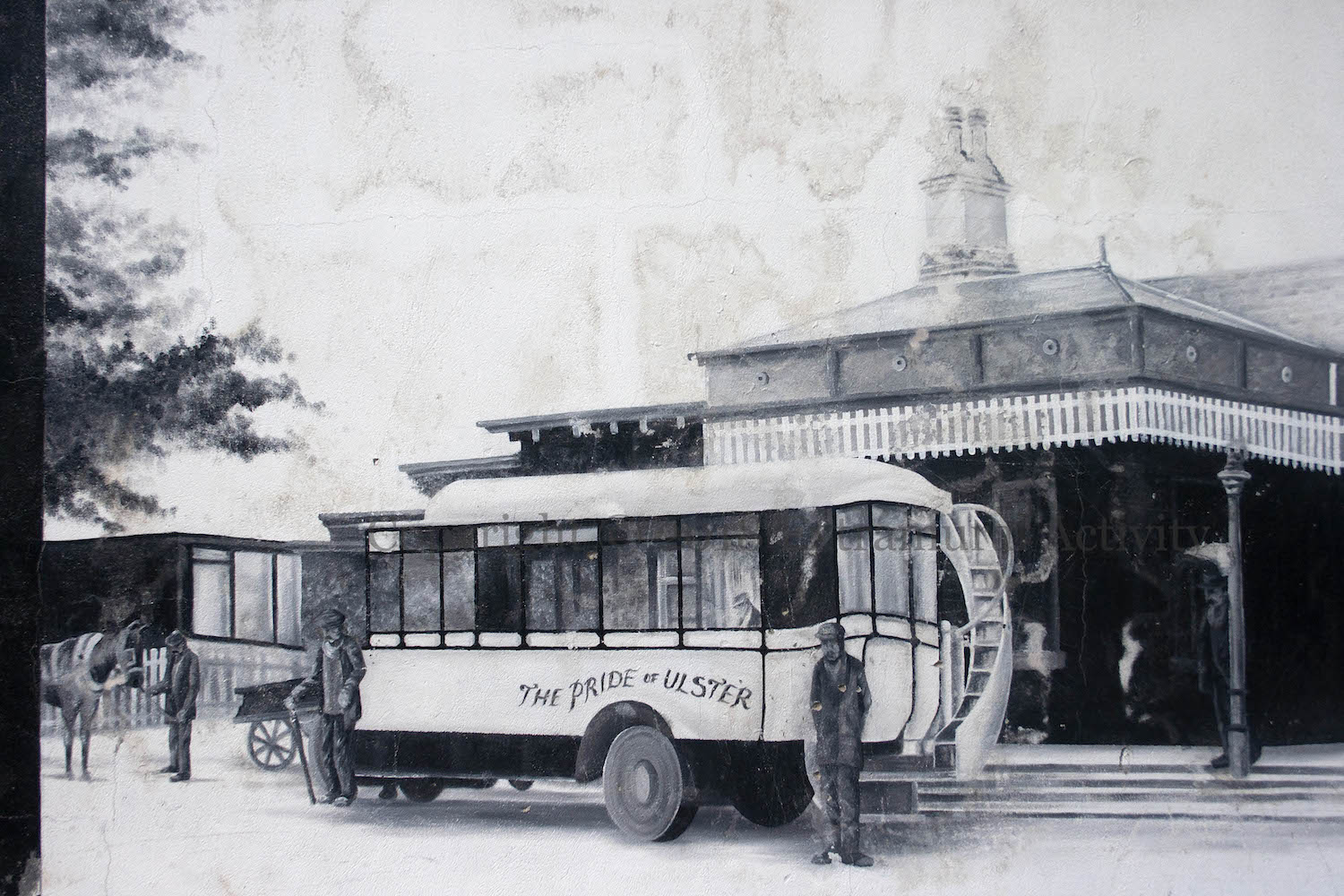
Little is known about the omnibus called “The Pride Of Ulster”, except that this picture shows it at Newtownards Railway Station, Victoria Avenue, c. 1920. SAS soldier and boxer (and rugby-player) Blair “Paddy” Mayne, DSO, is portrayed in the second panel. (For more, see these posts about Mayne from 2013 and 2014.).
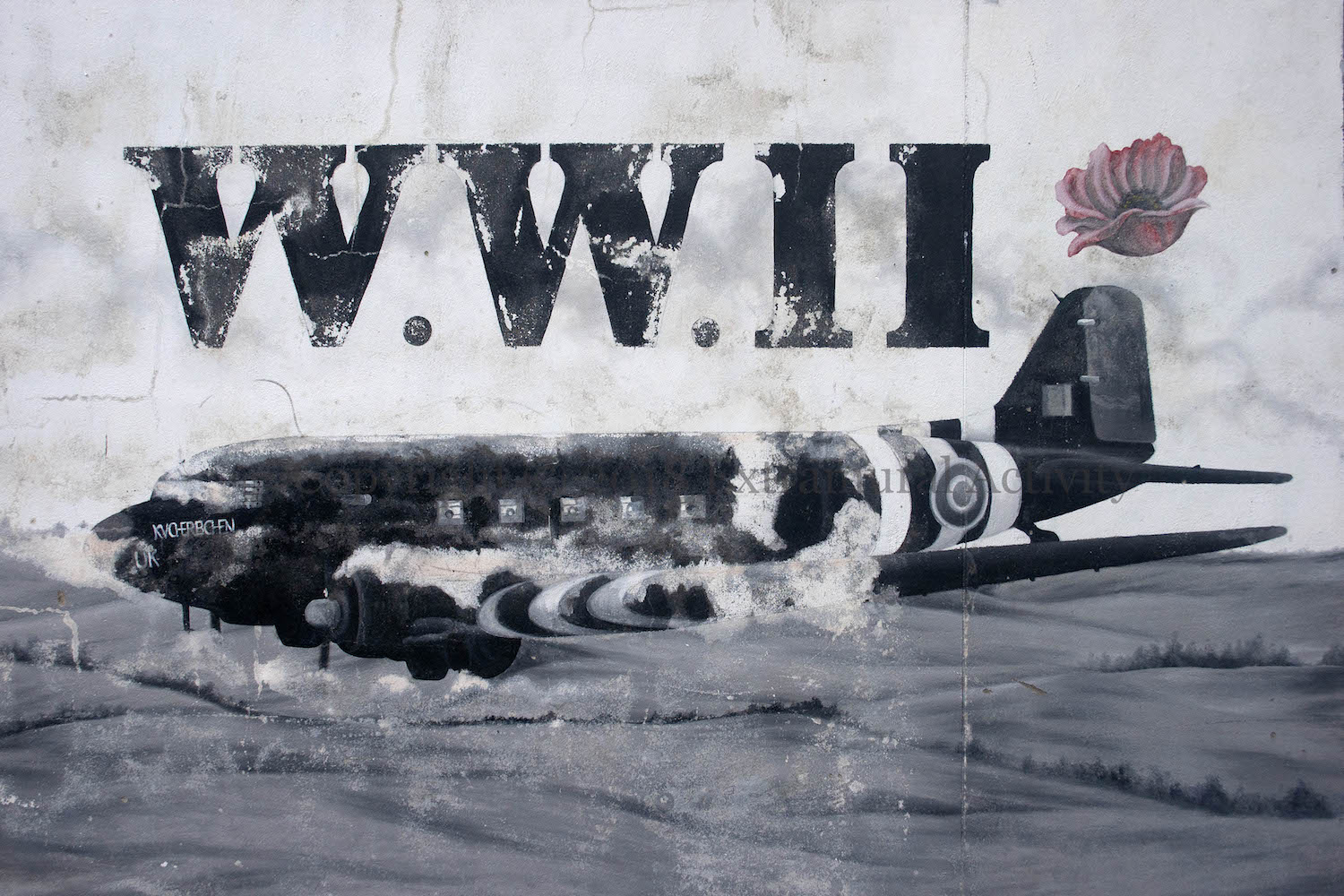
On the other side of the Ulster Banner in the centre is a WWII Douglas Dakota C-47, specifically “FZ692 of No. 233 Squadron, around the D-Day period in 1944. This aircraft, which was named “Kwicherbichen” by her crews, was involved in Para-dropping operations on the eve of D-Day and subsequently in re-supply and casualty evacuation missions into and out of forward airfields in the combat areas” (RAF).
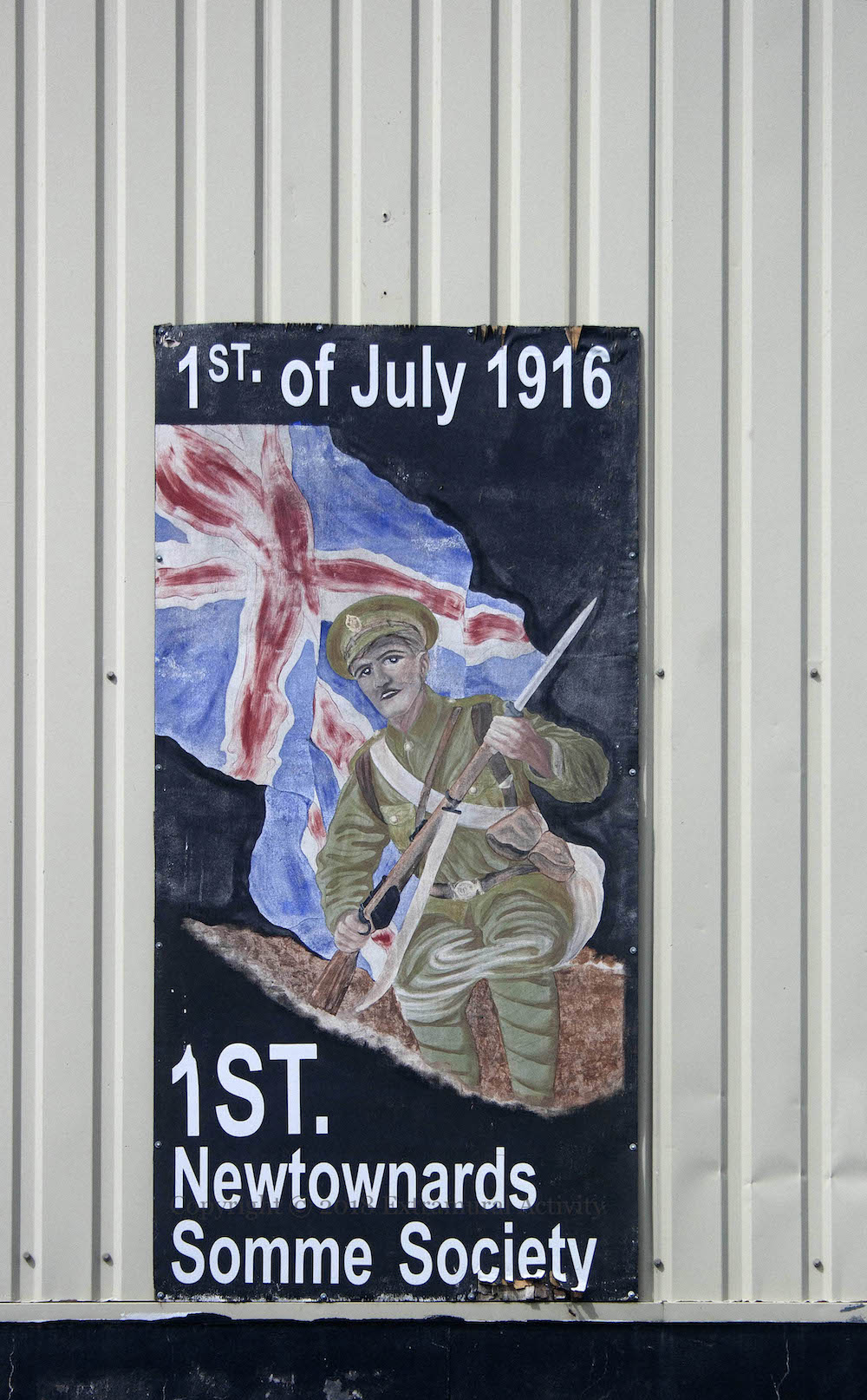
Motorcyclist Joey Dunlop is on the far right (see Race Of Legends), and above them all is a WWI board from the 1st Newtownards Somme Society (based in the Somme museum in Conlig?).
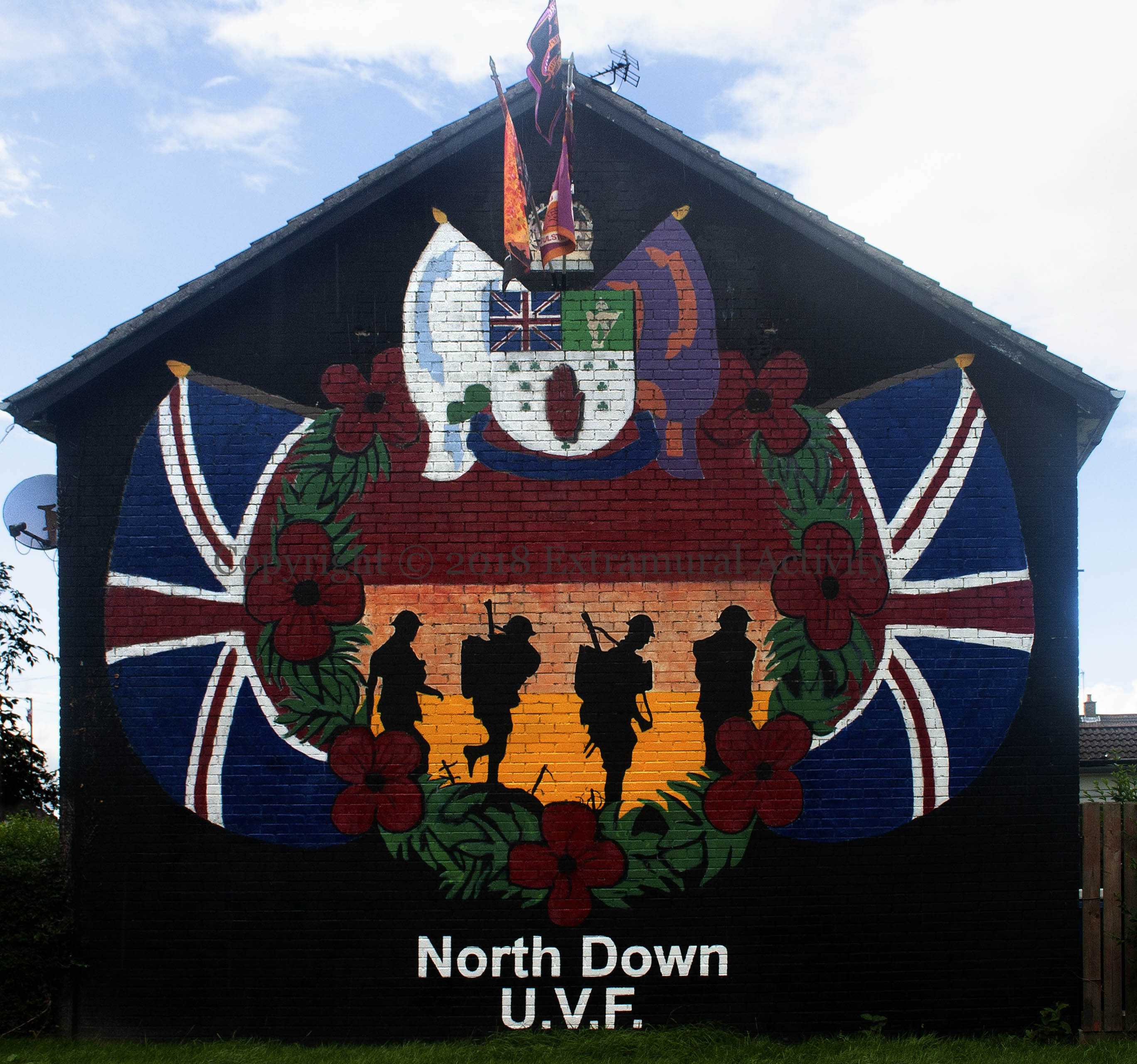
This mural at the bottom of Kilcooley estate in Bangor has recently been repainted, with the main alteration being the “North Down UVF” replaces “1st July 1916”, focusing attention on the locals from battalion that joined the 36th and away from the Somme. (See the previous mural in 1st July 1916.)
 Seosamh Mac Coille Collection