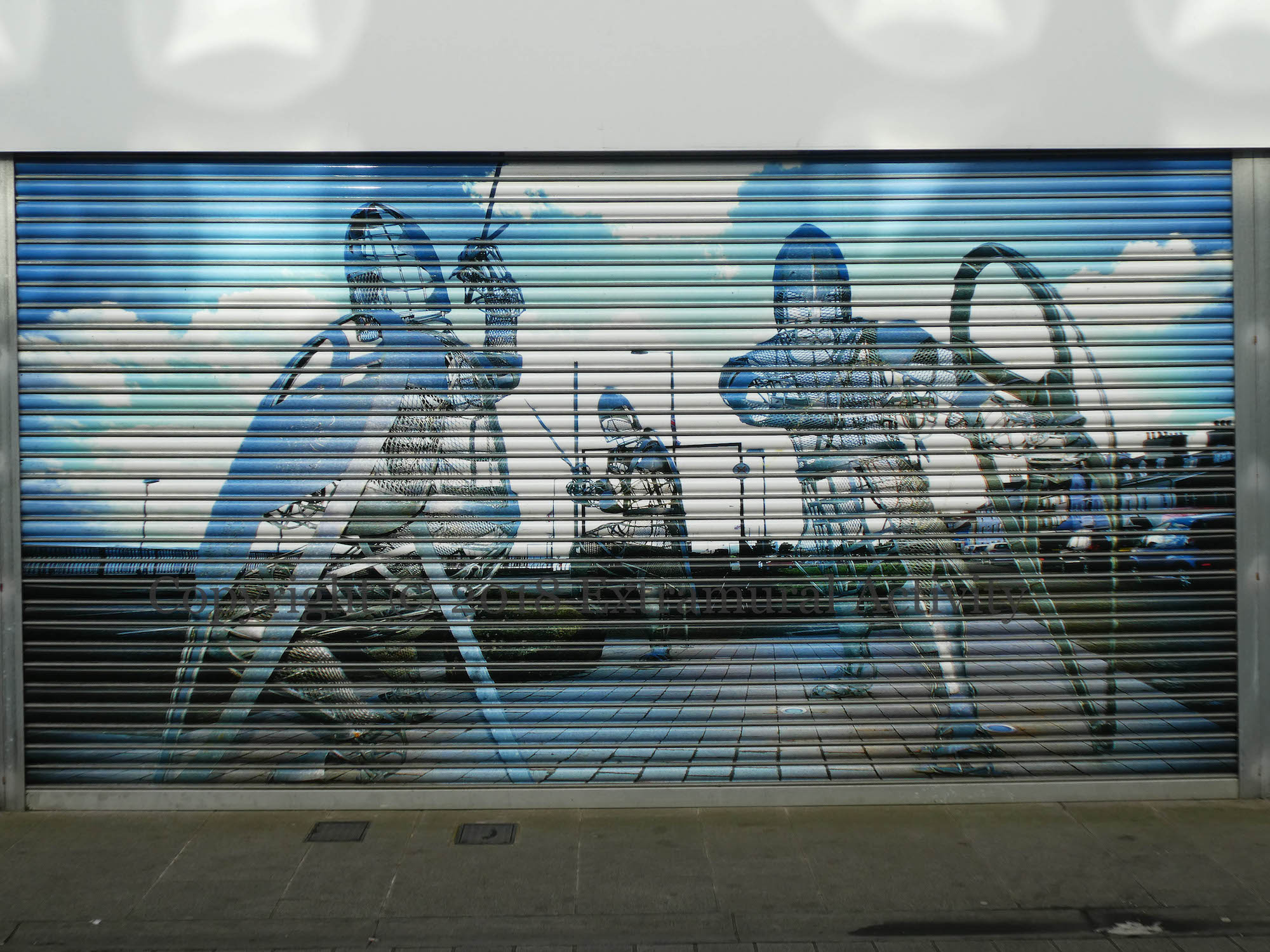
Carrickfergus dates back to the 1100s and contains a well-preserved Norman castle. The mediaeval history of the town is celebrated in a trio of knight statues in Marine Gardens.
Shown today is not the statue itself, but a photographic reproduction on shutters in West Street.
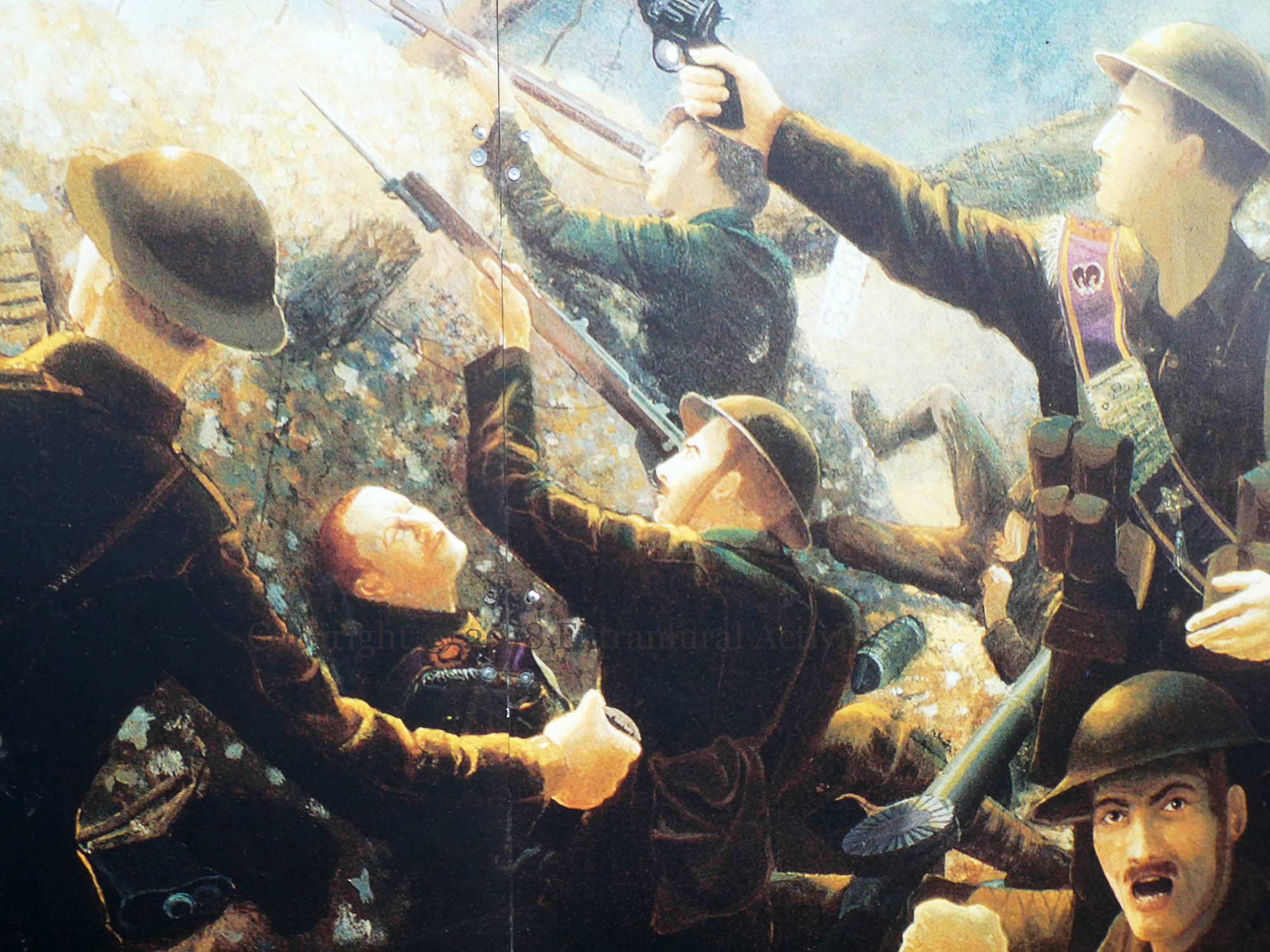
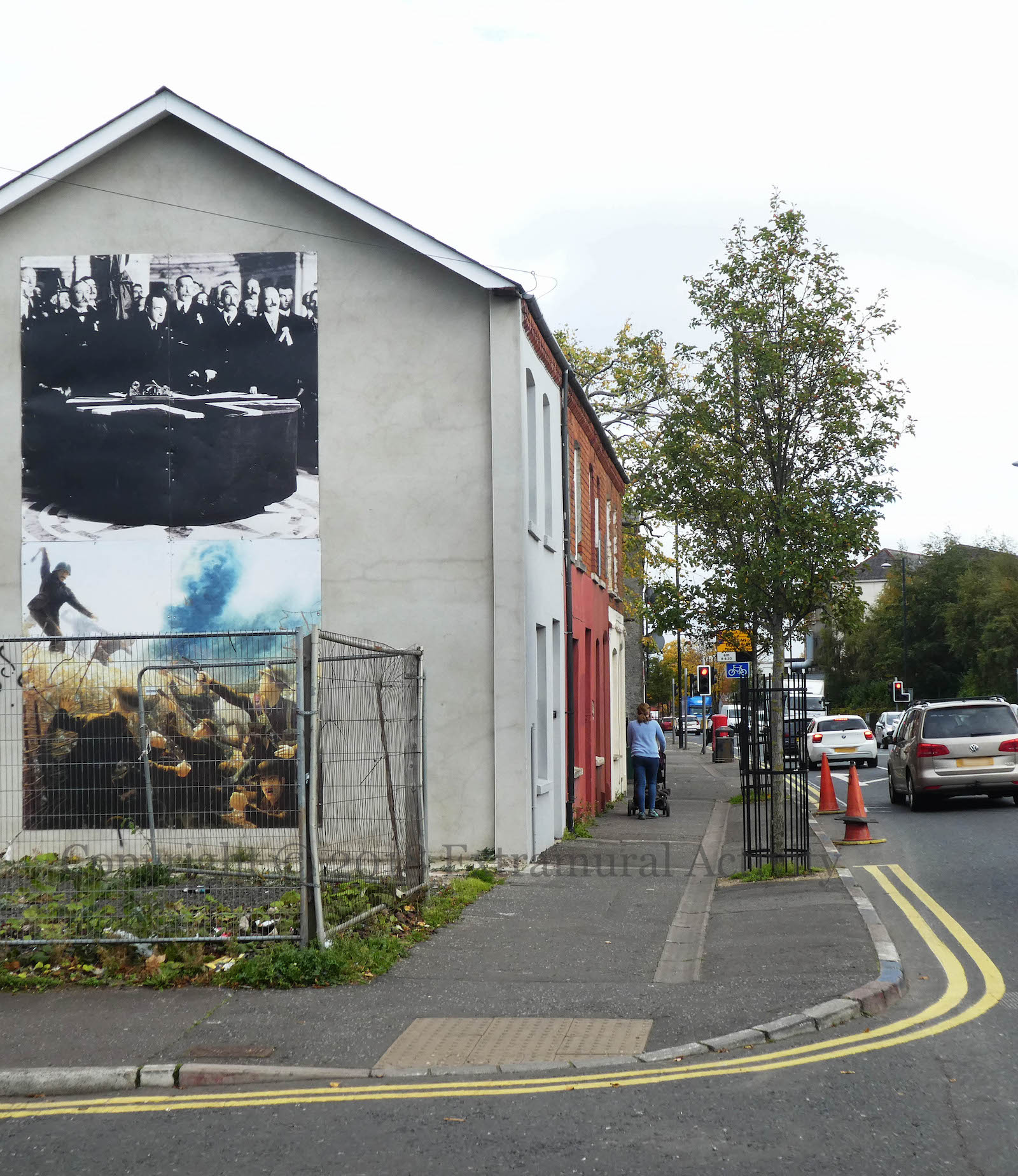
For the third time, these two panels – one of the signing of the Covenant in 1912 and the other of soldiers in collarettes and sashes defending their trench against a German attack – are visible at Barrington Gardens. They were originally on the gable at the corner before it was demolished (see July 1st); during re-development they were placed on a metal frame (see Out Of The Rubble).
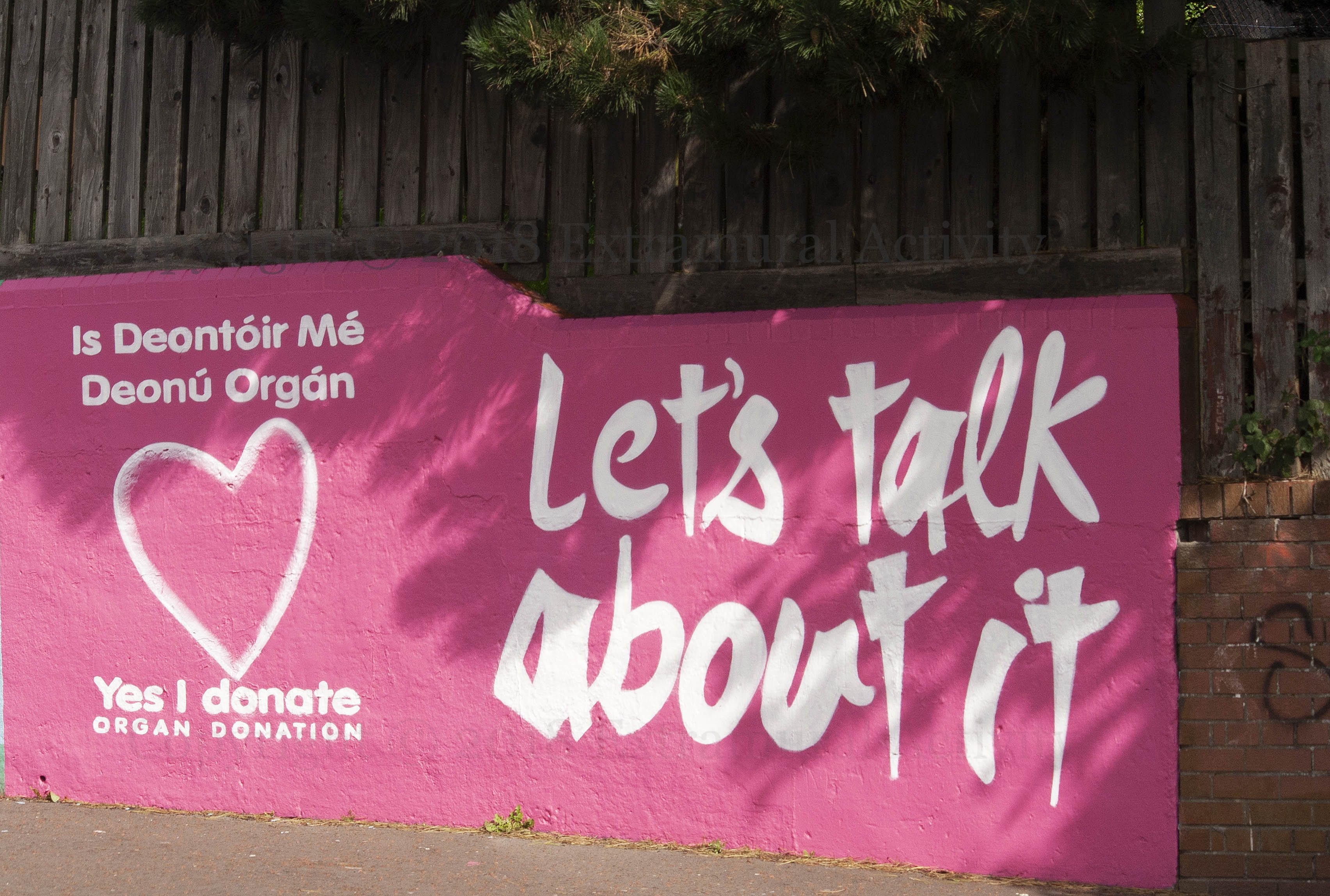
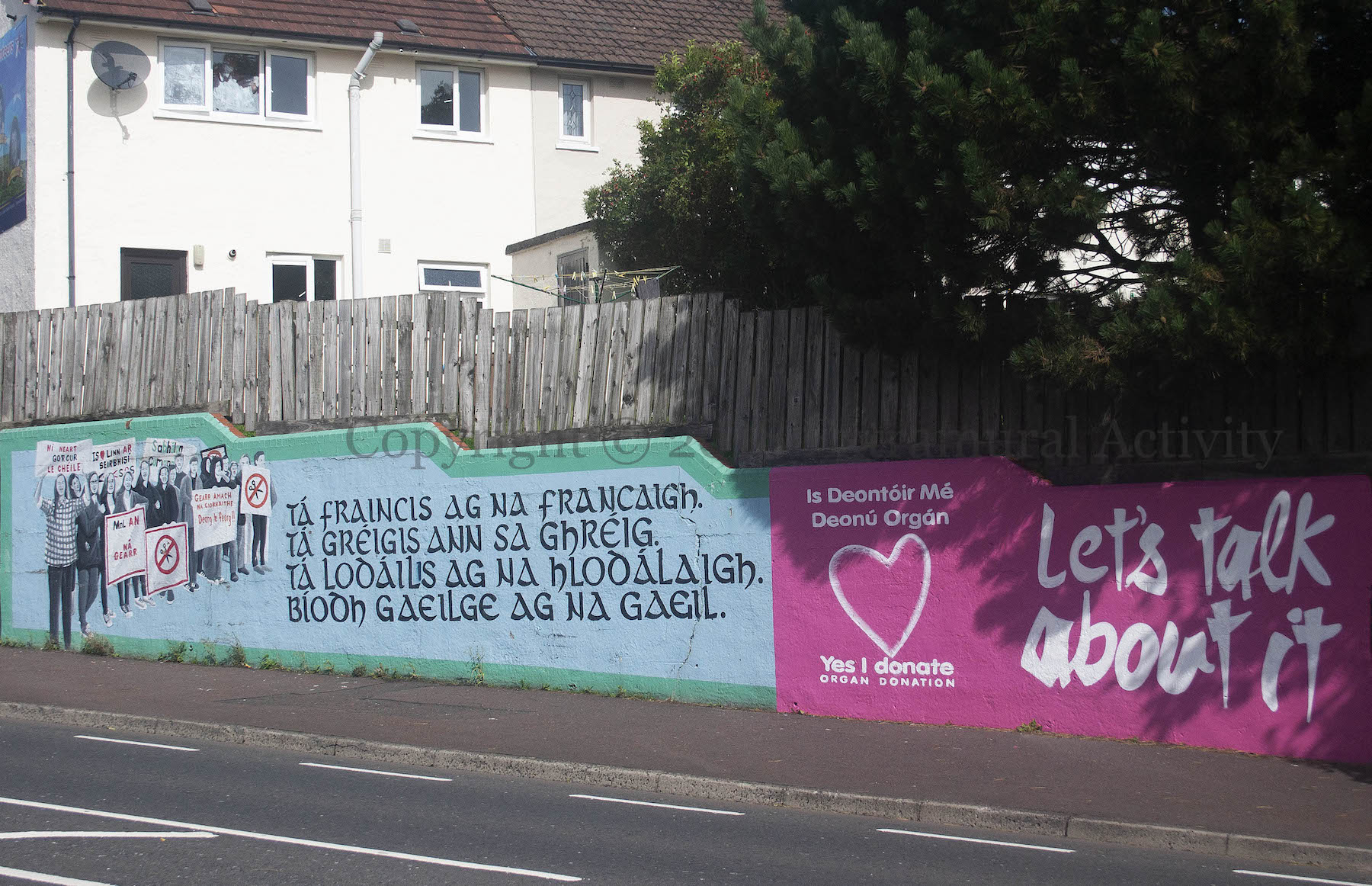
500 people took part in the 10K Na Ceathrún Gaeltachta/Gaeltacht Quarter 10K last Sunday to raise awareness for organ donation. Youngster Dáıthí Mac Gabhann (Donate4Daithí Fb) has become the face of the Irish-language campaign; his Facebook site has a gallery of 300+ images from the race. The mural above is on the Whiterock Road. You can register as a donor with the NHS.
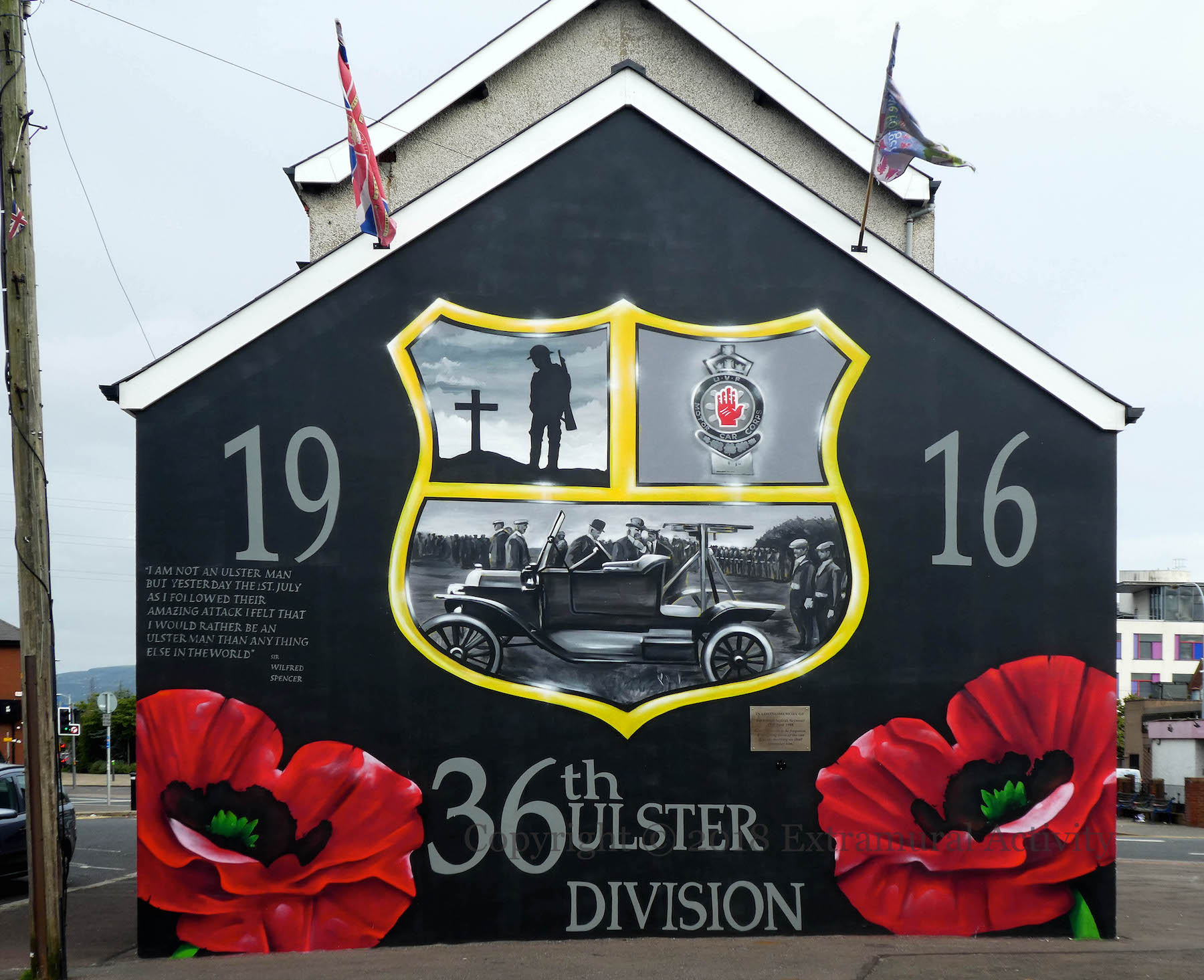
The first time that the horseless carriage was used in a military operation was the Ulster Volunteers’ “Larne Gunrunning” of April 1914. By this time, there are thought to have been 350 vehicles in the Corps (Angelsey). It’s not clear whether the cars were later used by the 36th (Ulster) Division – please comment/get in touch if you can shed light on this. (For Spencer’s quote on the left, see I am not an Ulsterman.) The plaque is to (modern) UVF volunteer ‘Squeak’ Seymour.
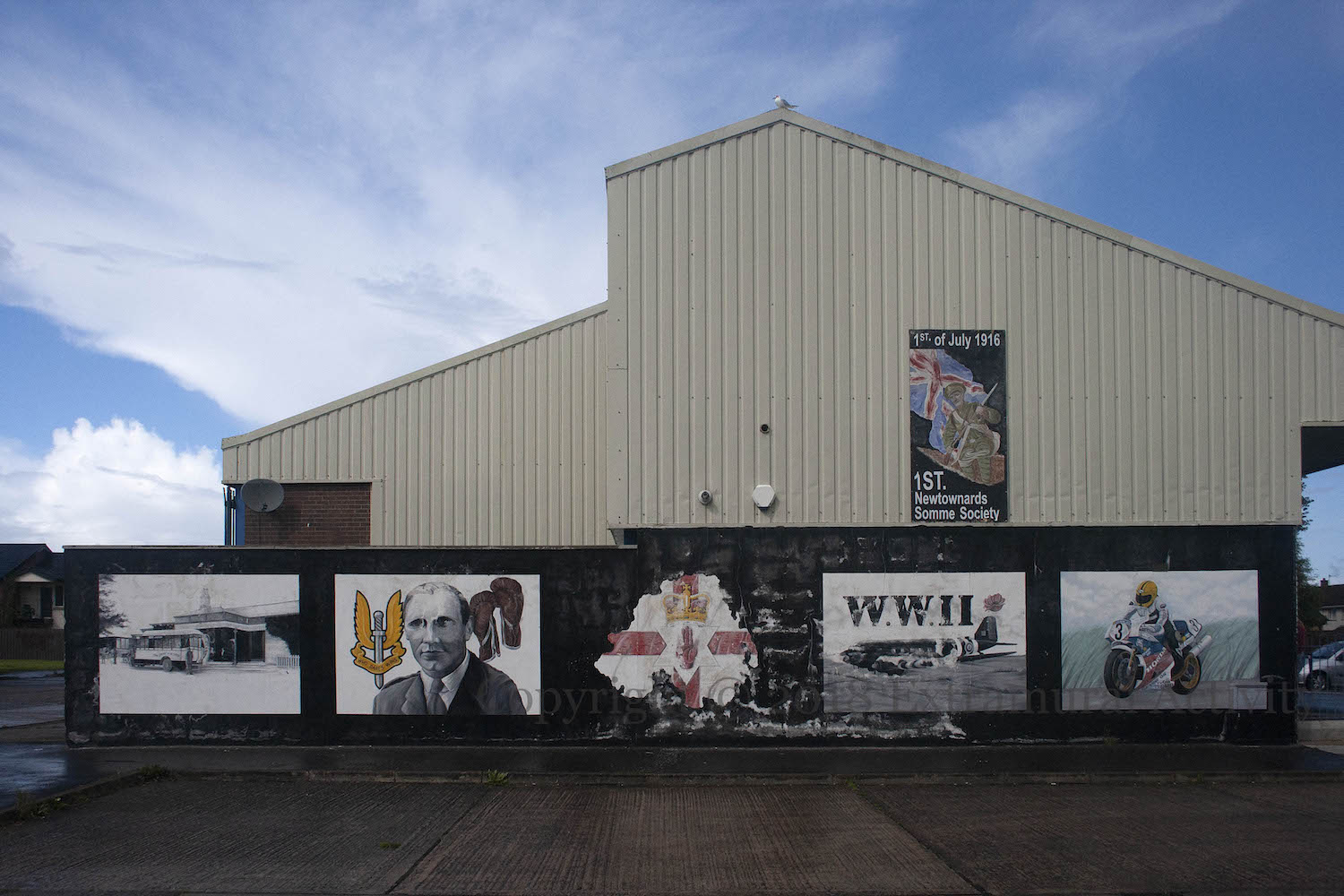
Here are six panels from the shops in the Westwinds estate in Newtownards, which have replaced a UVF mural (Help Us To Help You).
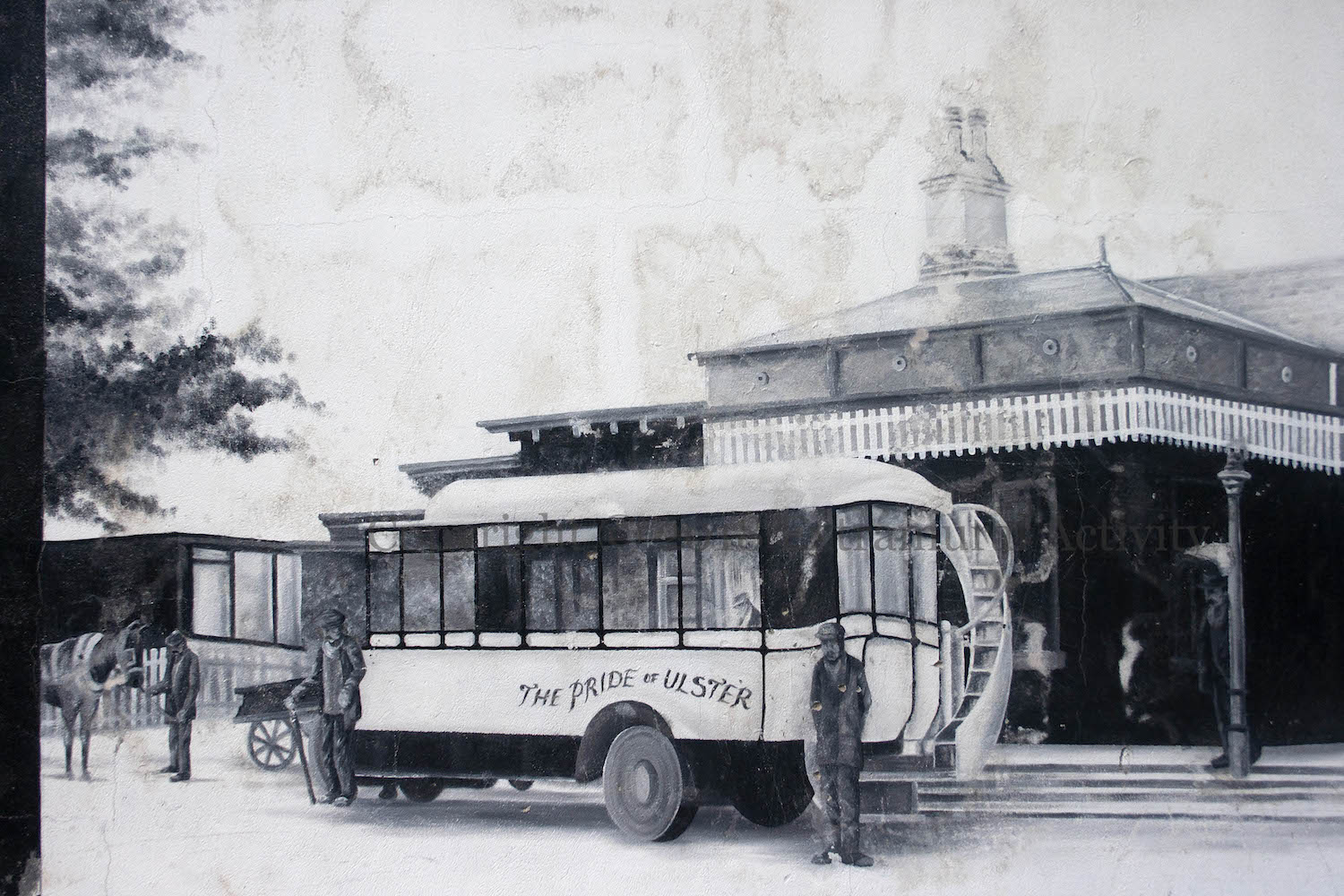
Little is known about the omnibus called “The Pride Of Ulster”, except that this picture shows it at Newtownards Railway Station, Victoria Avenue, c. 1920. SAS soldier and boxer (and rugby-player) Blair “Paddy” Mayne, DSO, is portrayed in the second panel. (For more, see these posts about Mayne from 2013 and 2014.).
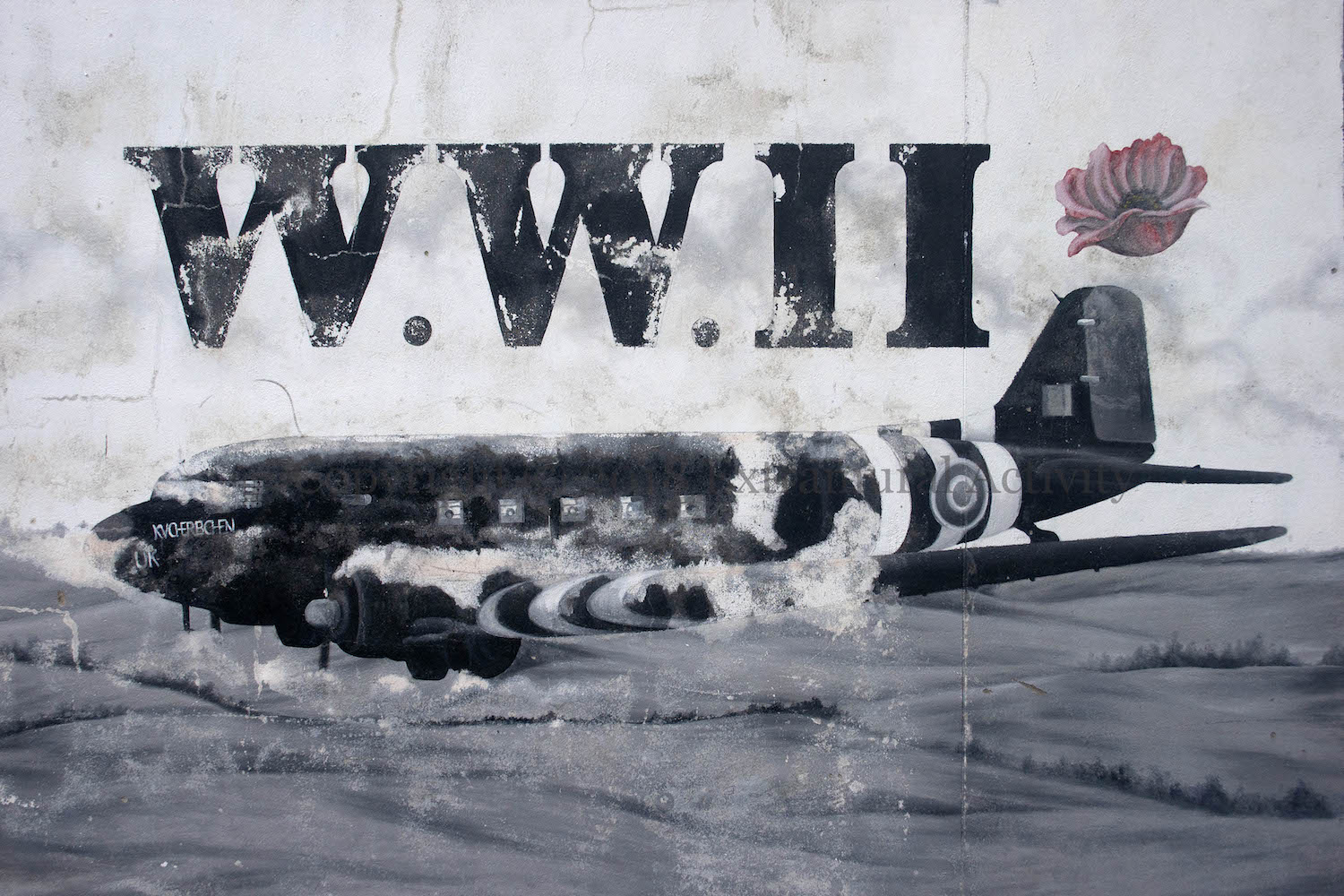
On the other side of the Ulster Banner in the centre is a WWII Douglas Dakota C-47, specifically “FZ692 of No. 233 Squadron, around the D-Day period in 1944. This aircraft, which was named “Kwicherbichen” by her crews, was involved in Para-dropping operations on the eve of D-Day and subsequently in re-supply and casualty evacuation missions into and out of forward airfields in the combat areas” (RAF).
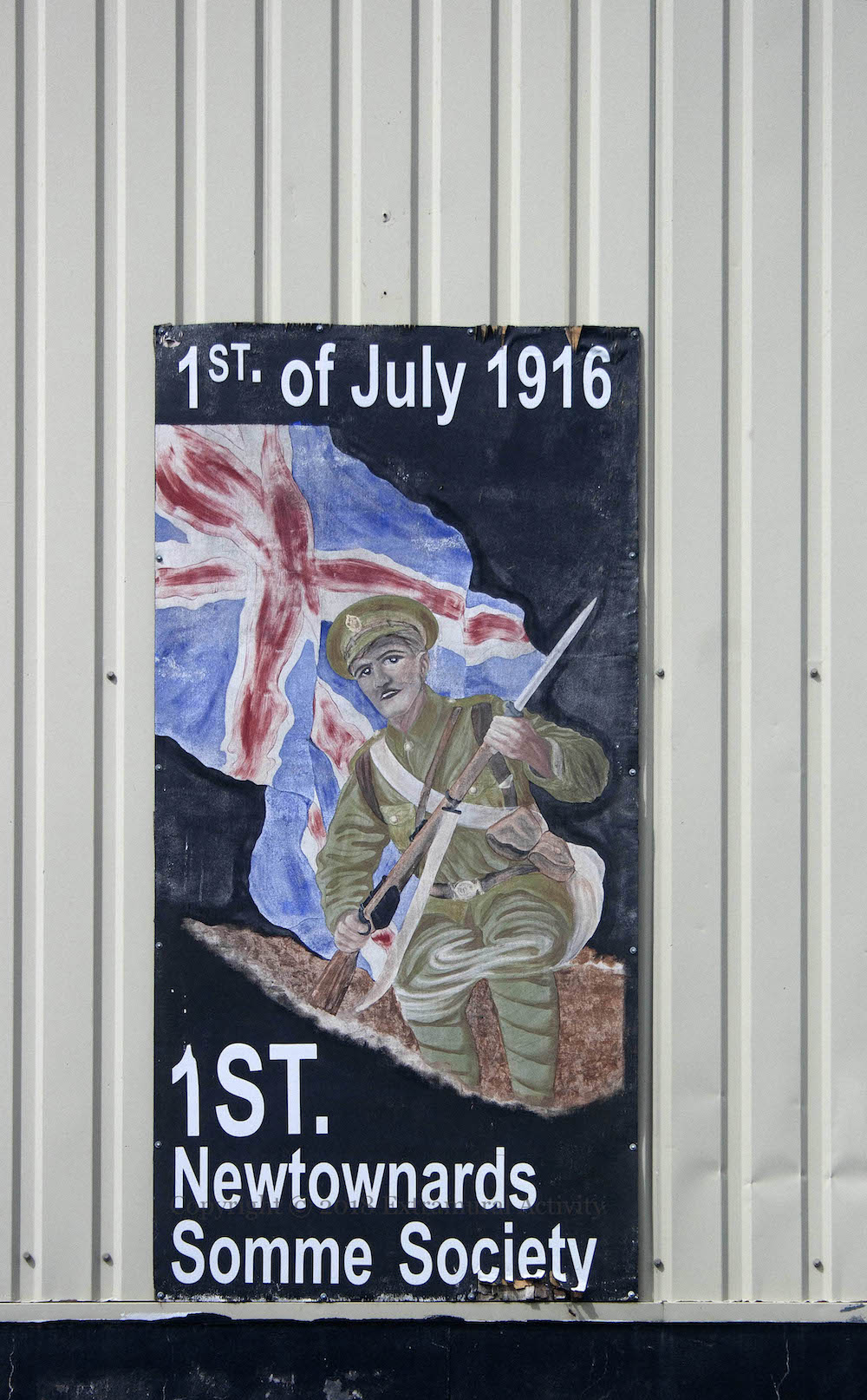
Motorcyclist Joey Dunlop is on the far right (see Race Of Legends), and above them all is a WWI board from the 1st Newtownards Somme Society (based in the Somme museum in Conlig?).
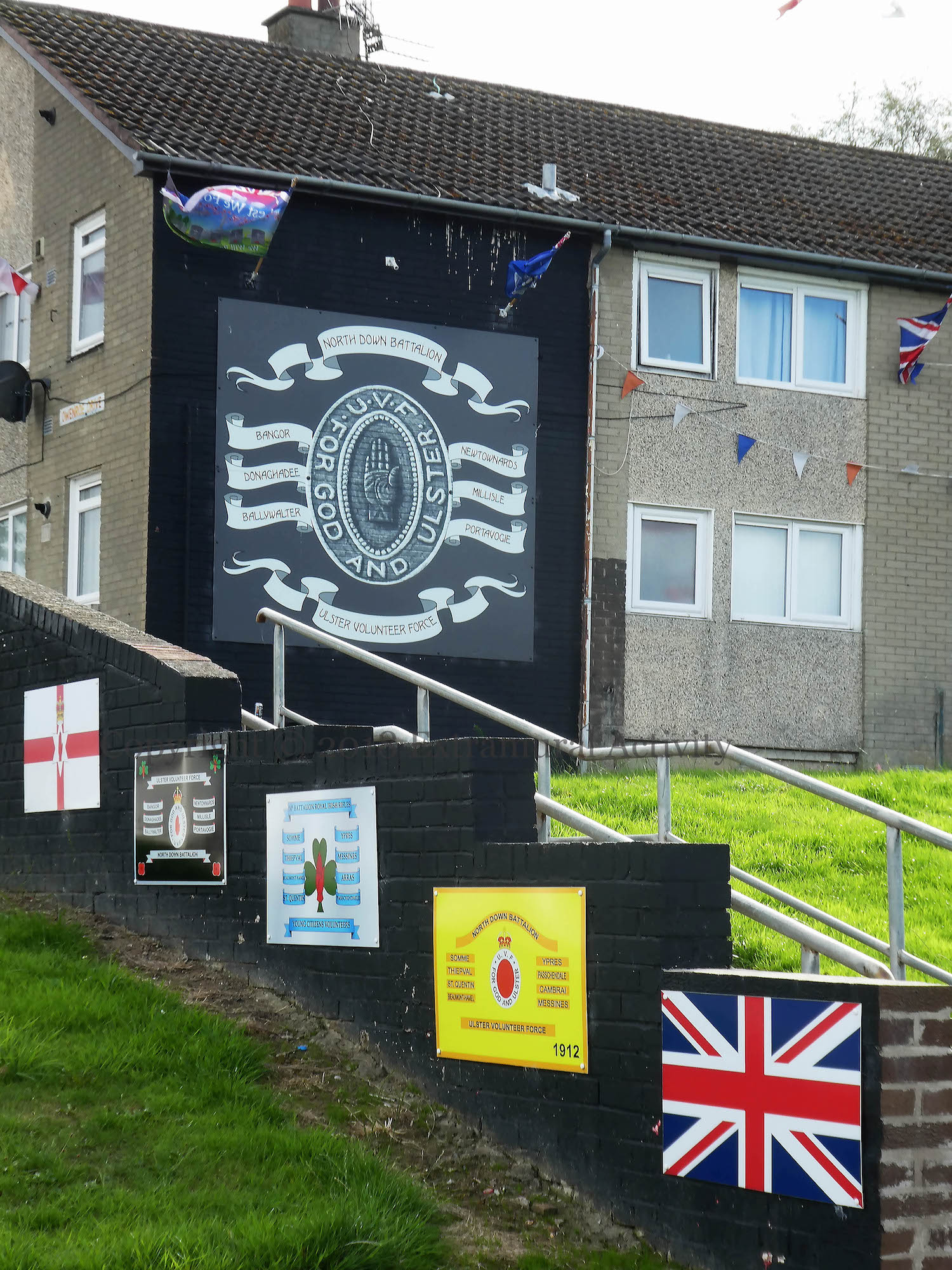
The yellow board in the foreground lists battles of the North Down Battalion in World War I (for a description of the battalion, see the previous 2017 post). Added to that since then is a large black-and-white board to the modern Ulster Volunteer Force and its divisions: Bangor, Donaghadee, Ballywalter, Newtownards, Millisle, and Portavogie. (It’s worth noting that although this is a board, the UVF emblem in the middle is depicted as having been painted on a brick wall, indicating a preference for old-school muraling.)
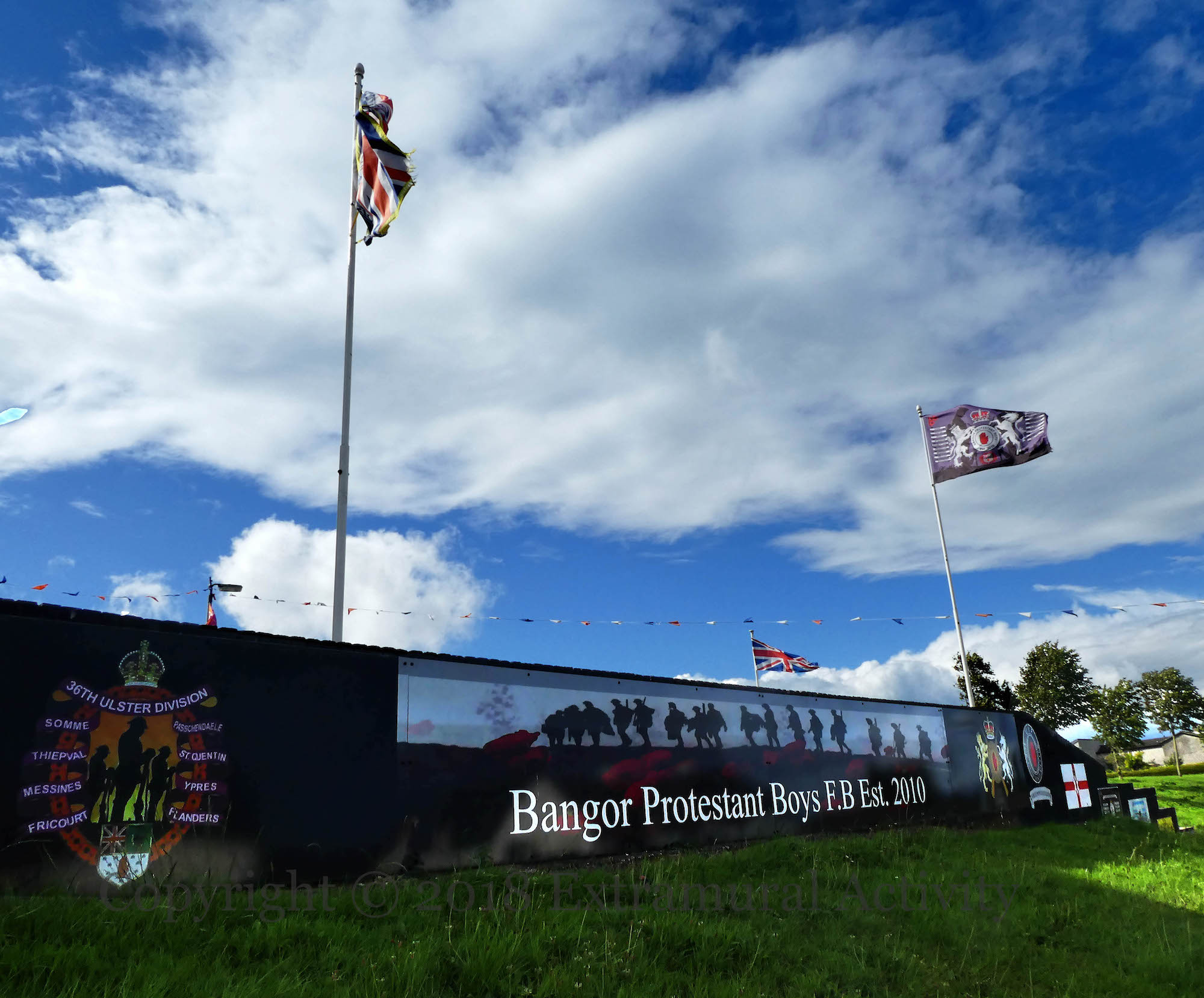
Below is a shot of the rest of the low wall, with Bangor Protestant Boys Flute Band (previously seen in 2017).
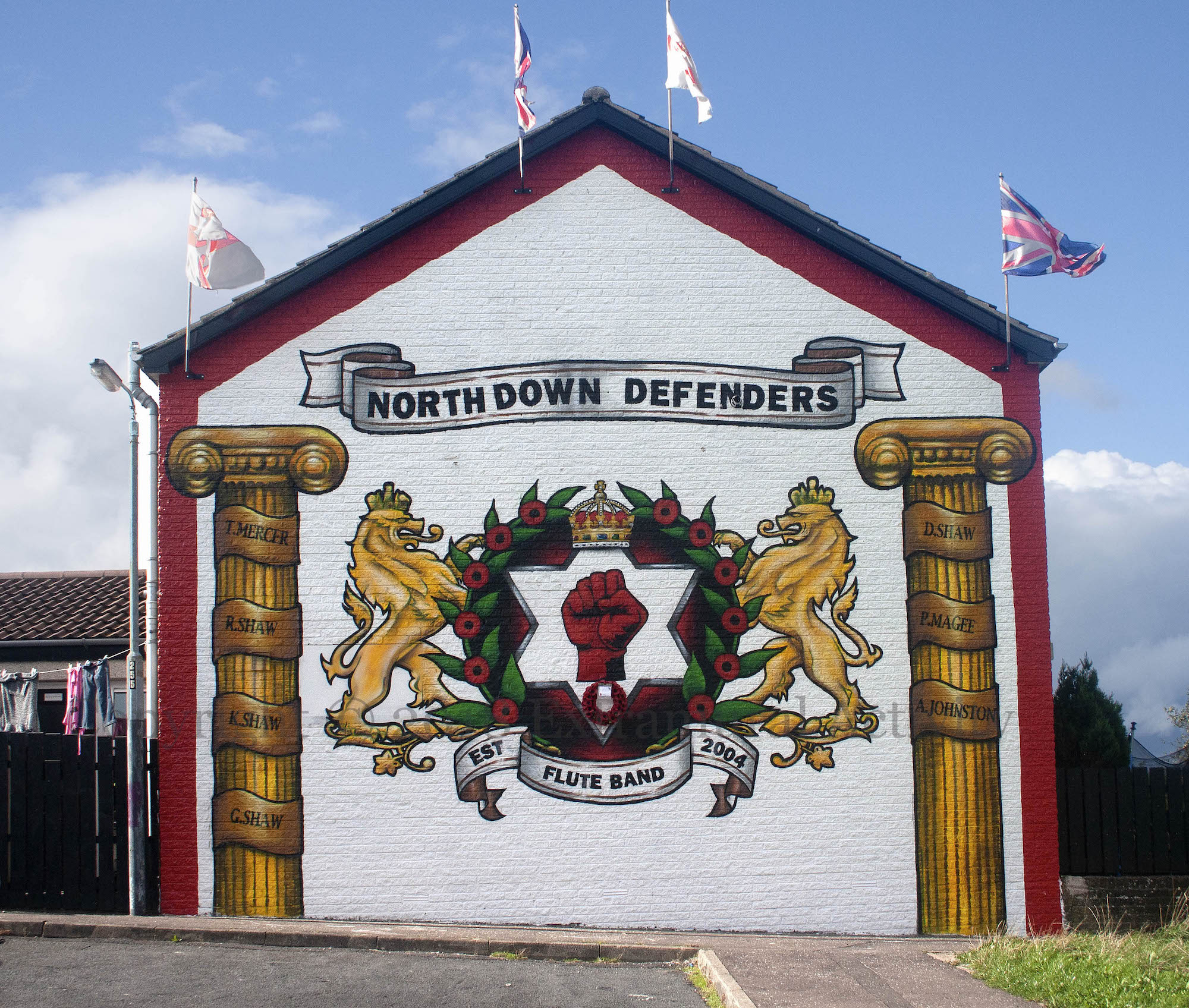
Dee Stitt of the UDA resigned last week as chair of Charter NI citing the strain on his family caused by negative media attention (BBC-NI | Irish News). At the end of 2016, Stitt was criticised for remarks describing his North Down Defenders (Fb) as the “homeland security” of the area and describing working-class estates as “jungles” in which there is always a “big guy” (Guardian video 8 min mark ff.| BelTel | ITV) . The mural above does not directly indicate ties to the UDA/UFF, except for the red fist. For a more explicit NDD board further down the estate, with UDA, UFF, UYM, and LPA flags, see North Down Defenders.
For the recent tension between UDA factions in north Down, see Ulster Defence Unions.
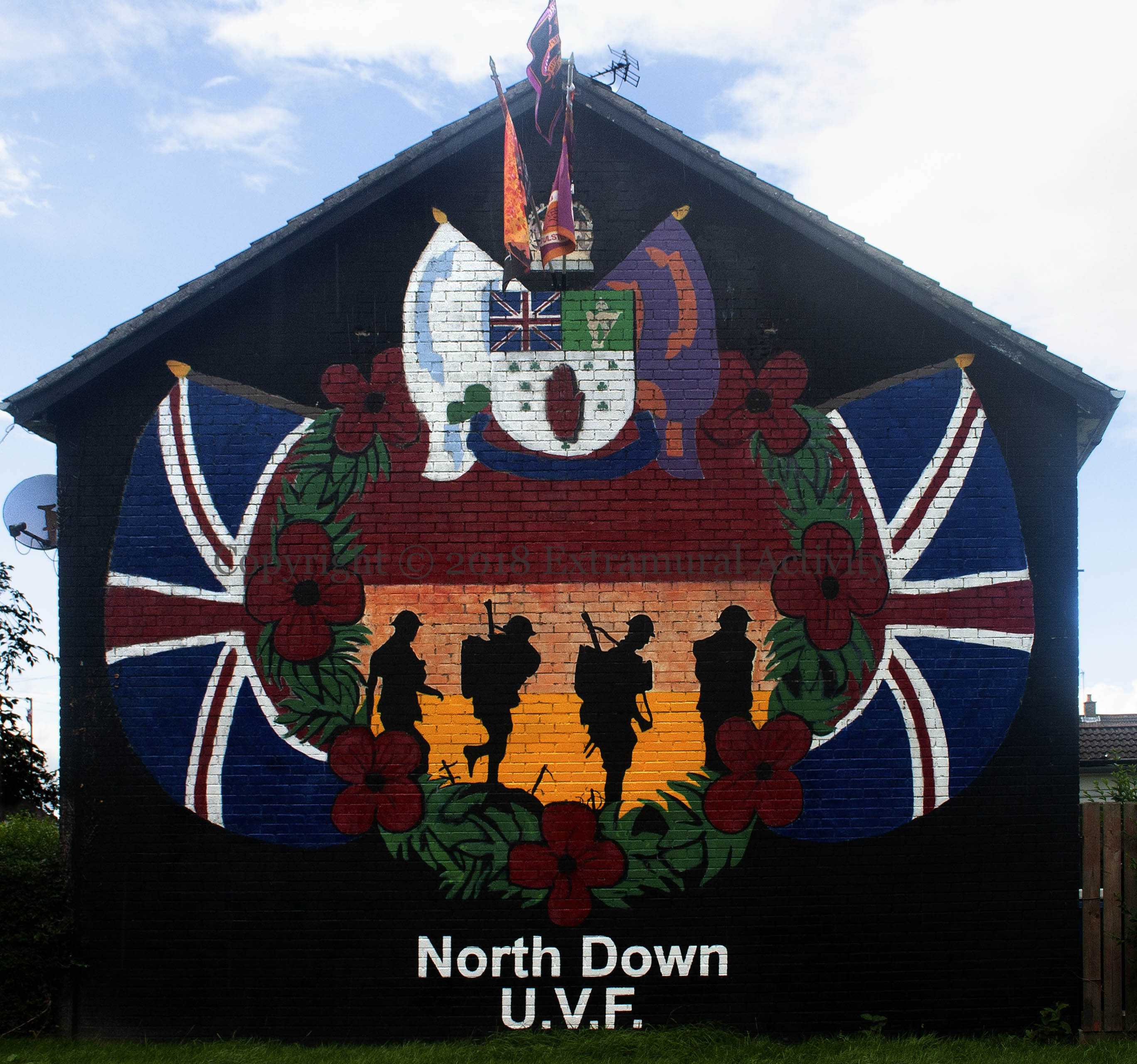
This mural at the bottom of Kilcooley estate in Bangor has recently been repainted, with the main alteration being the “North Down UVF” replaces “1st July 1916”, focusing attention on the locals from battalion that joined the 36th and away from the Somme. (See the previous mural in 1st July 1916.)
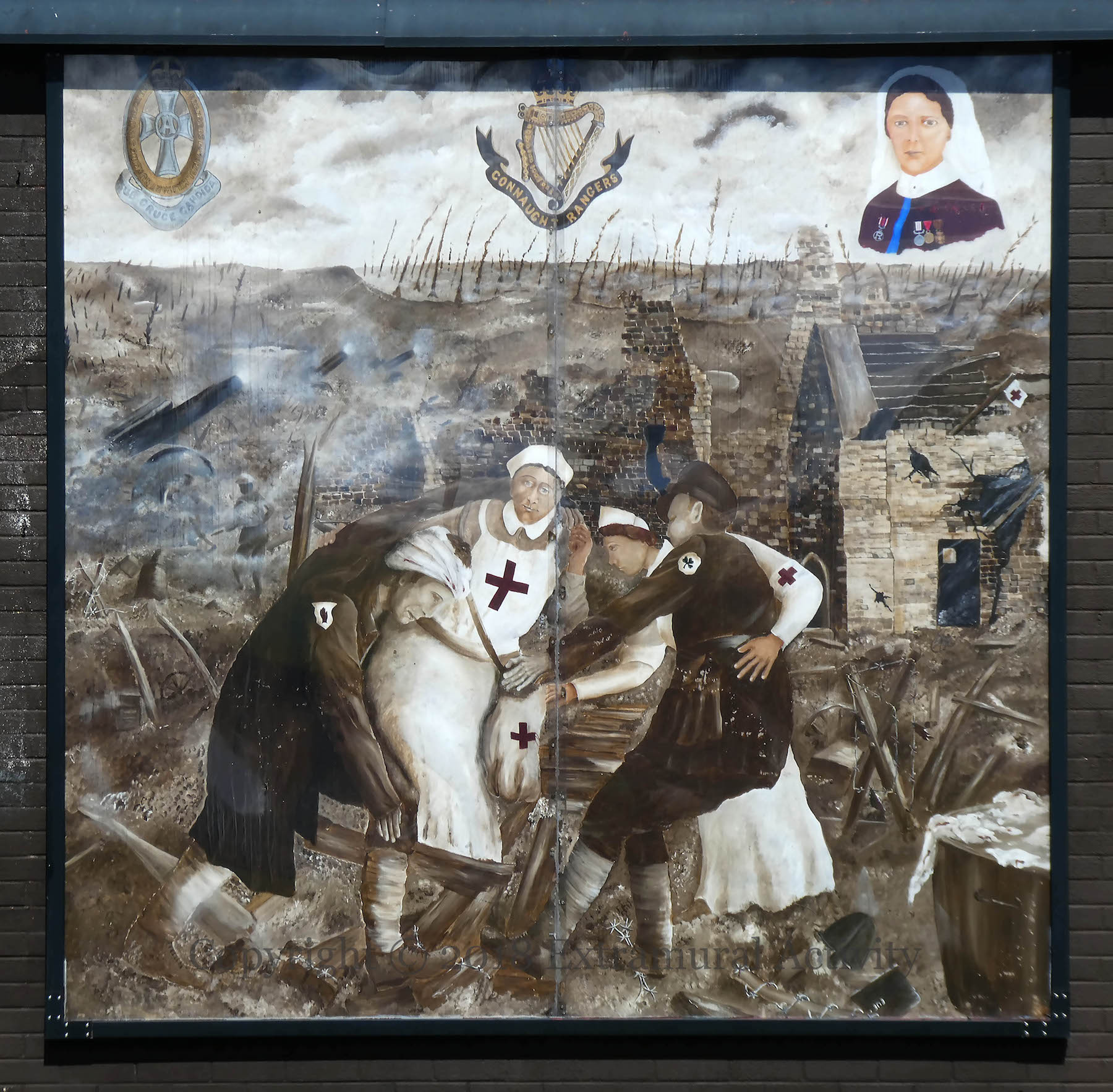
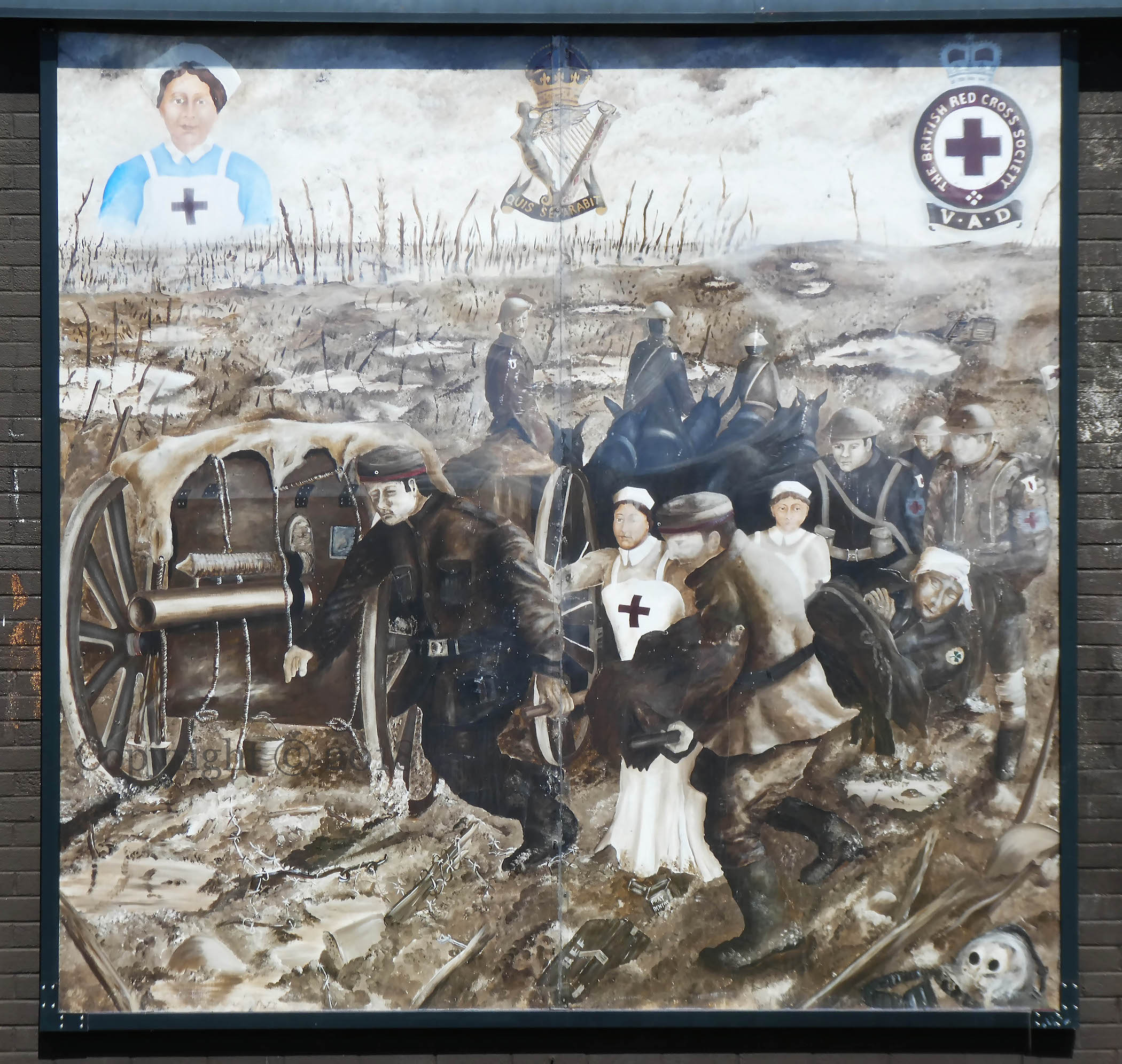
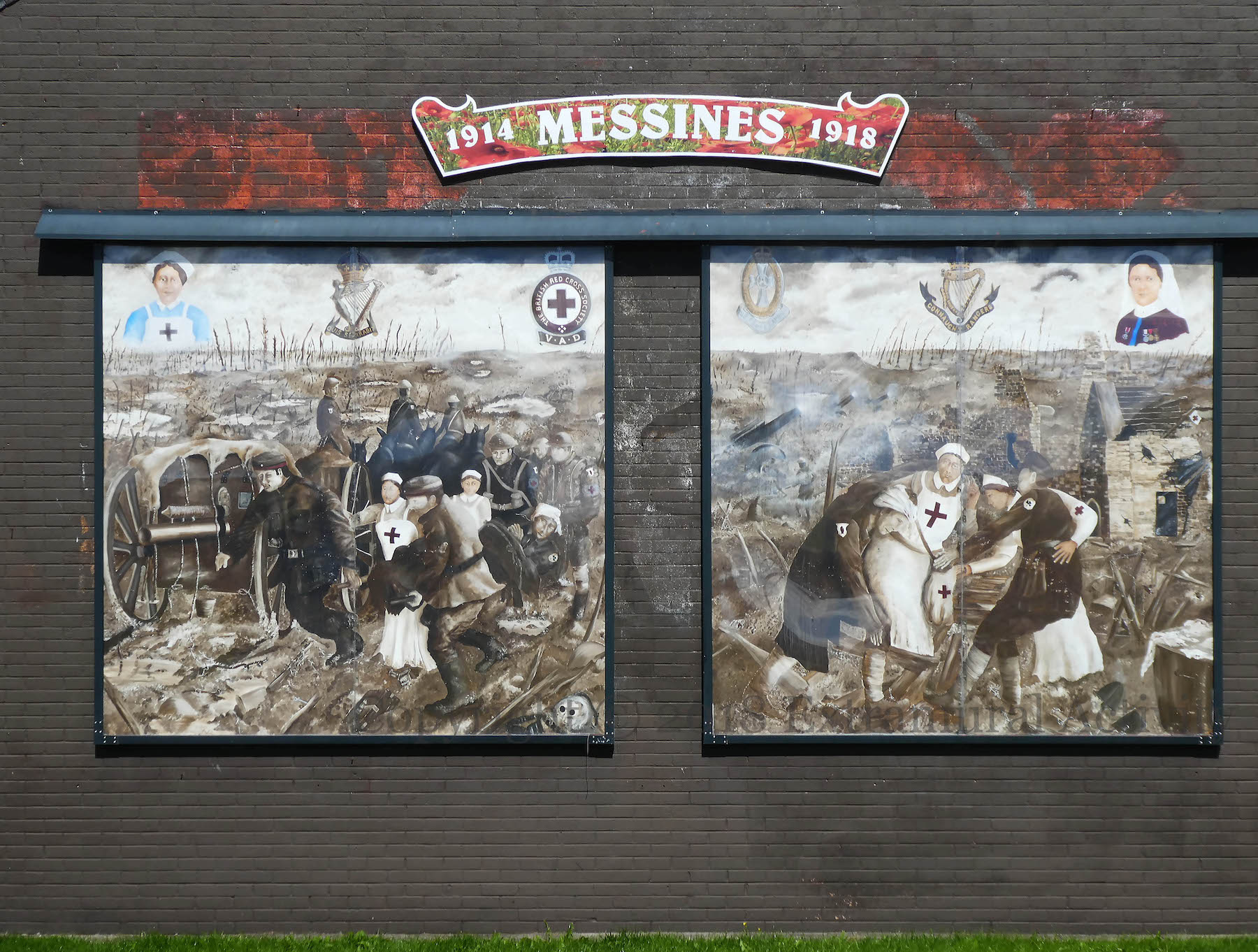
Two panels commemorate the Battle Of Messines in 1917 and the role of nurses in attending to the wounded. This NIHE article says that the two nurses depicted are Annie Colhoun from London-/Derry and Margaret Dewar from Glasgow. “Margaret Dewar lost her life during the battle whilst Annie Colhoun survived and was decorated for her work during the war by the French, Serbian and British Governments.” (This presumably makes her the decorated nurse in the right-hand panel.) An Army Nursing Service page says, however, that they were nurses at Monastir in Macedonia.
“Sub cruce candida” (“under a white cross”) is the motto of the Queen Alexandra’s Royal Army Nursing Corps, though at the time of WWI it was Queen Alexandra’s Imperial Military Nursing Service. “VAD” stands for “voluntary aid detachment” of the British Red Cross.
The soldiers wear red hands or shamrocks on their arms. The red hand is for the 36th (Ulster) Division and the cap badge in the left panel is of the 36th. The shamrock is the symbol of the 16th (Irish) Division, and the right panel shows the cap badge of the Connaught Rangers whose battalions served in both the 10th (Irish) and 16th (Irish) Divisions in WWI. Both the 36th and 16th fought at the Somme and at Messines (WP).
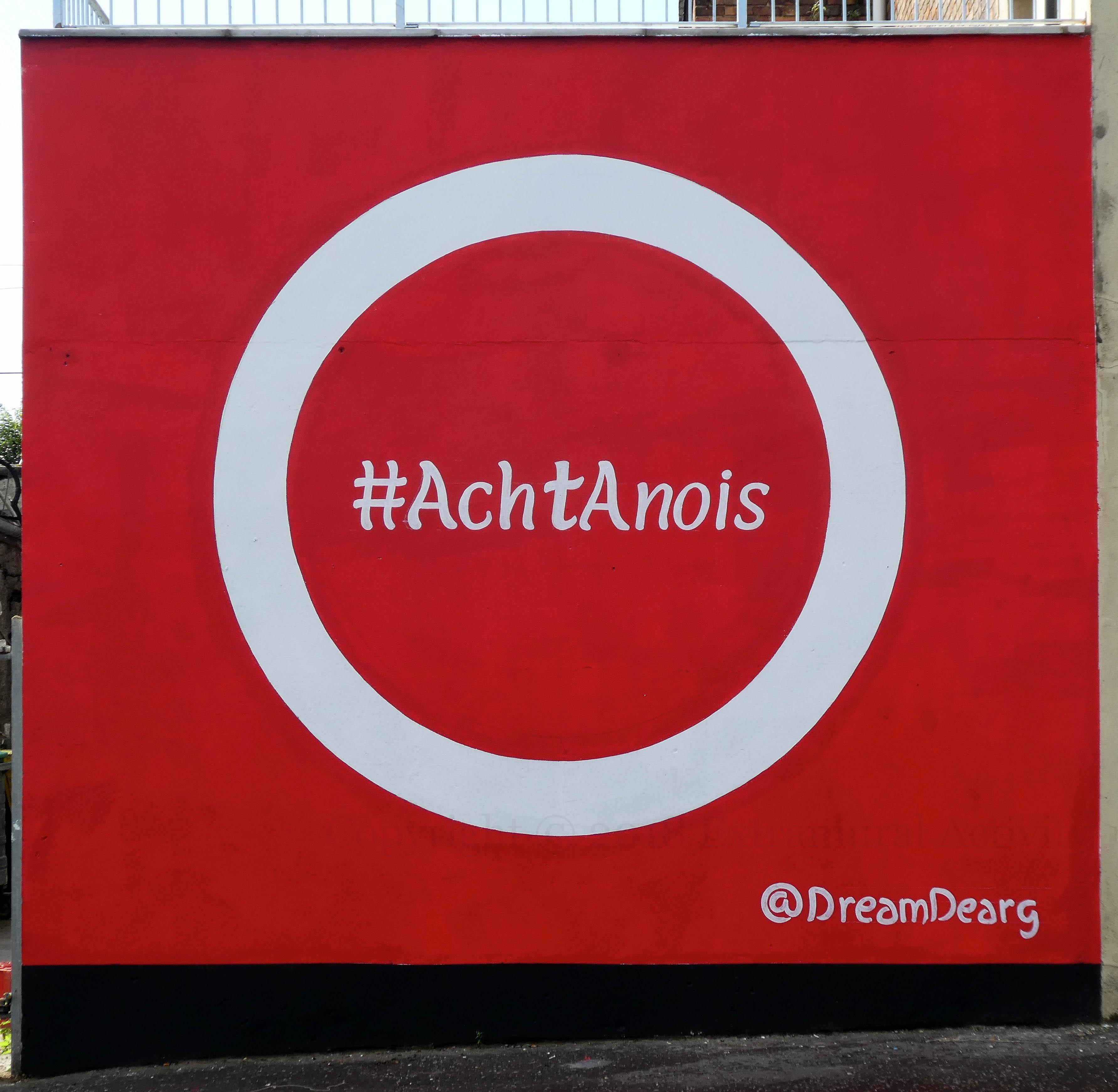
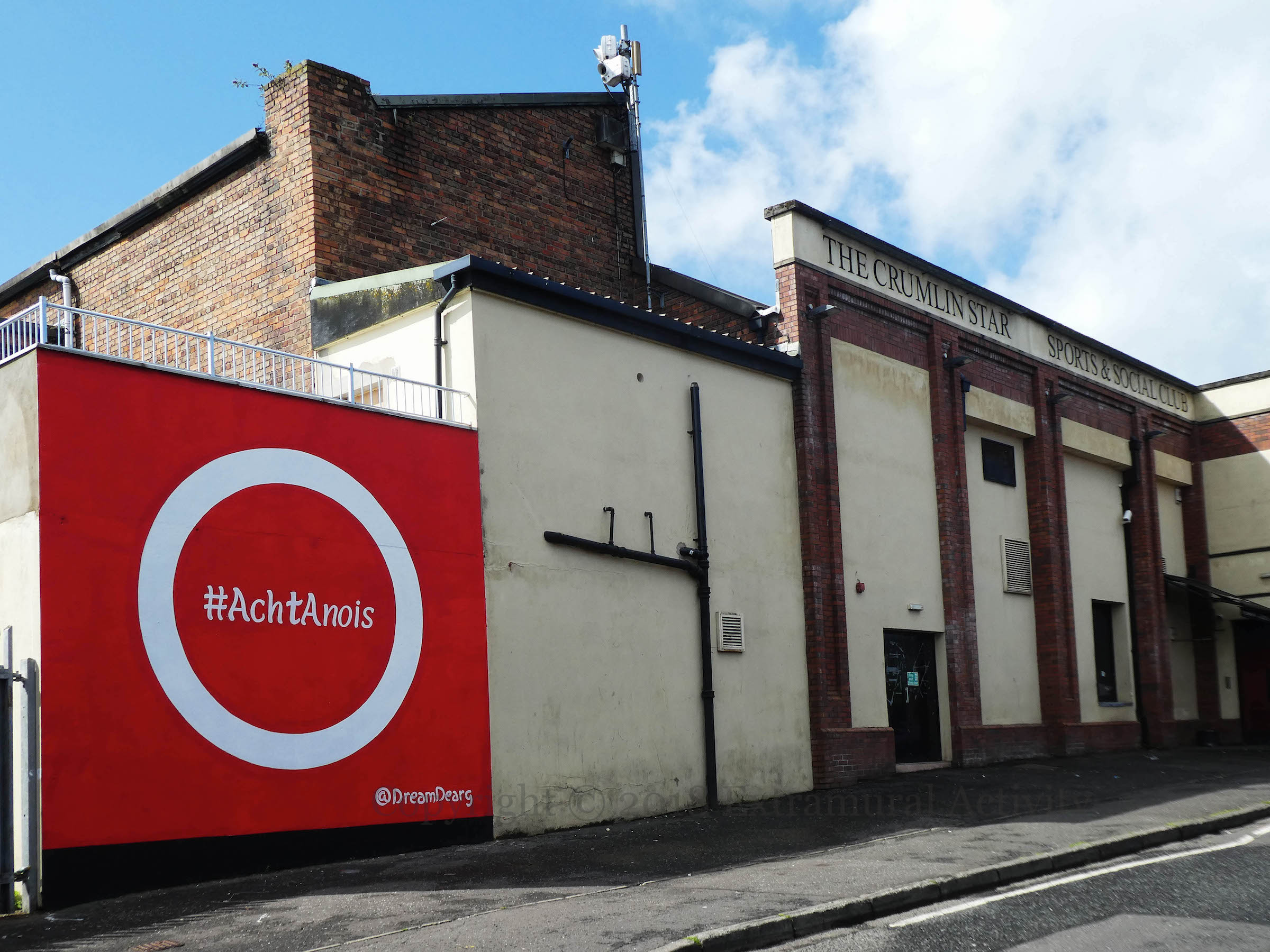
An Dream Dearg (Fb) takes its campaign for an Irish-Language Act (Acht Na Gaeılge) to the streets of Ardoyne after a deal to introduce such an act collapsed in February (BBC-NI | Irish Times).