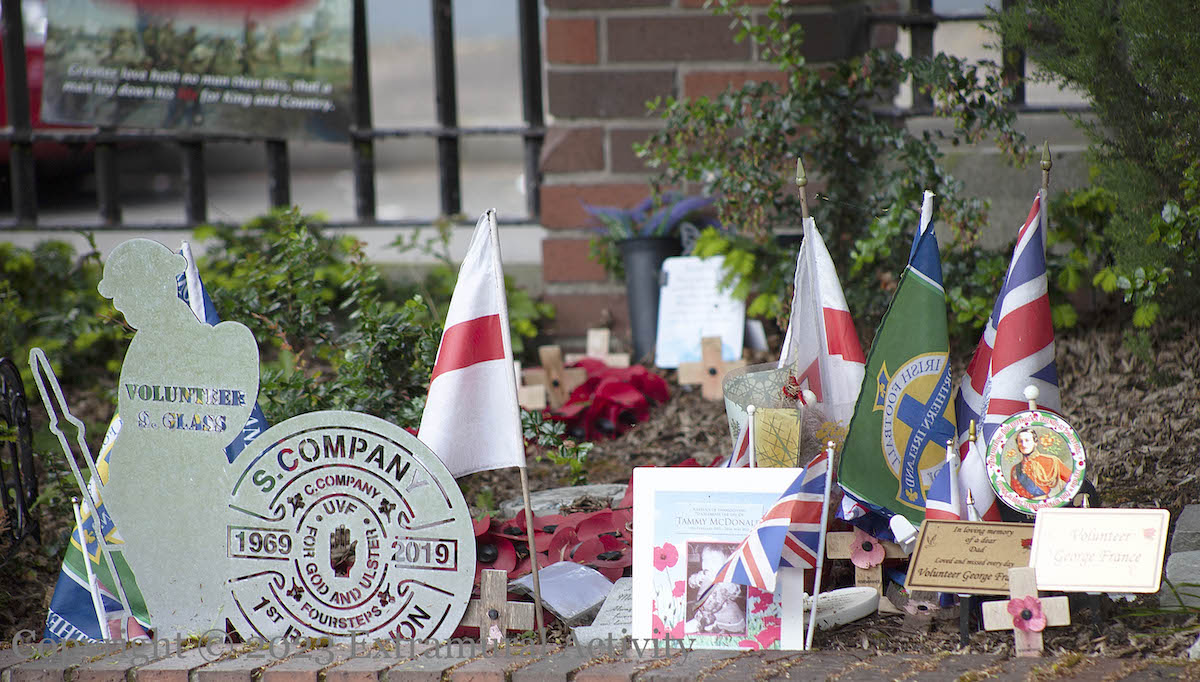
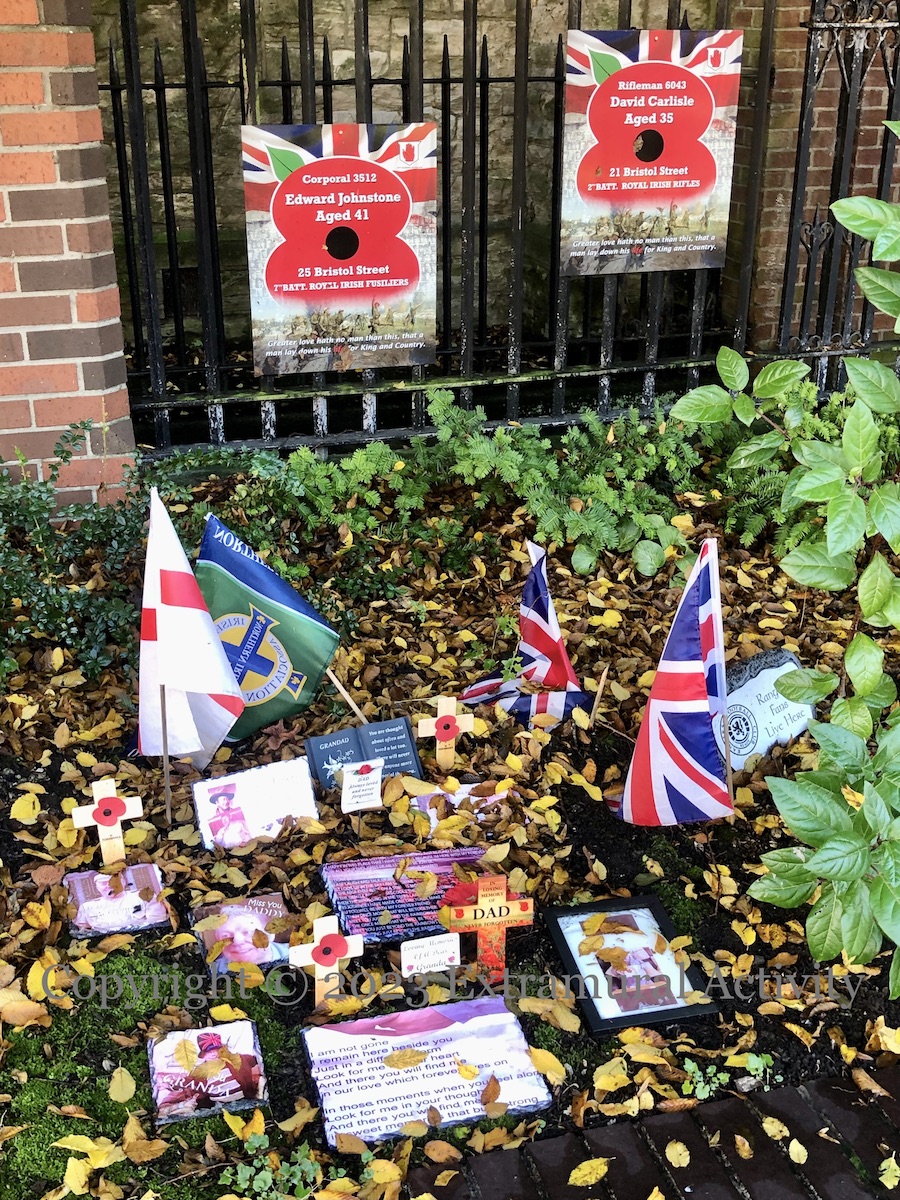
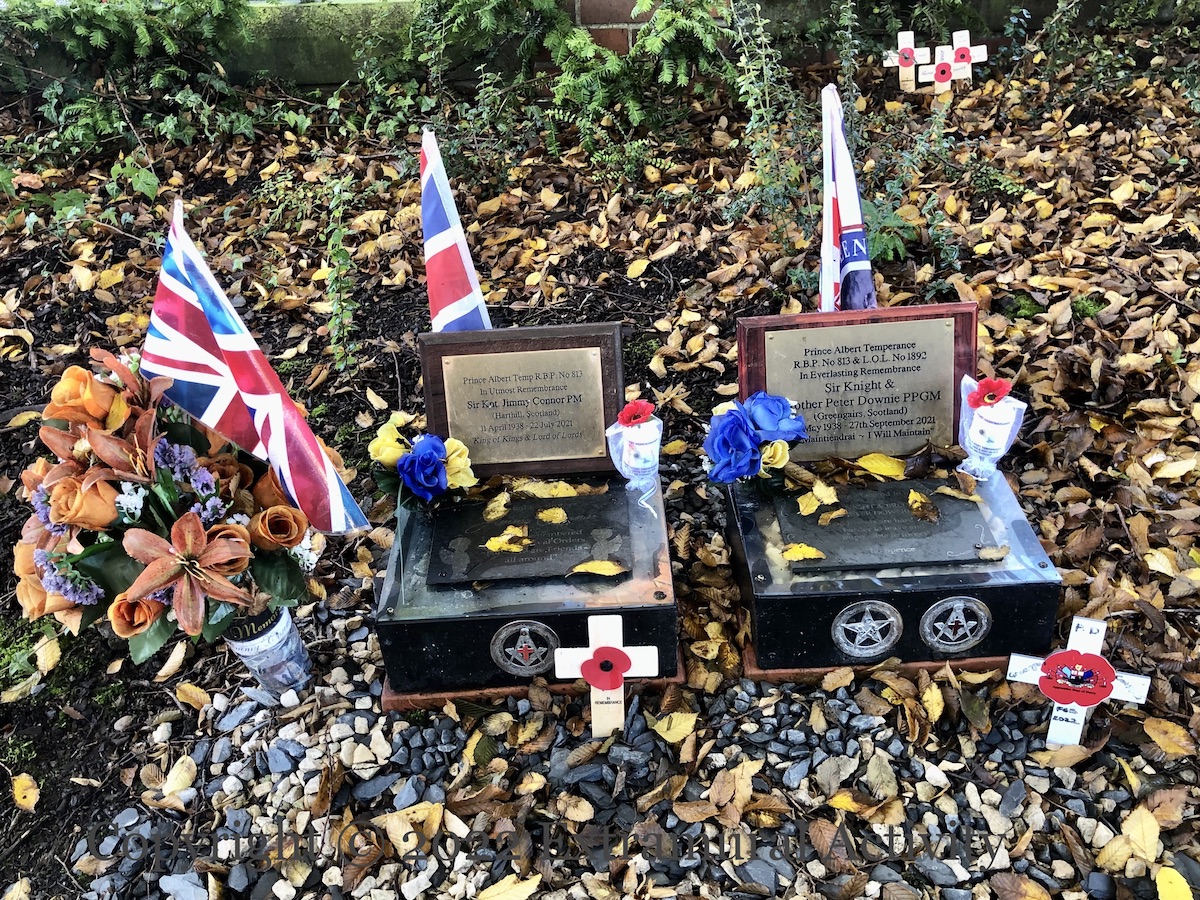
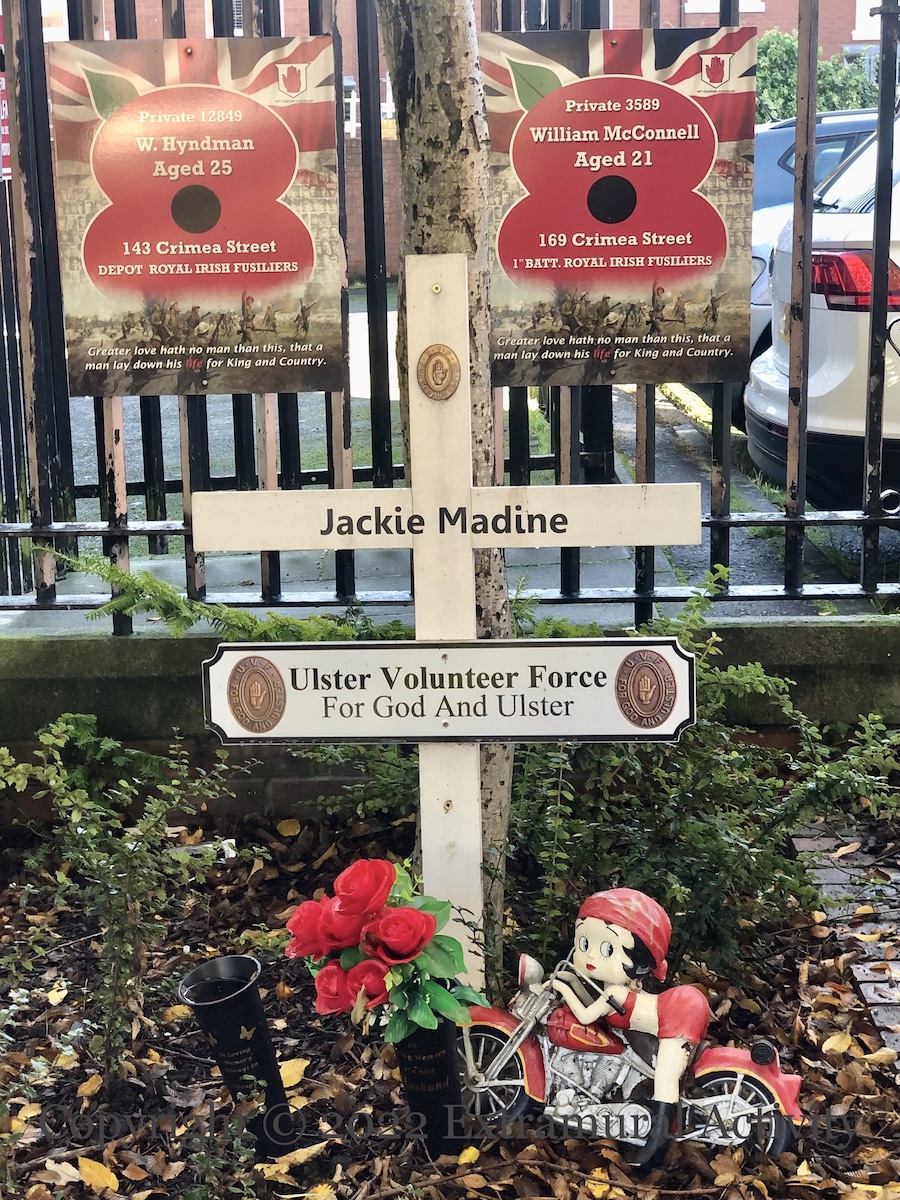
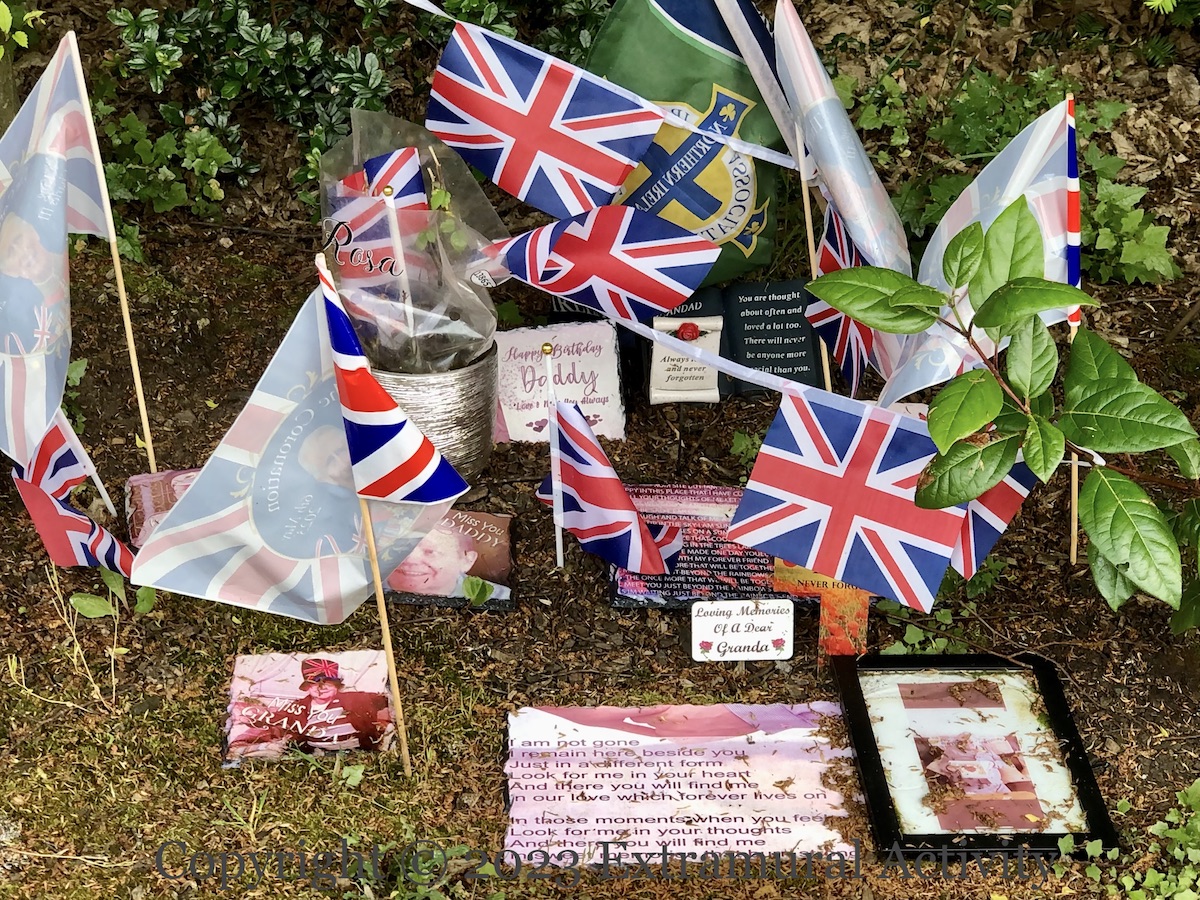
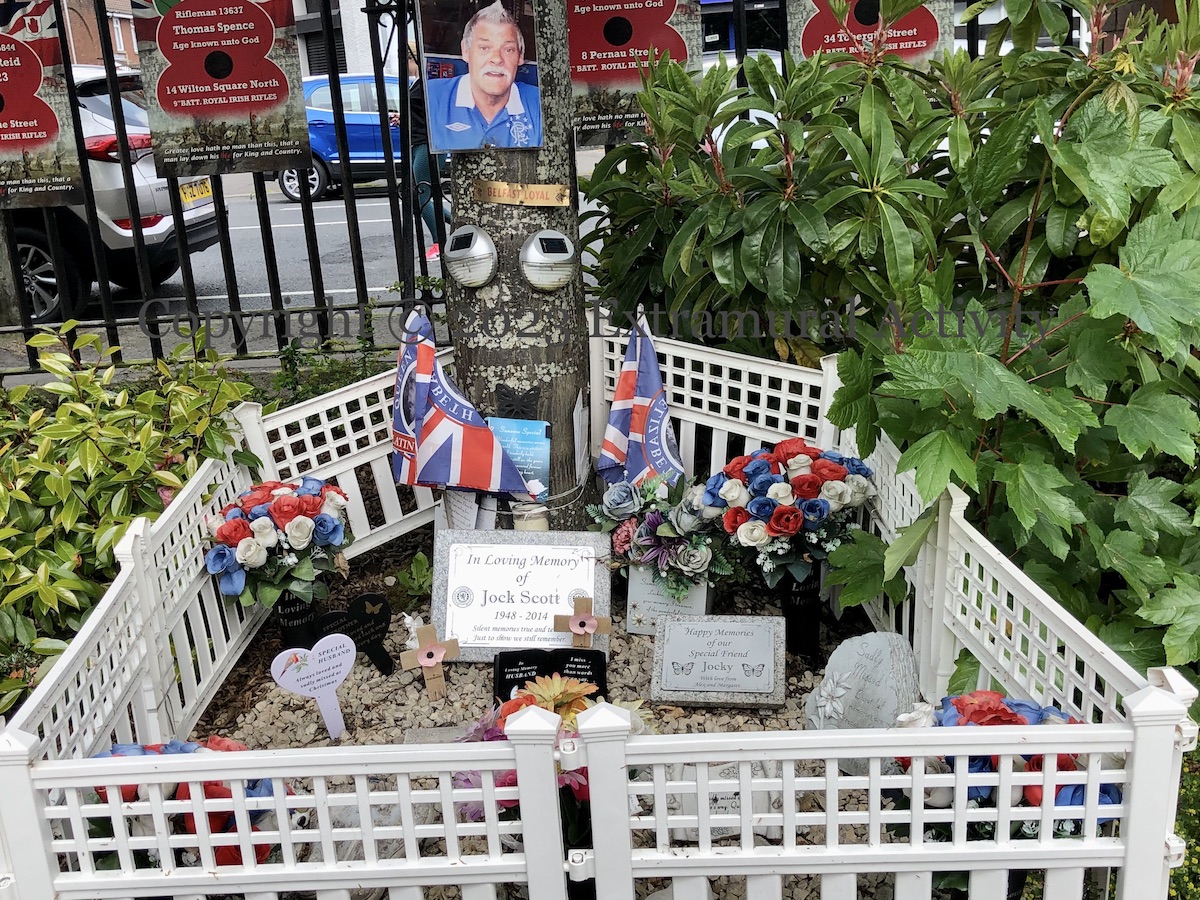
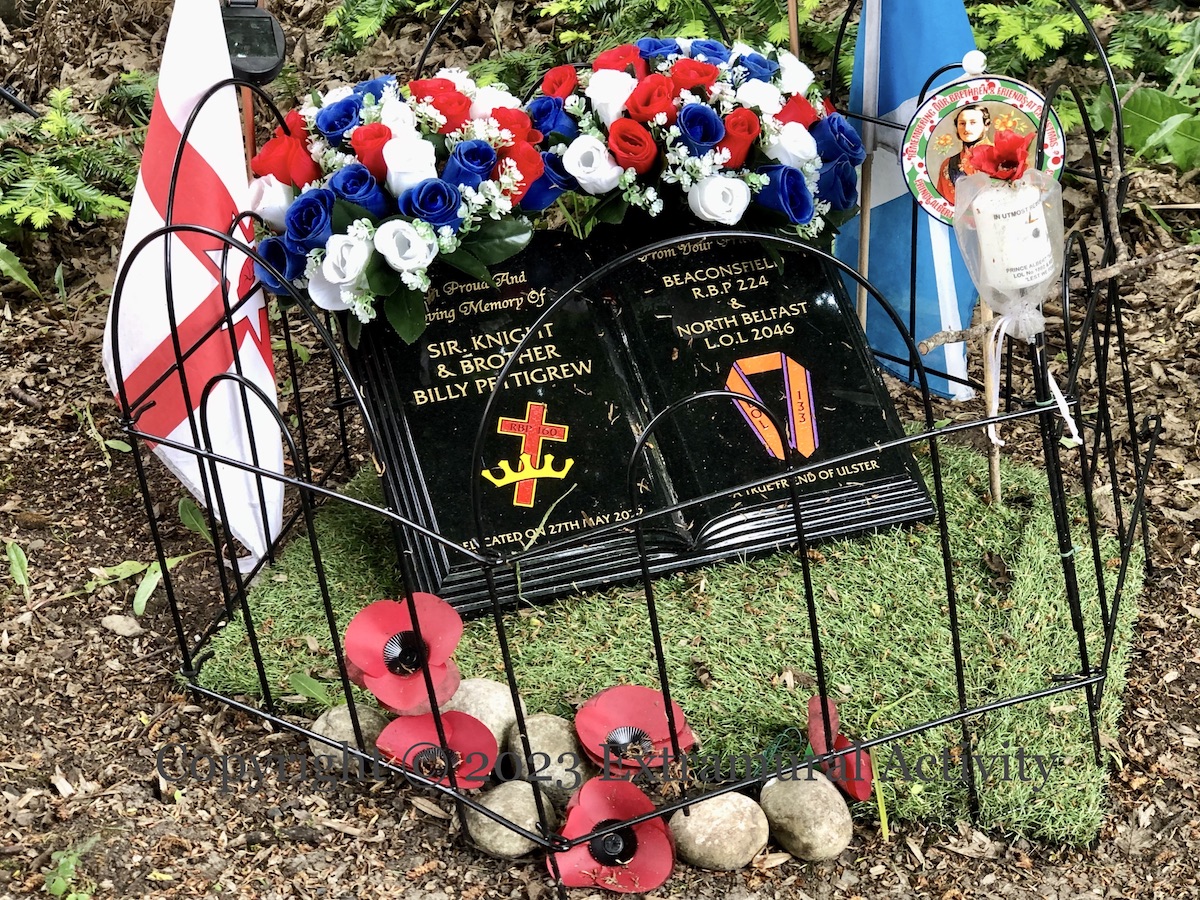
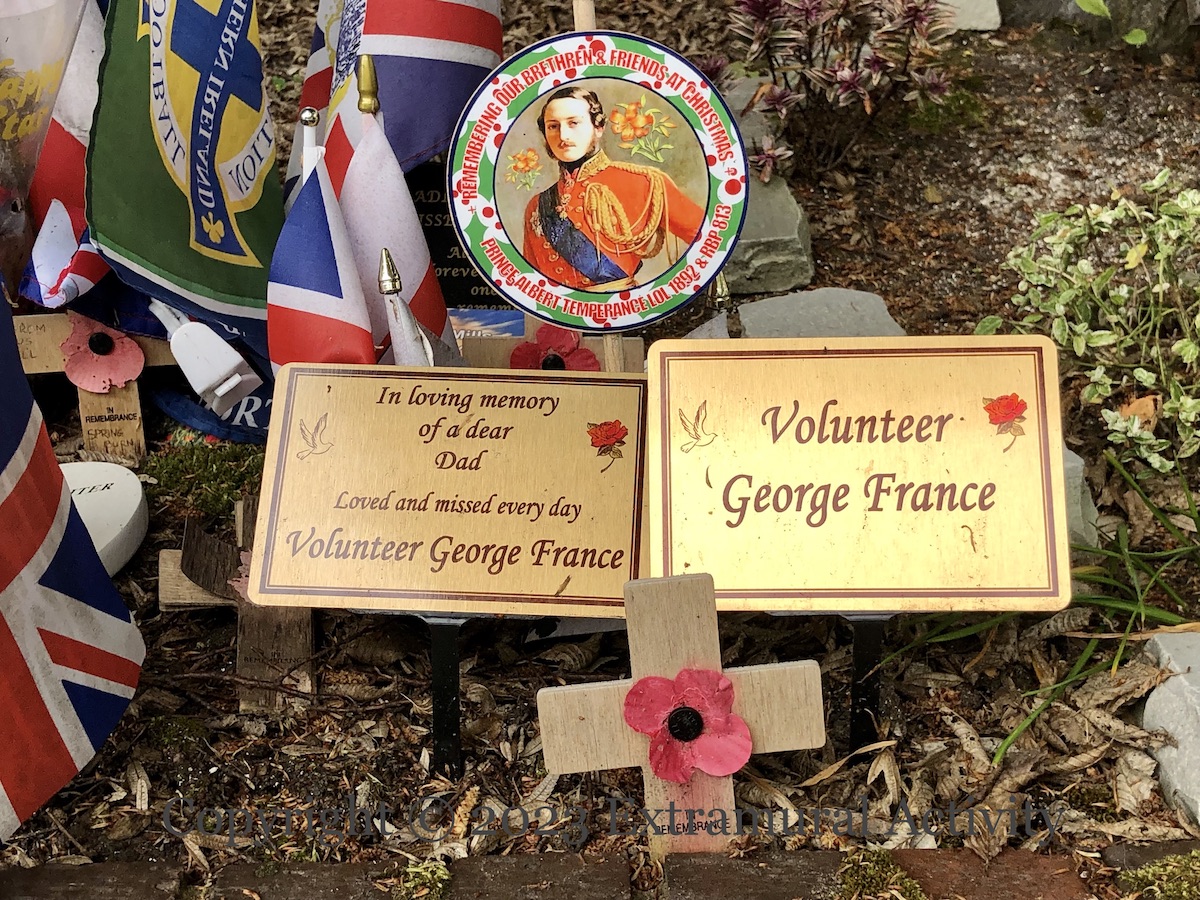
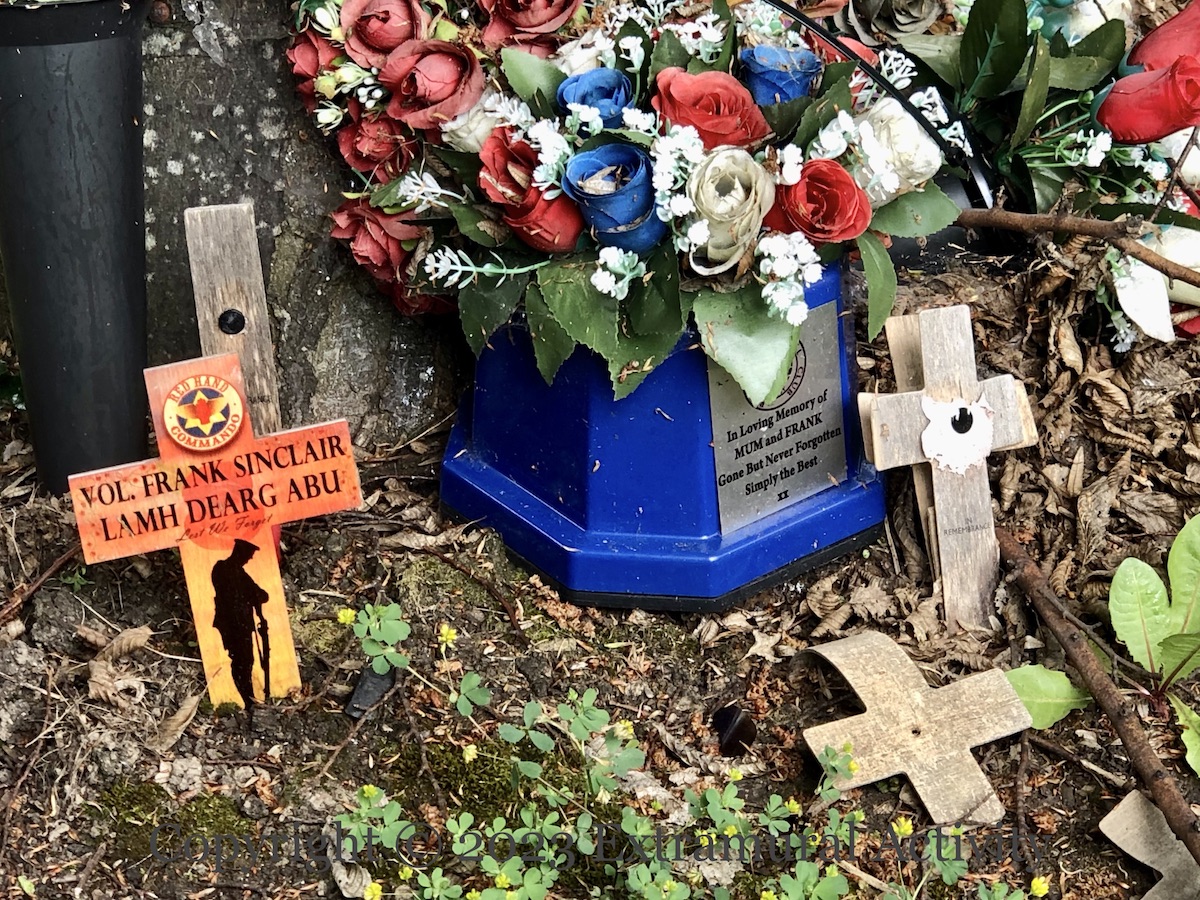
The Shankill Memorial Garden next to West Kirk Presbyterian is home to memorials to WWI (see Who Went To War And Never Returned) and the Shankill Bombing (see In The Shadow Of Death) . It has also become the site of many small memorials to local people, including volunteers in the UVF. For “S Company” see S Company, C Company.
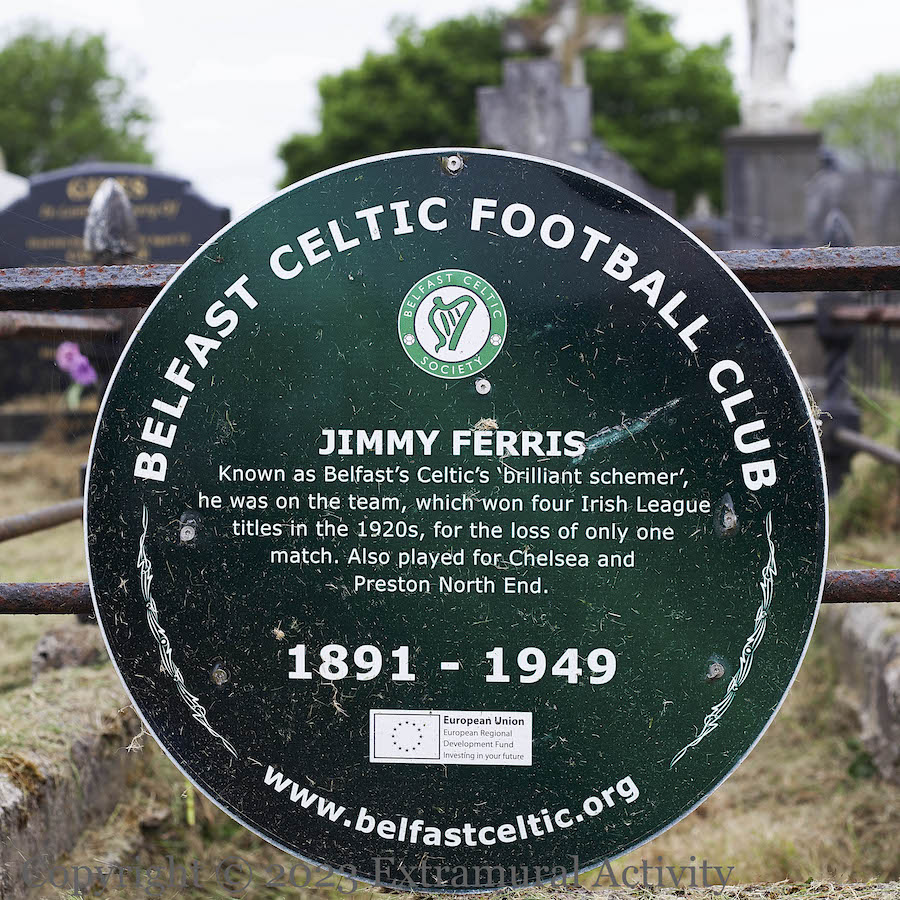
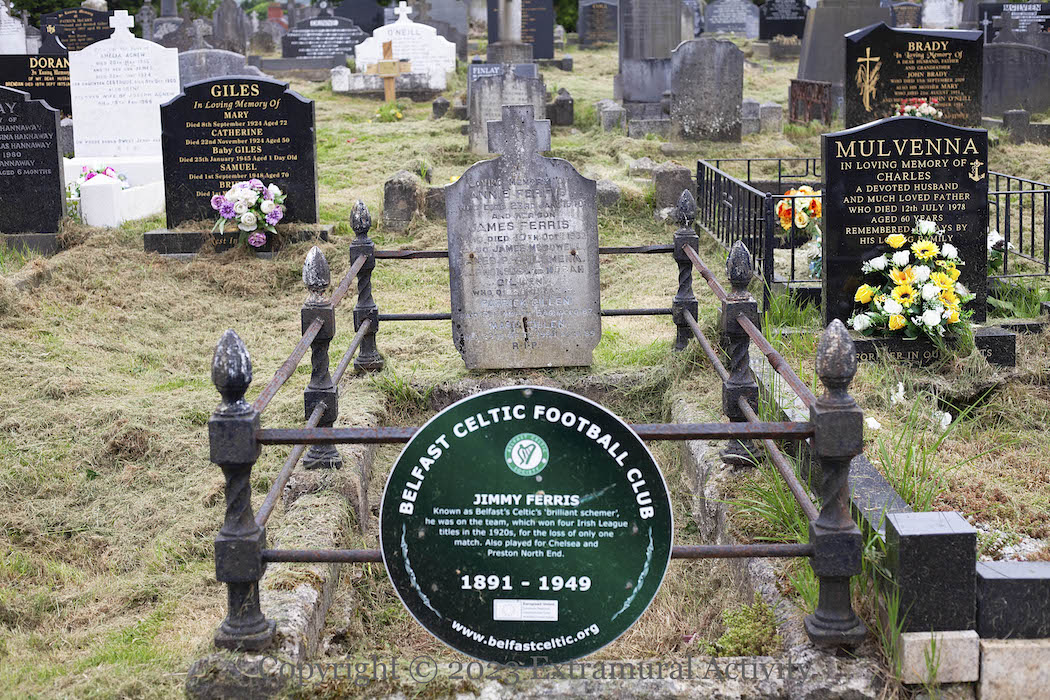
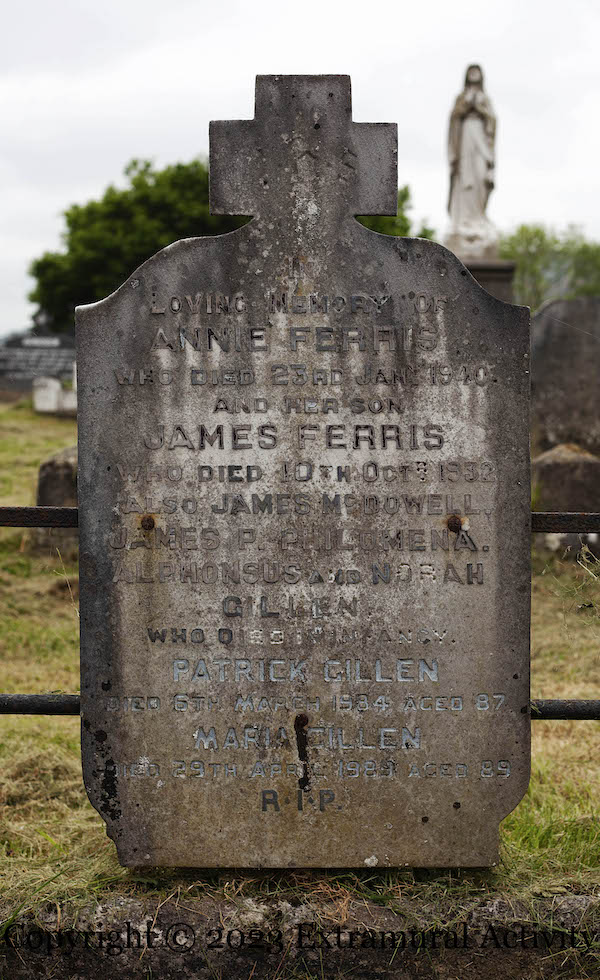
“1891-1949” are the dates of the operation of Belfast Celtic, not the dates of forward Jimmy Ferris, who lived from 1894 to 1932. Ferris played for the club for nine years, and for various British clubs during the pogroms. He quit playing in 1930 because of a heart condition and died two years later, at the age of 37. The Ferris family grave, shown in today’s images, is in Milltown Cemetery. (Belfast Celtic | WP)
“Jimmy Ferris, known as Belfast Celtic’s ‘brilliant schemer’, he was on the team, which won four Irish League titles in the 1920s, for the loss of only one match. Also played for Chelsea and Preston North End.” With funding from the “European Regional Development Fund”.
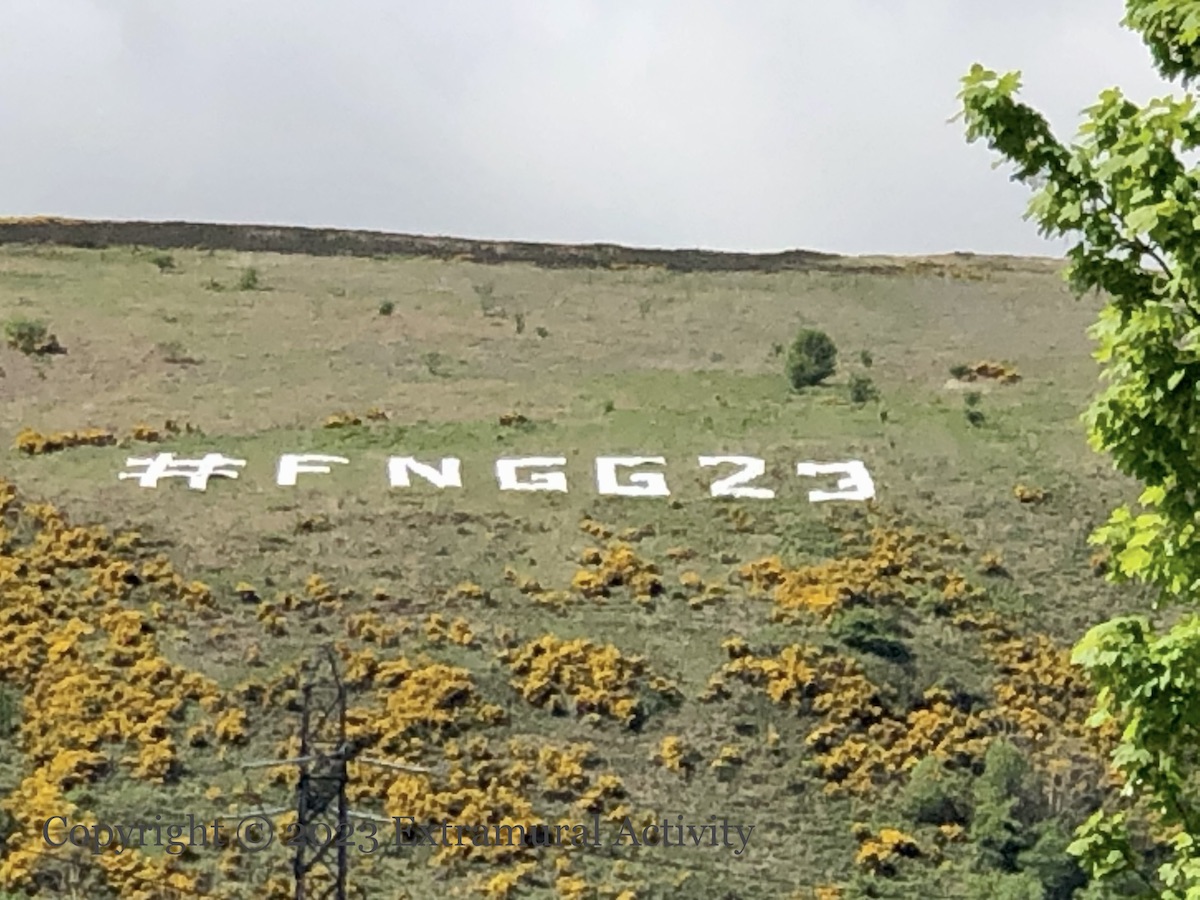
“FNGG” stands for “Féıle Na gCloıgíní Gorma” [Festival Of The Bluebells]. Bluebells – cloıgíní gorma – typically grow in woodlands rather than on open hillsides (Belfast Hills Partnership) but Slıabh Dubh/Black Mountain (site of this latest message on the mountain in support of the festival) is also a blooming ground – images can be seen in the festival’s full programme (at Glór Na Móna). The festival includes plenty of outdoor activities, including a bluebell walk on Friday morning; Damien Dempsey headlines the concert at St Comgall’s on Thursday night.
The title of today’s post [The Magic/Spell/Charm Of Black Mountain] comes from a piece by Feargal Mac Ionnrachtaıgh, writing about his childhood experiences of the upper Springfield area, including the bluebells on the mountain, his father Terry’s love for the hill, and the killing of brother Terry Óg by the LVF. See previously (at Peter Moloney’s site) Save The Black Mountain, and No Such Thing As Failure | Páırc Mhıc Ionnrachtaıgh.
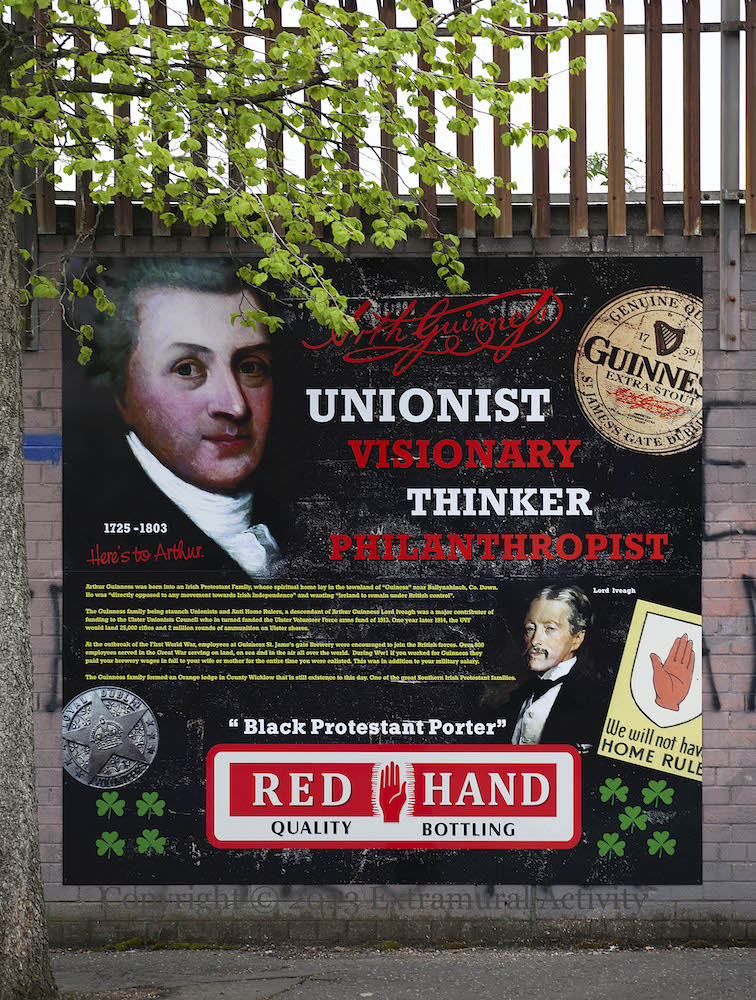
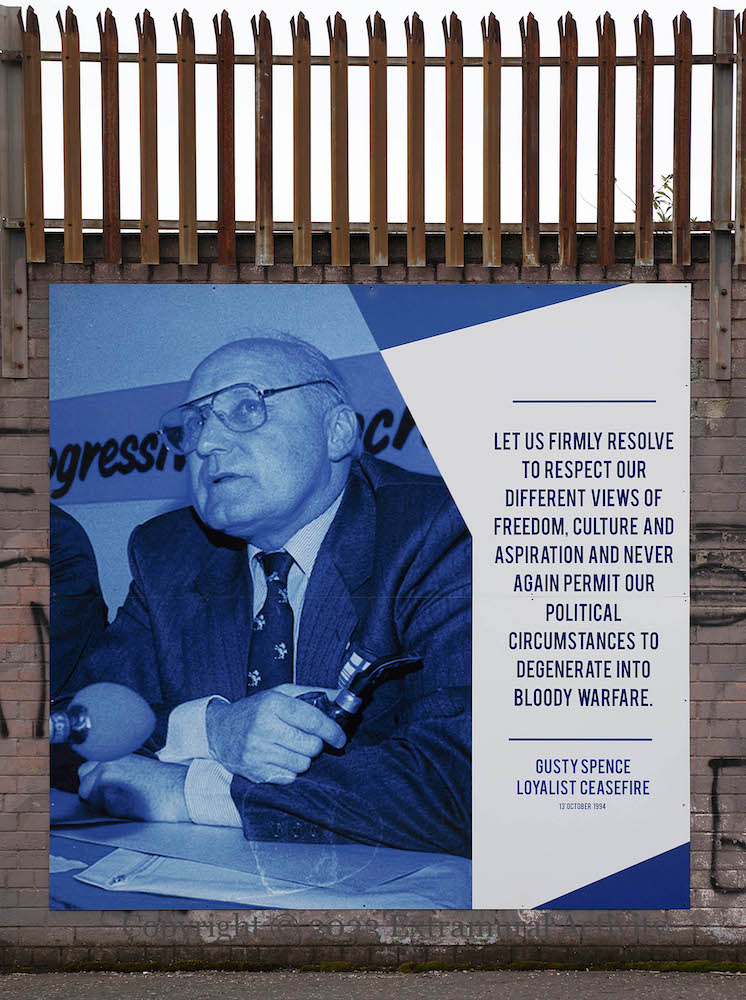
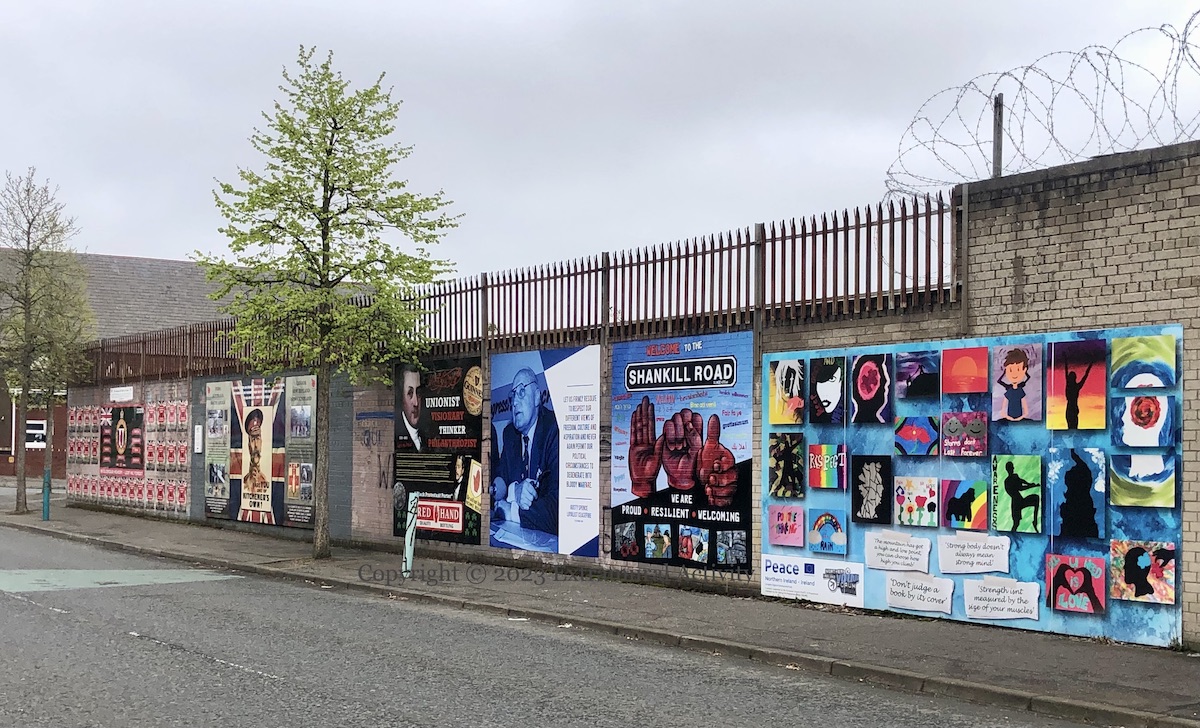
Here are three new pieces above the security gates on Northumberland Street, covering over the “Deserted! Well, We Can Stand Alone” graffiti in the last remaining spot on the wall without a mural. From left to right:
Arthur Guinness: “Black Protestant Porter” as a description of Guinness stems from Arthur Guinness’s opposition to the 1798 rebellion (Indo). The Union Star (newspaper in Belfast – A Planet Of Light And Heat) called Guinness a spy and advised that “United Irishmen will be cautious of dealing with any publican who sells his drink.” (An Phoblacht).
Gusty Spence, a former commander of the UVF, read out the ceasefire statement of the “Combined Loyalist Military Command” (UVF, RHC, and UDA): “Let us firmly resolve to respect our different views of freedom, culture and aspiration and never again permit our political circumstances to degenerate into bloody warfare – Gusty Spence, loyalist ceasefire [statement in full], 13 October, 1994.”
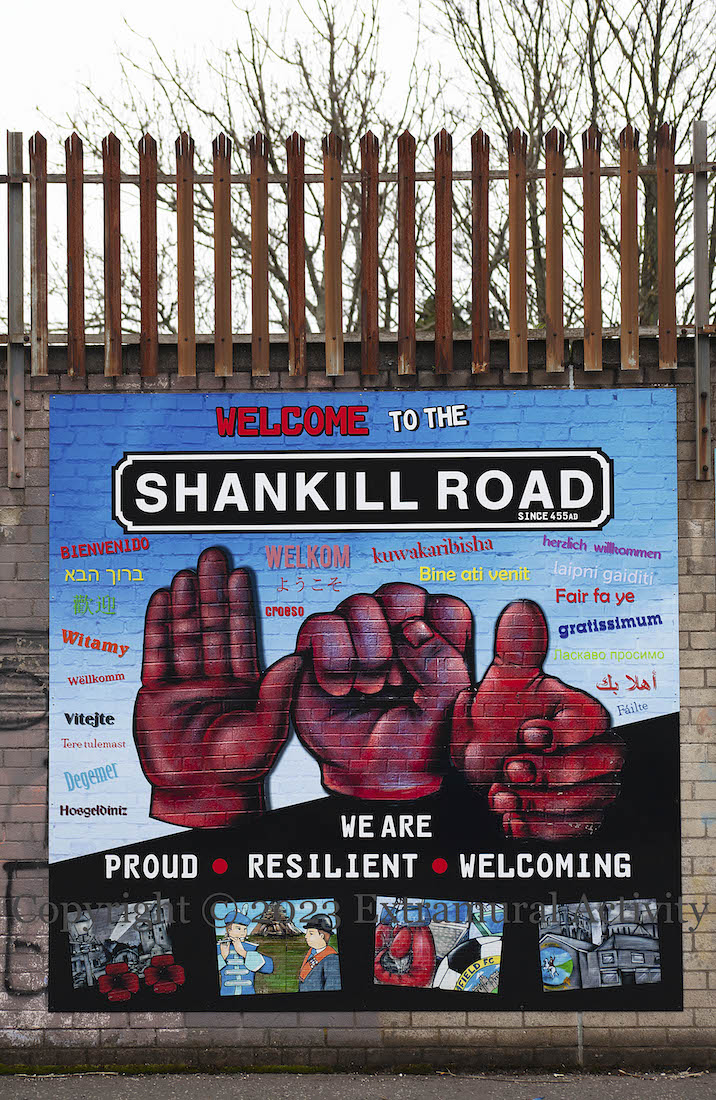
“Welcome To The Shankill Road – we are proud, resilient, welcoming”: The original ‘three hands’ was on Northumberland Street, just above this spot – see Proud, Defiant, Welcoming – which was then reproduced in reduced form in Gardiner Street – see Welcome To The Shankill Road.
This is the most conciliatory statement ever made by loyalism and the decision to put it on Northumberland Street, especially in the context of the internationally famous and associated-with-Ireland Guinness and the “welcome” mural, suggests that the trio is directed at tourists rather than locals.
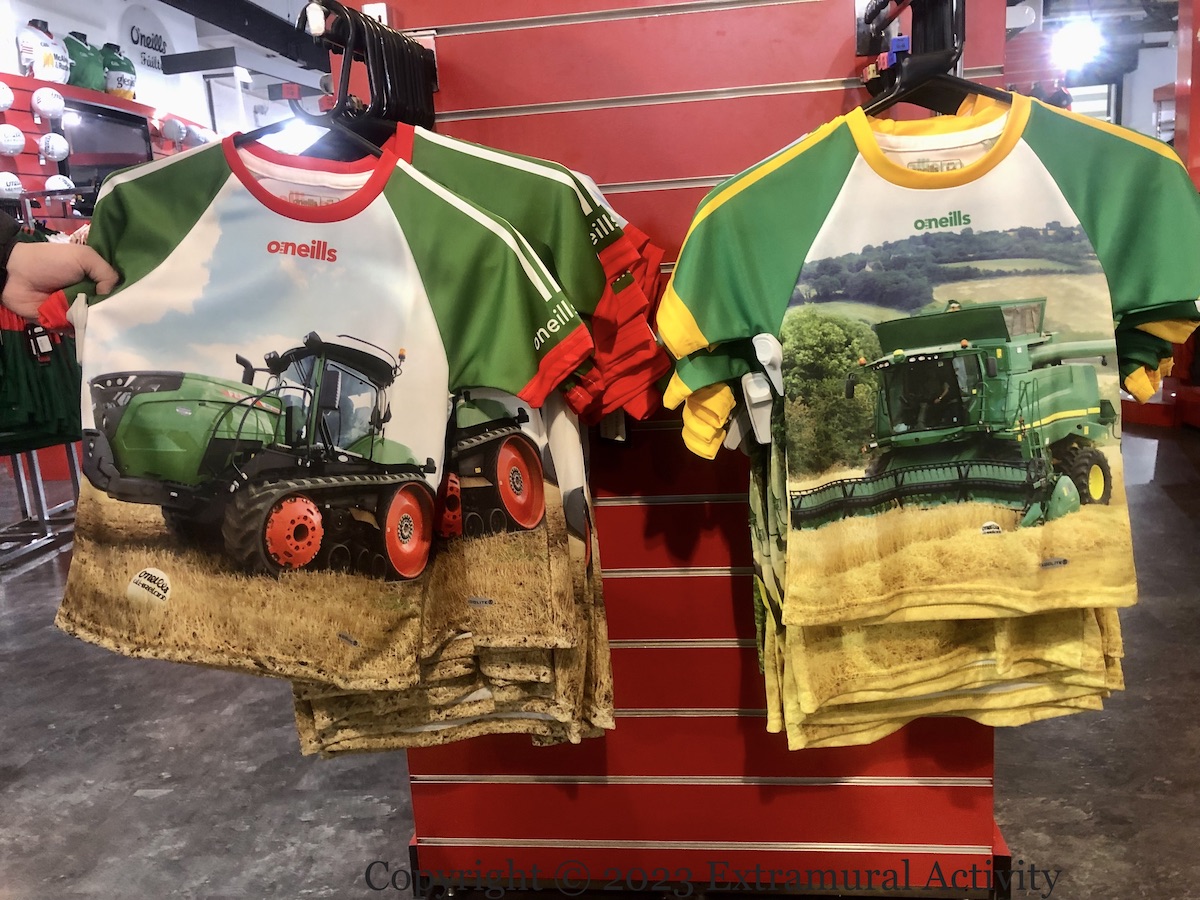
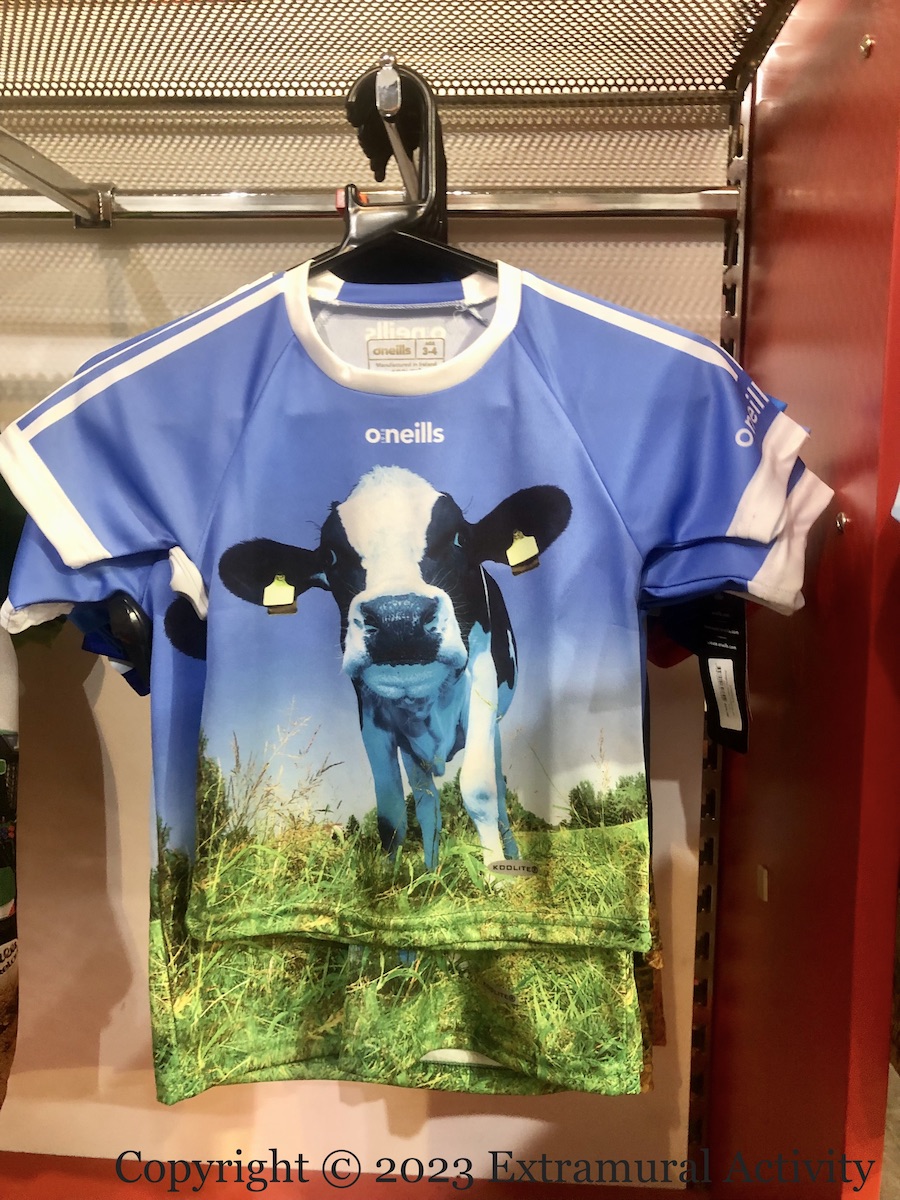
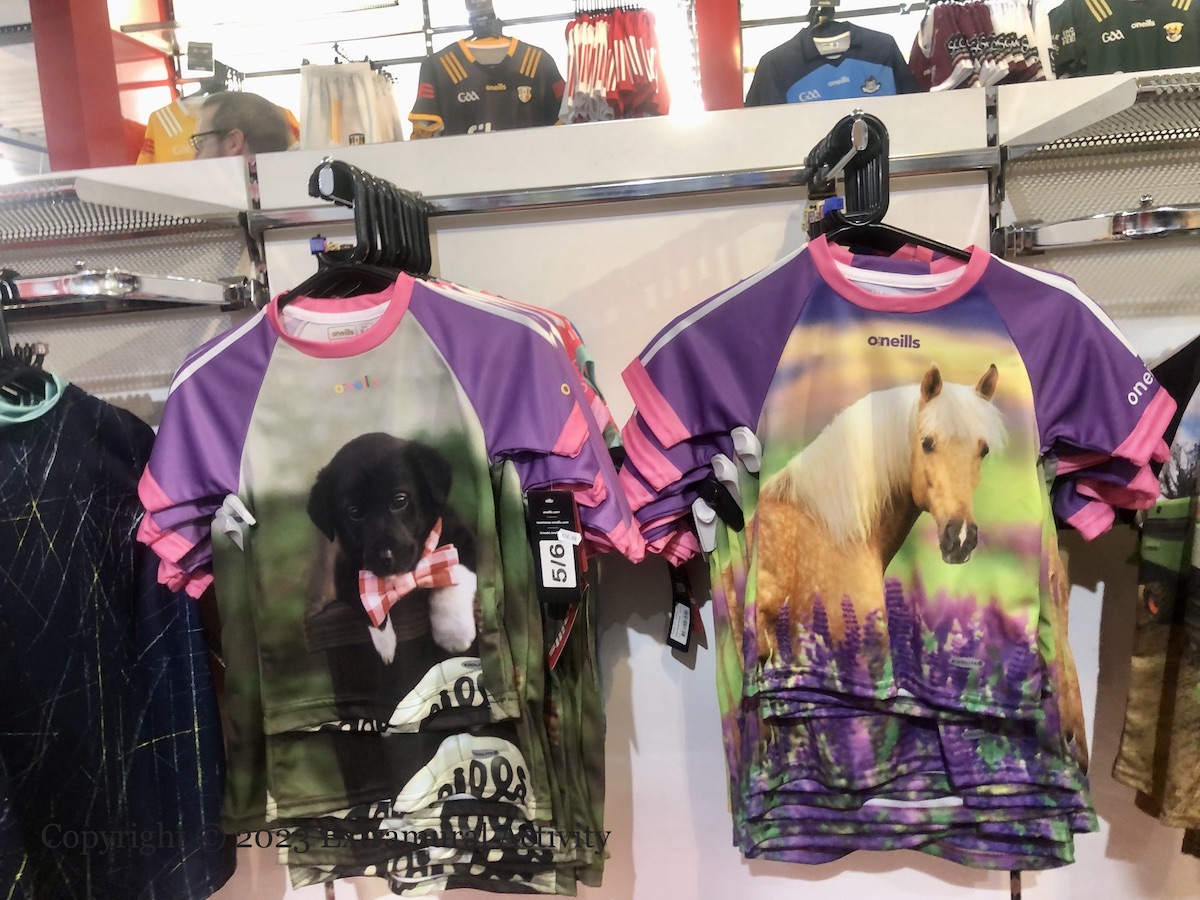
Amid all the GAA and other sports tops in the O’Neill’s shop in the Kennedy Centre can be found a number of jerseys produced for the 2022 ploughing championships (RTÉ).
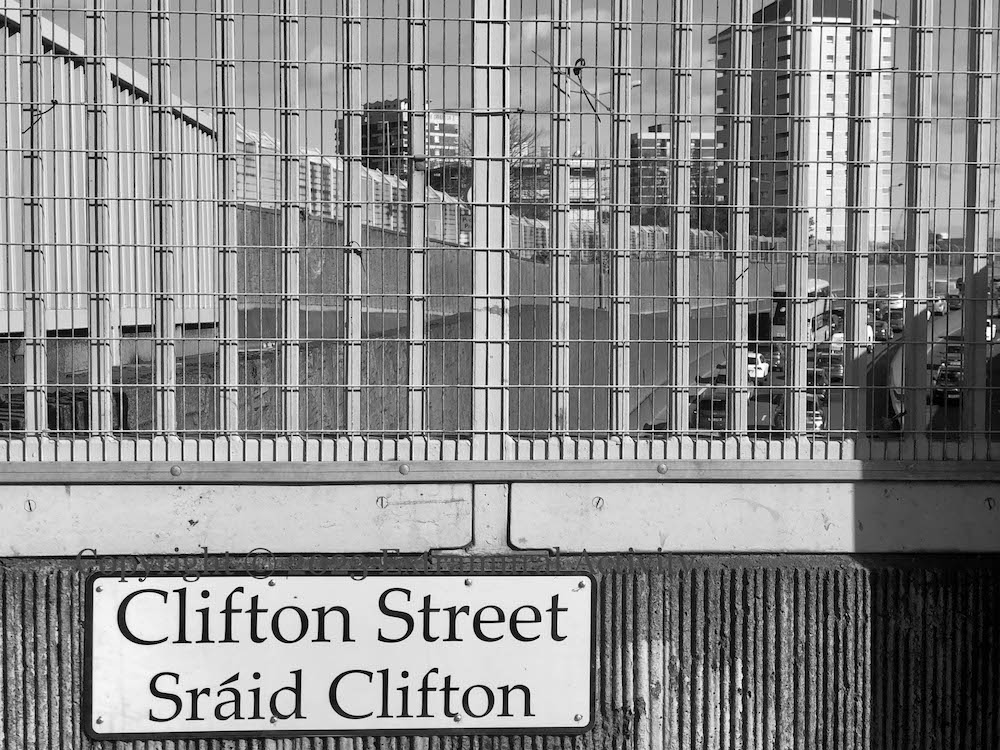
It is a year since the new policy on bilingual street signs was made public; by September there had been 500 applications (Belfast Media) but by January of this year no new signs had been erected and 600 applications were awaiting decision (Belfast Live | Irish News from Feb). One new sign – shown here – was erected in February on Clifton Street (Belfast Media).
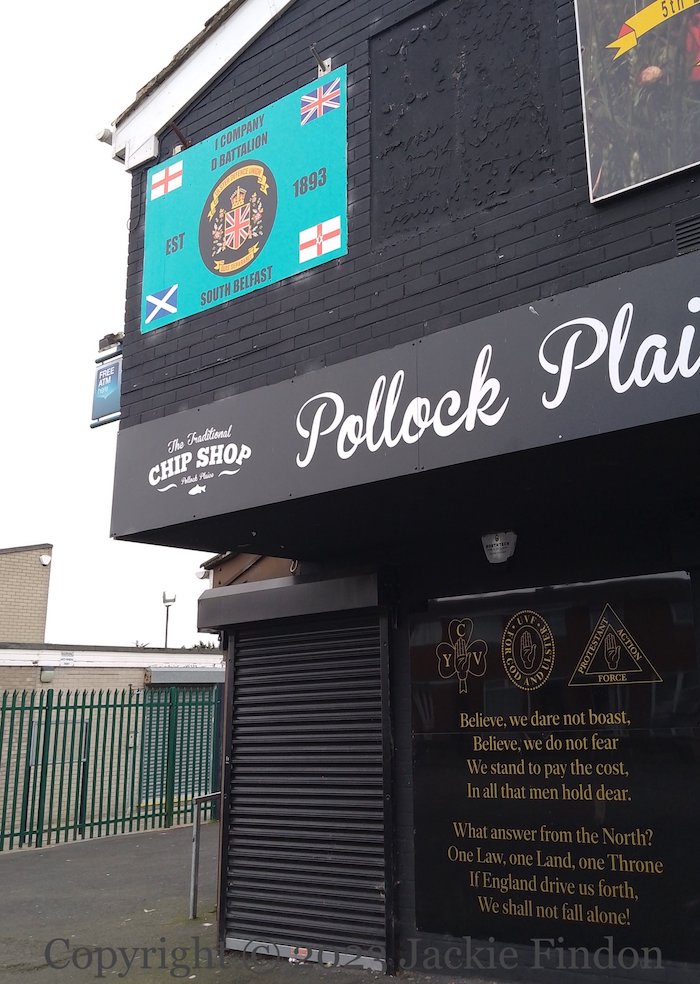
These are the boards at the chip shop (formerly a Spar and before that a Mace) in the centre of the Mourneview estate, Lurgan.
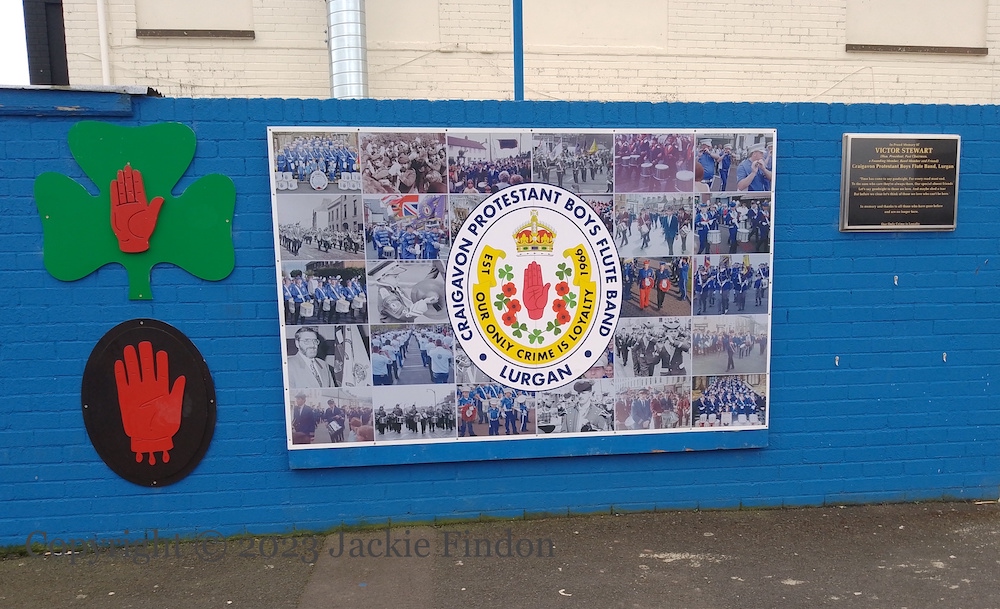
Above, in Mourne Road, a gallery of photographs of the Craigavon Protestant Boys (Fb) past and present, with a plaque in memory of Victor Stewart. “Our only crime is loyalty.”
Below are the images from the front of the shop, in Pollock Drive:
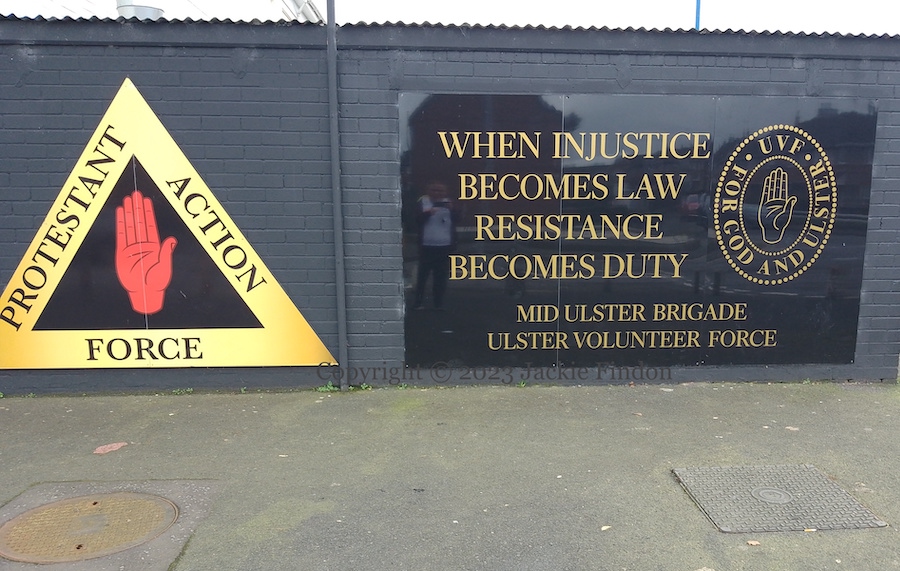
First/right: “When injustice becomes law resistance becomes duty.” The same panel was seen in Ballyclare, though for the 1st East Antrim battalion rather than the Mid Ulster brigade.
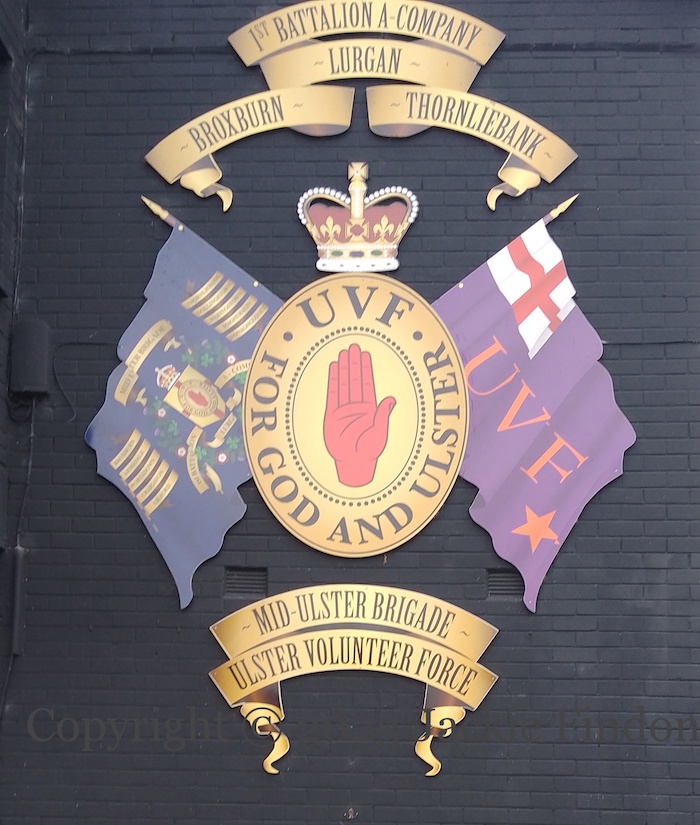
Next: A company, 1st battalion, Mid Ulster brigade UVF – Lurgan as well as Broxburn (outside Edinburgh) and Thornliebank (near Glasgow).
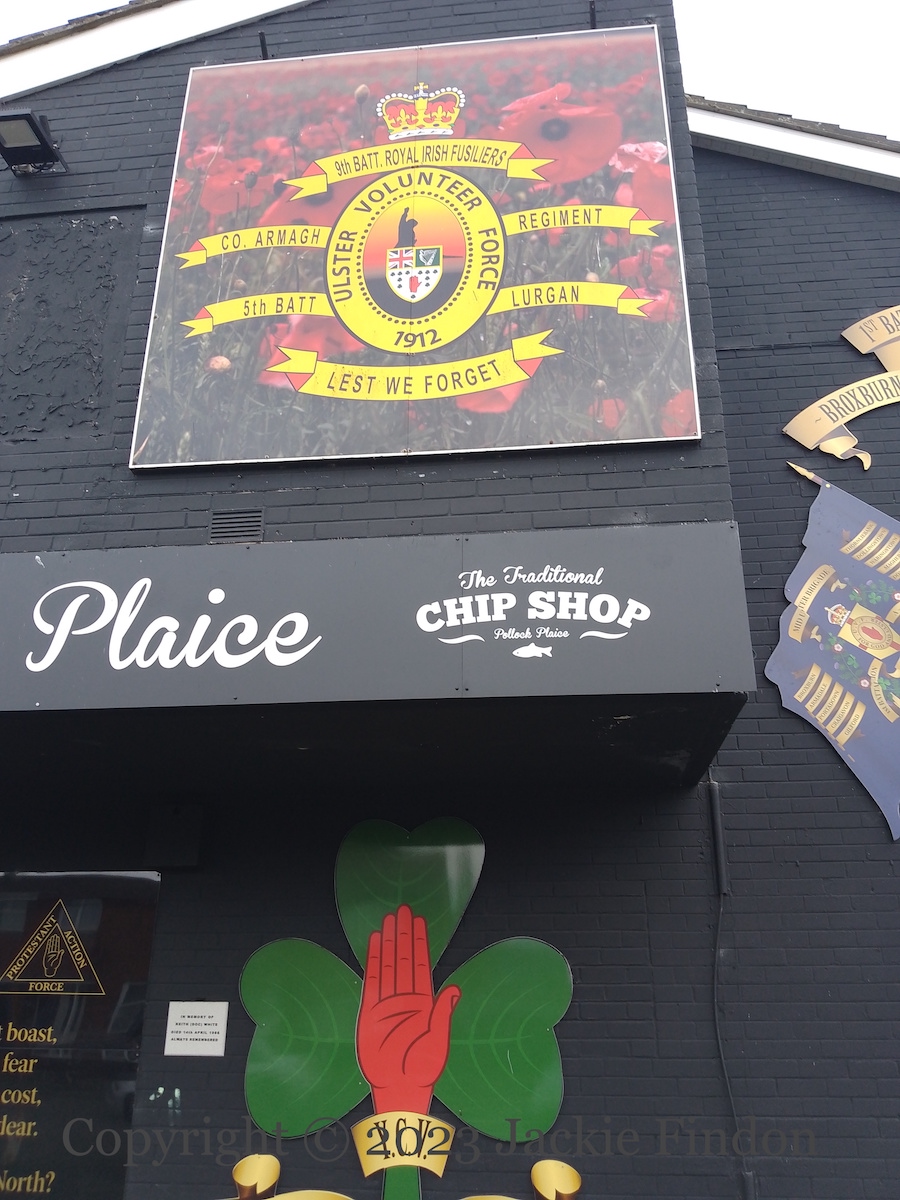
Next: A tribute to the Ulster Volunteers from the area: the 9th battalion Royal Irish Fusiliers joined the 108th brigade in the 36th (Ulster) Division; the 5th battalion joined the 31st brigade and the 10th (Irish) Division. This board goes back to (at least) 2011.
Next: “Believe, we dare not boast,/Believe, we do not fear/We stand to pay the cost,/In all that men hold dear.//What answer from the North?/One Law, one Land, one Throne/If England drive us forth,/We shall not fall alone!” Kipling’s poem Ulster.
All of the preceding pieces are UVF/PAF, but the last, high up on the left, is a UDU board in the top left of the wall, to 1 company, D battalion, South Belfast.
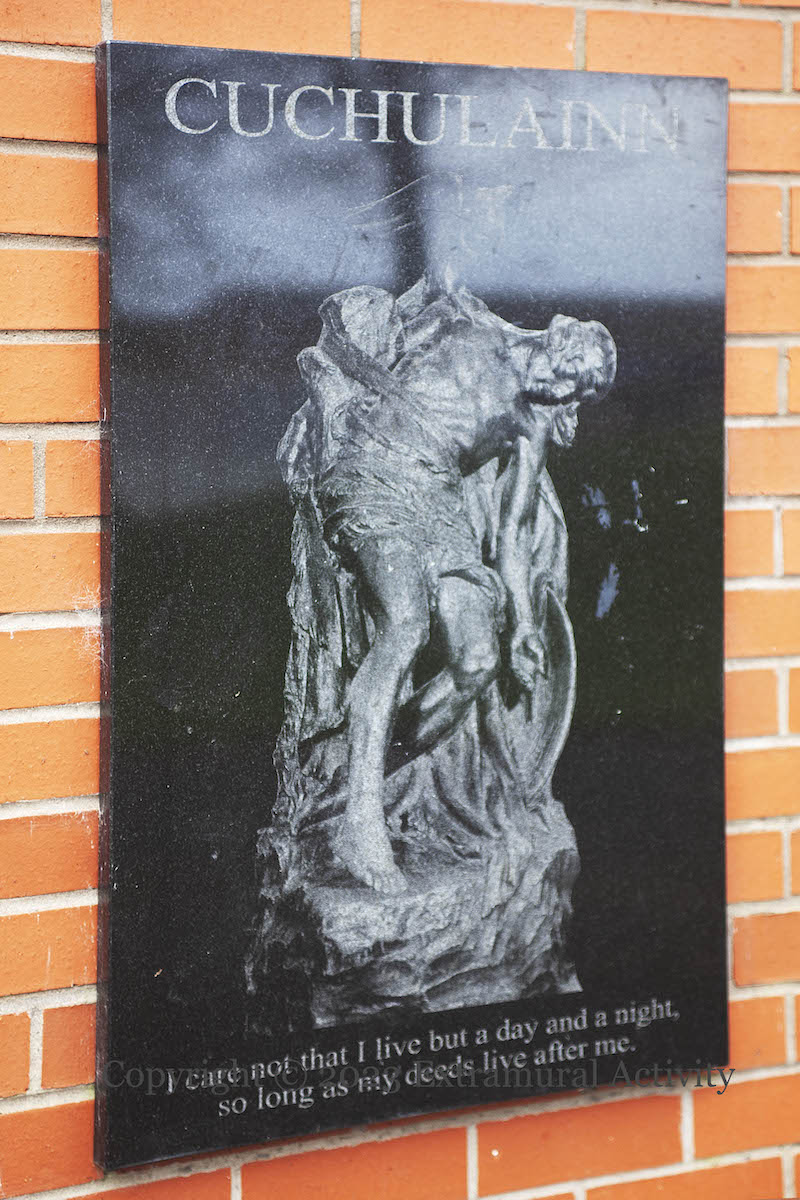
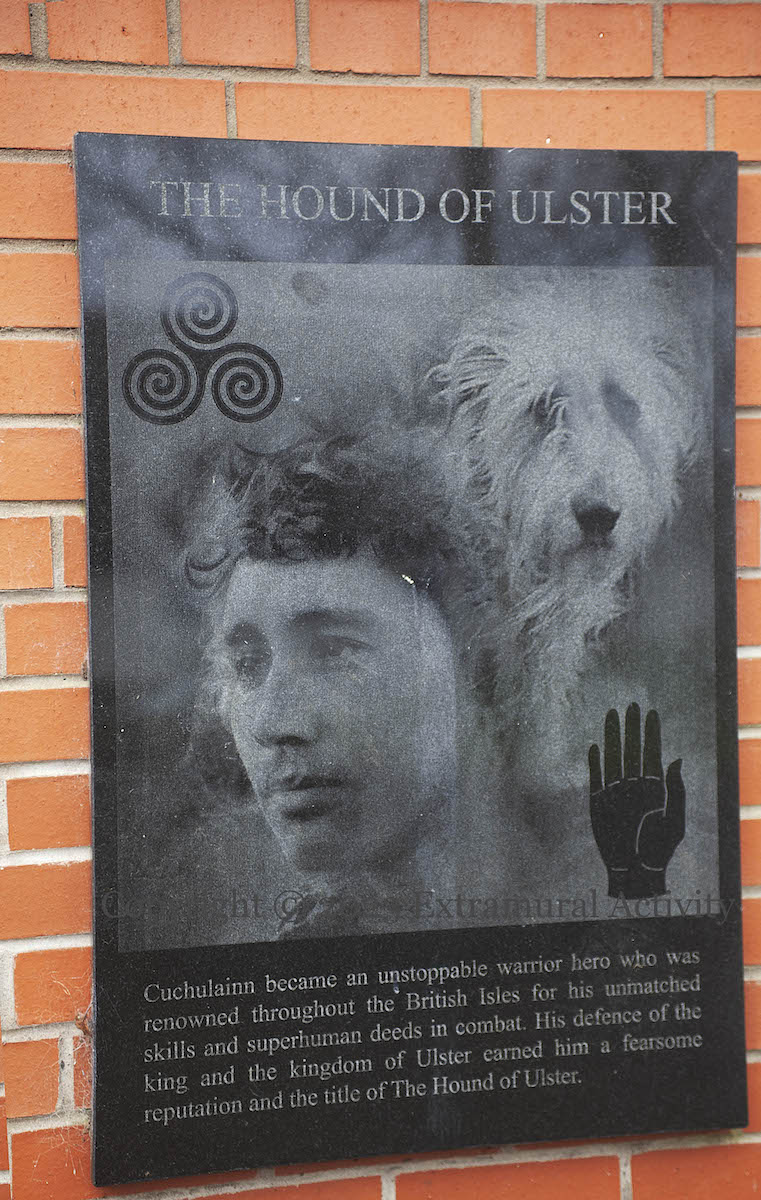
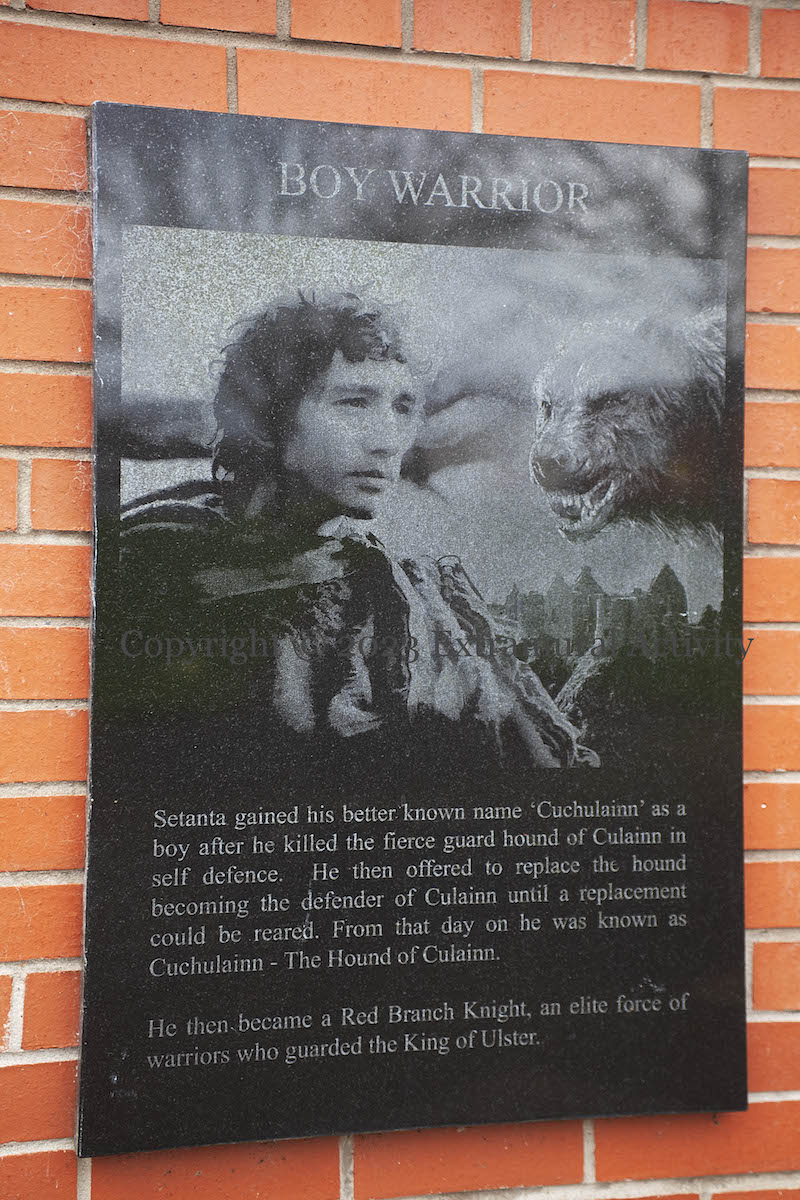
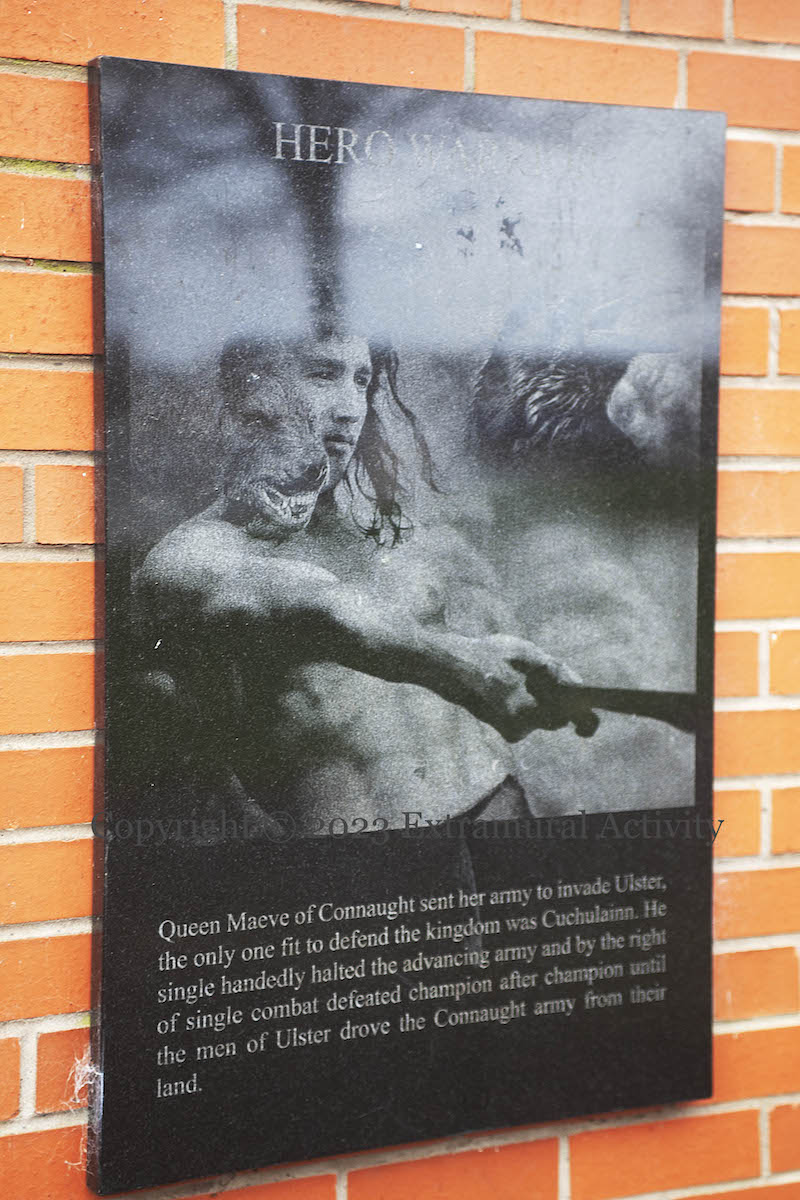
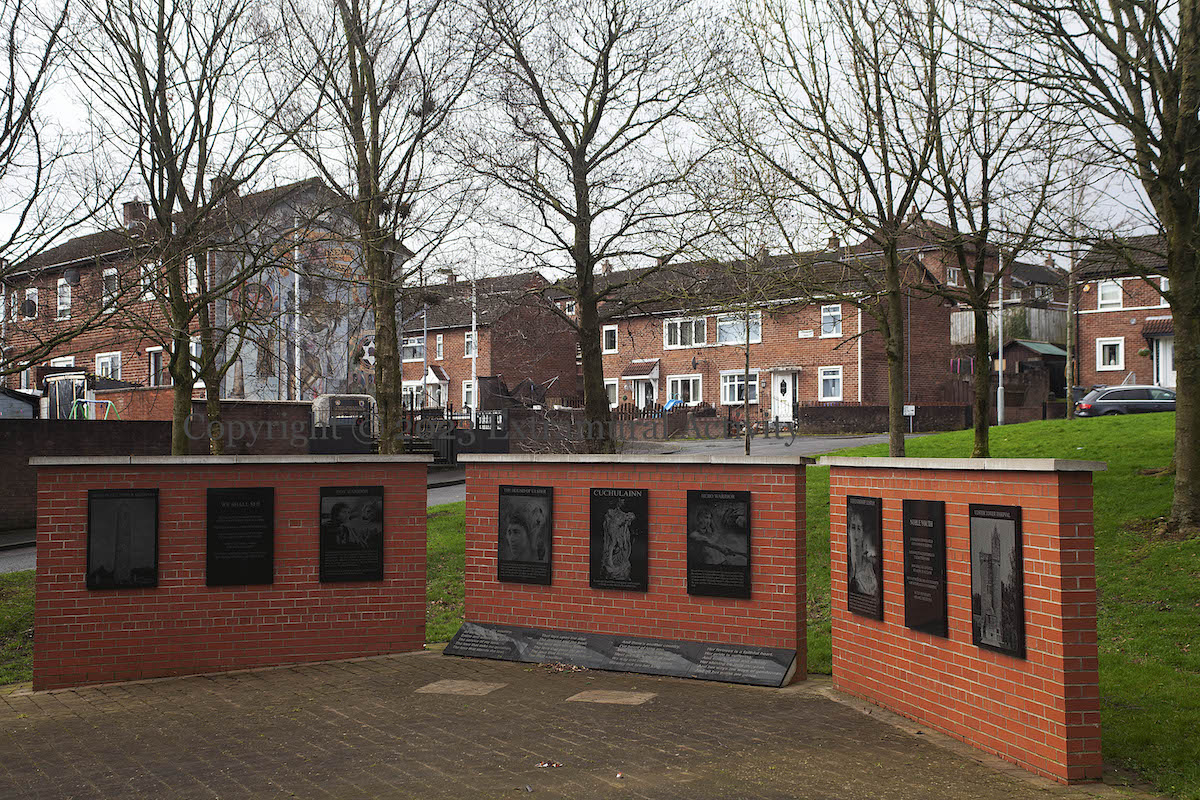
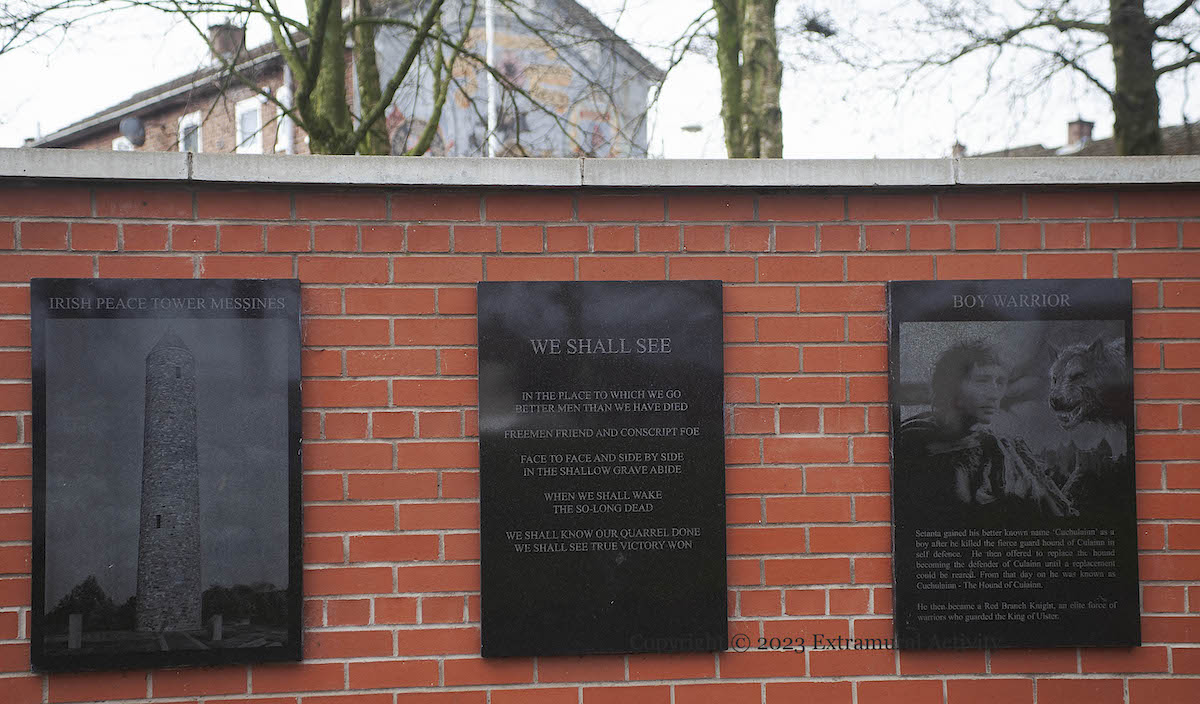
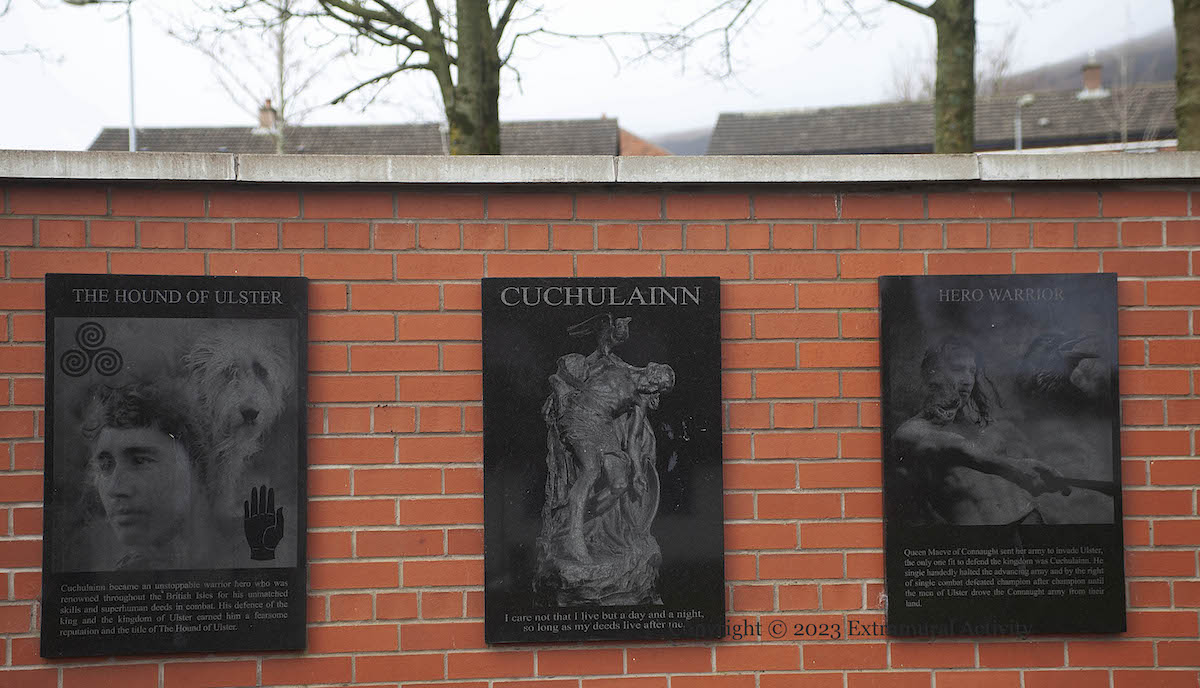
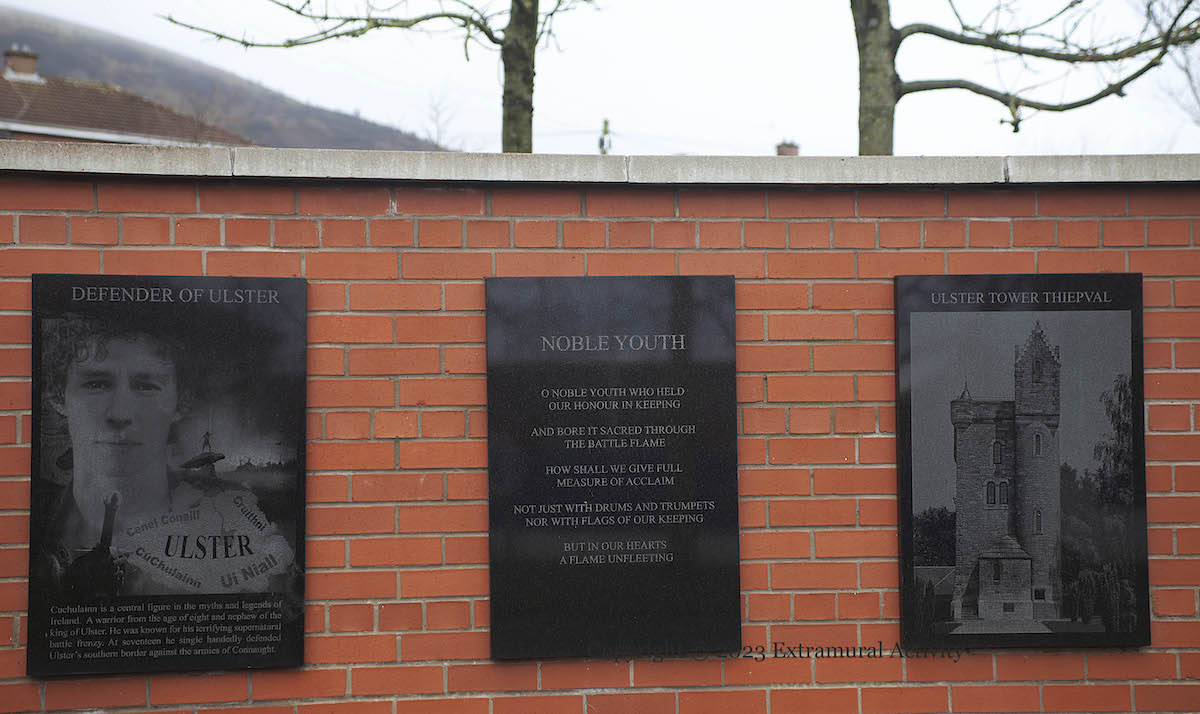
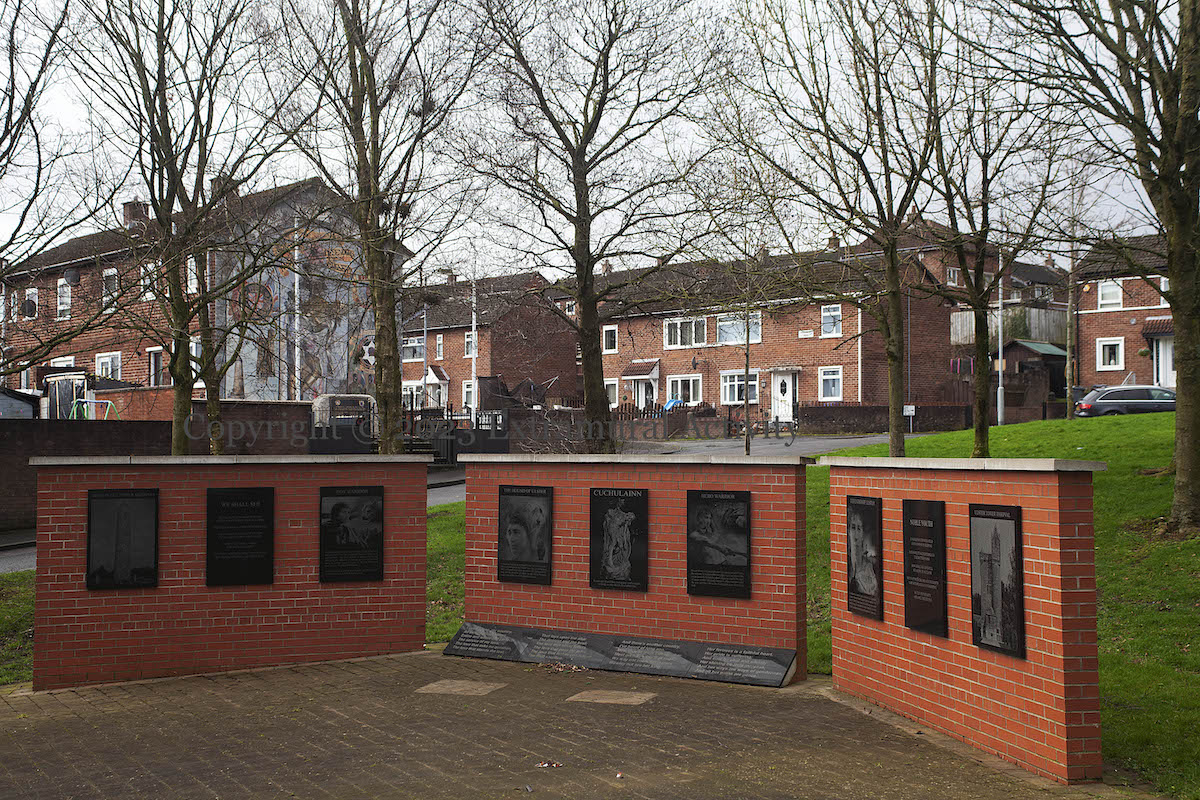
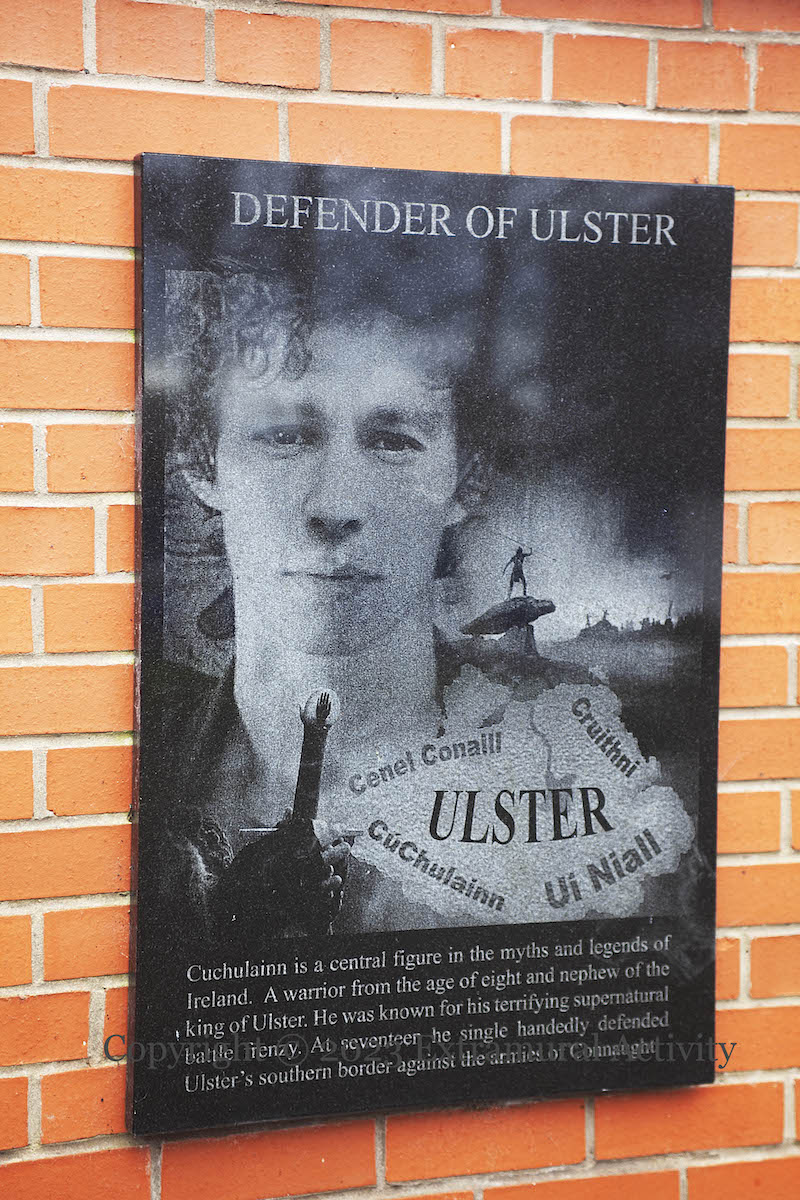
As the Visual History page on the role of Cú Chulaınn makes clear, in PUL muraling and iconography, Cú Chulainn serves as the “ancient defender of Ulster”, and the B Specials, UDR, and loyalist paramilitaries – primarily the UDA but also the UVF – then fit into that tradition. Using Cú Chulaınn as a precursor for service in the Ulster Division of WWI is unique to the panels on Highfield green, five of which are devoted to the hero Cú Chulaınn and four – two on each end – refer to the Great War.
The five Cú Chulaınn panels are (from left to right) Boy Warrior, Hound Of Ulster, Sheppard’s statue, Hero Warrior, and Defender Of Ulster – all shown individually in this post.
On the far left, there are two panels showing Messines tower and a few lines from a Ronald Lewis Carton poem Réveillé (though given a more ‘victorious’ ending) and on the far right, a few lines from Duncan Campbell Scott’s To A Canadian Lad Killed In The War and Thiepval tower. The words to I Vow To Thee My Country (lyrics) are along the bottom (see the wide shot, final image below).
The biographical panels focus on Cú Chulaınn’s age – the sixth panel emphasises that Cú Chulaınn was only 17 when he held off Maeve’s forces – which is perhaps a similarity with those who joined the 36th Division, but how the “defender of Ulster” is connected to the defense of Europe is obscure.
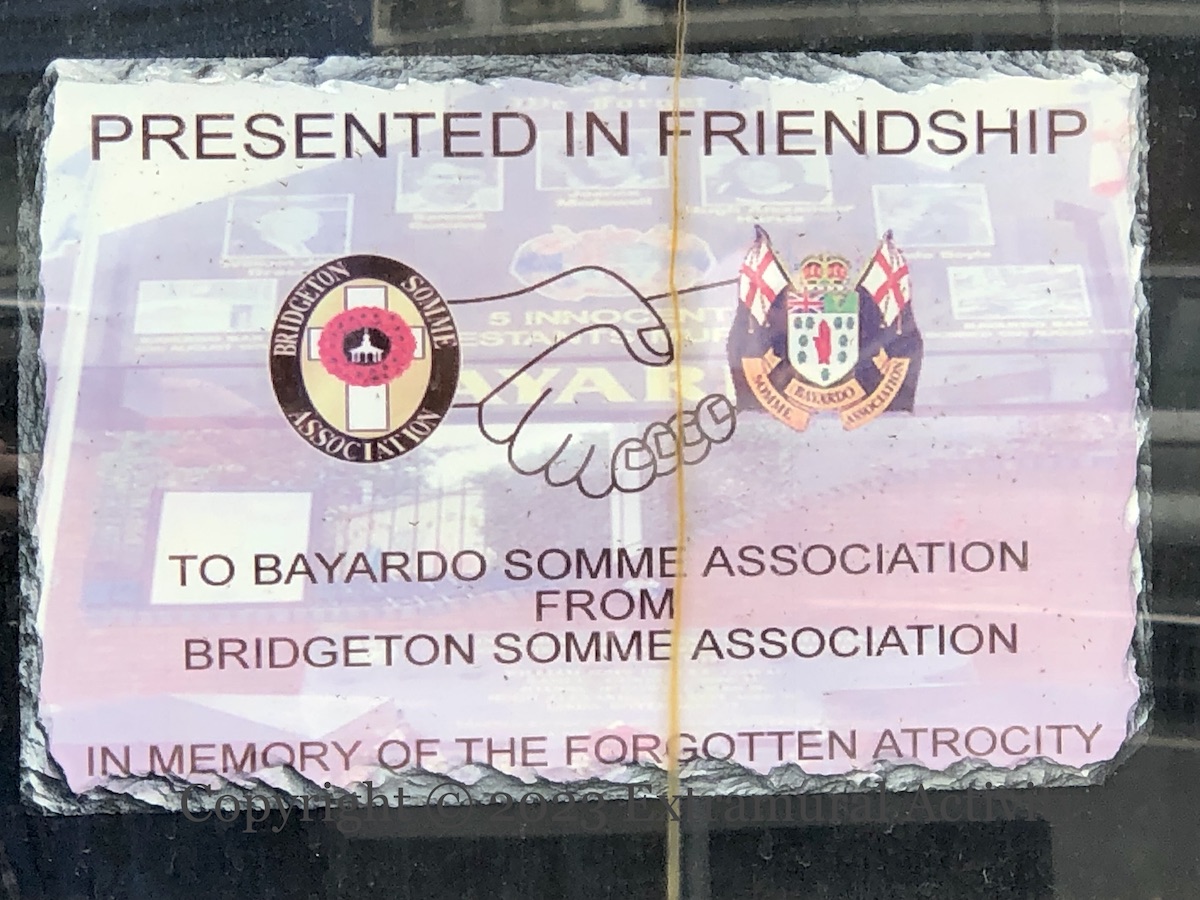
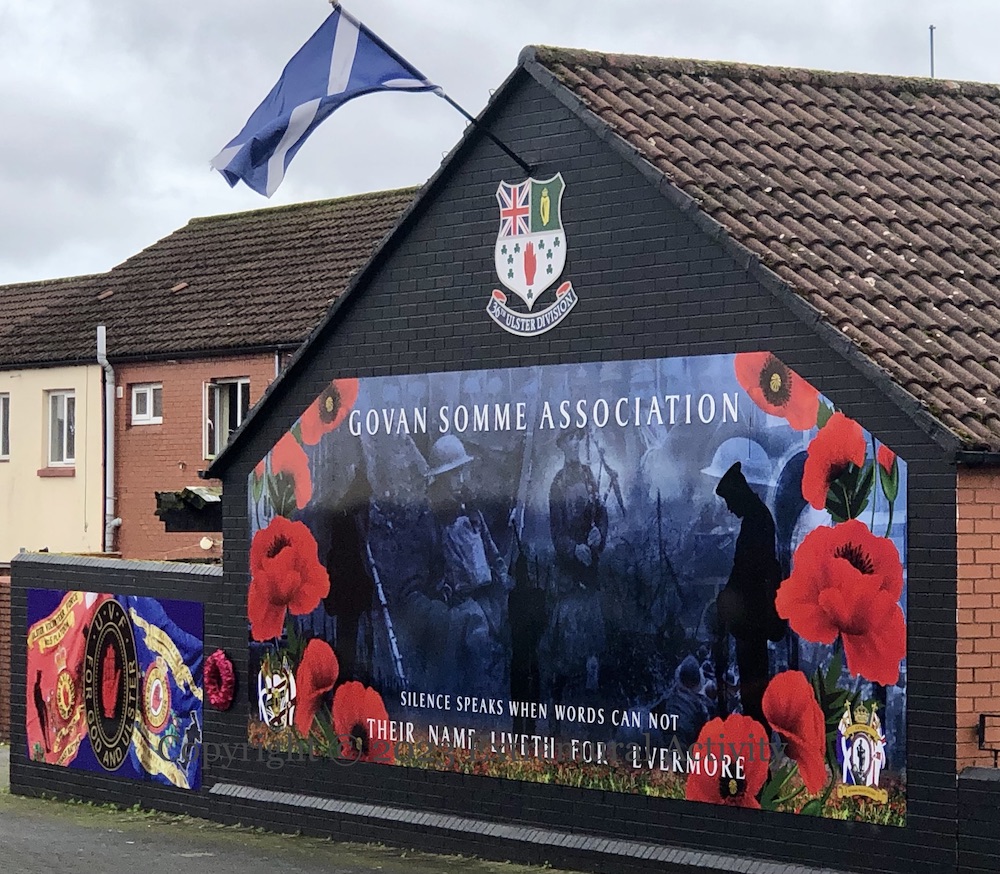
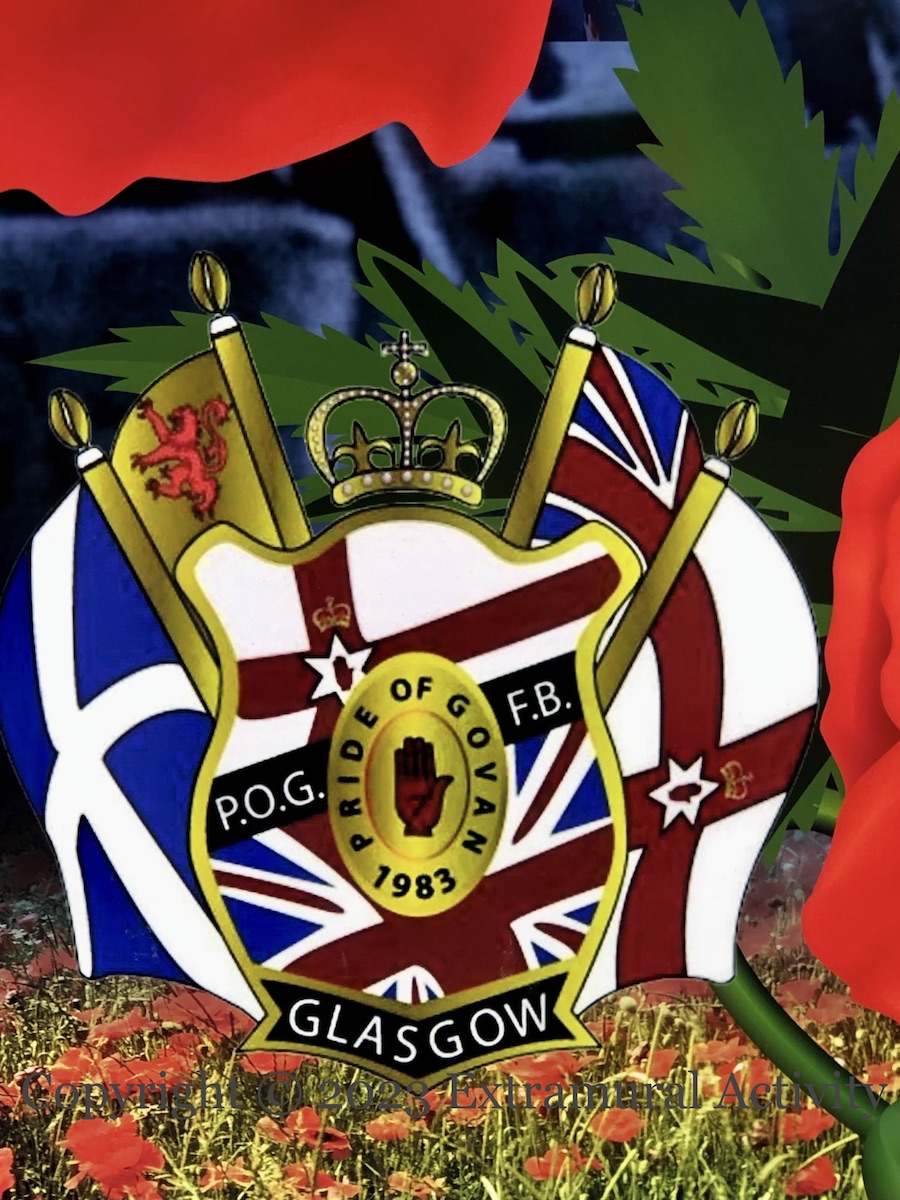
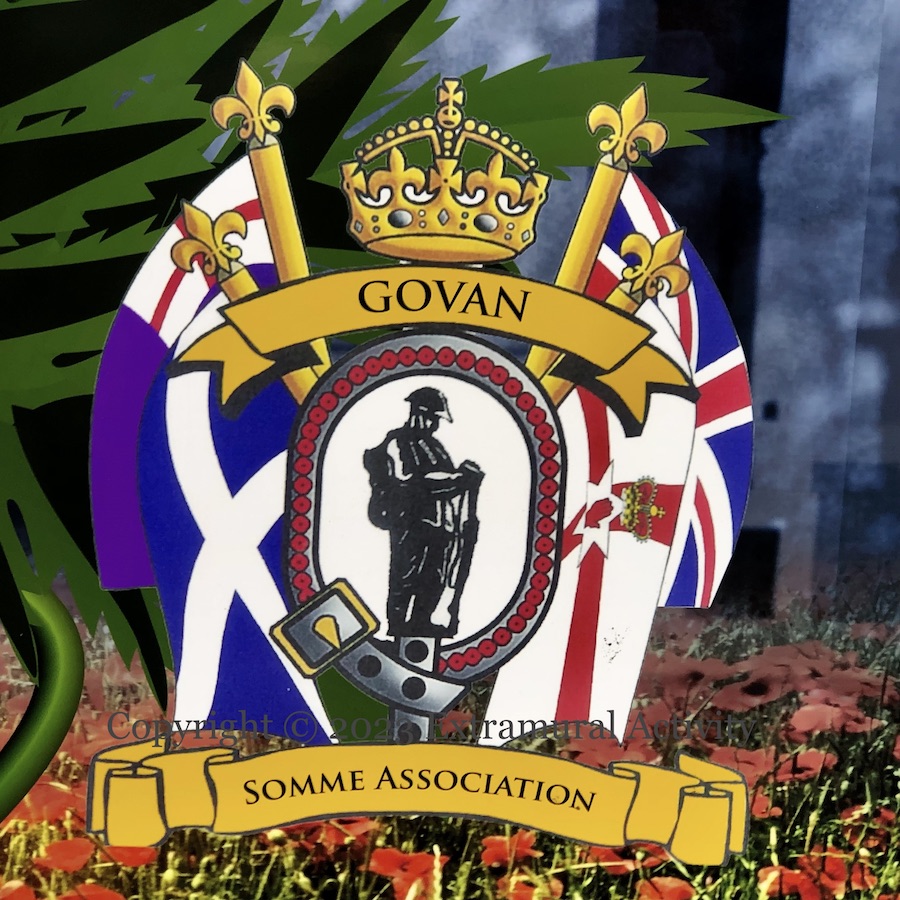
There was previously a (painted) mural on this wall – see Passchendaele Court – but this latest display is a large printed board, with photographs blended together and framed by graveside mourners, poppies, and the emblems of the Pride Of Govan flute band and the Govan Somme Association (Fb), which also supported the previous mural.
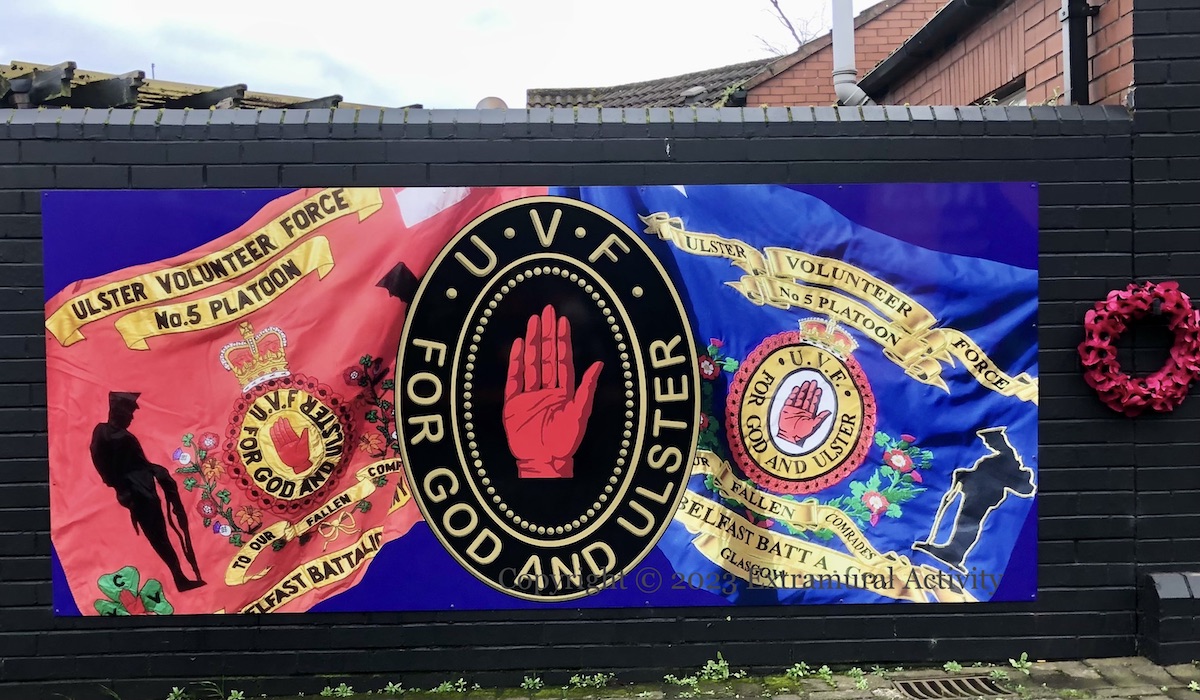
To the left, as seen in the final images, is a smaller UVF (1st Battalion) A Company 5th Platoon board – like the other new board in the street We Will Always Be Ready (and on the other side of Conway Street – see When Needed We Shall Rise Again).
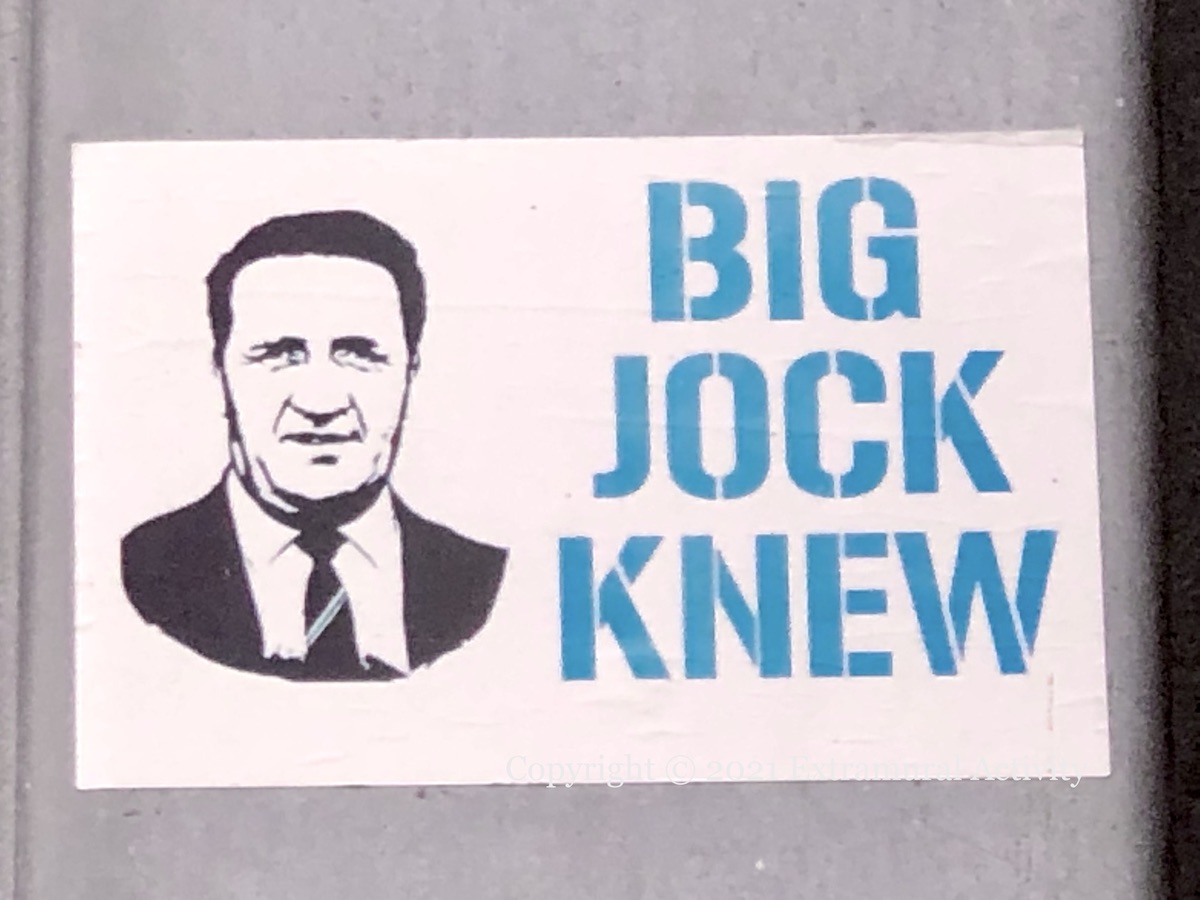
Below, second, from the Shankill: “Big Jock Knew”, that is Celtic manager Jock Stein knew of the sexual abuse of Boys Club manager Jim Torbett. Torbett was sacked by Stein in 1974 but returned to the position in the 1980s. Torbett was tried in 1998 for crimes during the earlier time-period and served 30 months, and again in 2018, for various offenses, receiving a sentence of six years (WP). More charges are to be heard in April, 2023 (Daily Record). The phrase is the title of song sung by fans of teams playing against Celtic (WP).
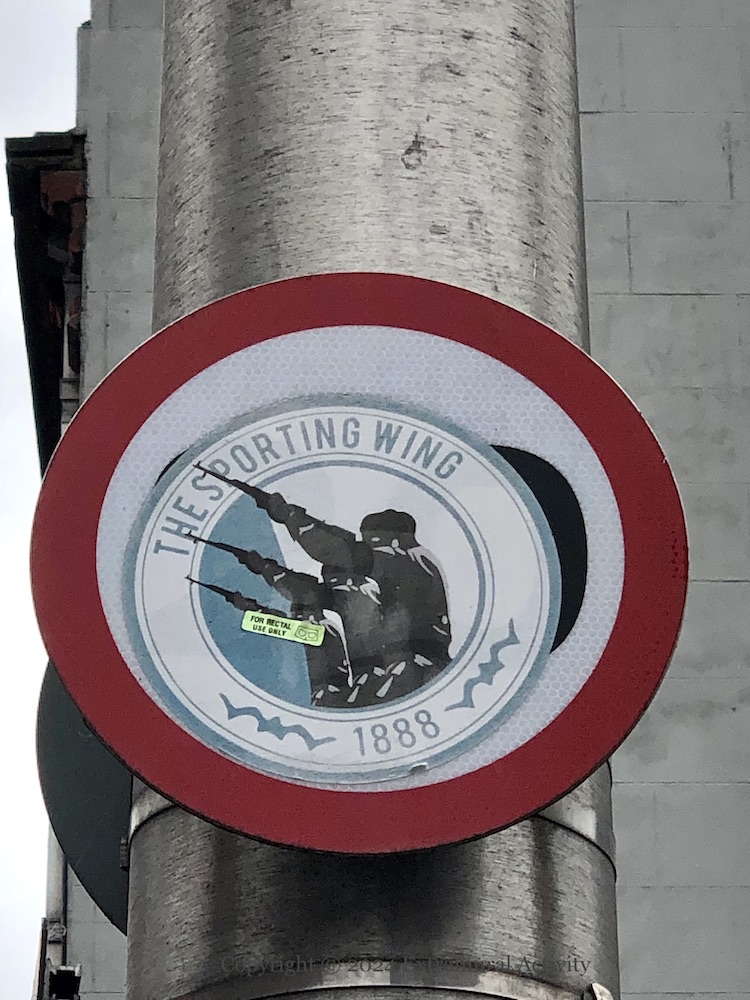
Below, third, from city centre (and also seen on the Falls): “The sporting wing [of the IRA]” is a play on the idea that Sınn Féın was the “political wing” of the IRA and so Celtic FC is the group’s “sporting wing”. Instead of Celtic’s usual four-leaf clover, three hooded gunmen fire a funeral volley.
The GAA has also been given the title (BelTel 2020); Sammy Wilson, as DUP press officer defending UDA attacks on GAA halls in Belfast and Banbridge, in September 1993, described the GAA as “the IRA at play” (WP). (For a history of the two organisations, see Irish Peace Process.) Instead of Celtic’s usual four-leaf clover, three hooded gunmen fire a funeral volley.
 Seosamh Mac Coille Collection