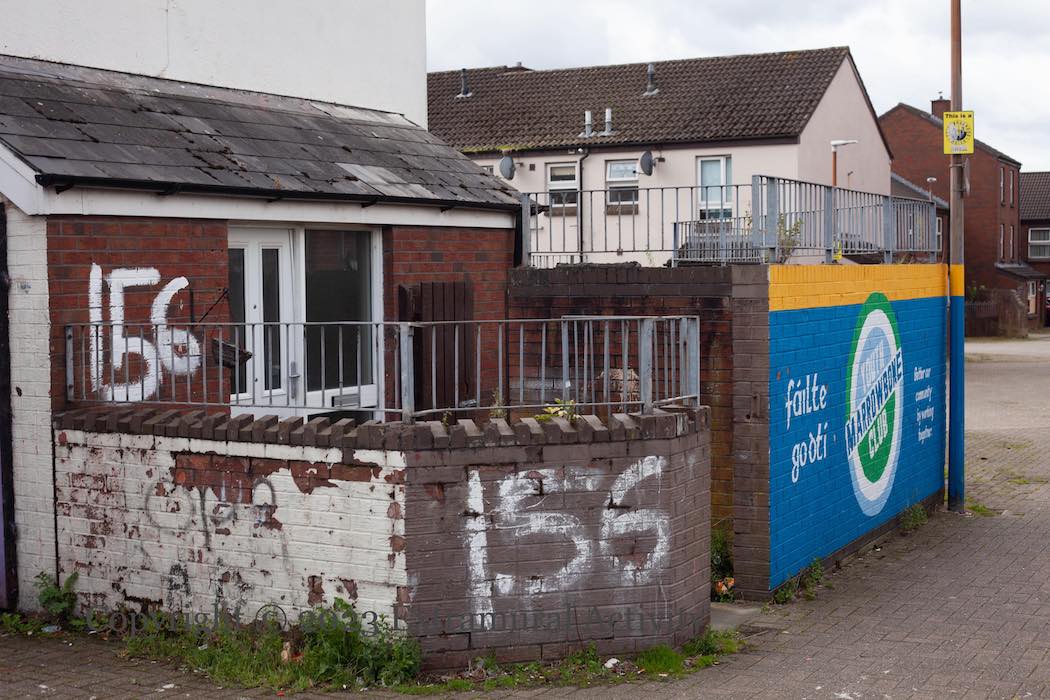
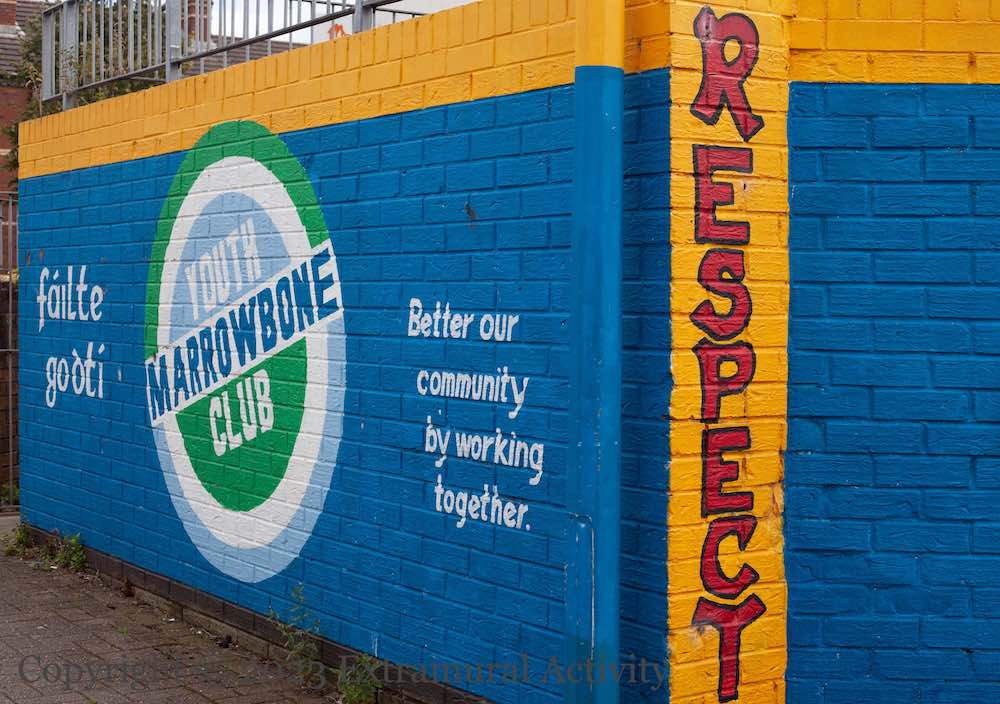
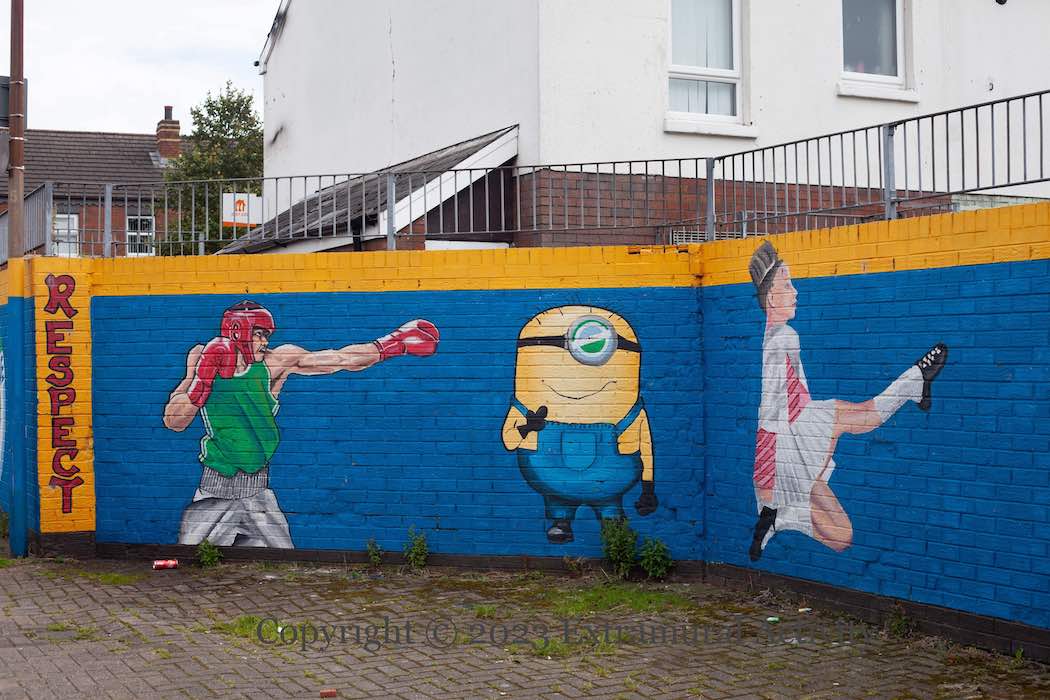
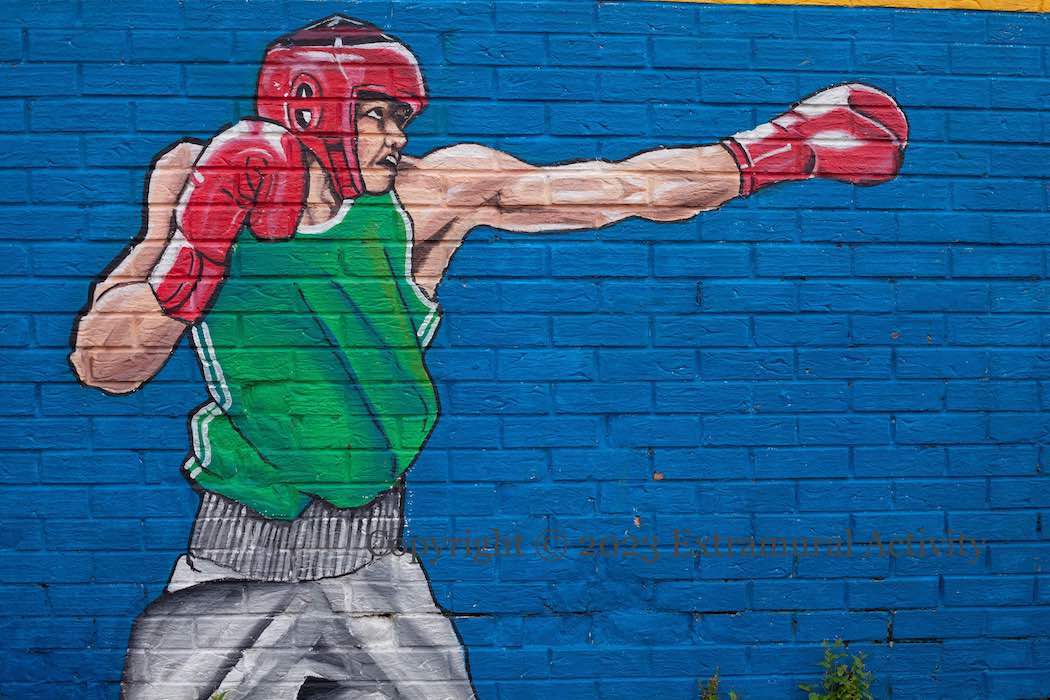
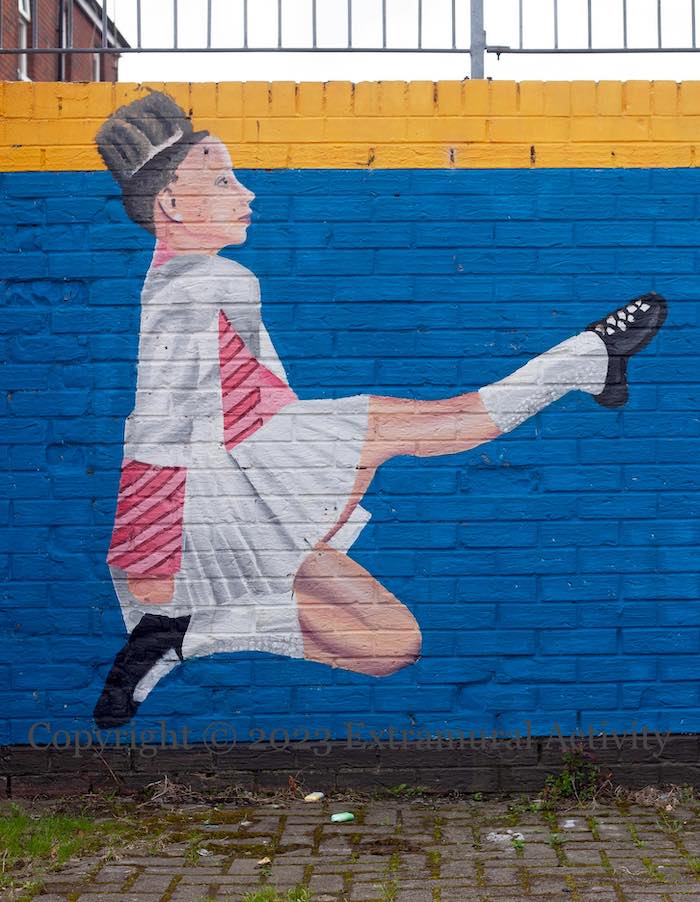
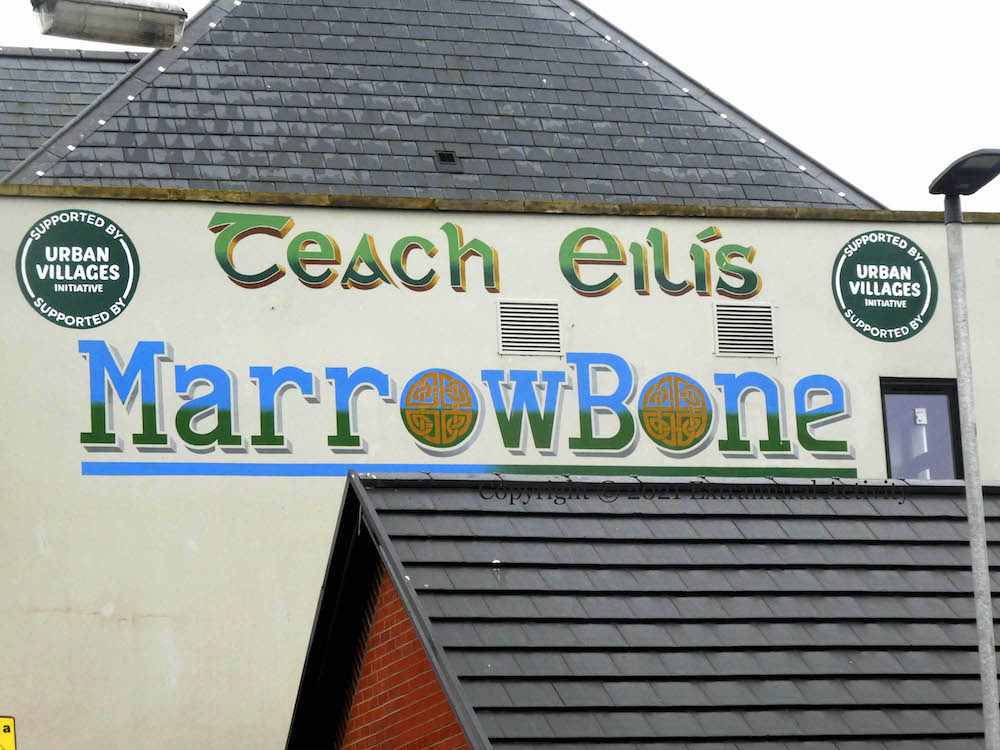
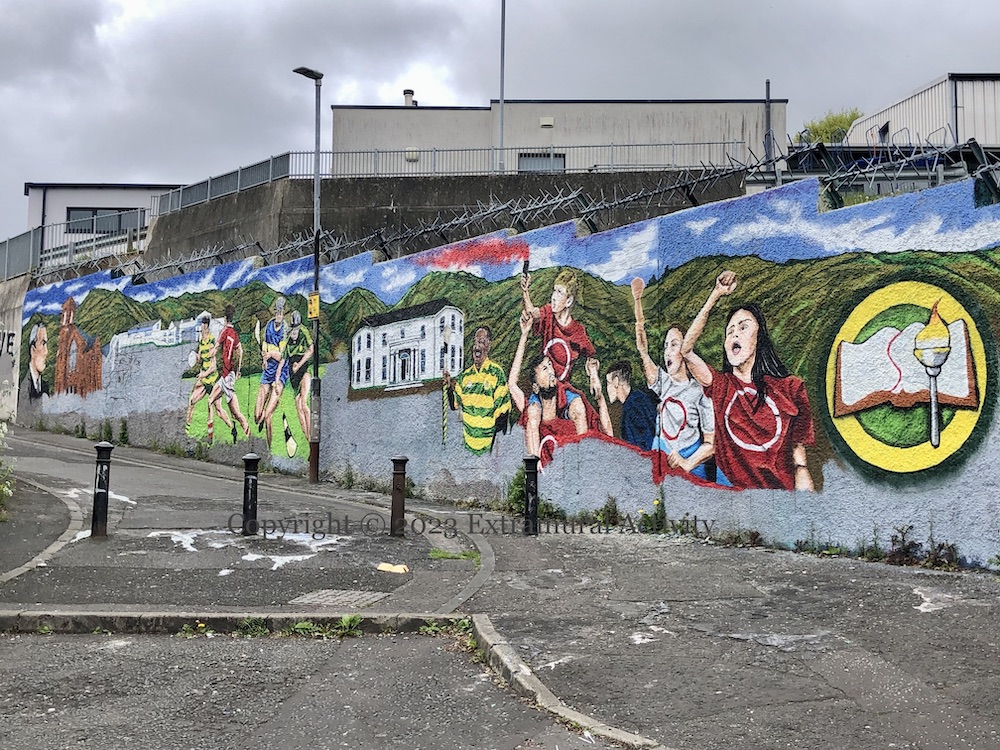
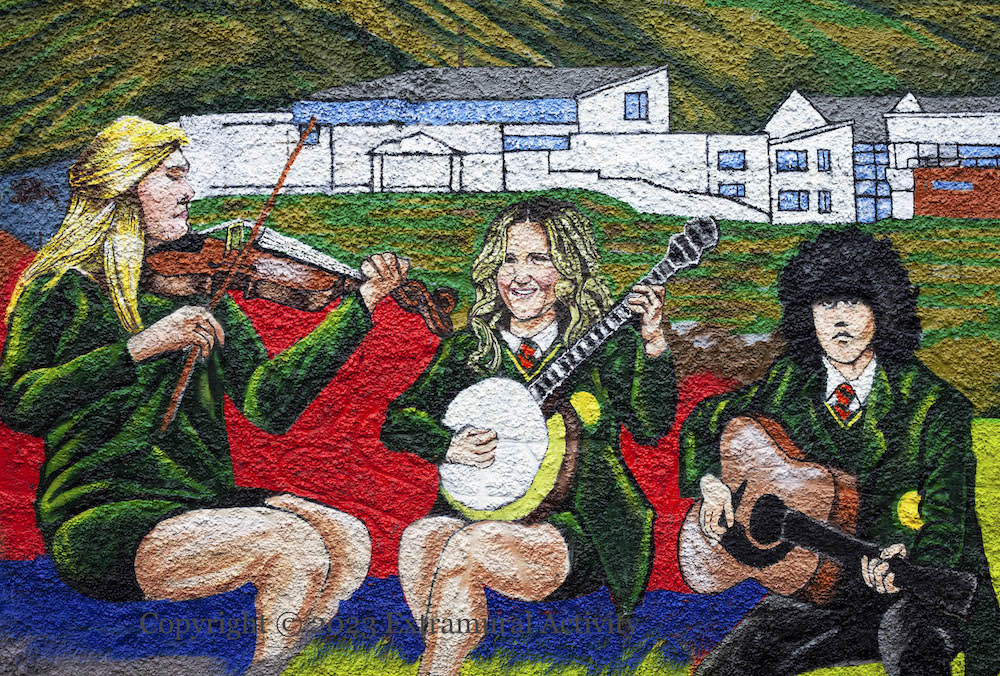
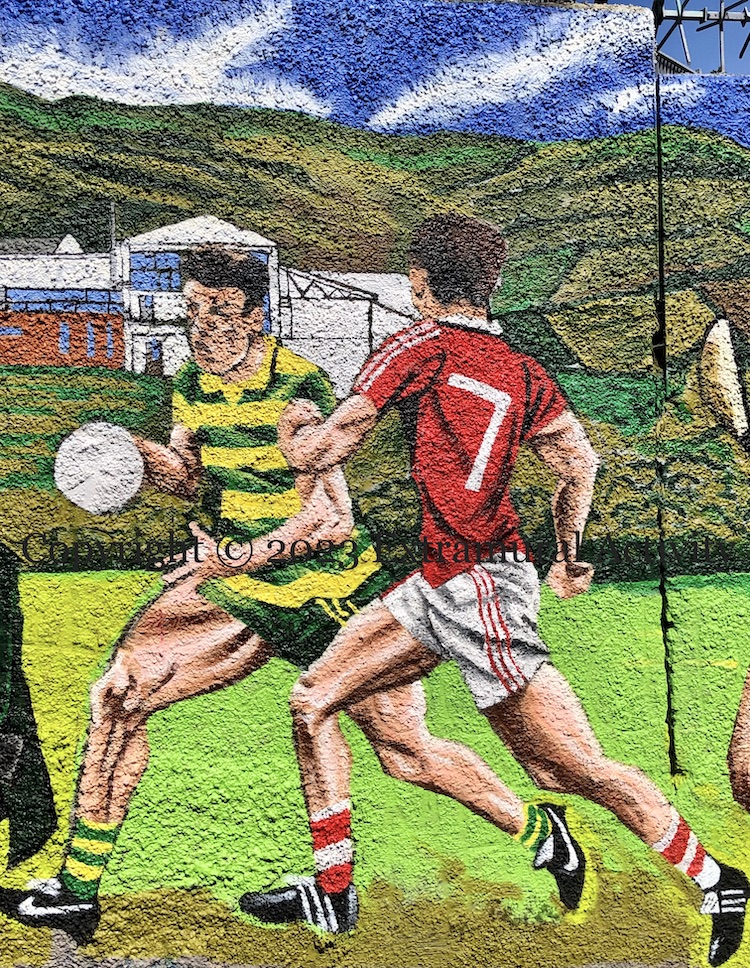
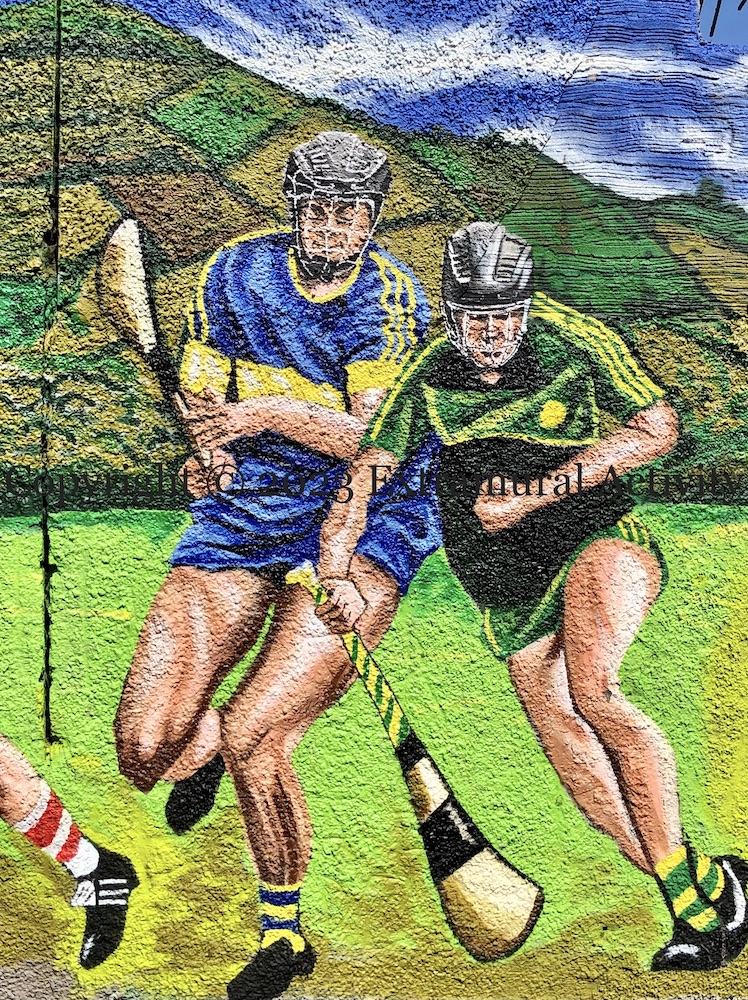
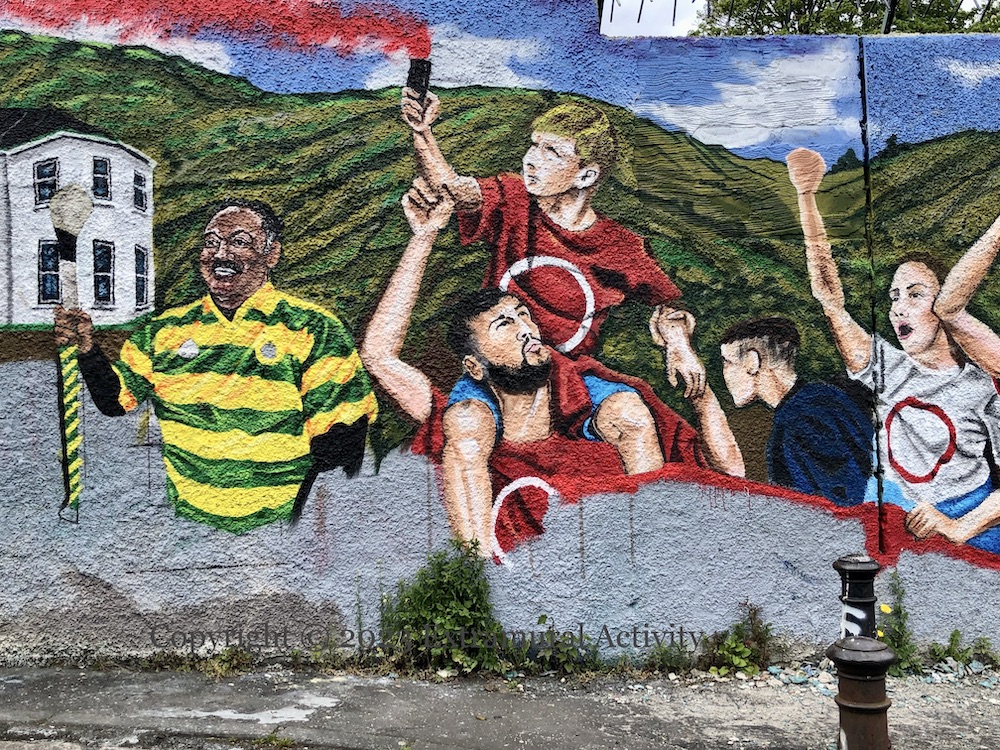
“Fáılte go dtí Marrowbone youth club [club óıge Mhachaıre Bothaın (Fb)] – better our community by working together.” The verbiage is a mix of Irish and English and the imagery is a mix of youth activities and … a minion.
The previous mural – which included Cliftonville (soccer) and Antrim (GAA) emblems – was seen previously in 2013 and in 2021.
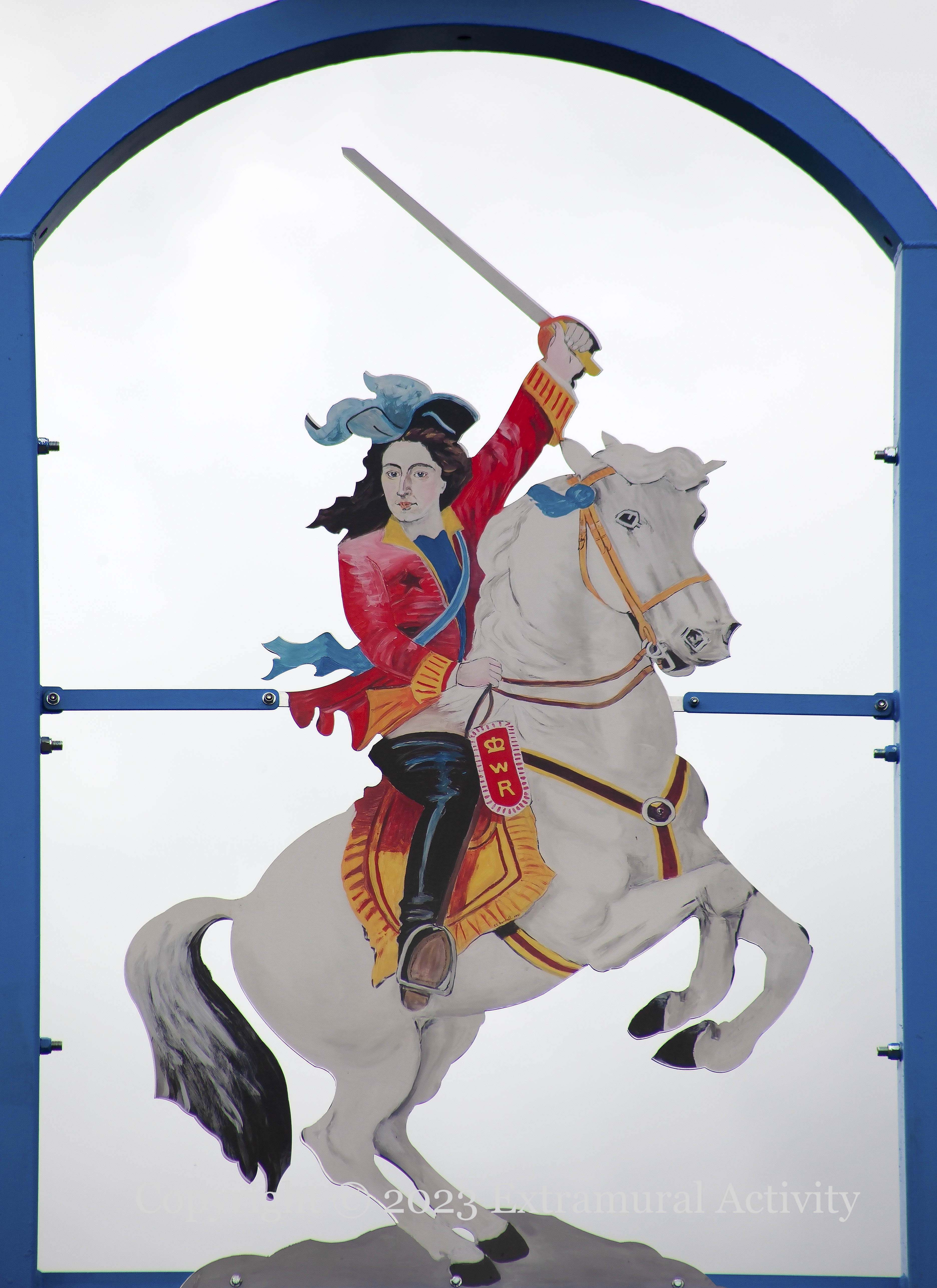
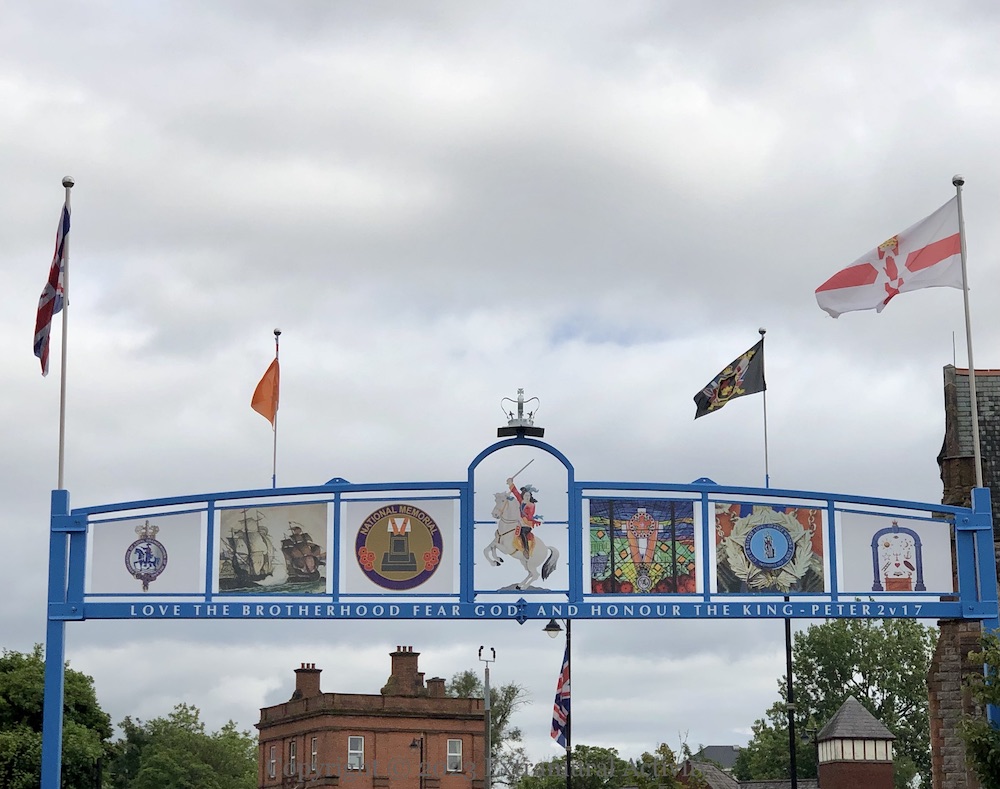
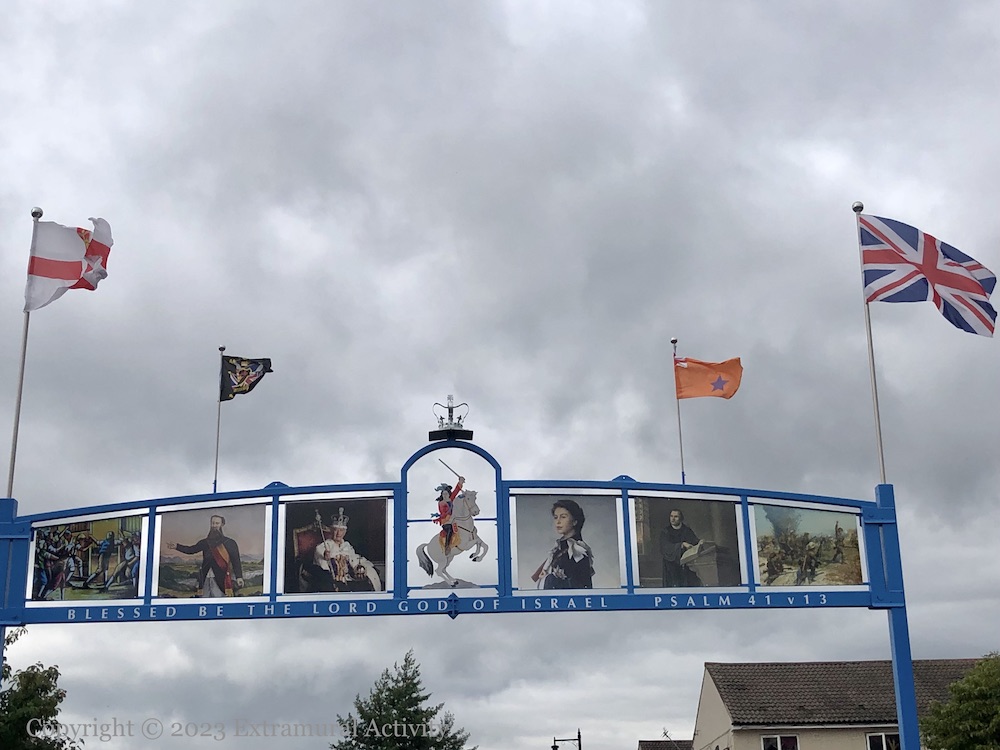
This entry is an update to 2022’s Upward which showed the new arch in Denmark Street (the north side of the lower Shankill estate). To each side of the arch has since been added a quote from scripture: on the outside, “Blessed be the Lord God of Israel – Psalm 41 v. 13”, and on the inside “Love the brotherhood, fear God, and honour the King – [1st] Peter 2 v. 17”
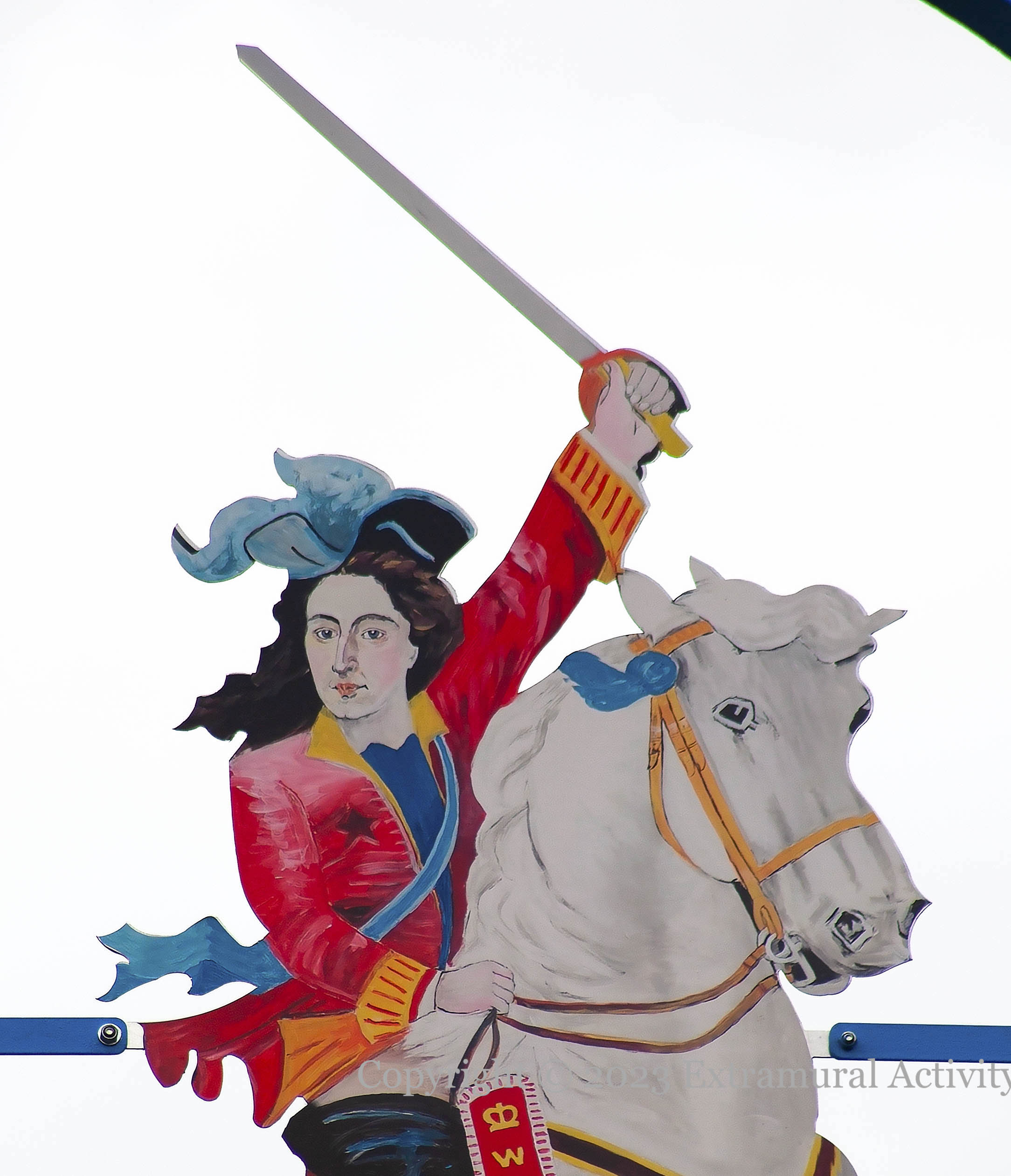
The ‘Platinum Jubilee’ panel has been replaced with the image from the other side of the ‘Faithful Unto Death’ stained glass that is in Schomberg House (see Our Murdered Brethren), and it has been replaced with an image King Charles III.
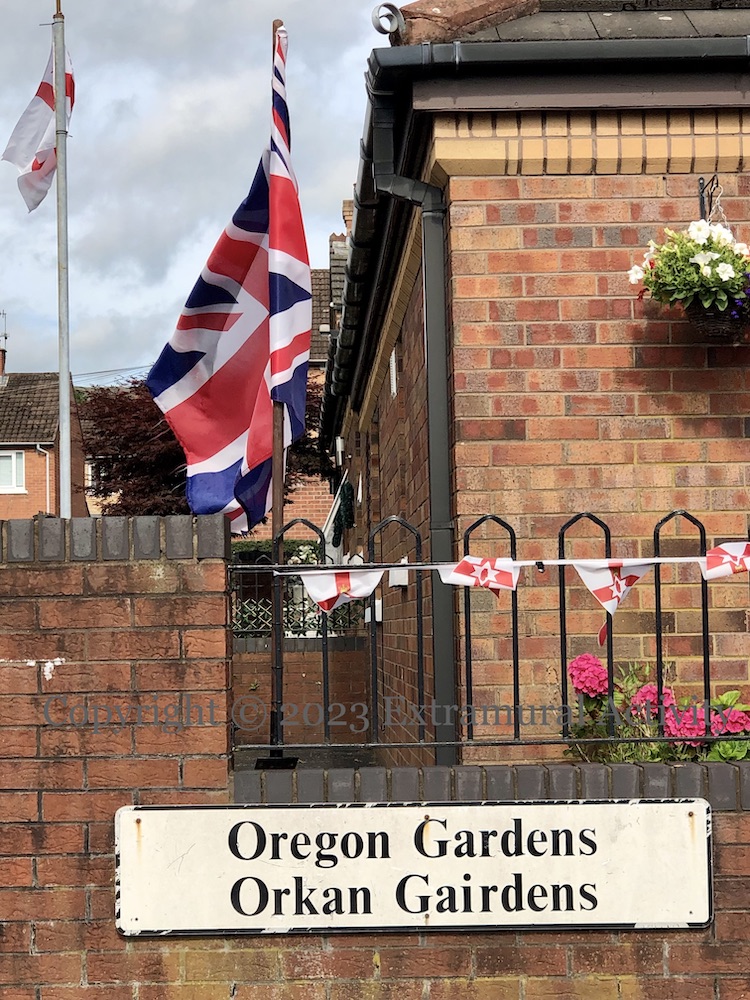
The application form for a dual-language street sign is completely agnostic as to which language (in addition to English) should go on the street sign. Based on news reports (including, recently, one home-owners complaint that such a sign would lower property values – BelTel) and our impression from tramping the streets, Irish (Gaeilge) is by far the most commonly requested language, but there are a few that include Ulster Scots; previously we recorded Heichbrea Airt in Castlereagh, and to that can now be added the sign shown above in the Woodvale: “Oregon Gardens” / “Orkan Gairdens”. (Please get in touch if you know of others.)
Ards & North Down council has just approved its own dual-language policy; like the old Belfast policy, one third of householders must sign the initial petition and two-thirds must respond positively to the subsequent survey of the street (News Letter).
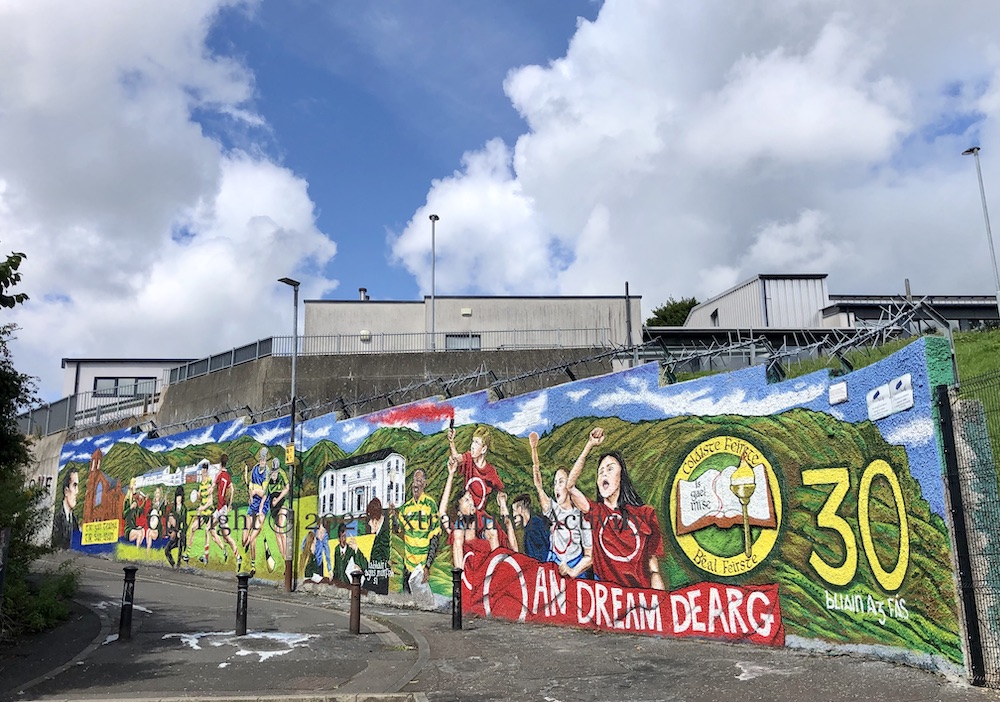
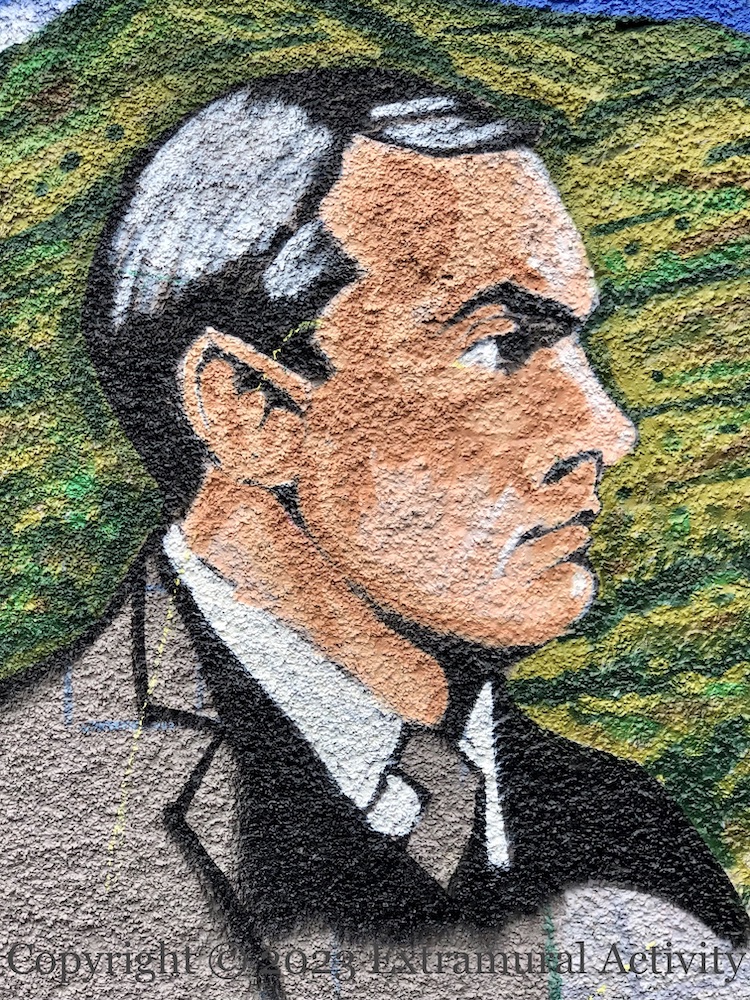
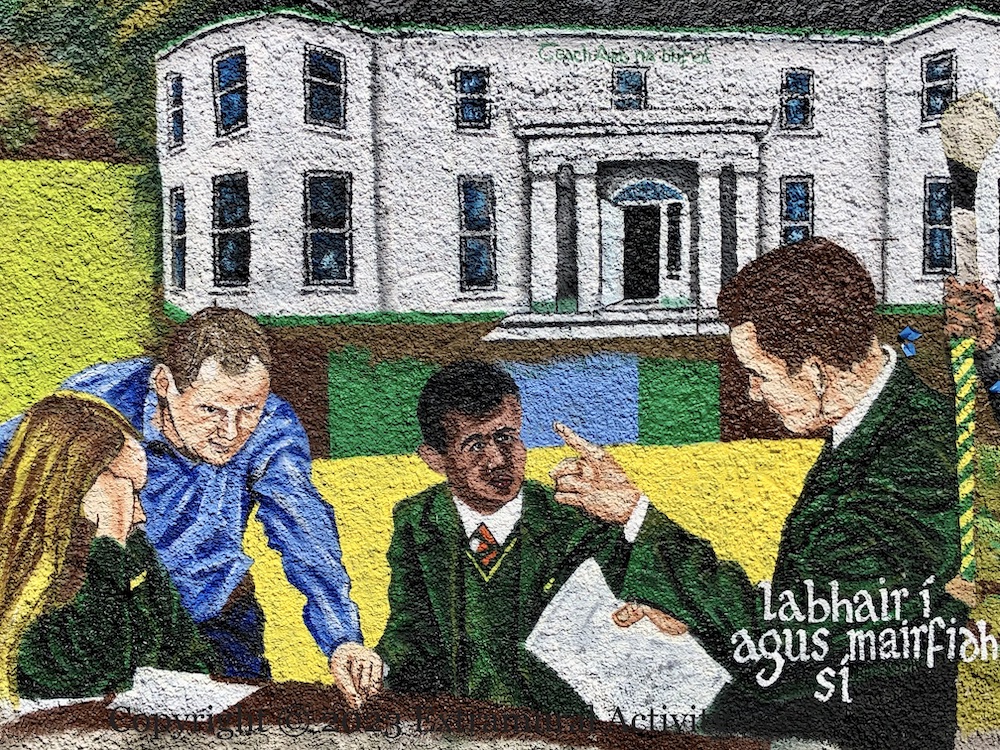
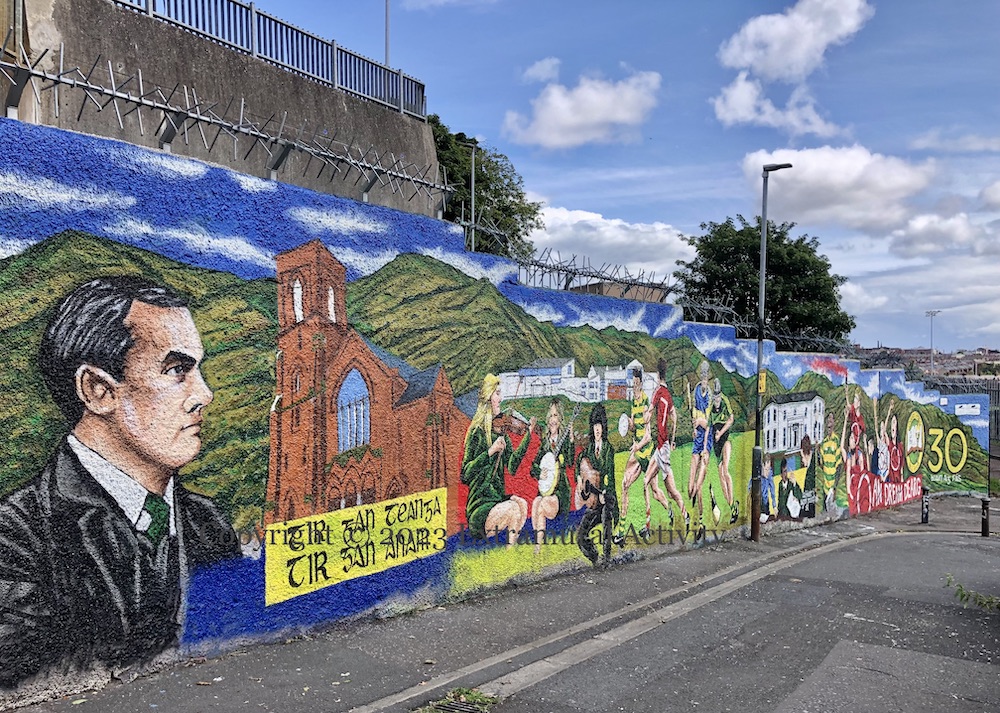
What is now Coláıste Feırste began life as Meánscoıl Feırste in 1991, teaching a group of nine students a curriculum inspired by Patrick Pearse (discussed previously in An Tusa An Chéad Laoch Eıle?) and based in Cultúrlann MacAdam-Ó Fıaıch (Cultúrlann). It moved to Beechmount in 1998 and in 2018 expanded into new buildings that were meant to accommodate 600 pupils (Doherty Architects), which it has now exceeded (BBC) as it enters its thirty-third year in existence.
The theme of preserving and promoting the Irish language occurs in several places in the mural: next to Pearse we see his saying, “Máırtín Ó Chadháın ” [a land without a language [is] a land without a soul], in the classroom scene we have “Labhaır í agus maırfıdh sí” [speak it and it will endure], and finally we see the Dream Dearg protesting for an Irish-Language Act (see previously #AchtAnoıs).
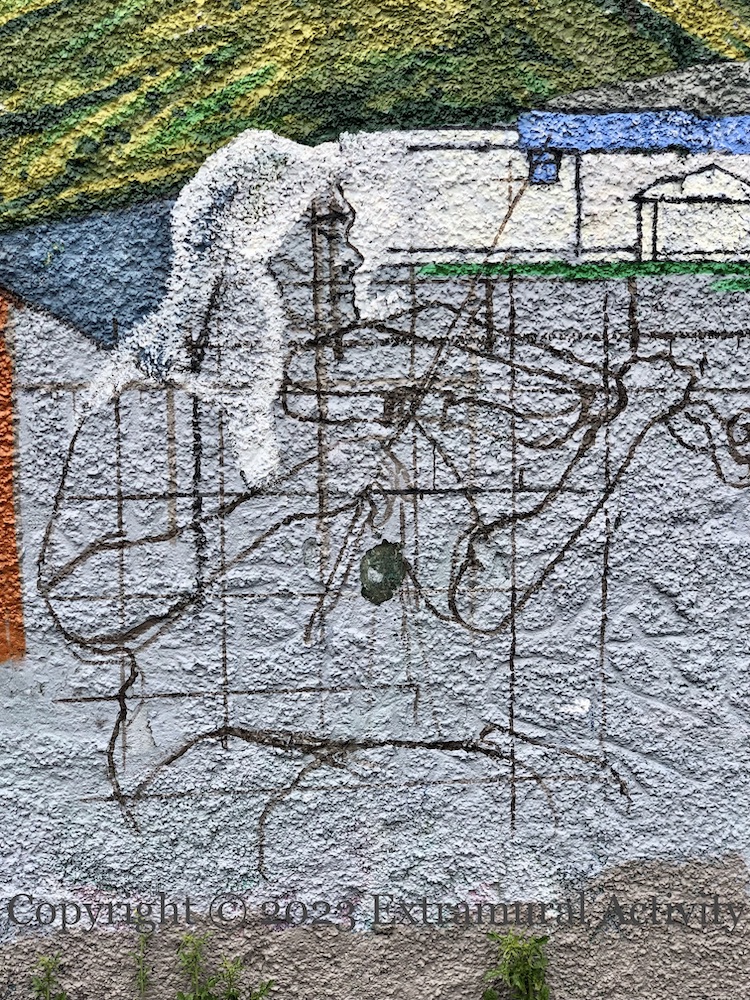
The in-progress images included below among completed detailed shots date from May 6th and 20th.
Giant’s Foot/Beechview Park. Replaces the short-lived mural of Olympians, seen in Sporting Giants.
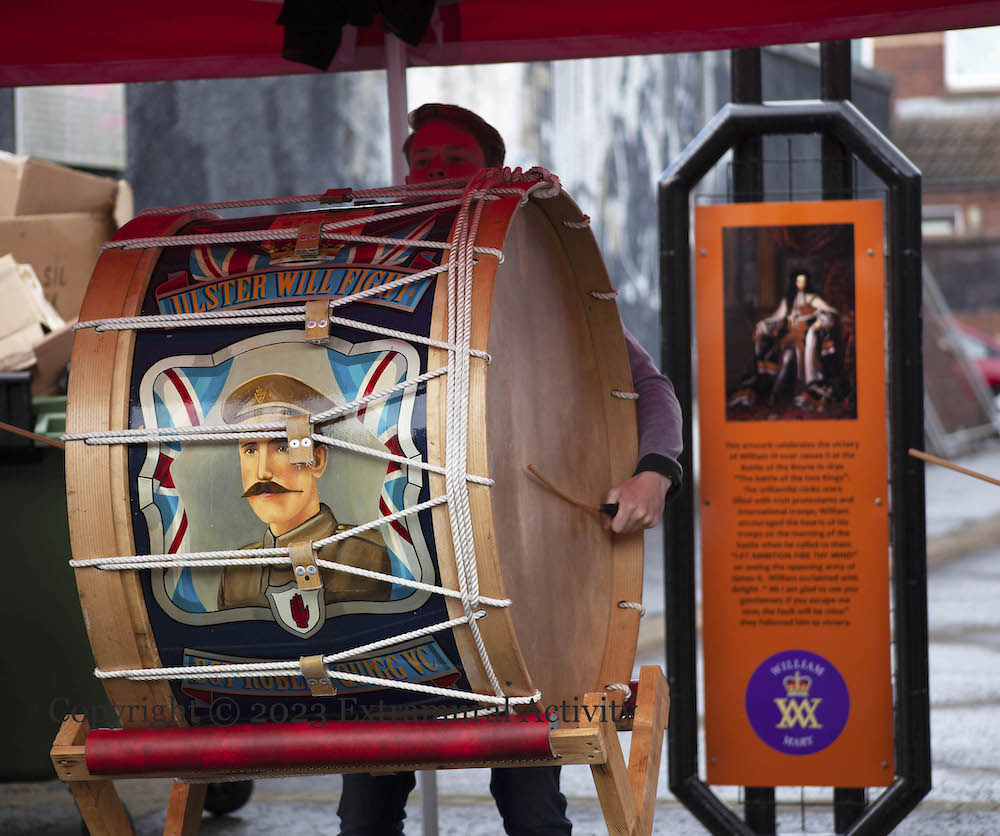
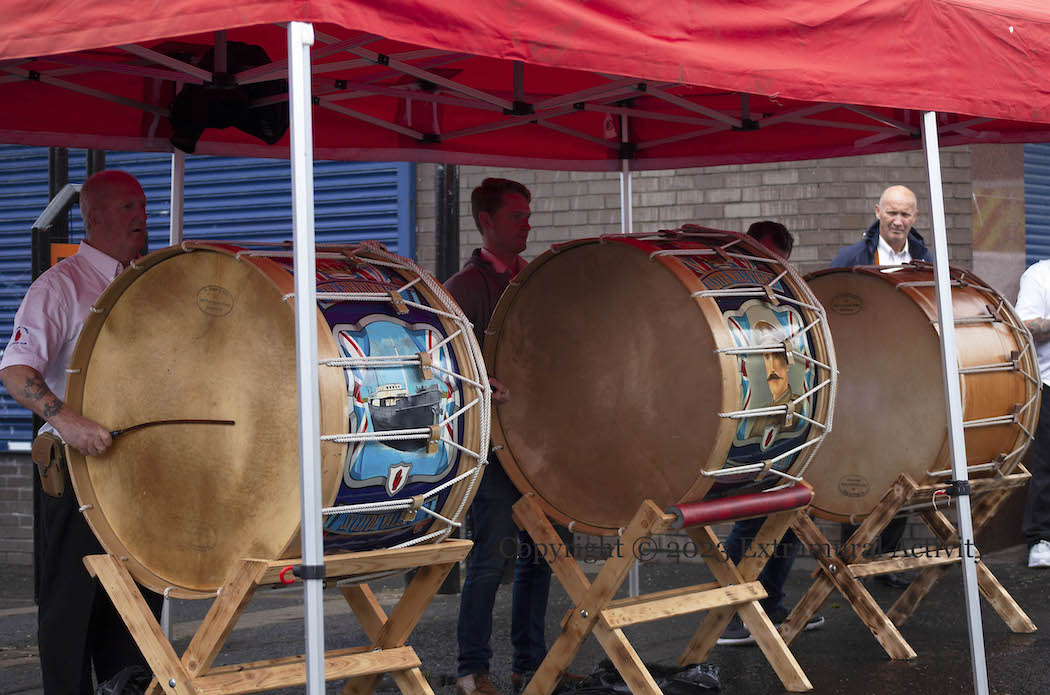
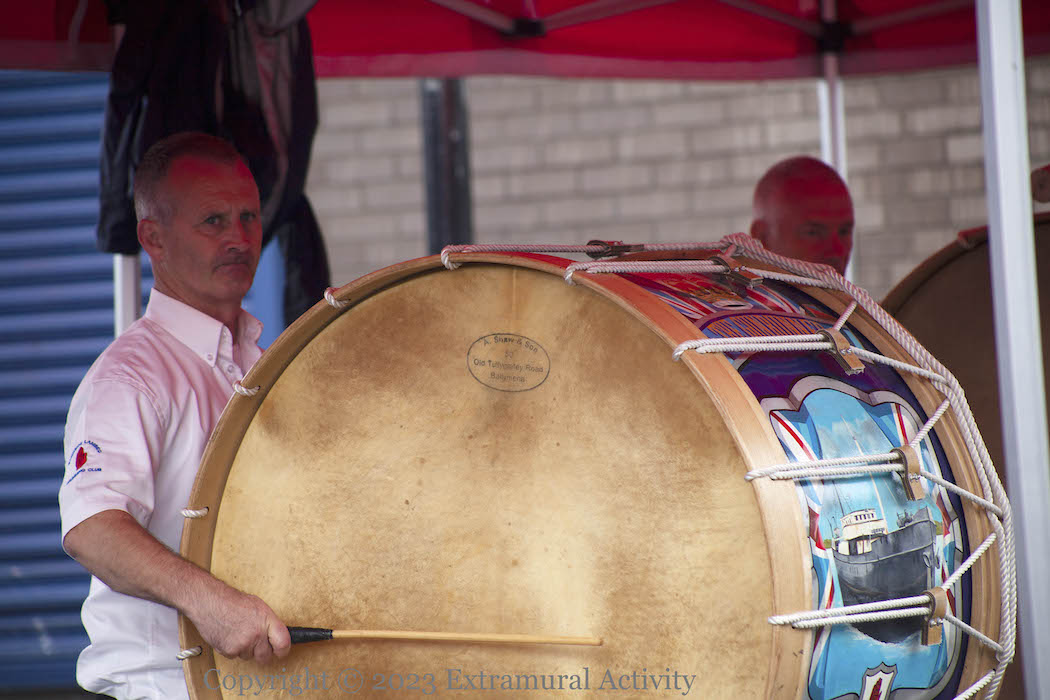
The “Lambeg drum” is named for the village near Lisburn, perhaps invented there to celebrate a visit by King Billy (LAD), or perhaps because it was there that the (already existing) drum was played with canes (WP).
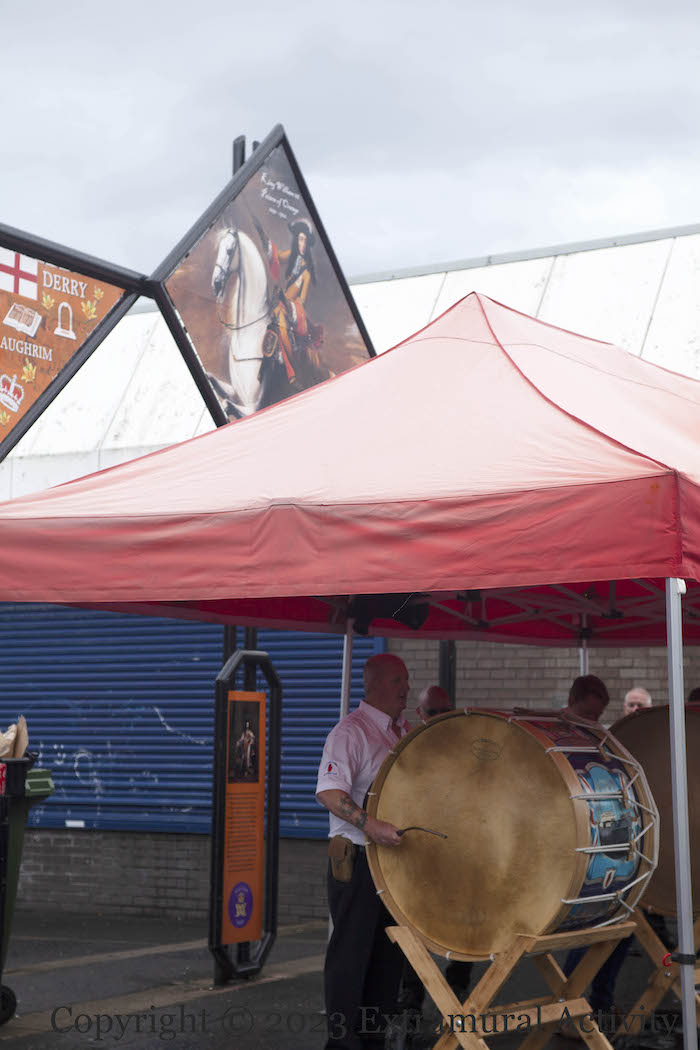
As can be seen from these images, the drums are extemely large – three feet in diameter – which makes them difficult to use in parades, as does their immense noise (up to 120 dB); they are more frequently seen on their own at drumming displays such as this one on the Shankill yesterday (July 11th).
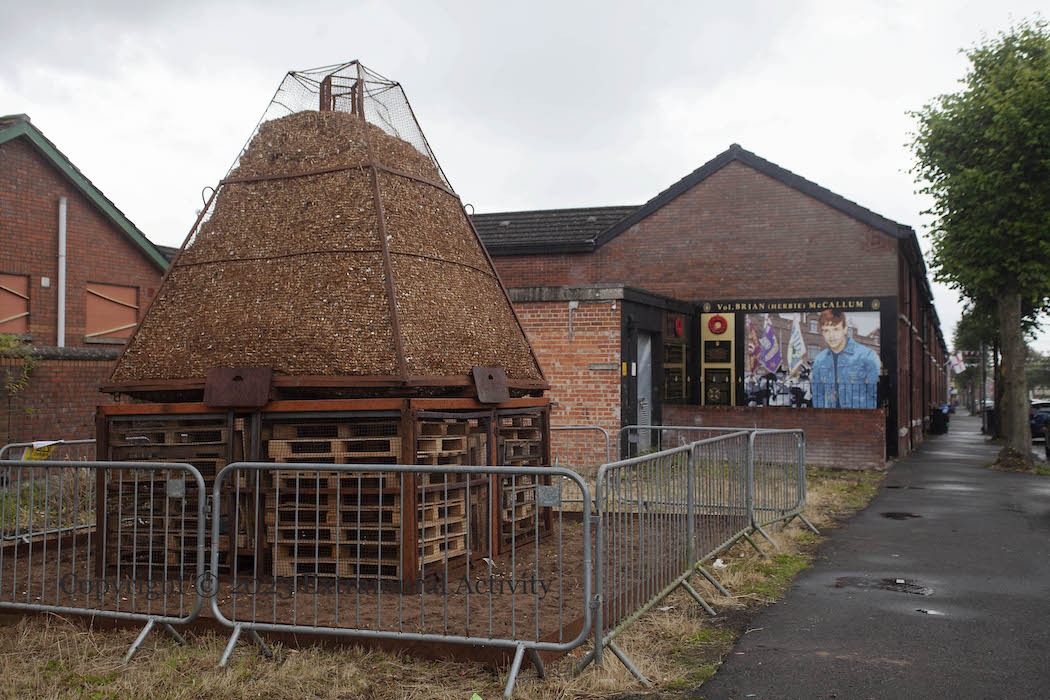
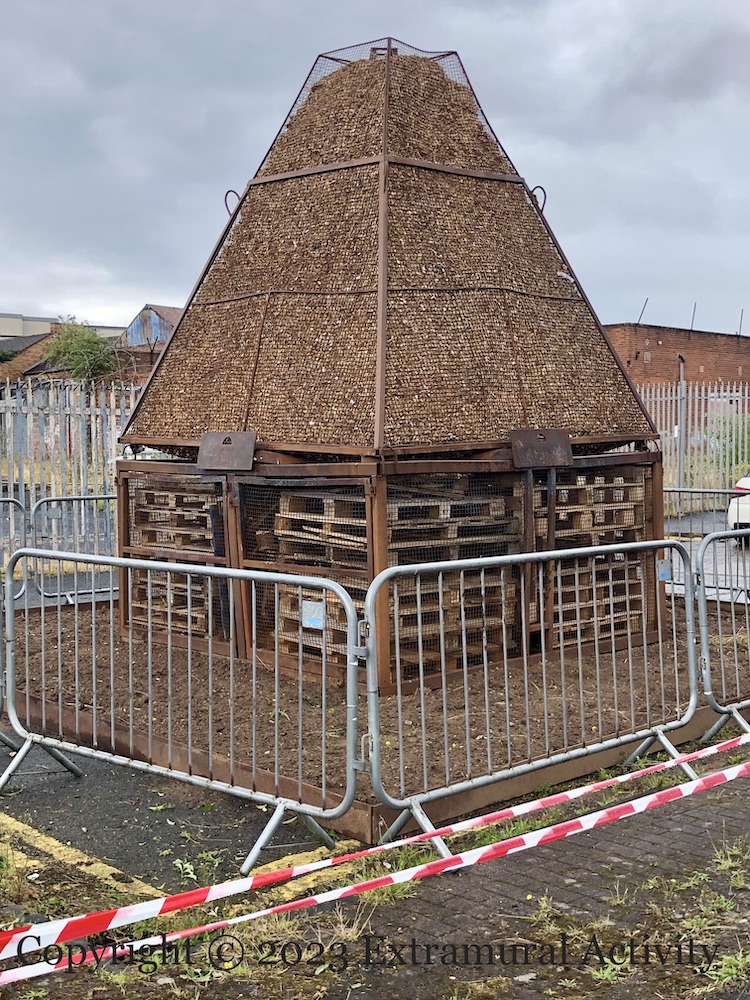
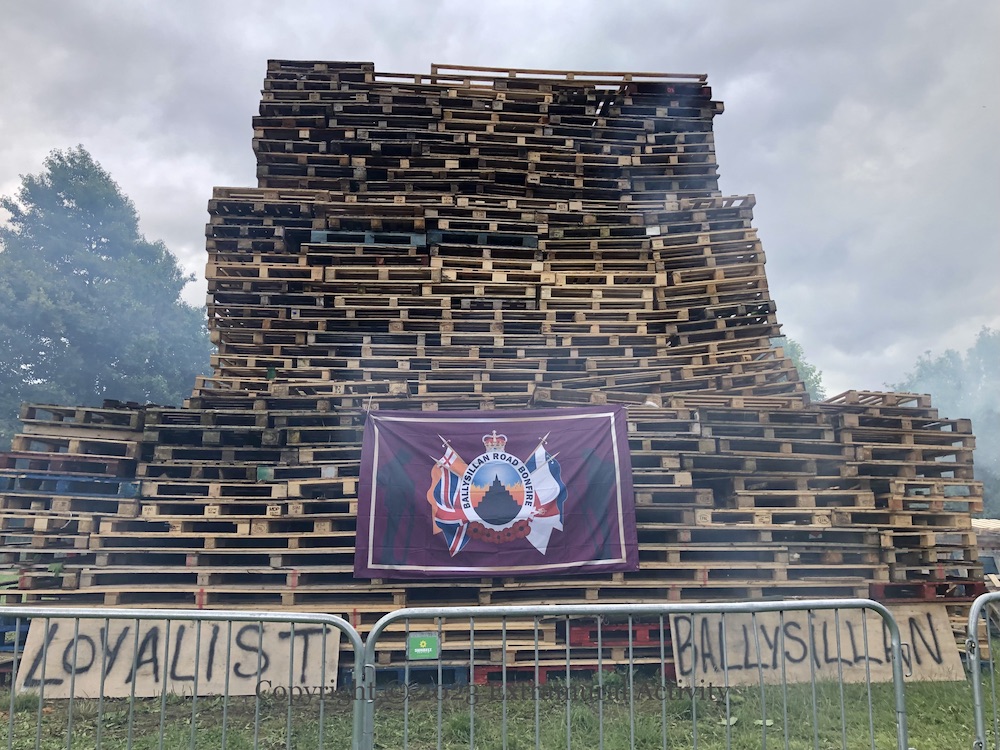
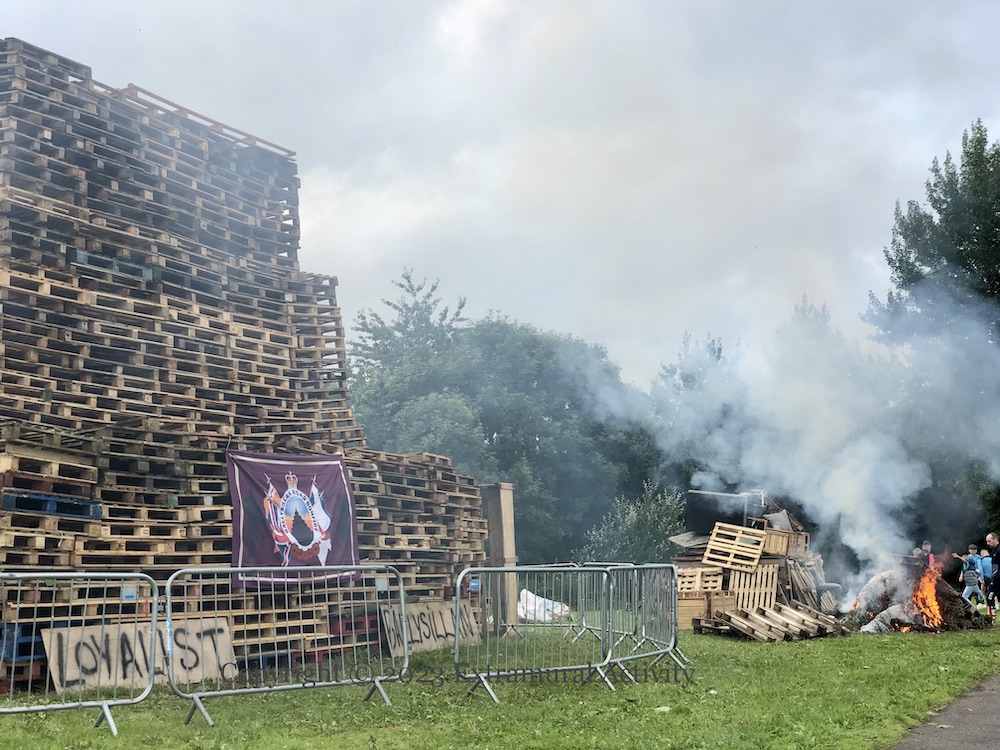
11 “beacons” are being lit across Belfast this evening, an increase over the eight from last year (Belfast Live). They are re-usable metal frames filled with willow wood (above a base of pallets) and sit on a bed of sand in order to avoid scarring the ground (BBC). The name evokes the beacons lit in the hills of Antrim and Down that allowed King William’s forces to land at Carrickfergus in 1690; the practice of lighting bonfires for festivals goes back to pagan times (Gailey).
Rather than being collected by the local commuinity, the materials are provided by a City Council programme now in its fifteen year of operation; the cost of the beacons this year is 81,000 pounds (BelTel). For discussion of the beacons (and the wider bonfire programme), see this Slugger article.
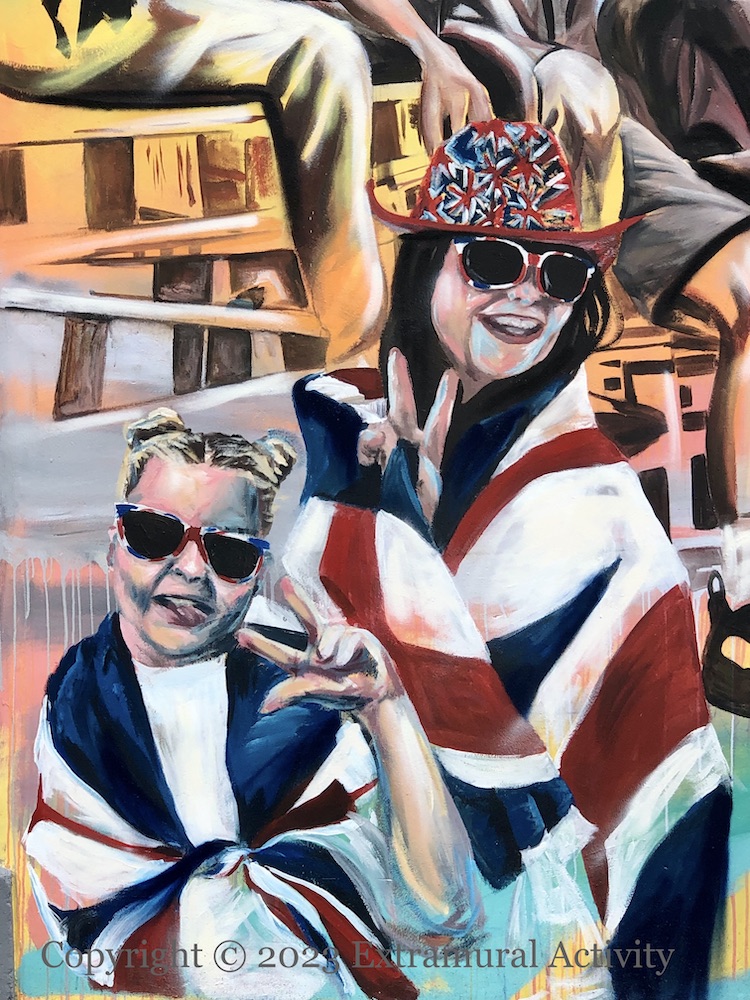
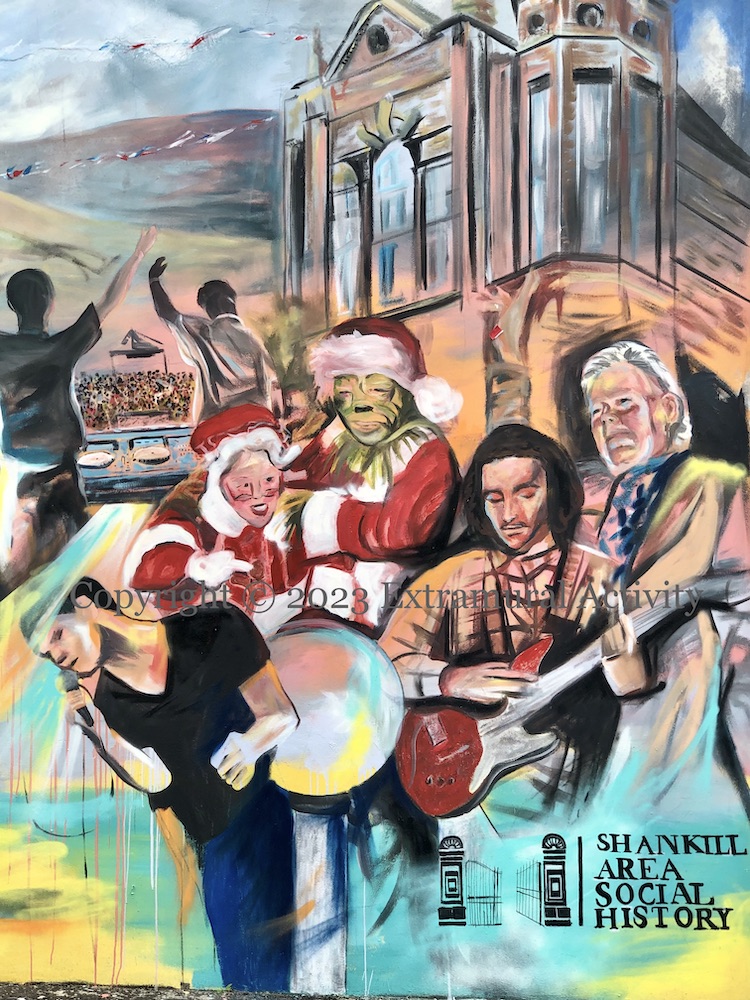
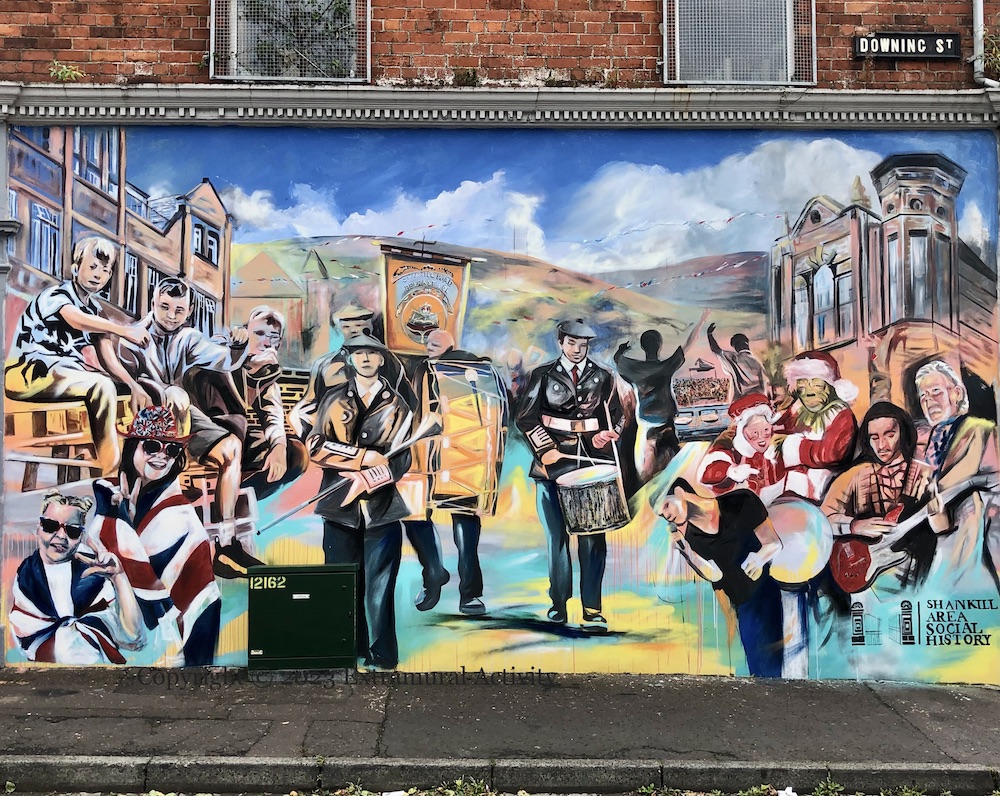
The Shankill Area Social History (SASH) (Fb) celebrates the people and events of the Shankill Road with a new mural in Downing Street.
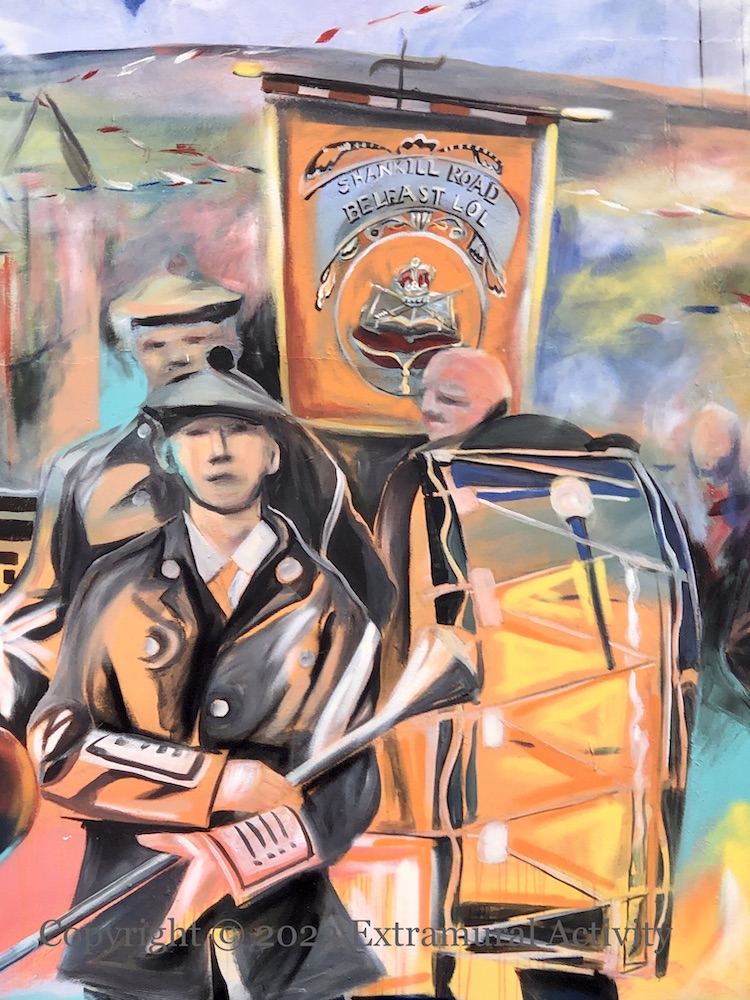
From left to right: girls wrapped in Union Flags watching the parade; boys on pallets; the Shankill Mission; Orange Order parade; the Summer festival in Woodvale Park (The Cabin); the former Belfast Savings Bank, now an undertaker’s; the Winter festival and switching-on of the Christmas tree lights, with Mrs. Claus, the Grinch in Santa jacket and hat, and last year’s (2022) celebrity guest Charlie Lawson (youtube); local band Casual Riots (ig). (SASH Fb Gallery)
For a mural of famous Shankill faces and places, see Save The Shankill.
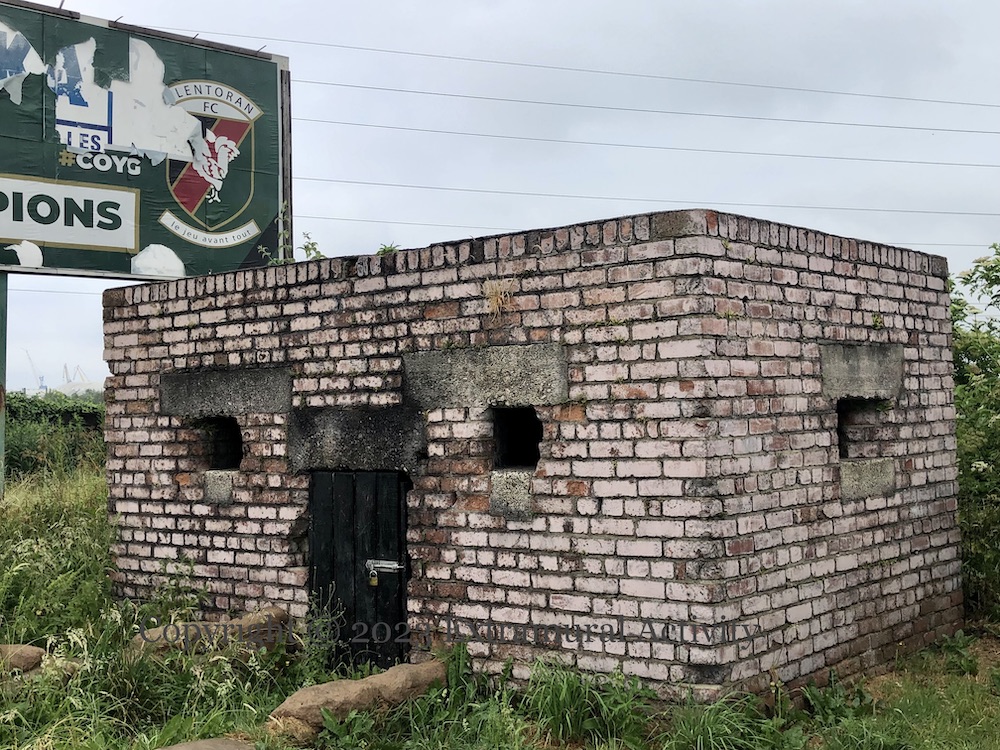
During the second World War, six basic designs for pillboxes, numbered from ‘Type 22’ to ‘Type 27’ were promulgated by the division of Fortifications And Works as part of anti-invasion planning (WP). This Type 24 is still standing in a corner of the Oval grounds in east Belfast. This image – showing the door – is of the rear of the pillbox; the anticipated line of attack was along Belfast Lough.
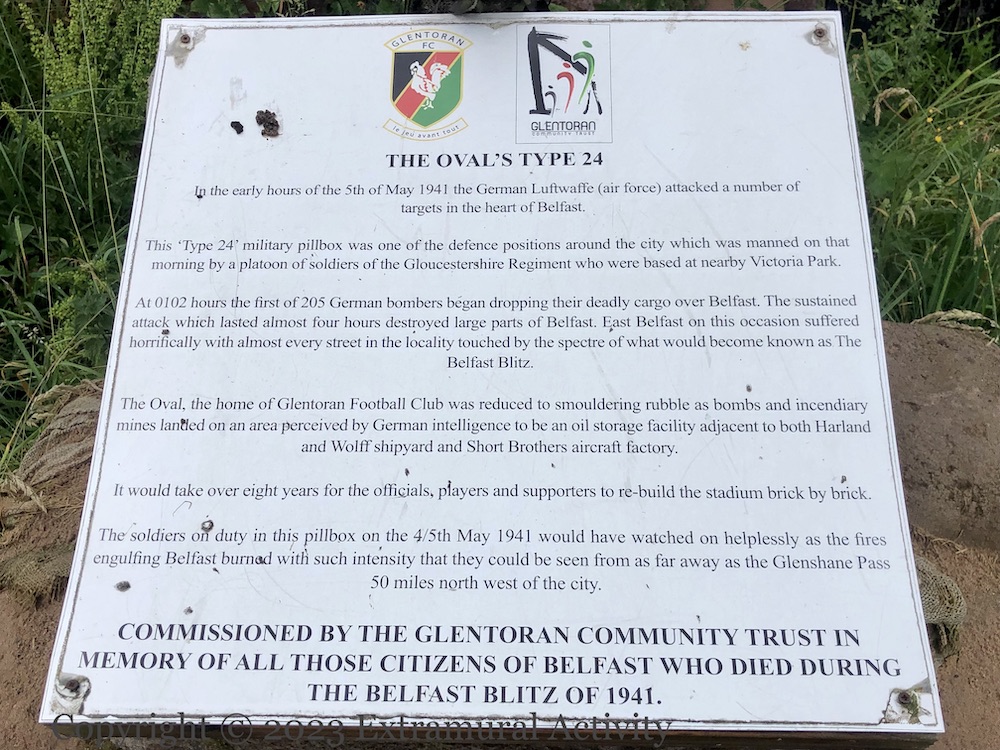
“The Oval’s Type-24. In the early hours of the 5th of may the German Luftwaffe (air force) attacked a number of targets in the heart of Belfast. This ‘Type 24’ military pillbox was one of the defence positions around the city which was manned on that morning by a platoon of soldiers of the Gloucestershire Regiment who were based at nearby Victoria Park. … The Oval, the home of Glentoran Football Club was reduced to smouldering rubble as bombs and incendiary mines landed on an area perceived by German intelligence to be an oil storage facility adjacent to both Harland and Wolff shipyard and Short Brothers aircraft factory.”
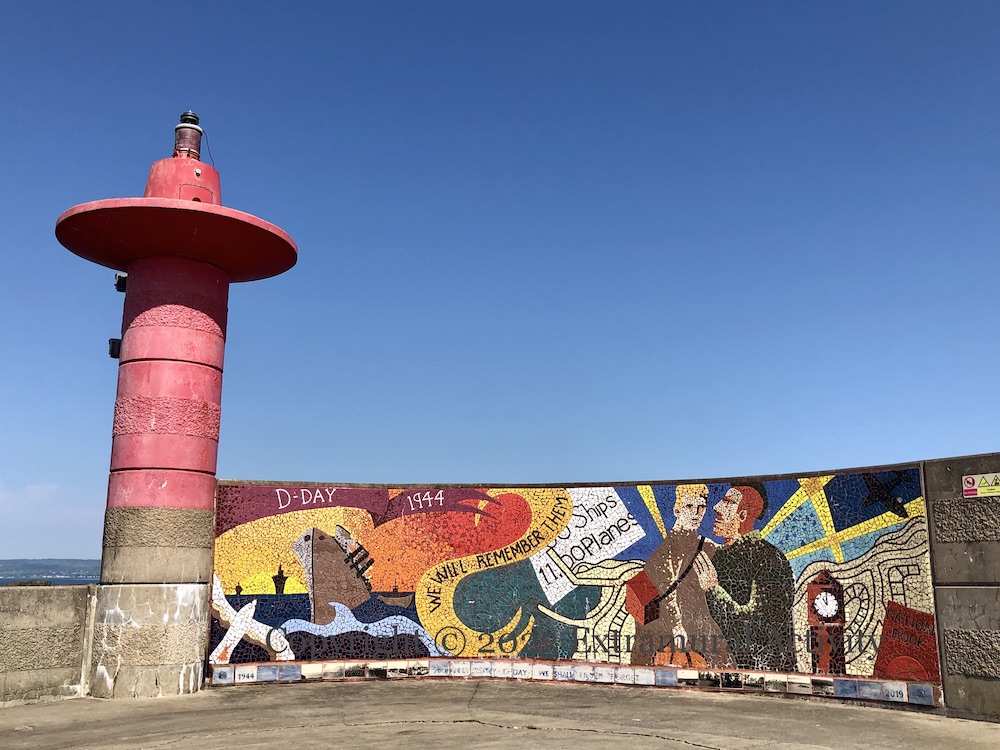
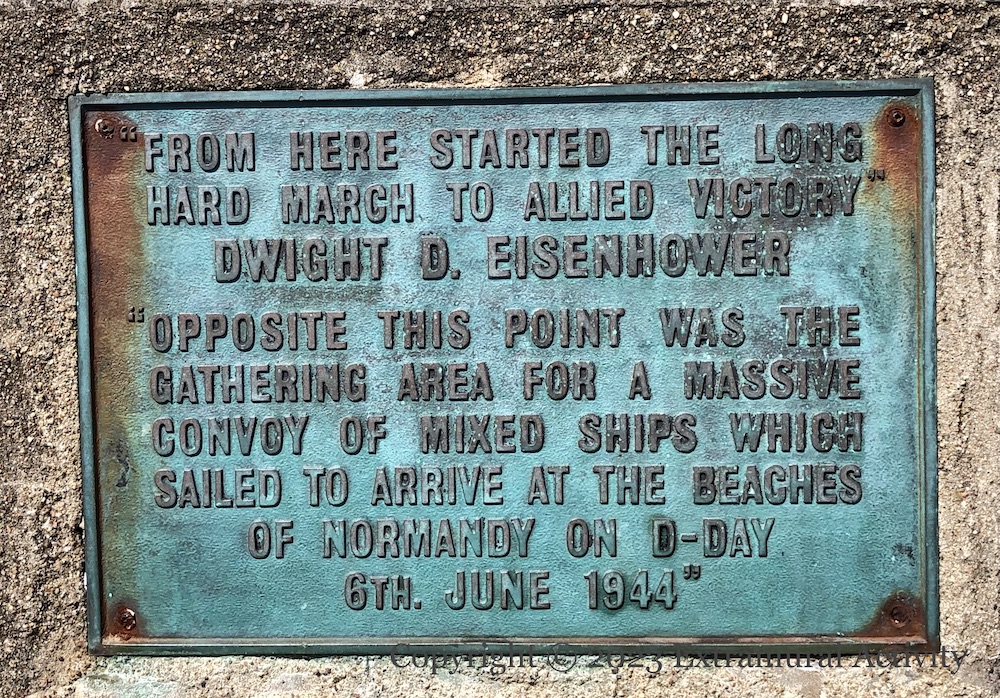
“”From here started the long hard march to allied victory” Dwight D. Eisenhower. “Opposite this point was the gathering area for a massive convoy of mixed ships which sailed to arrive at the beaches of Normandy on D-Day 6th. June 1944.”” US naval vessels gathered in Belfast Lough and Commander Thomas Keane (photo) was residing at the Royal hotel in Bangor (WartimeNI). General Eisenhower inspected the USS Quincy at Bangor on 19th May, 1944, (WartimeNI). Bangor’s North Pier was renamed Eisenhower Pier in 2004.
The quote is from August, 1945, when Eisenhower received an honorary doctorate from Queen’s (WartimeNI).