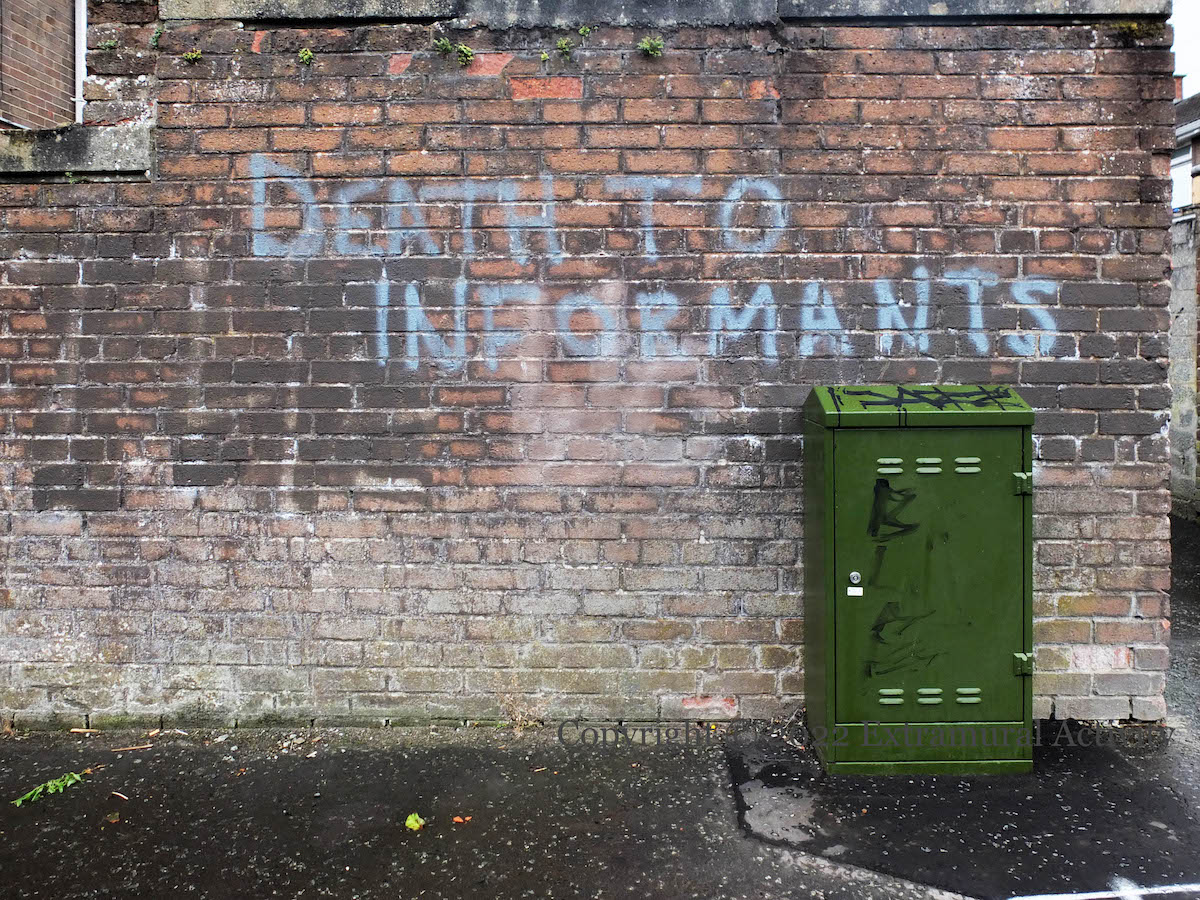
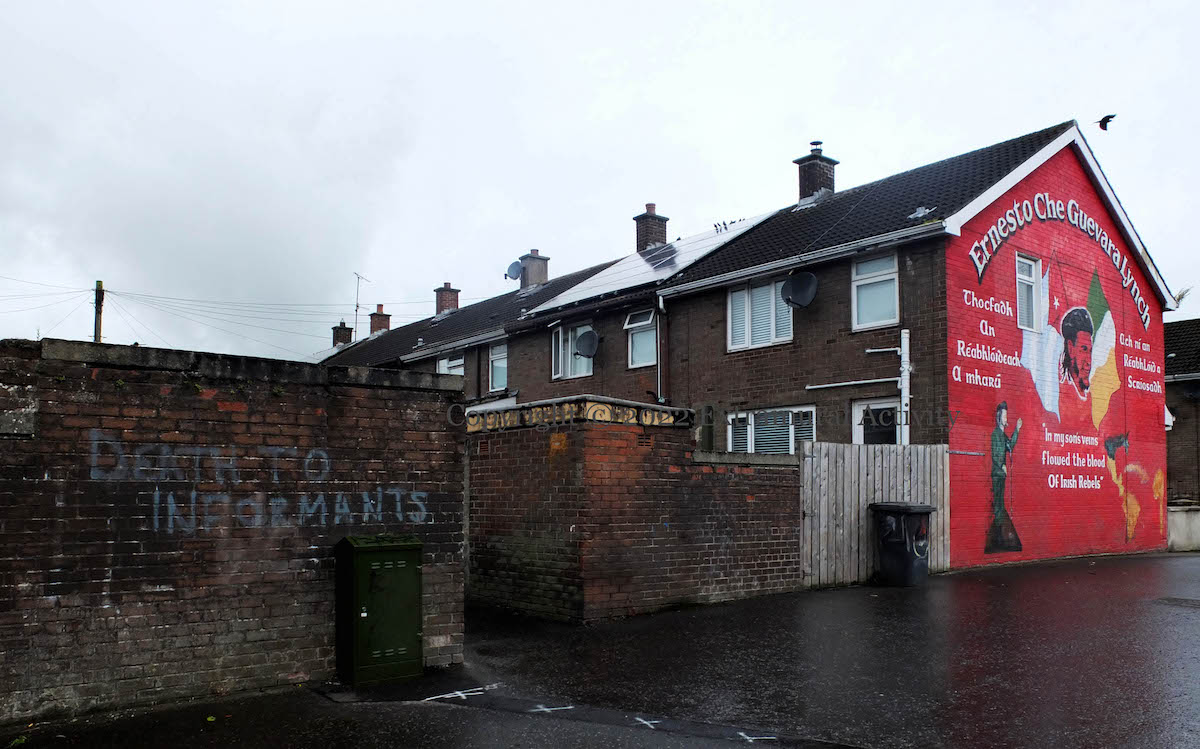
Republican graffiti in Fahan Street, Derry, adjacent to the Che Guevara Lynch mural. Any specific reference is unknown; in 2019 there was controversy over signs threatening informers in relation to the killing of Lyra McKee (e.g. extra).
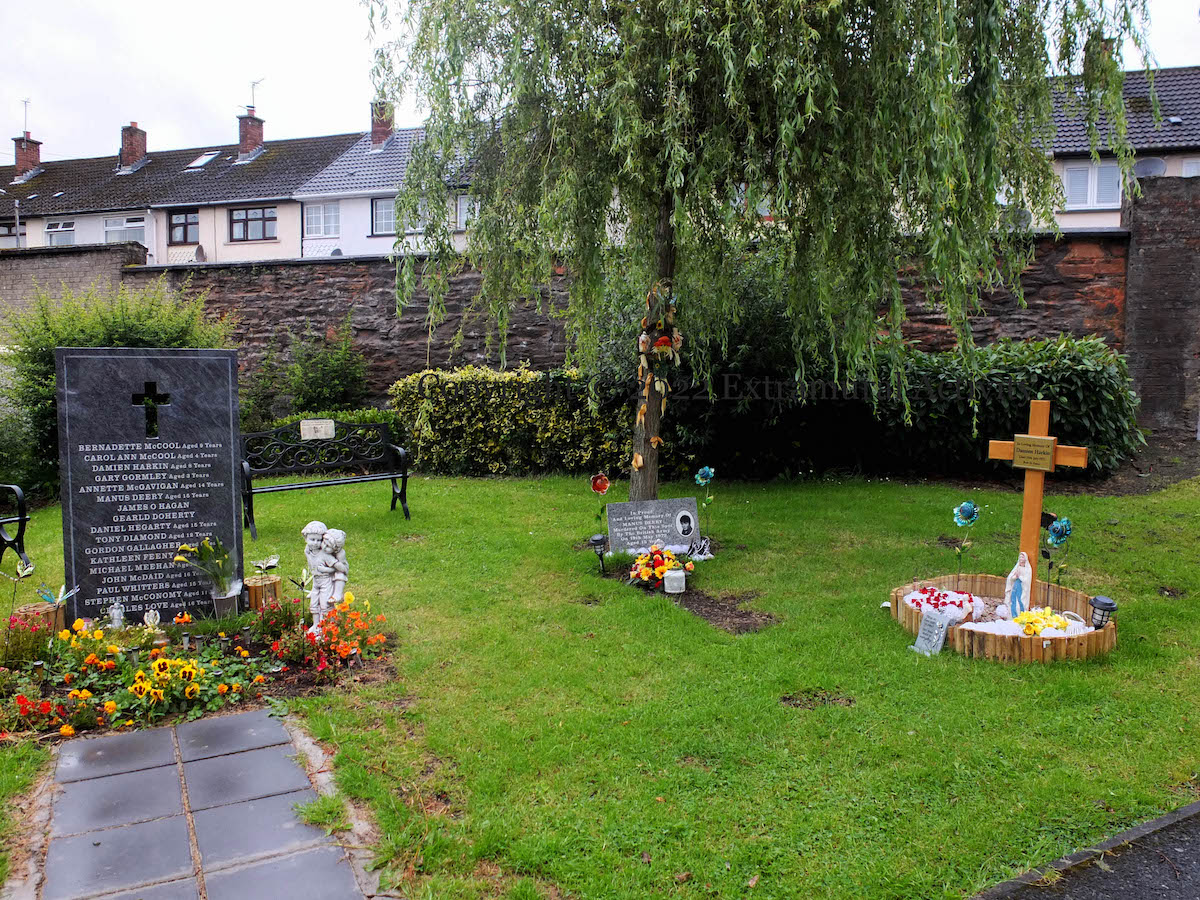
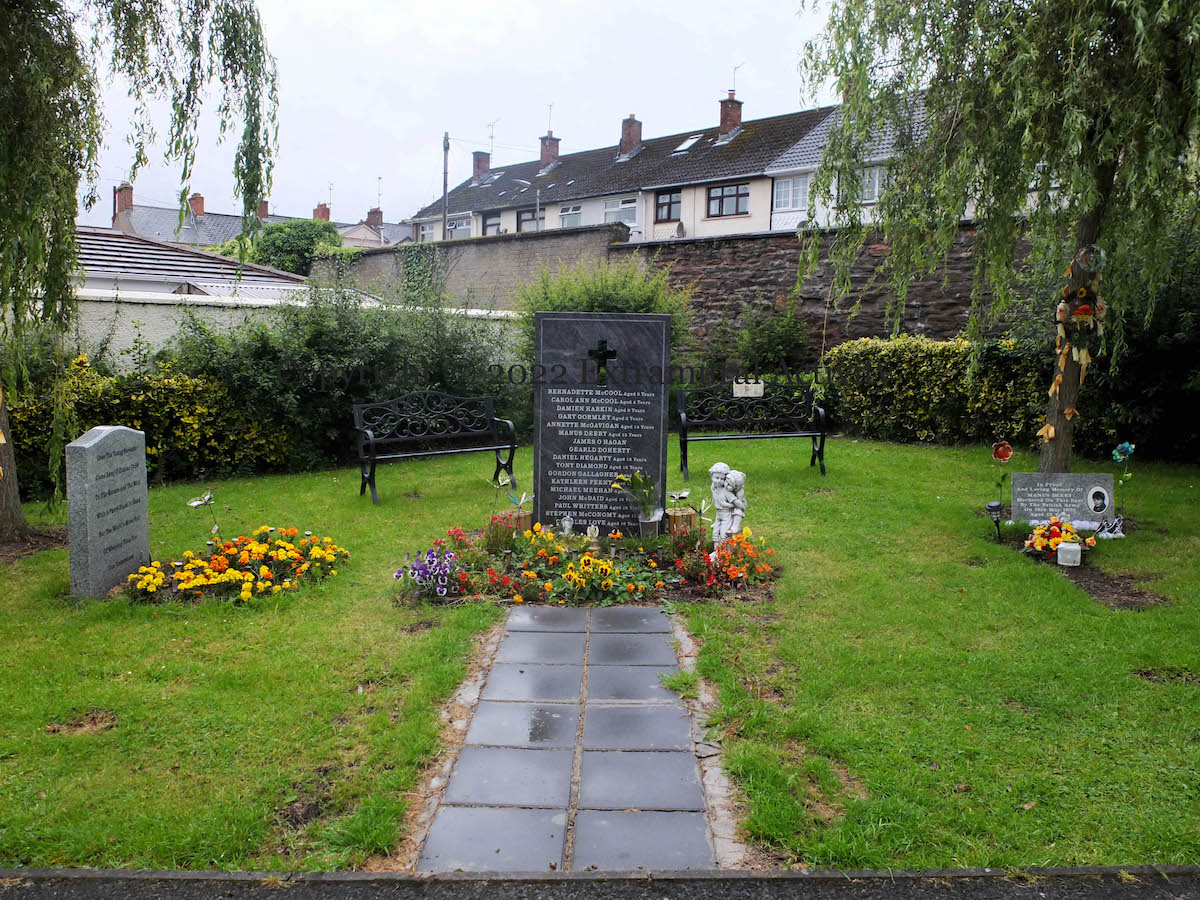
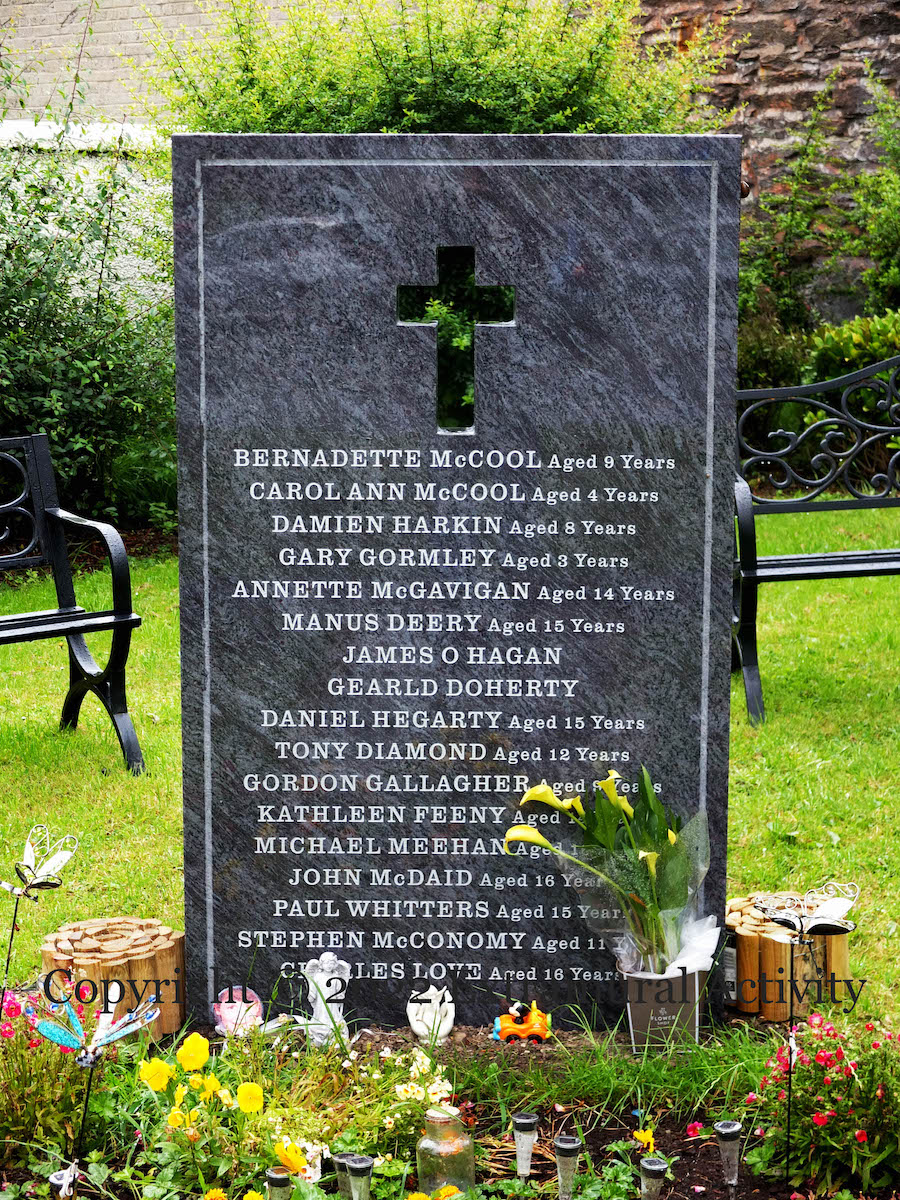
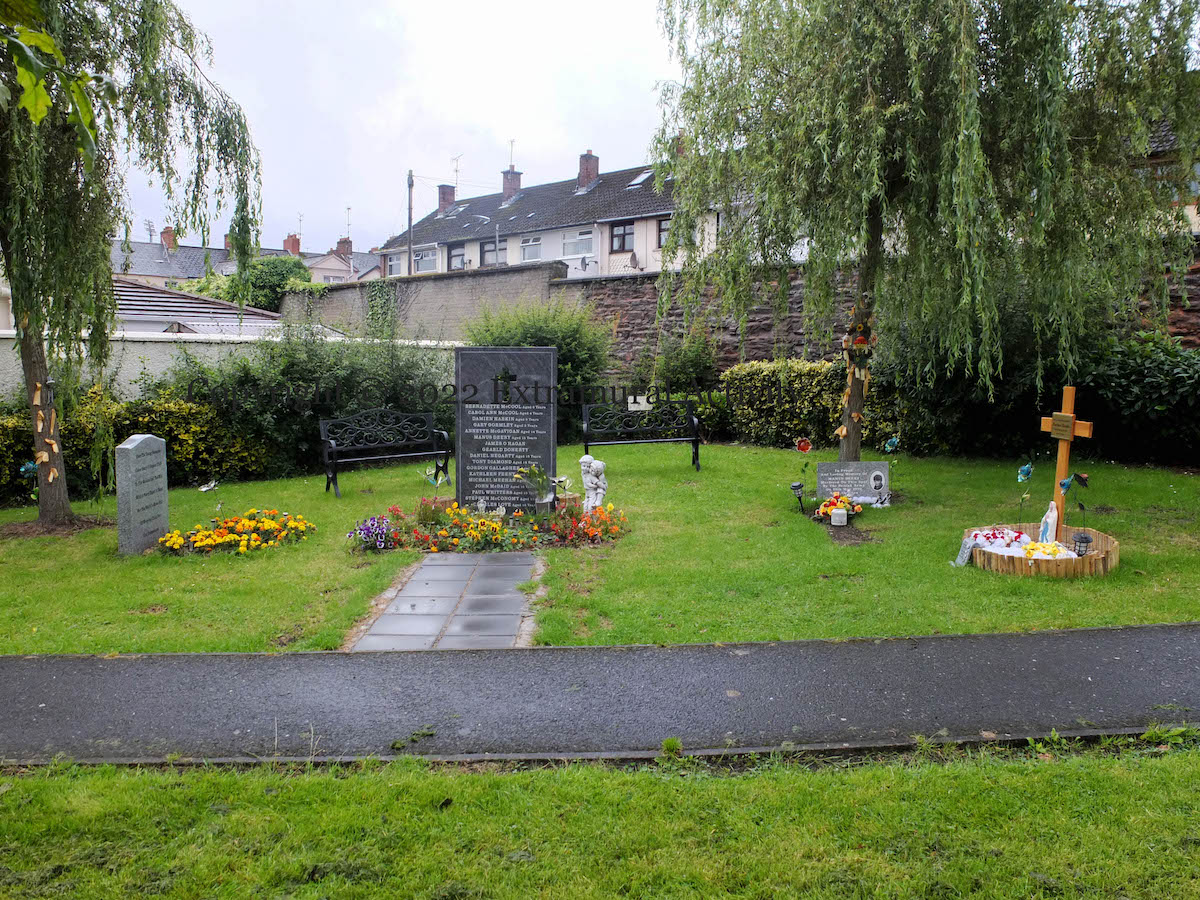
This is a memorial garden in Westland Street, Derry, in remembrance of children who have died during the Troubles.
They are listed in the following order on the main stone: Bernadette McCool, Carol Ann McCool, Damien Harkin, Gary Gormley, Annette McGavigan, Manus Deery, James O’Hagan, Gerald Doherty, Daniel Hegarty, Tony Diamond, Gordon Gallagher, Kathleen Feeny, Michael Meenan, John McDaid, Paul Whitters, Stephen McConomy, Charles Love.
McGavigan was the first to die at the hands of British forces, in September 1971, though the cross on the right is to nine-year-old Damien Harkin, who was crushed in July 1971 by a British Army lorry accident in the Bogside (MFD). Gary Gormley was also crushed by an armoured car (MFD). McGavigan is depicted in one of the murals in the ‘Bogside Gallery‘ series: The Death Of Innocence.
Other deaths were earlier but did not involve British forces: the McCool sisters died in a premature explosion in Creggan in 1970 and James (Jim) O’Hagan was killed in August 1971 by a fellow IRA member.
Gerry Doherty, Kathleen Feeney, Tony Diamond, Gordon Gallagher, Michael Meenan, John McDaid, and Charles Love also died accidentally by their own or IRA actions (MFD profiles, which lists 20 children, adding David Devine, Joseph Connolly, and Kathryn Eakin). Charles Love was killed by flying masonry from an IRA bomb; he is remembered by a plaque in Fahan Street. There is also a plaque to Stephen McConomy in Fahan Street and long ago he was depicted in a mural in Glenfada Park.
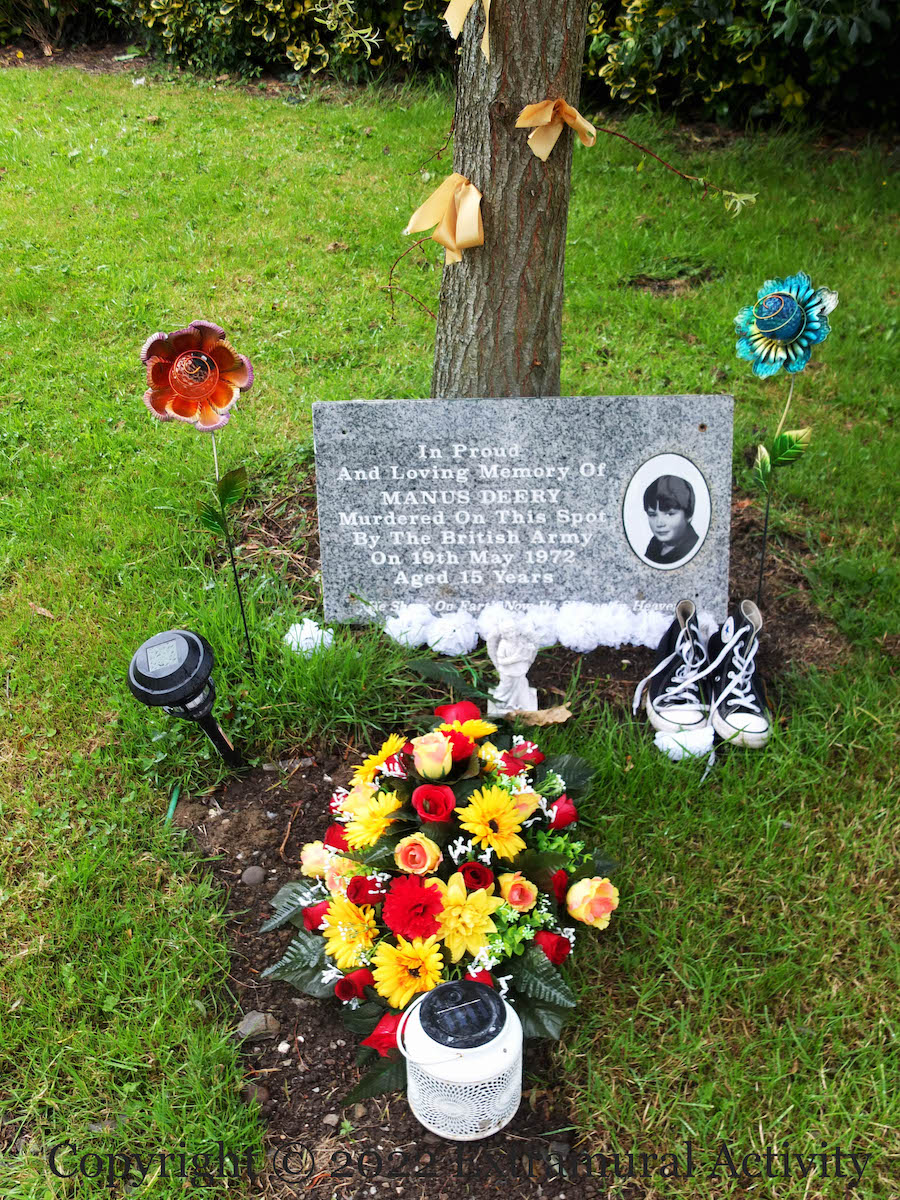
The Manus Deery plaque under the tree to the right was previously on a wall behind the Bogside Inn, before the pub was torn down – see M01919.
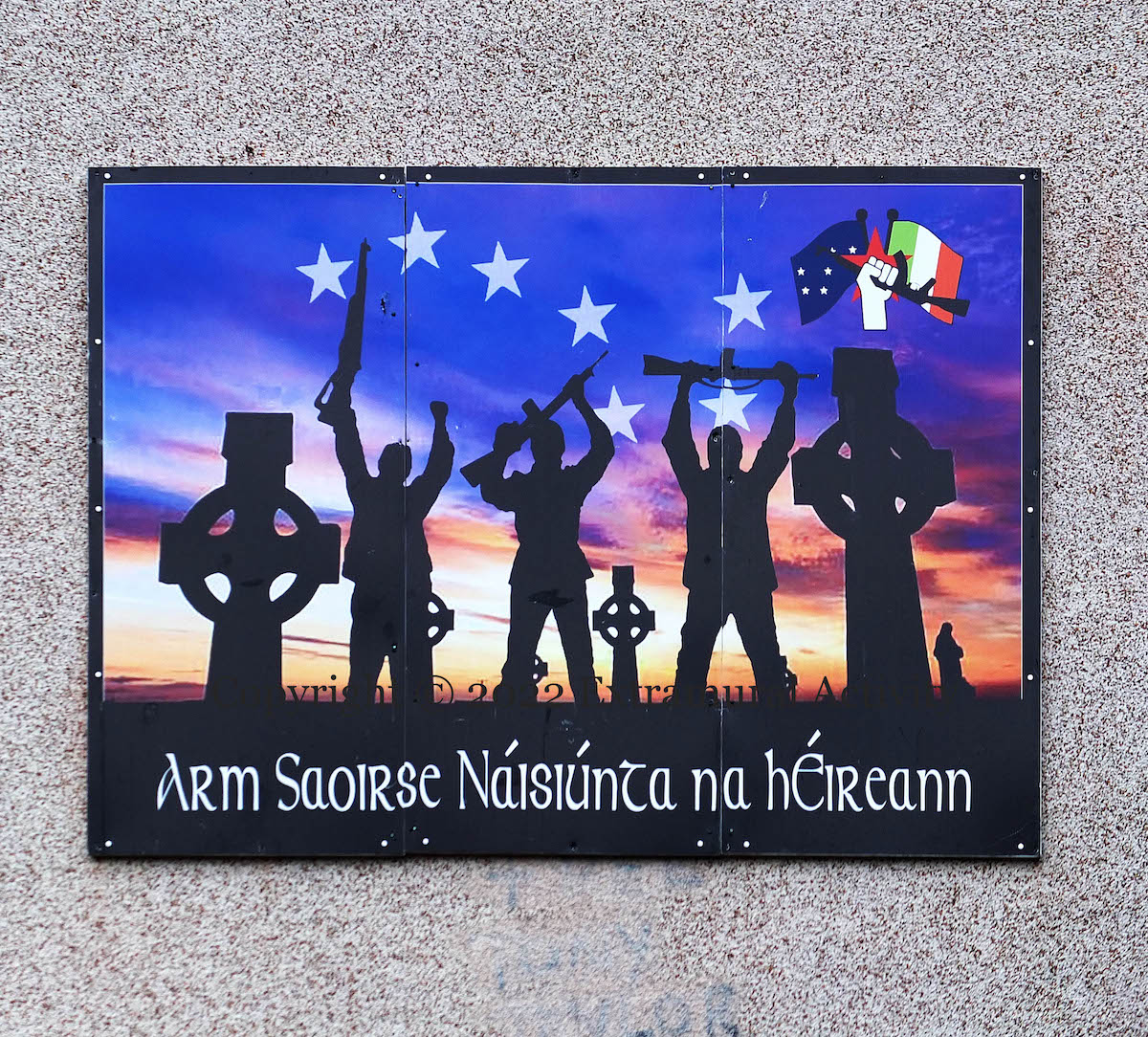
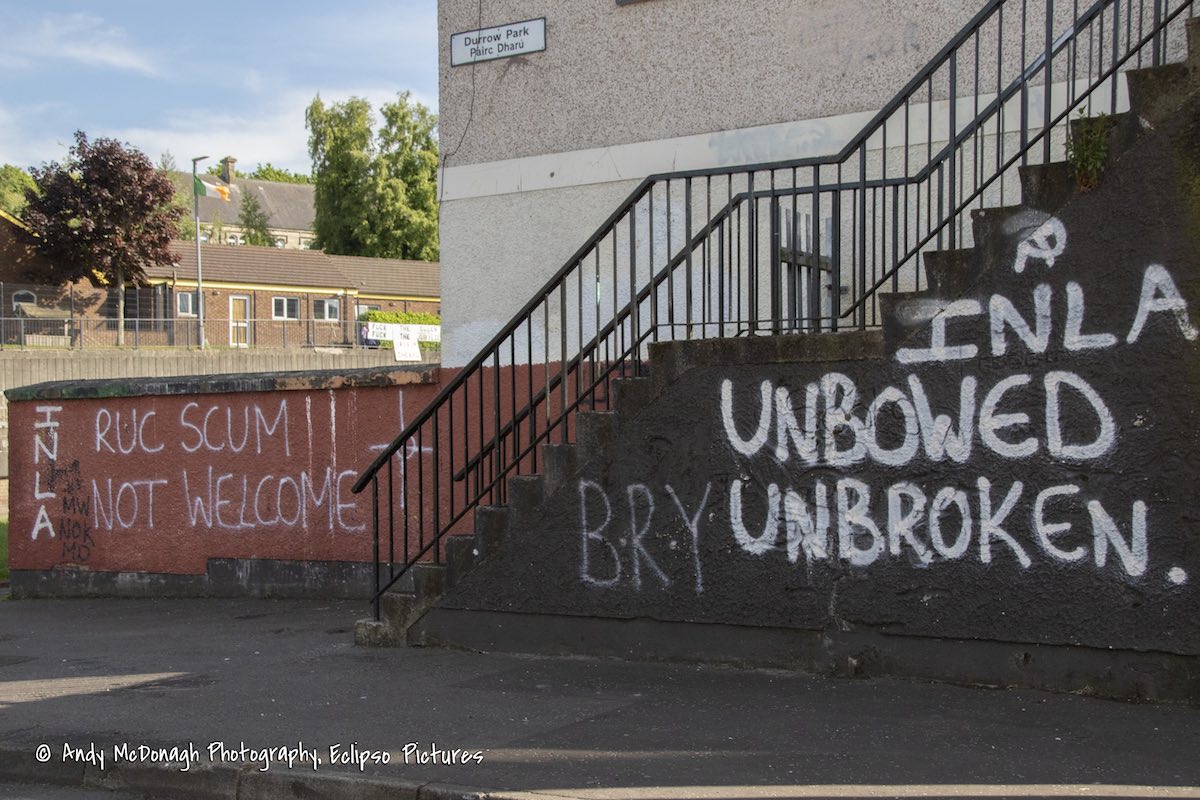
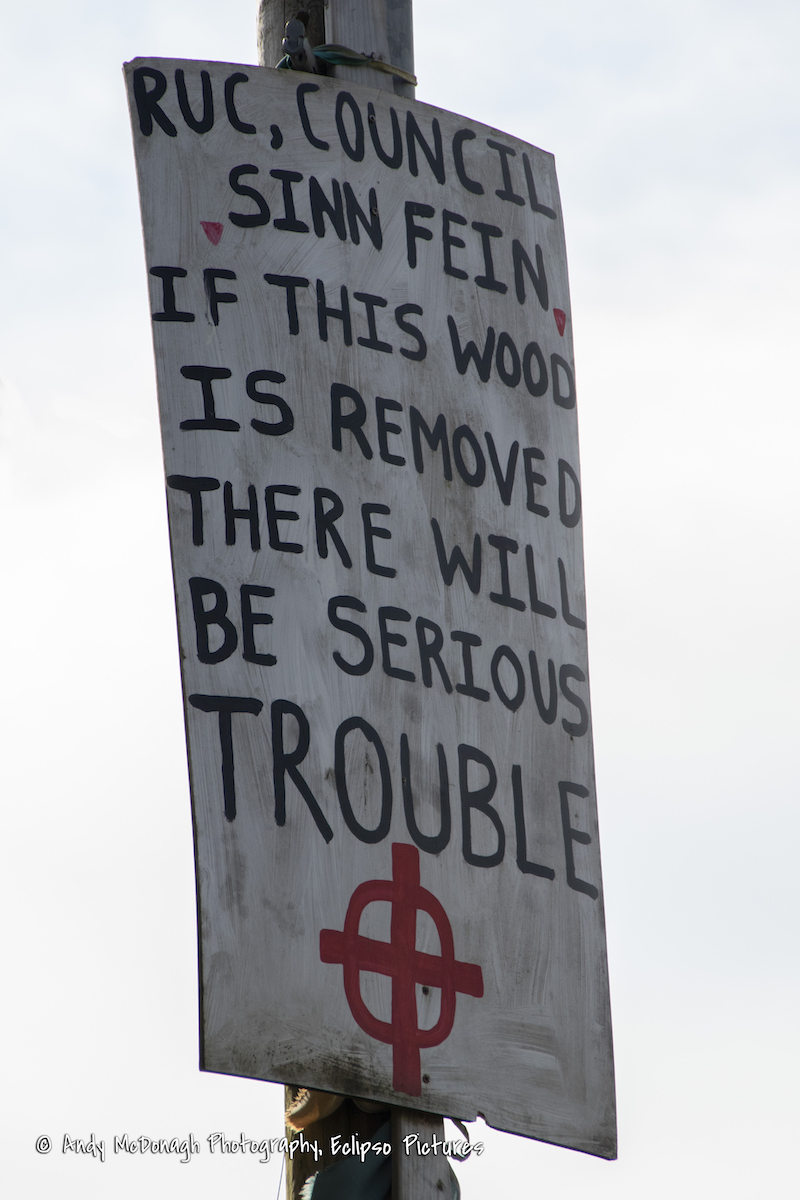
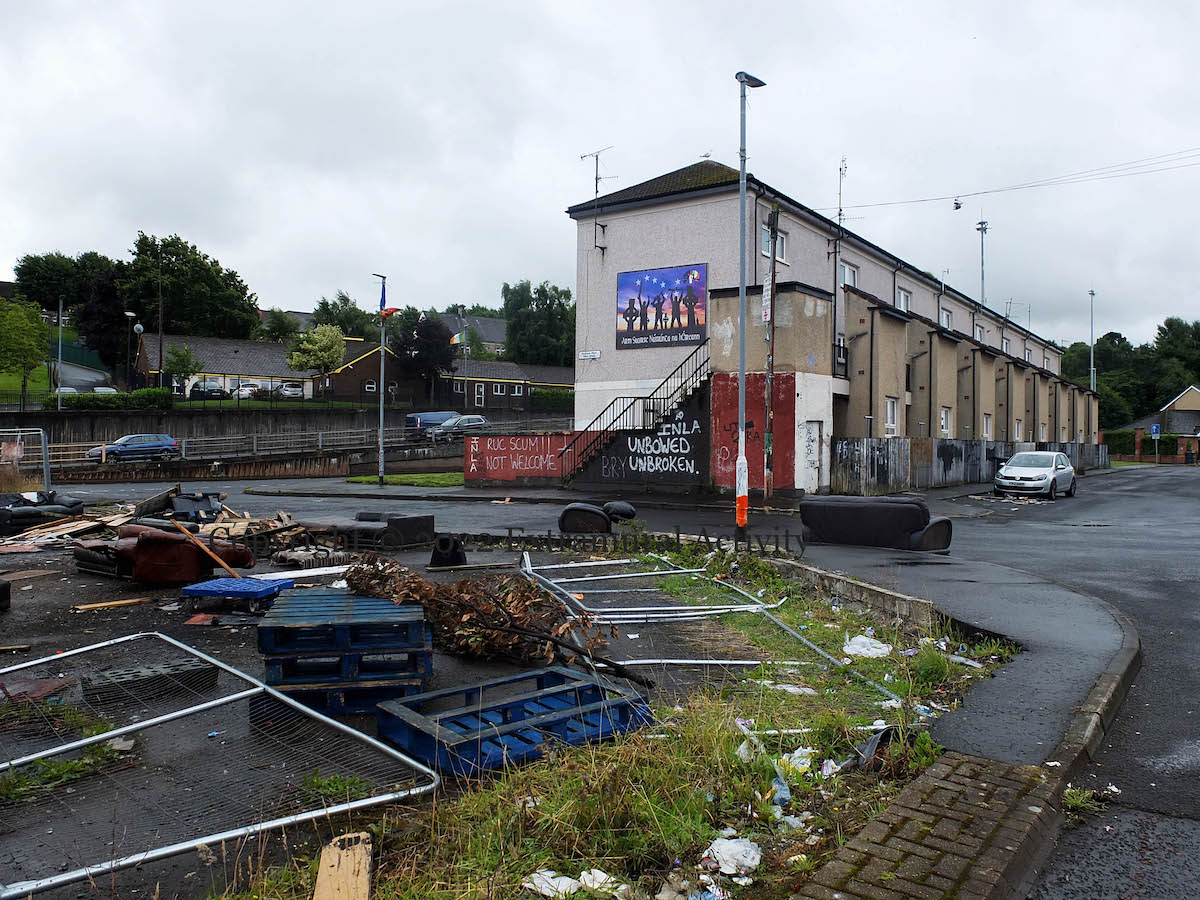
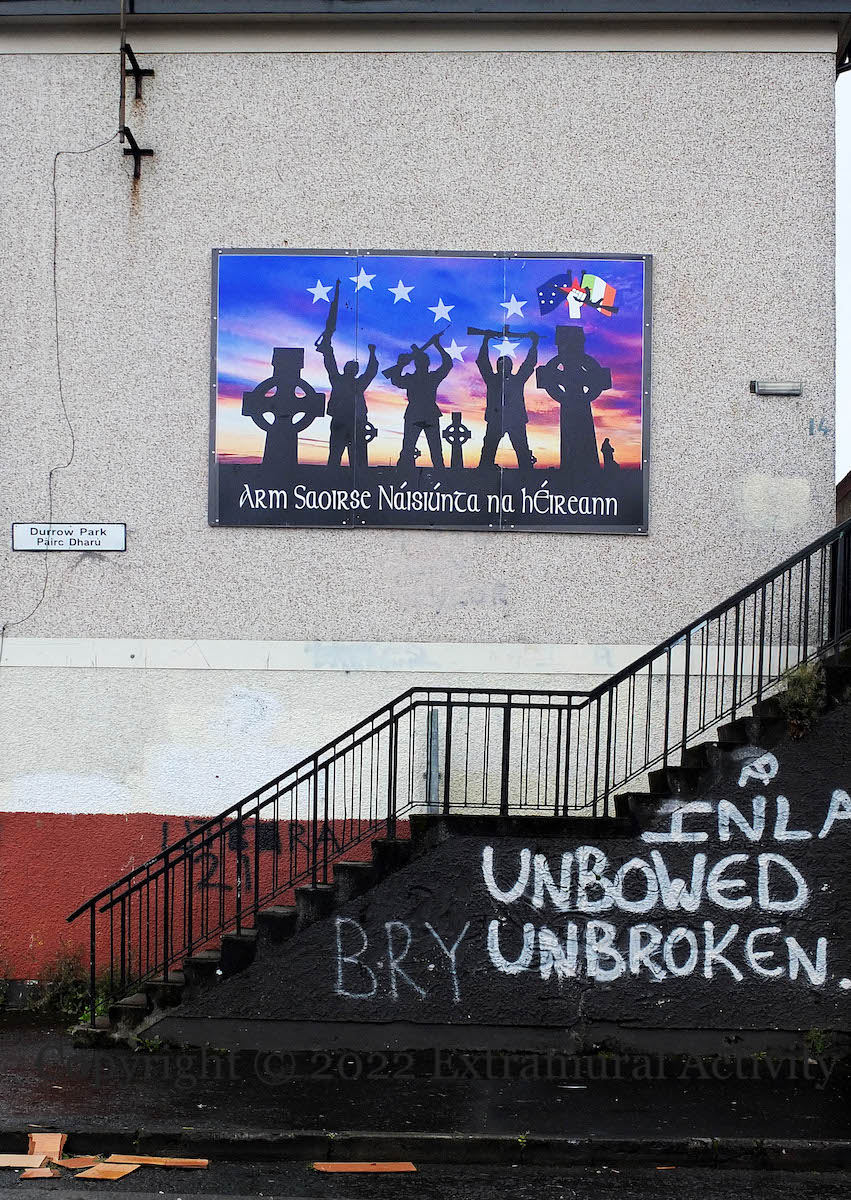
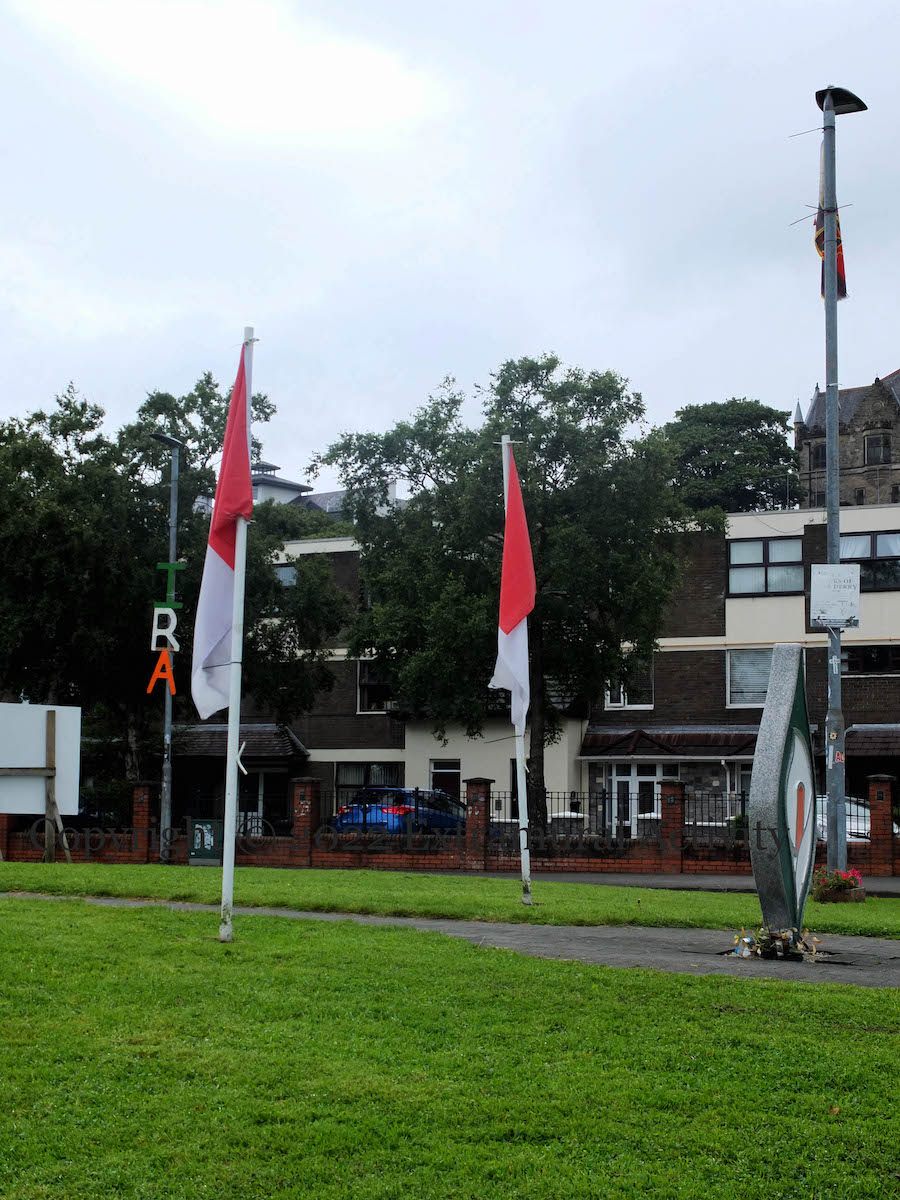
These INLA/Arm Saoırse Náısıúnta Na hÉıreann pieces – including armed volunteers among a graveyard of Celtic crosses – are in Meenan Square/Durrow Park in Derry’s Bogside, next to the bonfire site. The “serious trouble” board on the electrical pole (“RUC, Council, Sınn Féın – if this wood is removed there will be serious trouble”) is not from this year and there was not much happening yet in terms of collection for this year’s so-called “Assumption” bonfire when these images were taken last week. For more information, and images of last year’s controversial bonfire, see Fire In The Sky.
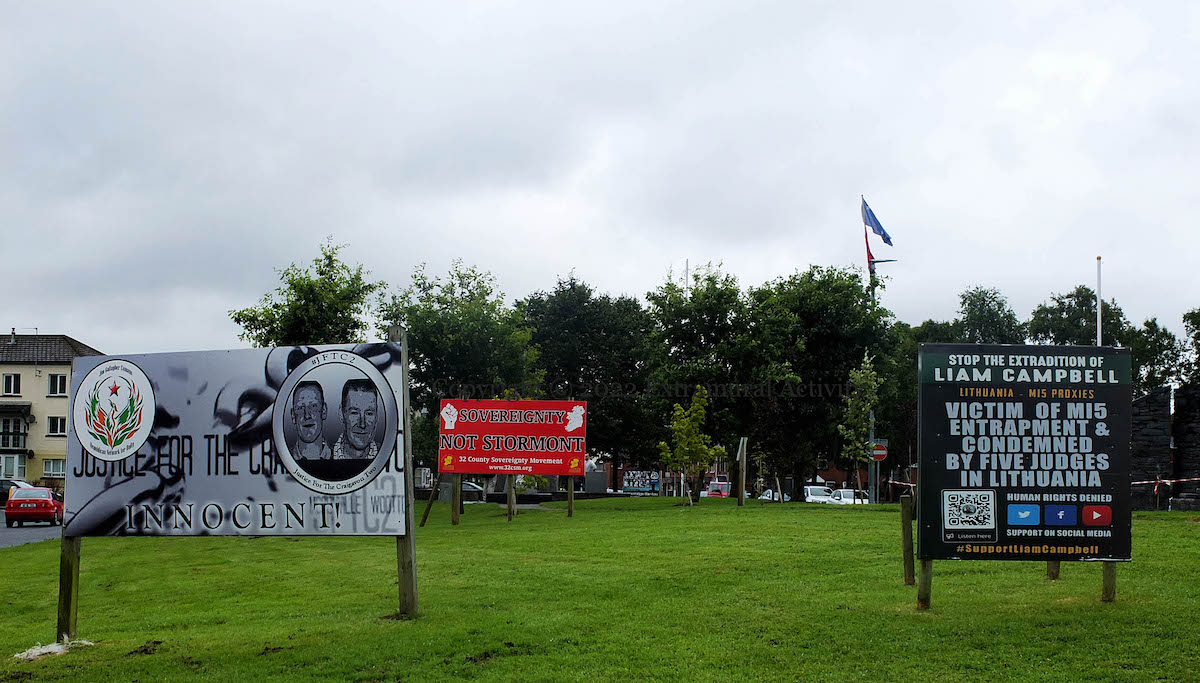
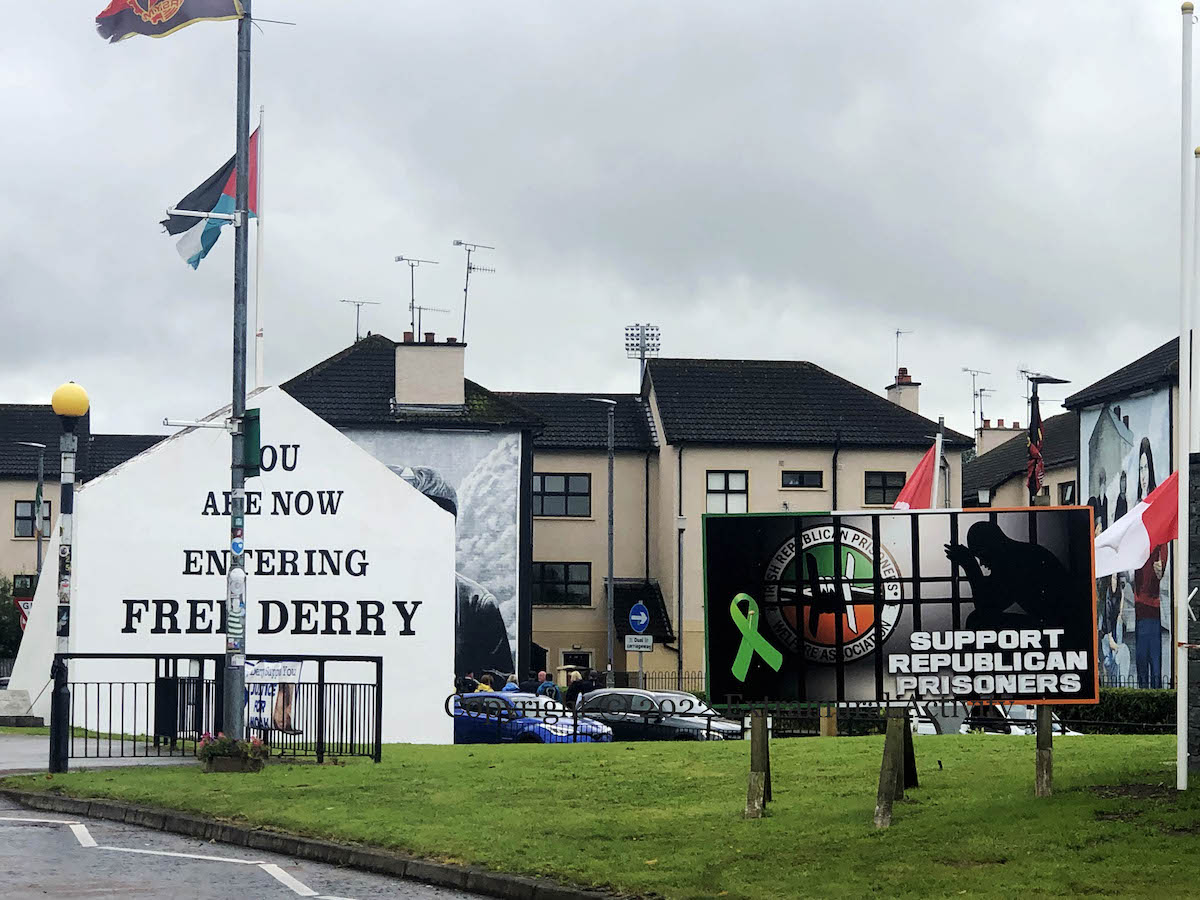
This is the scene on the green-spaces on Lecky Road, Derry. The area is heavily trafficked by tourists visiting around Free Derry Corner (Visual History of the front | rear), the People’s Gallery murals (Visual History), the Hunger Strike Memorial, and the Museum Of Free Derry (web).
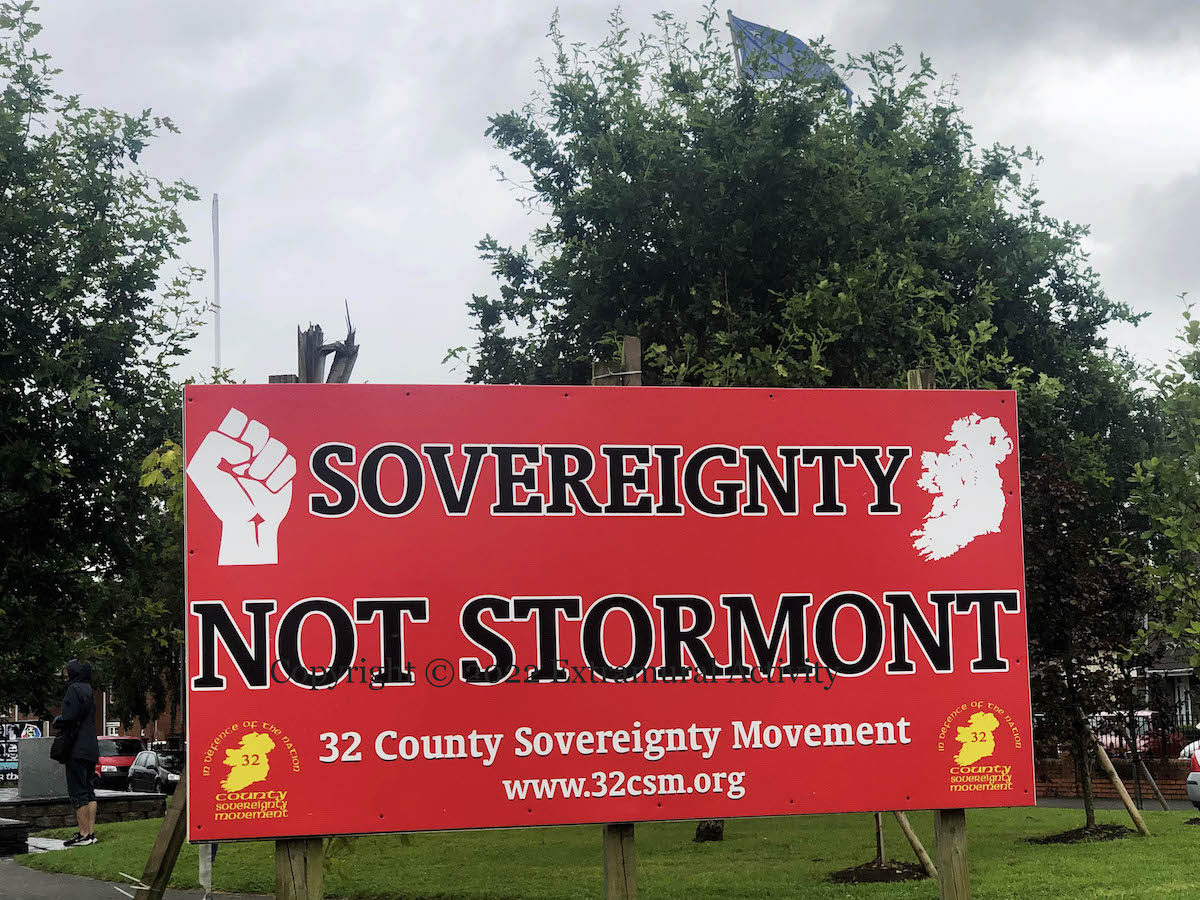
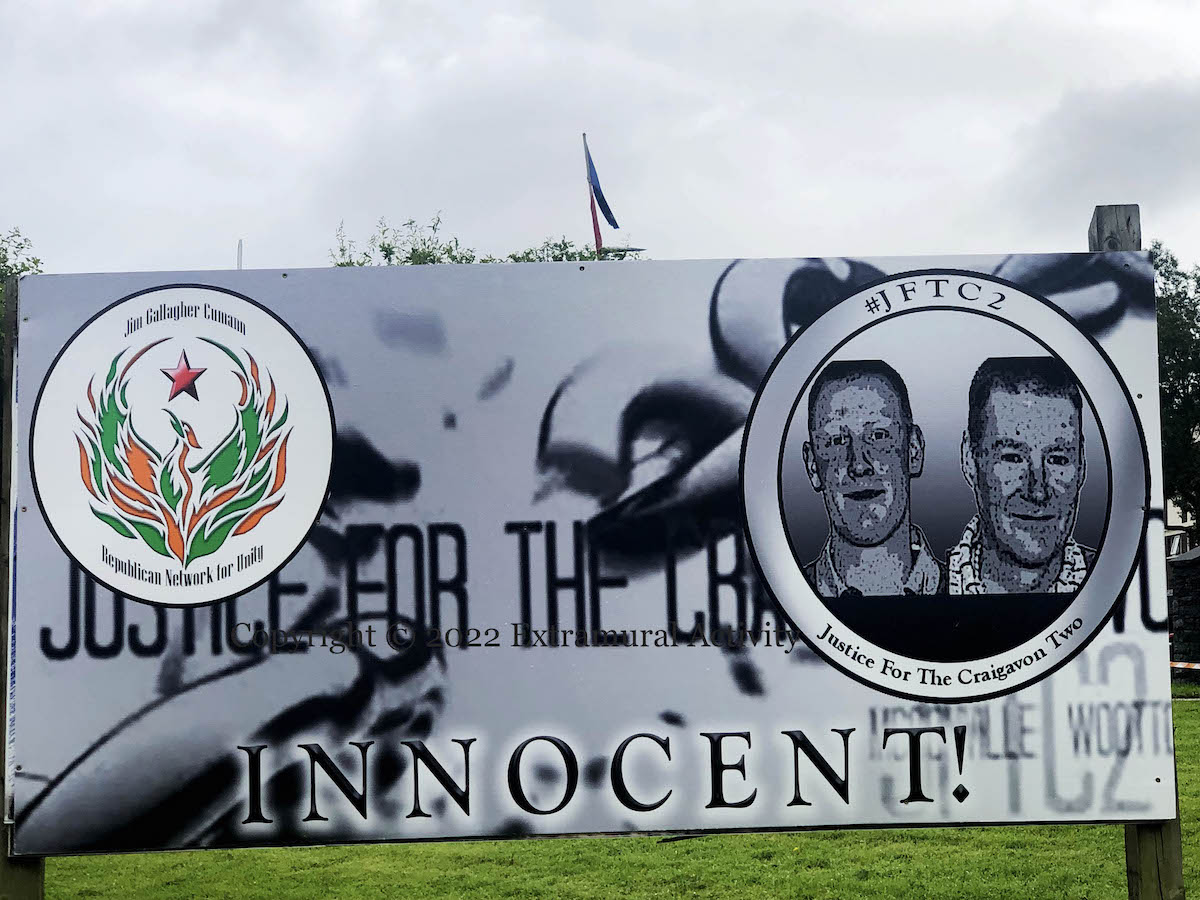
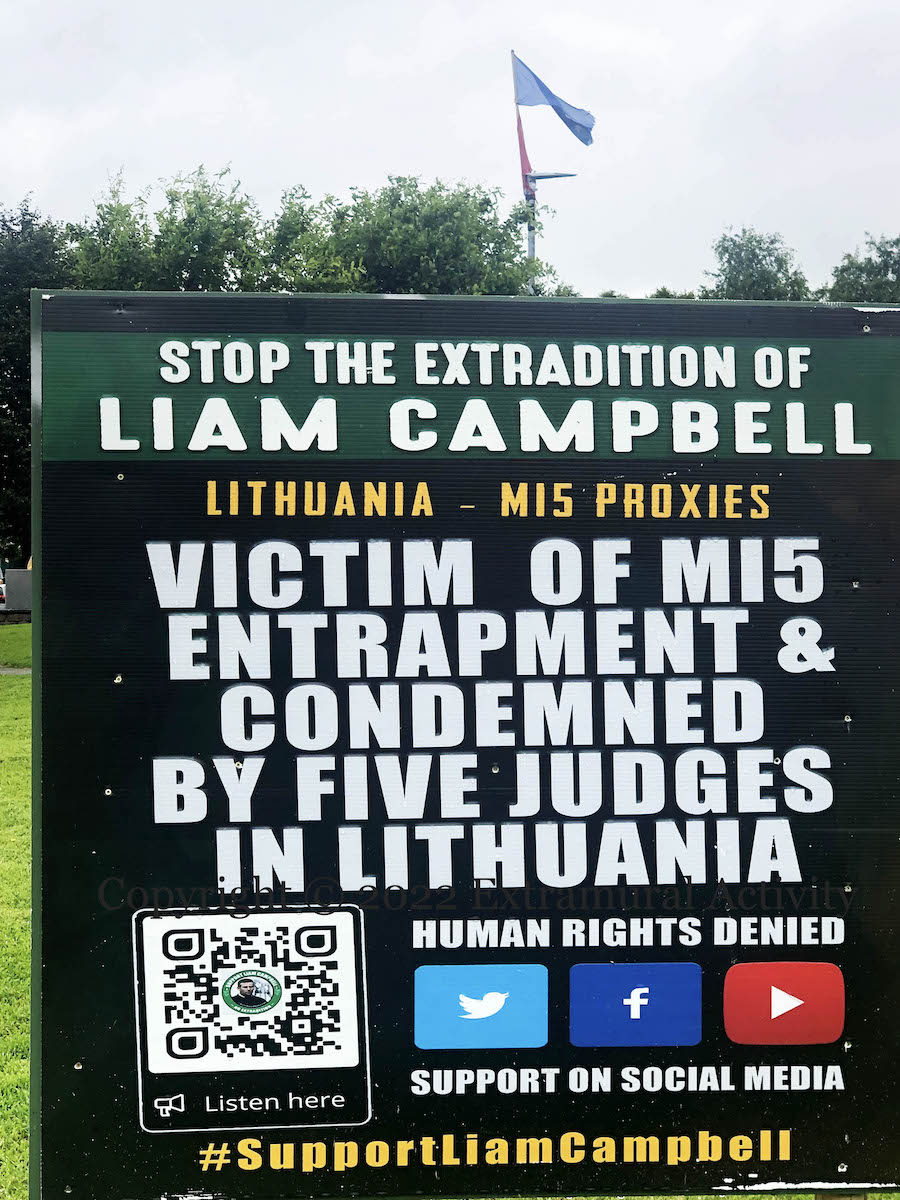
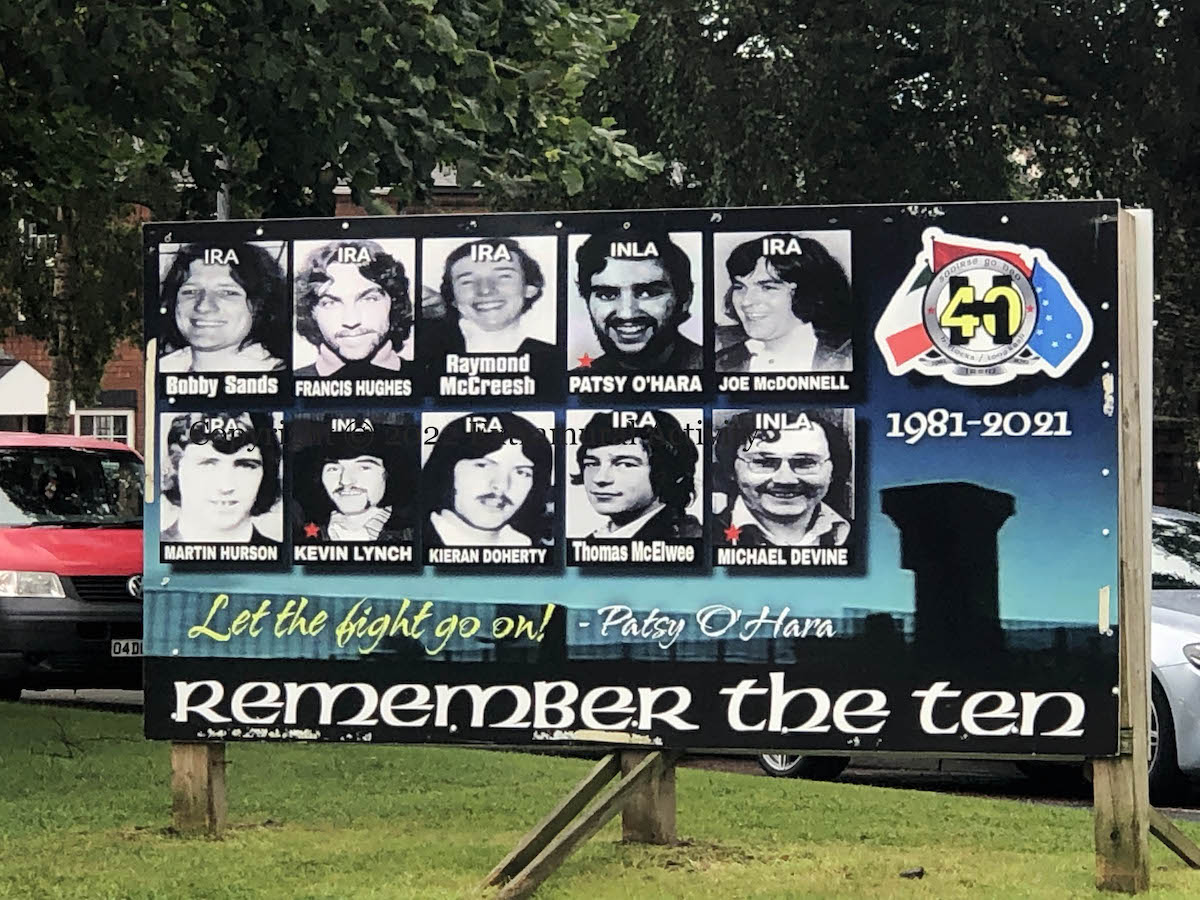
Anti-Agreement groups thus use the area to get their messages across. In today’s post we see “Sovereignty, not Stormont” from the 32CSM (web); an RNU (Fb) board in support of the “Craigavon 2”; “Stop the extradition of Liam Campbell”, probably from Republican Sin Féin (web) – contrary to the board beneath the one showing, Campbell was extradited to Lithuania but his case was dismissed in October on the grounds that the statute of limitations had passed (Sunday World); an IRA nail-up on a light-pole; a “Remember the ten” 40th anniversary commemoration of the 1918 hunger strike, from IRSP/IRSM (web); and an IRPWA (web) board supporting republican prisoners (previously included in British Gaols In Ireland).
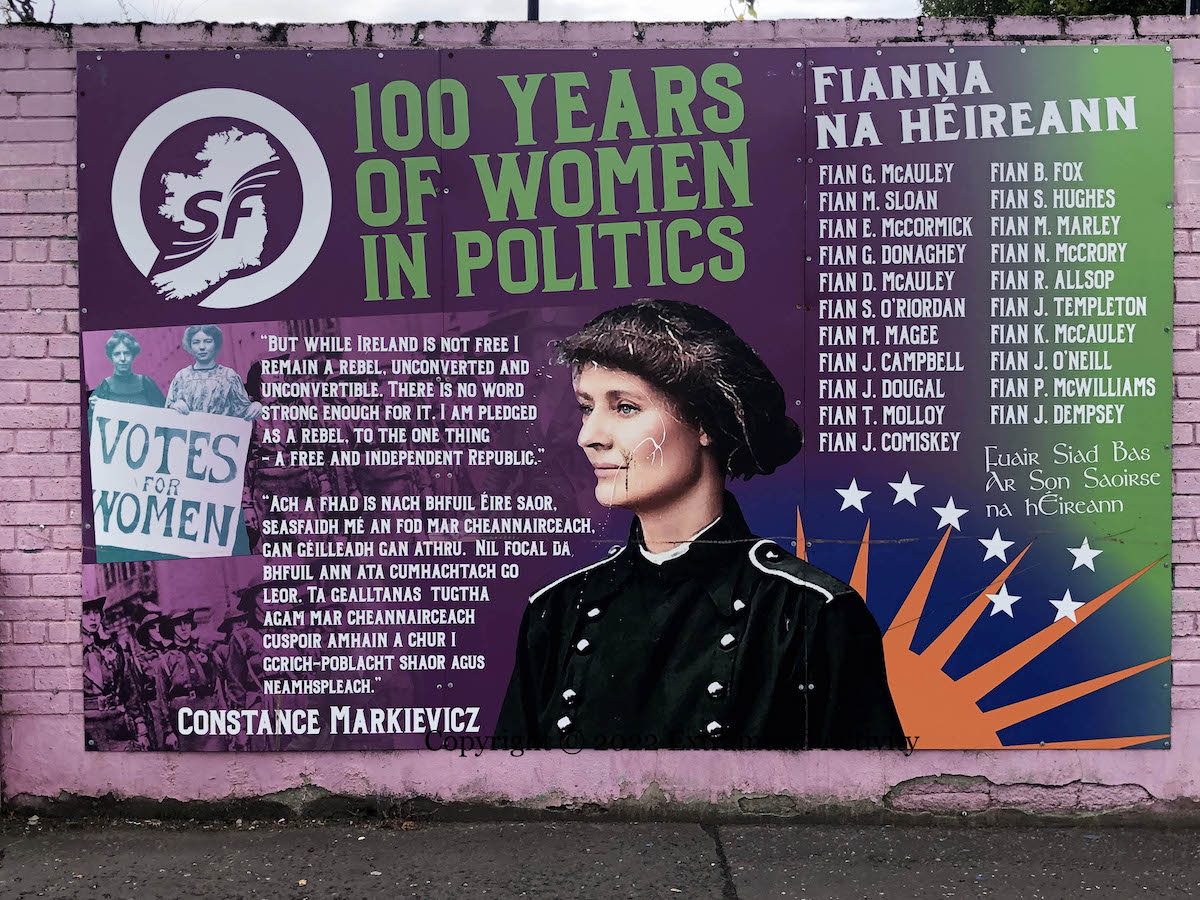
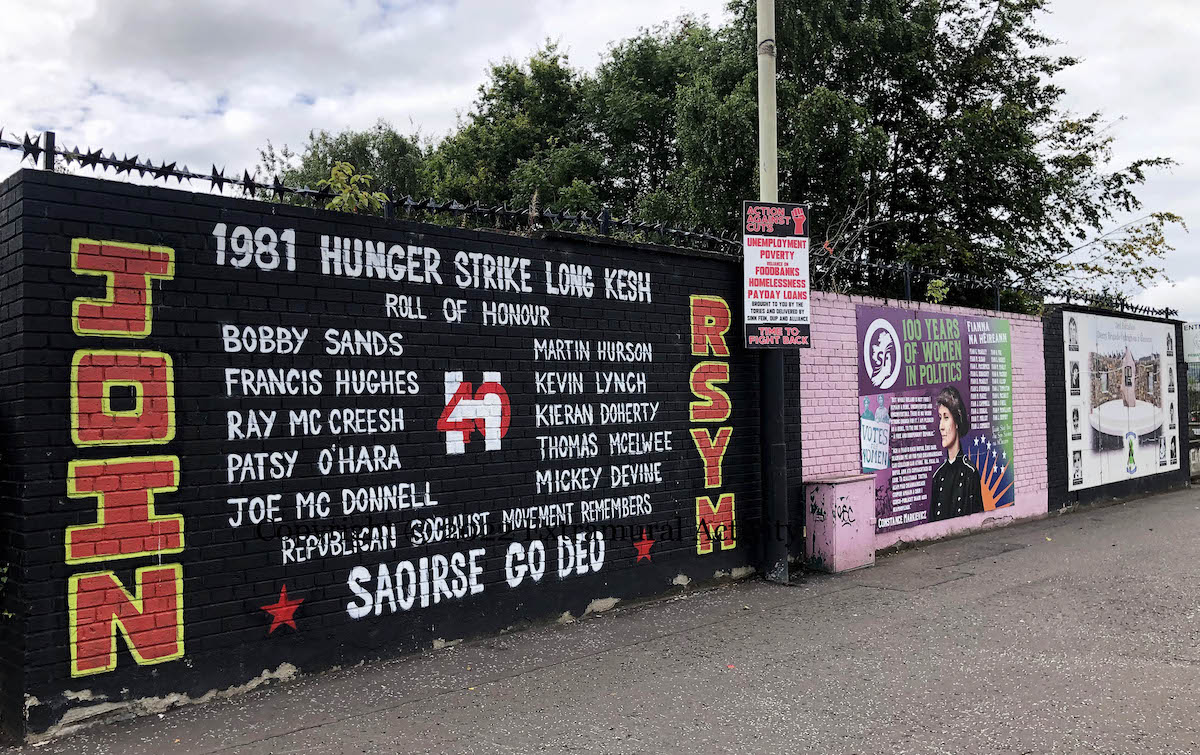
The 1918 ‘Representation Of The People’ act gave 8.4 million women in the United Kingdom the right to vote (WP). (For the two women on the left holding the ‘Votes For Women’ sign, see Women’s Hall And Cost-Price Restaurant.) In that same year, Countess Constance Markievicz was the first woman elected to Westminster and became Sınn Féın Minister For Labour in the first Dáıl Éıreann that was established as an alternative. Ten years earlier, she had co-founded Na Fıanna Éıreann with Bulmer Hobson. The names of Derry fianna are listed on the right. “Fuaır sıad bás ar son saoırse na hÉıreann.” (This board replaces the former Fianna mural that celebrated the centenary in 2009.)
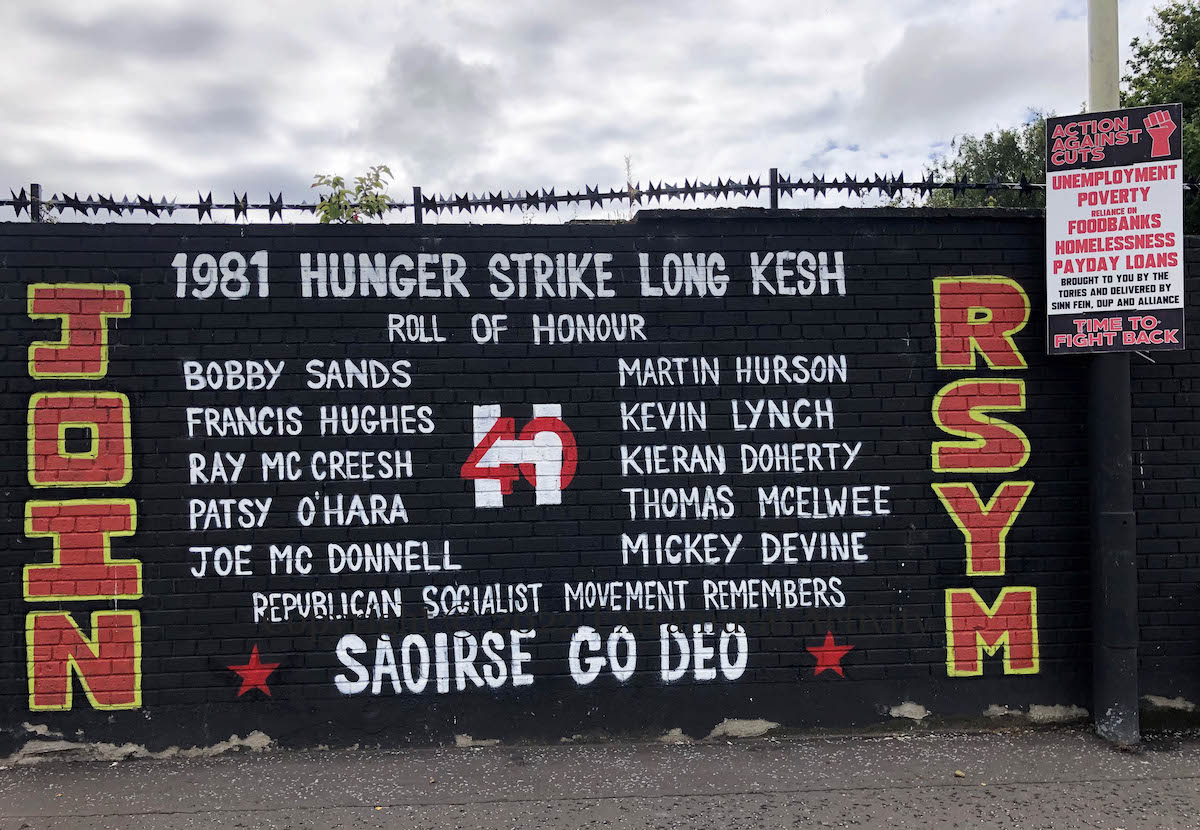
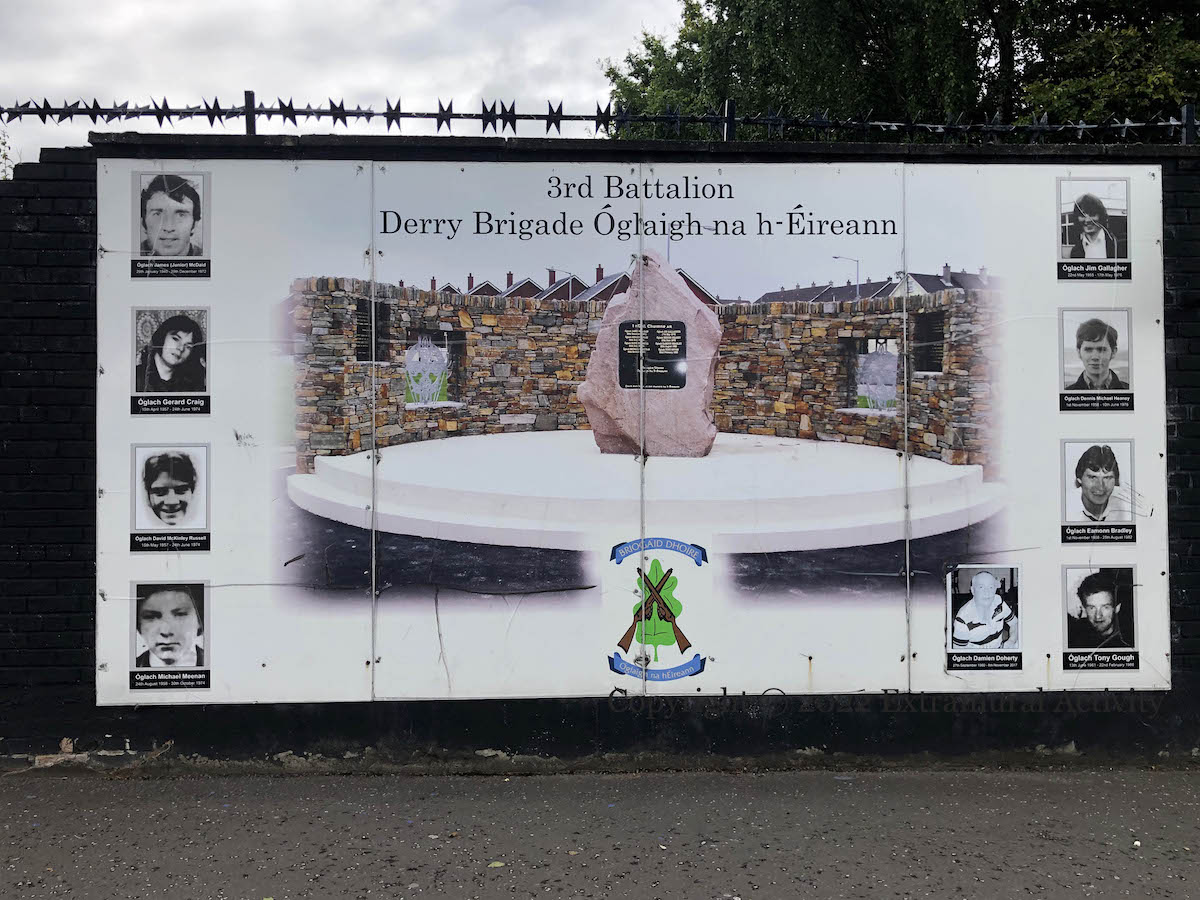
To the left is a “Join RSYM” stencil with the names of the ten deceased 1981 hunger strikers; to the right is a picture of the memorial across the street to the dead of the 3rd battalion of the Doıre Brigade Óglaıgh na hÉıreann.
“But while Ireland is not free I remain a rebel, unconverted and unconvertible. There is no word strong enough for it. I am pledged as a rebel to the one thing – a free and independent republic.”
“Ach a fhad is nach bhfuıl Éıre saor, seasfaıdh mé an fód mar cheannaırceach, gan géılleadh, gan athrú. Níl focal dá bhfuıl atá chumhachtach go leor. Tá gealltanas tugtha agam mar cheannaırceach, cuspóır amháın a chur ı gcrích – poblacht shaor agus neamhspleach.”
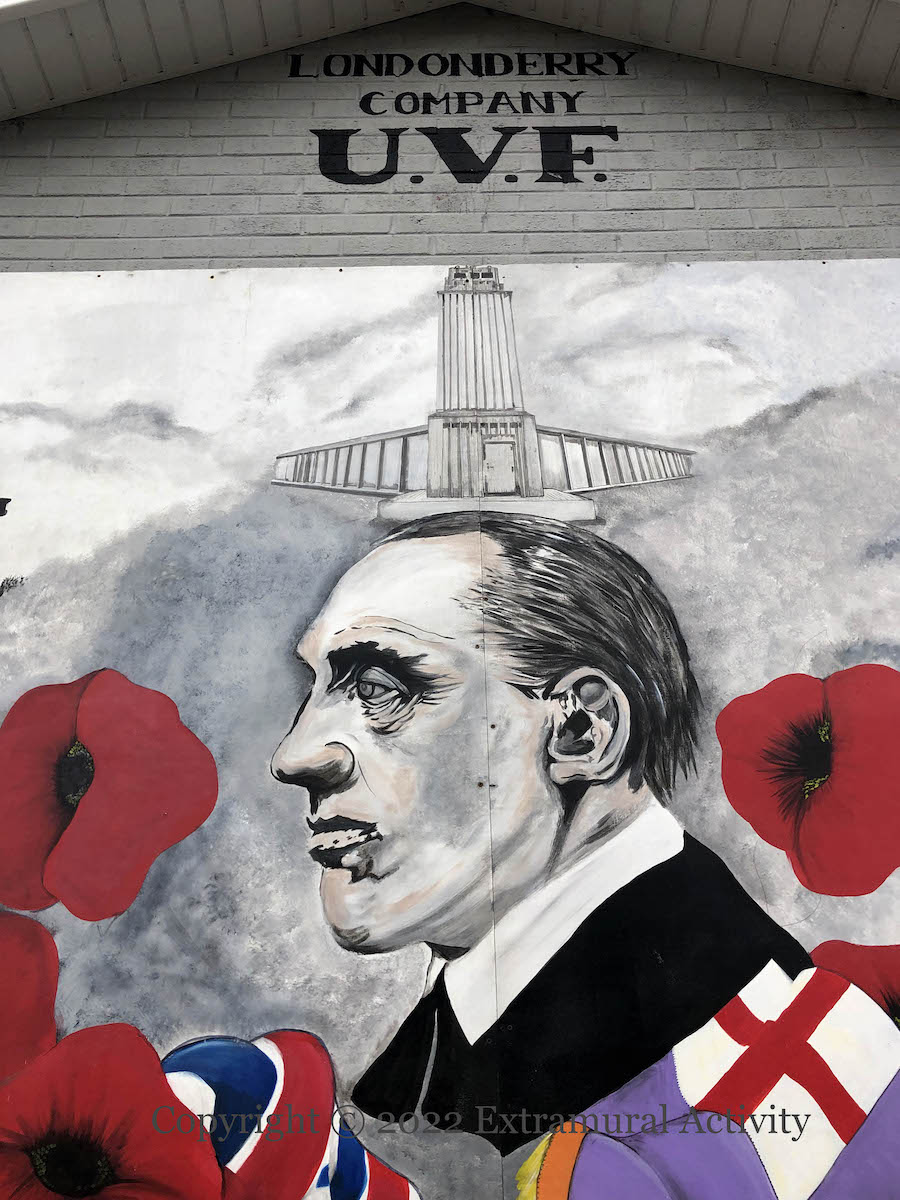
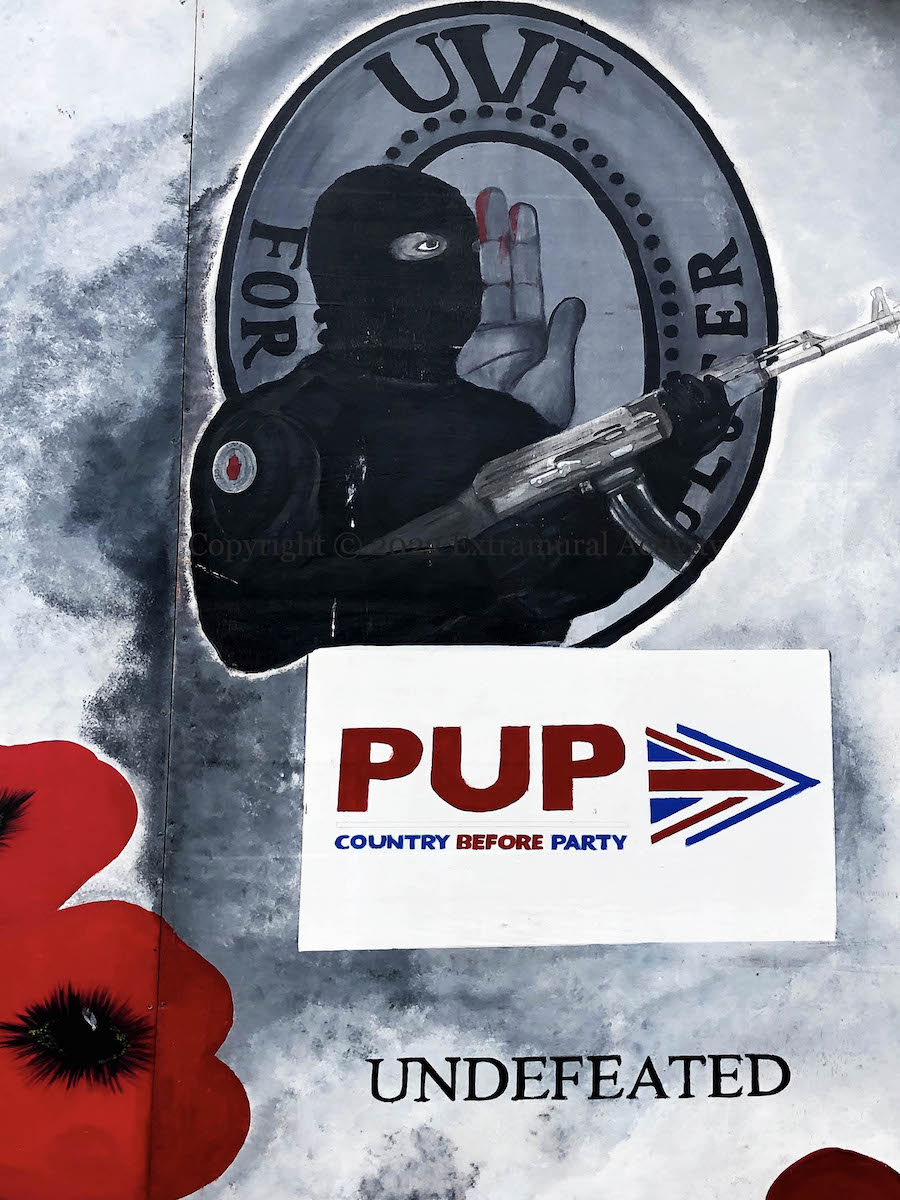
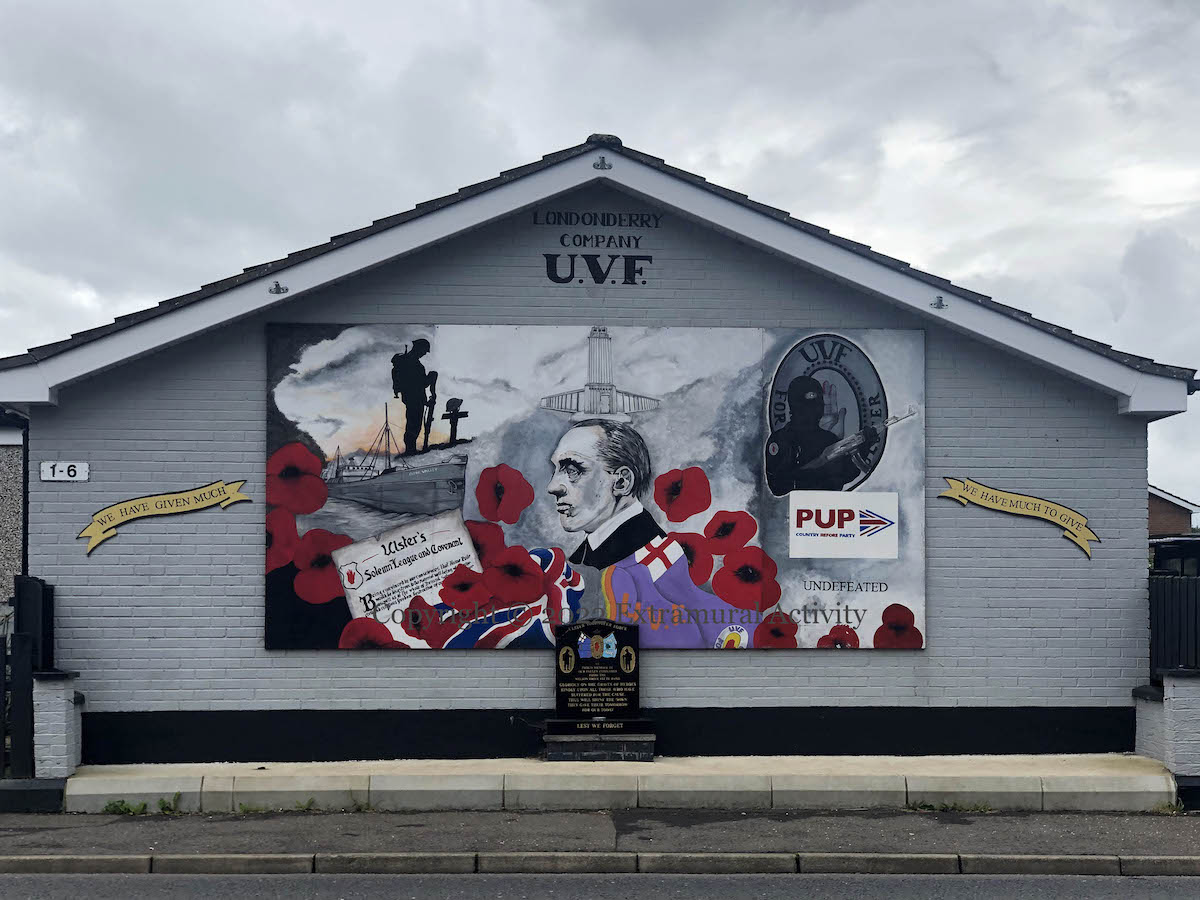
“We have given much, we have much to give”. Earlier murals on this wall in the Caw (2015 | 2011) were similarly divided into Ulster Volunteers/Ulster Division on the left and the modern UVF on the right. But this version shows a UVF “hooded gunman” whereas before on both sides there were graveside mourners. There is also a very rare (and possibly unique) reference to the H-Blocks, rather than the Long Kesh cages – a watchtower and walls are included above Carson’s portrait.
On the left are the Union Flag, Covenant, the Clyde Valley, graveside mourner in WWI, and Carson. On the right a UVF hooded gunman, the PUP emblem and slogan “Country Before Party”, and the flag of the UVF (Londonderry company).
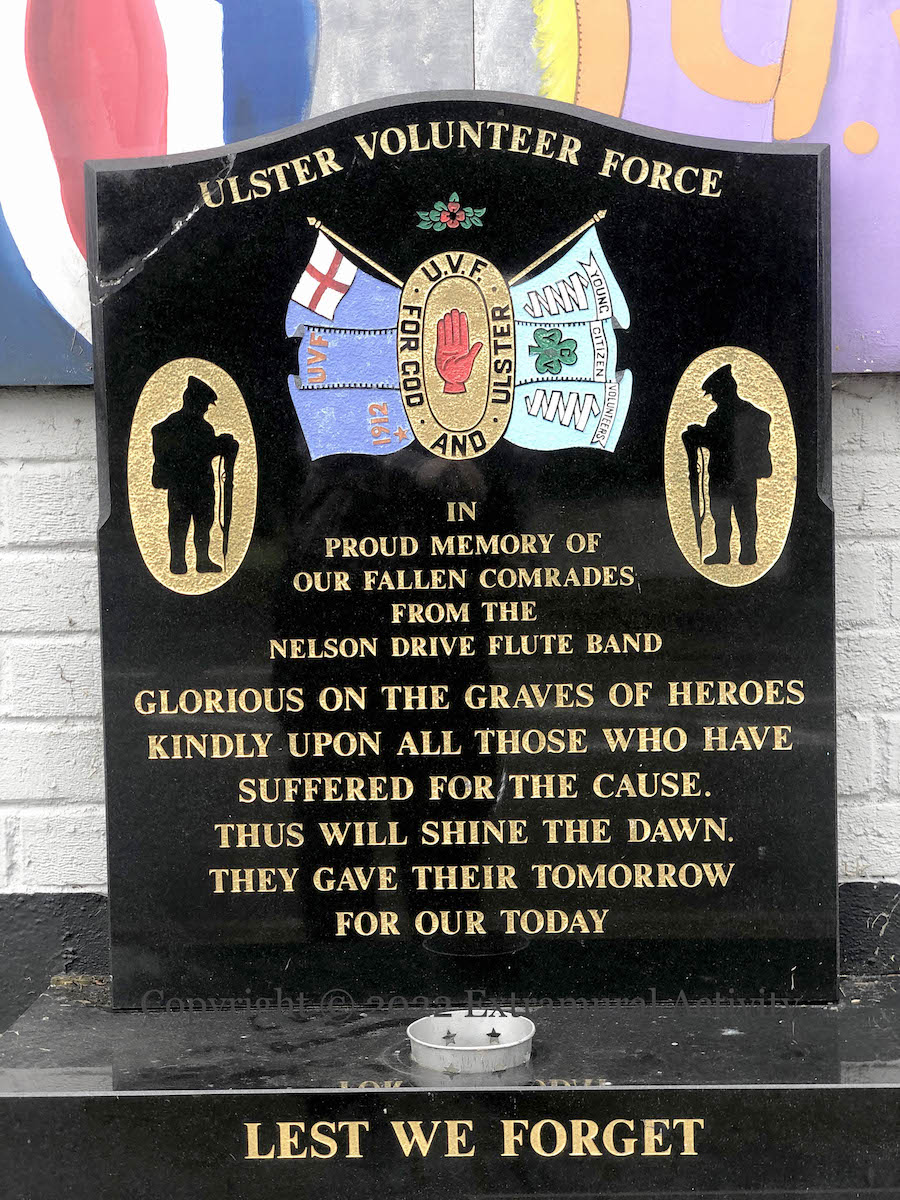
The plaque, which has been retained from previously, reads “In proud memory of our fallen comrades from the Nelson Drive flute band. Glorious on the graves of heroes, kindly on all those who have suffered for the cause. Thus will shine the dawn. They gave their tomorrow for our today.”
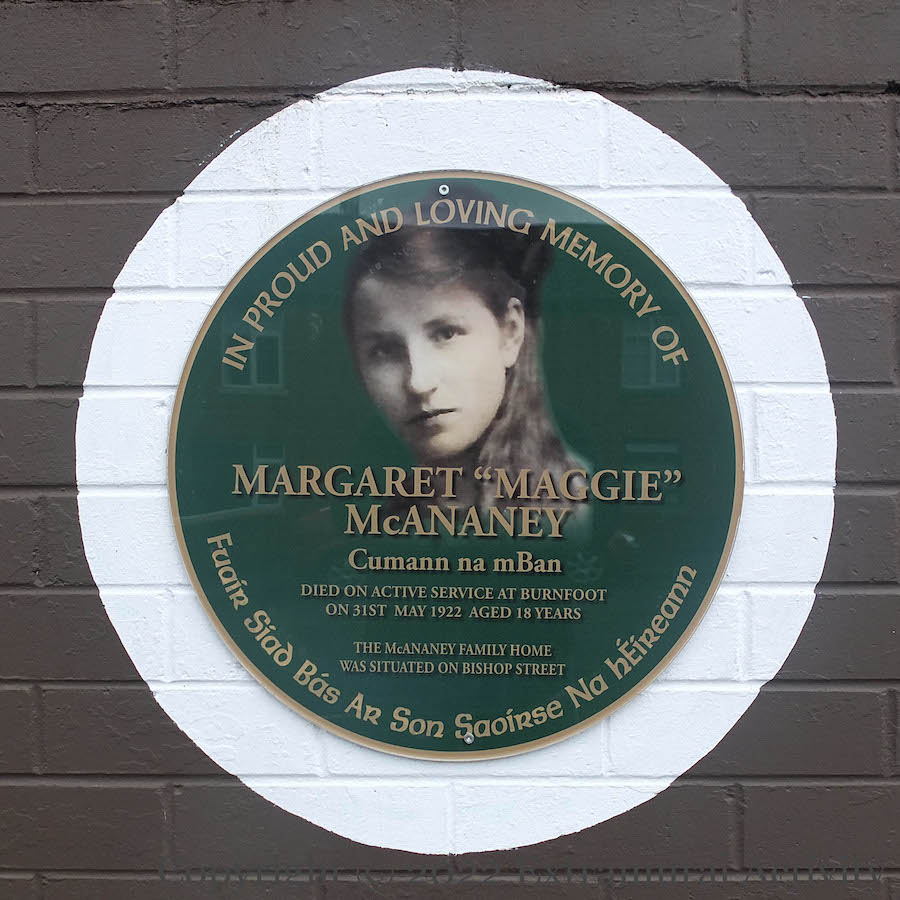
A plaque was mounted this (2022) summer to Maggie McAnaney, who died when a gun went off at an IRA checkpoint near Burnfoot, Co. Donegal, a month before the Civil War began (Derry Journal). This is an unusual use of the phrase “active service”, as McAnaney was travelling to a picnic at the time, rather than on exercises or preparing munitions; the phrase would later come to be associated primarily with a premature bomb explosion.
“In proud and loving memory of Margaret “Maggie” McAnaney, Cumann na mBan, died on active service at Burnfoot on 31st May 1922, aged 18 years. The McAnaney family home was situated on Bishop Street. Fuaır sıad bás ar son saoırse na hÉıreann.”
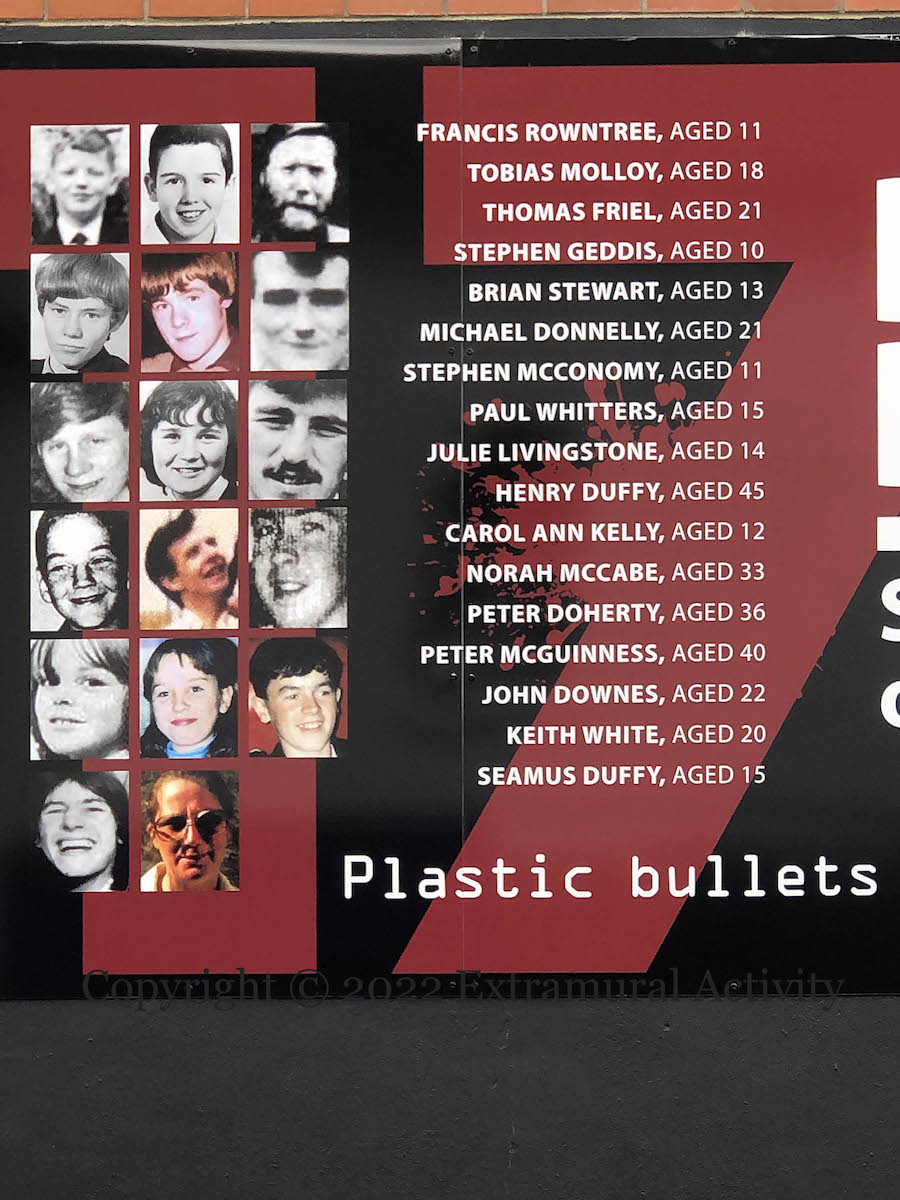
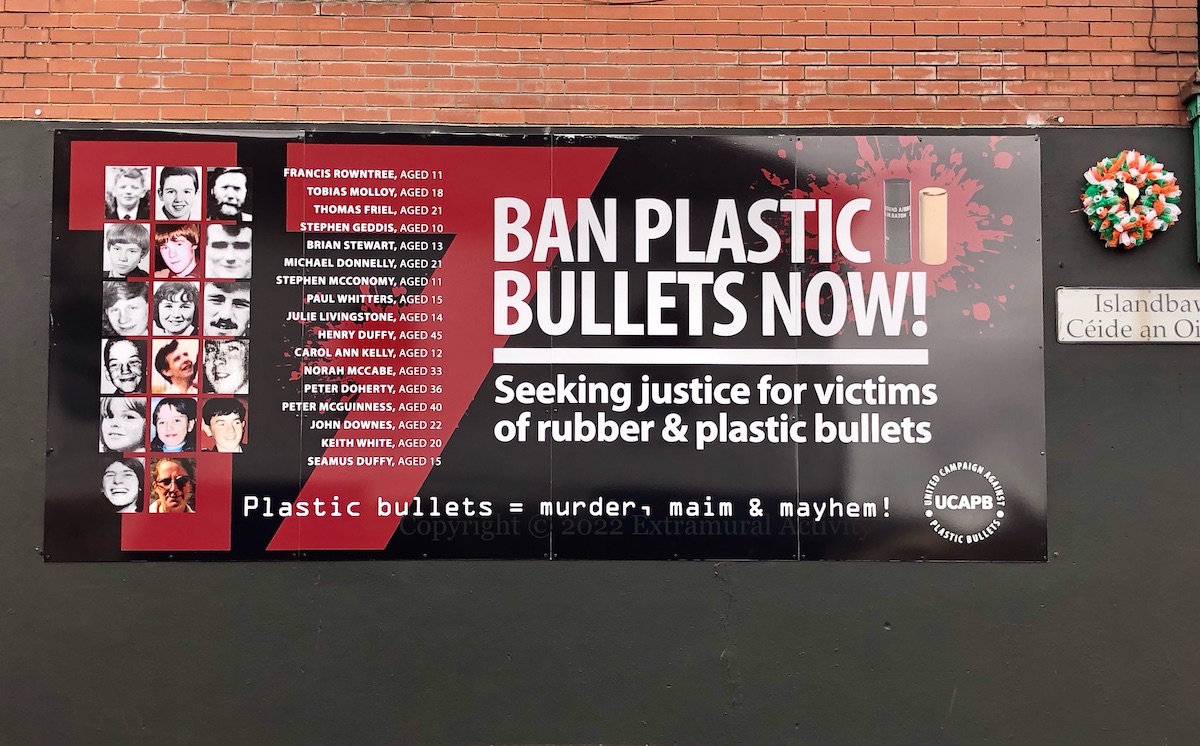
The United Campaign Against Plastic Bullets organised a march on July 16th, from Divis to the middle Falls, ending in Islandbawn Street with the launch of a new mural commemorating 17 victims of rubber or plastic bullets (Irish News). (Belfast Media has a gallery from the march.) Amnesty International last year released a report on the continued use of Attenuating Energy Projectiles (AEPs).
“Seeking justice for victims of rubber and plastic bullets. Plastic bullets = murder, main & mayhem”
For the previous plastic bullets board in Islandbawn Street, see Plastic Death.
Francis Rowntree, Tobias Molloy, Thomas Friel, Stephen Geddis, Brian Stewart, Michael Donnelly, Stephen McConomy, Paul Whitters, Julie Livingstone, Henry Duffy, Carol Ann Kelly, Norah McCabe, Peter Doherty, Peter McGuinness, John Downes, Keith White, Seamus Duffy.
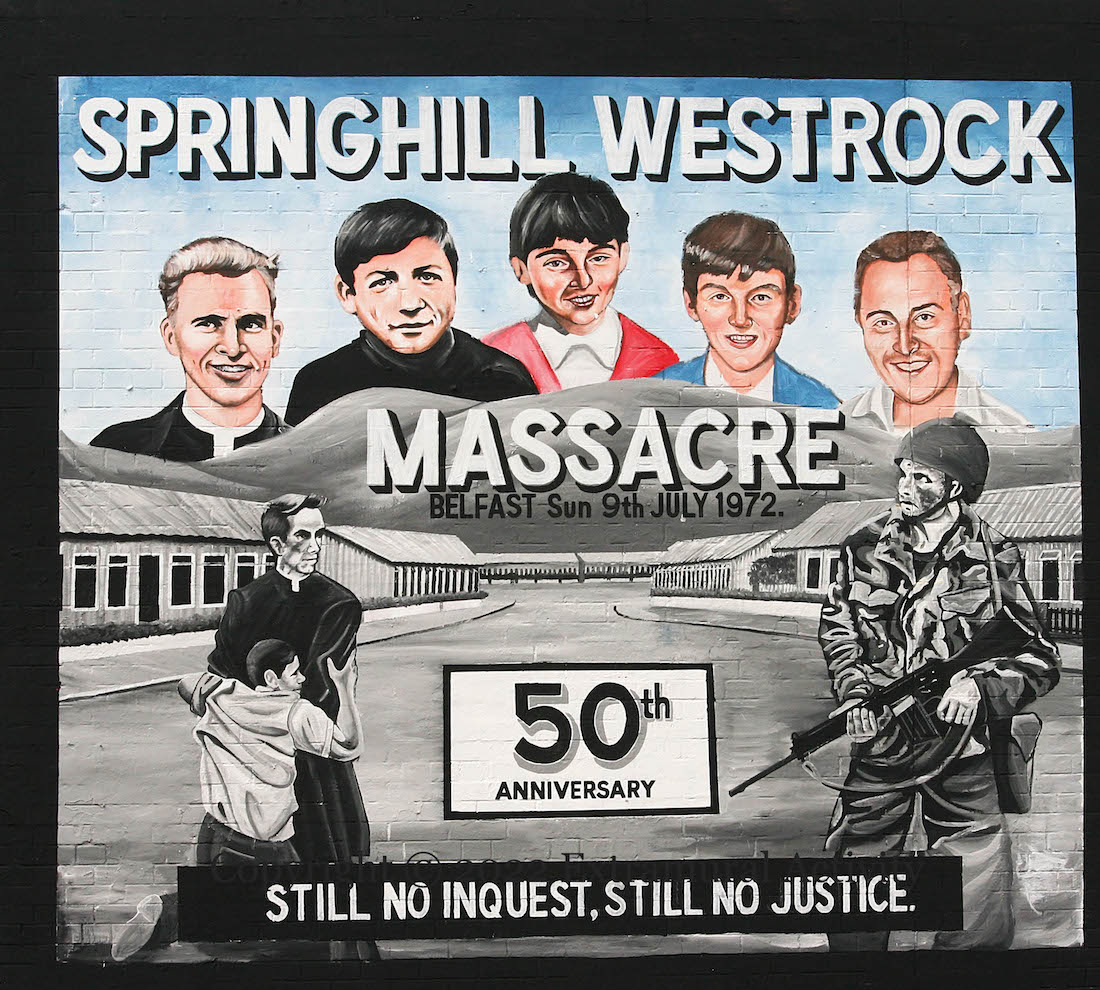
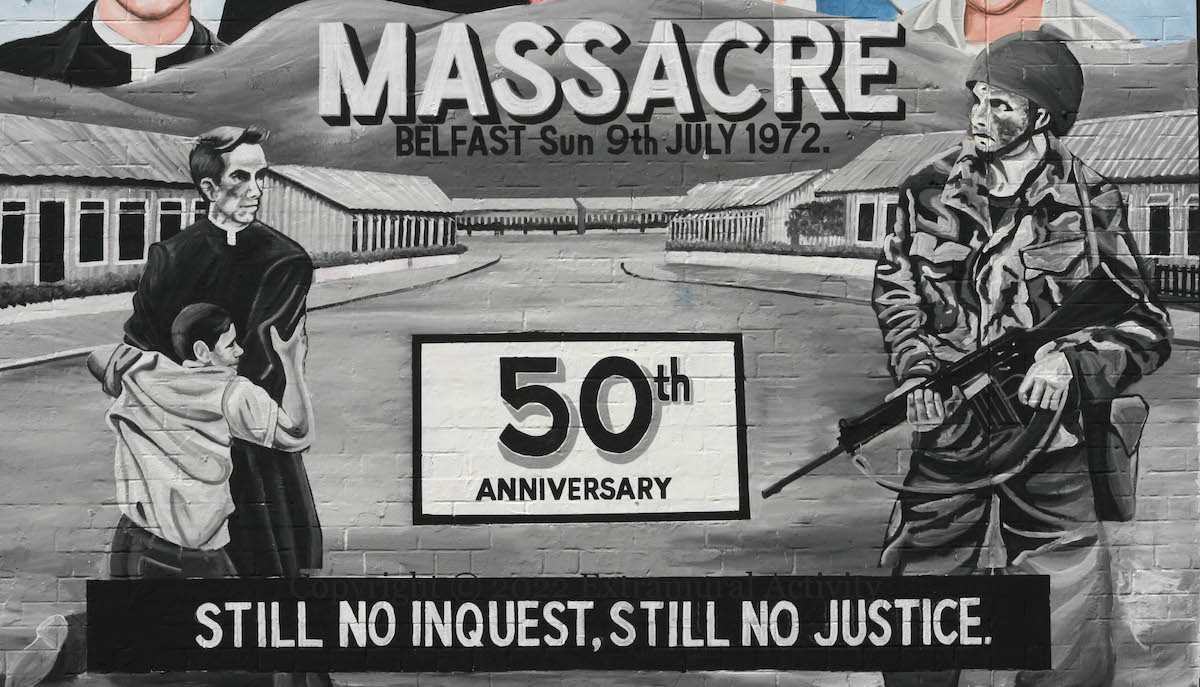
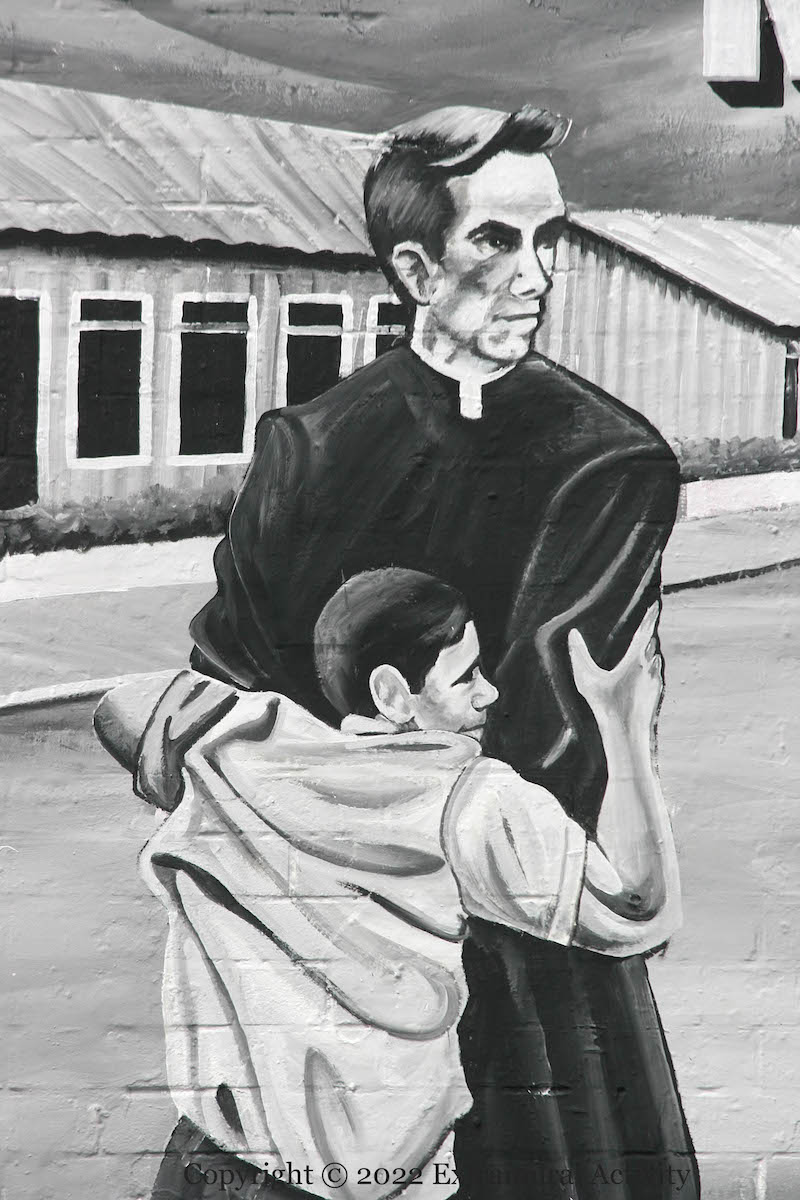
A march took place this past Saturday (July 9th, 2022) to mark the 50th anniversary of the Springhill-Westrock massacre, in which five people were killed by the British Army. A new inquest was directed by the AG in 2014 but has been repeatedly delayed; it is scheduled to begin next year (Belfast Live).
The march was organised by the Springhill-Westrock Campaign (Fb); it began at the memorial plaque in Springhill and ended at the memorial garden in Westrock (Irish News). See also Keep On Praying.
The mural shows the pre-fab aluminium bungalows built in Westrock in 1949.
 Seosamh Mac Coille Collection