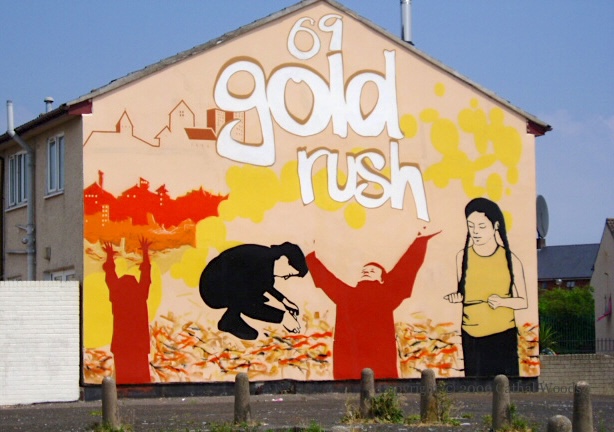
Gold Rush

From the info board, later added to the left: “The Gold Rush mural replaces a paramilitary image of two silhouetted gunmen representing Scottish Brigade. This new image by artist Tim McCarthy represents an event in July 1969 in Christopher Street when children digging in the rubble of the then demolished ‘Scotch Flats’ discovered a hoard of gold sovereigns. Word spread quickly and thus began ‘the Gold Rush’. The project was funded by the Re-imaging Communities programme of the Arts Council of Northern Ireland and delivered by Belfast City Council with the support of the Lower Shankill Community Association. The project would not have been possible without the support and participation of the local community.”

There is a short series of BBC radio programmes on the finding of the sovereigns and how they came to be in the chimney.

With support from the Arts Council, Belfast City Council, and Lower Shankill Community Association. By Tim McCarthy/Verz in Hopewell Crescent, lower Shankill, Belfast.

Click image to enlarge small image
Copyright © 2009 Cathal Woods
X00298 [X05054] ’69 gold rush
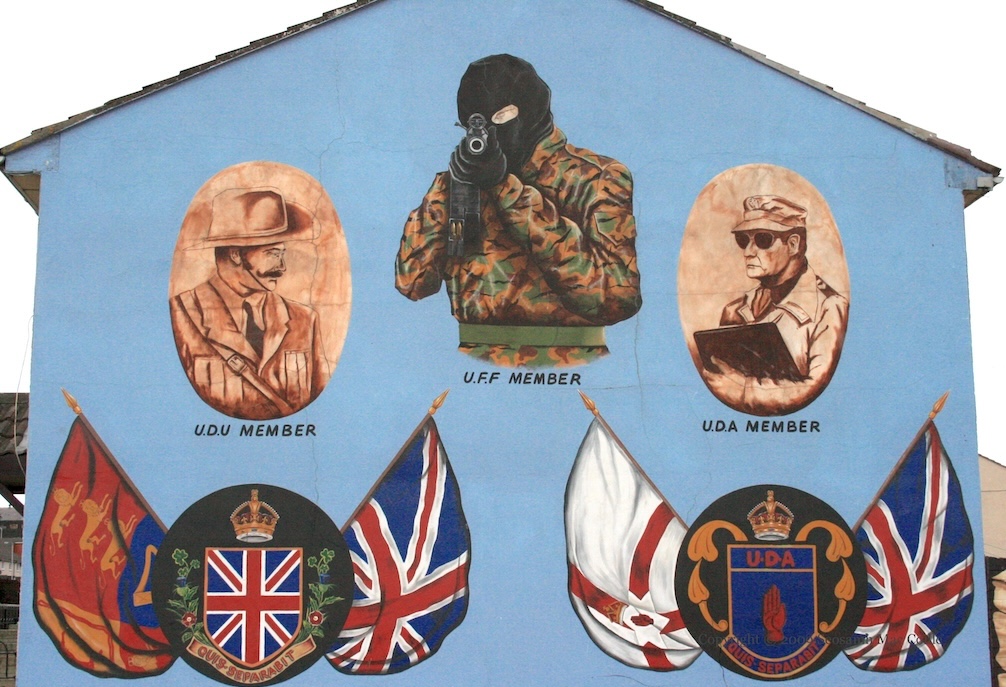
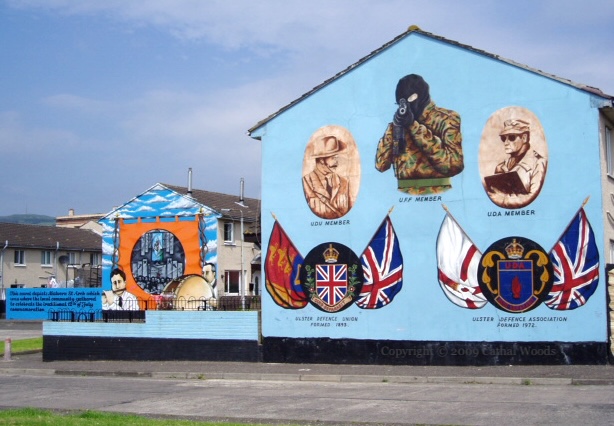
UDU-UFF-UDA

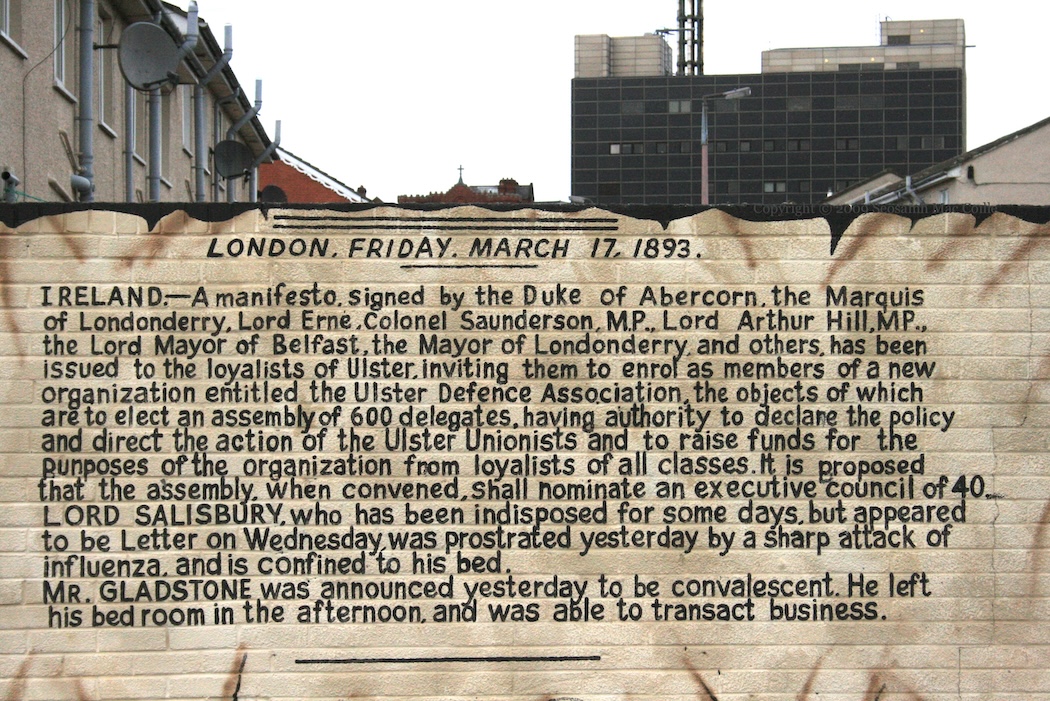
This is a 2007? repainting of a lower Shankill mural placing Ulster Freedom Fighters/Ulster Defence Association (UFF/UDA) within the historical context of “a new organization entitled the Ulster Defence Association, the objects of which are to elect an assembly of 600 delegates, having authority to declare the policy and direct the action of the Ulster Unionists and to raise funds for the purposes of the organization from loyalists of all classes.” The motto of the organisation was “Quis separabit” (which is the same as the UDA’s).

The Union faded away in the 1910s, but the name was revived by the UDA in 2007.

The manifesto was launched on St Patrick’s day 1893, in response to the 2nd Home Rule bill. Membership was closed on June 1st, by which time 170,000 people had signed up. The newspaper source of the text is unknown; a similar newspaper article from the Tasmanian Daily Telegraph can be found here. The words “Ulster Defence Association” do not occur in the manifesto.

For more on Saunderson, see Union Is Strength.

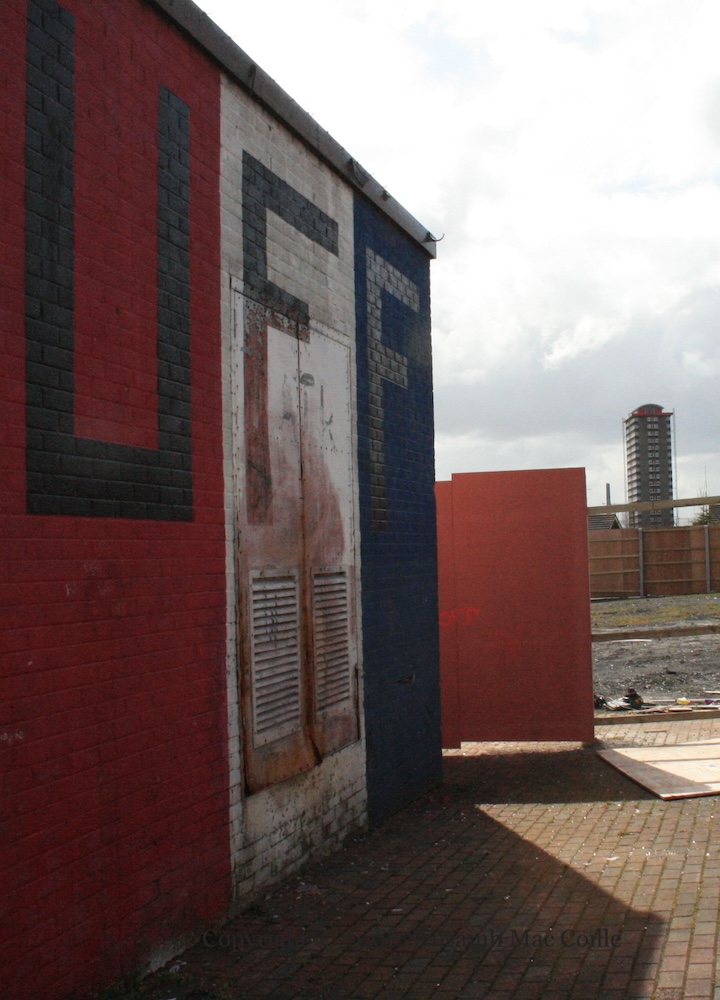
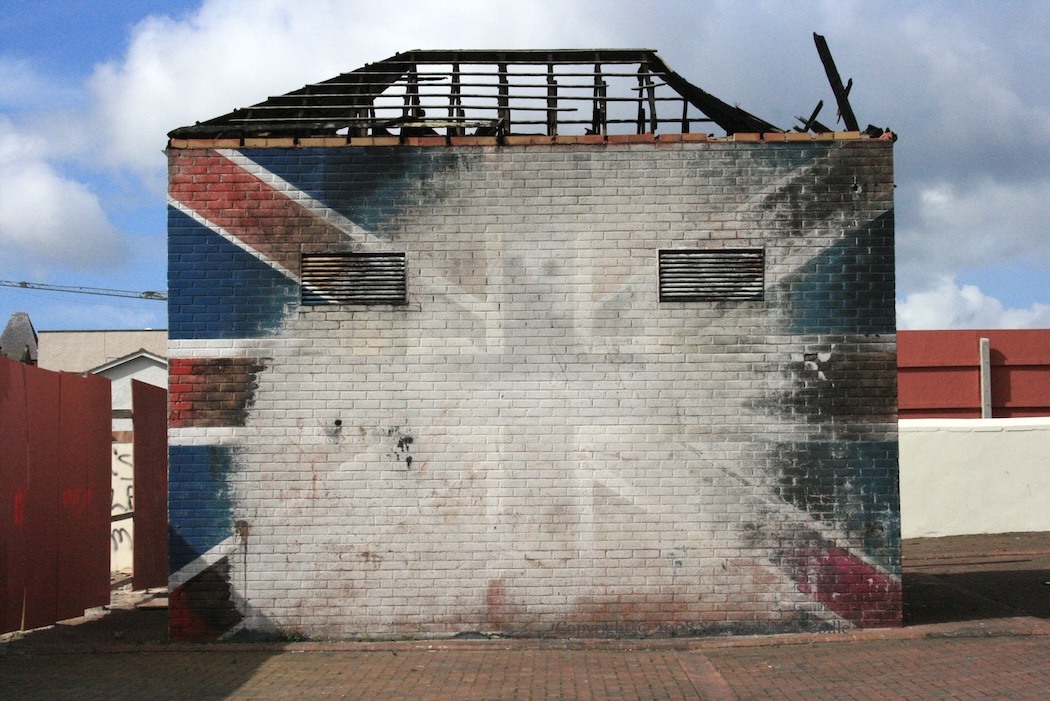
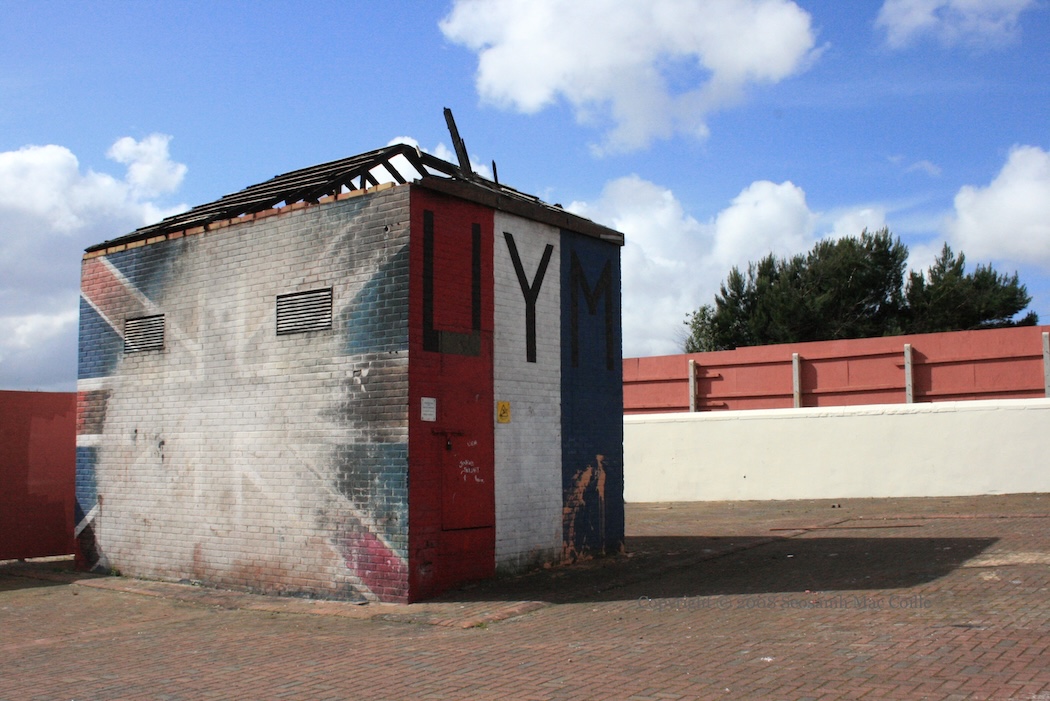
The side wall is new, and other small changes were made during the repaint: “UFF member” was previously above the gunman and “Est.” was previously used instead of “Formed”.

The Orange Order mural in the background is here.

Click image to enlarge
Copyright © 2009
X00283 Seosamh Mac Coılle
X00310 Cathal Woods
X00284 Seosamh Mac Coılle
[X00328]
member founded 1893 1972 ulster defence union

Malvern Arch

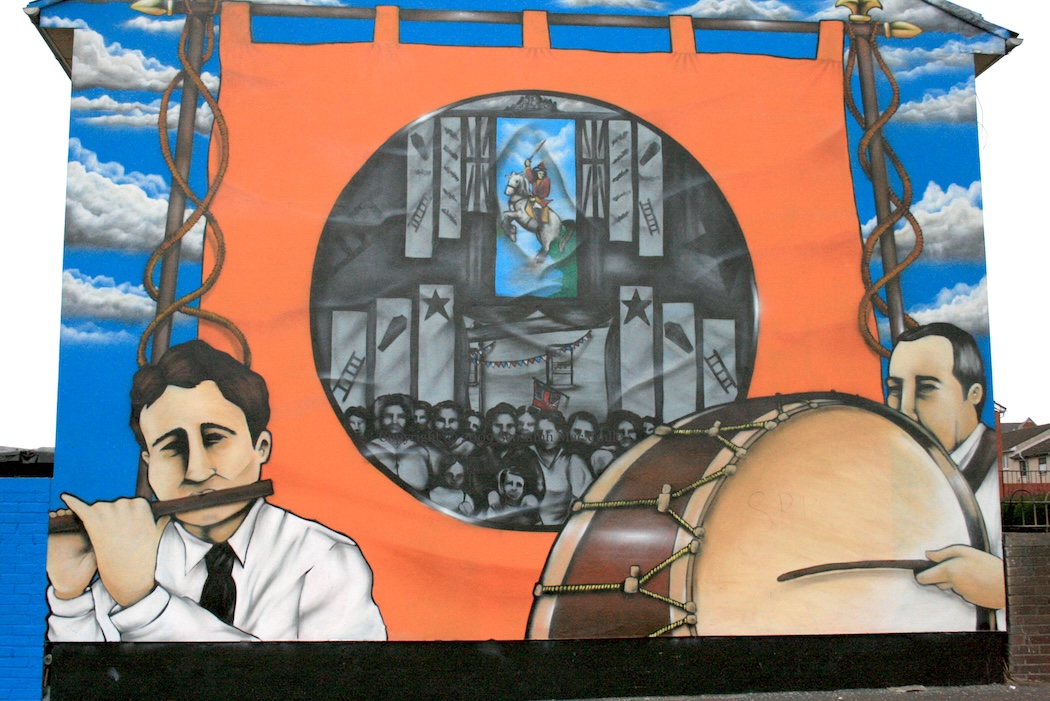
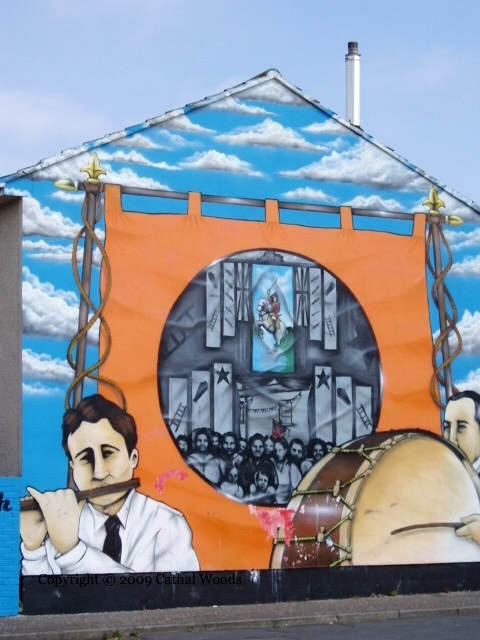
This mural shows Orange Order marchers in front of a banner depicting previous gatherings in Malvern St. The text on the side wall reads “This mural depicts Malvern St arch which was where the local community gathered to celebrate the traditional 12th of July commemoration.”

By Blaze FX in Hopewell Crescent, lower Shankill, west Belfast

Click image to enlarge
Copyright © 2009
X00275 Seosamh Mac Coılle
X00305 Cathal Woods
[X00306+]

UVF 3rd Battalion North Belfast

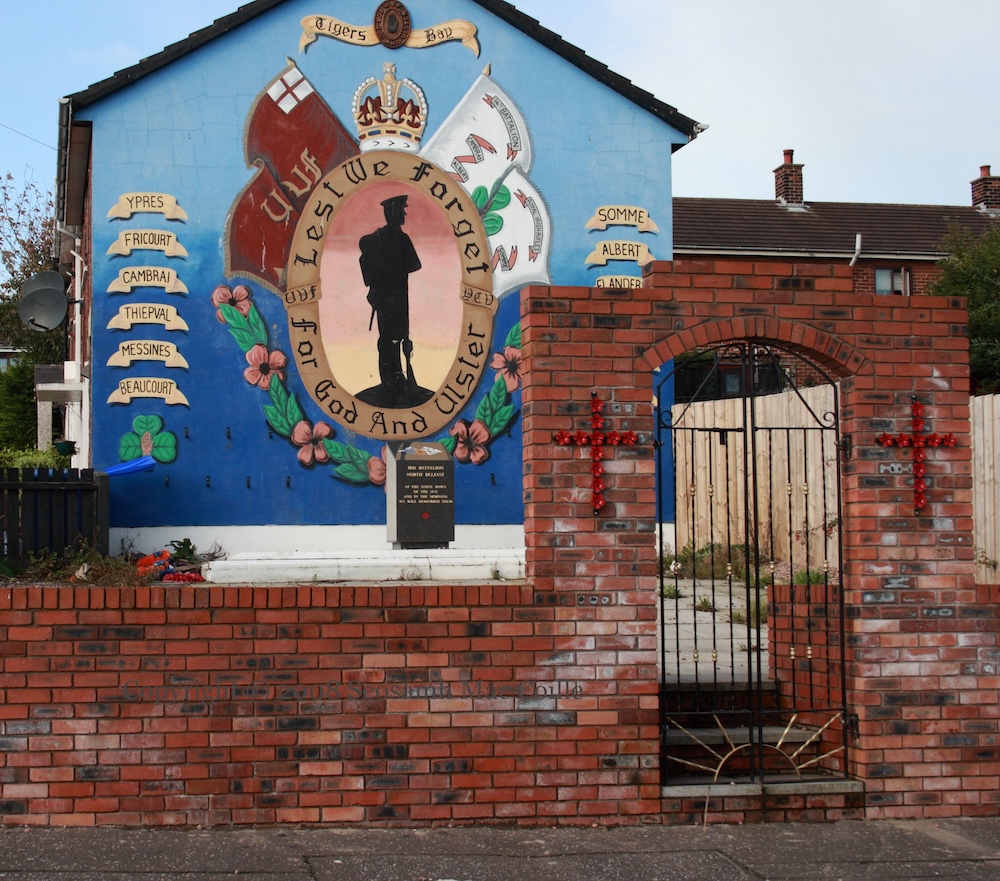
The UVF memorial garden in Mount Vernon gets a new wall, with poppy crosses on either side of the gate (see the previous wall). On the mural, the battles that the 36th (Ulster) Division took part in are listed on either side of the silhouetted soldier: Ypres, Fricourt, Cambrai, Thiepval, Messines, Beaucourt, Somme, Albert, Flanders, St Quentin, Bailleul, Courtrai. Although the mural is in Mount Vernon, the scroll at the top says “Tiger’s Bay”. The memorial stone is to the “3rd battalion, north Belfast”. A plaque would later replace the poppy cross to the left of the gate.

Click image to enlarge
Copyright © 2008 Seosamh Mac Coılle
X05030

The War Of Northern Aggression

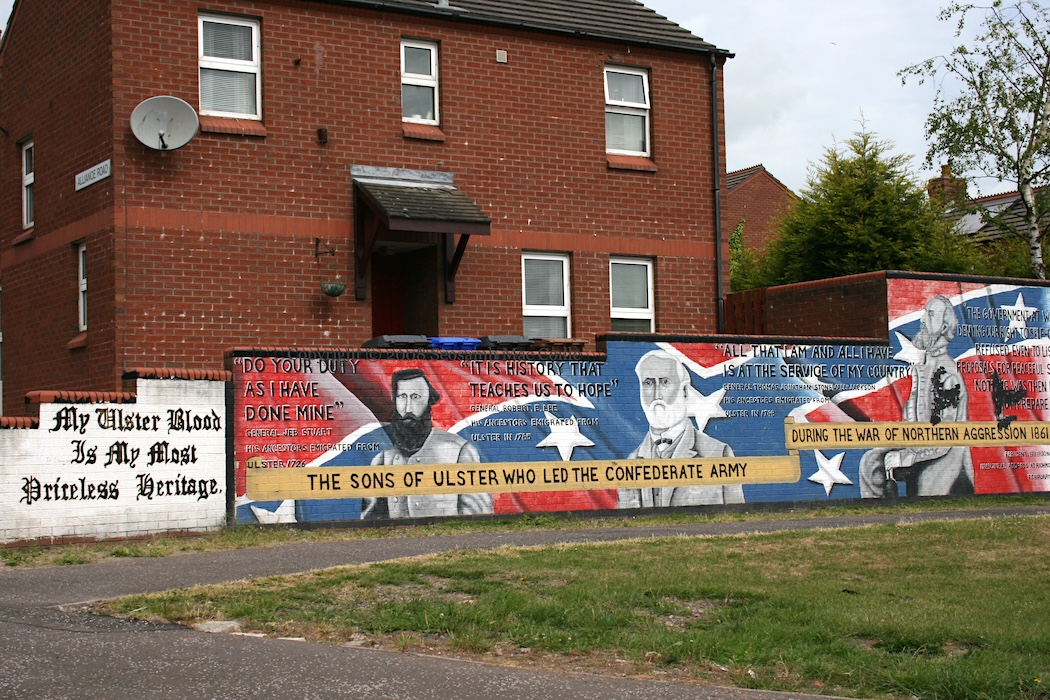
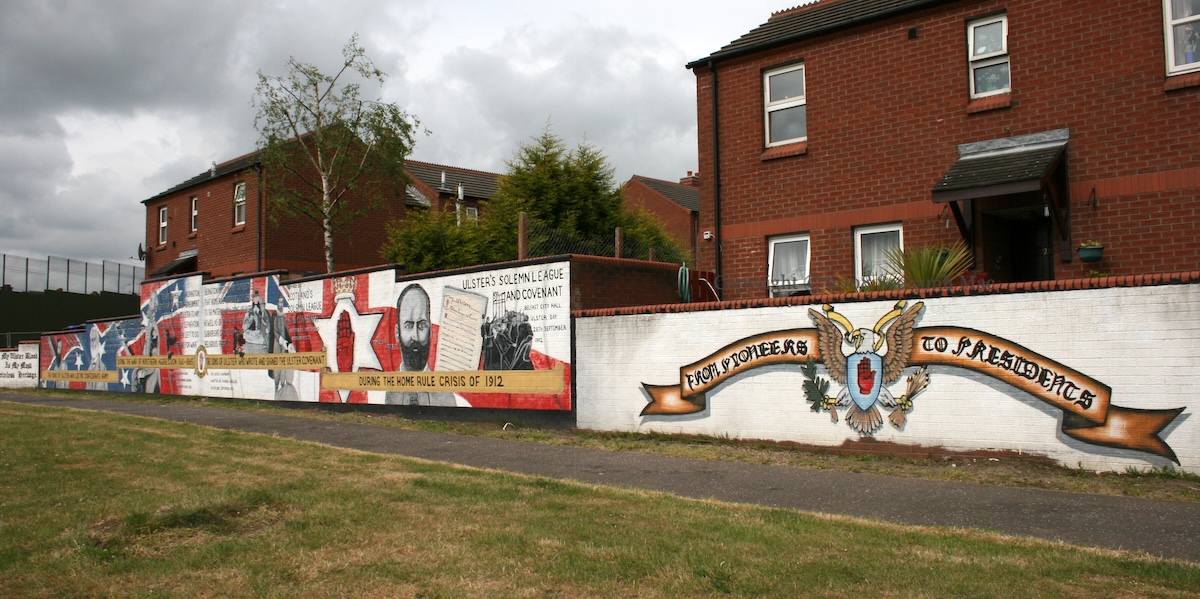
The confederate attempt to secede from the United States is here put in parallel with loyalist resistance to Home Rule. The Visual History page on Ulster-Scots Murals contains an attempt to understand the logic of this mural.

Various “sons of Ulster who led the confederate army” “during the War of Northern Aggression” [a.k.a. the Civil War] are quoted in the mural:

  • “Do your duty as I have done mine – General [James Ewell Brown] Jeb Stuart”
  • “It is history that teaches us to hope – General Robert E Lee”
  • “All that I am and all that I have is at the service of my country – General Thomas Jonathan Stonewall Jackson”
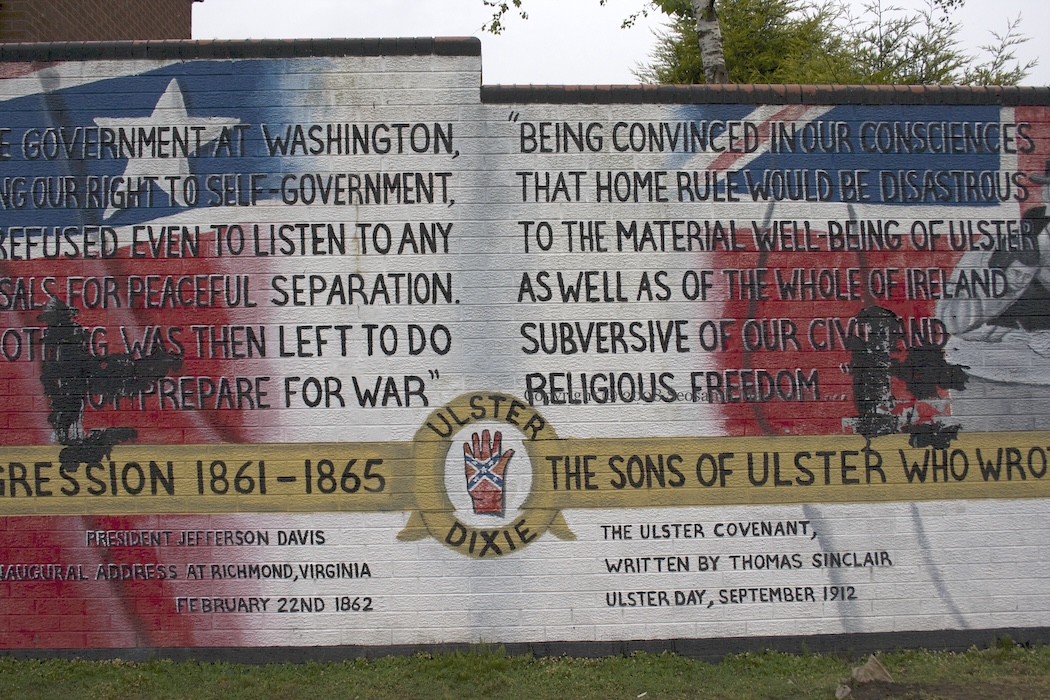
  • “The government at Washington denying our right to self-government, refused even to listen to any proposals for peaceful separation. Nothing was then left to do but prepare for war – President Jefferson Davis, inaugural address at Richmond, Virginia, February 22nd 1862”.
  • “My Ulster blood is my most priceless heritage” on the left-most panel is from James Buchanan.

The sons of Ulster who wrote and signed the Ulster Covenant during the Home Rule crisis of 1912 are described in this quote:

“Being convinced in our consciences that Home Rule would be disastrous to the material well-being of Ulster as well as the whole of Ireland, subversive of our civil and religious freedom … – The Ulster Covenant, written by Thomas Sinclair, Ulster Day, September 1912 inspired by Scotland’s Solemn League and Covenant, Greyfriar’s Churchyard, Edinburgh 1638.”

The right-most panel reads, “From pioneers to Presidents”. Murals under this theme – including two of Buchanan – were painted in 1999 (Belfast | Londonderry). This mural dates back to 2005 and perhaps earlier, part of a second wave of Ulster Scots murals that included Davy Crockett in Ballymena (2002), a gallery of famous famous faces in Newtownards (2005), and Andrew Jackson in the Shankill (c. 2007). See Visual History 08.

See also: the Confederate flag flying in Cluan Place | a confederate battle flag in Ballymacarett.

Click image to enlarge
Copyright © 2008 Seosamh Mac Coılle
X00257 X00258 X00259

Sean McCaughey

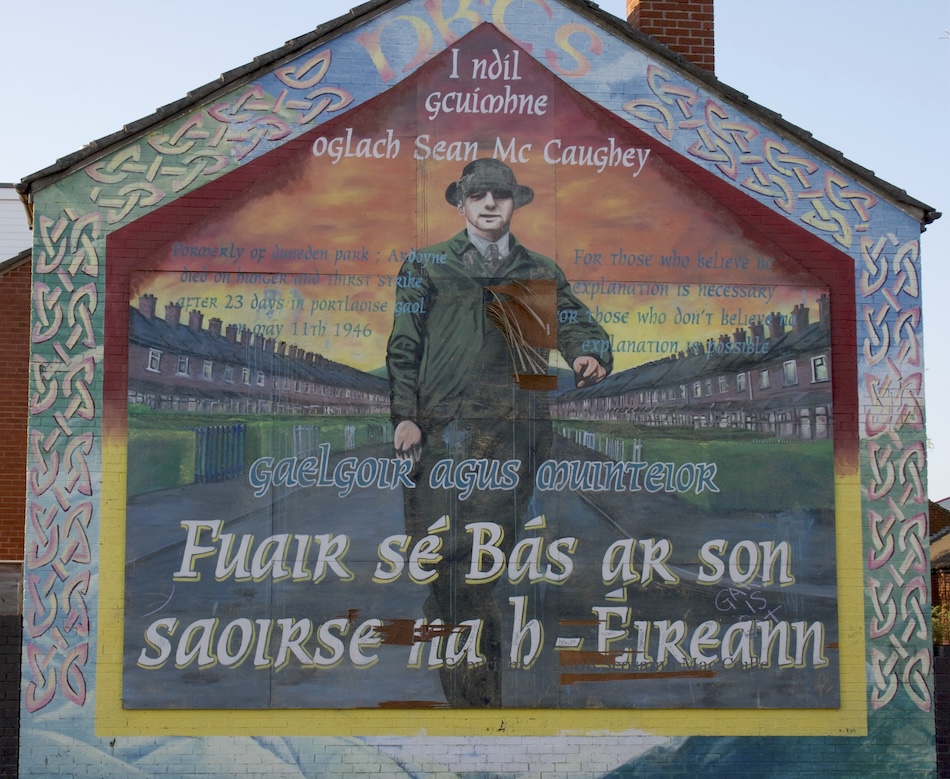
“I ndıl gcuımhne oglach [sic] Sean McCaughey, Gaelgoır [sic] agus muınteıor [sic] [Irish-speaker and teacher]. Fuaır sé bás ar son saoırse na hÉıreann.” “Formerly of Duneden Park, Ardoyne. Died on hunger and thirst strike after 23 days in Portlaoise gaol on May 11th 1946.” “For those who believe no explanation is necessary; for those who don’t believe no explanation is possible.”

McCaughey was convicted of kidnapping and torturing IRA chief of staff Sean Hayes, who was suspected of treason. His hunger and thirst strike was preceded by five years on the blanket.

“NBCS” = North Belfast Cultural Society.

Click image to enlarge
Copyright © 2008 Seosamh Mac Coılle
X00247

Remember The Hunger Strike

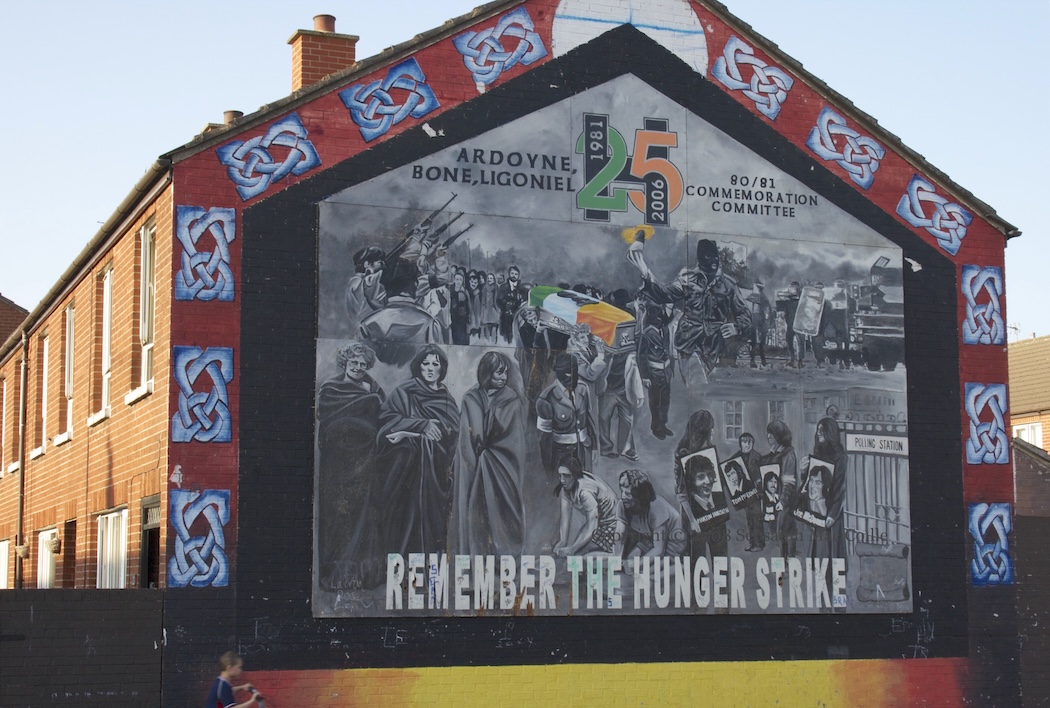
2006 was the 25th anniversary of the second hunger strike, in 1981. This Ardoyne commemorative piece combines a painted border of Celtic knotwork with boards depicting scenes from 1981: a funeral volley, Derry women in blankets, women banging binlids, a masked protester throwing a Molotov cocktail at an armoured jeep, marchers outside a polling station.

Click image to enlarge
Copyright © 2008 Seosamh Mac Coılle
X00244

Ard Eoın Kickhams

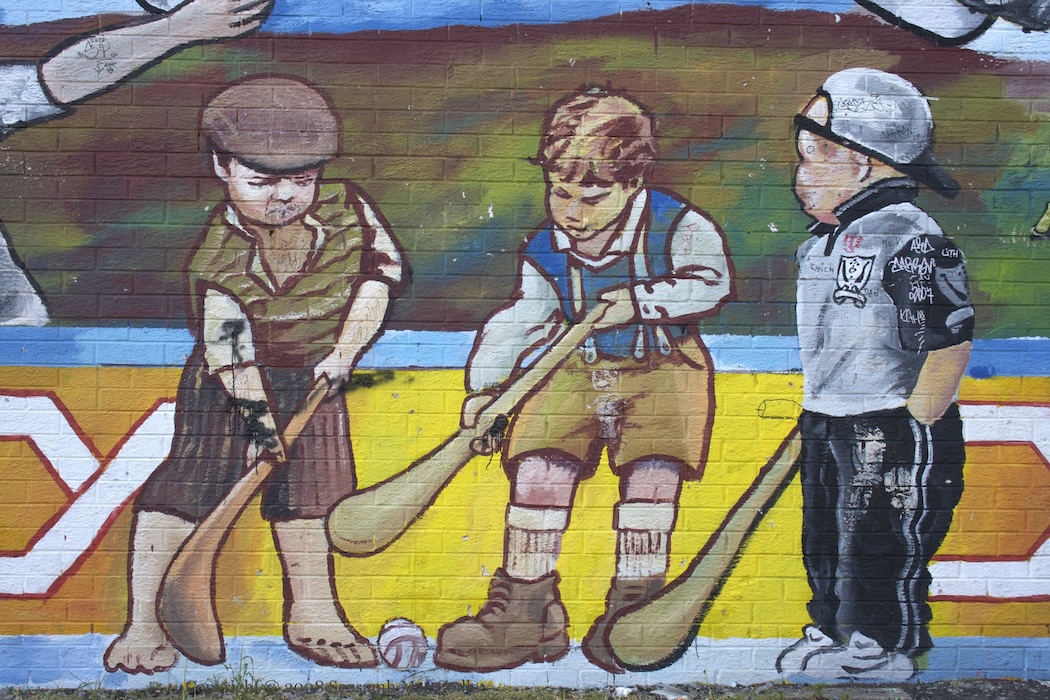
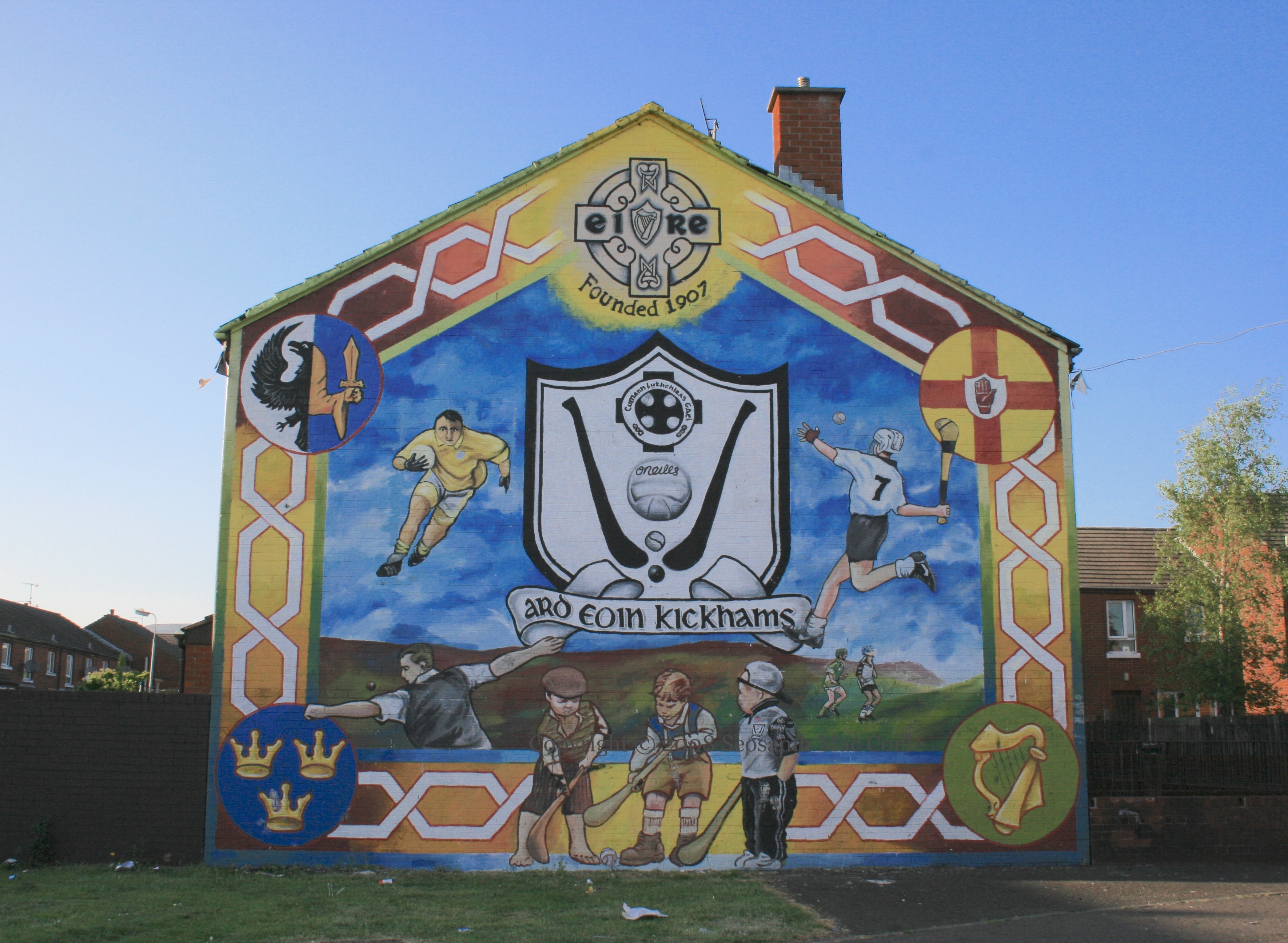
The close-up shows three generations of toddler hurlers, from barefoot and cloth-cap to boots and braces to baseball cap and tracksuit. Kickhams is the local Cumann Luthchleas Gael (GAA club) (Fbtw), founded 1907, named for republican writer Charles Kickham. The mural shows football, hurling, and handball.

Click image to enlarge
Copyright © 2008 Seosamh Mac Coılle
X00246 X00245

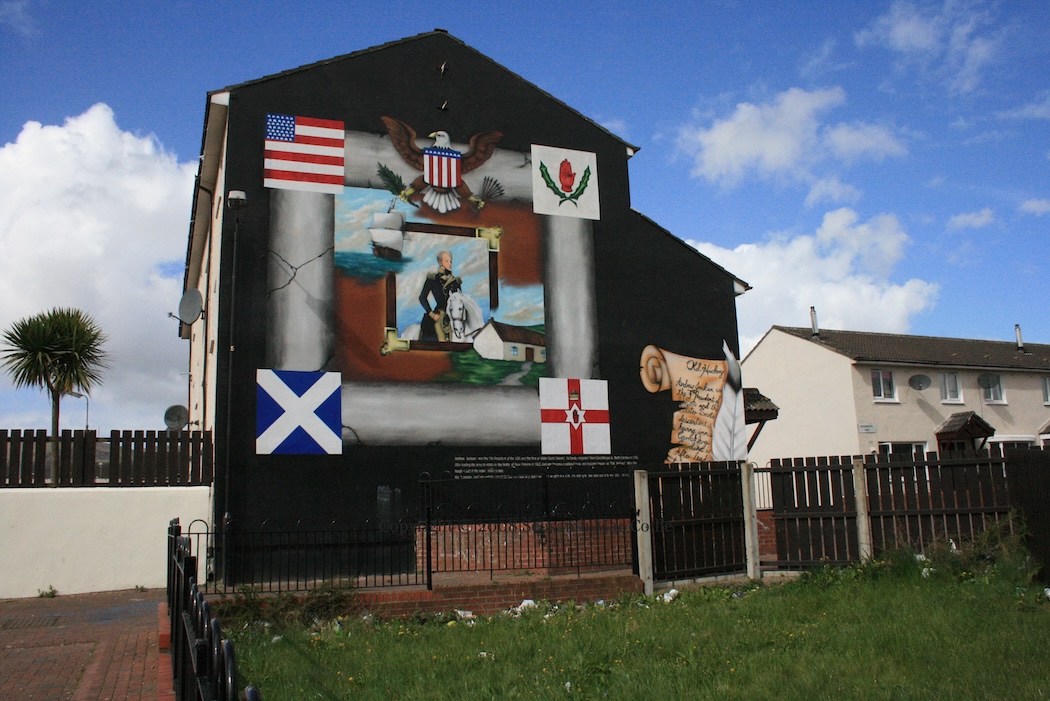
Andrew Jackson

“Andrew Jackson was the 7th President of the USA and the first of Ulster-Scots descent, his family emigrated from Carrickfergus to North Carolina in 1765. After leading the army to victory in the Battle Of New Orleans in 1815 Jackson became a national hero and became known as “Old Hickory” after the tough wood of the native American tree. His “common man” credentials earned Jackson a massive popular vote and swept him into the Presidency for two consecutive terms (1829-1837).” He also hated the British, owned slaves, and signed the Indian Removal Act of 1830, which led to the infamous “Trail of Tears” (Irish Times).

See also the Visual History page on Ulster-Scots murals.

Click image to enlarge
Copyright © 2008 Seosamh Mac Coılle
X00285