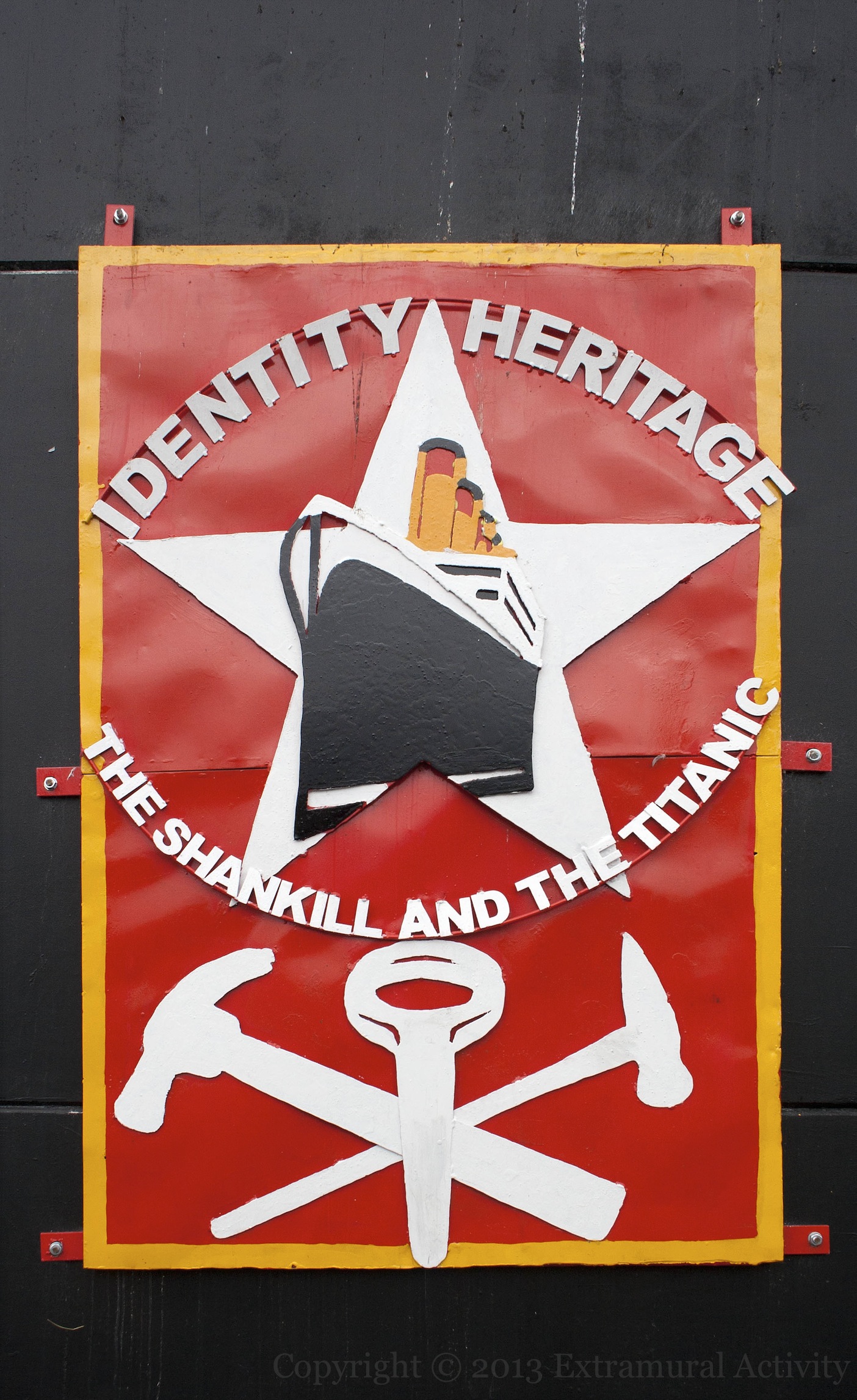
Another colourful piece of metalwork on the Cupar Way “peace” line, celebrating the construction of the Titanic at Harland & Wolff shipyard.
Click image to enlarge
Copyright © 2013 Seosamh Mac Coılle
X01289
Another colourful piece of metalwork on the Cupar Way “peace” line, celebrating the construction of the Titanic at Harland & Wolff shipyard.
Click image to enlarge
Copyright © 2013 Seosamh Mac Coılle
X01289
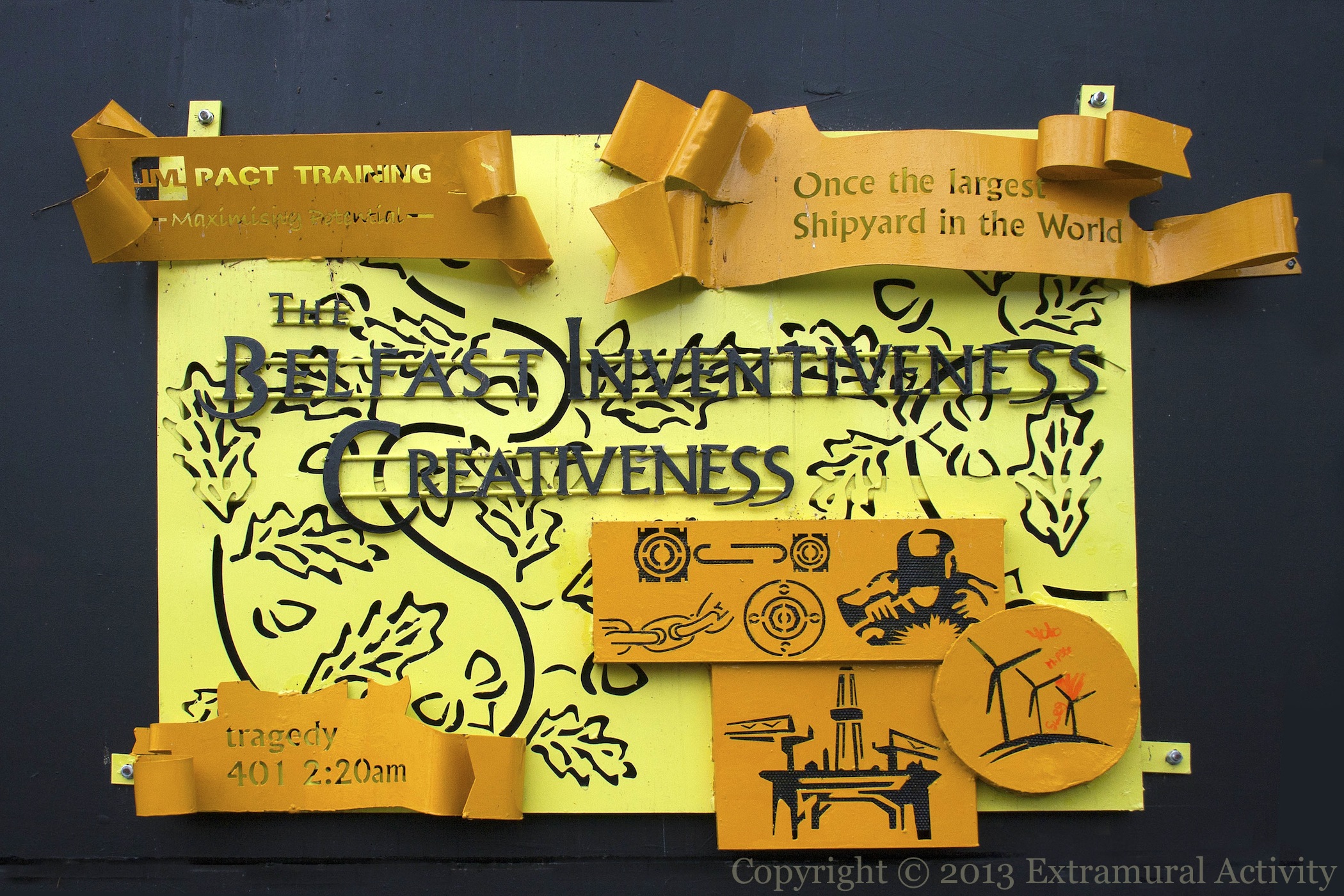
Titanic was hull number “401” at Harland & Wolff, and, after hitting an iceberg at 11:40 p.m. on April 14th, 1912, sank at 2:20 a.m. (WP). Above is another (see also Hope Lost, Identity) metal-work piece on the Cupar Way “peace” line, with images of a boat dock, solderers, and wind turbines.
Click image to enlarge
Copyright © 2013 Seosamh Mac Coılle
X01286 creativeness impact training maximising potential once the largest shipyard in the world creativeness tragedy 401 2:20 am
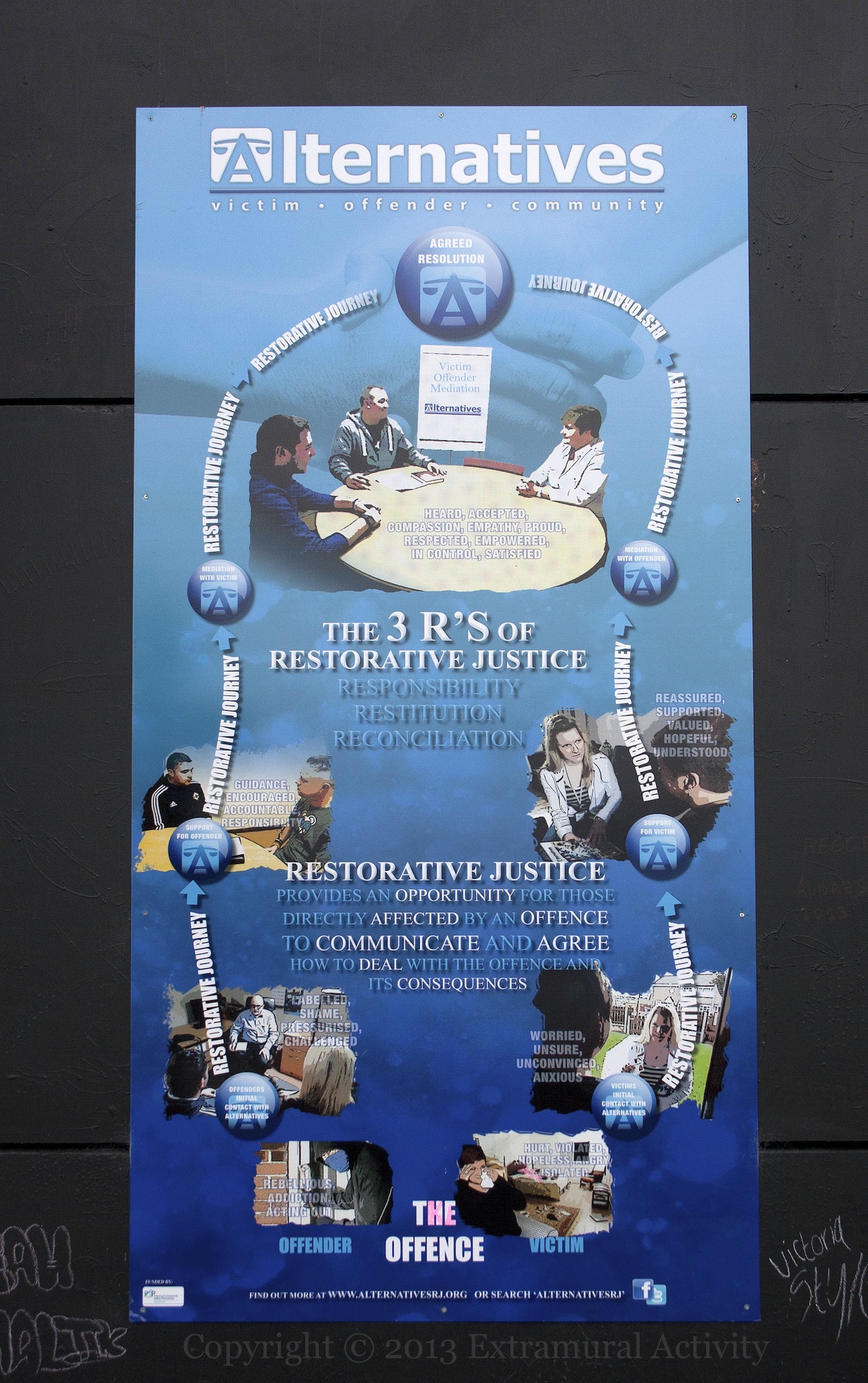
Above is another ‘Alternatives‘ board, on Cupar Way, encouraging reconciliation between victims and offenders (alternativesrj.org).
Click image to enlarge
Copyright © 2013 Seosamh Mac Coılle
X01284 the offence offender victim restorative journey agree resolution responsibility restitution reconciliation provides an opportunity for those directly affected by an offence to communicate and agree how to deal with the offence and its consequences alternatives mediation heard accepted compassion empathy proud respected empowered in control satisfied
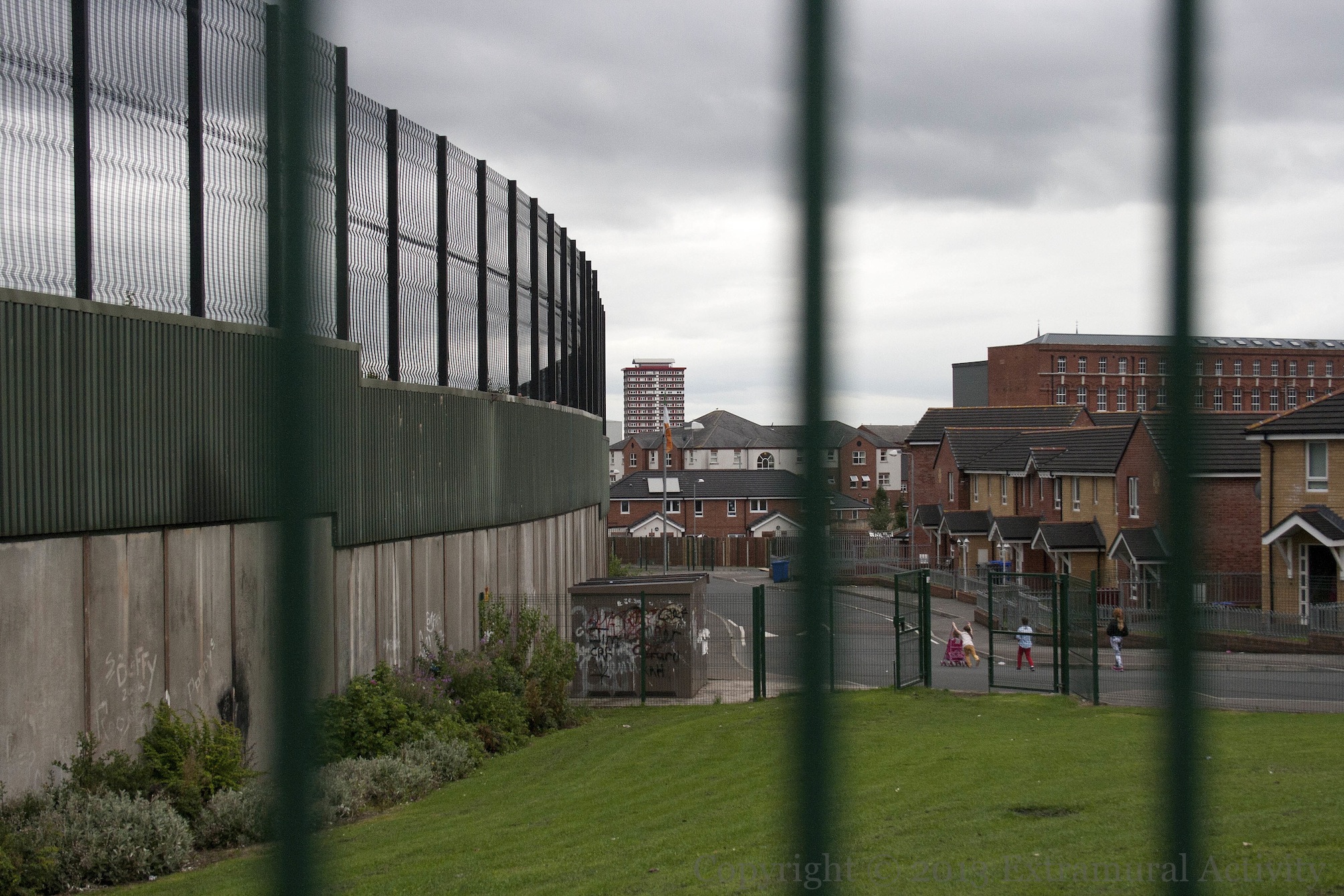
Previously we featured an image from the north (loyalist) side of the Cupar Way “peace” line, a.k.a. “war wall” or “wall of hostility” – the wall/fence separating neighbourhoods along the Shankill from those along the Falls. Here are two shots from the south (republican) side of the line, in Bombay Street. Divis tower is visible in the distance in the first. The second, below, shows the additional fencing that covers the backs of some houses.
More information about the west Belfast war wall is included in the Visual History page State Art Vs Graffiti On The West Belfast “Peace” Line.
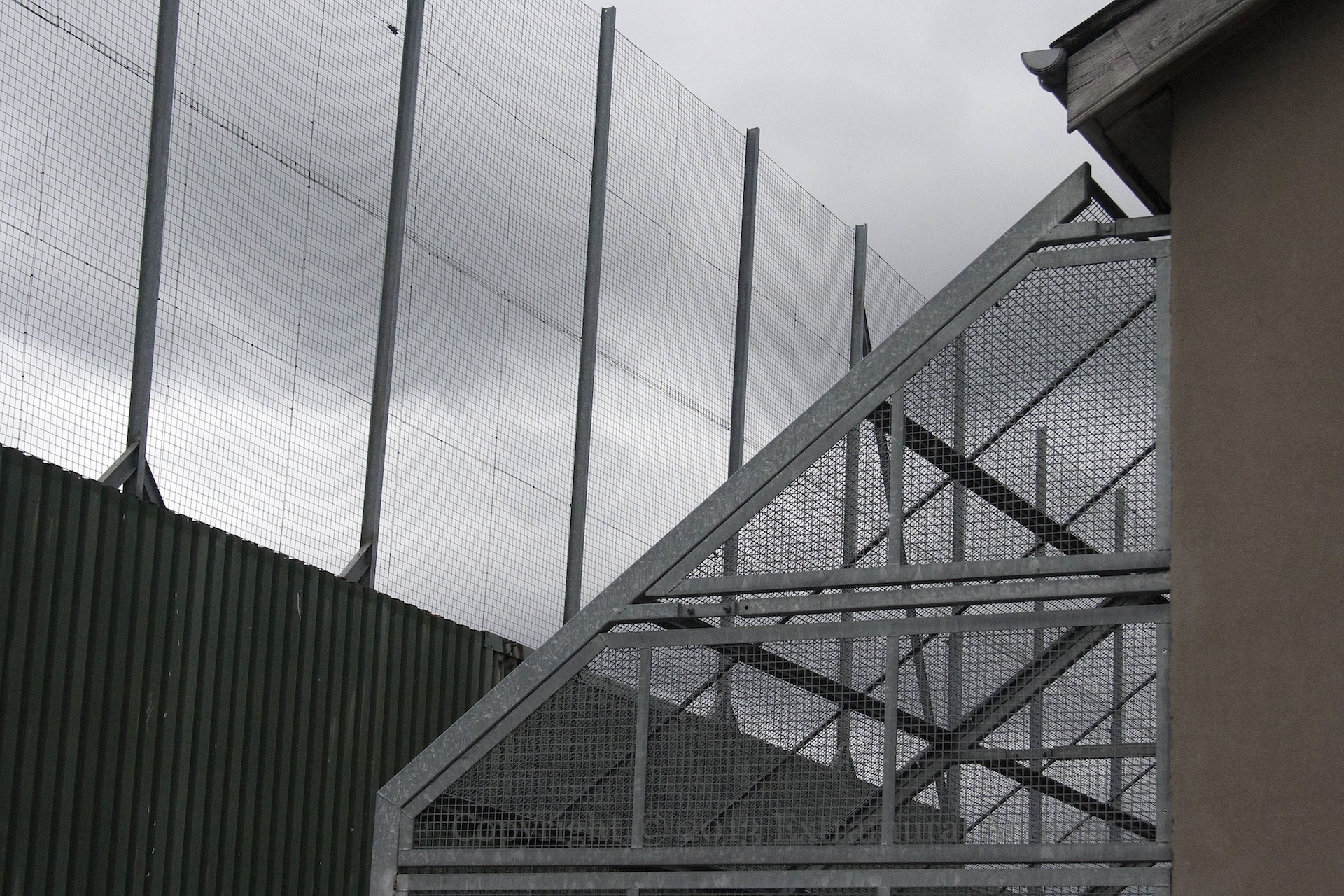
Click image to enlarge
Copyright © 2013 Seosamh Mac Coılle
X01285 X01273
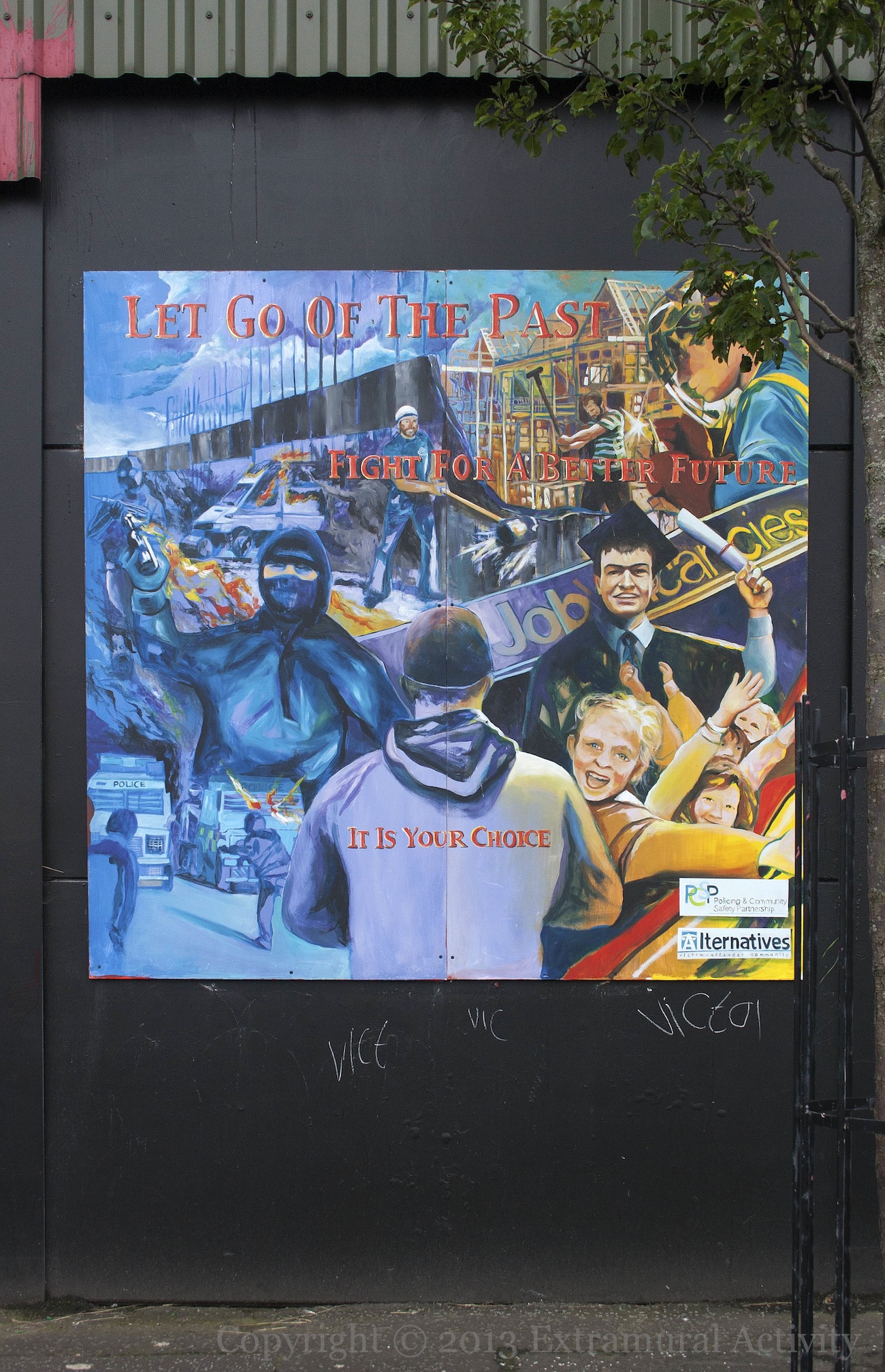
Board on the Cupar Way side of the “peace” line showing, on the left hand side, rioters with petrol bombs attacking the police, the “peace” line, and a burning vehicle, and, on the right, construction workers, university graduates, and happy children. “Fight for a better future. It is your choice.” For more information, see Daniela Balmaverde.
Click image to enlarge
Copyright © 2013 Seosamh Mac Coılle
X01283
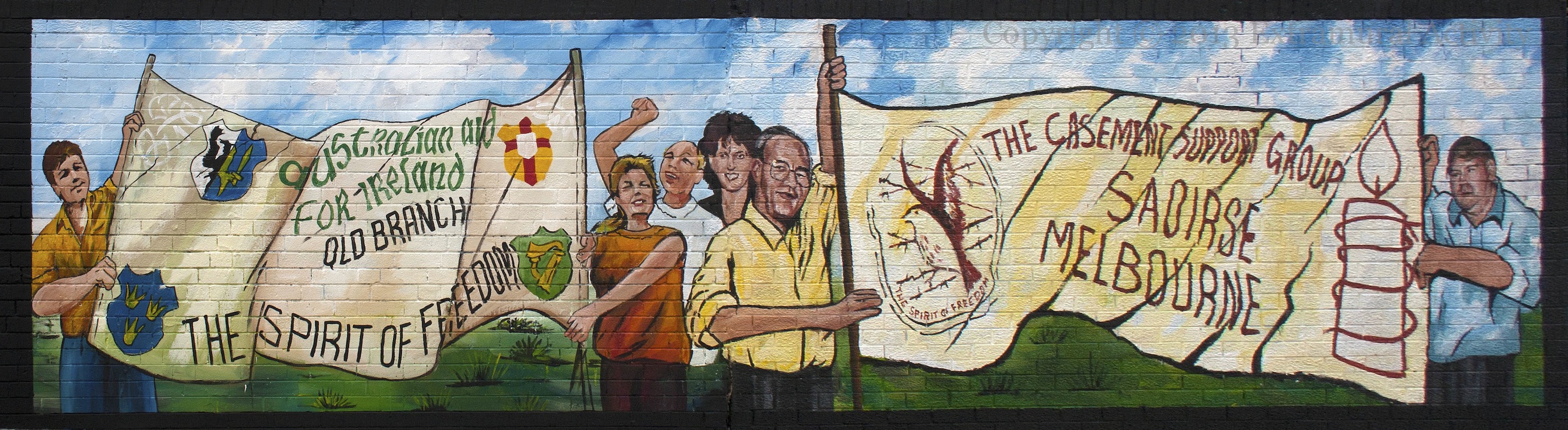
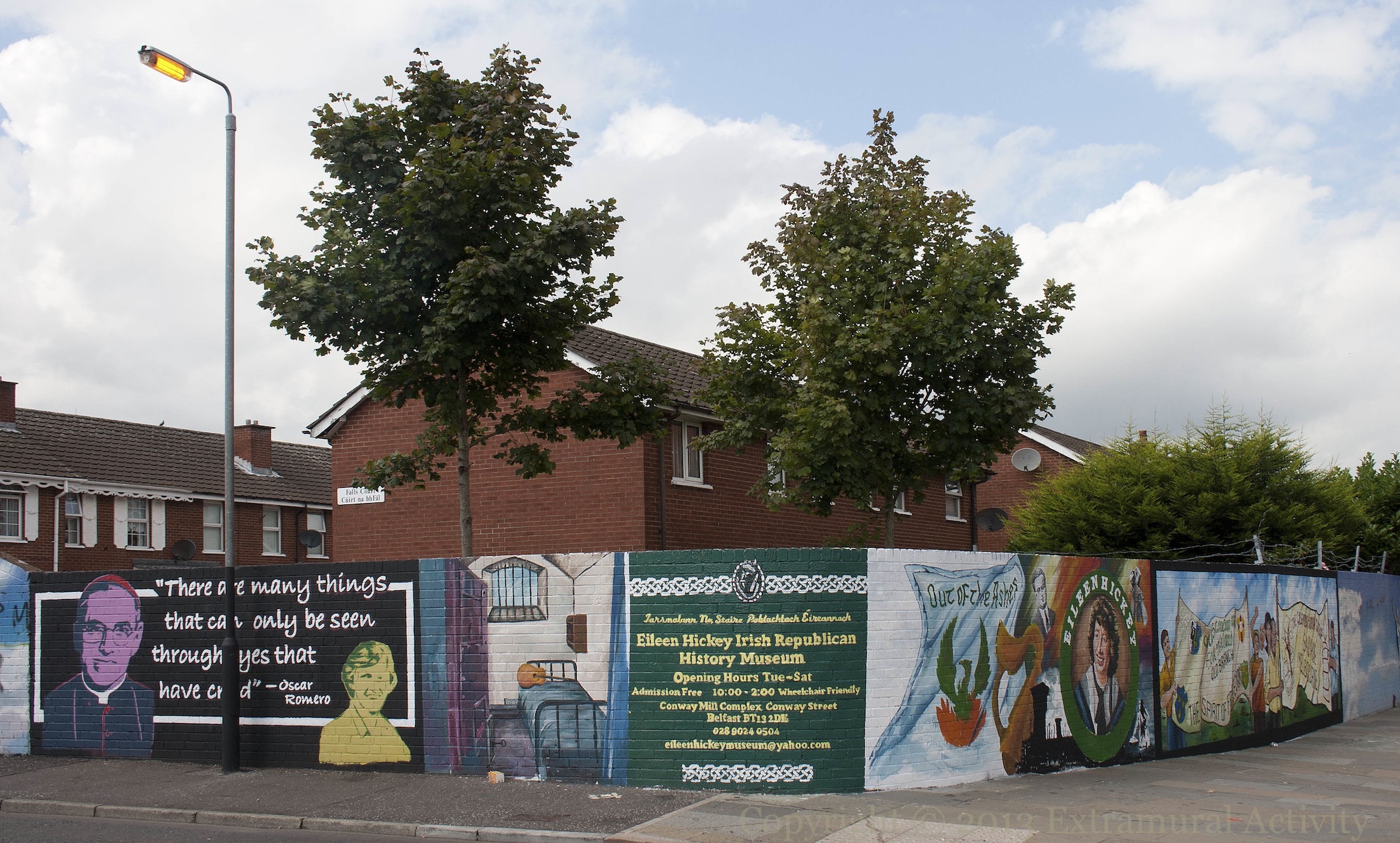
Above is an extra-wide shot (2700 pixels) of another panel from the wall next to the Republican Museum on Conway Street (next to the previously featured Eileen Hickey). The mural features banners of two Australian Republican support-groups, holding banners reading “Australian Aid for Ireland QLD [Queensland] Branch – The Spirit of Freedom” and “The Casement Support Group – Saoirse Melbourne”.
Click image to enlarge
Copyright © 2013 Seosamh Mac Coılle
X01281 lark, fuiseog, old branch hunger strike amnesty
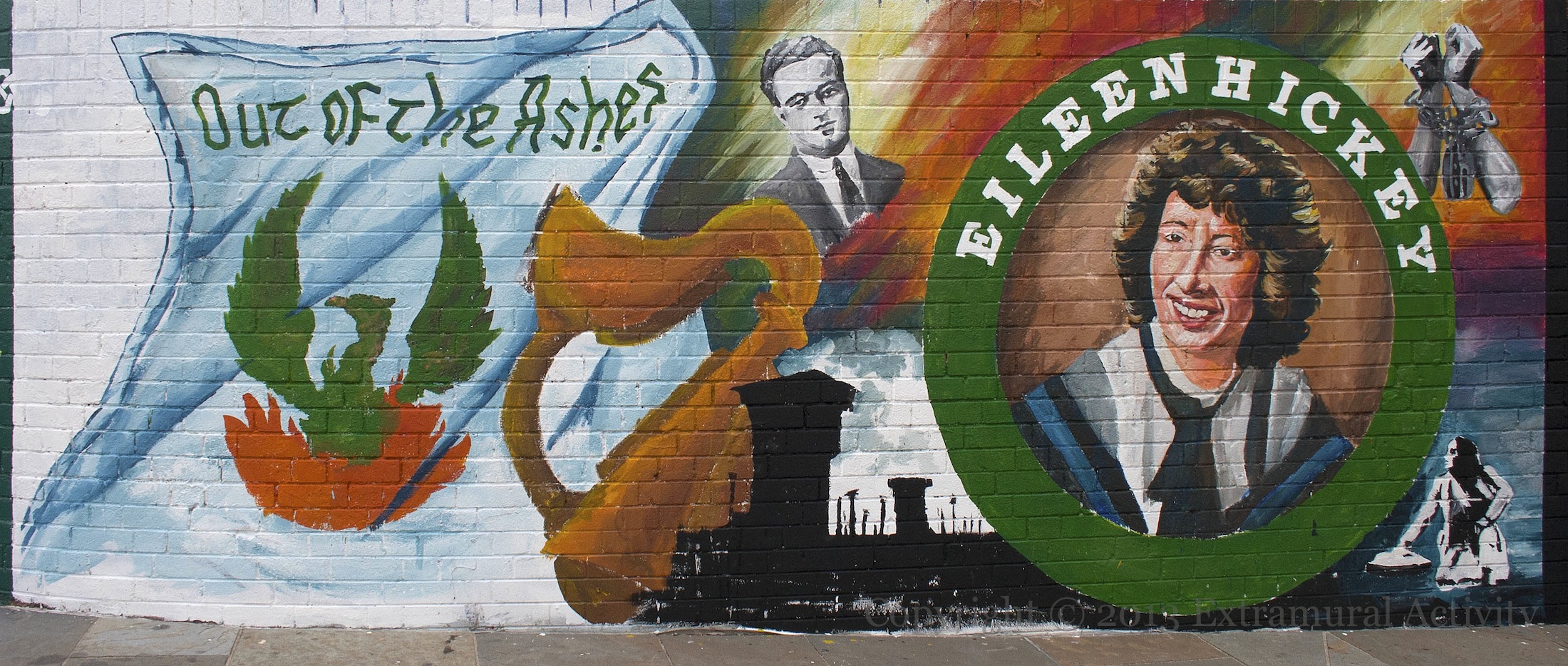
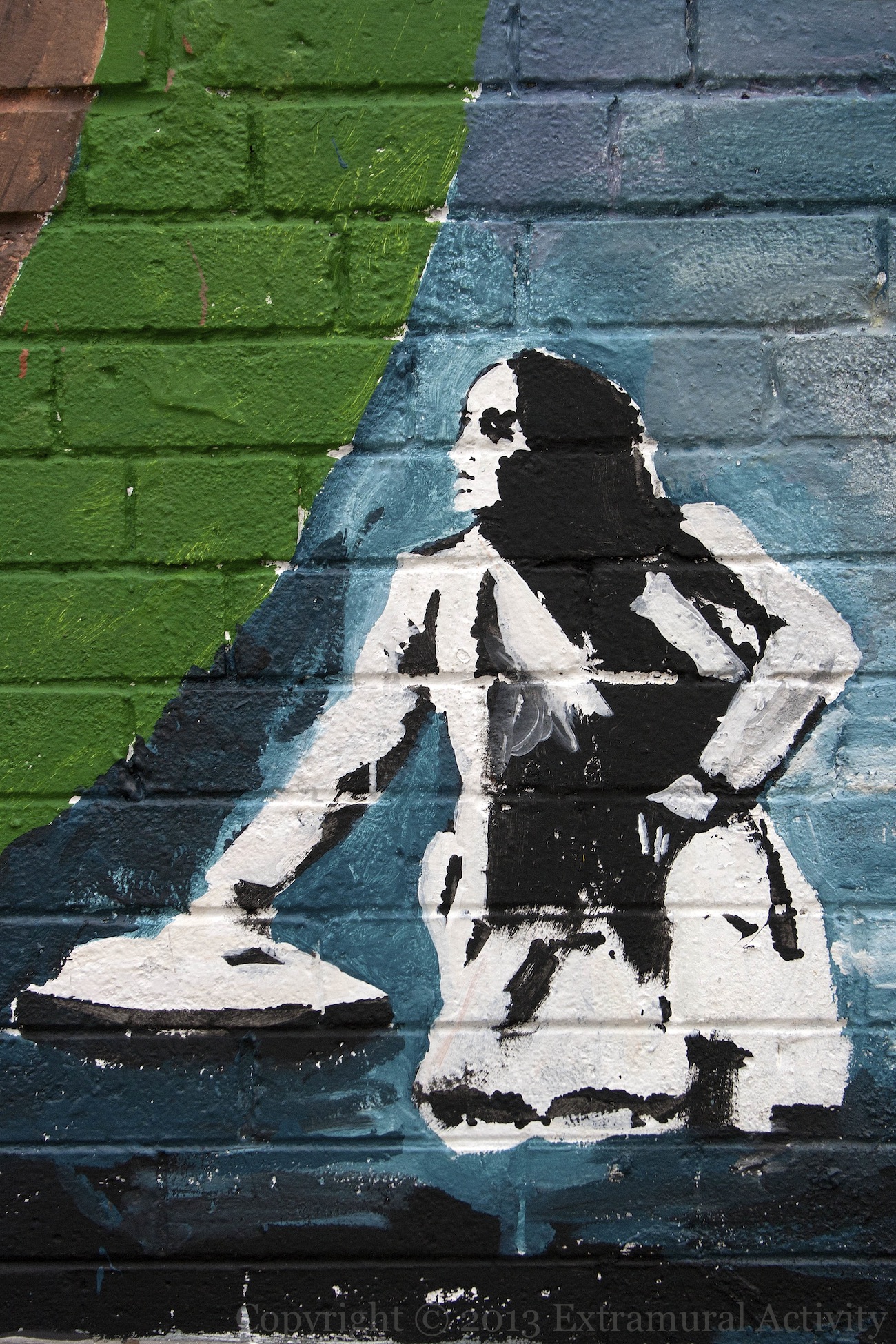
The ‘Eileen Hickey Irish Republican History Museum‘ — which is across the street behind the Conway Mill — is named for Eileen Hickey, a Provisional IRA member who served time in Armagh prison; she died in 2006, one year before the opening of the museum (obituary at An Phoblacht). A close-up of the woman with a bin lid, in the lower right-hand corner, can be found below.
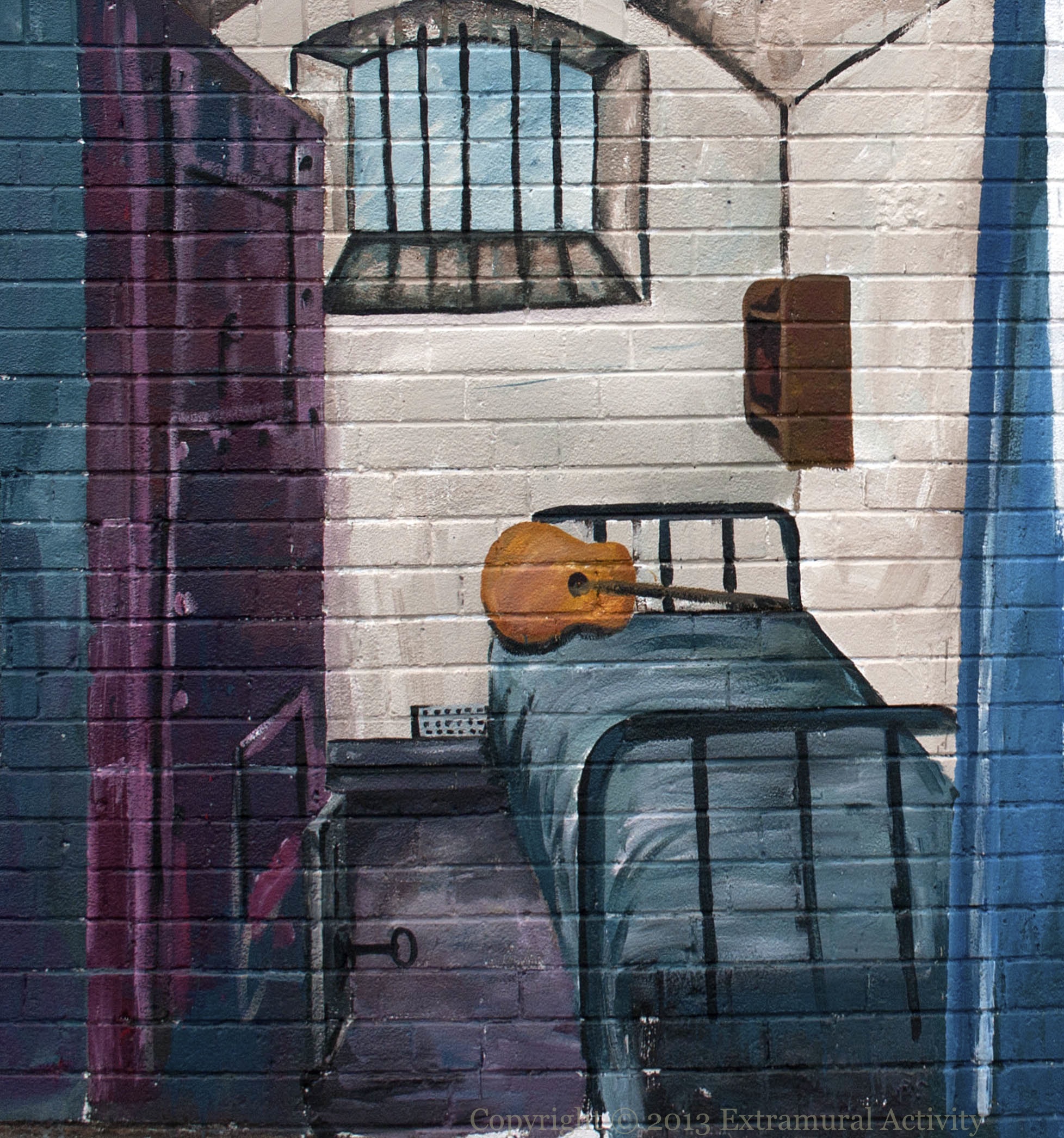
Next to the opening hours is an image of a prison cell in the Armagh women’s prison. The museum itself contains a cell door and a bed from the prison.
For the Oscar Romero mural in the wide shot, see Eyes That Have Cried. On the right is Australian Aid.

Click image to enlarge
Copyright © 2013 Seosamh Mac Coılle
X01282 X01275 X00635 X01274
T01619 (courtesy of Paddy Duffy 2023)
Conway Link/Street out of the ashes, harp, maze long kesh
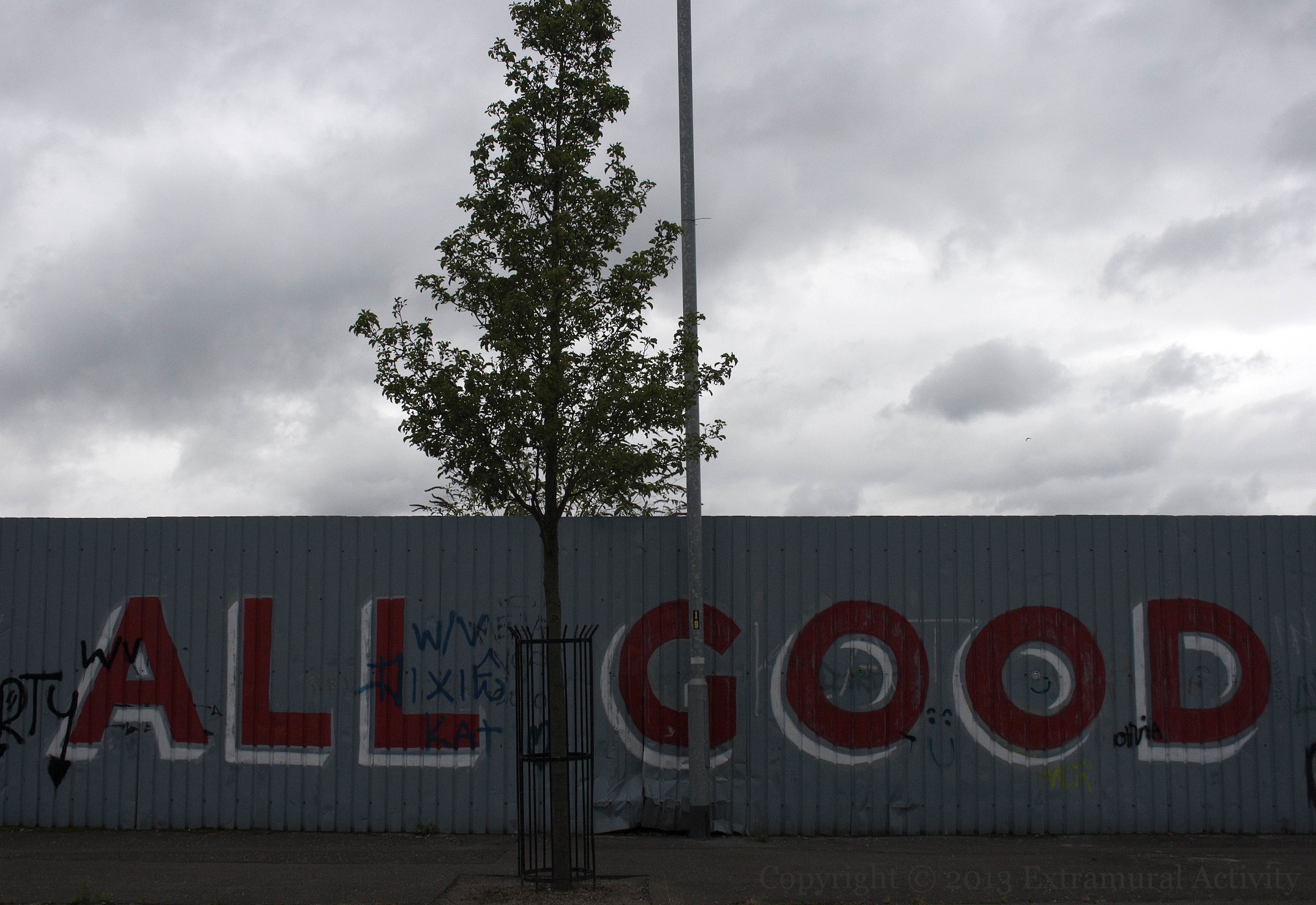
“(It’s) All Good” on the north side of Cupar Way, near the Howard Street gate. Painted by Dublin street artist Maser (web).
Click image to enlarge|
Copyright © 2013 Seosamh Mac Coılle
X01276
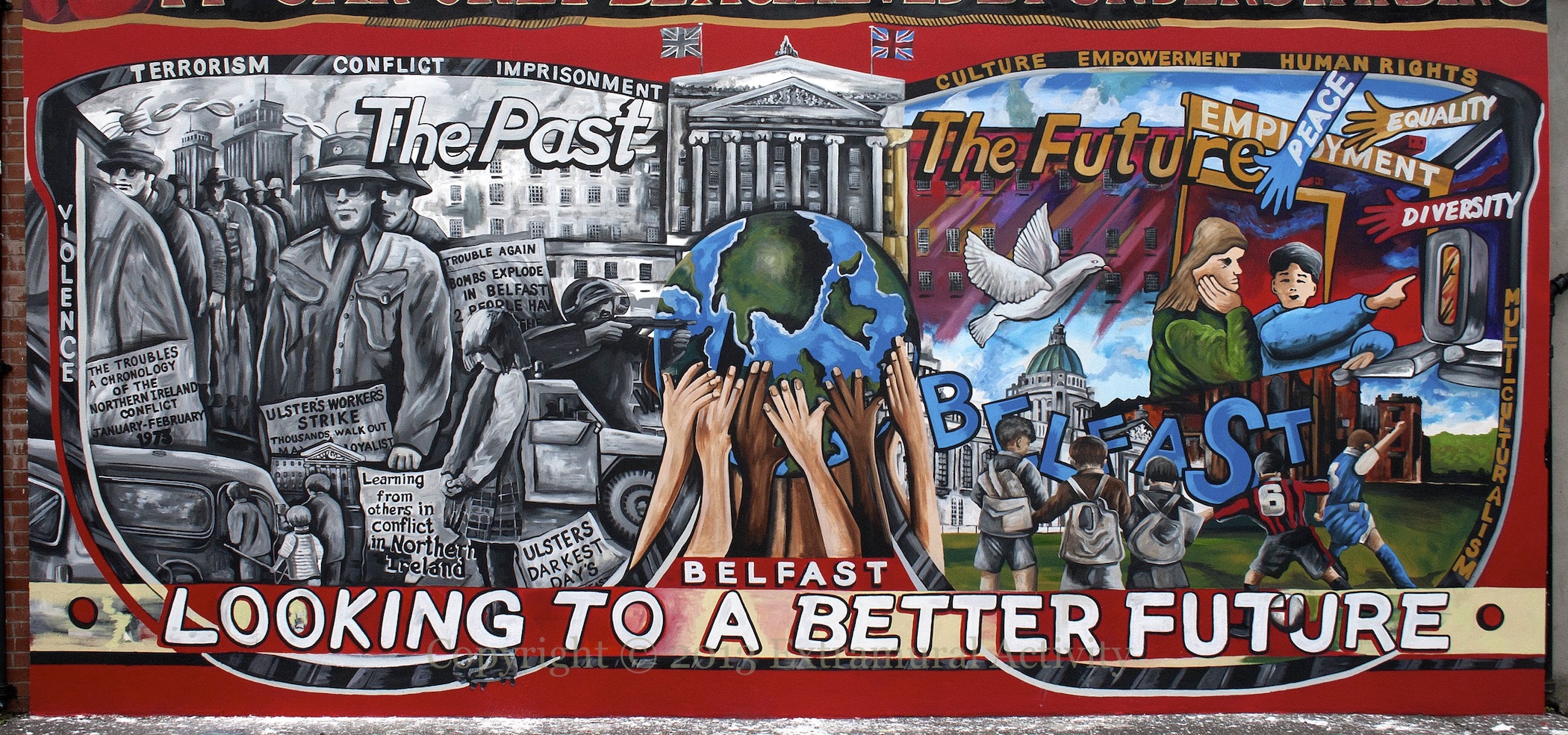
In this new east Belfast mural, we move from a part of “violence – terrorism – conflict – imprisonment’ to a future of ‘culture – empowerment – human rights – multiculturalism’. The mural is black-and-white on one side and colour on the other. On the left we have watchtowers and paramilitaries in hats and sunglasses; on the right schoolchildren in front of city hall, working on a computer and playing football.
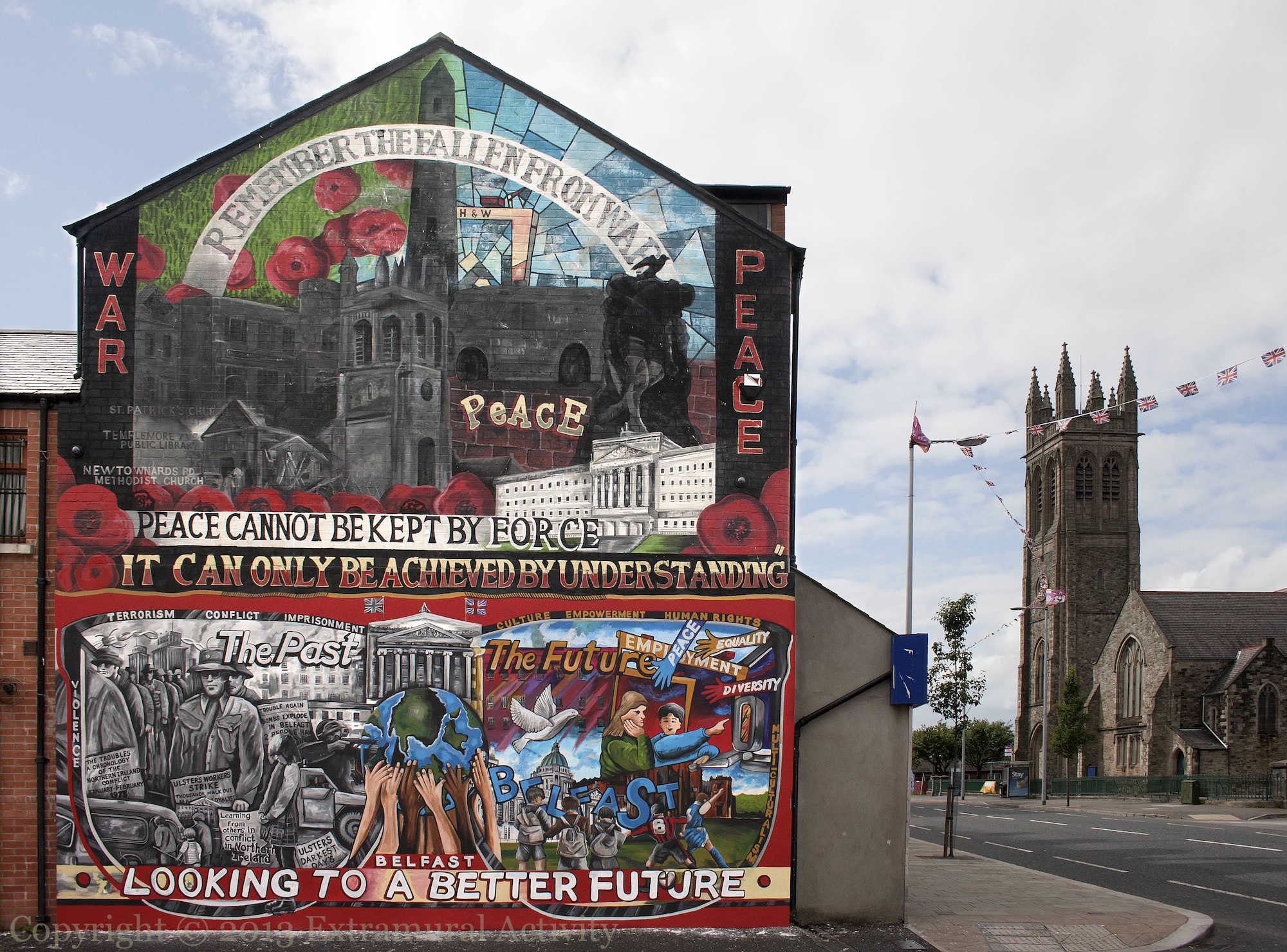
The mural was defaced immediately after it was finished (roughly the end of July), indicating dissatisfaction with the current direction of ‘the future’, but quickly repaired. There is a mural directly above this one. A wide shot of them both can be found below.
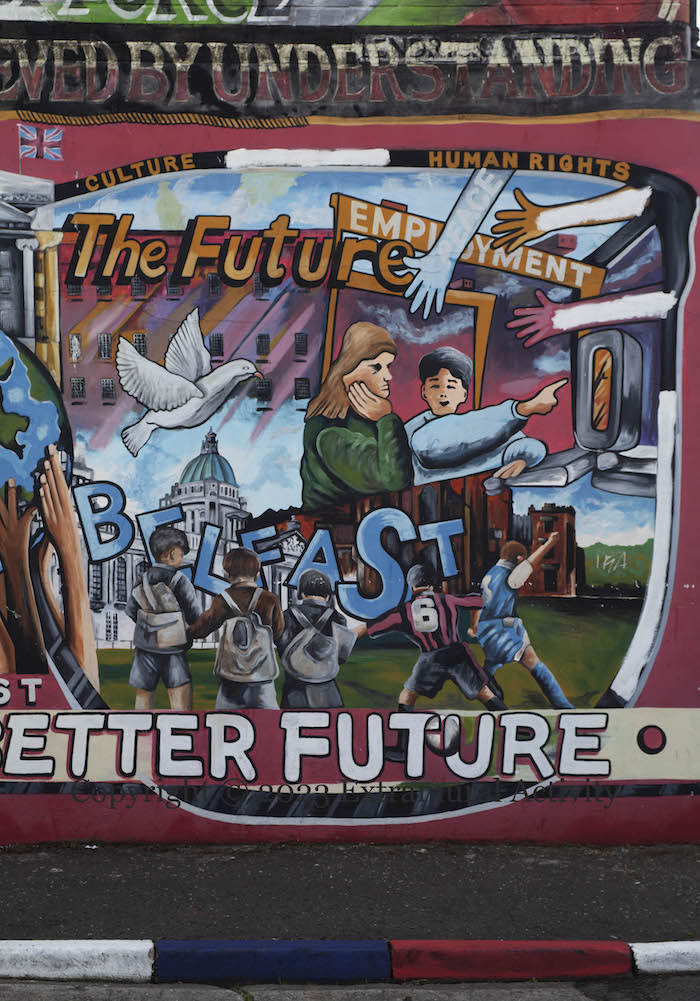
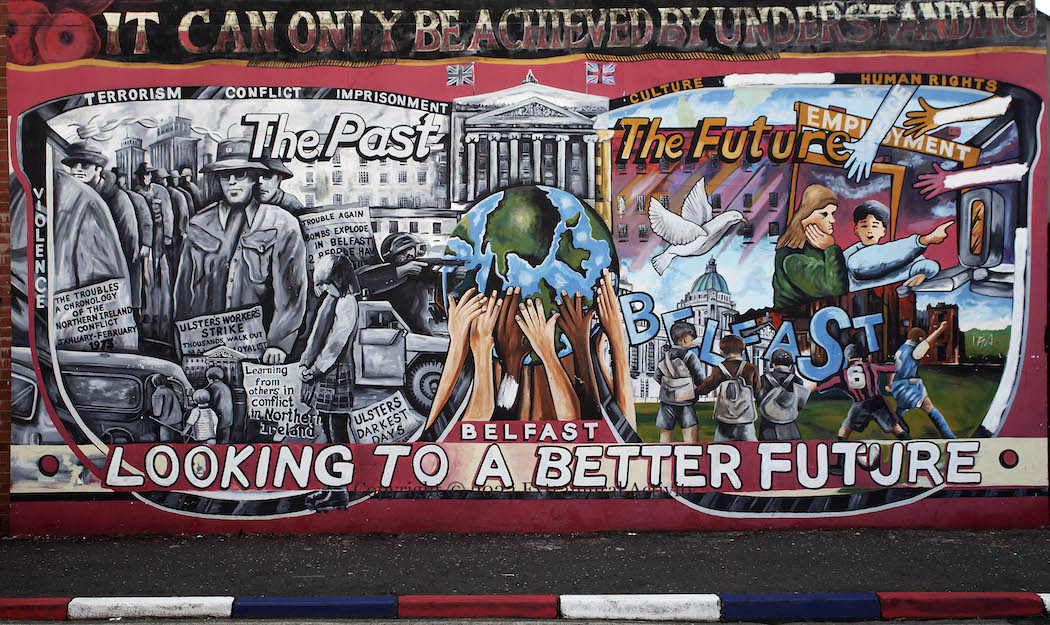
Update: Spring 2022 – some of the words on the colourful ‘future’ side of the mural have been painted over: “empowerment”, “equality”, “diversity”, “multiculturalism”. There is also a streak of white paint on the arm of a black person in the centre of the mural. See the final two images.
Click image to enlarge
Copyright © 2013/2022 Seosamh Mac Coılle
X01278 X01277 X14079 X14078 looking to a better future, learning from others in conflict in northern ireland ulsters darkest day’s days trouble again bombs explode the troubles a chronology of the northern ireland conflict january-february 1973 stormont earth globe john stewart BCC press release
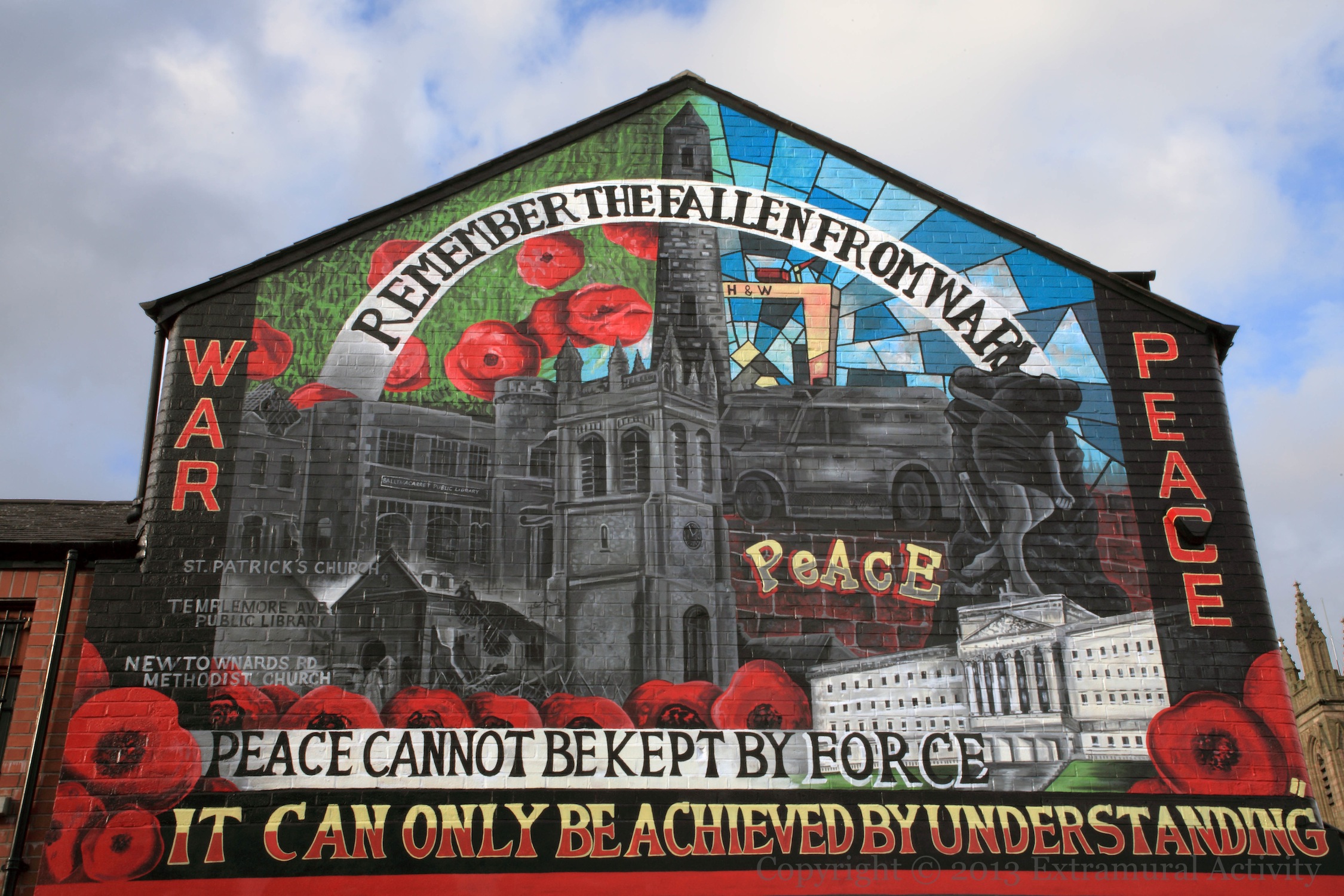
The mural above is on the Newtownards Road at Lendrick Street and shows a bombed-out Ballymacarrett library, St. Patrick’s church (the church itself is visible in the lower right-hand corner) – both were hit by the blitz in 1942 – a police land rover (perhaps representing the “fallen” during the Troubles), and Cuchulainn (perhaps representing the IRA, though Cuchulainn is also a UDA icon – see the bottom of the Visual History page on Cú Chulaınn), and Stormont (representing … peace???). Poppies in a field and a H&W crane against stained glass provide a background.
We are supposed to remember the dead because (perhaps) their deaths were unnecessary and misguided as means to peace, at least according to the saying along the bottom (sometimes attributed to Einstein): “Peace cannot be kept by force; it can only be achieved by understanding” – understanding of the Nazis during the blitz, it seems, and of loyalists and republicans during the Troubles. (If you have a better interpretation, please leave a comment.)
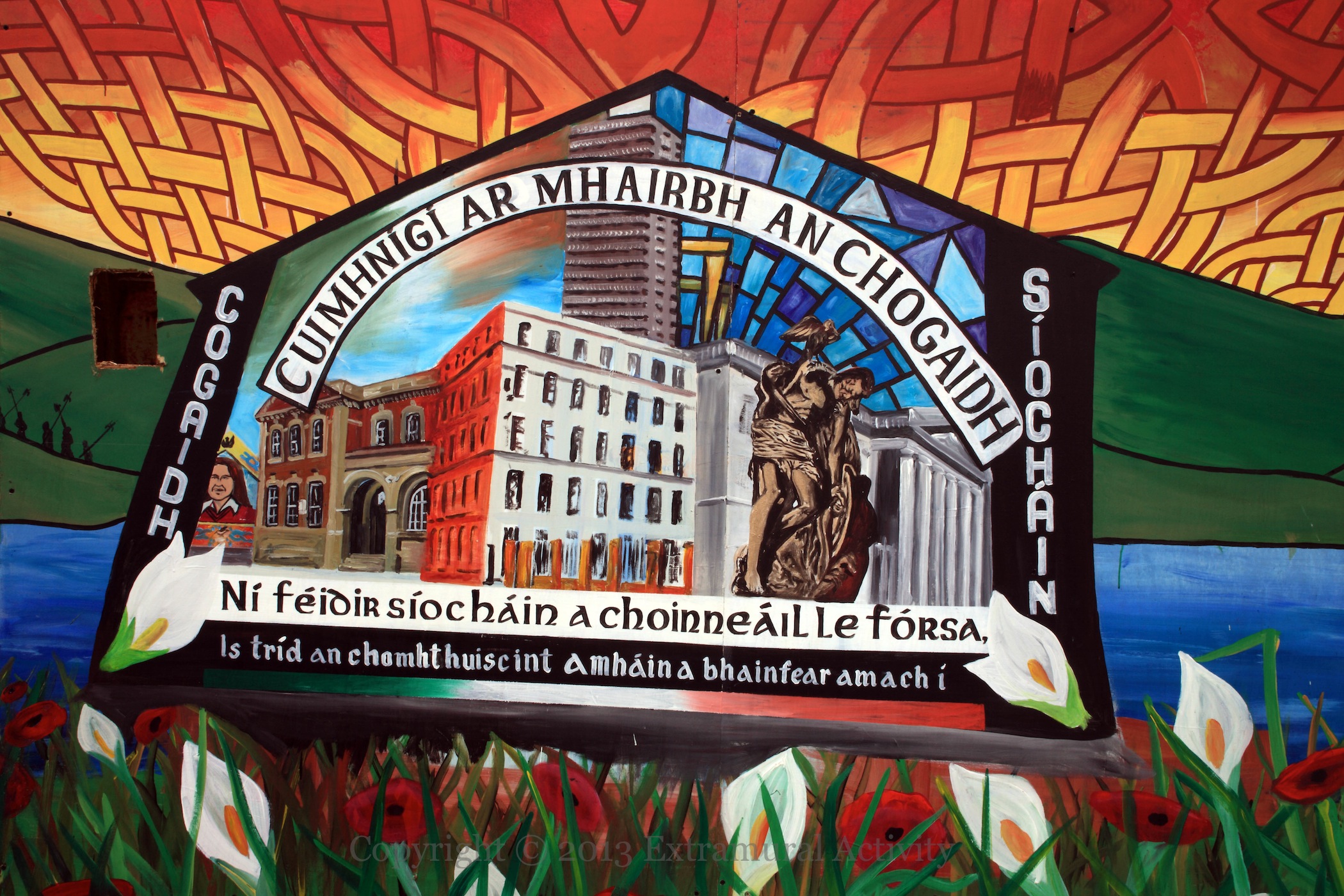
The mural was imitated on the hoarding around An Chultúrlann on the Falls Road during its renovation (shown below): the left hand side of the side was replaced with images of the Falls library and Bobby Sands mural and Divis tower, and Cú Chulaınn on the right was placed in front of the GPO, and the poppies were joined by lilies, and the words translated into Irish. The message here seems clearer, lamenting the CNR dead and calling for understanding of the CNR community (sc. by Britain and the Orange state) though the poppies below include the dead of WWI.
Click image to enlarge
Copyright © 2013 Seosamh Mac Coılle
X01280 X01279 war cogaıdh, peace síocháın, remember the fallen from war cuimhnígí ar mhairbh an chogaidh, peace cannot be kept by force ní féidır síocháın a choınneáıl le fórsa, it can only be achieved by understanding is tríd an chomhthuıscınt amháın a bhaınfear amach í
 Seosamh Mac Coille Collection