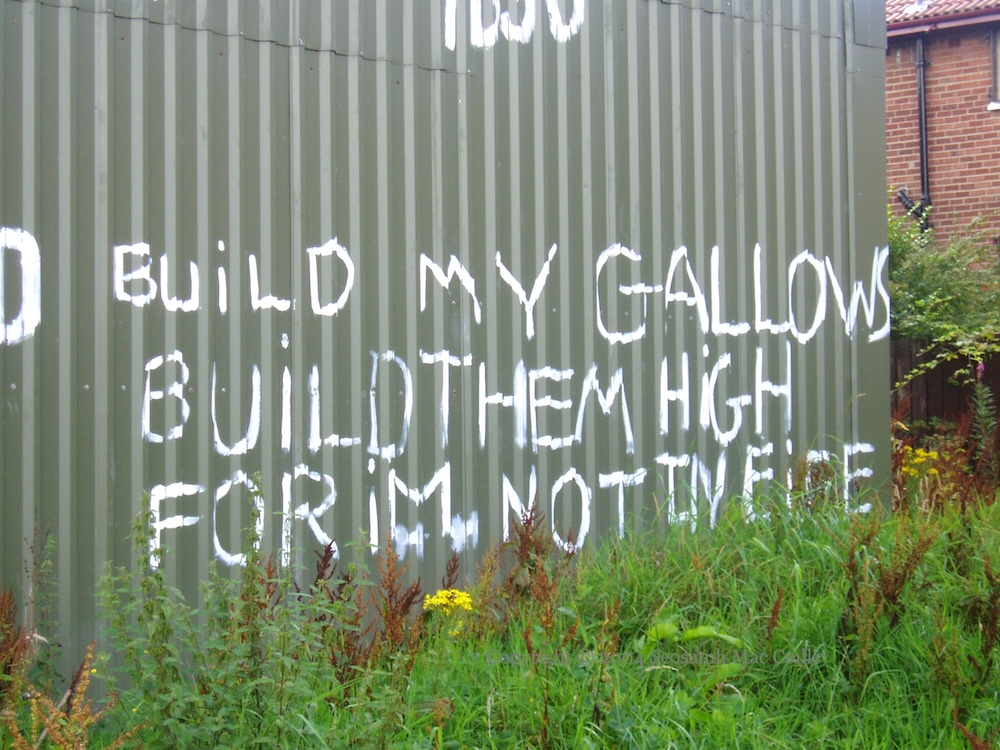
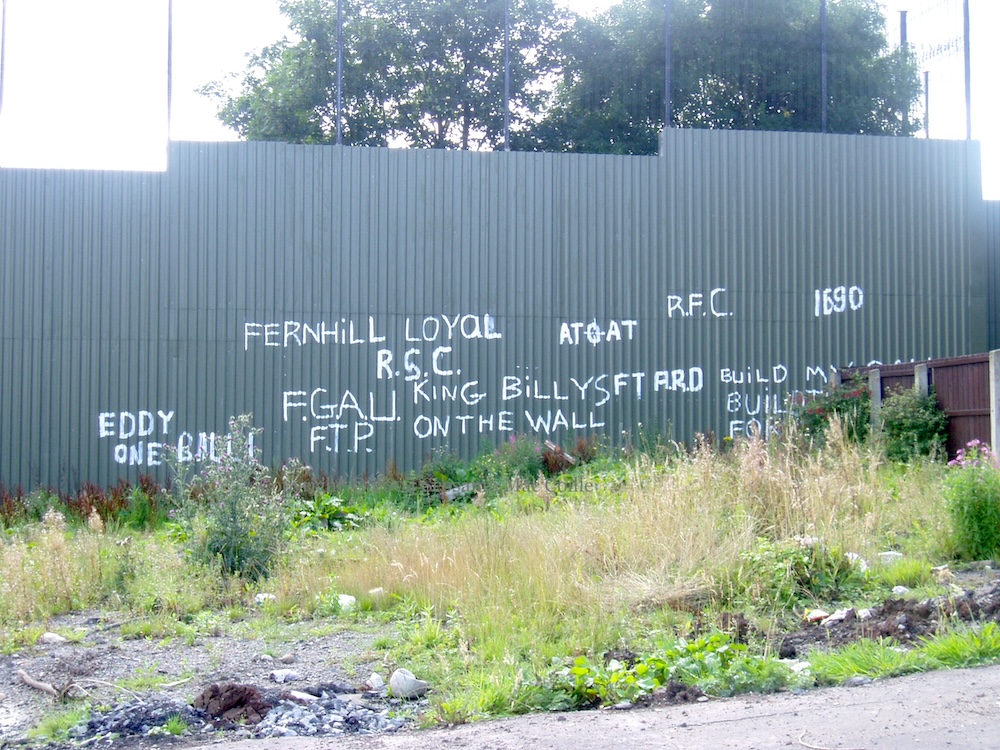
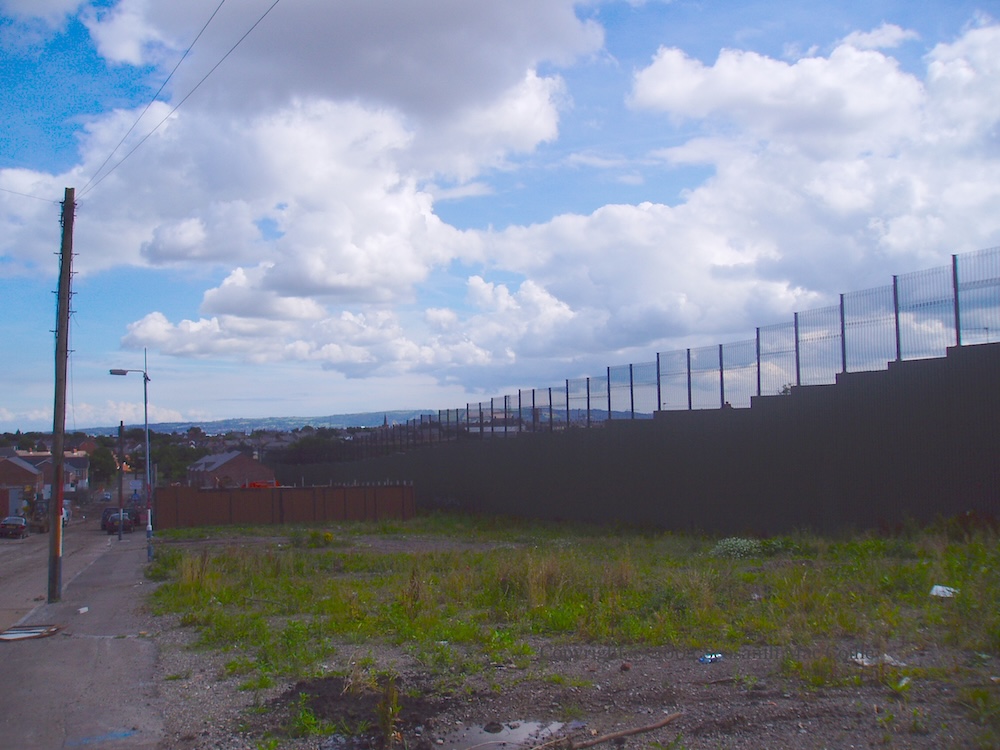
This is the scene as Glenbryn Park was being rebuilt. The “peace” line separates Protestant Glenbryn from Catholic Ardoyne. “Build My Gallows” is a Rangers football song, but the last line here is “Build my gallows, build them high … for I’m not in Eire”.
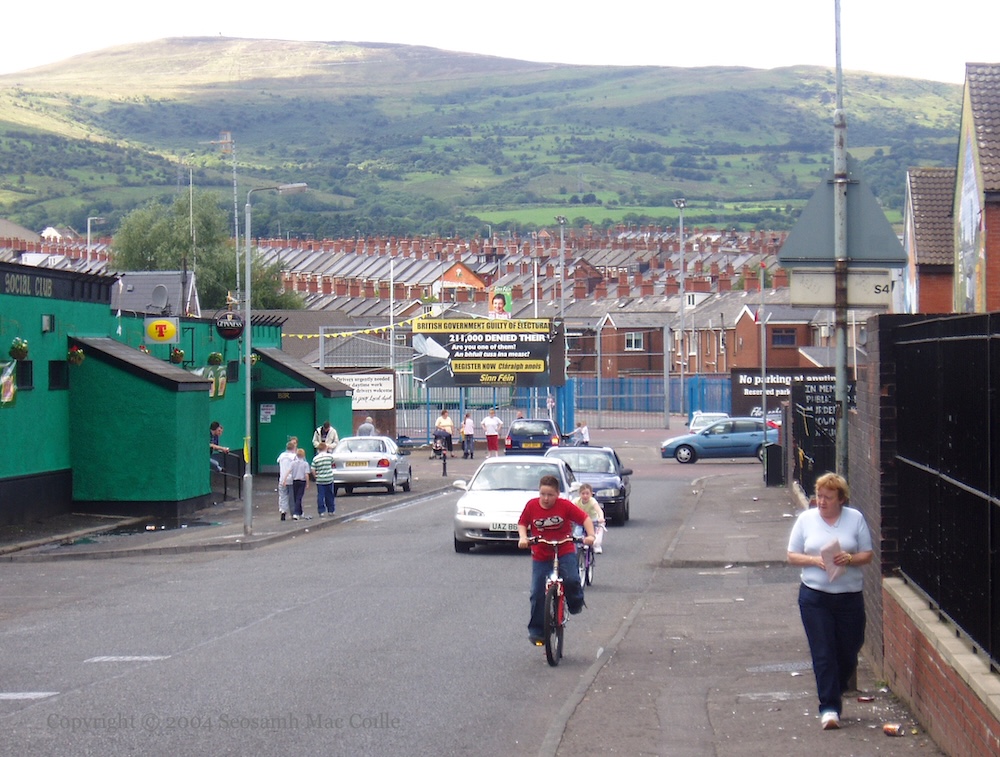
This is the scene in Ardoyne Avenue, looking west towards Berwick Avenue and Divis mountain. In the middle ground, Sınn Féın urge people to get on the electoral rolls: “British government guilty of electoral fraud. 211,000 denied their vote [see also in Linden St]. Are you one of them? An bhfuıl tusa ına measc? Register now. Cláraıgh anoıs. Sınn Féın.”
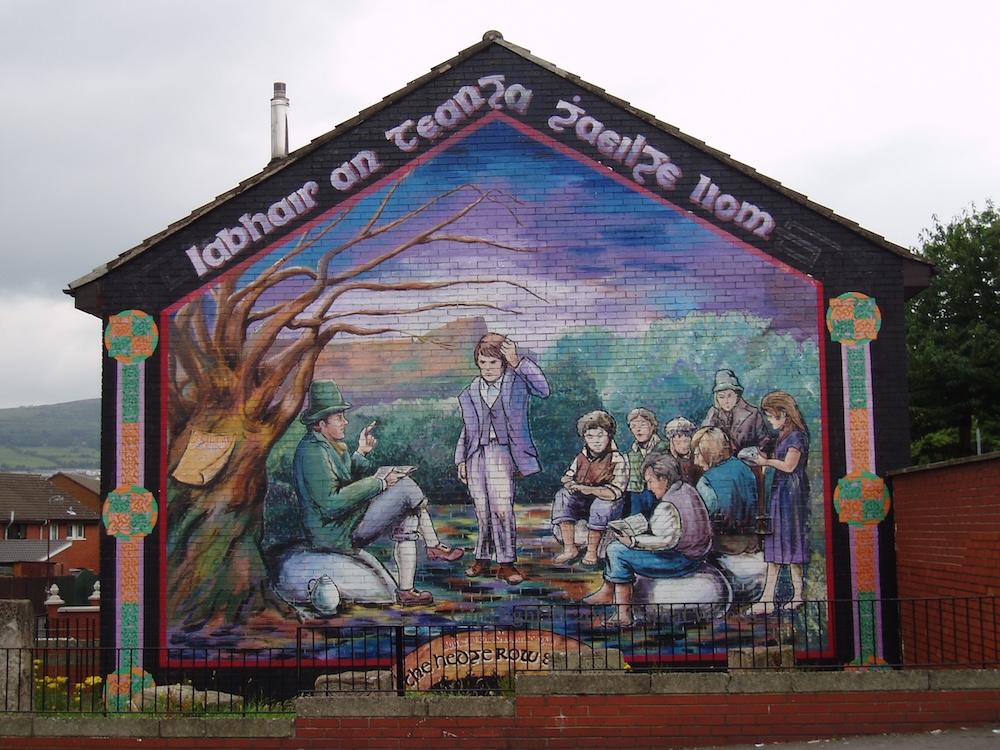
“Labhaır an teanga Ghaeılge lıom.” Catholic (and Presbyterian) education was prohibited by the penal laws (WP) and particularly the Education Act of 1695 (WP) – this is probably what’s on the notice on the left-hand tree. Schooling by Catholics (in Irish) nonetheless took place, in covert houses and outhouses, as well as in fields and hedge-rows. The Act was repealed in 1782, provided the teacher took an oath of allegiance to the Crown.
The mural is in Ardoyne Avenue, alongside the Mass Rock mural. See also the Cromwell mural in the lower Shankill estate.
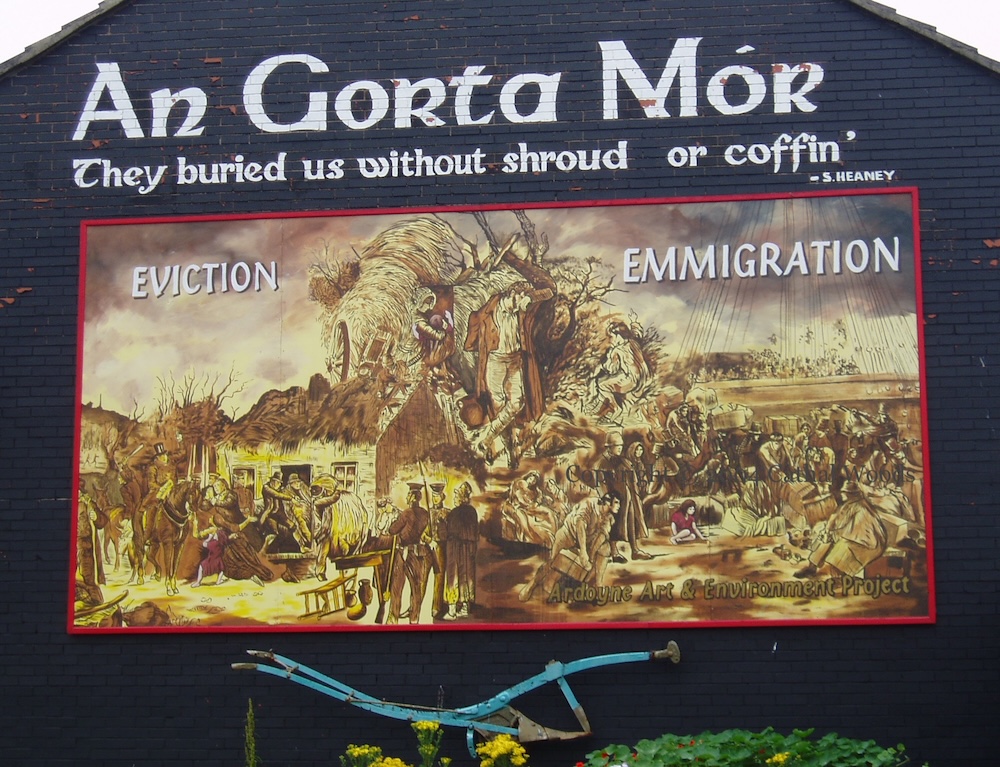
Board remembering An Gorta Mór, The Great Hunger, The Famine/Genocide (WP) with an (actual) old-fashioned plough in front. There is a Visual History page on The Great Hunger.
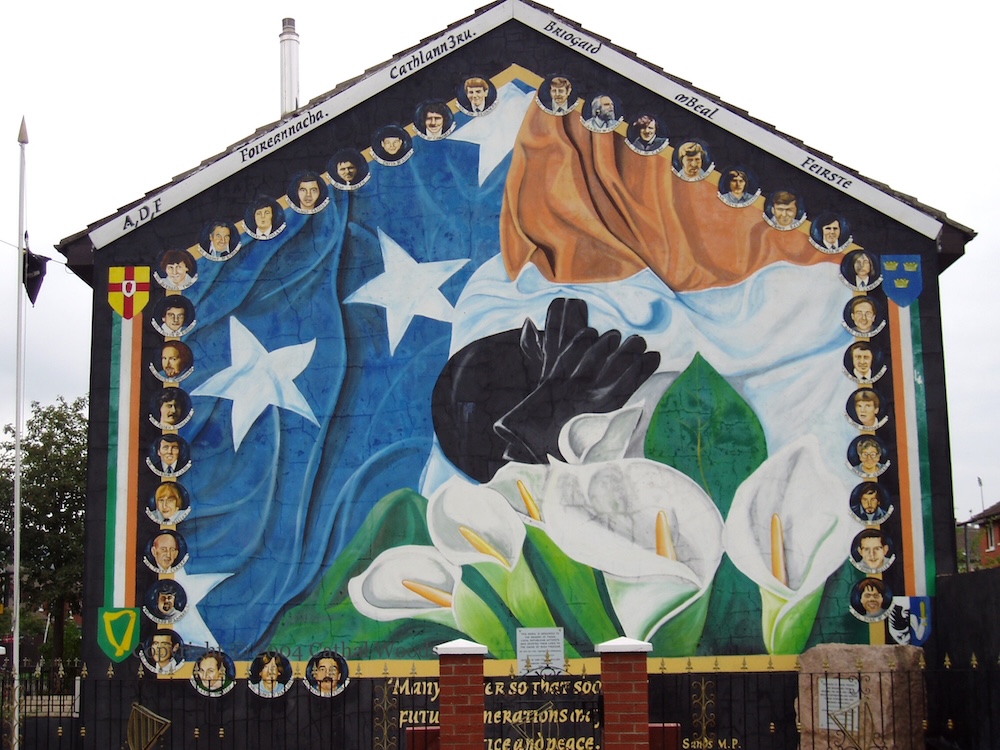
Easter lilies, starry plough (WP), Irish tricolour, black beret and gloves, commemorating dead IRA volunteers from the third battalion of the Belfast brigade.
The plaque on the stone in the corner thanks local residents for their contribution to the struggle. There’s a close-up of the stone in Peter Moloney’s collection (M02420).
“This mural is dedicated to the memory of those local republican activists [34 portraits of volunteers from “A, D, F foıreannacha, cathlann 3rú, Brıogáıd mBéal Feırste”] who devoted their lives to the cause of Irish freedom. Ar son na c[ú]ıse. Óglaıgh na hÉıreann. Unveiled by Sınn Féın councillors Martin Meehan and Margaret McClenaghan.”
“Many suffer so that some day future generations may live in justice and peace – Bobby Sands MP.”
“Dedicated to those friends and neighbours from Ardoyne, the Bone and Ligoniel whose contribution and support to our struggle was and remains invaluable. Aıthníonn muıd a gcrógacht. Óglaıgh na hÉıreann. Meán Fómhaır 2003.”
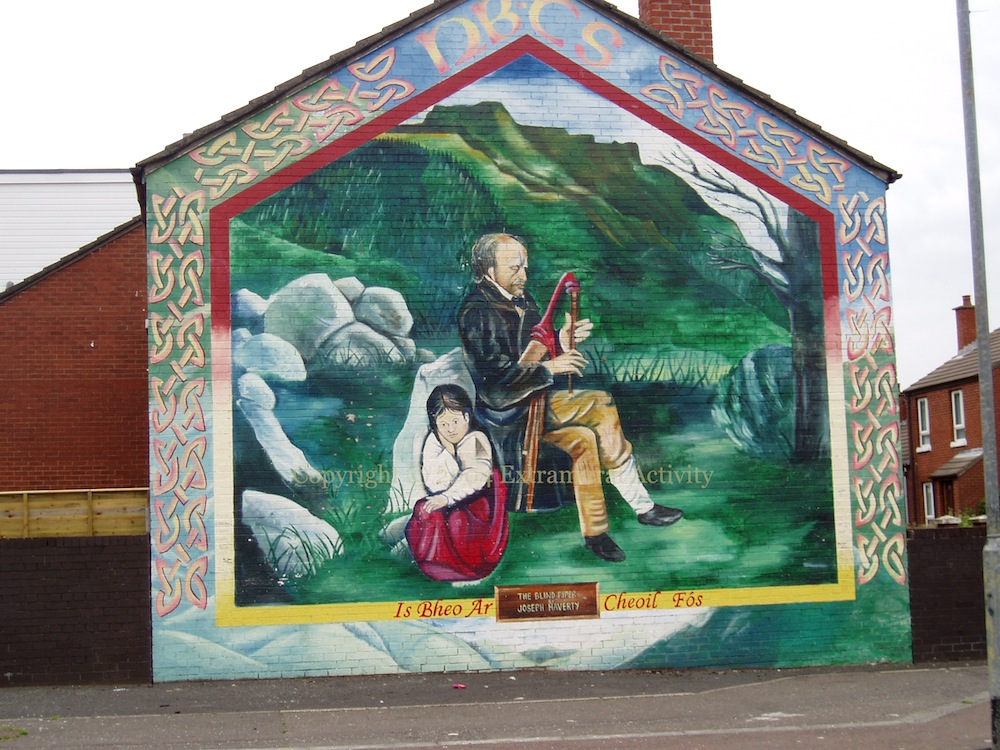
“Is beo ár cheoıl fós” [our music still lives] The Blind Piper is a painting (original) by Joseph Haverty (WP), here placed in the context of North Belfast’s Cave Hill.
Sponsored by North Belfast Cultural Society (“NBCS” in the apex).
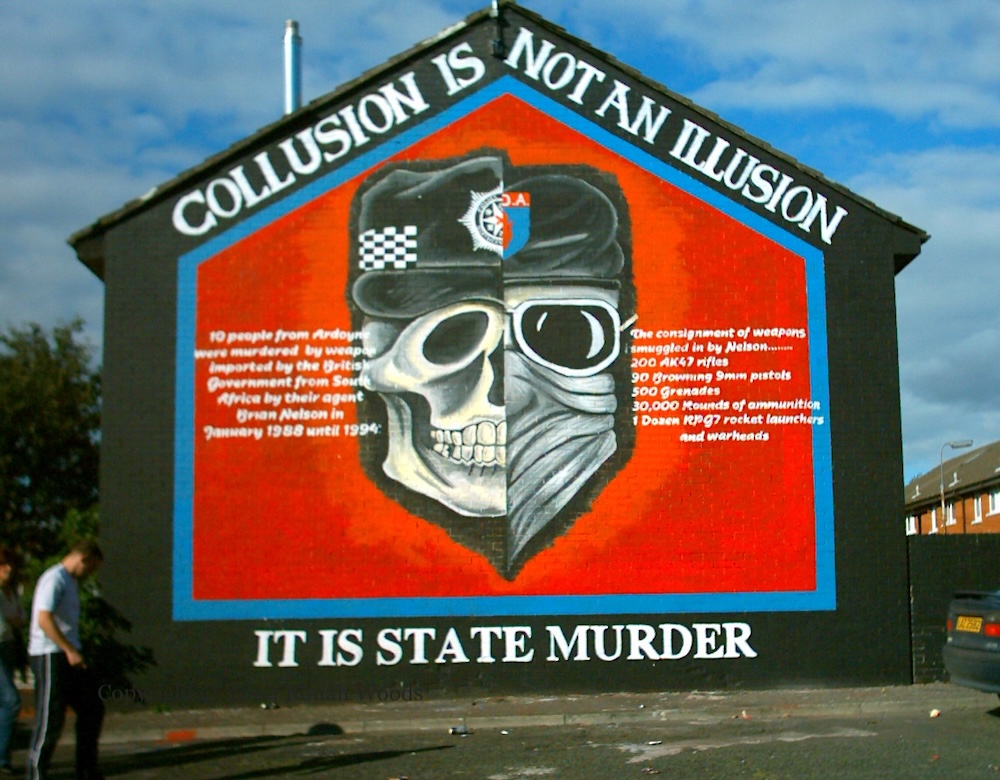
“Collusion is not an illusion, it is state murder.” “10 people from Ardoyne were murdered with weapons imported by the British government from South Africa by their agent Brian Nelson in January 1988 until 1994. The consignment of weapons smuggled in by Nelson: 200 AK47 rifles, 90 Browning 9mm pistols, 500 grenades, 30,000 rounds of ammunition, 1 dozen RPG7 rocket launchers and warheads.”
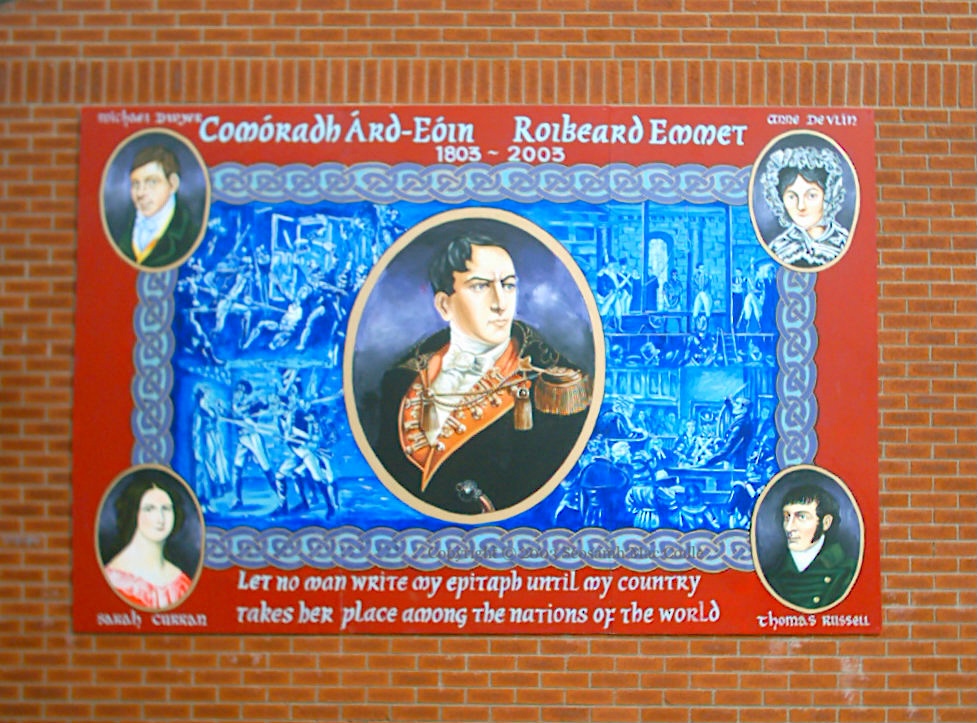
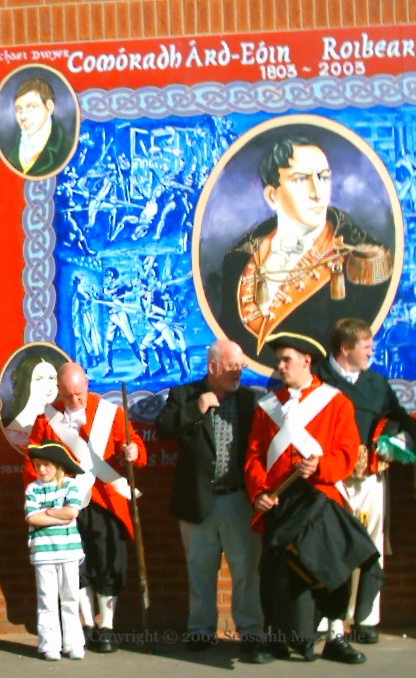
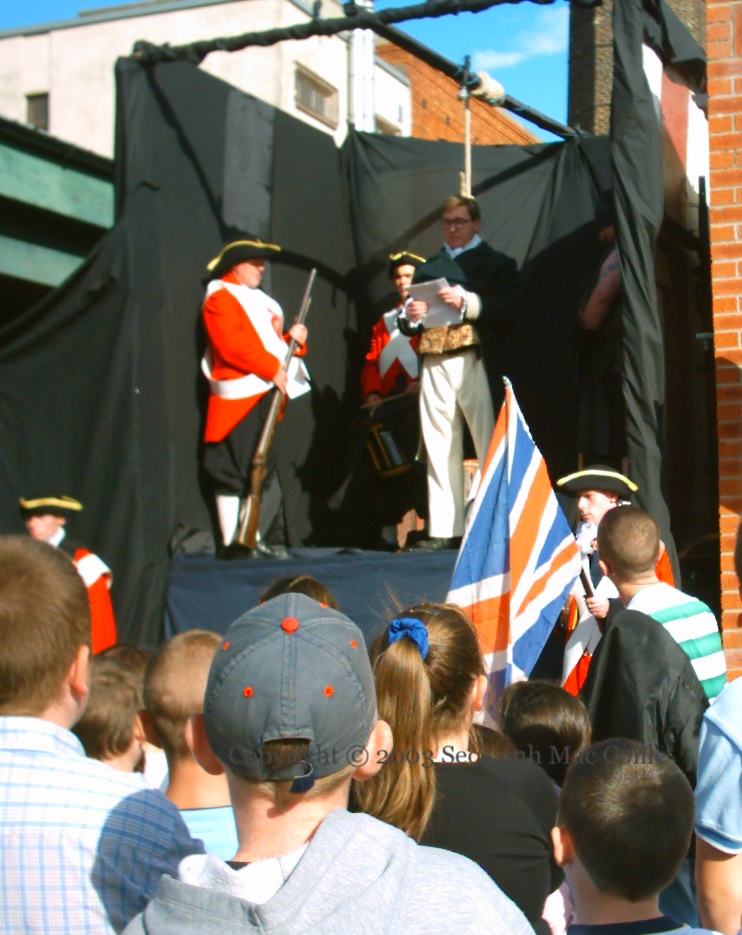
“Emmet to hang!” The launch of a new 200th-anniversary Robert Emmet board in Ard Eoın/Ardoyne (“Comóradh Ard Eoın – Roıbeard Emmet 1803-2003”) included a re-enactment of Emmet’s execution on 20th September, 1803, for his role as the leader of the 1803 rising of the United Irishmen (WP). The words along the bottom of the board – “Let no man write my epitaph until my country takes her place among the nations of the world” – come from Emmet’s Speech From The Dock, given after the ‘guilty’ verdict was announced.
In the medallions in the corners are (clockwise) three United Irish republicans Michael Dwyer, (cousin) Anne Devlin and Thomas Russell, and Emmet’s fiancée Sarah Curran.
A mural to Emmet was one of the very few CNR mural painted before the Troubles, in 1953 for the sesquicentennial – see Visual History 02.
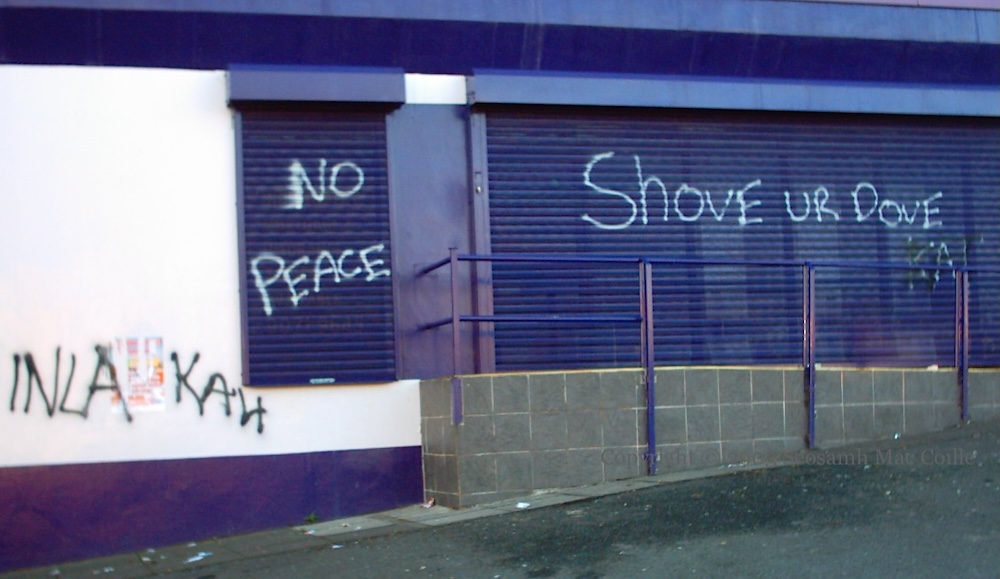
“No peace”, “INLA”, and “KAH” [Kill all Huns/Protestants] but also “KAI” [Kill All Irish] covered over on the right – republican graffiti in a mixed area, the junction of Cavehill Road and North Circular Road in north Belfast.
 Seosamh Mac Coille Collection