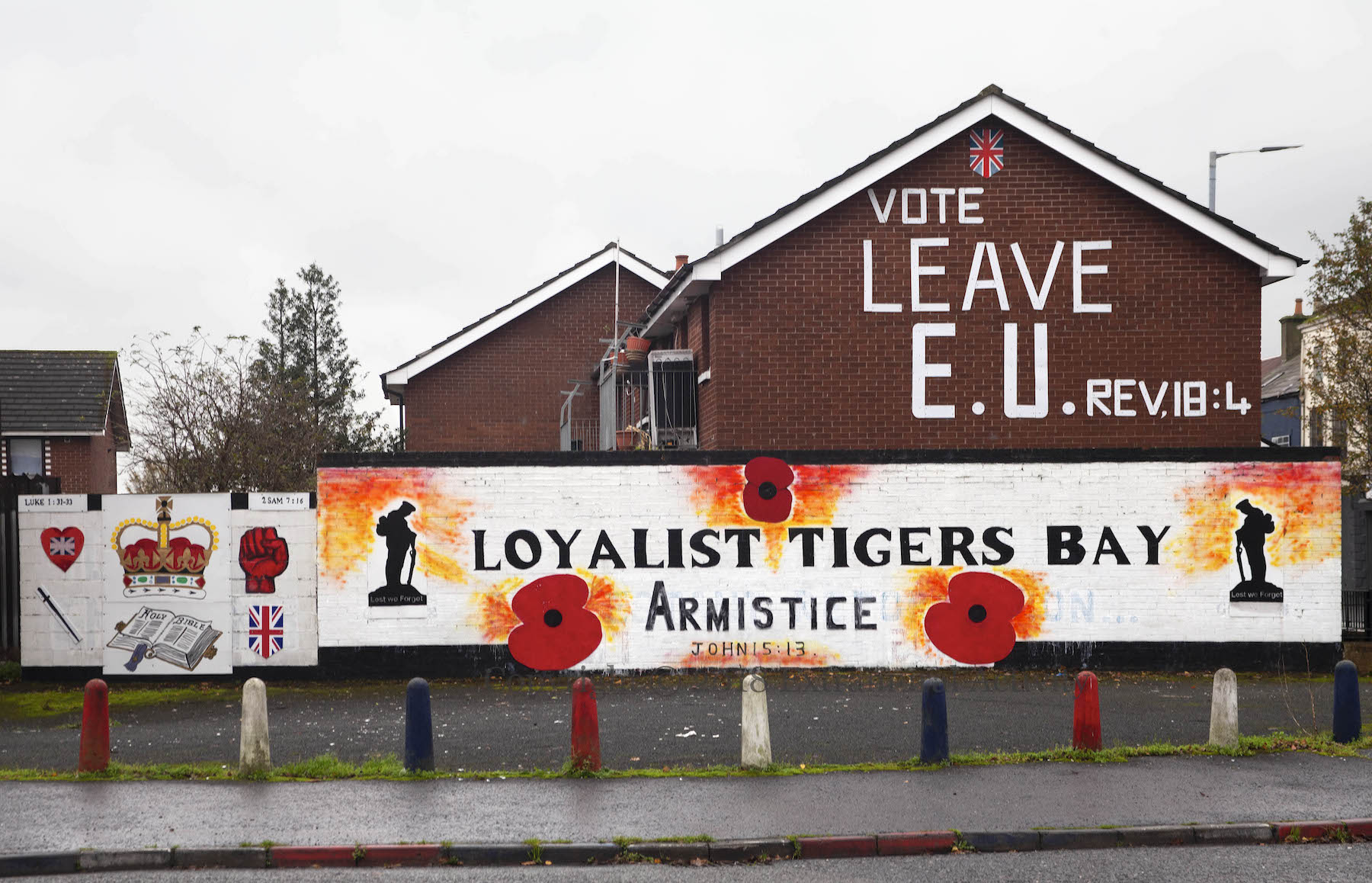
John 15:13 reads “Greater love hath no man than this: to lay down his life for his friends.” Fighting in the Great War ceased at 11 a.m. on November 11th, 1918, after approximately 10 million military deaths, 10 million civilian deaths, and another 20 million injured.
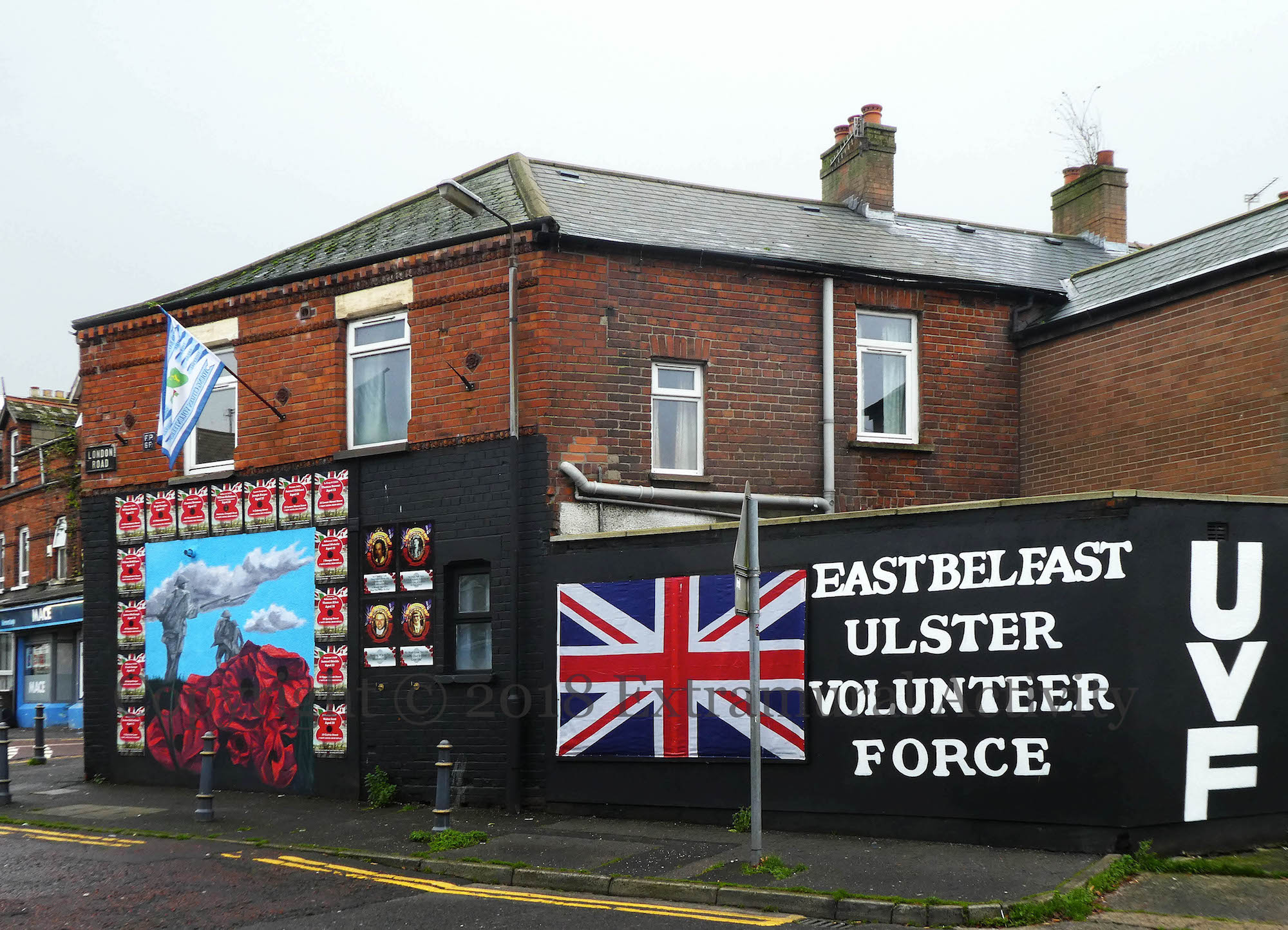
The Union Flag/UVF side-wall is a new addition to the Ulster Volunteers/UVF memorial in London Road, east Belfast. The main panel shows WWI soldiers going over the top (see Between The Crosses) while the four portraits to its right are of deceased UVF volunteers of the 70s and 80s – Seymour, Long, Cordner, and Bennett – (see Ulster’s Brave).
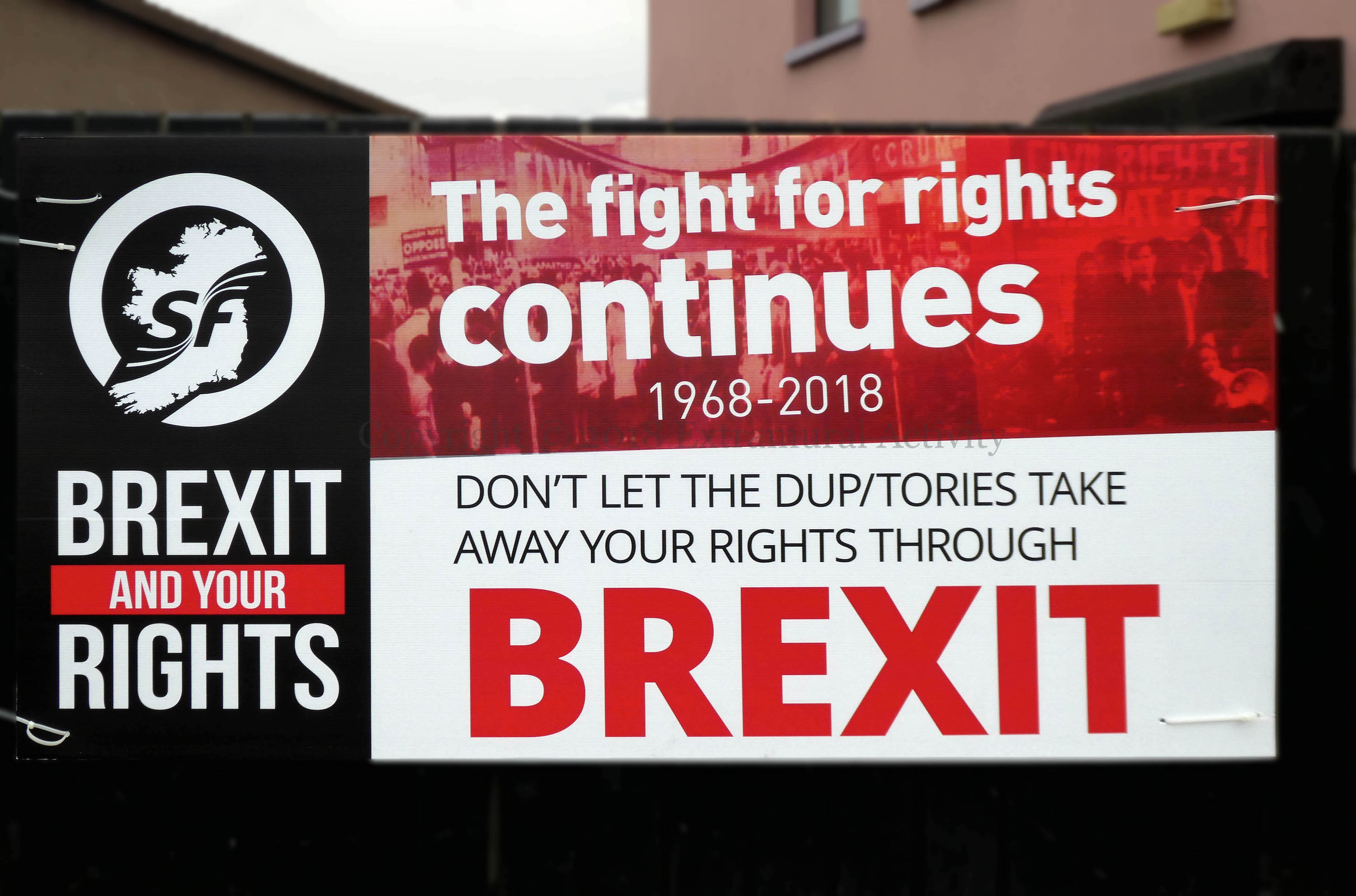
It’s still anybody’s guess as to how Brexit will happen in March, 2019. This week, the ball is in the court of the hard-Brexiteers as they decide whether or not to challenge Theresa May’s leadership of the Conservative Party. Political parties in Northern Ireland claim to be “fighting” for their side – such as this Sinn Féin board on Falls Road – but in practice this means only looking on with fascination and anxiety. “The fight for rights continues – 1968-2018. Don’t let the DUP/Tories take away your rights through Brexit.”
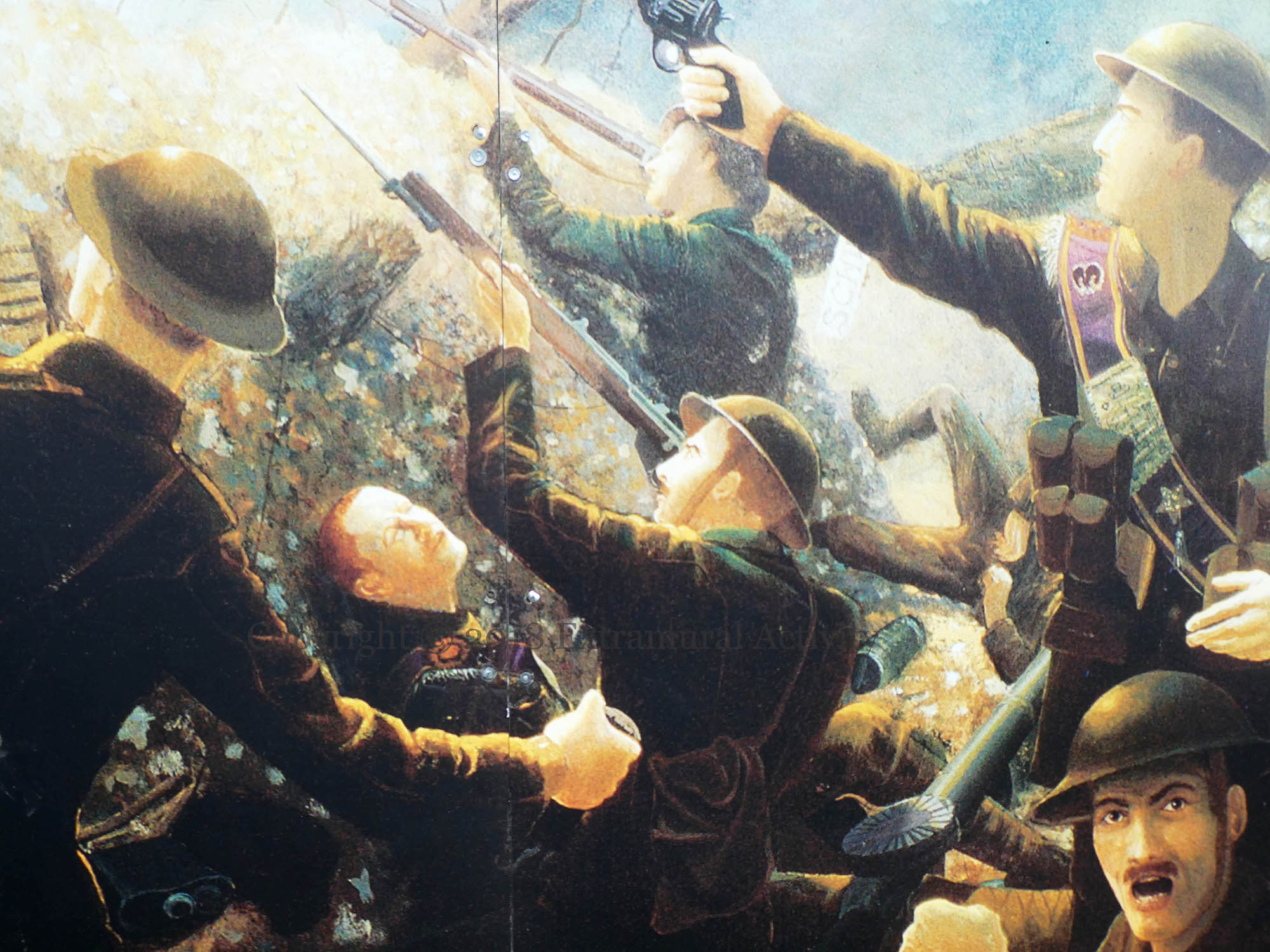
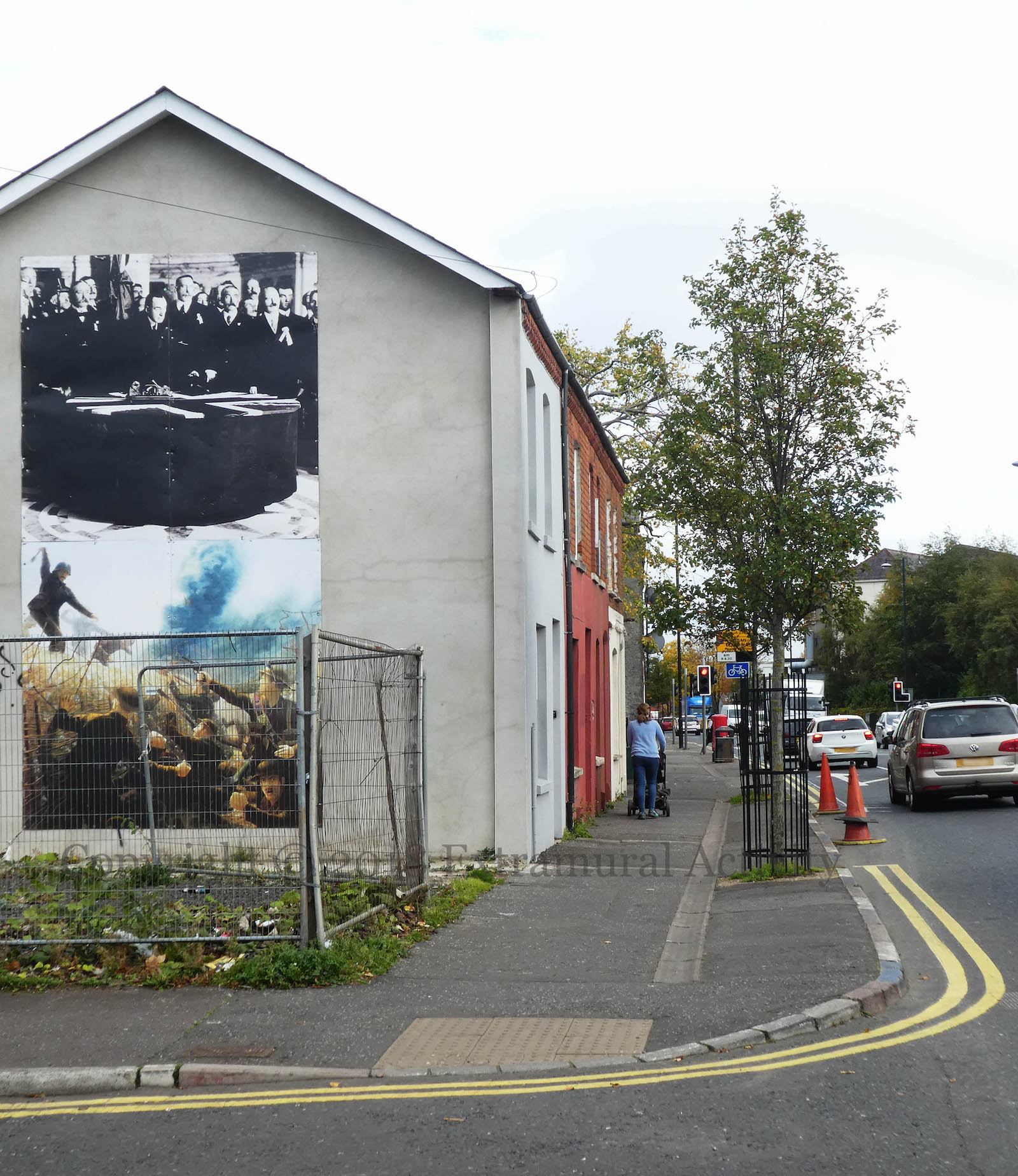
For the third time, these two panels – one of the signing of the Covenant in 1912 and the other of soldiers in collarettes and sashes defending their trench against a German attack – are visible at Barrington Gardens. They were originally on the gable at the corner before it was demolished (see July 1st); during re-development they were placed on a metal frame (see Out Of The Rubble).
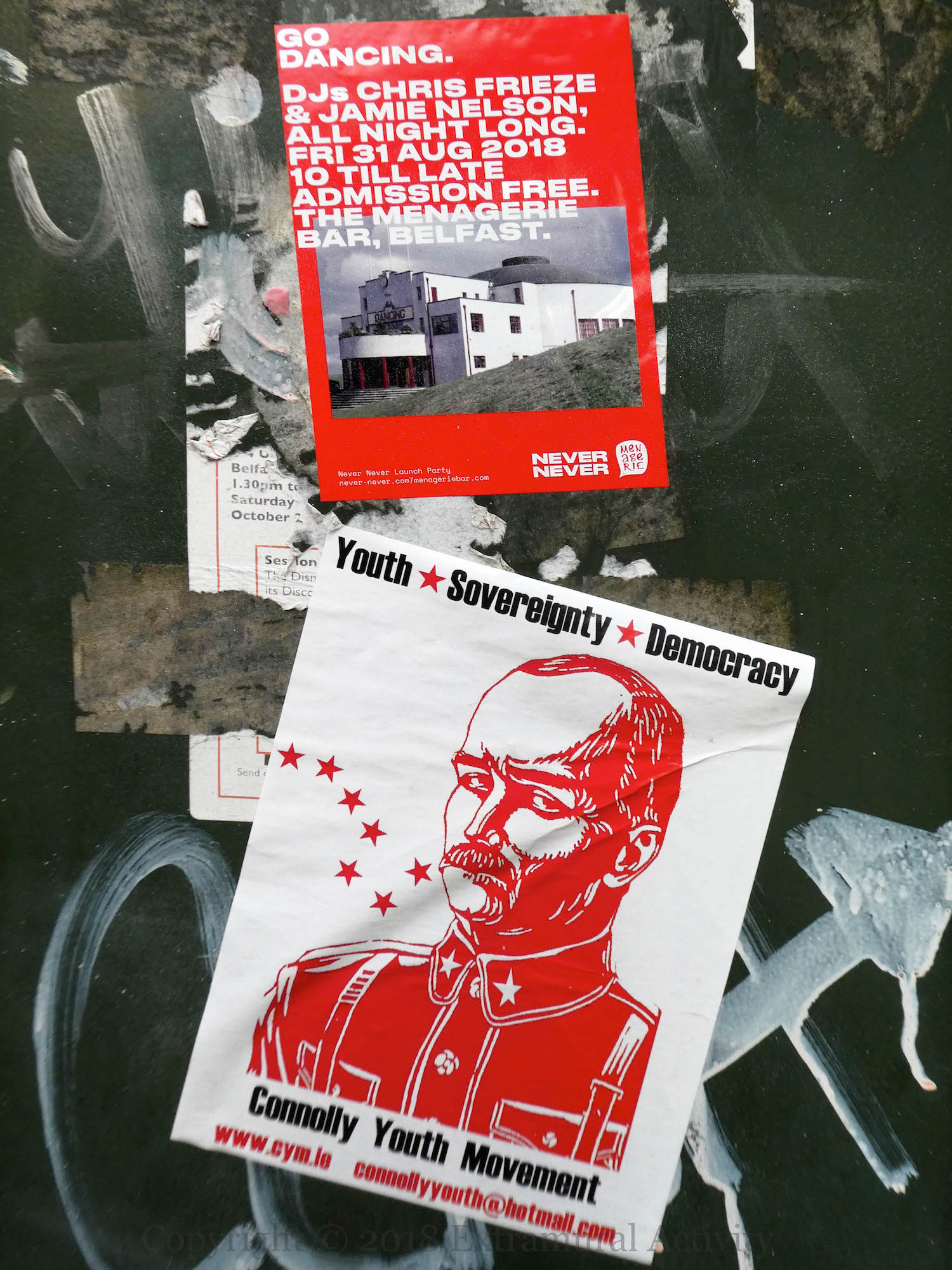
Communism and the Connolly Youth Movement (web | Fb) compete with a Menagerie (front | side | car-park) flyer for the for the attention of young people in Divis Street, Belfast.
In her autobiography, Living My Life, Emma Goldman wrote, “At the dances I was one of the most untiring and gayest. One evening a cousin of Sasha, a young boy, took me aside. With a grave face … he whispered to me that it did not behoove an agitator to dance. Certainly not with such reckless abandon, anyway. It was undignified for one who was on the way to become a force in the anarchist movement. My frivolity would only hurt the Cause. I grew furious at the impudent interference of the boy. … I was tired of having the Cause constantly thrown into my face. I did not believe that a Cause which stood for a beautiful ideal, for anarchism, for release and freedom from convention and prejudice, should demand the denial of life and joy. … If it meant that, I did not want it.” (p. 56)
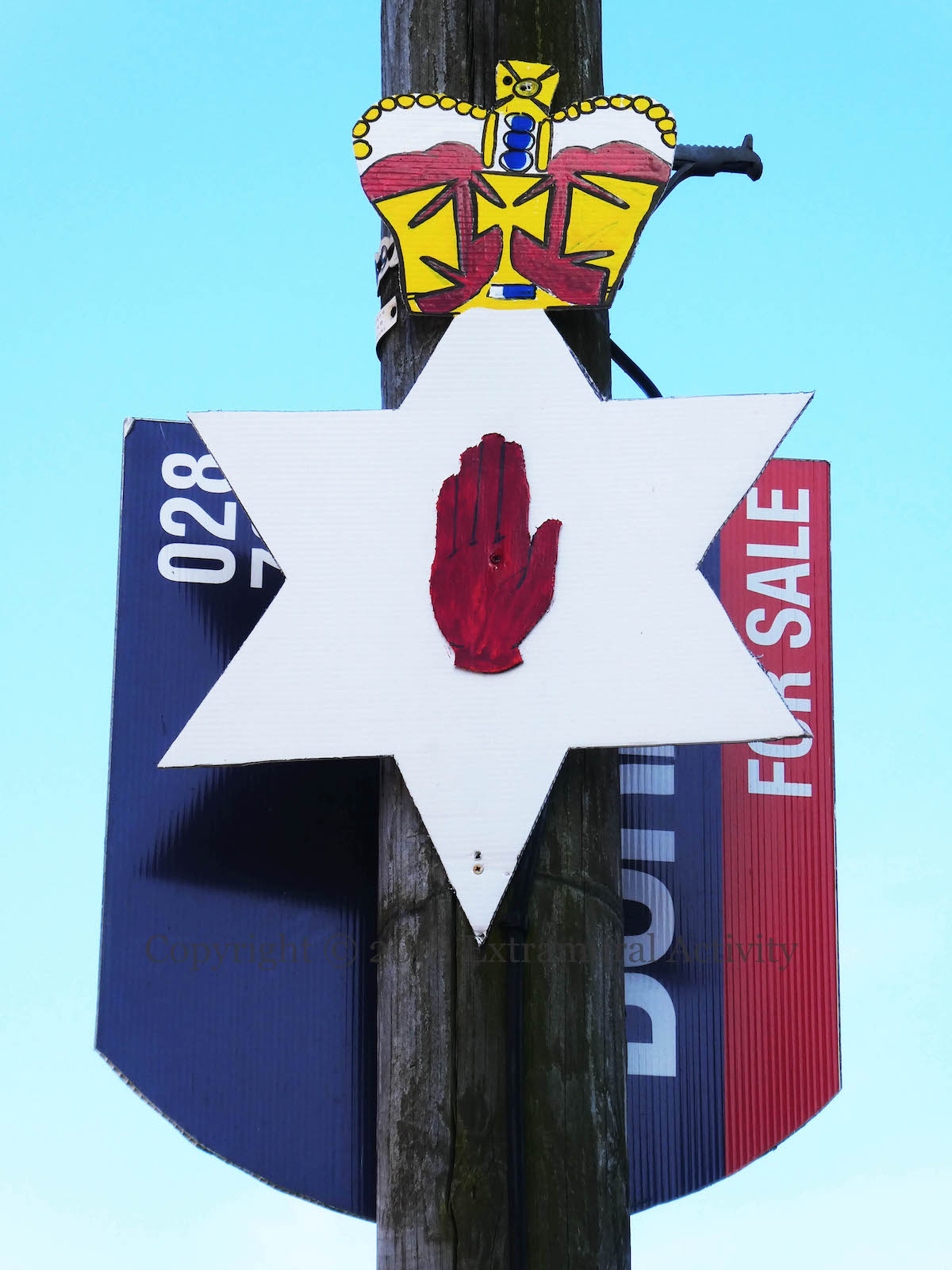
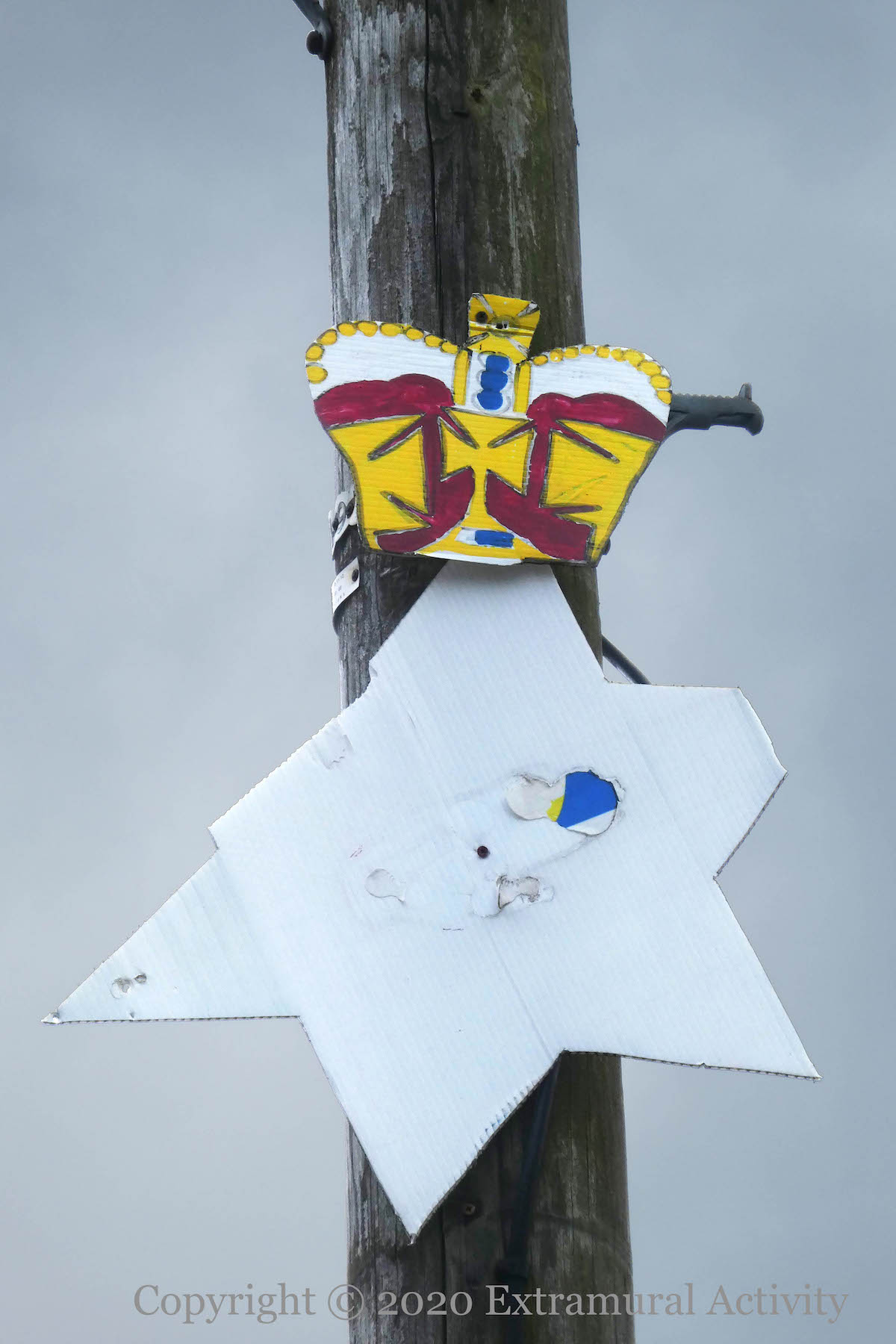
Use whatever you can find to express your identity: re-purpose the placards of capitalism, grab a pair of scissors and cut, draw the outline of your hand with a felt-tip pen.
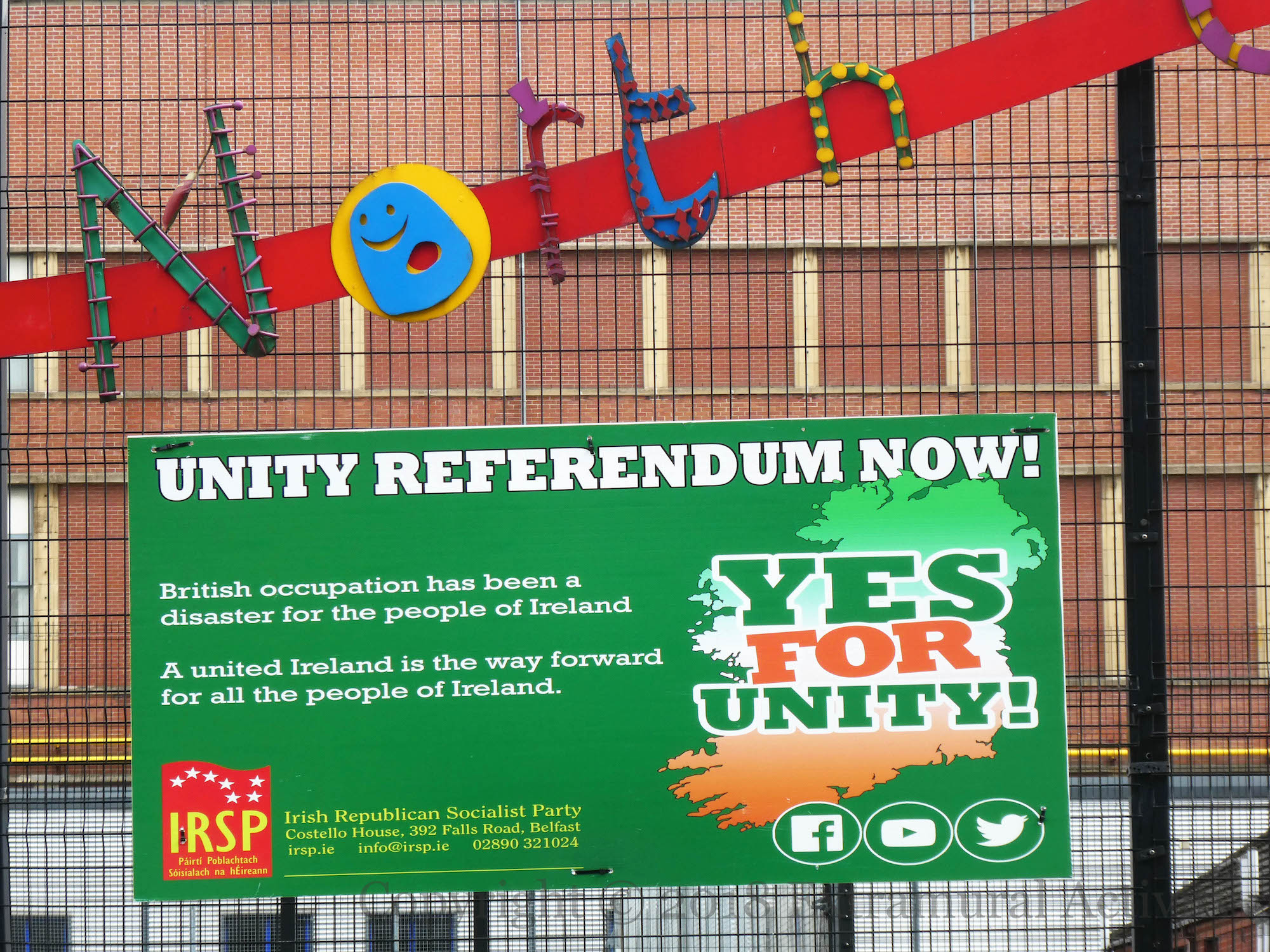
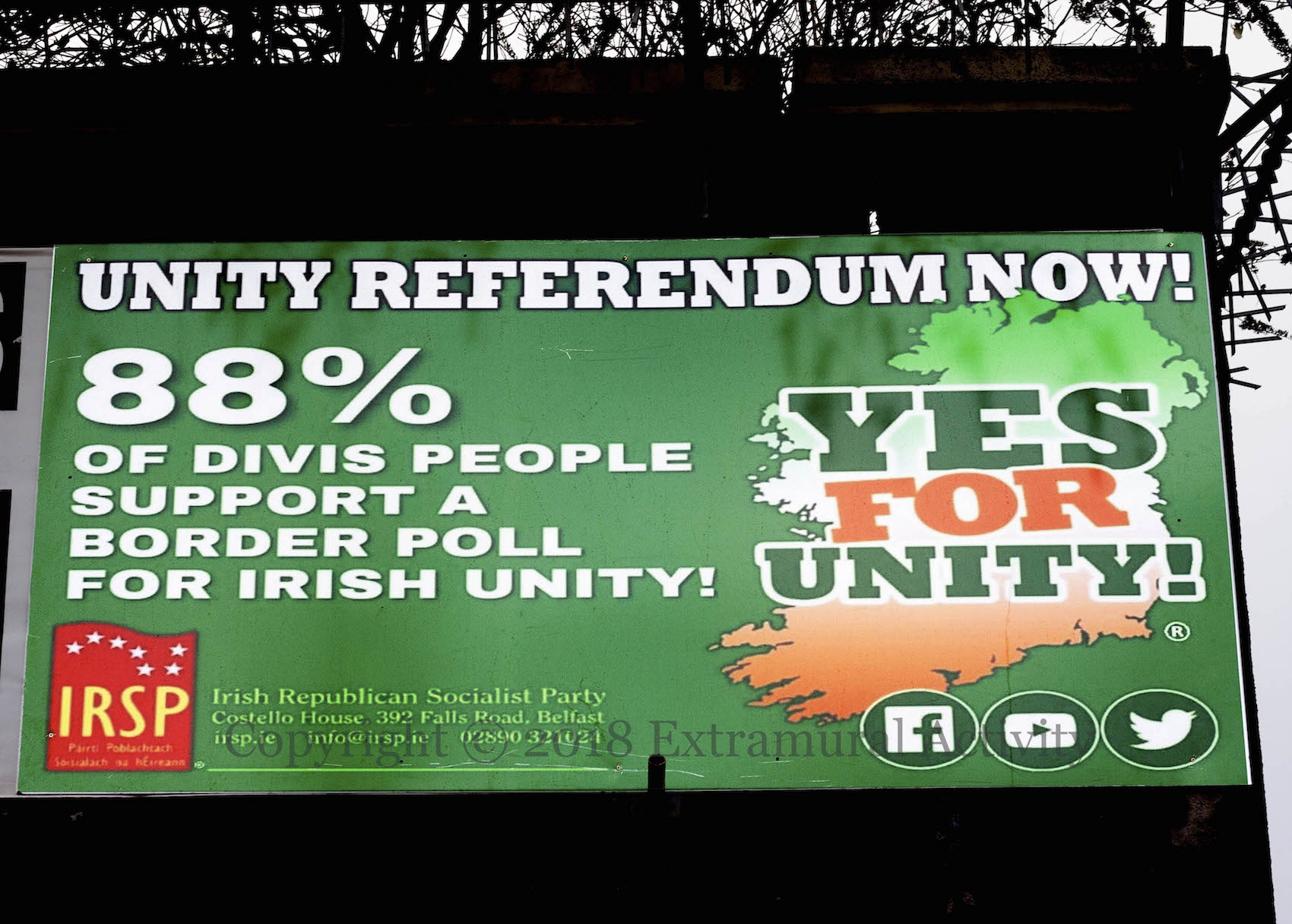
The IRSP last month (September, 2018) launched a campaign on Facebook, youtube, and twitter to poll various districts on the question of a border poll. “Unity referendum now! British occupation has been a disaster for the people of Ireland. A united Ireland is the way forward for all the people of Ireland.” The one above is on the fence around the North Queen Street play park; the one below (“88% of Divis people”) is below Divis tower.
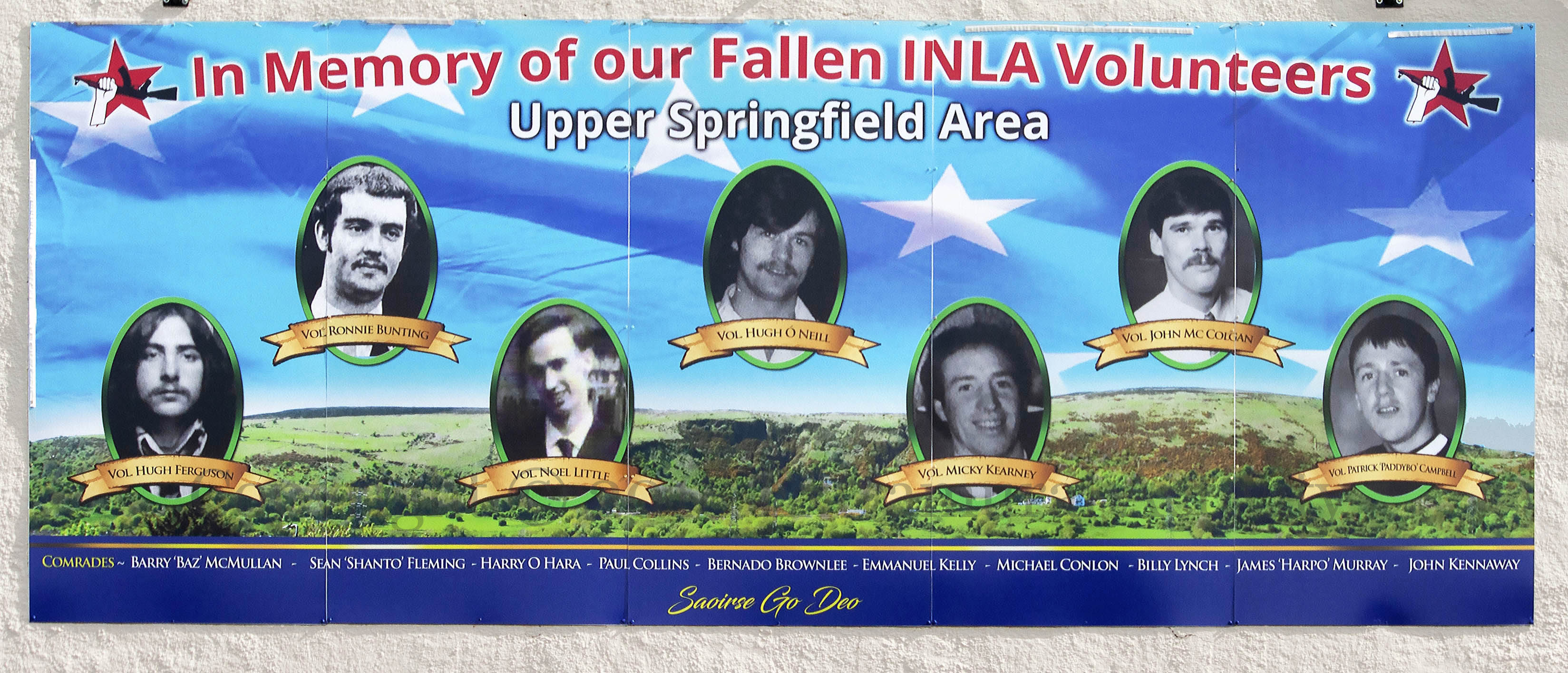
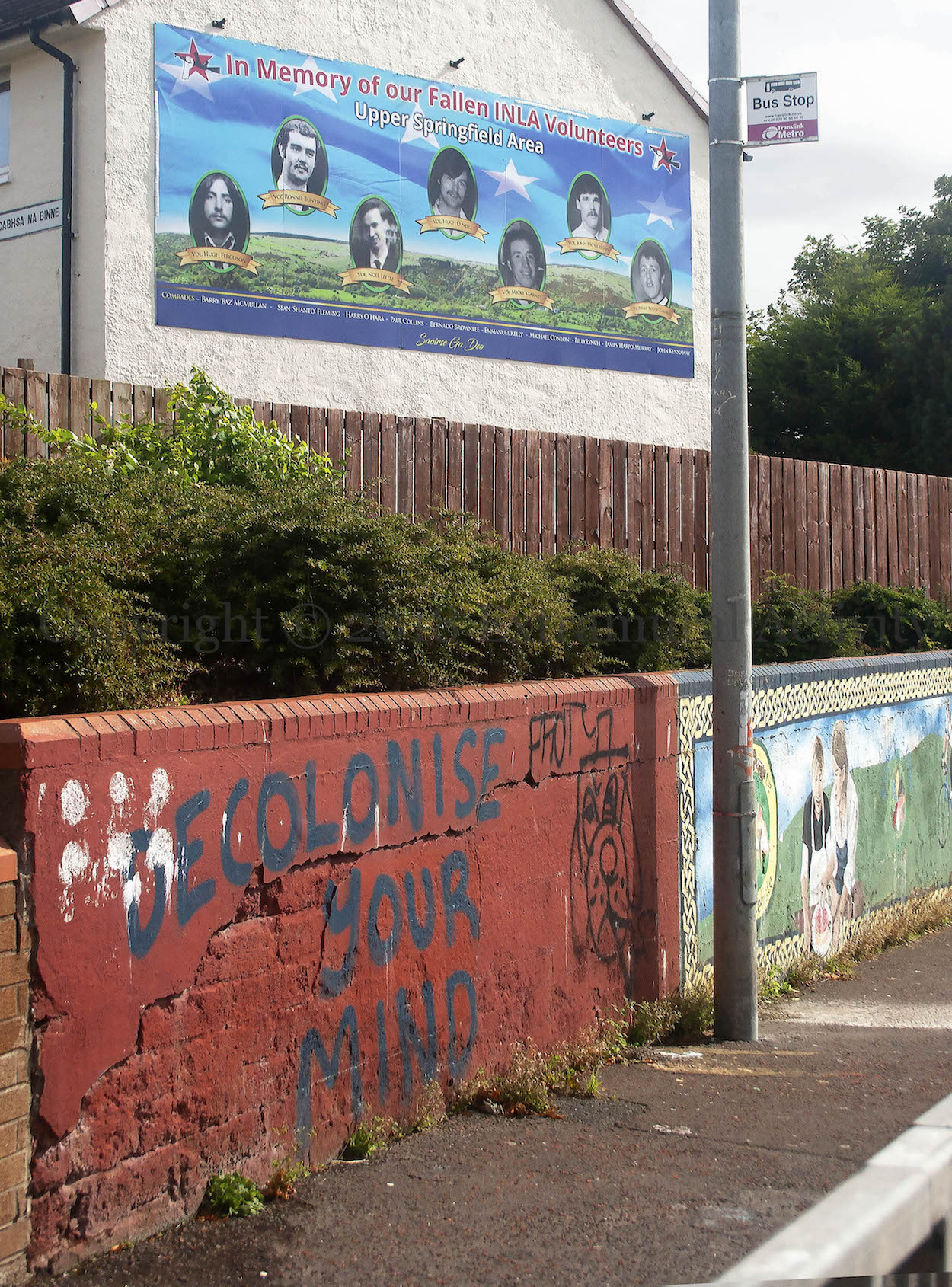
“In memory of our fallen INLA volunteers, upper Springfield area: Hugh Ferguson, Ronnie Bunting, Noel Little, Hugh O’Neill, Micky Kearney, John McColgan, Paddy “Paddybo” Campbell. Comrades: Barry “Baz” McMullan, Sean “Shanto” fleming, Harry O’Hara, Paul Collins, Bernado Brownlee, Emmanuel Kelly, Michael Conlon, Billy Lynch, James “Harpo” Murray, John Kennaway. Saoırse go deo [freedom forever].” Ferguson was the first member of the INLA to die, in 1975 in the feud with the OIRA. Bunting and Little/Lyttle (both Protestants) were shot dead in 1980 in Bunting’s Andersonstown home by masked gunmen from the UDA or SAS with RUC complicity.
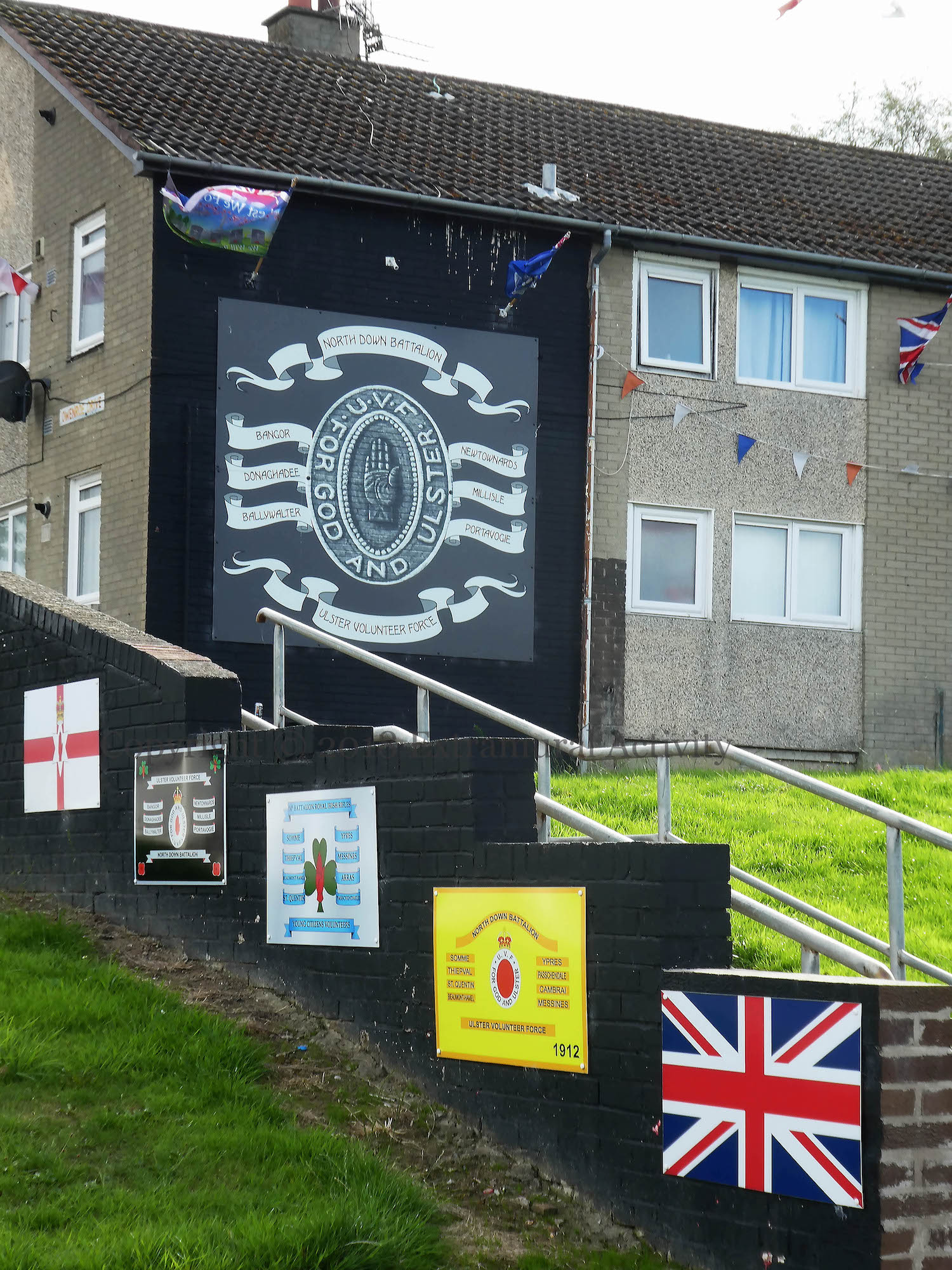
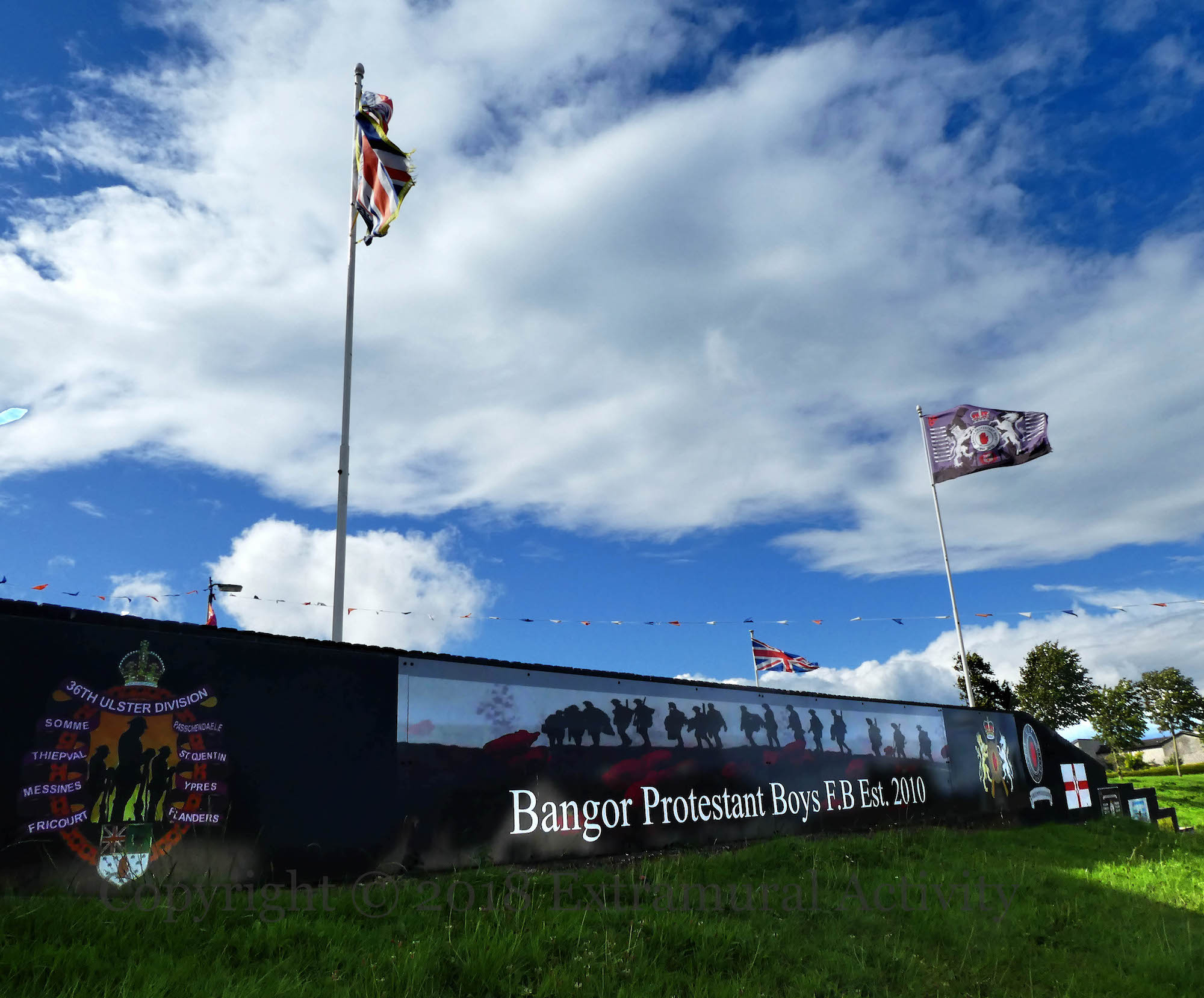
A large black-and-white board to the modern Ulster Volunteer Force and its divisions – Bangor, Donaghadee, Ballywalter, Newtownards, Millisle, and Portavogie – has been added behind the display for the Bangor Protestant Boys Flute Band (previously seen in 2017). It’s worth noting that although this is a board, the UVF emblem in the middle is depicted as having been painted on a brick wall, indicating a preference for old-school muraling.