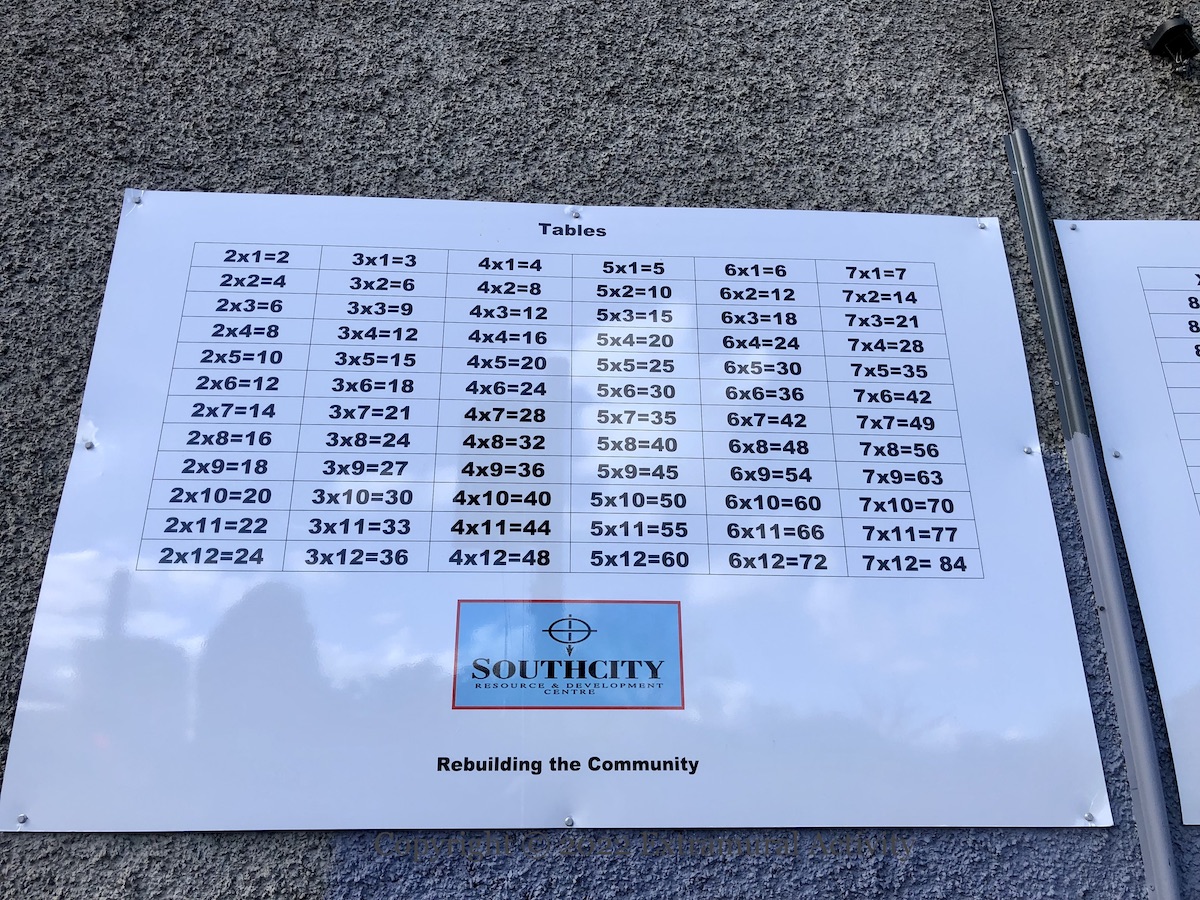
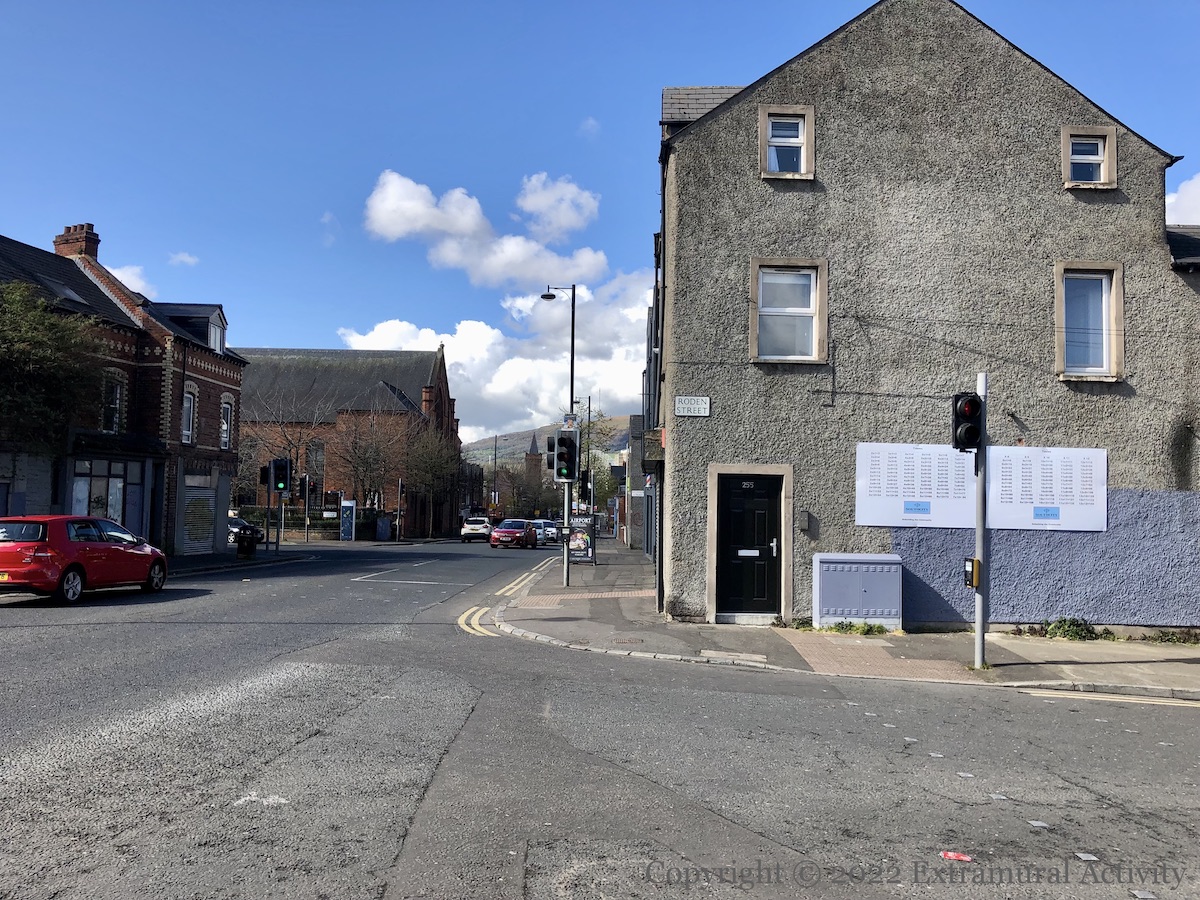
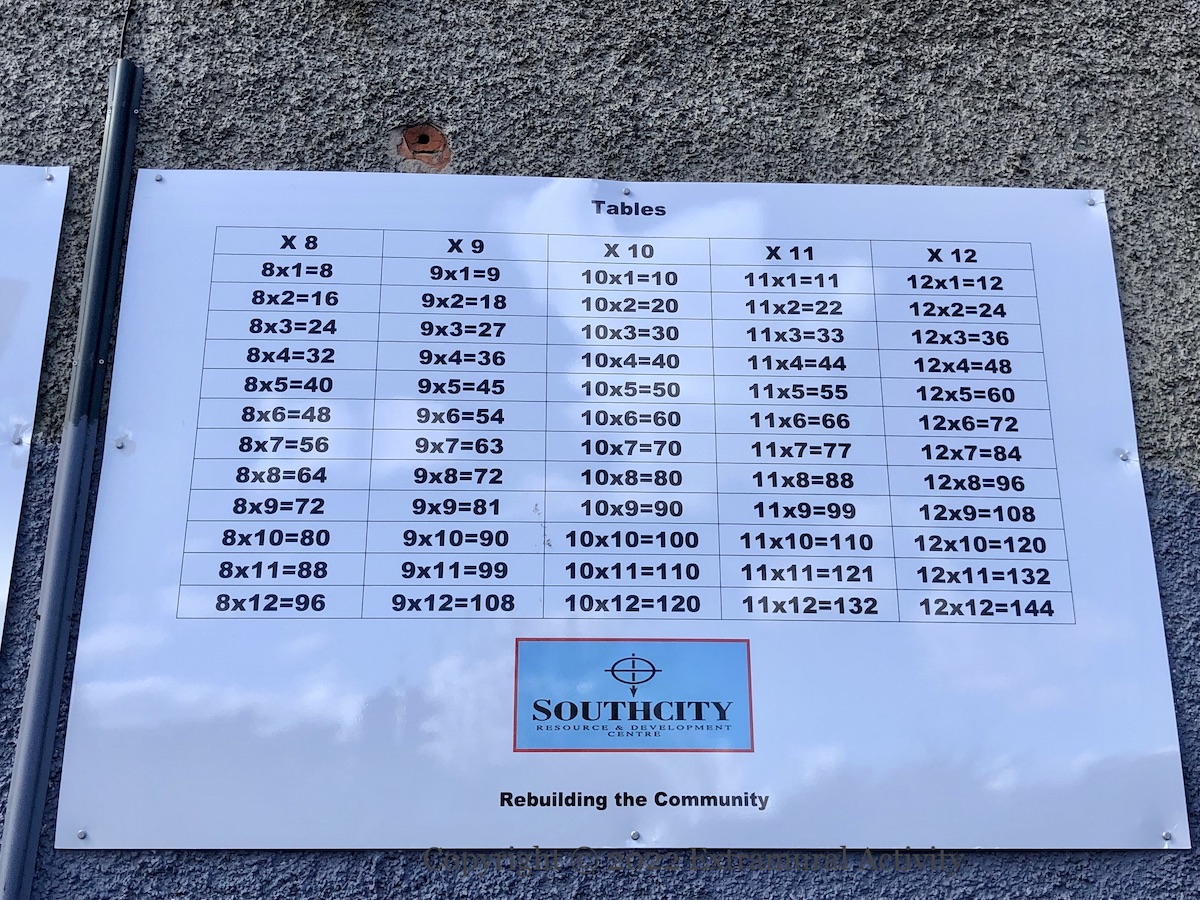
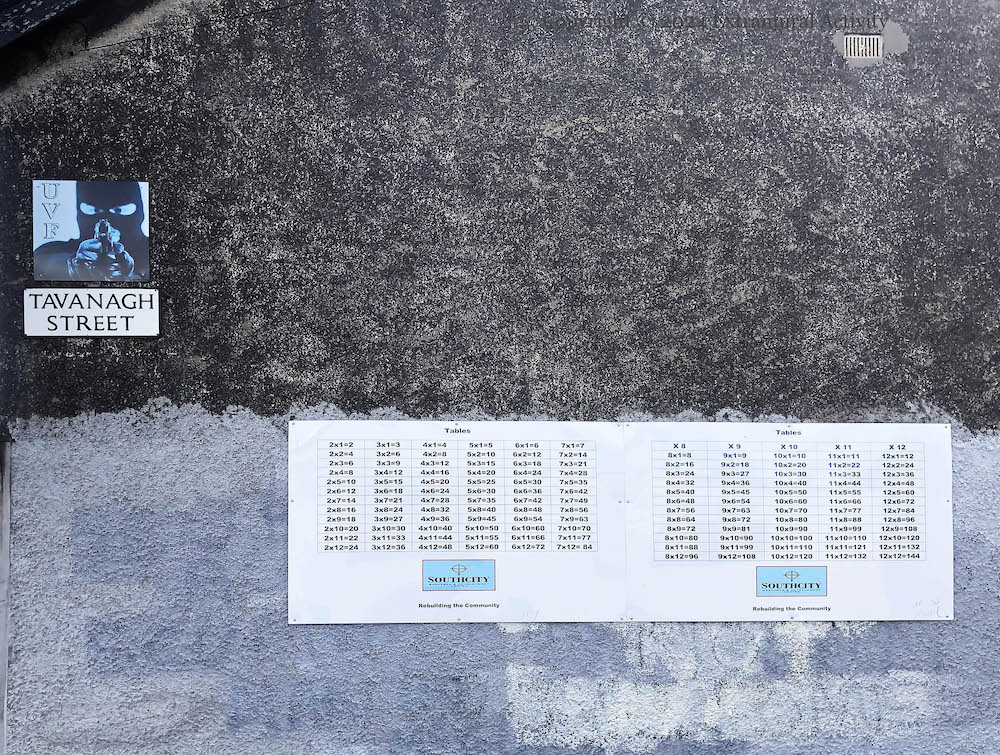
Southcity Resource & Development Centre (Fb) provides (among many other services) a ‘homework club’ on Tuesday afternoons. They have put up the times tables in four locations around the Village that will encourage kids walking to and from school to practice their maths. The set shown here is in Roden Street; the others are in Lemberg Street, Nubia Street, and Tavanagh Street – below this UVF hooded gunman.
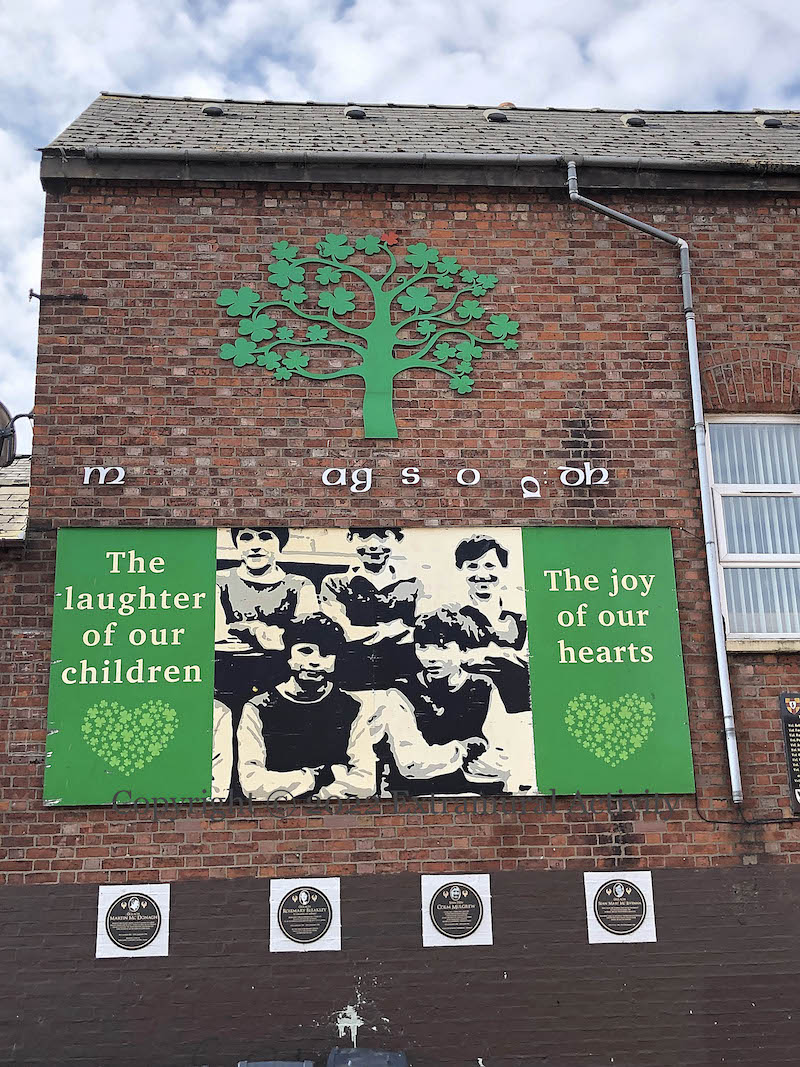
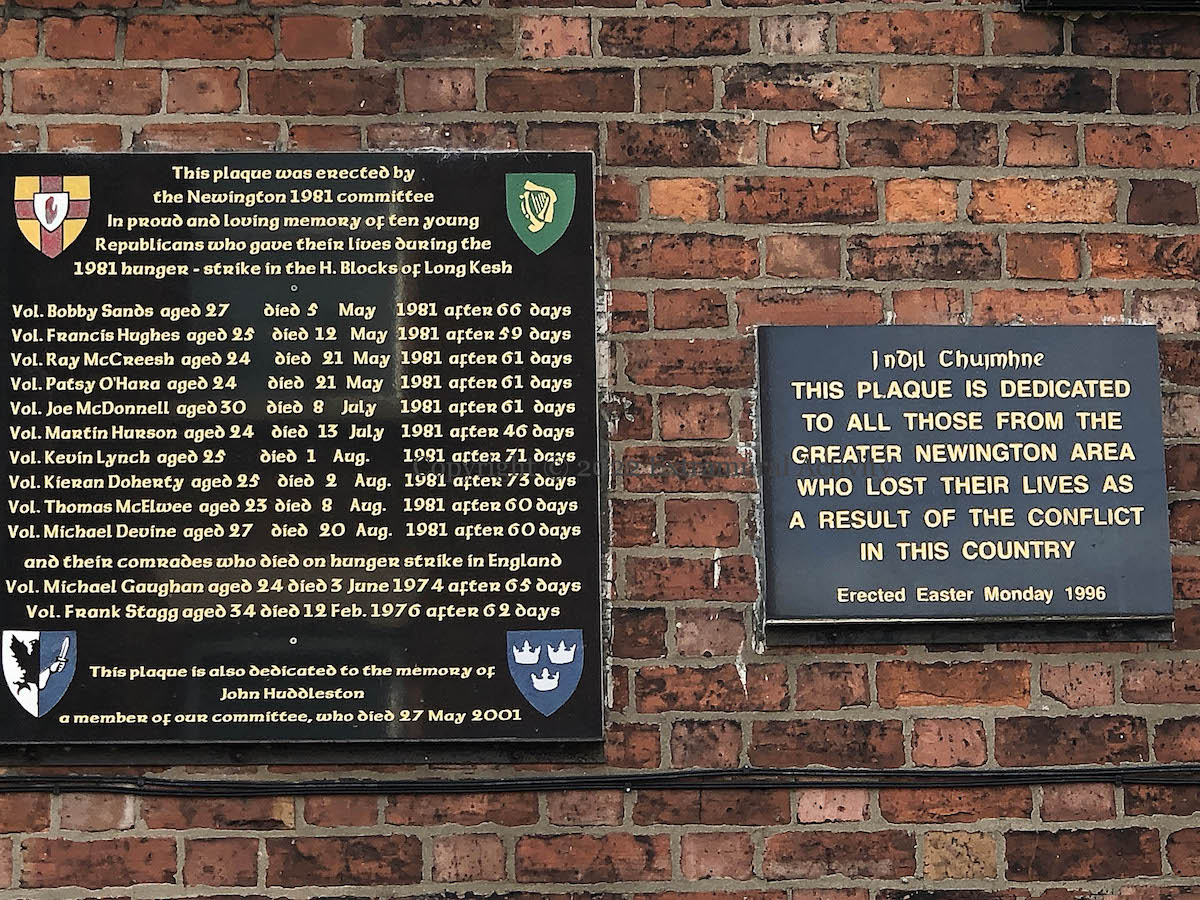
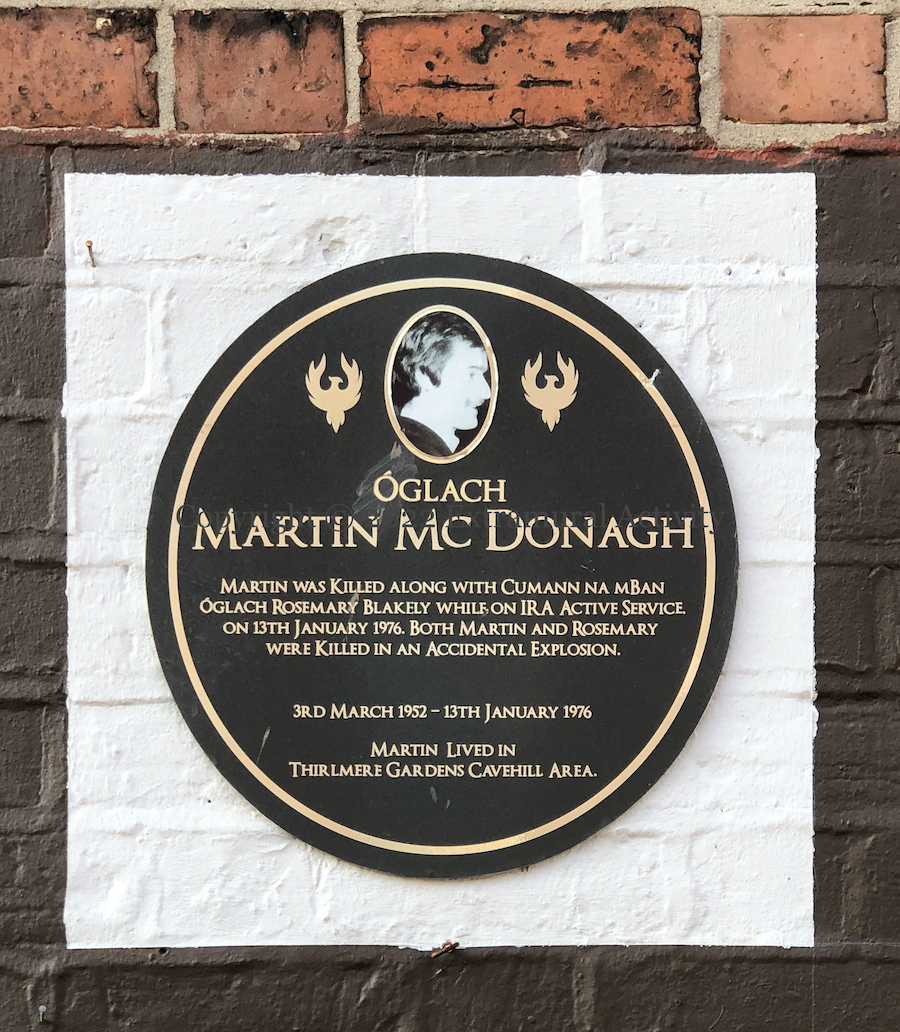
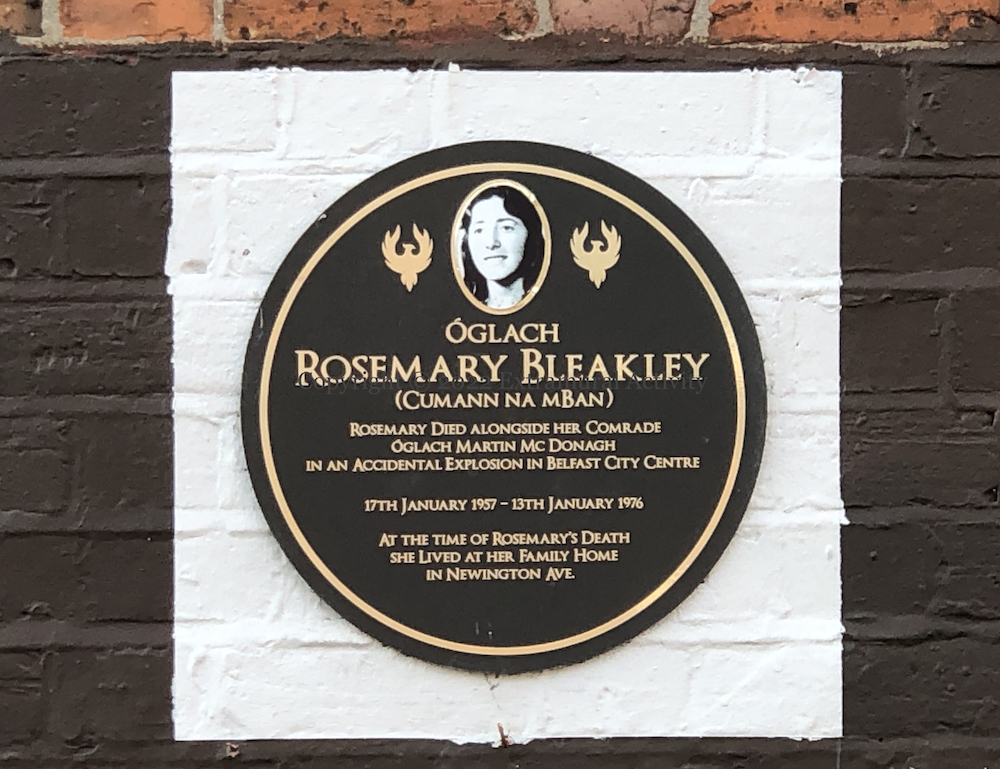
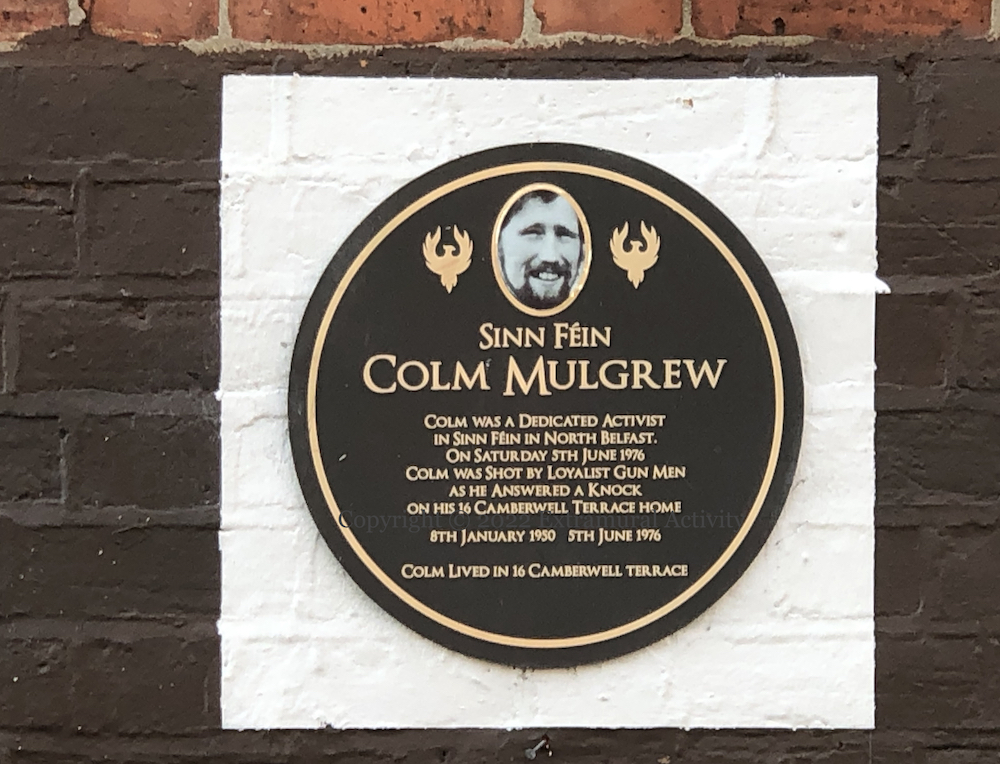
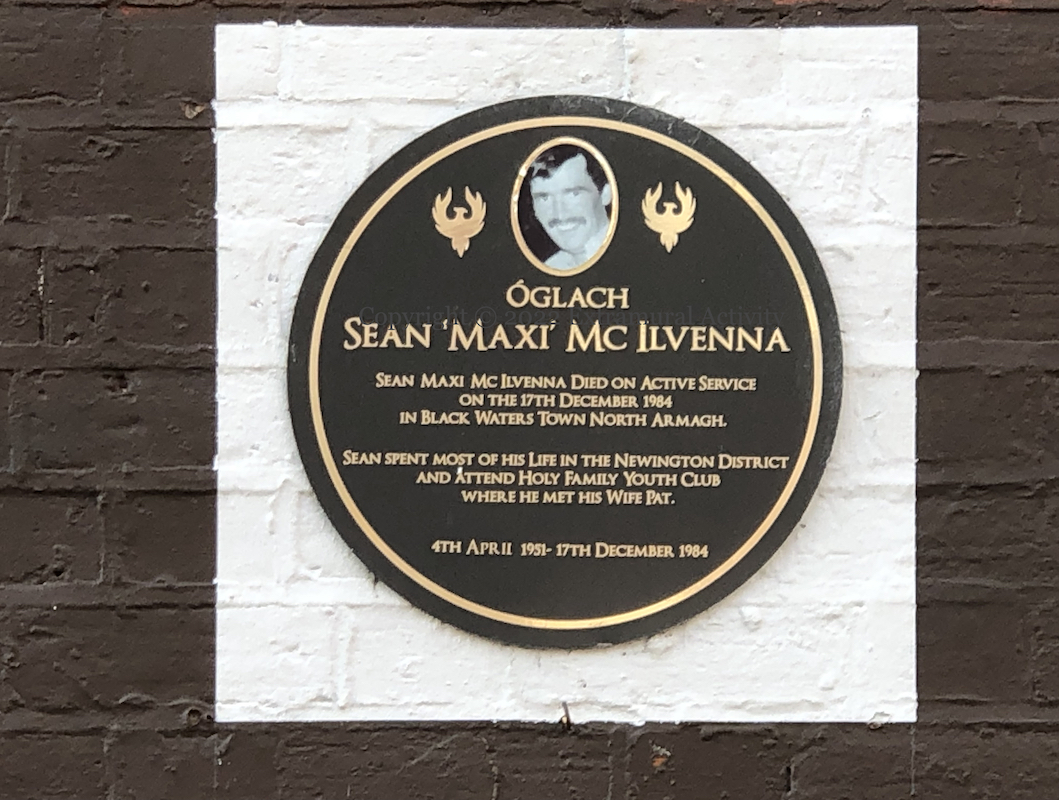
The Newington tribute to Bobby Sands and the other deceased hunger strikers of the 1970s and 80s (see previously: Mol An Óıge Agus Tıocfaıdh Sí) has been augmented with four plaques to republicans from the area who died in the Troubles: (l-r) Martin McDonagh, Rosemary Bleakley, Colm Mulgrew, and Sean ‘Maxi’ McIvenna.
Unbeknowst to her parents (Lost Lives), Bleakley had joined Cumann Na mBan at 18 and was four days short of her nineteenth birthday when she and McDonagh were killed in a premature bomb explosion in the North Street arcade (Victor Patterson image of the blast), along with civilians Ian Gallagher and Mary Dornan (Sutton); 20 others were injured (Fortnight). Bleakley was not buried in the republican plot (in Milltown) but coincidentally in the plot adjacent to Dornan (BBC).
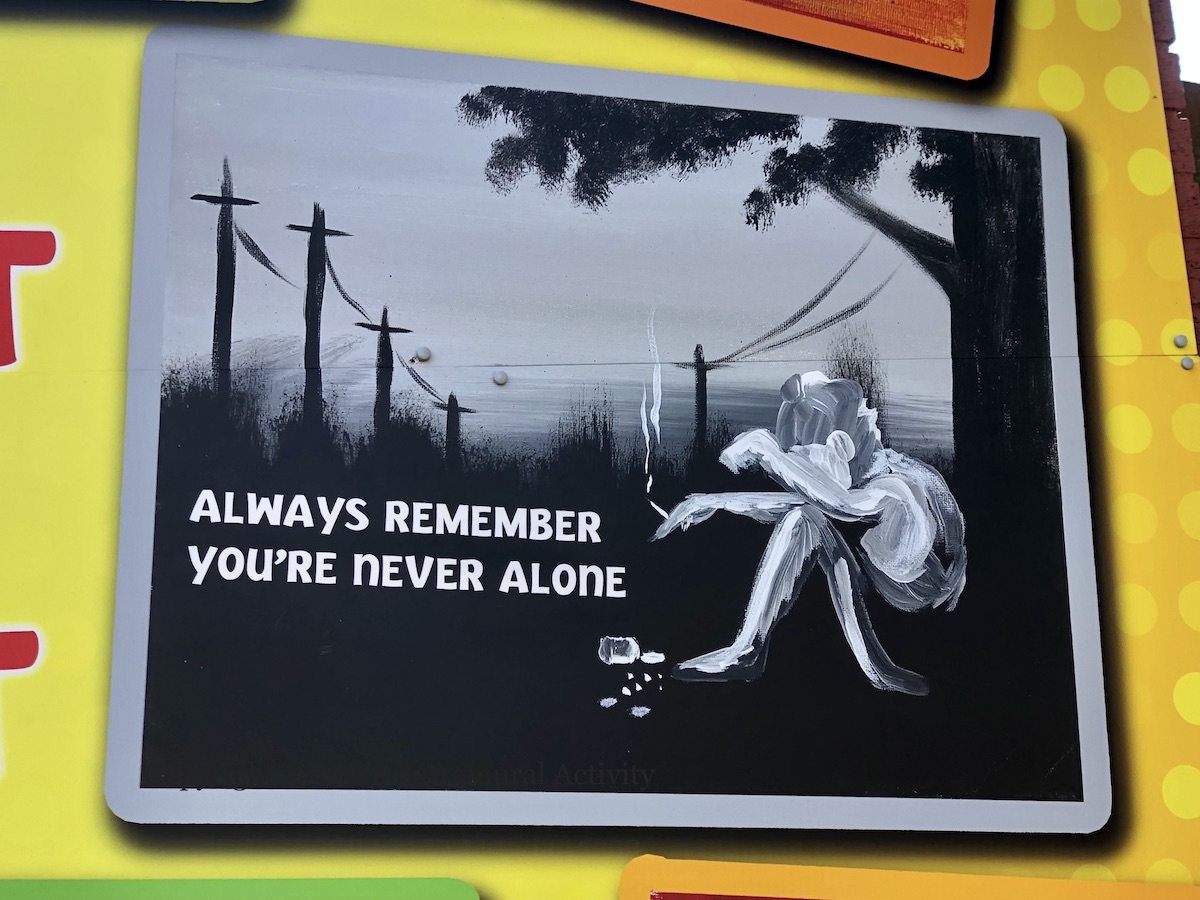
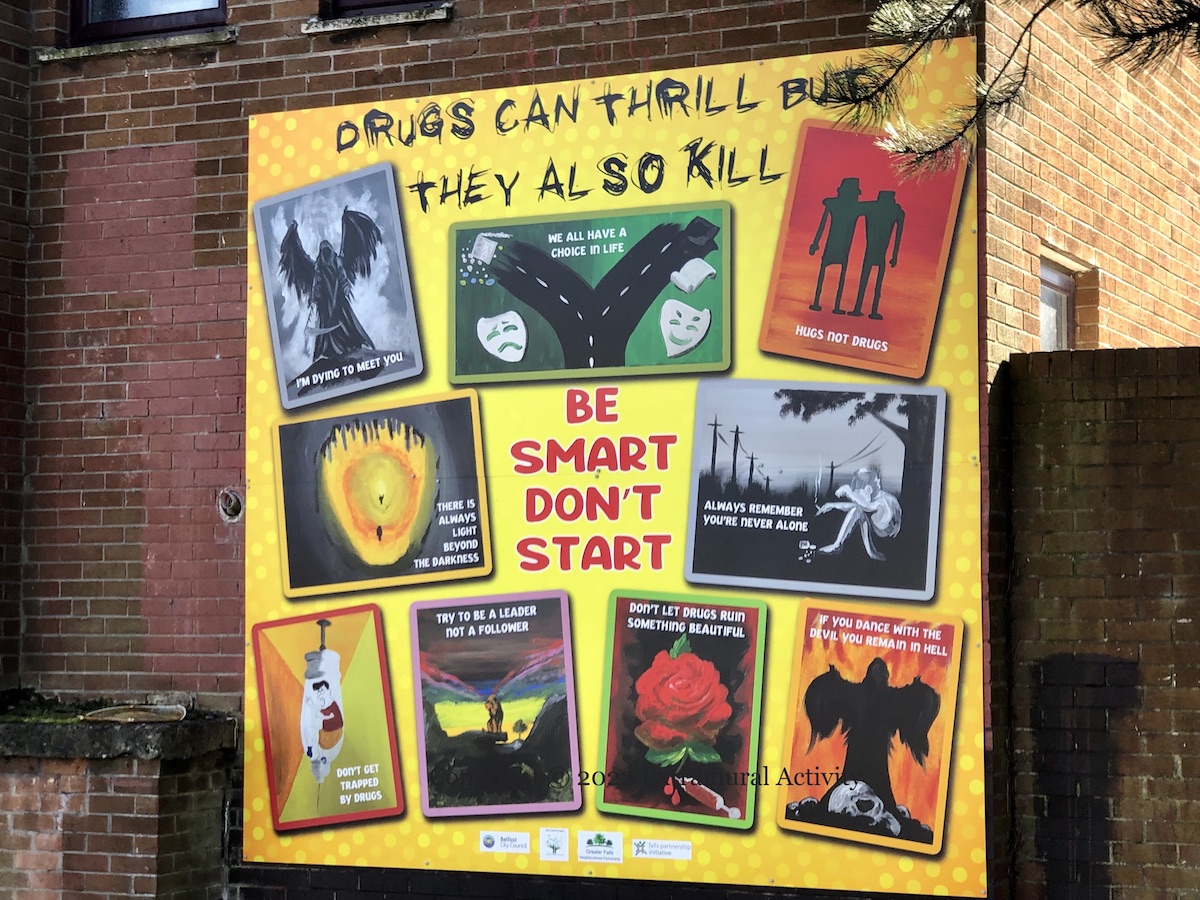
“Be smart, don’t start” – taking drugs, that is. This is a recent mural on the Falls Road, Belfast, with nine panels that discourage youth from taking drugs, alternately by reminding them of their dangers (including death – “Drugs can thrill but they also kill.” “I’m dying to meet you.” “If you dance with the devil you remain in hell.” “Don’t let drugs ruin something beautiful.” “Don’t get trapped by drugs.”) and providing support in persevering through dark times (“There is always light beyond the darkness.” “We all have a choice in life.” “Hugs not drugs.” “Always remember you’re never alone.” “Try to be leader not a follower.”)
The house in Ebrington Terrace that had been home to an Eddie mural for many years was torn down last summer (see final image for the hoarding around the site of the absent gable); it had been used since at least 1982 for images of the Commonwealth, King Billy, and, since 1996, Eddie The Trooper.
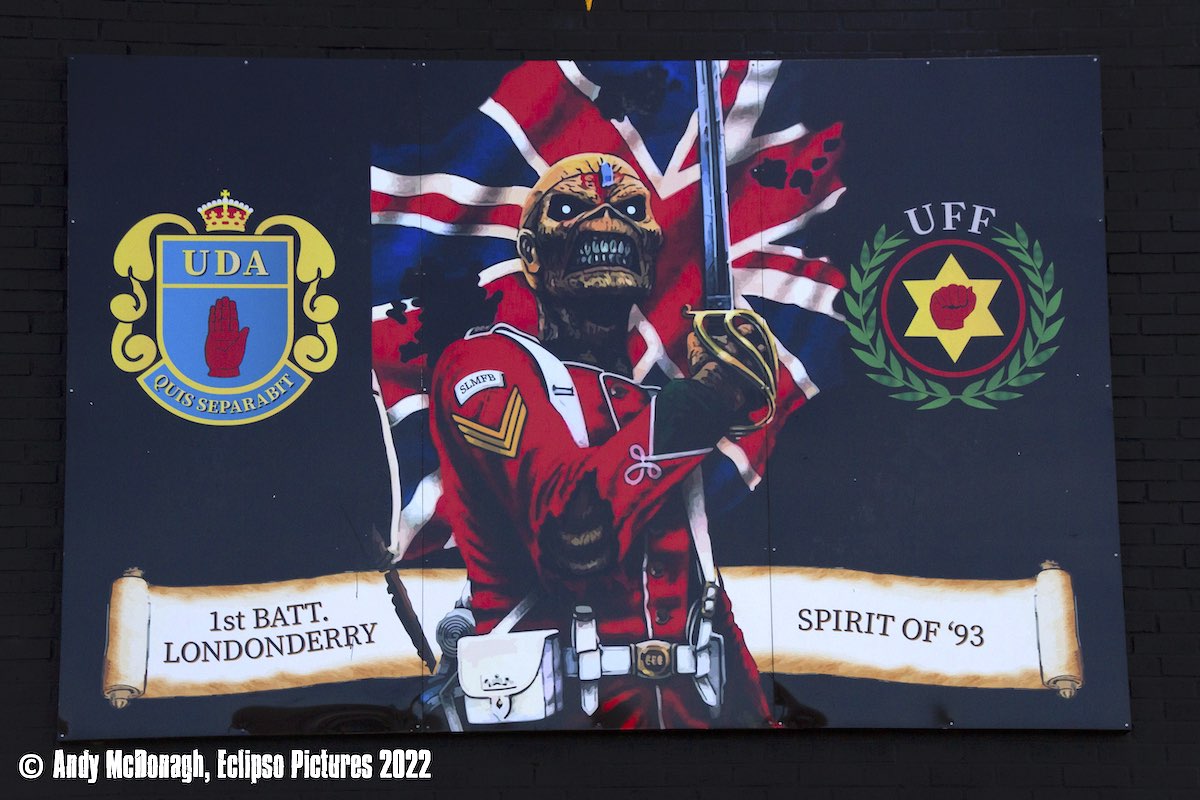
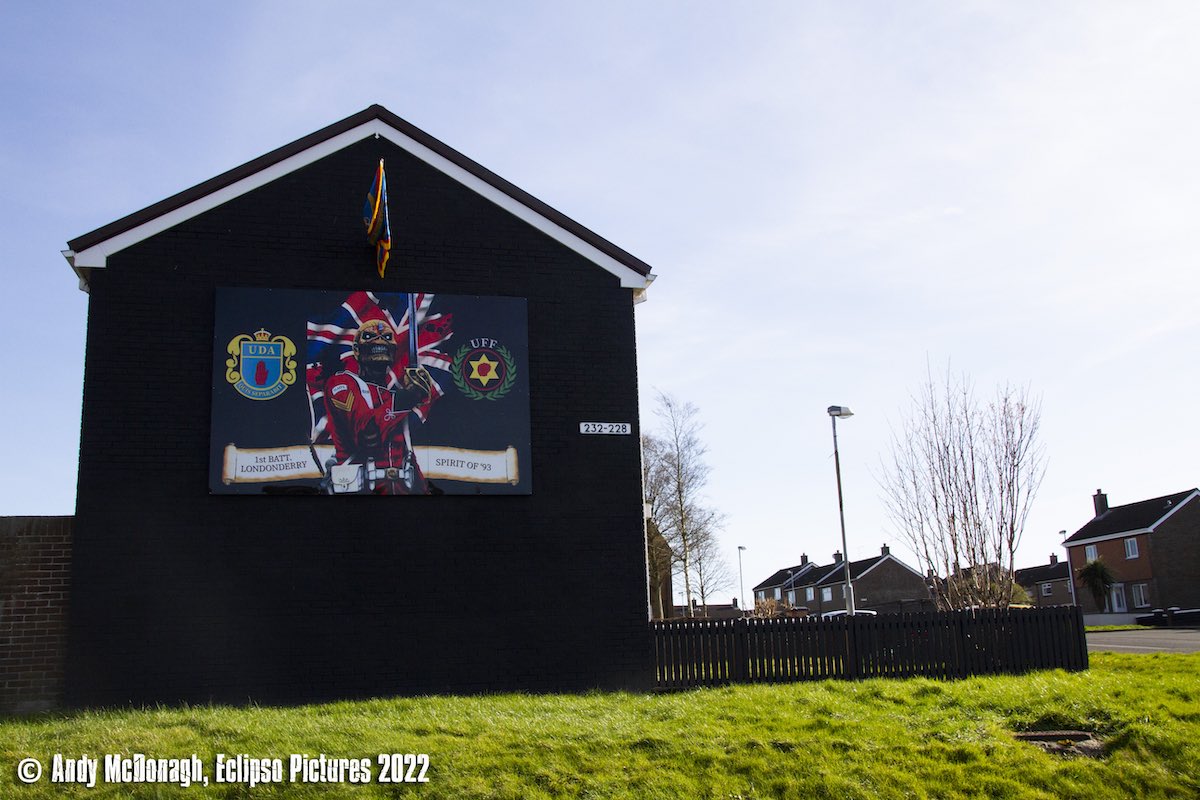
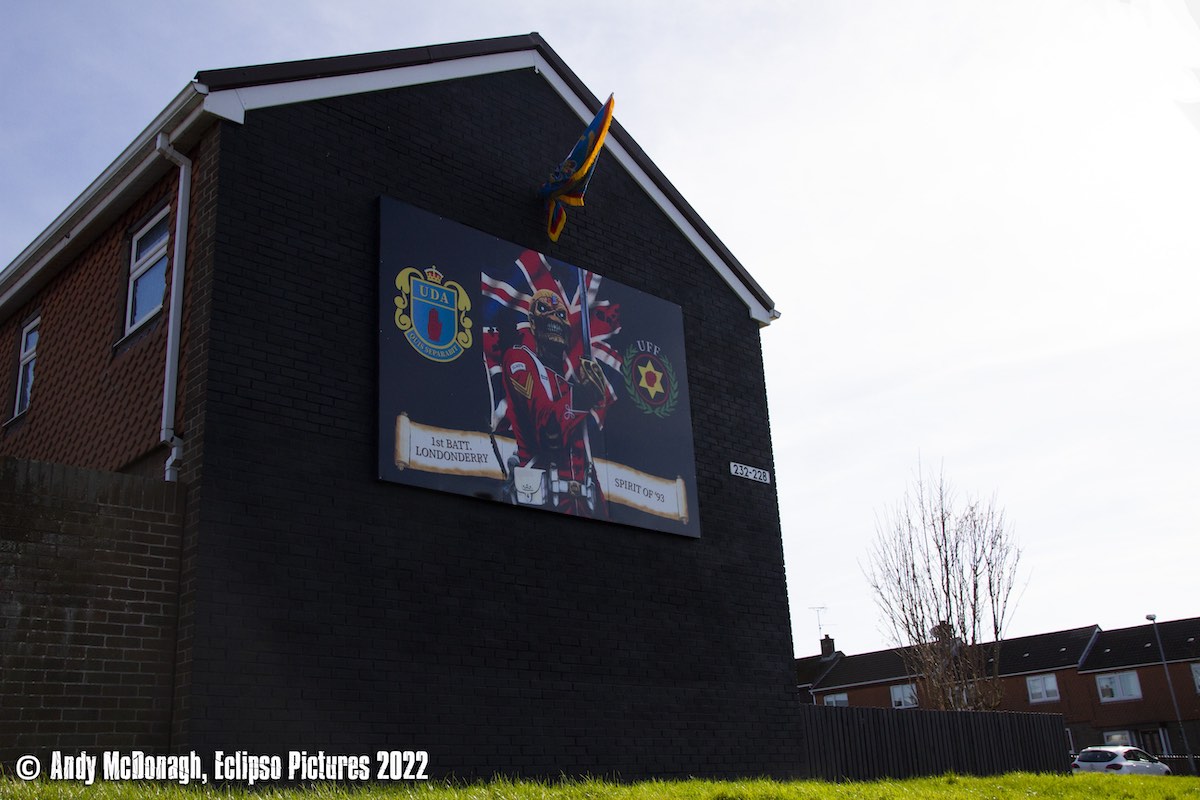
The final Eddie board that was on the wall has been moved (or repeated) one neighbourhood over, into Lincoln Court. It was the first to include the words “Spirit Of ’93” – presumably a reference to the Greysteel Massacre in which eight people in the Rising Sun bar were killed in reprisal for the Shankill Bombing (BelTel). The “raid” was planned in – and both gunmen rented rooms at – the UDP office on Bond’s Place, just across Bonds Street (NI Judiciary).
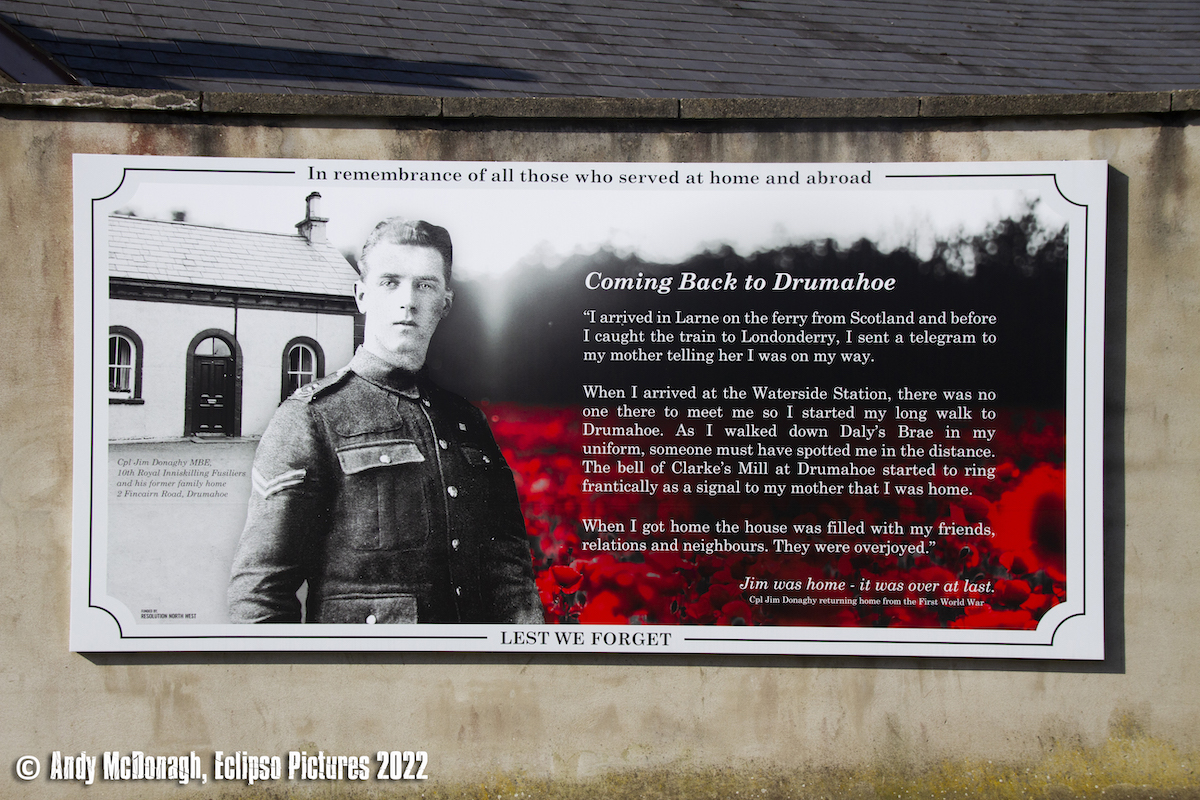
Jim Donaghy was born in the Bonds area of the Waterside but when he joined the 10th (Derry) Battalion his family was living in Drumahoe. It was to there that he returned after seeing action at The Battle Of Albert in 1916, as well as the Battle of Messines, the Battle of Langemarck, the Cambrai Operations, and the Capture Of Bourlon Wood (Reserves & Cadets | Three Cheers For The Derrys).
“”I arrived in Larne on the ferry from Scotland and before I caught the train to Londonderry, I sent a telegram to my mother telling her I was on my way. When I arrived in Waterside Station, there was no one there to meet me so I started my long walk to Drumahoe. As I walked down Daly’s Brae in my uniform, someone must have spotted me in the distance. The bell of Clarke’s Mill at Drumahoe started to ring frantically to my mother that I was home. When I got home the house was filled with my friends, relations and neighbours. They were overjoyed.” – Jim was home – it was over at least. Cpl Jim Donaghy returning home from the First World War.”
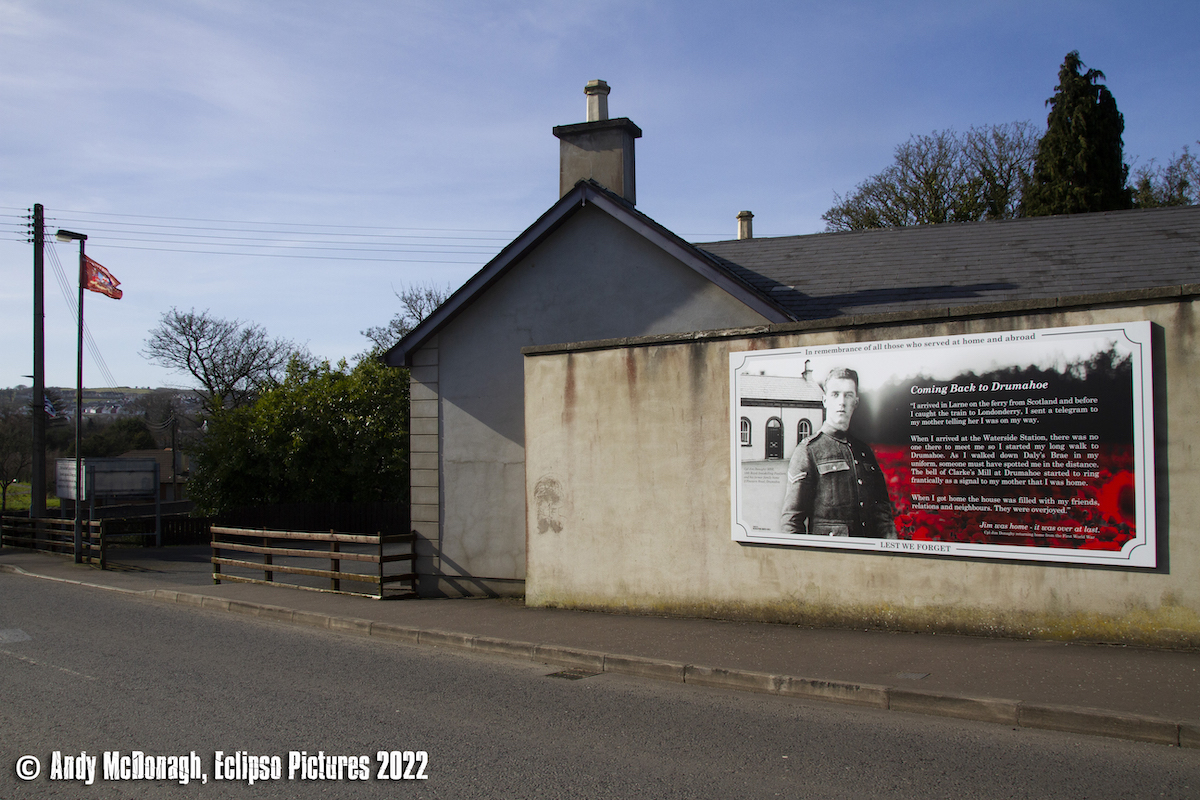
“Cpl Jim Donaghy MBE, 10th Royal Inniskilling Fusiliers and his former family home 2 Fincairn Road, Drumahoe.” The mural is on the yard wall of the house, which still stands.
“In remembrance of all those who served at home and abroad.”
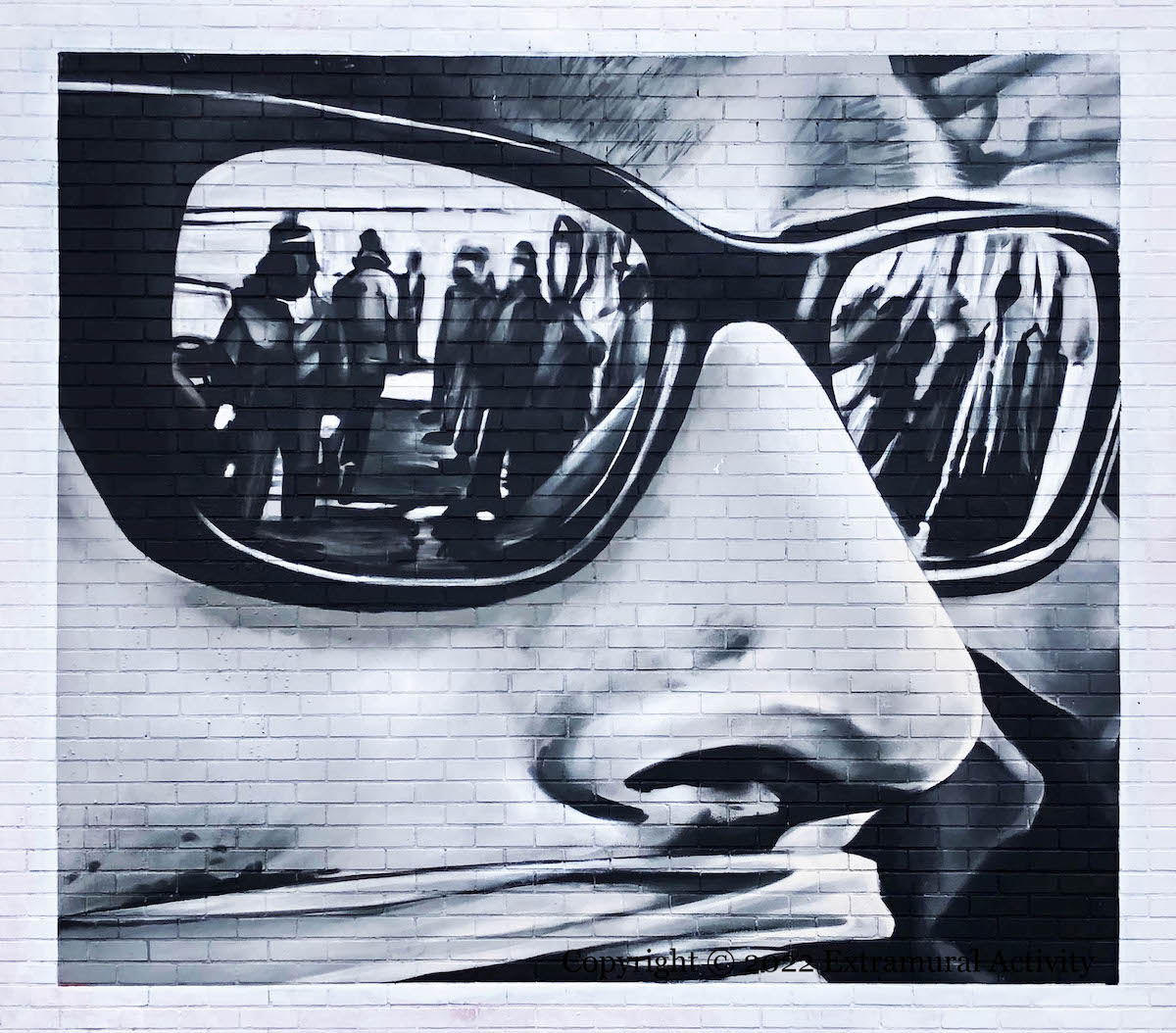
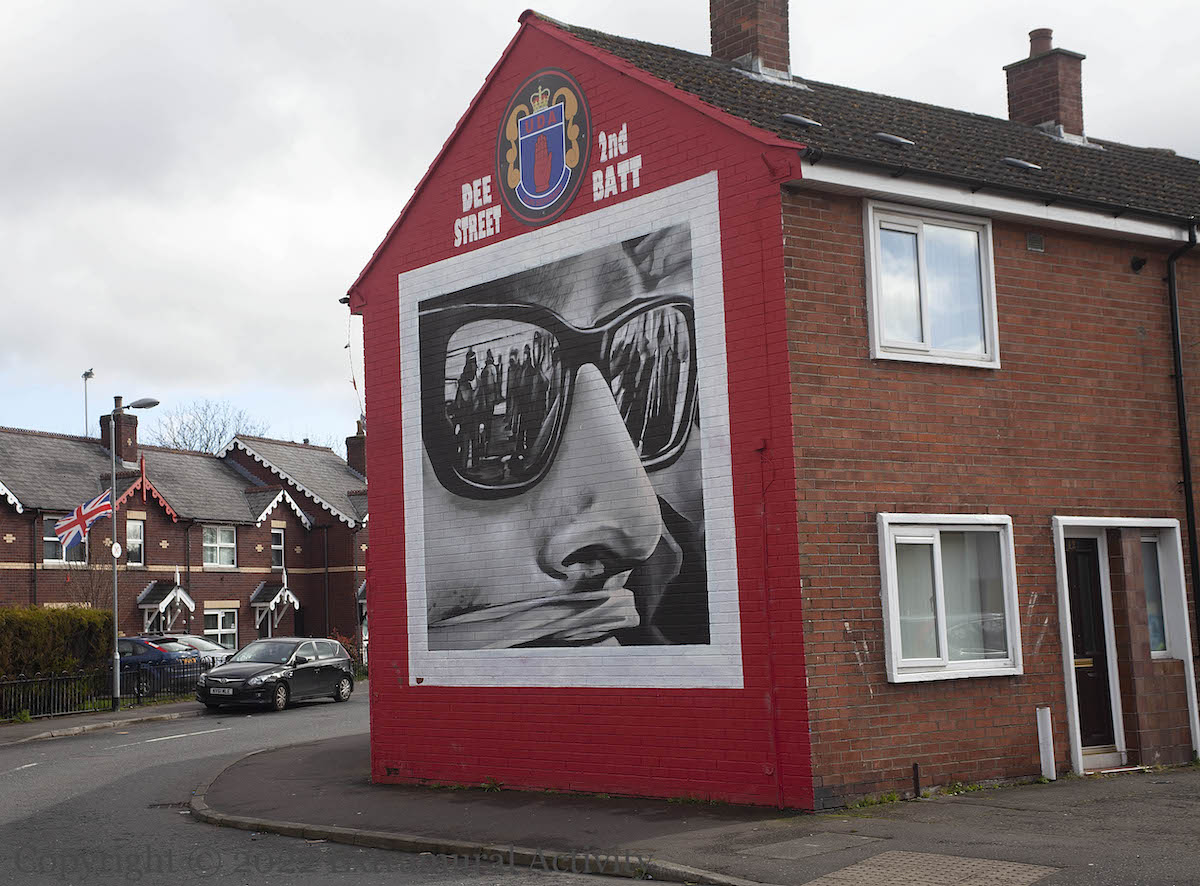
Perhaps because of the Covid pandemic, this mural of UDA volunteers on parade reflected in the sunglasses of one of their comrades took months to complete (it was started in late 2020 and was still unfinished last summer). It replaces the previous “UFF Formed 1973” mural – see Northern Island.
The photograph reproduced is from the 1974 Ulster Workers’ Strike; it appeared on the cover of Don Anderson’s Fourteen May Days (CAIN).
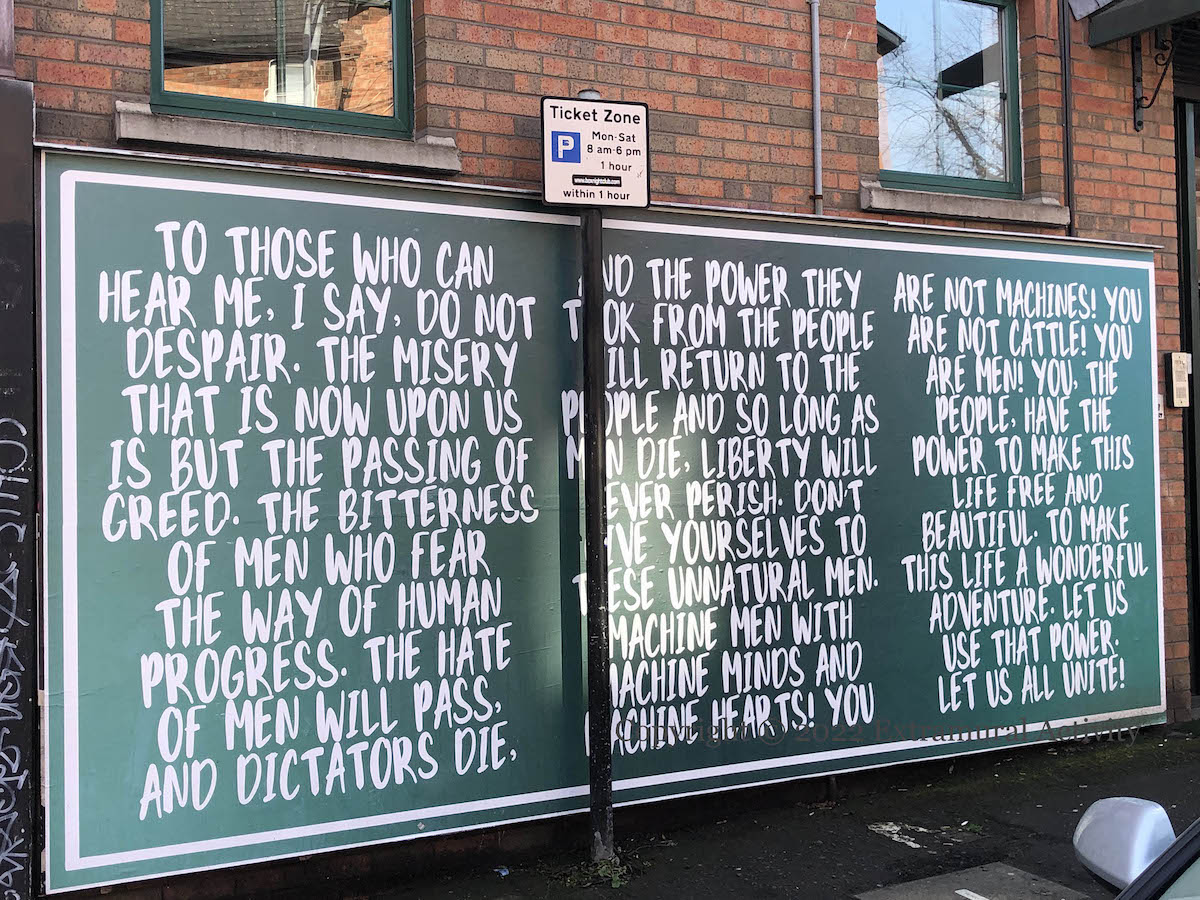
Chaplin’s first “talkie” was The Great Dictator in 1940, a satirical condemnation of Hitler (Adenoid Hynkel) and Mussolini (Benzino Napaloni). Towards the end, the Jewish barber impersonates Hynkel and gives a speech (youtube) in favour of liberty and democracy:
“To those who can hear me, I say, do not despair. The misery that is now upon us is but the passing of greed. The bitterness of men who fear the way of human progress. The hate of men will pass, and dictators die, and the power they took from the people will return to the people and so long as men die, liberty will never perish. [Soldiers, don’t give yourselves to brutes, men who despise you, enslave you, who regiment your lives, tell you what to do, what to think and what to feel! Who drill you, diet you, treat you like cattle, use you as cannon fodder.] Don’t give yourselves to these unnatural men, machine men with with machine minds and machine hearts! You are not machines! You are not cattle! You are men! [You have the love of humanity in your hearts. You don’t hate. Only the unloved hate, the unloved and the unnatural. Soldiers, don’t fight for slavery! Fight for liberty! In the 17th Chapter of St Luke it is written: “the Kingdom of God is within man” – not one man nor a group of men, but in all men! In you! You, the people have the power – the power to create machines, the power to create happiness!] You, the people, have the power to make this life free and beautiful, to make this life a wonderful adventure. [Then, in the name of democracy,] let us use that power. Let us all unite!”
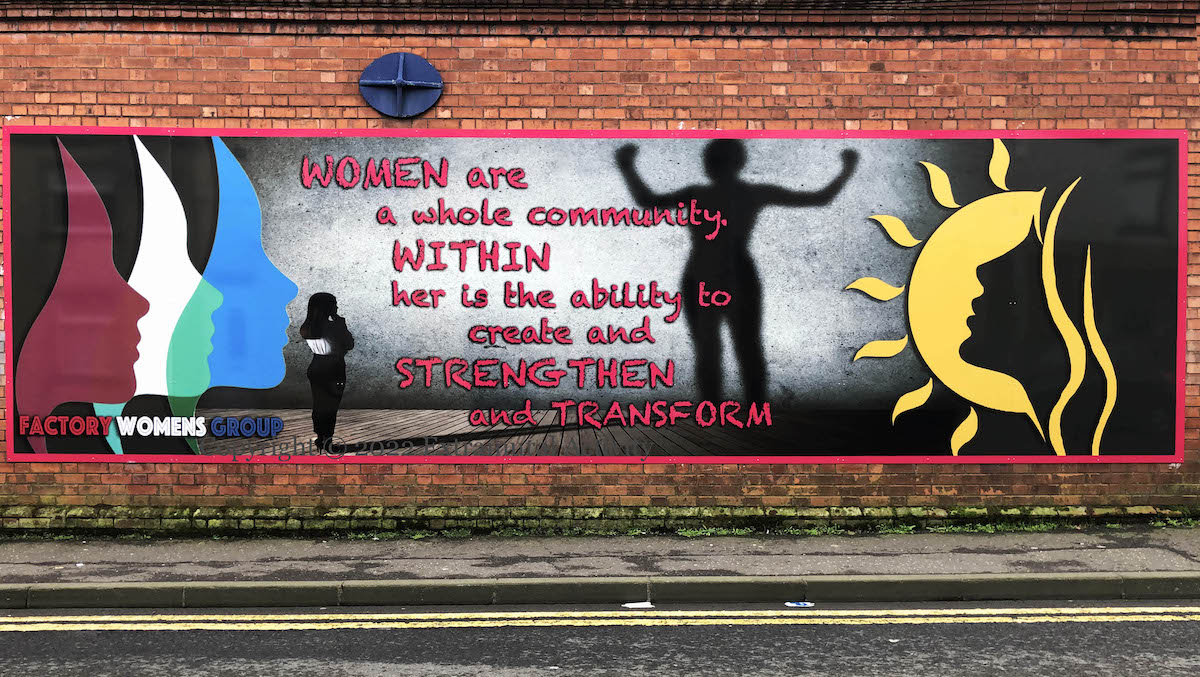
“Women are a whole community – within her is the ability to create and strengthen and transform”. The mural is part of the ‘Communities in transition’ programme from Factory Women’s Group/Factory Community Forum (web | Fb), along with the ‘Be Aware’ mephedone campaign.
Lower Waterloo Street, Larne, formerly Factory Row, site of Brown’s weaving mill.
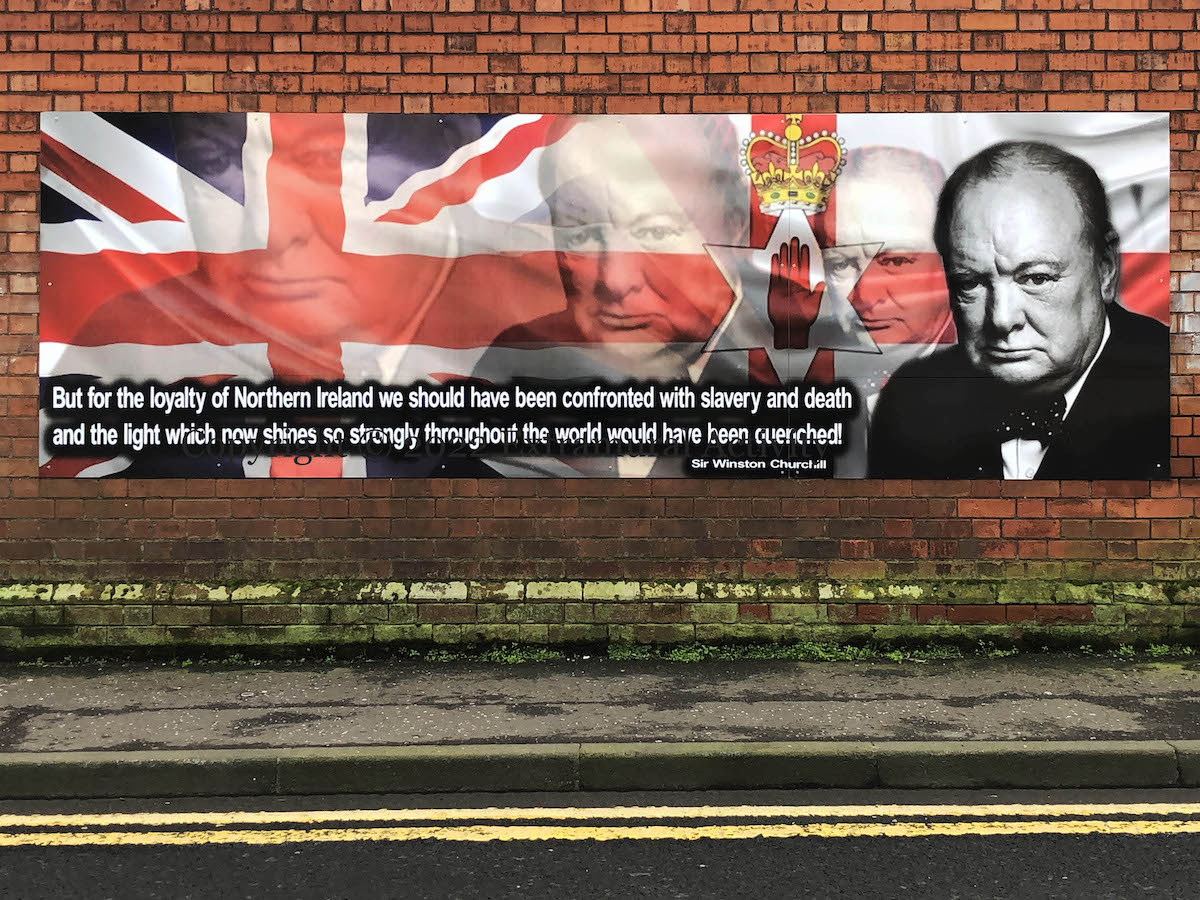
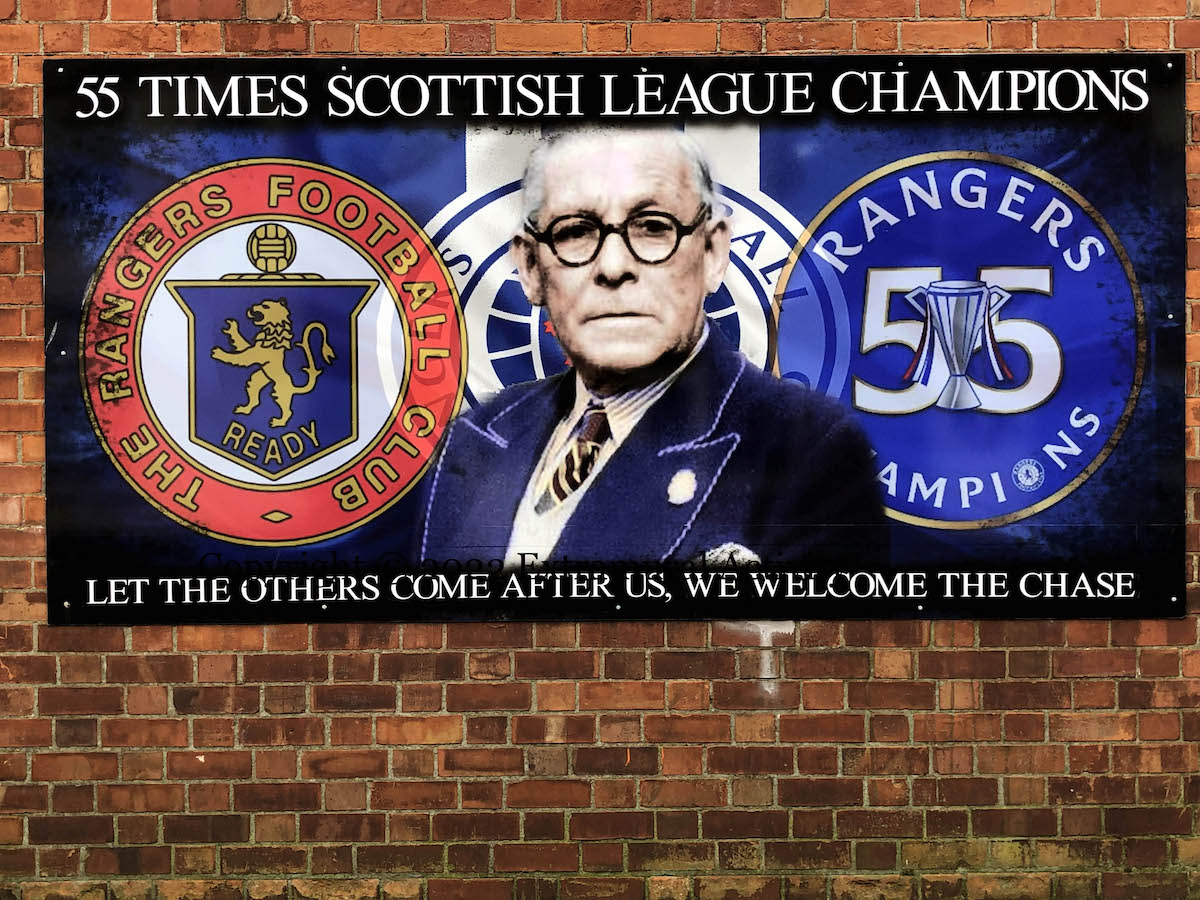
Two final pieces from Lower Waterloo Road, Larne: above, Winston Churchill, and below, Rangers. The Churchill quote comes from a letter to NI Prime Minister John Andrews when he stepped down in 1943. In full it reads “But for the loyalty of Northern Ireland [and its devotion to what has now become the cause of thirty Governments or nations,] we should have been confronted with slavery and death, and the light which now shines so strongly throughout the world would have been quenched.” Had the board been been erected more recently, it might have quoted another line from the letter: “During your Premiership the bonds of affection between Great Britain and the people of Northern Ireland have been tempered by fire, and are now, I firmly believe, unbreakable.”
Below is Walter Smith, two-time manager of Rangers, who died in 2021. See The Gaffer.
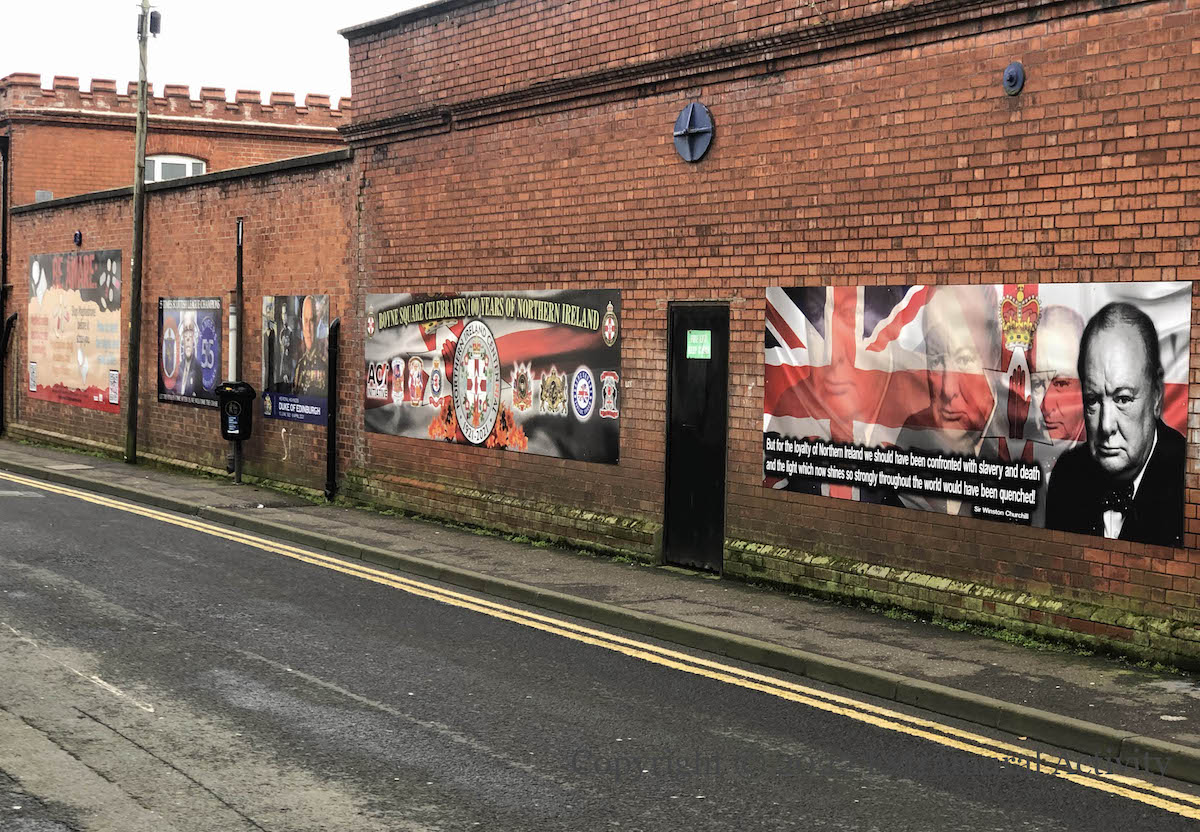
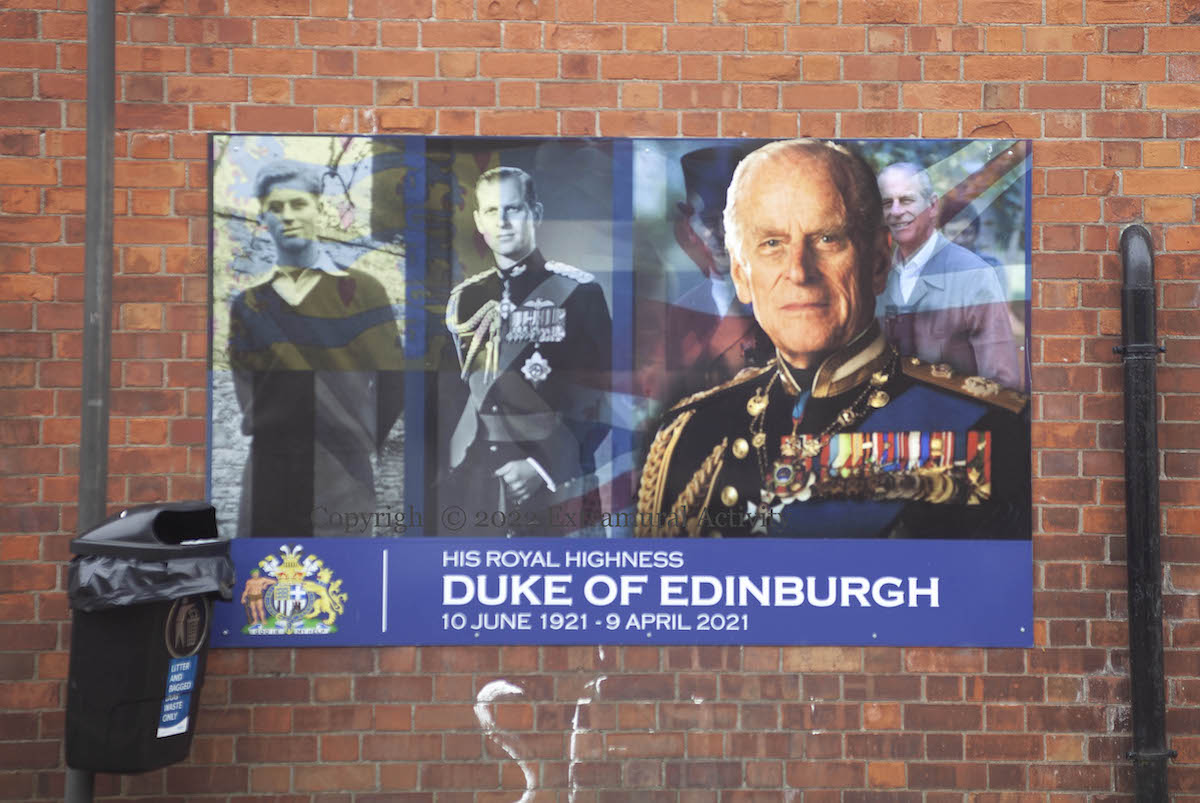
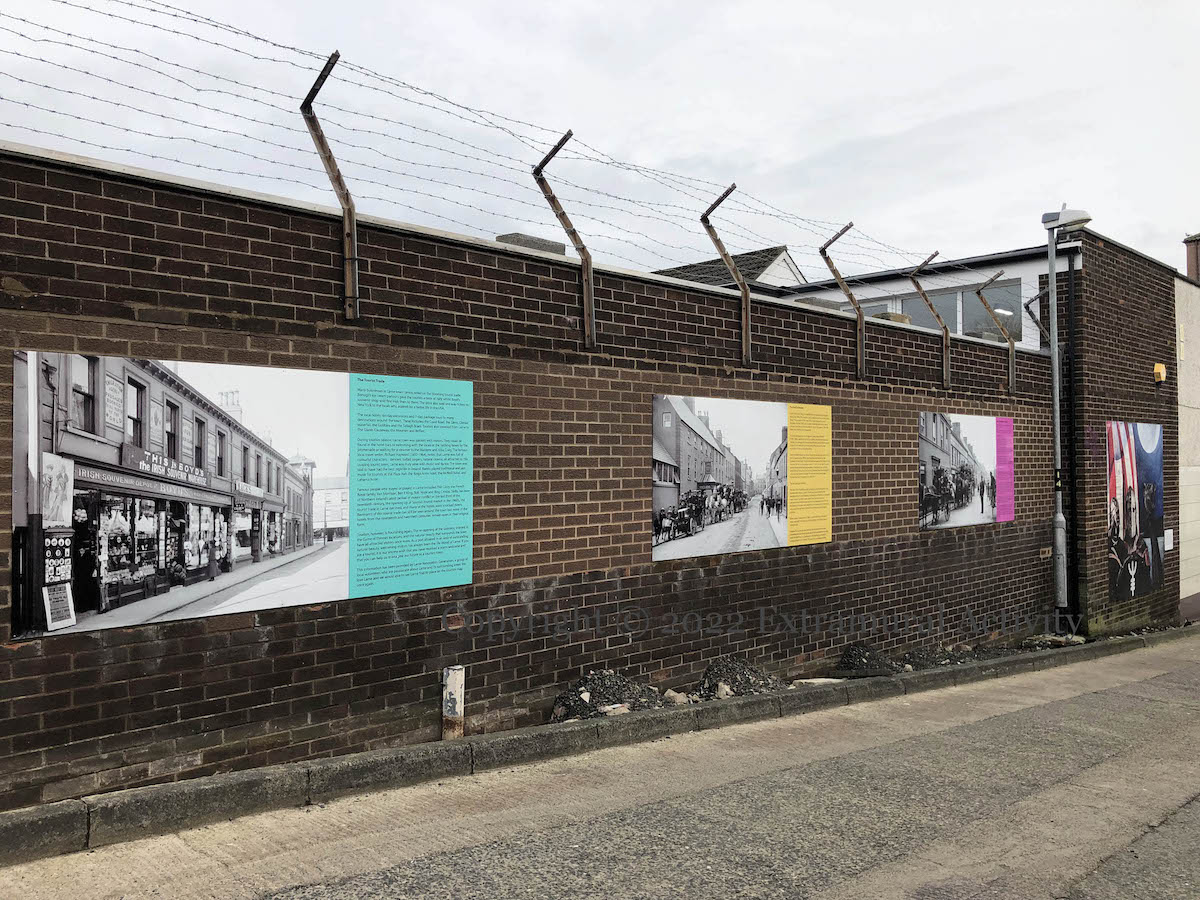
This post completes the set from Lower Waterloo Road in Larne – the wide shot shows Mephedrone to the far left; then Rangers, Duke Of Edinburgh, NI Centenary, and Churchill; Women Are A Whole Community is out of shot to the right.
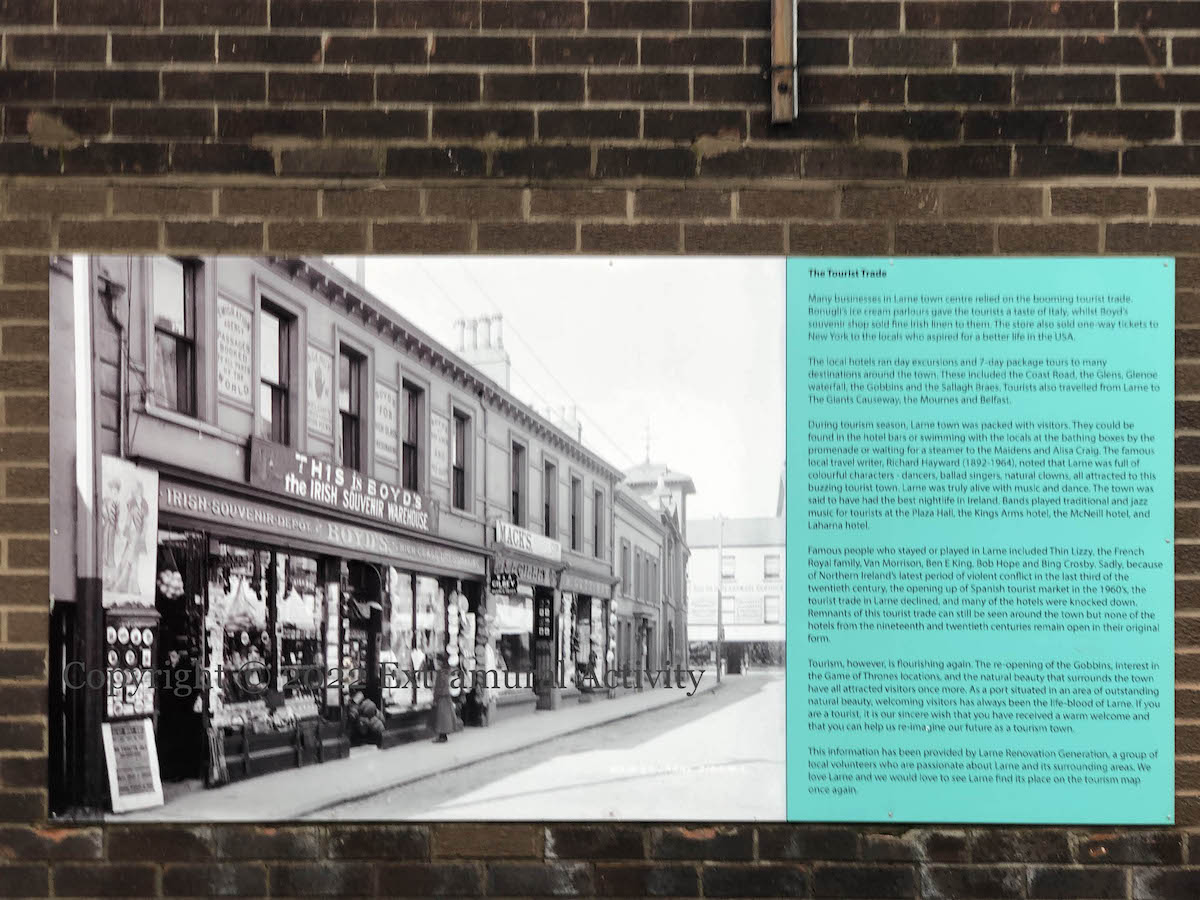
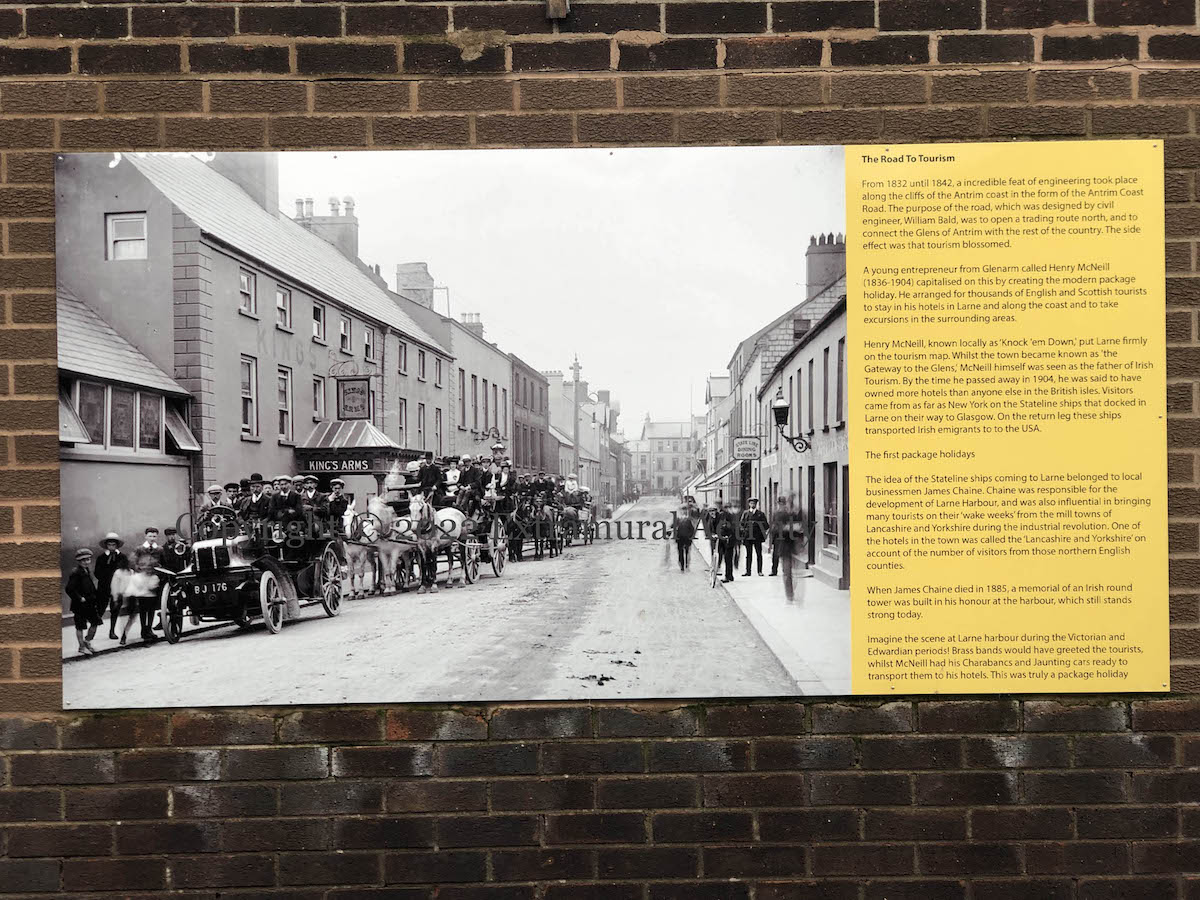
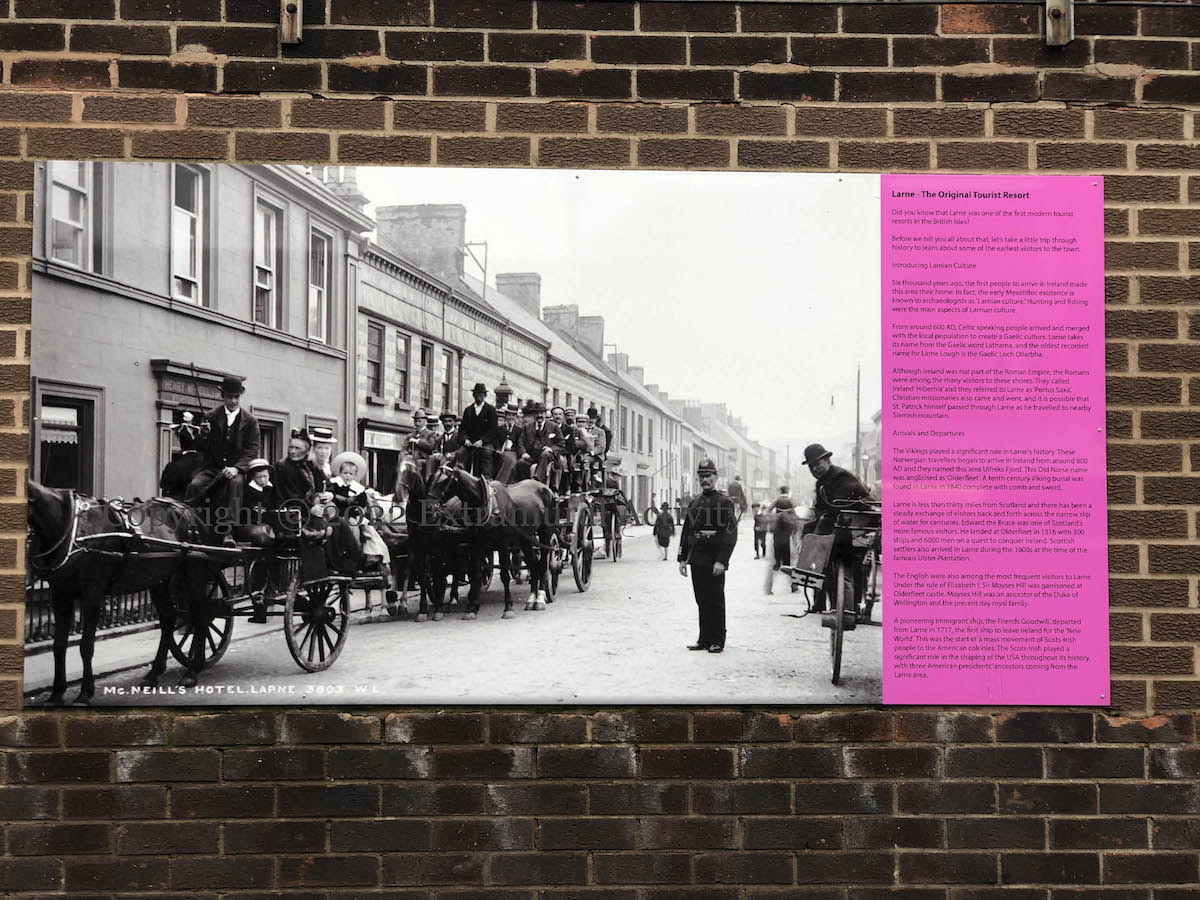
“Larne – the original tourist resort” going back to Larnians, Romans, Christians, vikings, the Scots (Edward The Bruce), the English (Sir Moyses Hill) but most particularly after 1842, when the Coast Road was finished, making Larne the “gateway to the Glens” and inspiring Henry McNeill to create the package holiday (see previously Those Magnificent Men In Their Flying Machines). Ships carrying tourists from America would ferry emigrants on the way back – Boyd’s souvenir shop (shown in the first panel, above) sold Irish linen to tourists and one-way tickets to New York. After a double whammy in the 1960s of the Troubles and easier access to Spain, “tourism is flourishing again” thanks to the Gobbins and Game Of Thrones.