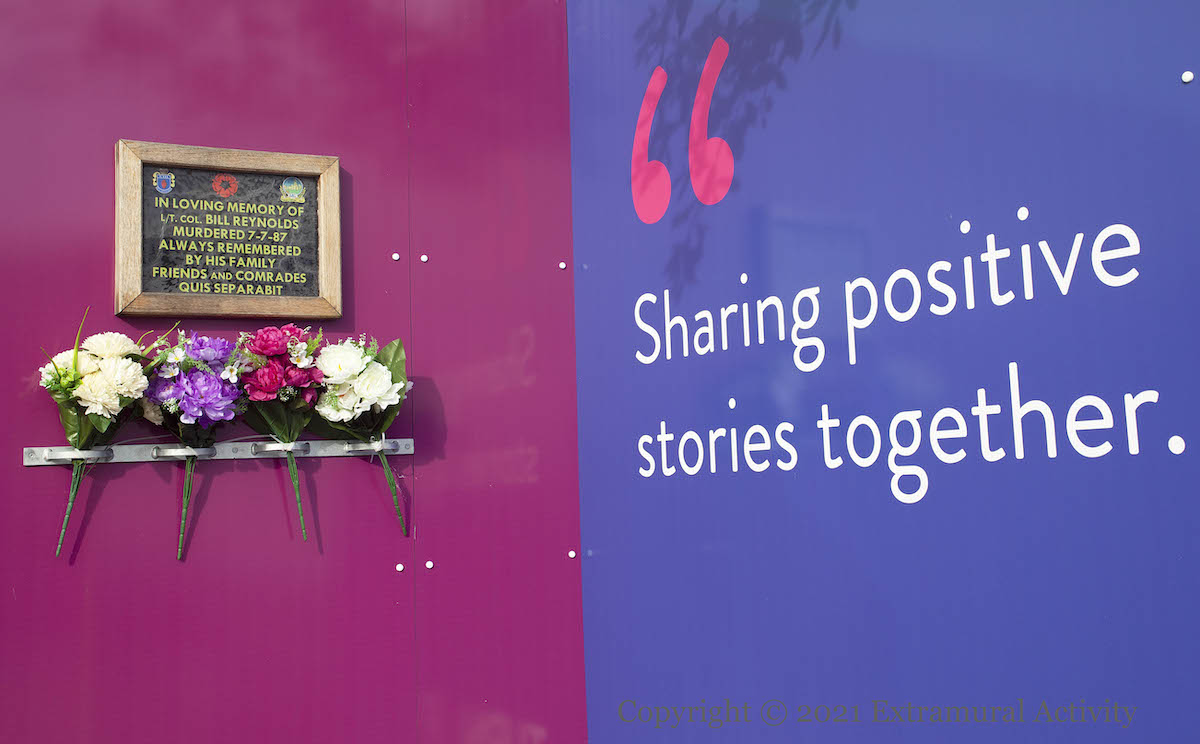
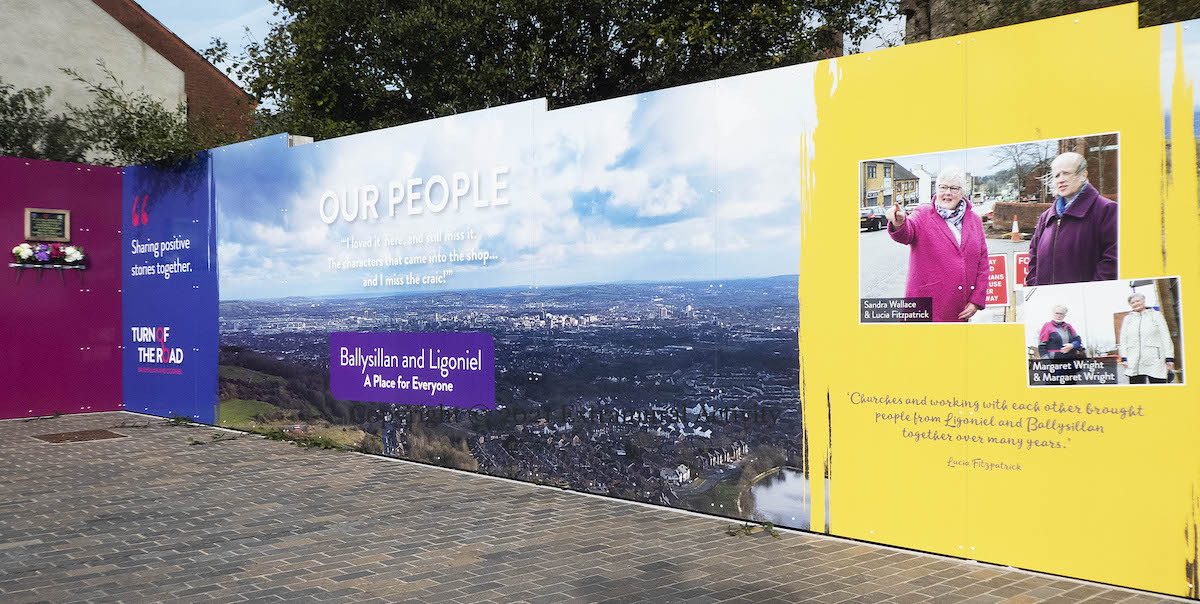
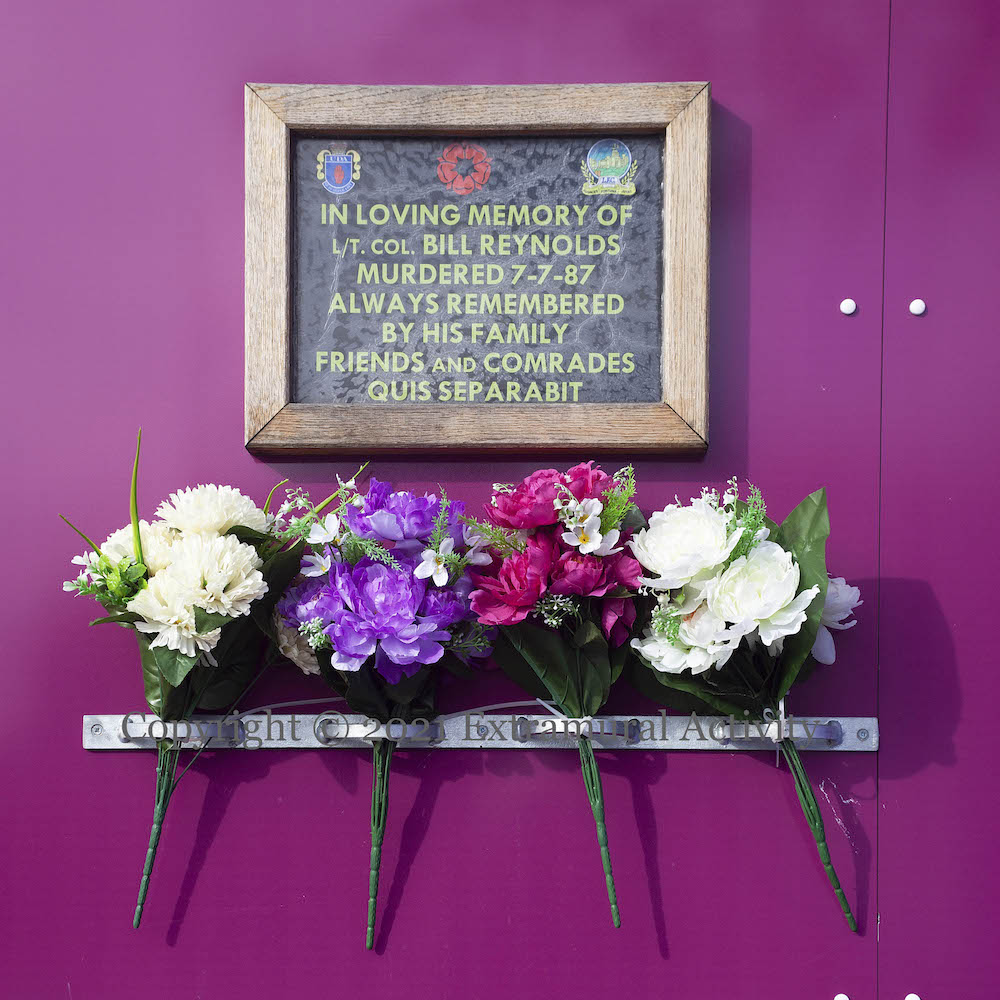
“I loved it here, and still miss it. The characters that came into the shop … and I miss the craic!” The advertising hoardings at the corner of Ligoniel and Crumlin roads have been replaced with this community alcove with pavers and a space for “sharing positive stories together” at “the turn of the road” from Ballysillan towards Ligoniel village. The plaque to the UDA’s Bill Reynolds, which stood on the building where he was killed until the building was demolished (see the old plaque) and then replaced with a new plaque next to the hoarding, has been included.
“In loving memory [UDA] Lt. Col. Bill Reynolds murdered [by the IRA] 7-7-87. Always remembered by his family, friends and comrades. Quis separabit.”
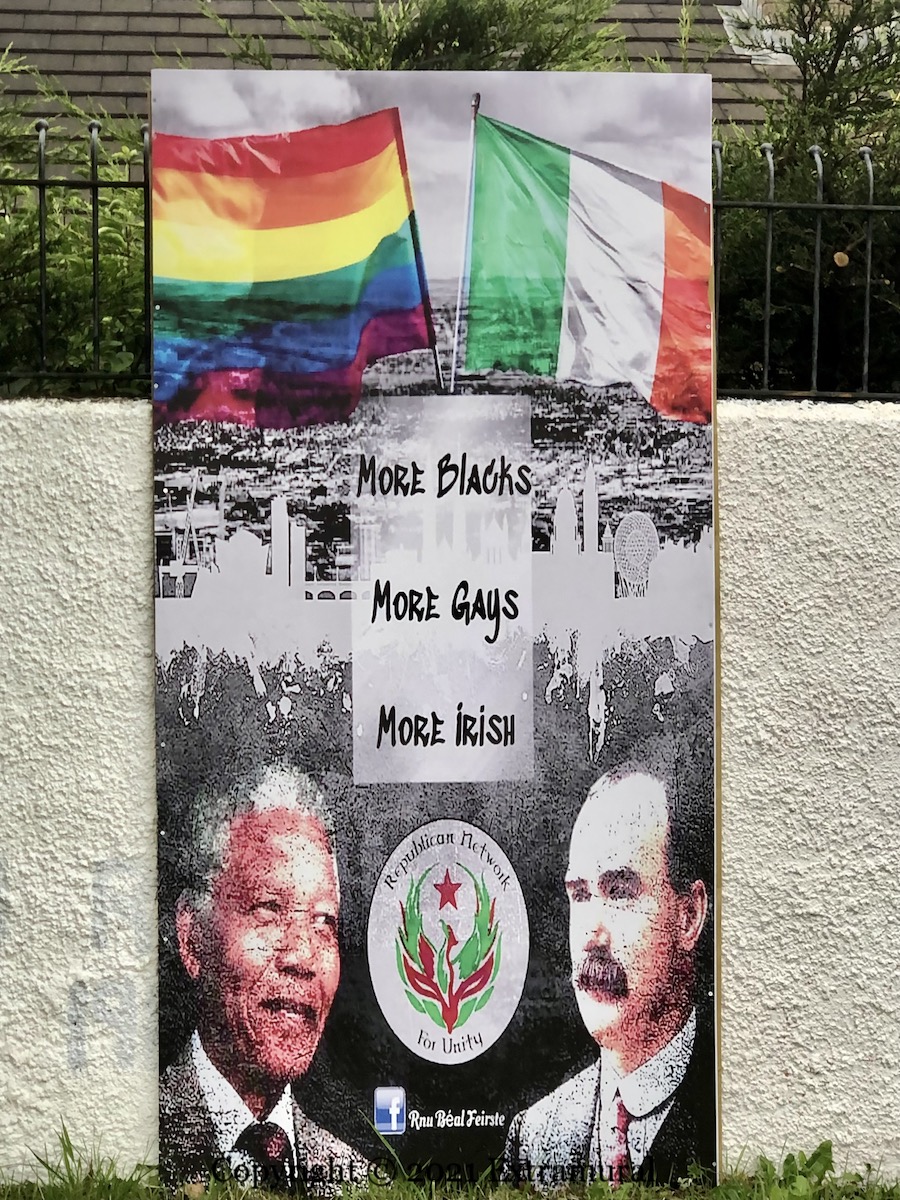
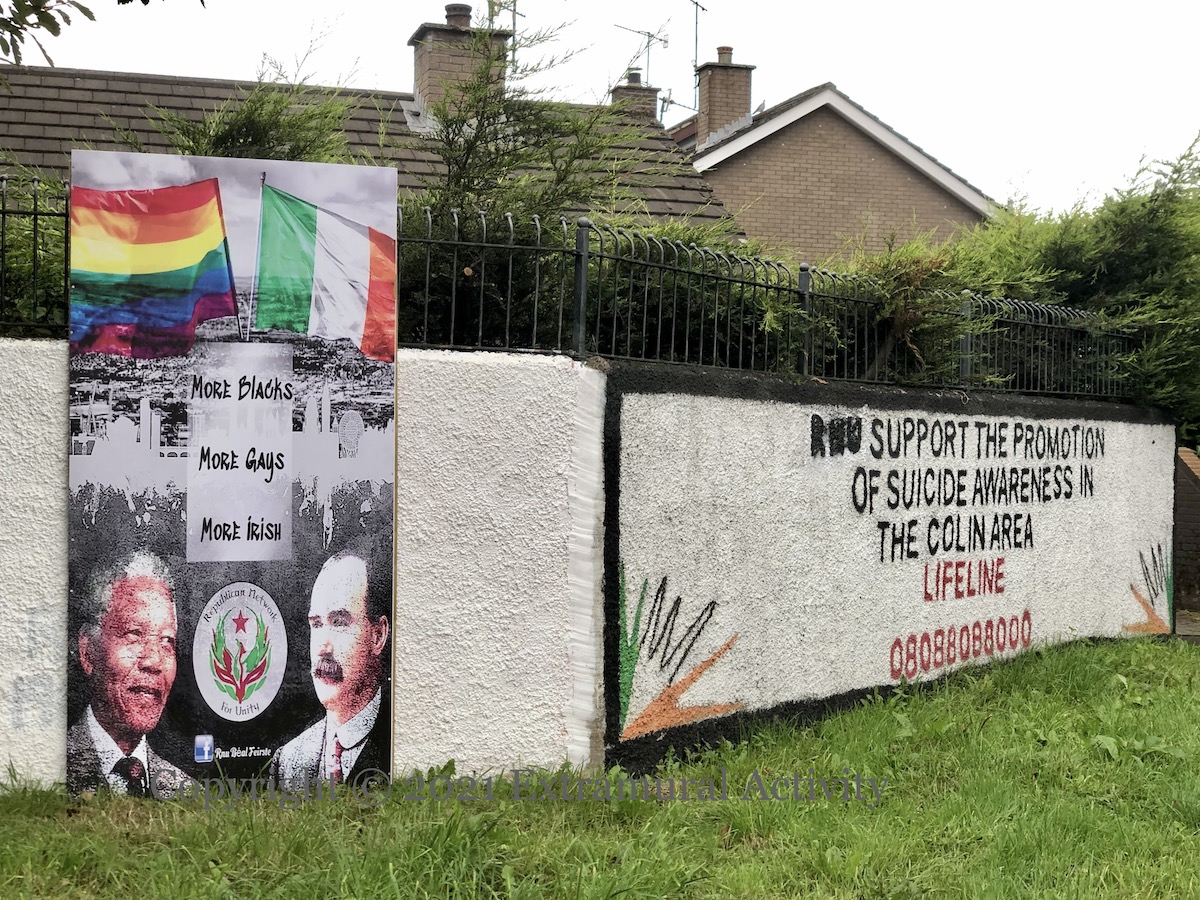
The old shop-window sign of the Irish experience in England “No blacks, no Irish, [no dogs]” is repurposed and reclaimed positively by the RNU in the Colin area, with the rainbow flag, Irish tricolour, and Nelson Mandela (alongside James Connolly) below the skyline of Belfast. For the original, see previously Oppose Racism | No Dogs, No POWs
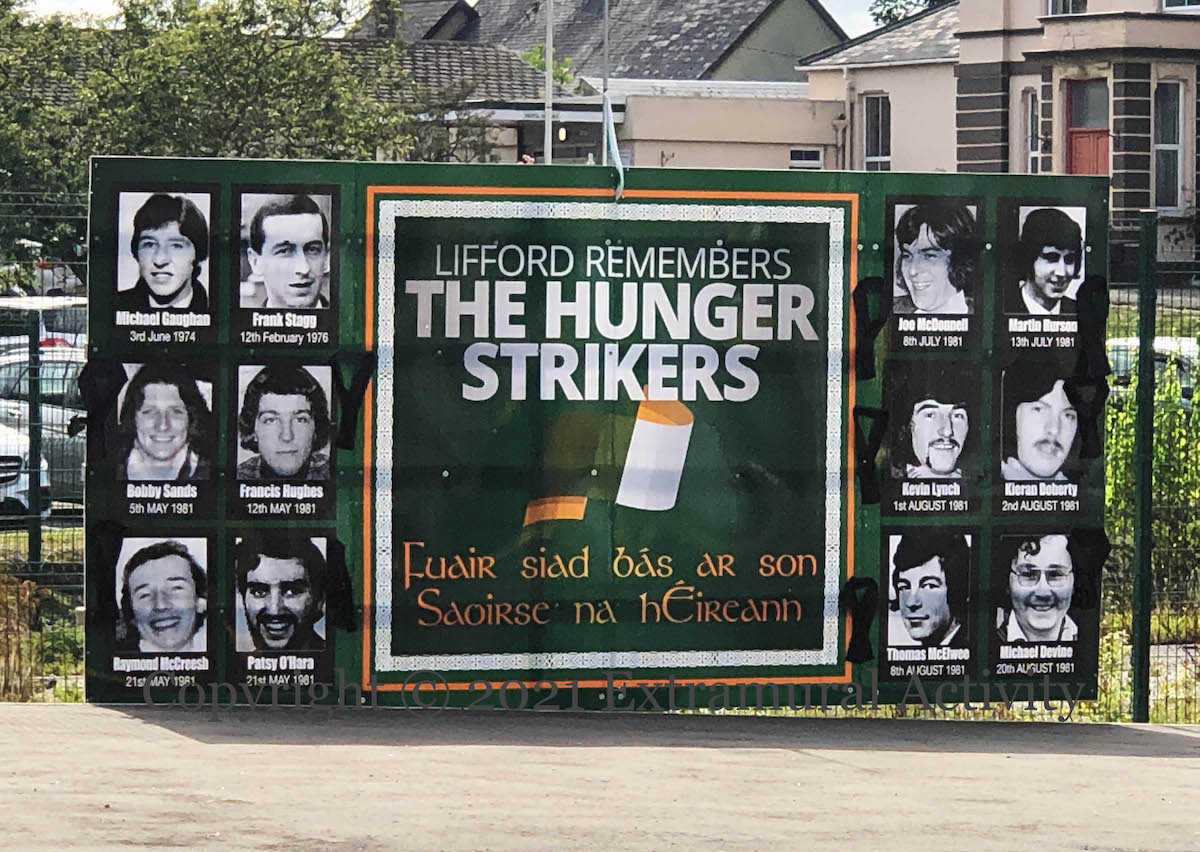
“Fuaır sıad bás ar son saoırse na hÉıreann” [they died for Ireland’s freedom] Although it’s the 40th anniversary of the 1981 hunger strike, this Lifford (Co. Donegal) board includes Michael Gaughan and Frank Stagg who died in English prisons in the 1970s.
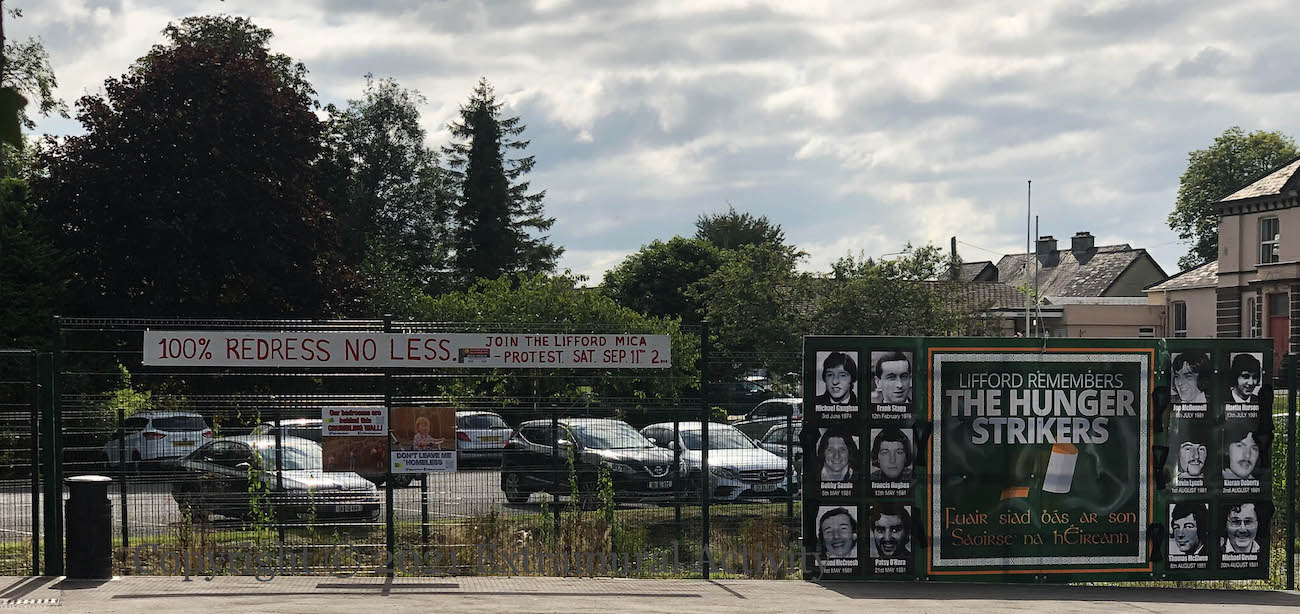
If you can explain the flag in the centre, please get in touch. The wide shot, below, includes a call to rally for 100% Redress, No Less.
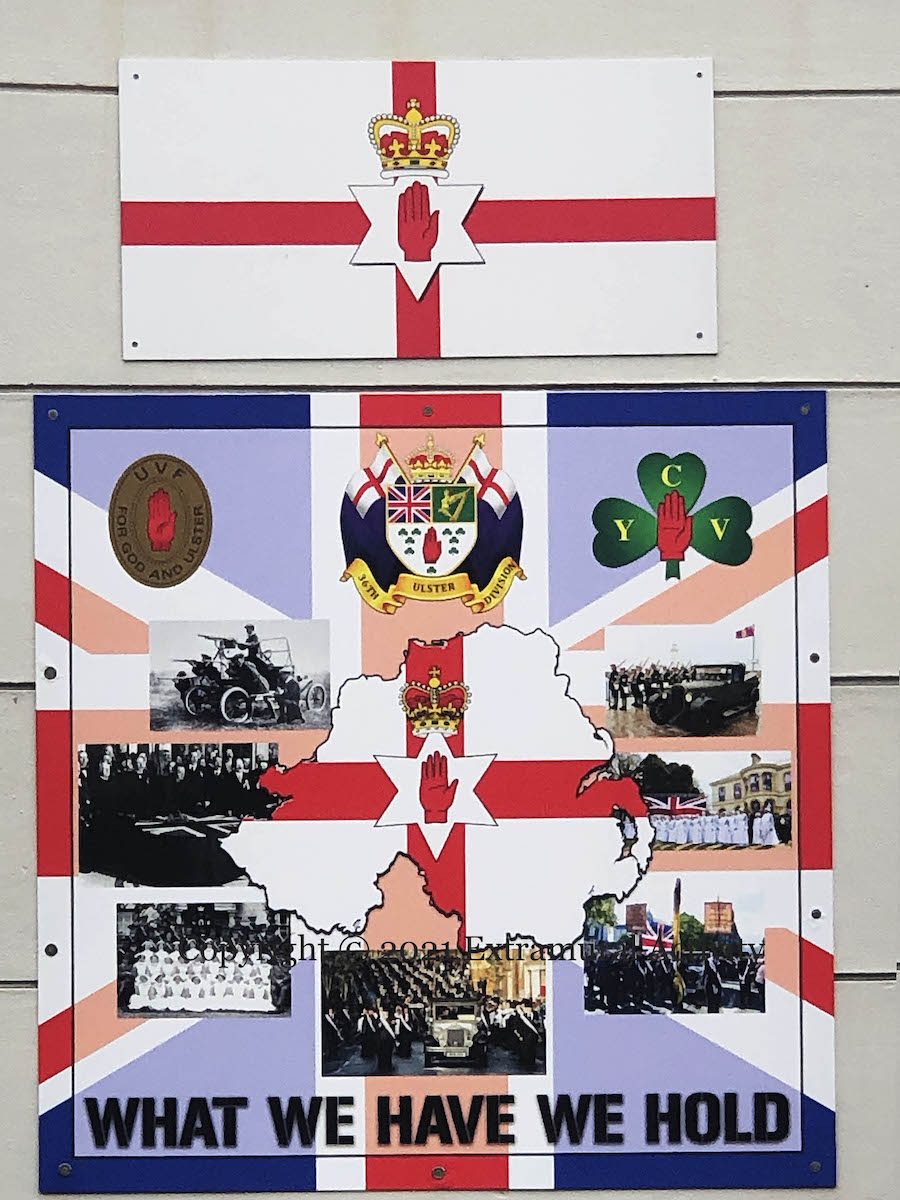
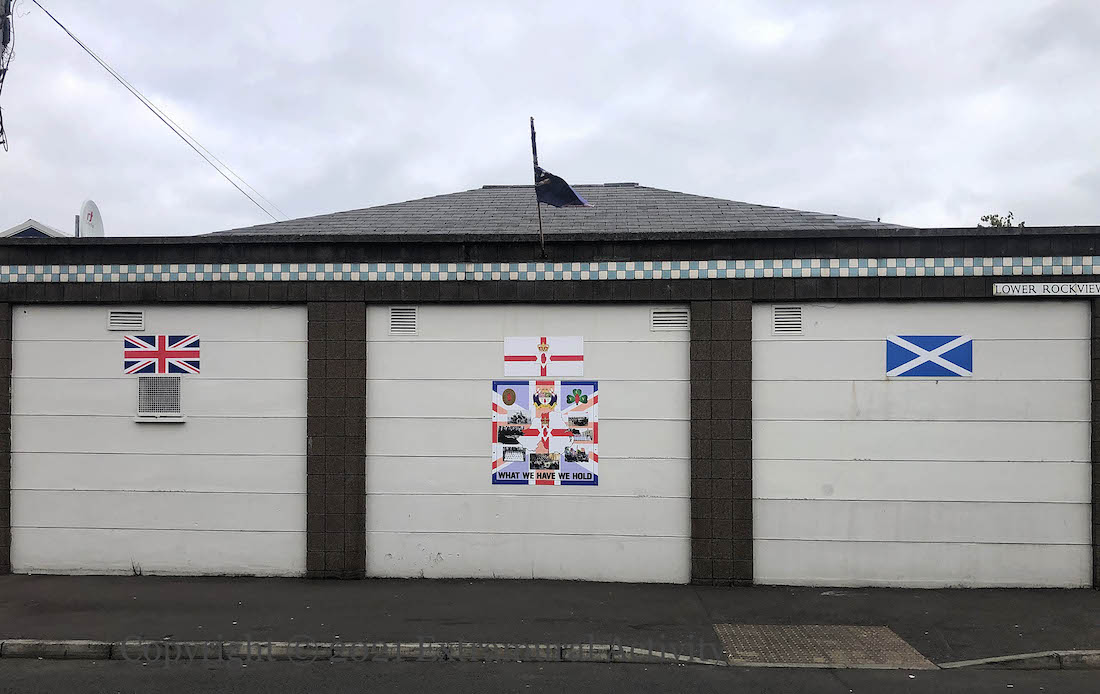
This Village board celebrates the Covenant, Ulster Volunteers, and the 36th (Ulster) Division, with photographs both vintage and contemporary.
For the photograph of Carson signing the Covenant, and an earlier mural, see Betting Office. For the photograph of the car-mounted gun, and an earlier mural recreating the photo, see UVF 75th Anniversary. For images akin to the contemporary photos, see these BelTel galleries one | two of the 100th anniversary celebrations of the Ulster Volunteers.
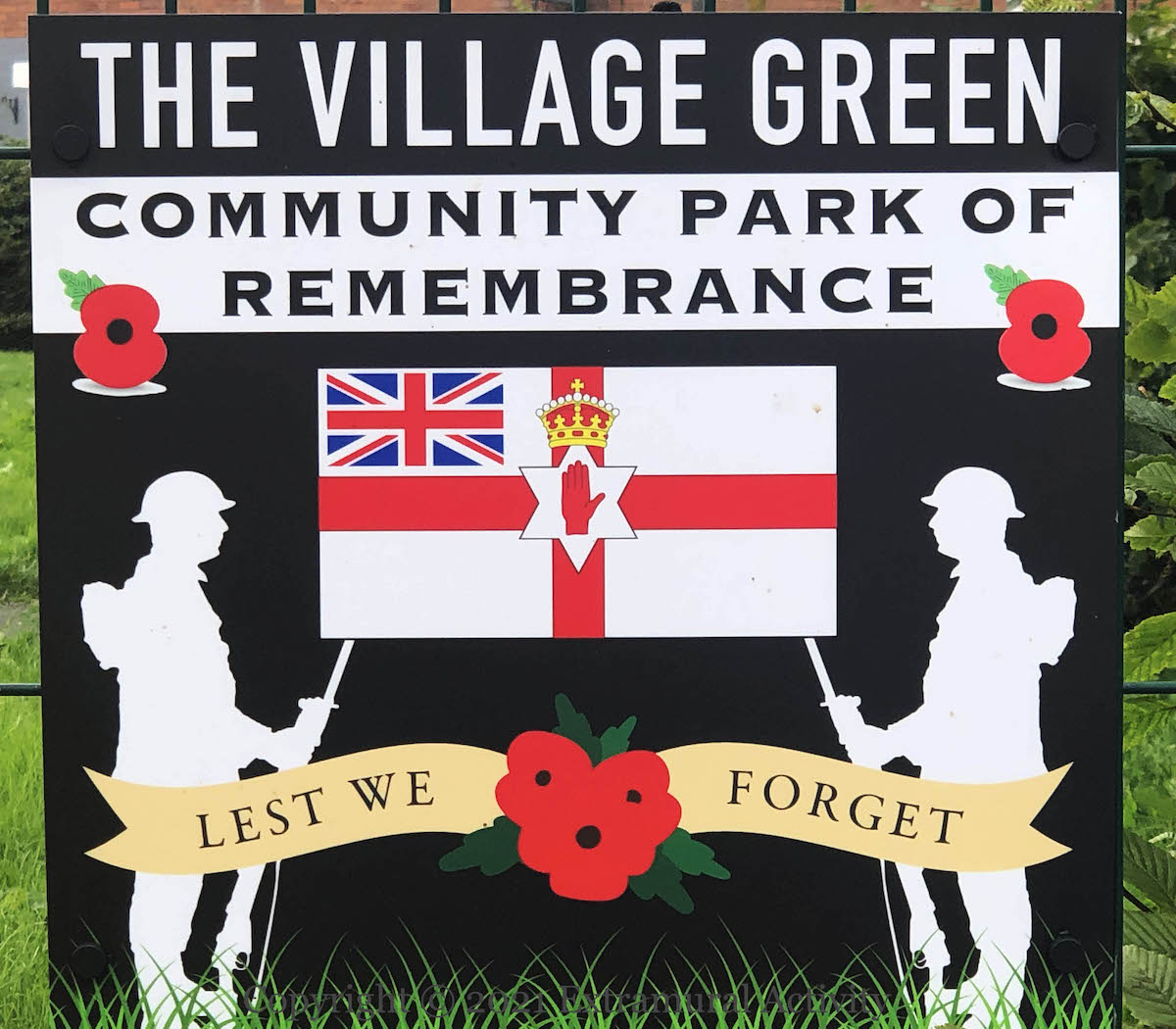
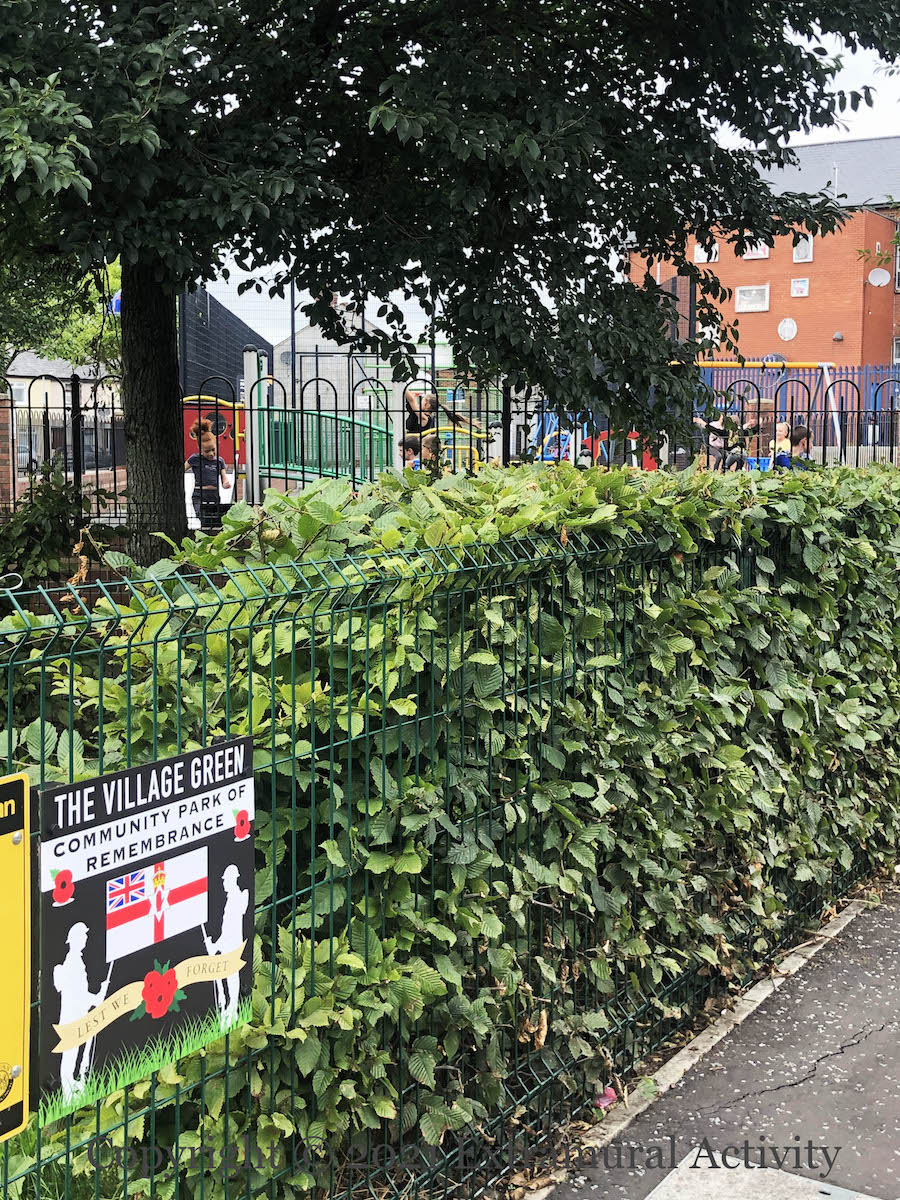
Part of the most recent development of the upper streets in the Village was not to rebuild the two rows on houses on Ebor and Nubia/Moltke streets and in their place construct a park – the Village Green – and playground. This new board on the outside railings make the park a “community park of remembrance” for WWI, showing an Ulster Banner with a Union Flag in the canton. There was formerly on this site an image of Thiepval Tower and a UVF stone.
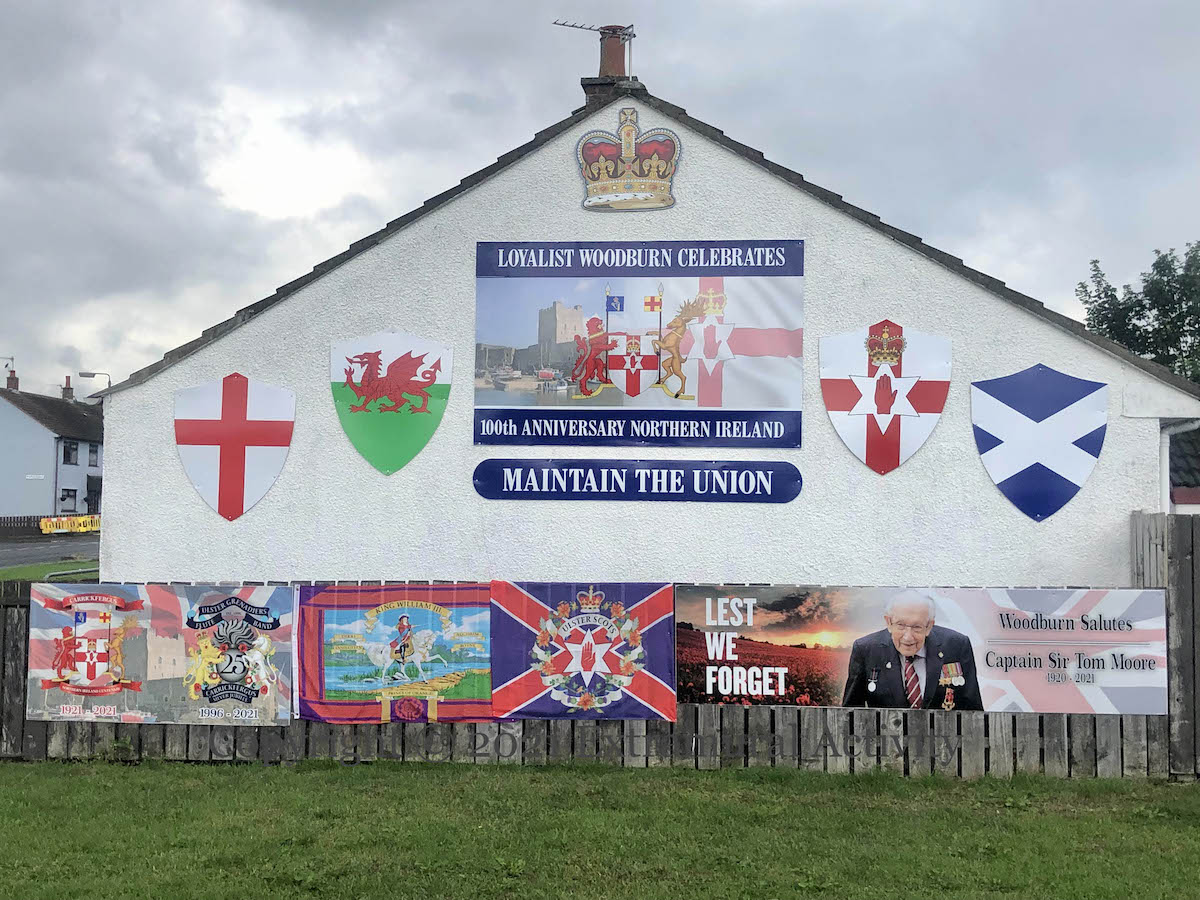
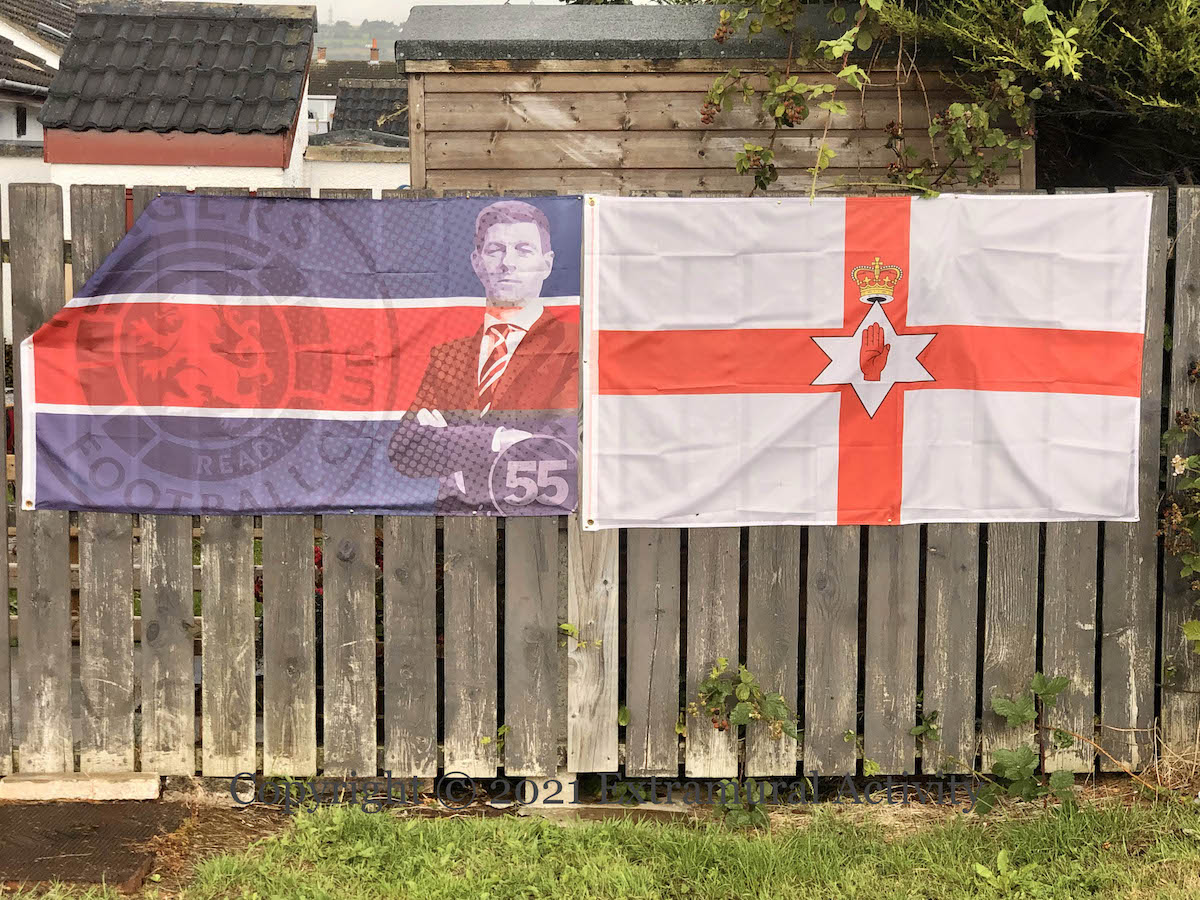
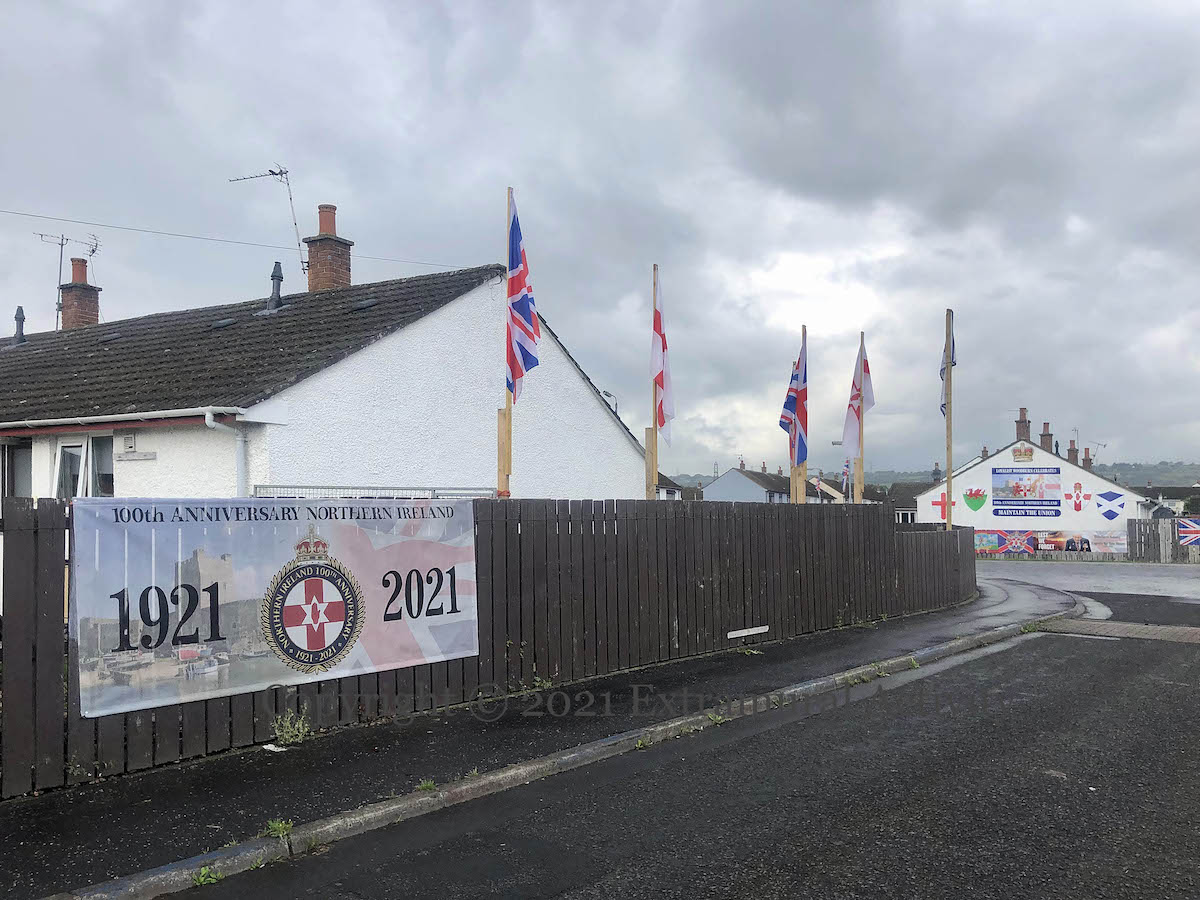
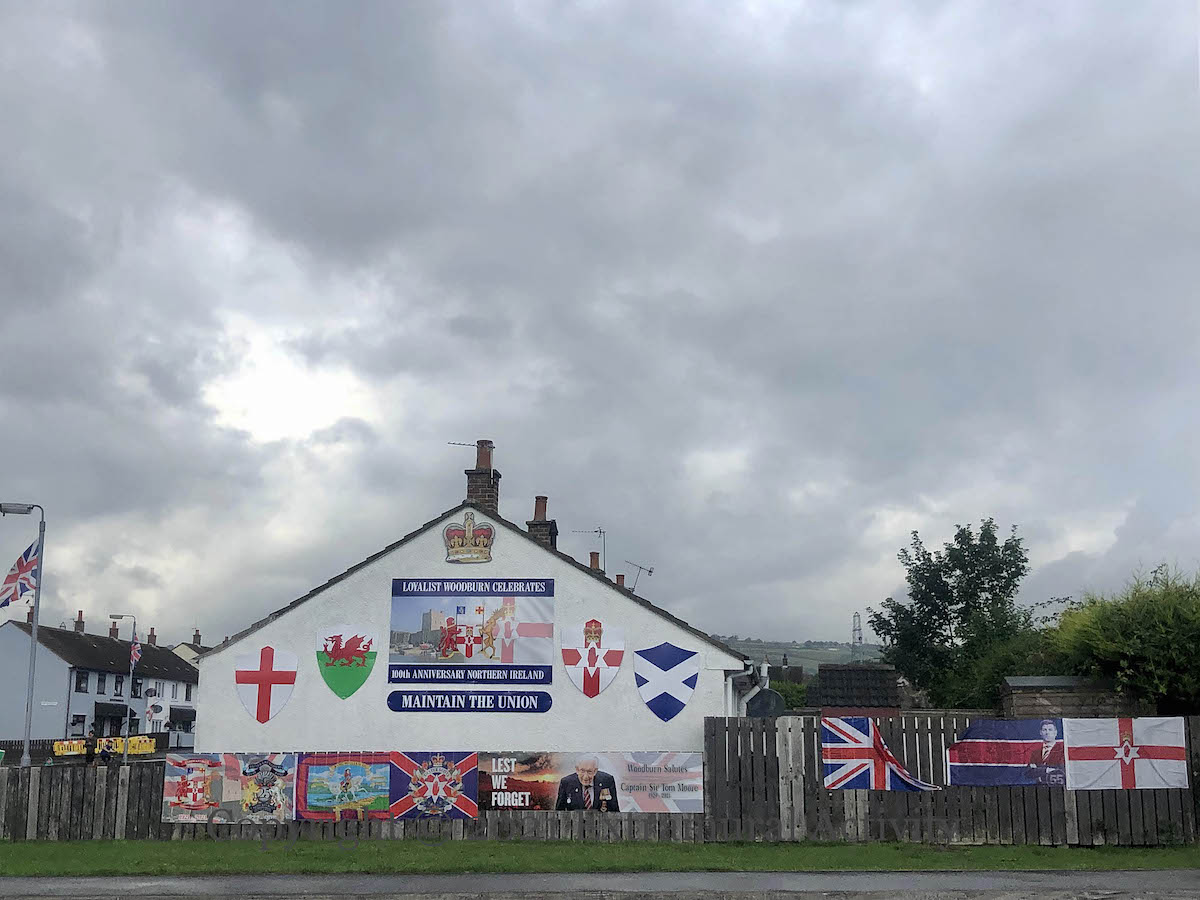
“Loyalist Woodburn celebrates 100th anniversary Northern Ireland”. Maintain the union of (left to right) England (St George’s Cross), Wales (The Red Dragon), Northern Ireland (Ulster Banner), Scotland (St Andrew’s Saltire). Along the fence we have the NI coat of arms, Ulster Grenadiers flute band (Fb) celebrating its 25th anniversary, King Billy at the Boyne, “Ulster Scots” (on an Independent Ulster flag?), Captain Sir Tom Moore, a Union Flag, Rangers 55, an Ulster Banner. The crown sits atop all.
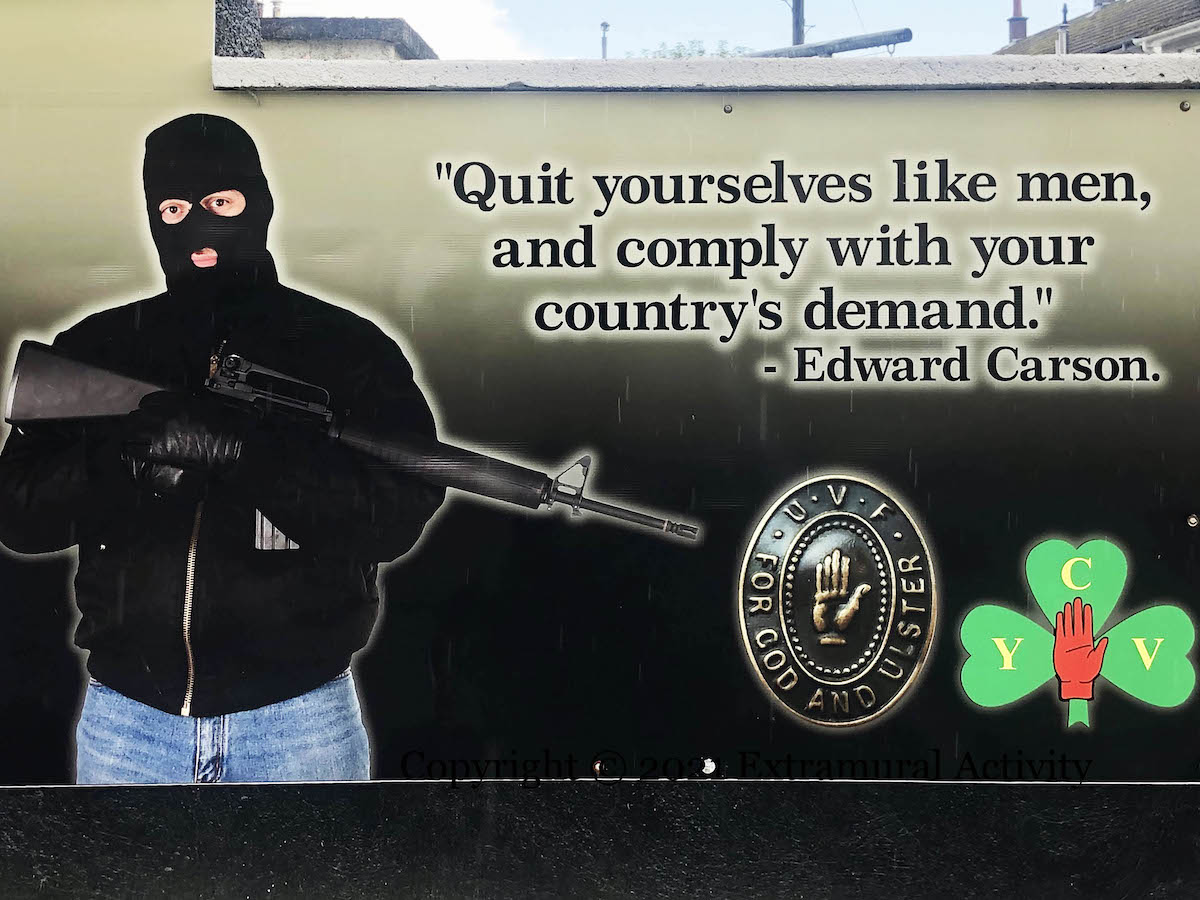
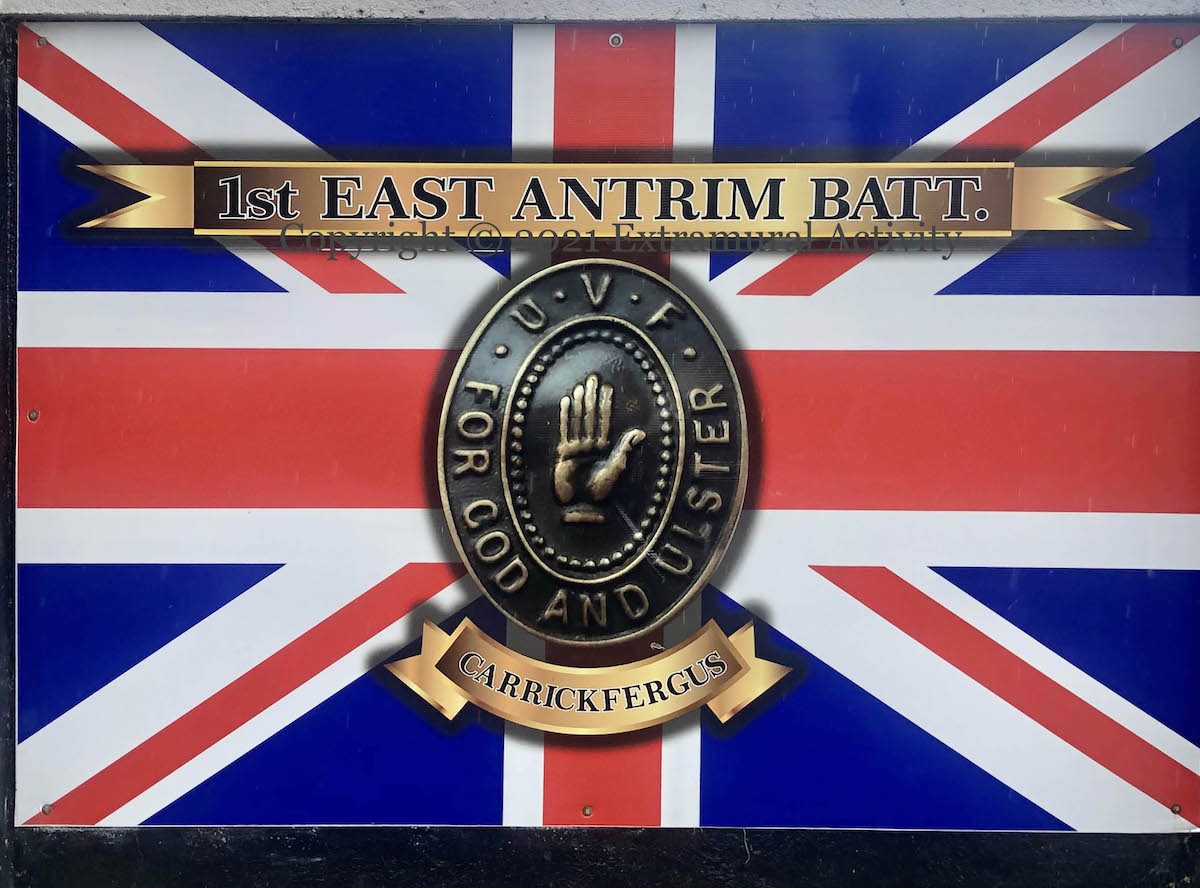
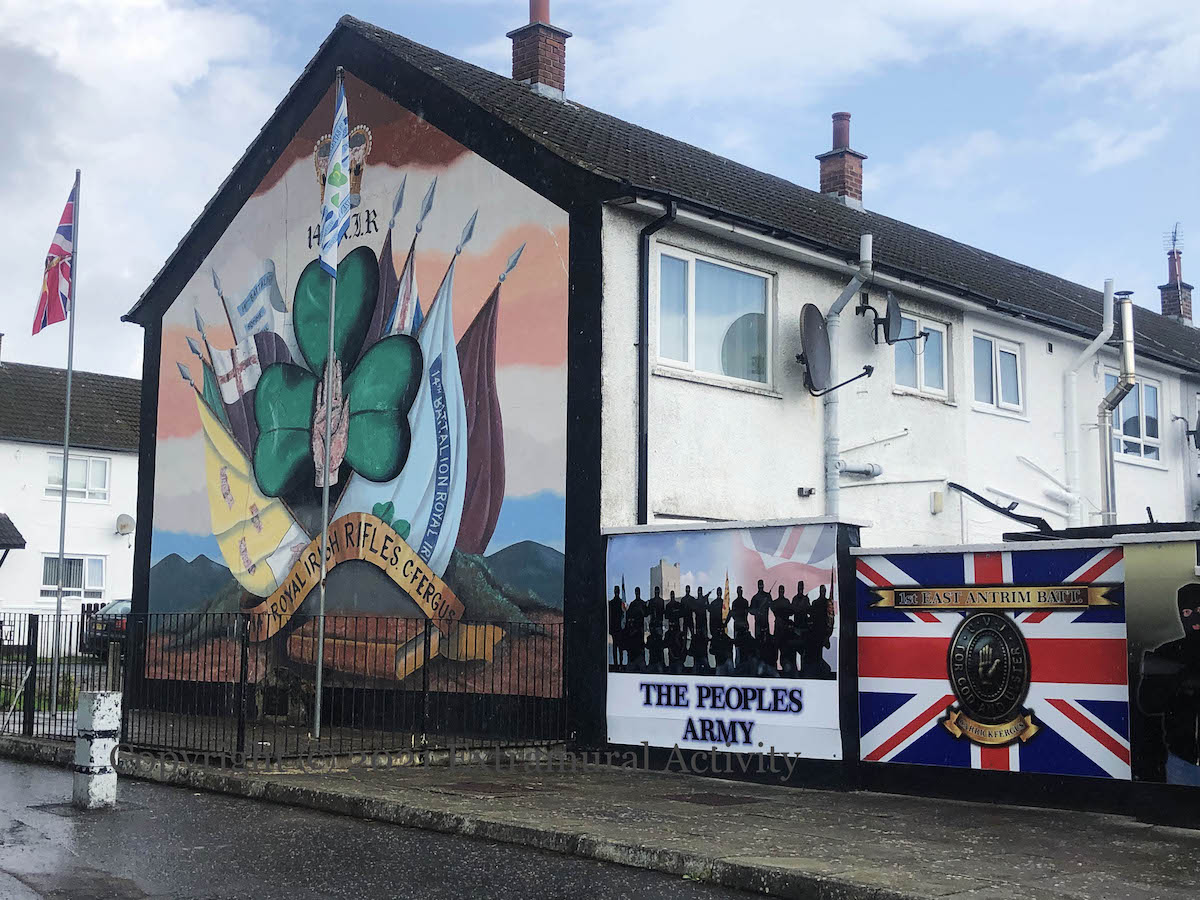
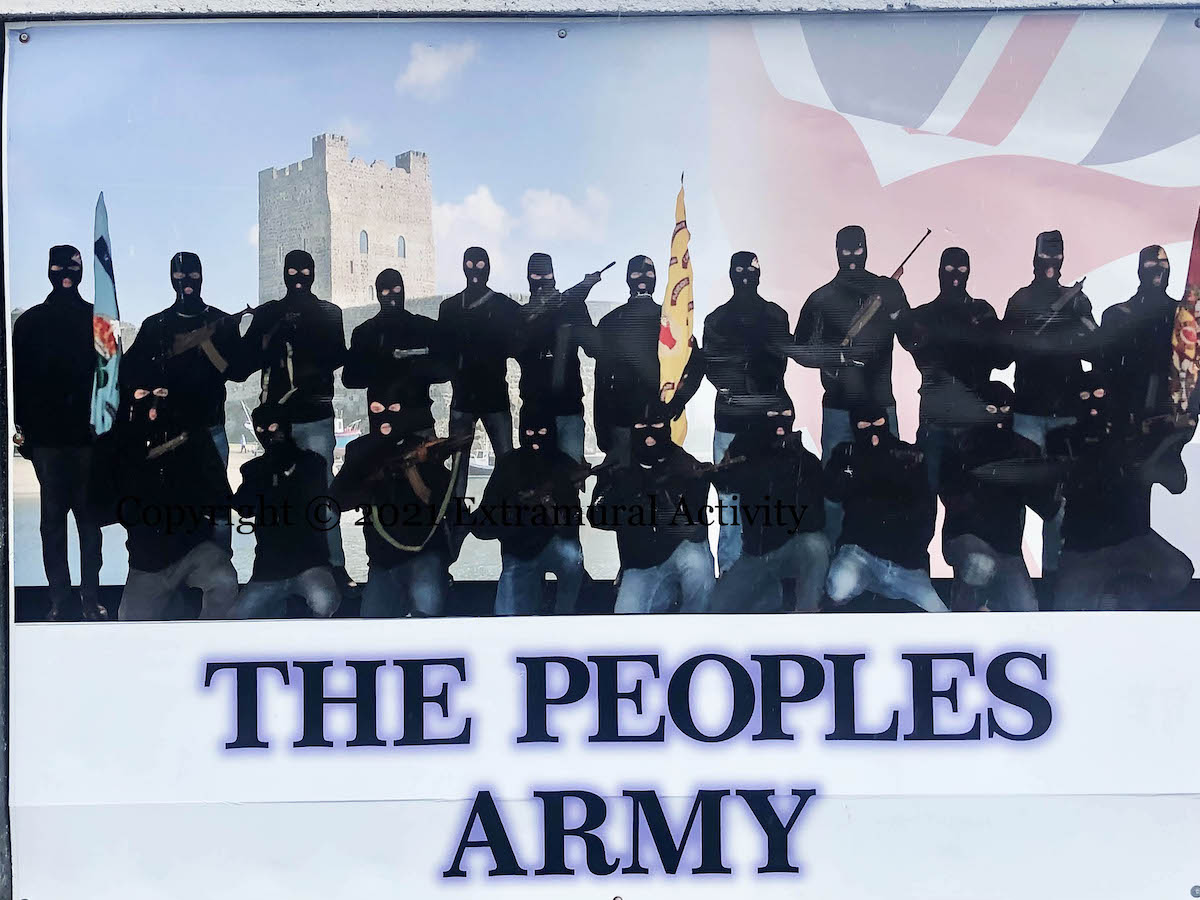
In September, 1914, six weeks after the Great War had begun, Edward Carson wrote to the Ulster Volunteers entreating “those who have not already responded” to “my call for Defenders of the Empire” to “enlist at once for the Ulster Division in Lord Kitchener’s Army”, fighting alongside “our fellow Britishers”: “Quit yourselves like men and comply with your country’s demand”. The impulse for the display of force shown here – two panels of hooded gunmen from the 1st East Antrim battalion of the UVF – is the other, original, motivation for the paramilitary force, which Carson describes as “to defend our citizenship in the United Kingdom” (Strachan & Nally).
For the RIR mural, see For Valour. The new panels shown here re-re-image the VC part of that previous mural in the Larches, Carrickfergus.
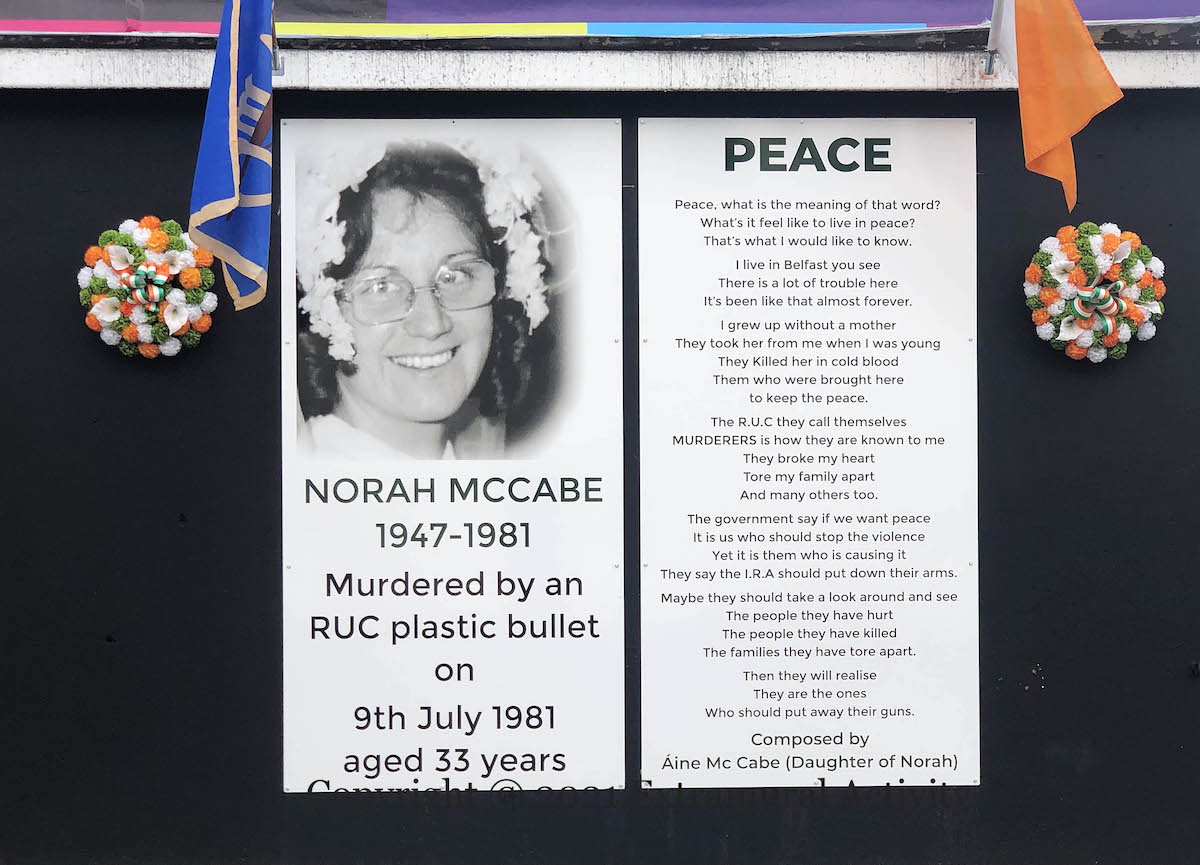
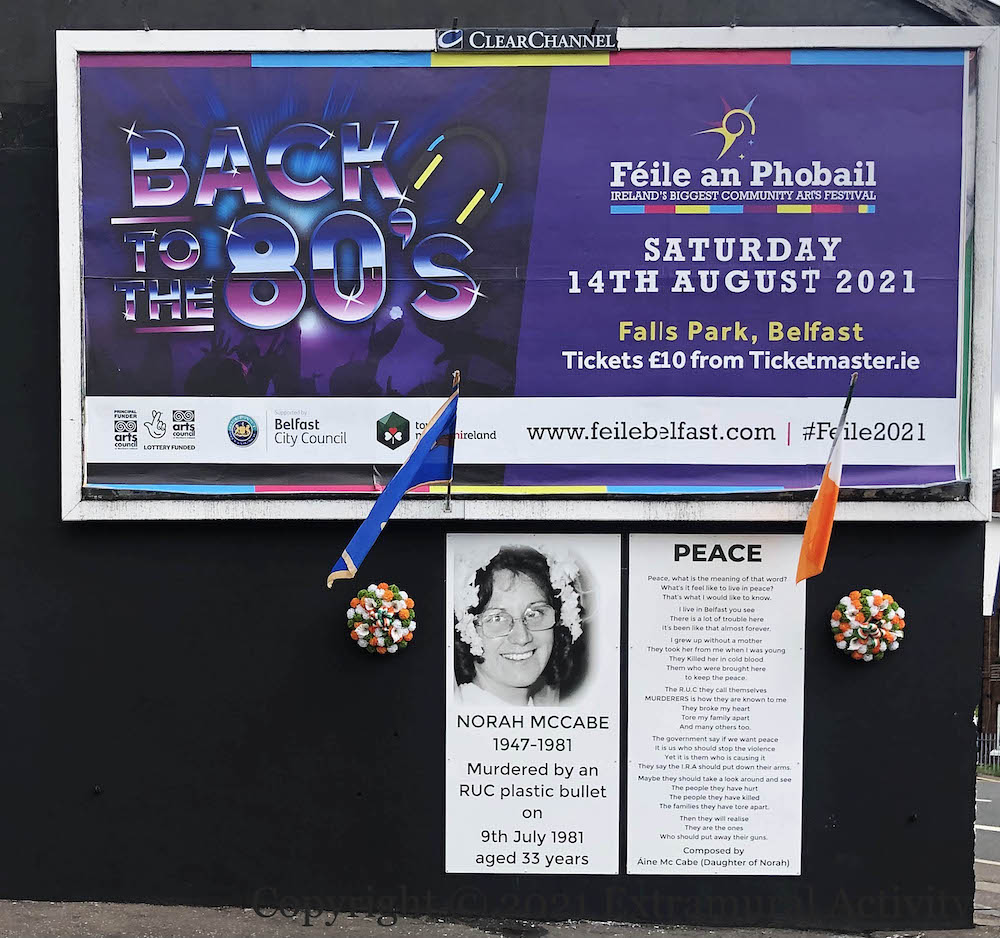
Norah McCabe was shot in the back of the head by a plastic bullet fired from an RUC land rover at around 7:45 a.m. on July 9th, 1981, the day after hunger striker Joe McDonnell died. (Danny Barrett would be killed by a British Army sniper in the evening.) The new boards were mounted to coincide with the fortieth anniversary of McCabe’s death. In 1981, a mural was painted at the same spot (in the old Linden Street) to protest the use of plastic bullets: see Plastic Death.
“Norah McCabe, 1947-1981, murdered by an RUC plastic bullet on 9th July 1981, aged 33 years.” With a poem “Peace” by daughter Áıne McCabe, who was three months old when her mother was killed (Irish News).
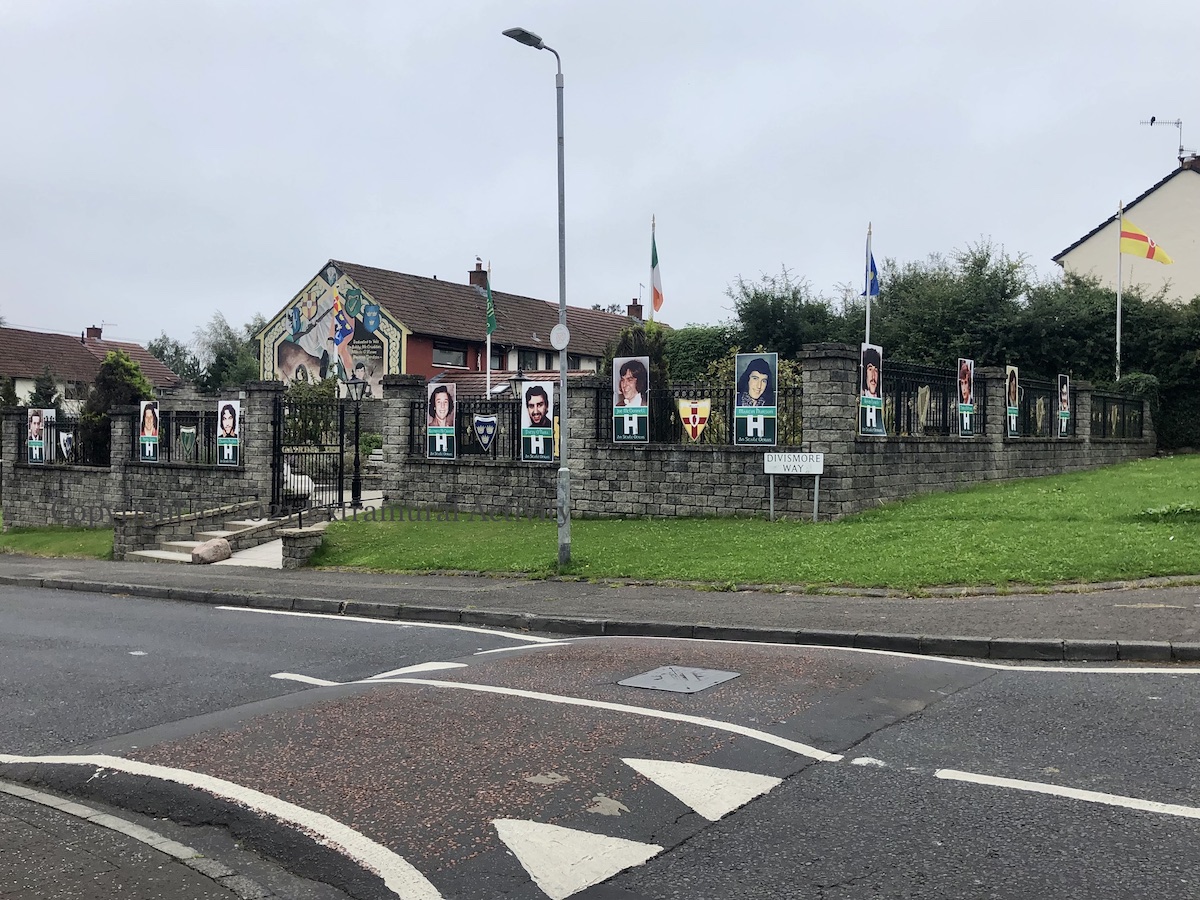
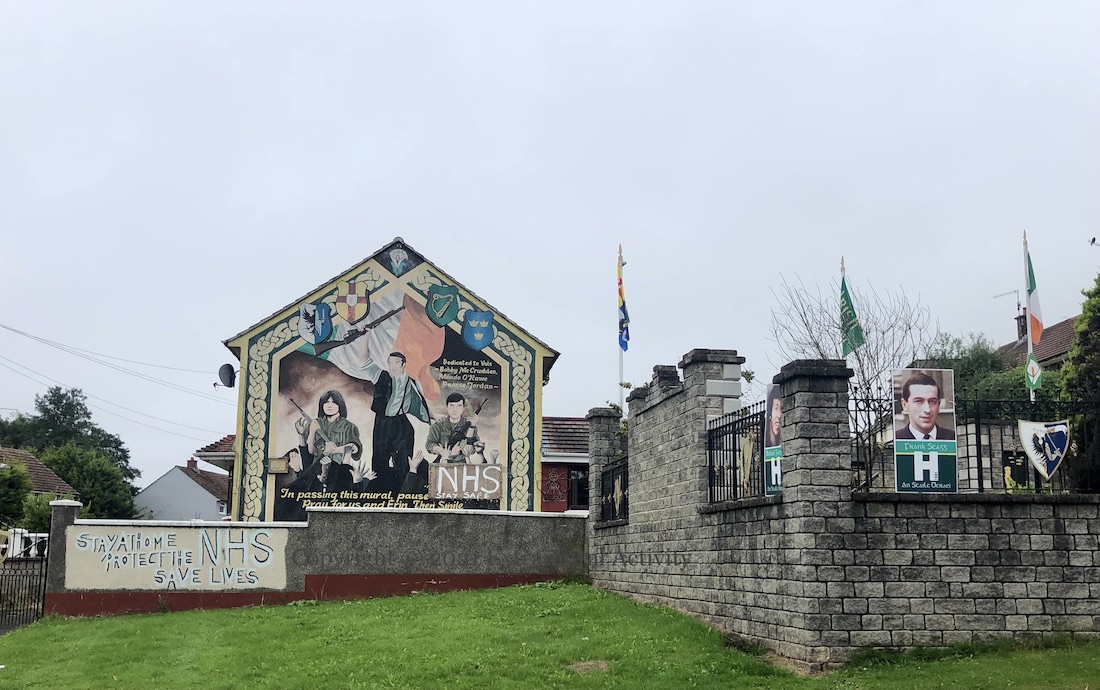
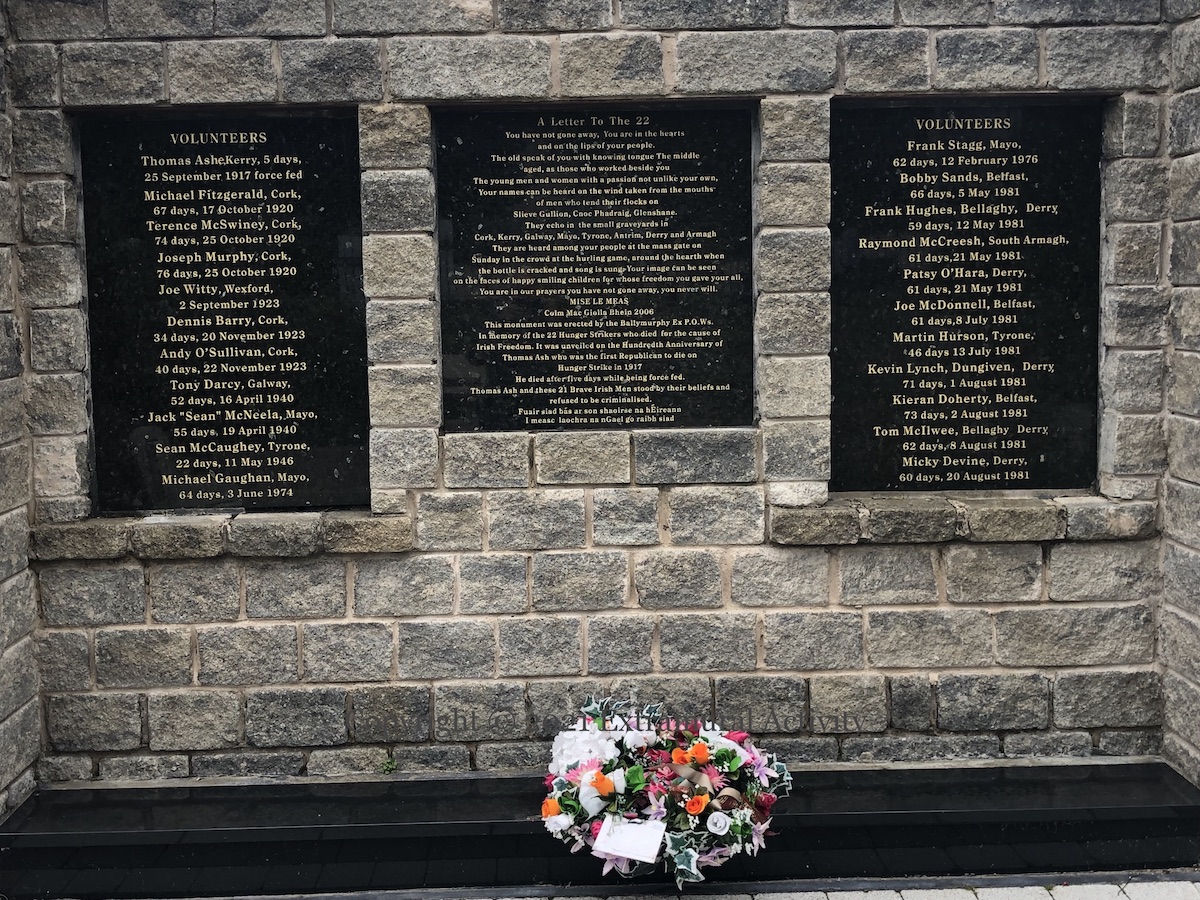
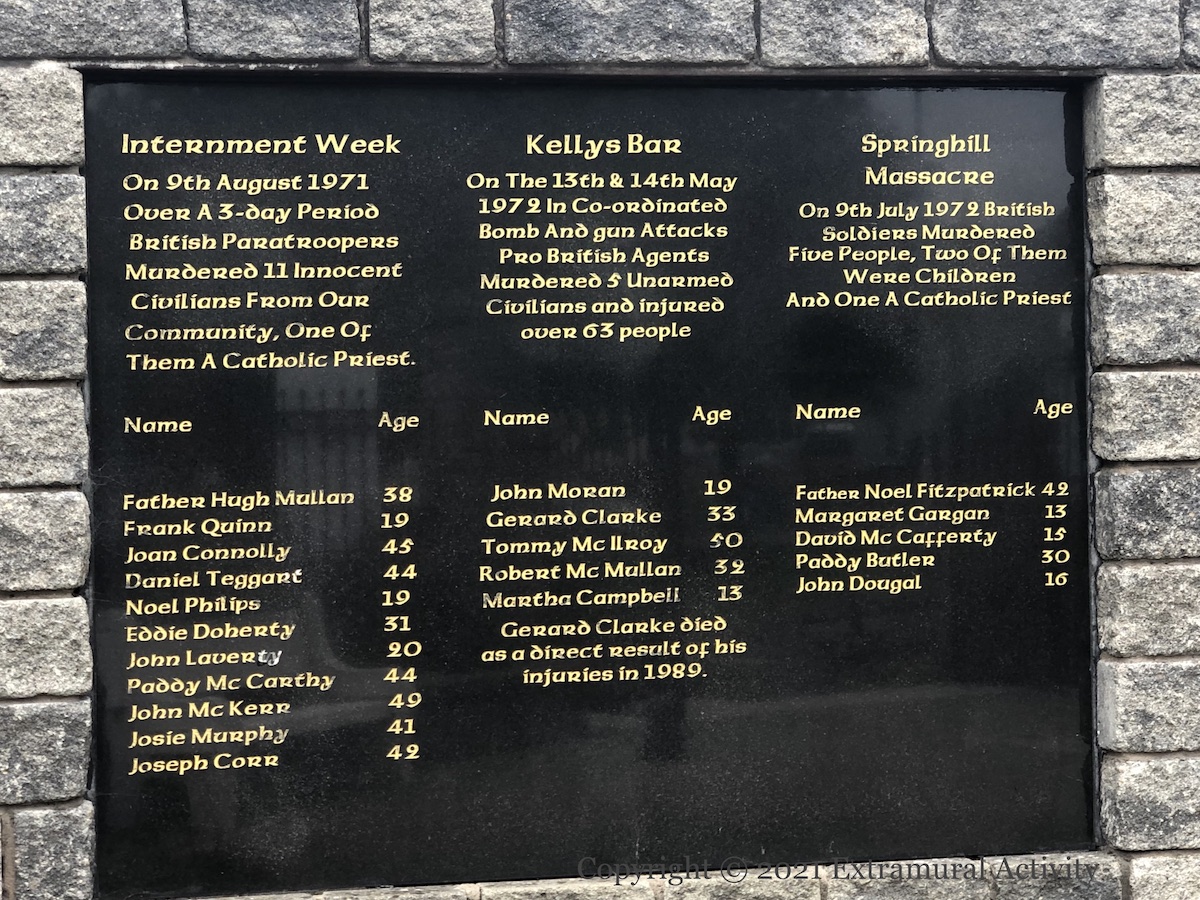
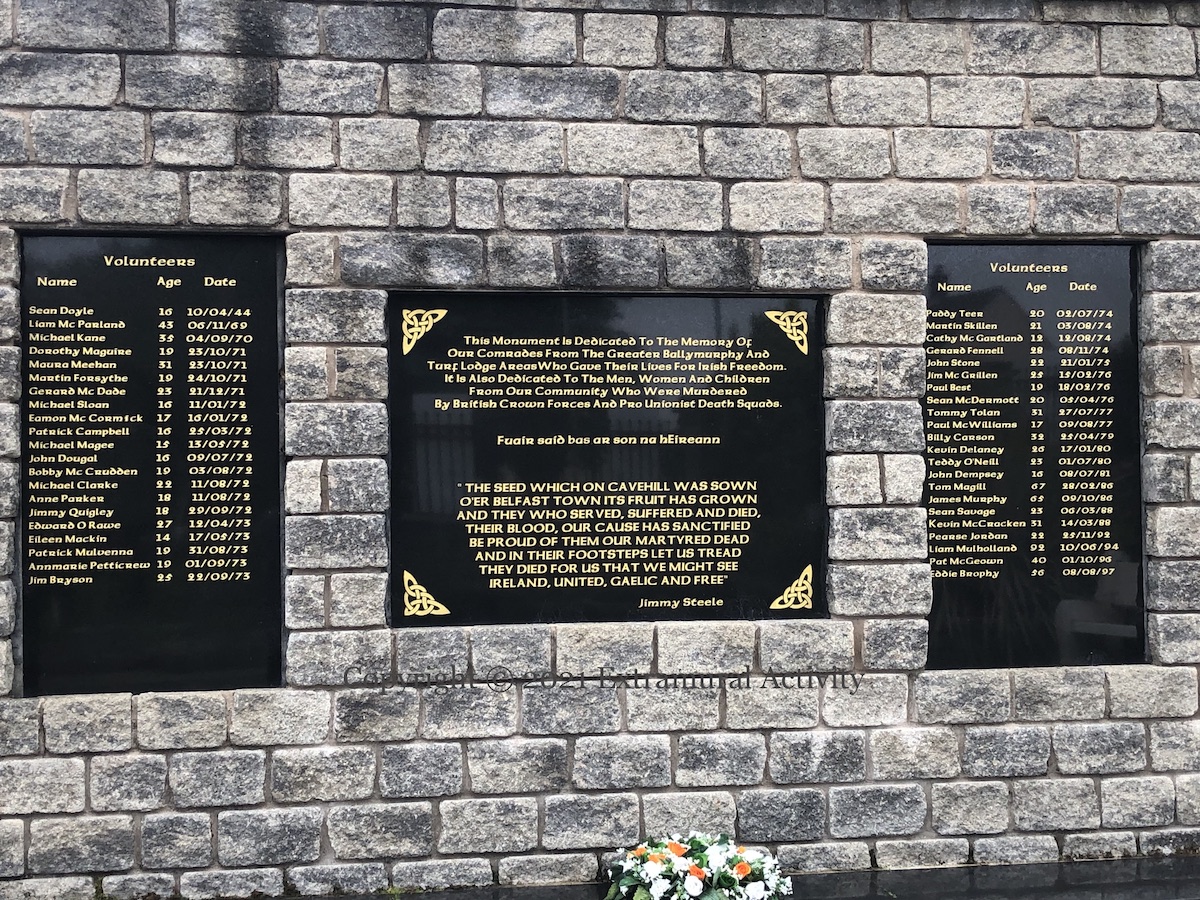
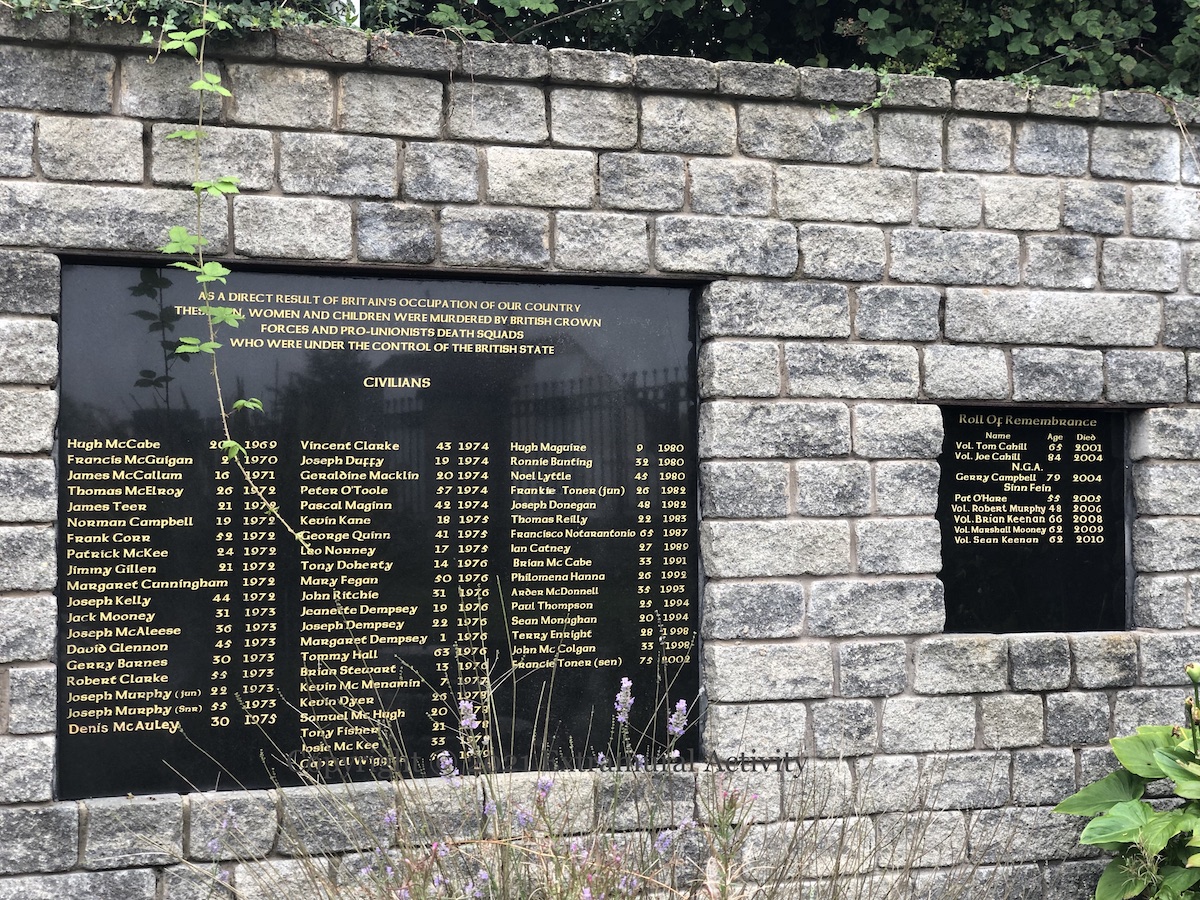
For the 40th anniversary of the 1981 Hunger Strike, portraits of the deceased ten (plus Frank Stagg and Michael Gaughan from the 1970s) were placed on the railings of the Ballymurphy memorial garden. There is a new (compared to 2006 and 2008) set of plaques, erected in 2017:
“A Letter To The 22: You have not gone away, you are in the hearts and on the lips of your people. The old speak of you with knowing tongue. The middle aged, as those who worked beside you. The young men and women with a passion not unlike your own. Your names can be heard on the wind taken from the mouths of men who tend their flocks on Slieve Gullion, Cnoc Phadraıg, Glenshane. They echo in the small graveyards in Cork, Kerry, Galway, Mayo, Tyrone, Antrim, Derry and Armagh. They are heard among your people at the mass gate on Sunday in the crowd at the hurling game, around the hearth when the bottle is cracked and song is sung. Your image can be seen on the faces of happy smiling children for whose freedom you gave your all. You are in our prayers you have not gone away, you never will. Mıse le meas Colm Mac Gıolla Bheın 2006. This monument was erected by the Ballymurphy Ex POWs in memory of the 22 hunger strikers who died for the cause of Irish freedom. It was unveiled on the hundredth anniversary of Thomas Ash[e] who was the first republican to die on hunger strike in 1917. He died after five days while being force fed. Thomas Ash[e] an these 21 brave Irish men stood by their beliefs and refused to be criminalised. Fuaır sıad bás ar son shaoırse na hÉıreann. I measc laochra na nGael go raıbh sıad.”