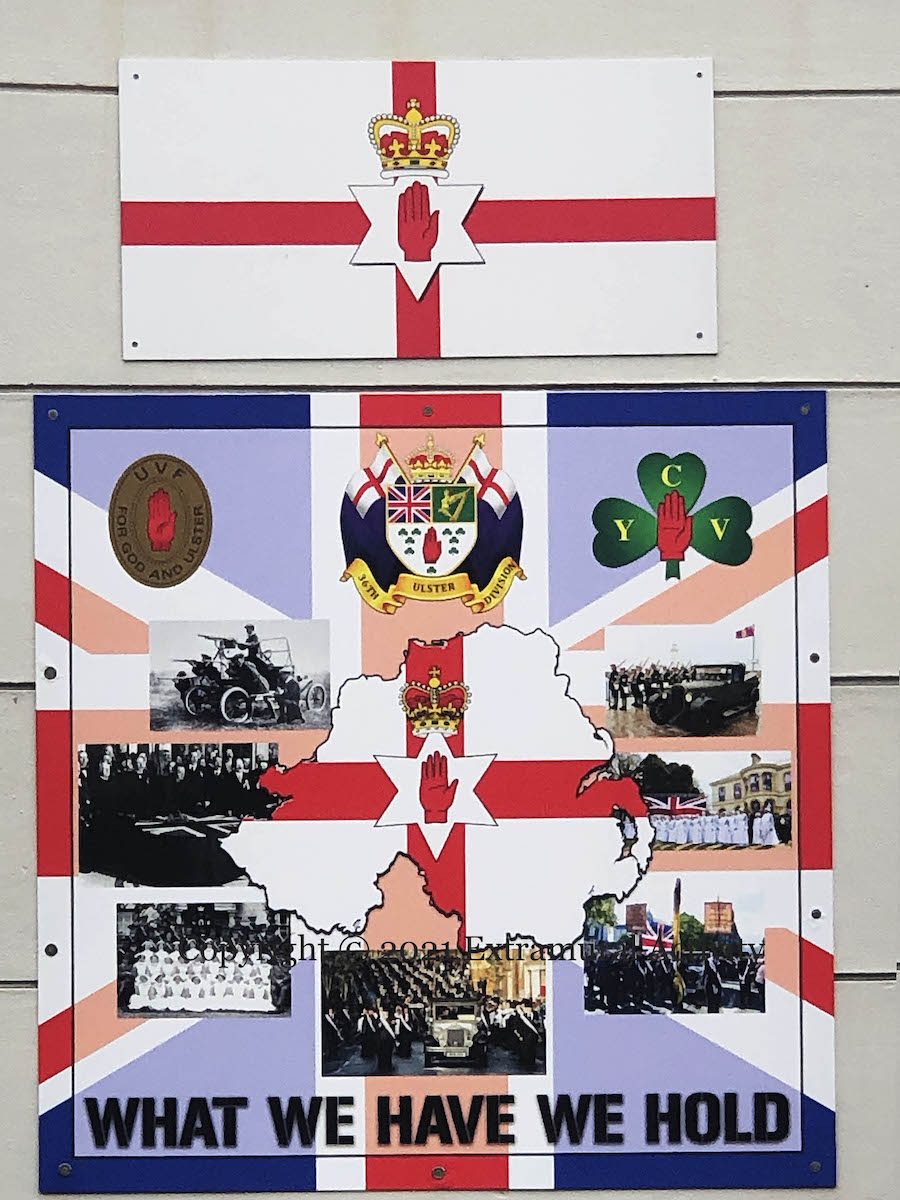
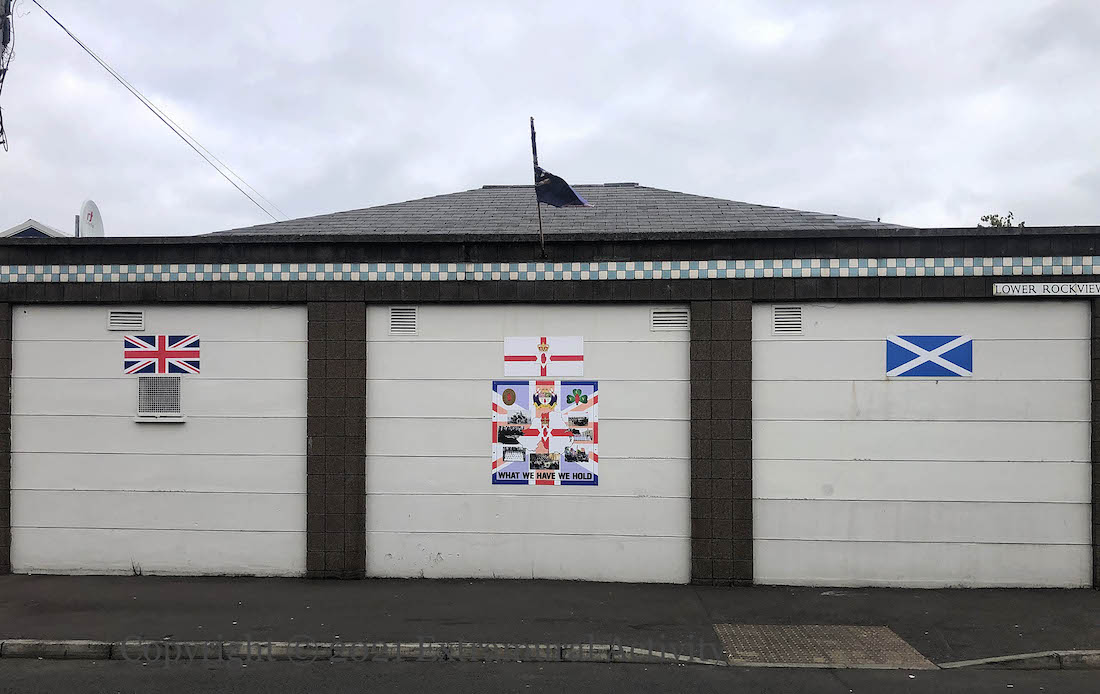
This Village board celebrates the Covenant, Ulster Volunteers, and the 36th (Ulster) Division, with photographs both vintage and contemporary.
For the photograph of Carson signing the Covenant, and an earlier mural, see Betting Office. For the photograph of the car-mounted gun, and an earlier mural recreating the photo, see UVF 75th Anniversary. For images akin to the contemporary photos, see these BelTel galleries one | two of the 100th anniversary celebrations of the Ulster Volunteers.
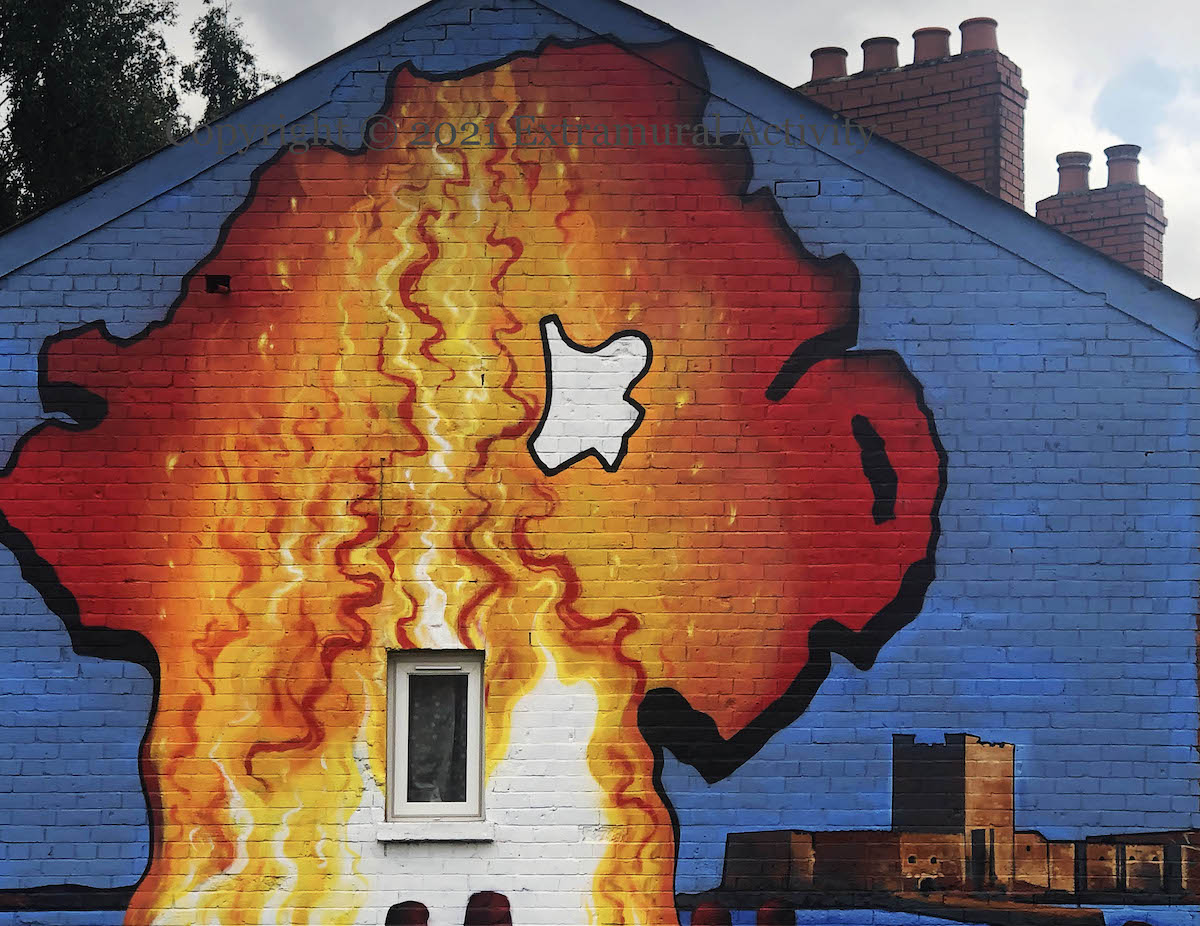
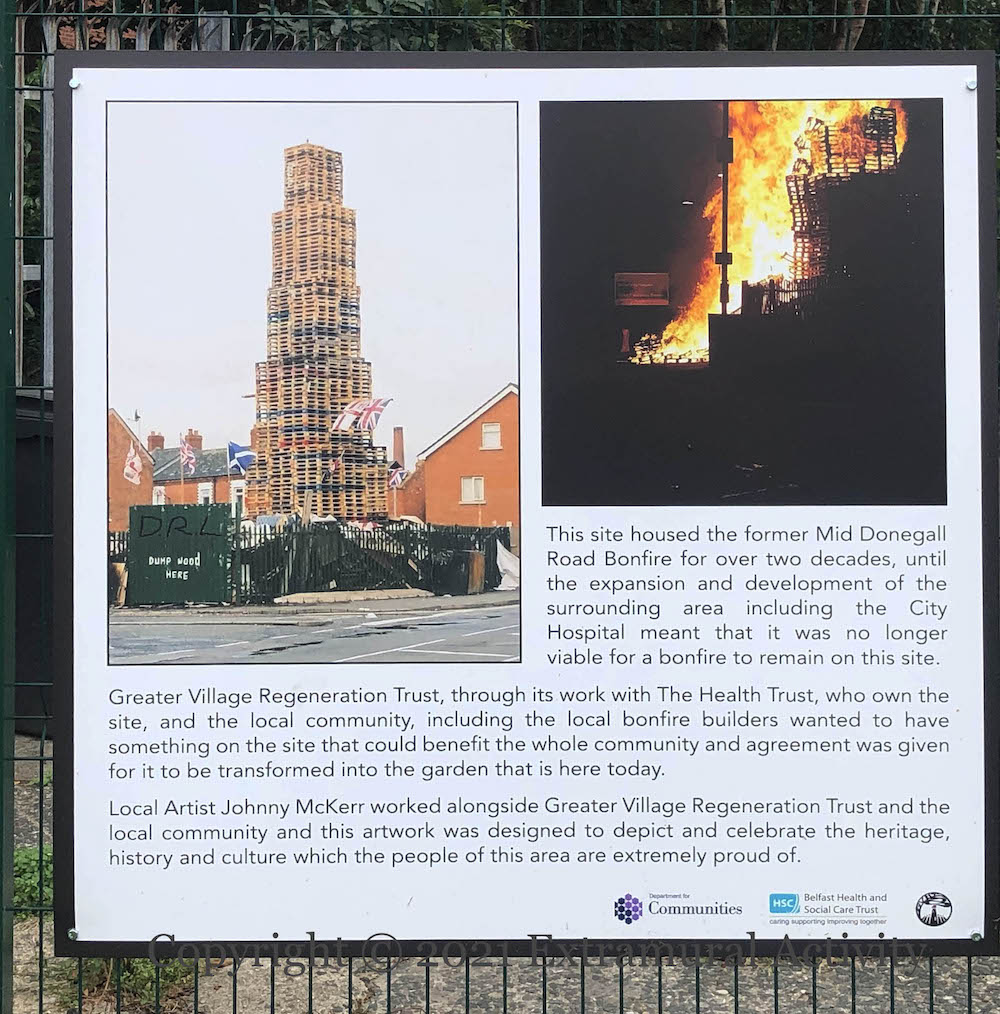
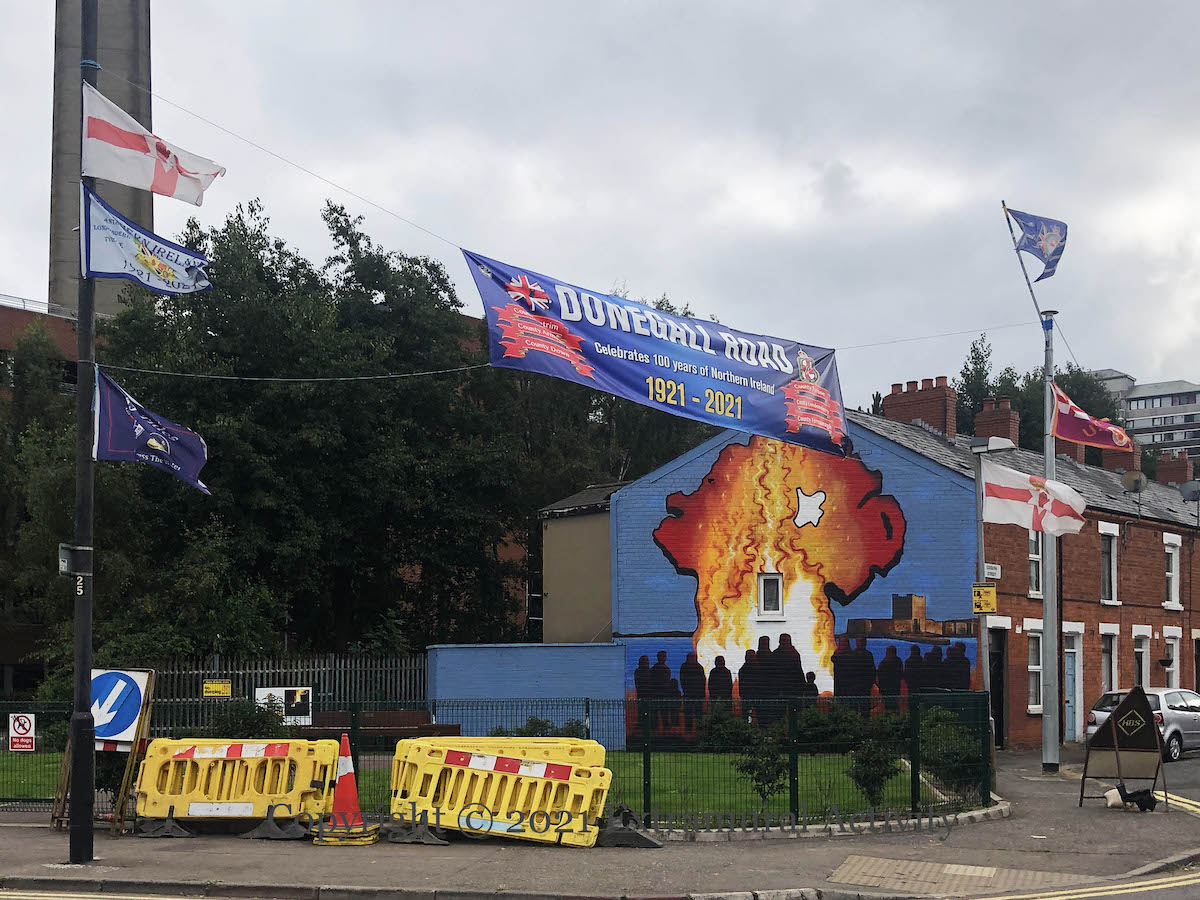
“This site housed the former Mid Donegall Road Bonfire for over two decades, until the expansion and development of the surrounding area including the City Hospital meant that it was no longer viable for a bonfire to remain on this site. Greater Village Regeneration Trust, through its work with The Health Trust, who own the site, and the local community, including the local bonfire builders wanted to have something on the site that could benefit the whole community and agreement was given for it to be transformed into the garden that is here today. Local Artist Johnny [sic] McKerr worked alongside Greater Village Regeneration Trust and the local community and this artwork was designed to depict and celebrate the heritage, history and culture which the people of this area are extremely proud of.”
The info board includes a photograph of the bonfire spilling out towards the car-park for the City. The other image is a photograph from the Peter Moloney Collection, used without permission, and photoshopped to add “DRL” – Donegall Road Loyalists.
According to Eddie Kelly of the GVRT, Carrickfergus castle is included because “This is where King William landed, and the annual bonfire is a symbol of a beacon lit across the coast to guide him” (Belfast Live).
Painted by JMK/Jonny McKerr (tw) at Coolfin St on Donegall Rd.
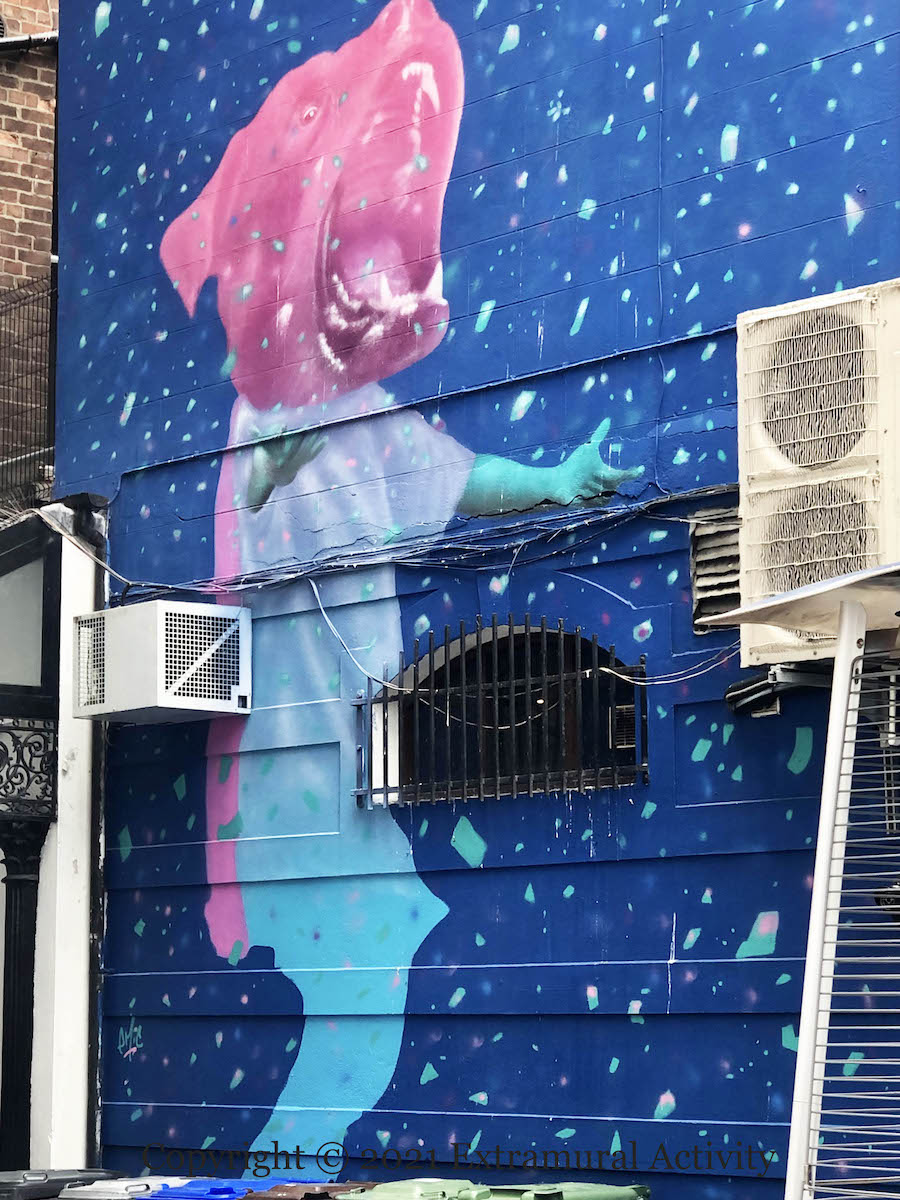
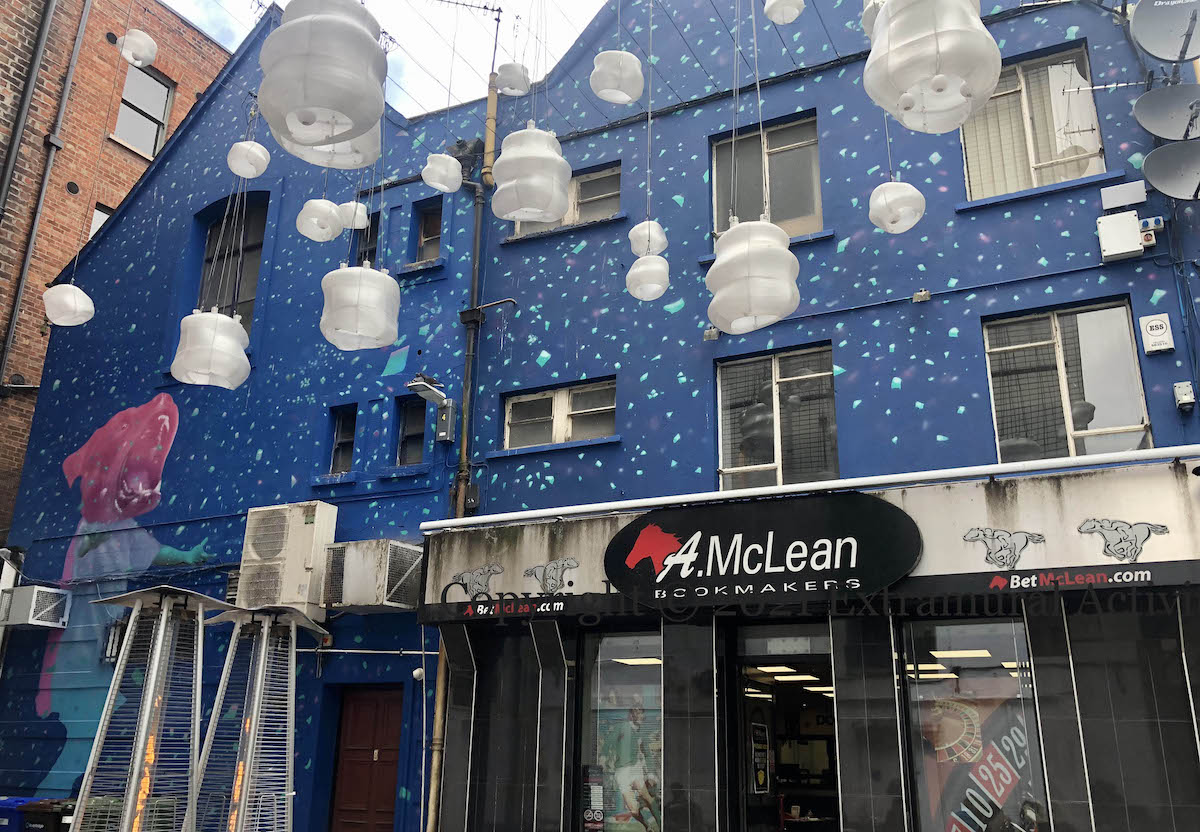
Work by emic (ig) – official title Ffallen [sic] – in Winecellar entry, inspired by Ciaran Carson’s Belfast Confetti, itself inspired by “a public notice from the corporation of Belfast (1678) which highlights a growing problem of Butchers and Tanners mastiff dogs attacking livestock, people, and even young children in the city” (Belfast Walking Tours). The wide shot (below) shows “3D printed floating orbs were created from recycled ocean plastics suspended over the central courtyard” (BCC).
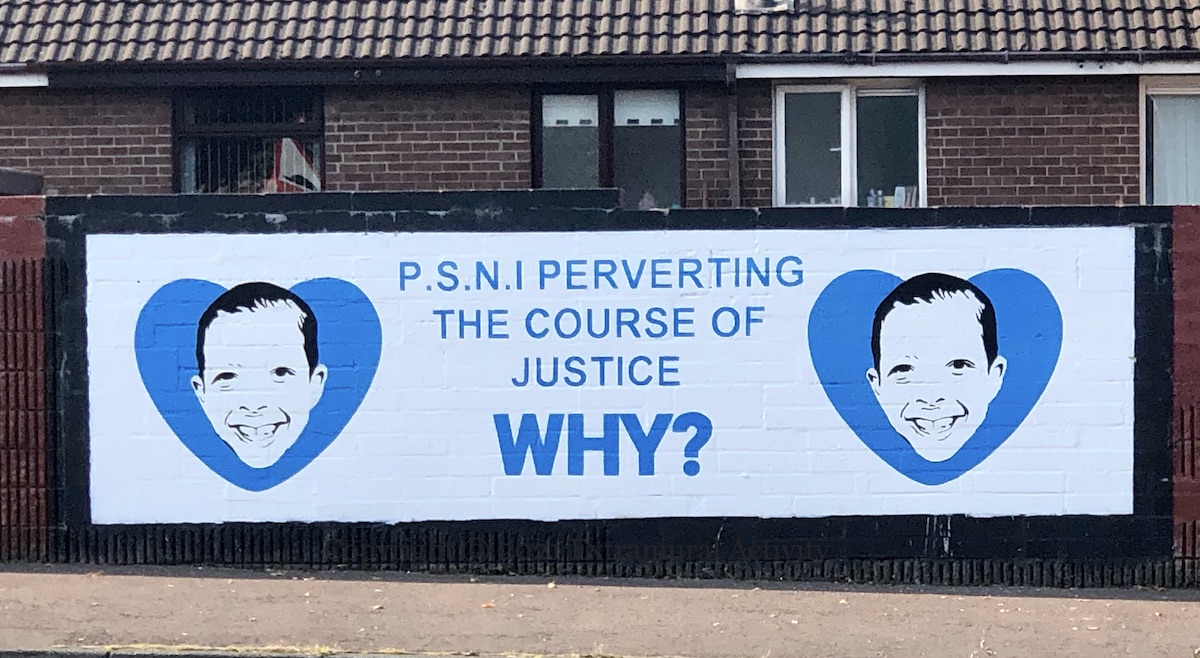
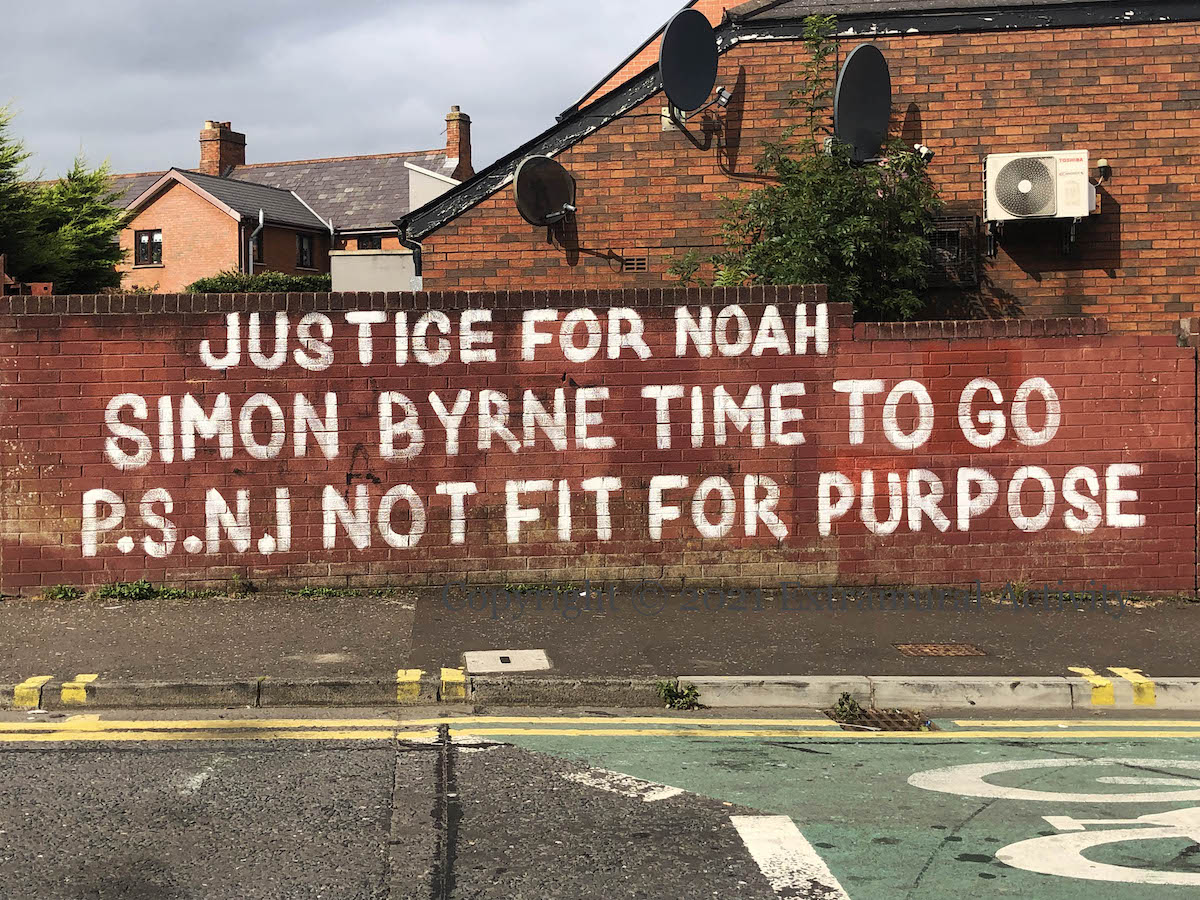
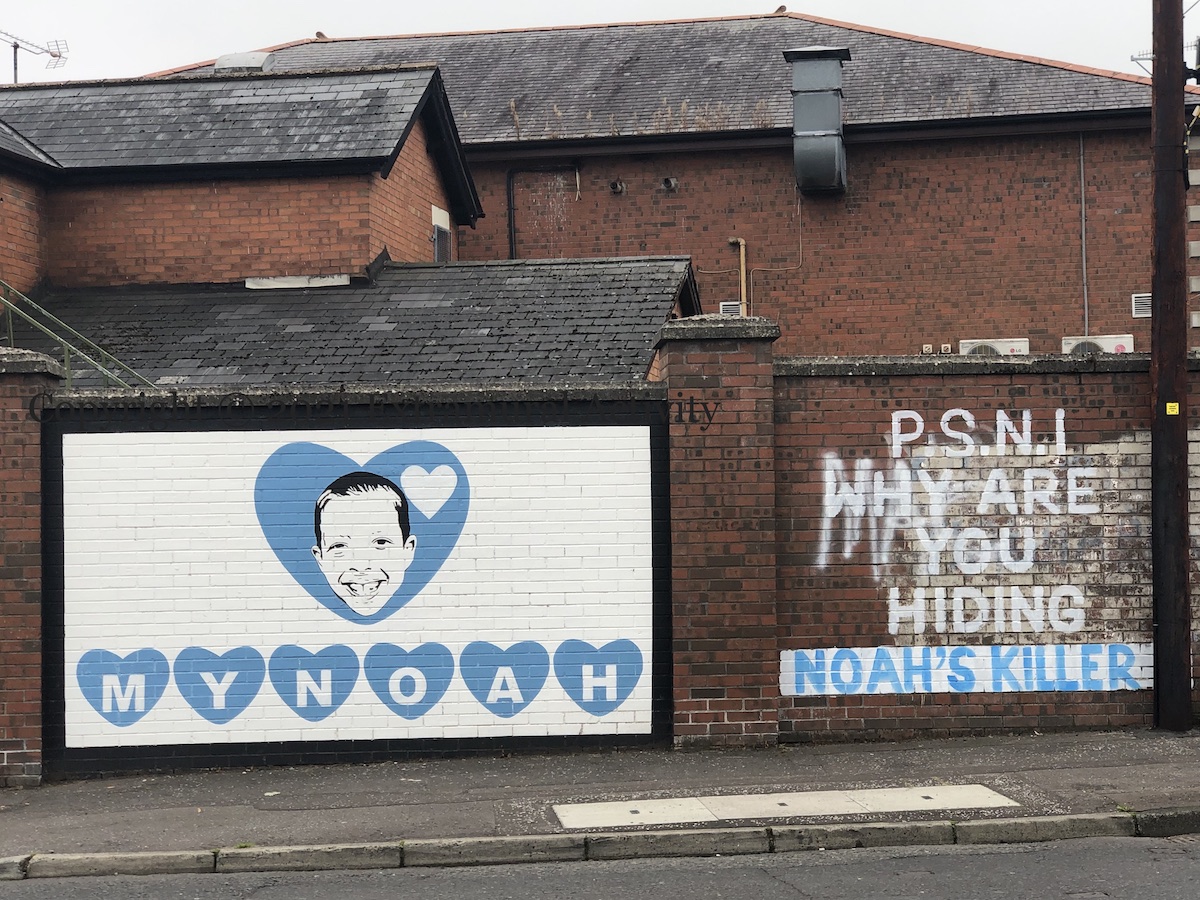
It is now more than a year since teenager Noah Donohoe was found dead in a north Belfast storm drain and the controversy and mystery over his death continues. Police were recently investigating an alleged confession by a prisoner and Noah’s mother Fiona has said that she was told by police of a witness statement that the UDA were called in to dispose of the body (Irish News). She has started a petition calling for Chief Constable Simon Byrne’s resignation. The walls of Belfast have been painted to reflect the persistent dissatisfaction with the investigation. The three shown here are on the Whiterock, Lake Glen, and Springfield roads. For some more examples, see sbear101 on Twitter.
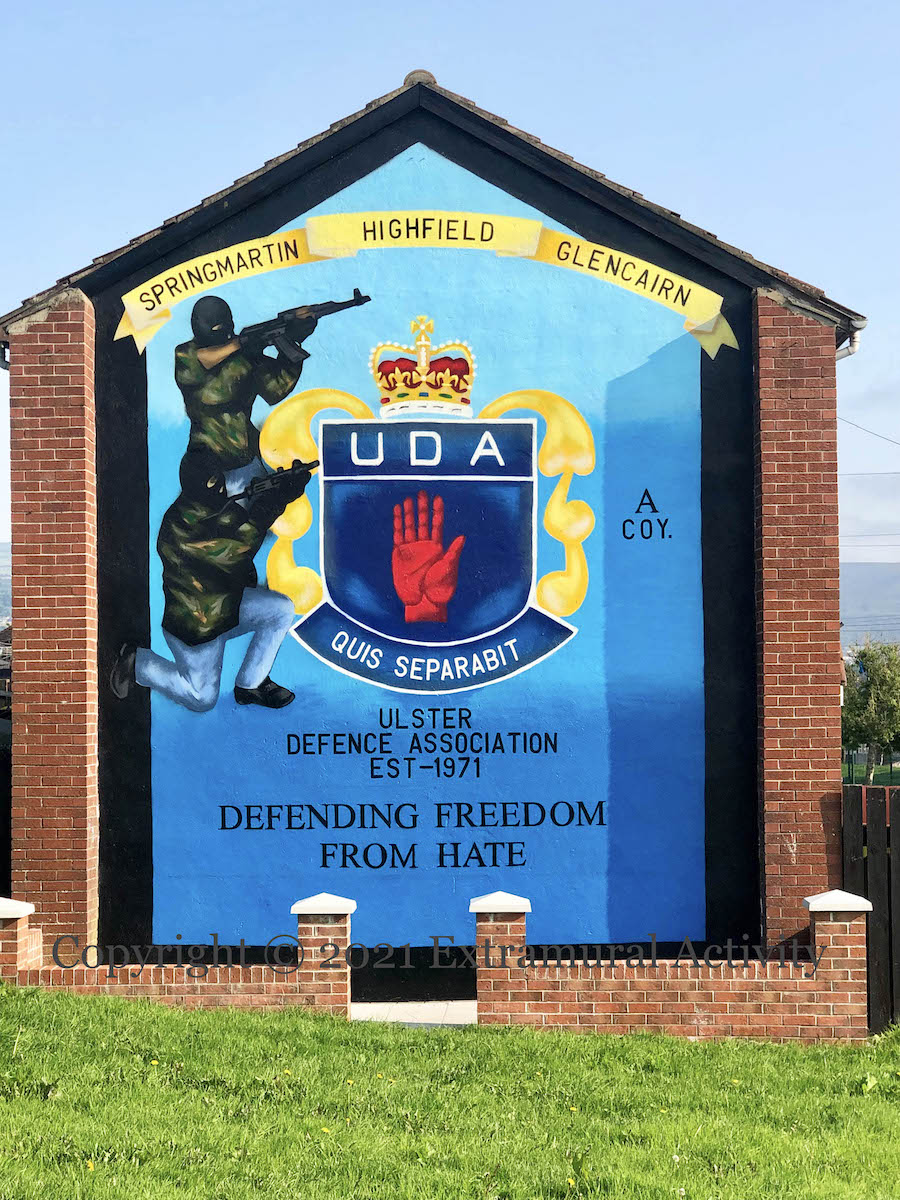
Compared to the UVF, the UDA more strongly detect an existential threat to loyalism and evince a siege mentality that provokes the need for armed resistance. Hence the more frequent presence of armed gunmen in UDA murals (which is also due in part to the UVF being able to “re-image” around the Ulster Volunteers and the Somme). With Brexit and the Protocol, however, armed gunmen have recently been appearing more frequently in UVF murals – see, for example, If Our Shores Are Threatened | Bang Up To Date | Our British Identity.
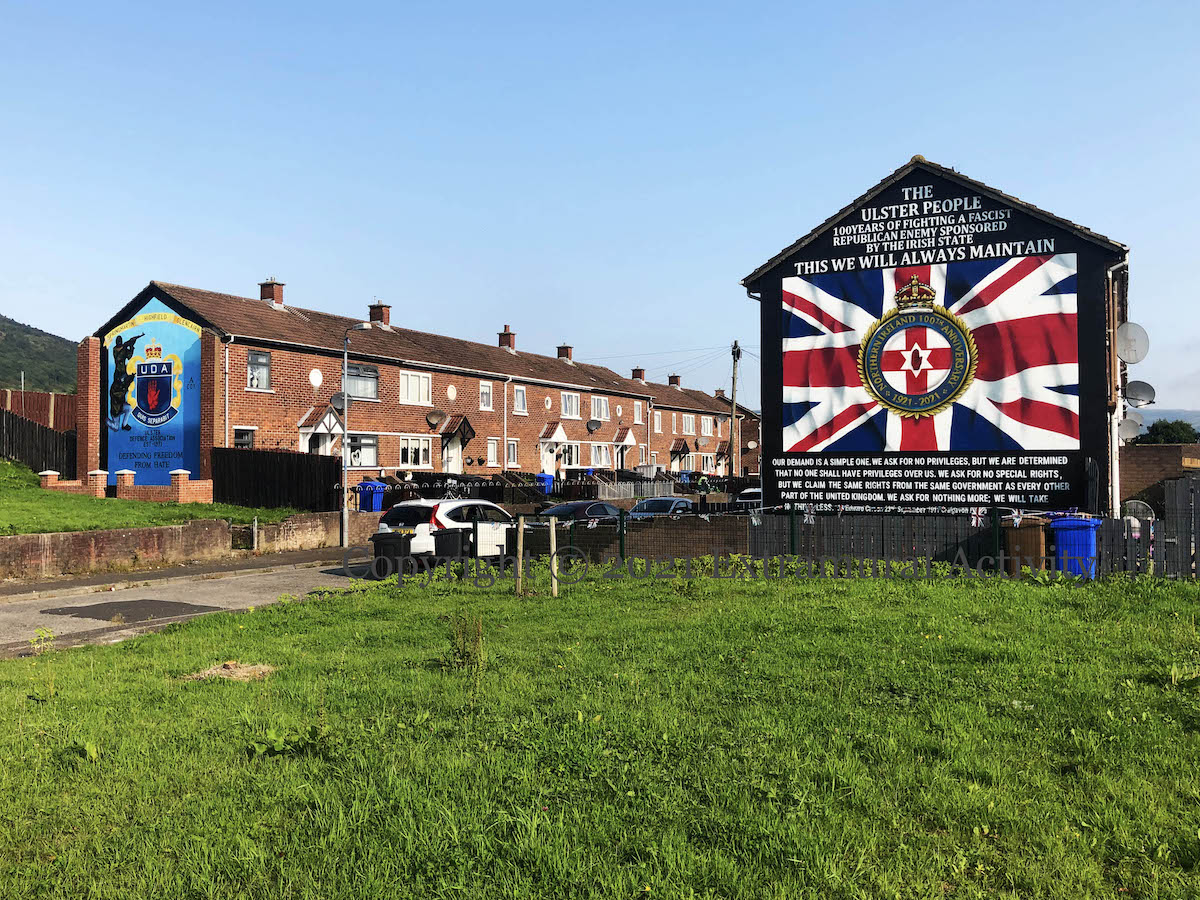
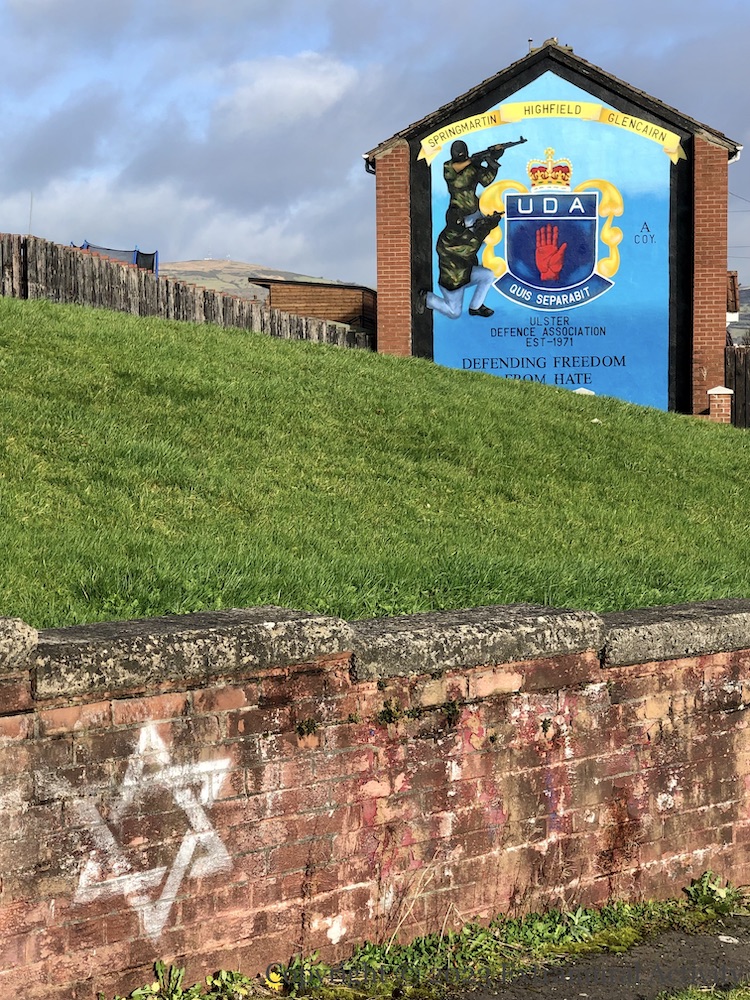
“Springmartin–Highfield–Glencairn Ulster Defence Association est. 1971. Defending freedom from hate.” As the companion mural (We Will Take Nothing Less) makes clear, the hate is coming from a “fascist republican enemy” (“Sinn Fein/IRA”, presumably) and the government of Ireland. Graphically, this mural is the same as the previous one on this wall: Under The Protection Of The UDA.
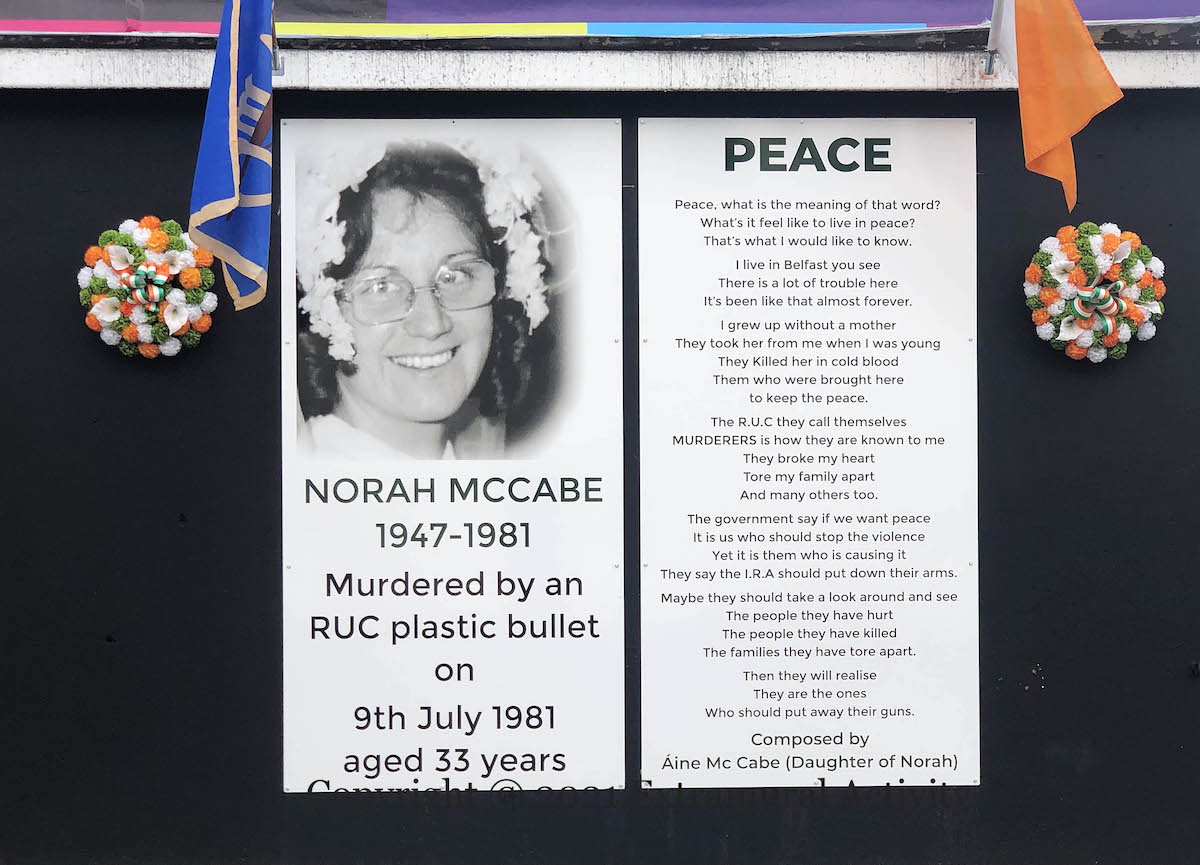
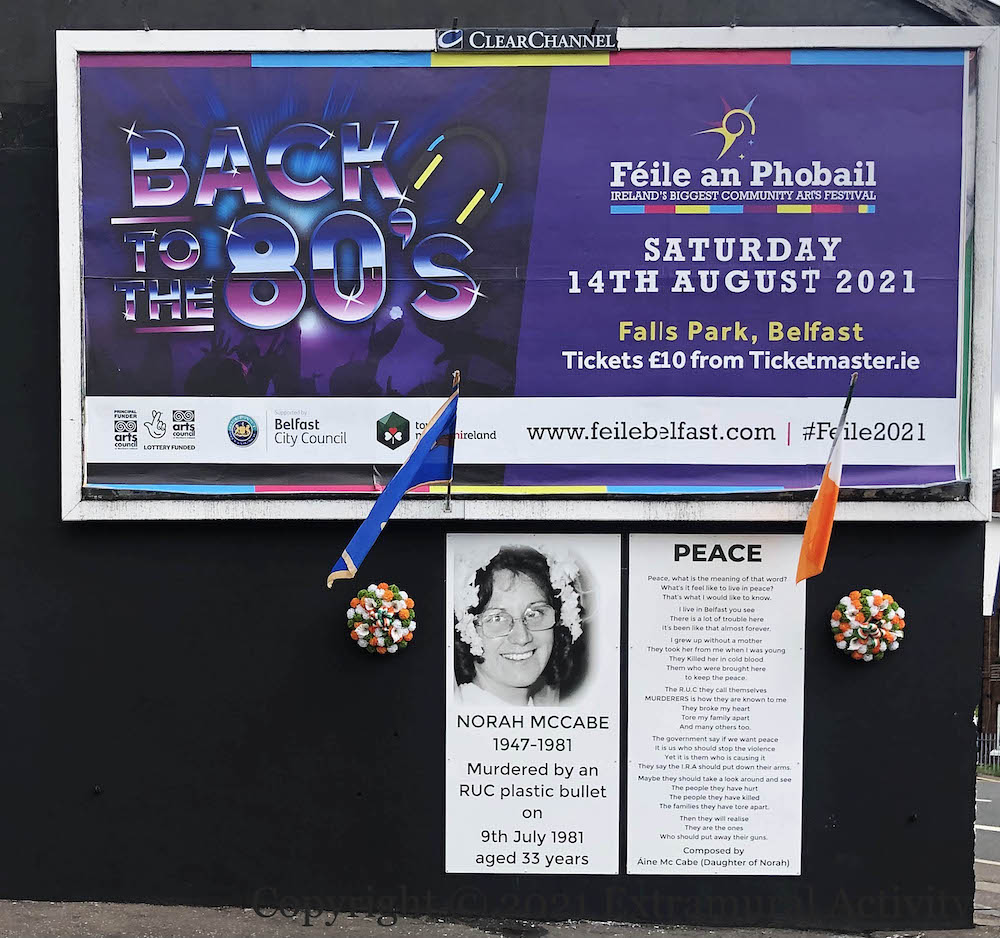
Norah McCabe was shot in the back of the head by a plastic bullet fired from an RUC land rover at around 7:45 a.m. on July 9th, 1981, the day after hunger striker Joe McDonnell died. (Danny Barrett would be killed by a British Army sniper in the evening.) The new boards were mounted to coincide with the fortieth anniversary of McCabe’s death. In 1981, a mural was painted at the same spot (in the old Linden Street) to protest the use of plastic bullets: see Plastic Death.
“Norah McCabe, 1947-1981, murdered by an RUC plastic bullet on 9th July 1981, aged 33 years.” With a poem “Peace” by daughter Áıne McCabe, who was three months old when her mother was killed (Irish News).
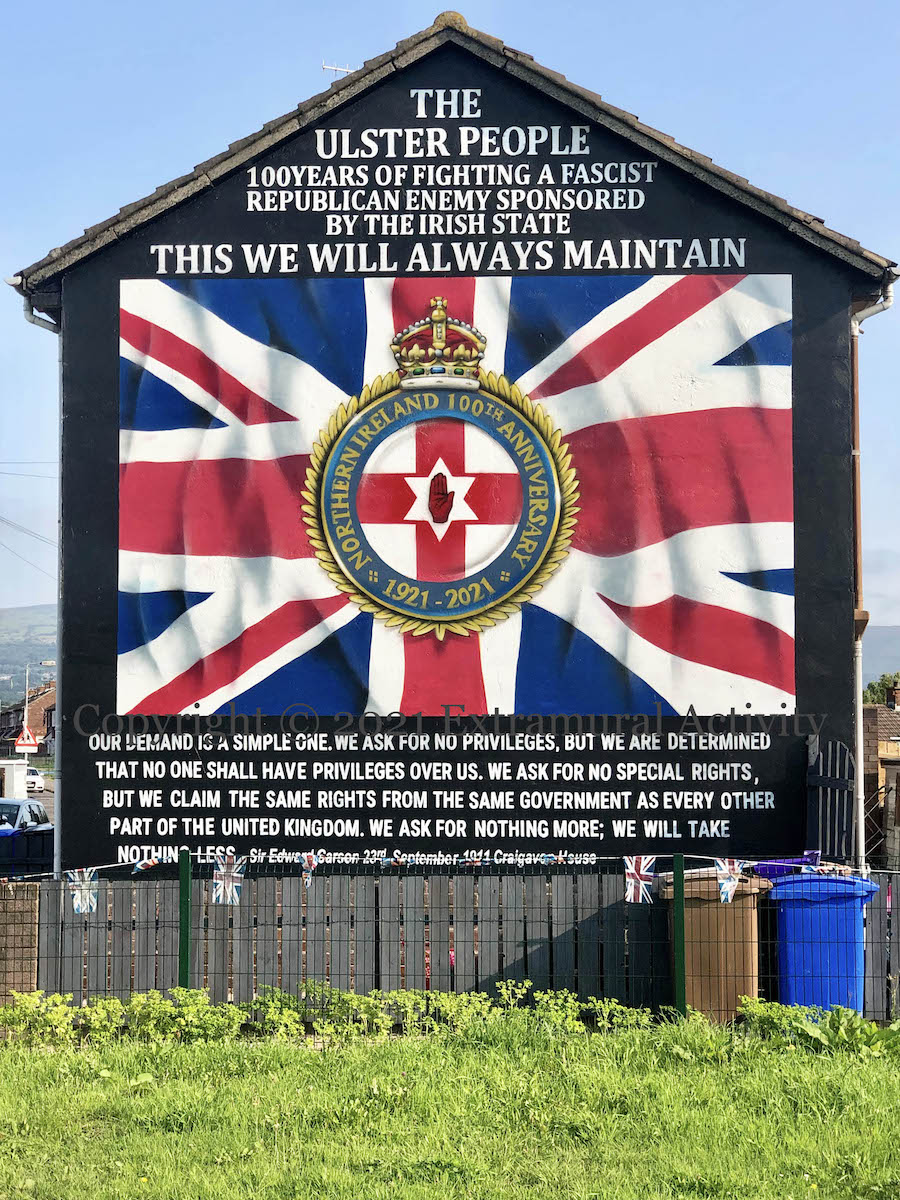
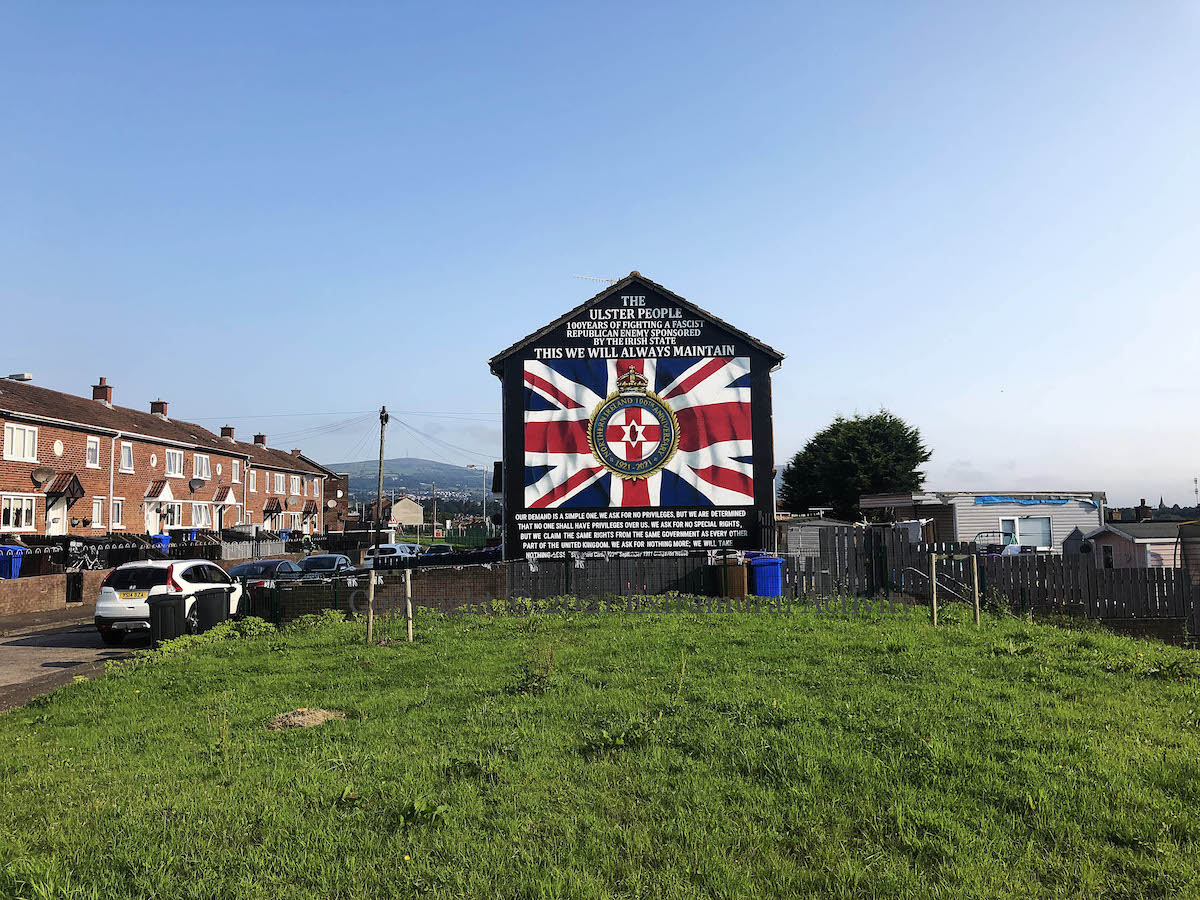
An estimated 100,000 people congregated at Craigavon House on the 23rd of September, 1911, to hear Edward Carson’s inaugural speech as Unionist leader (McNeill Ch. 4). In his speech he said “Our demand is a simple one. We ask for no privileges, but we are determined that no one shall have privileges over us. We ask for no special rights, but we claim the same rights from the same government as every other part of the United Kingdom. We ask for nothing more; we will take nothing less”. Ten years later, in 1921, Northern Ireland was created and it has survived to reach its centenary, despite (according to this mural) “100 years of fighting a fascist republican enemy sponsored by the Irish state.”
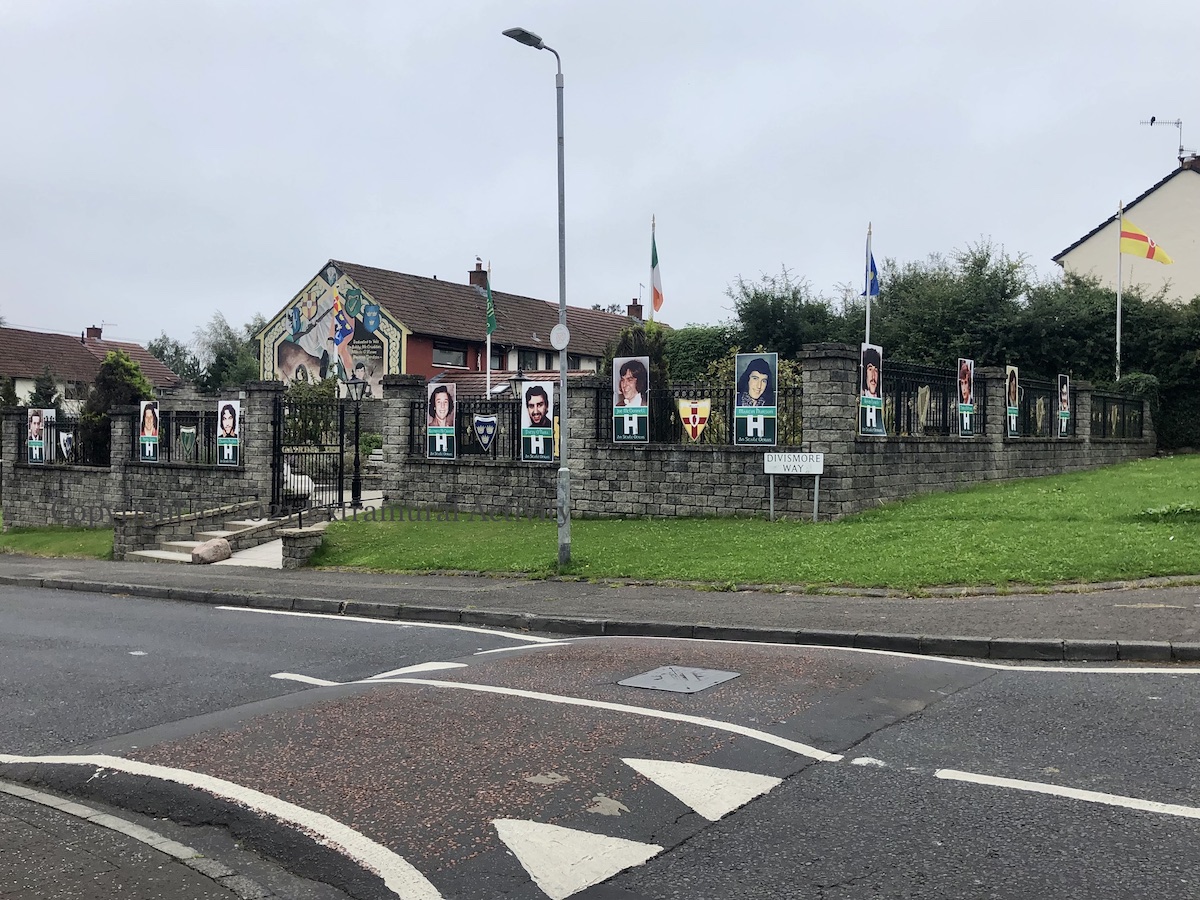
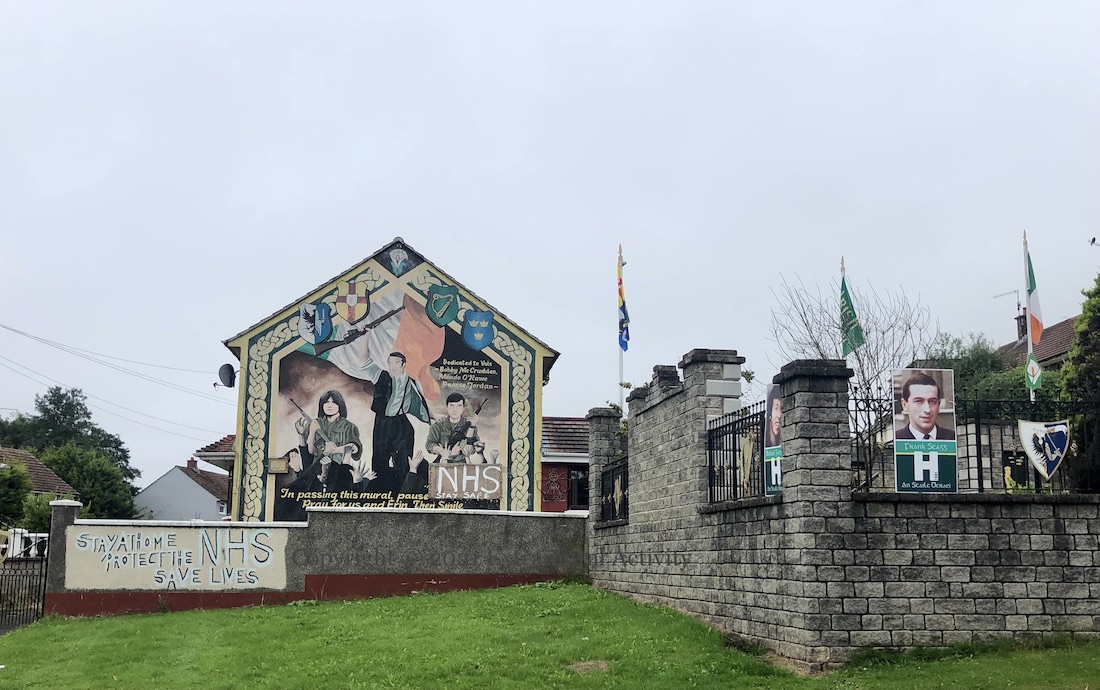
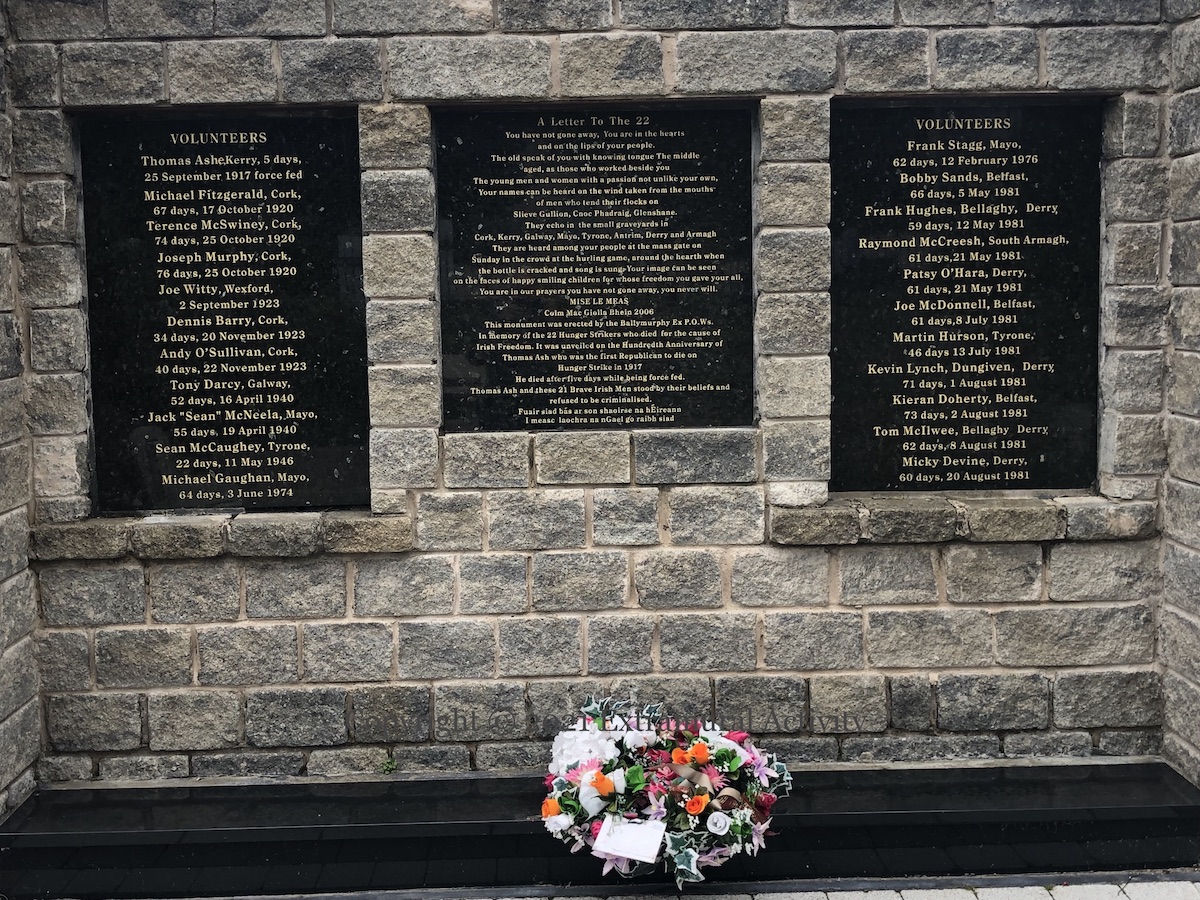
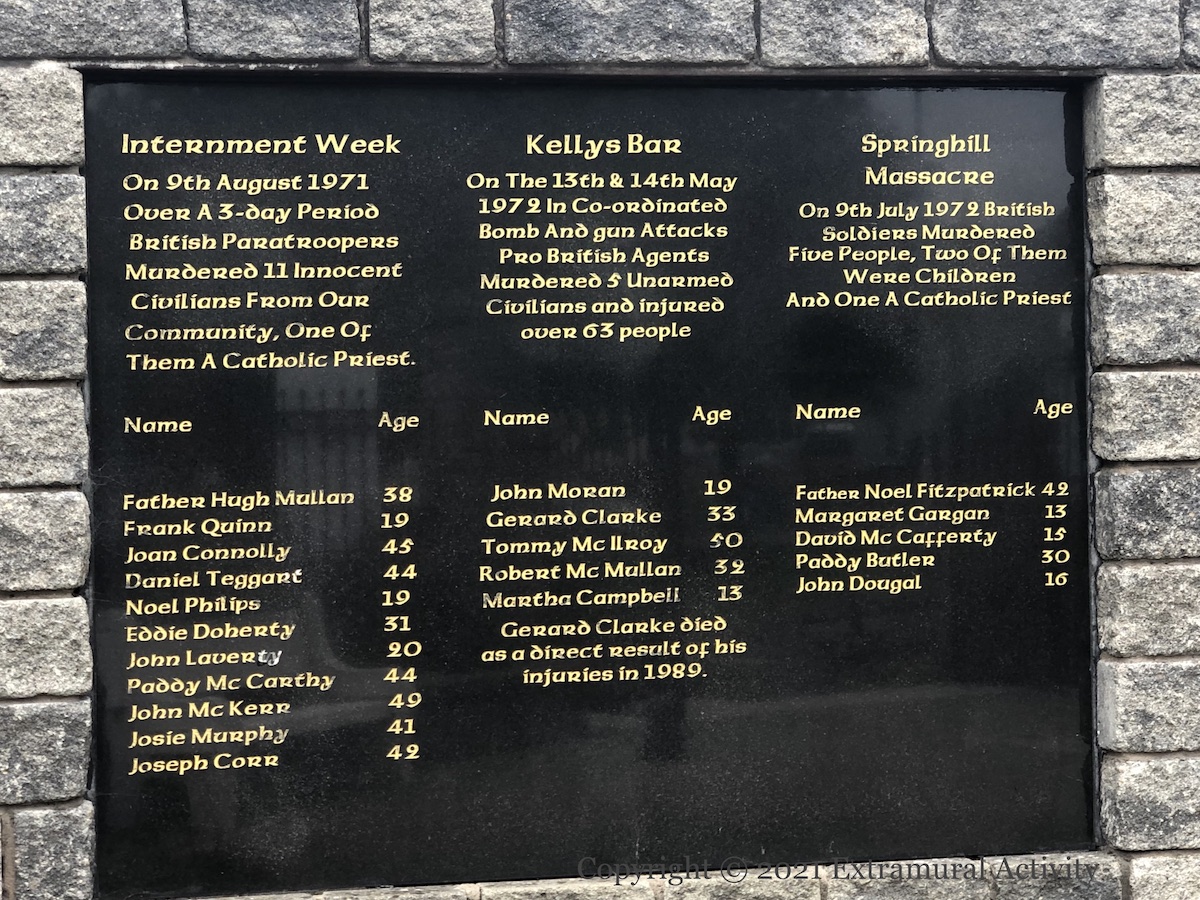
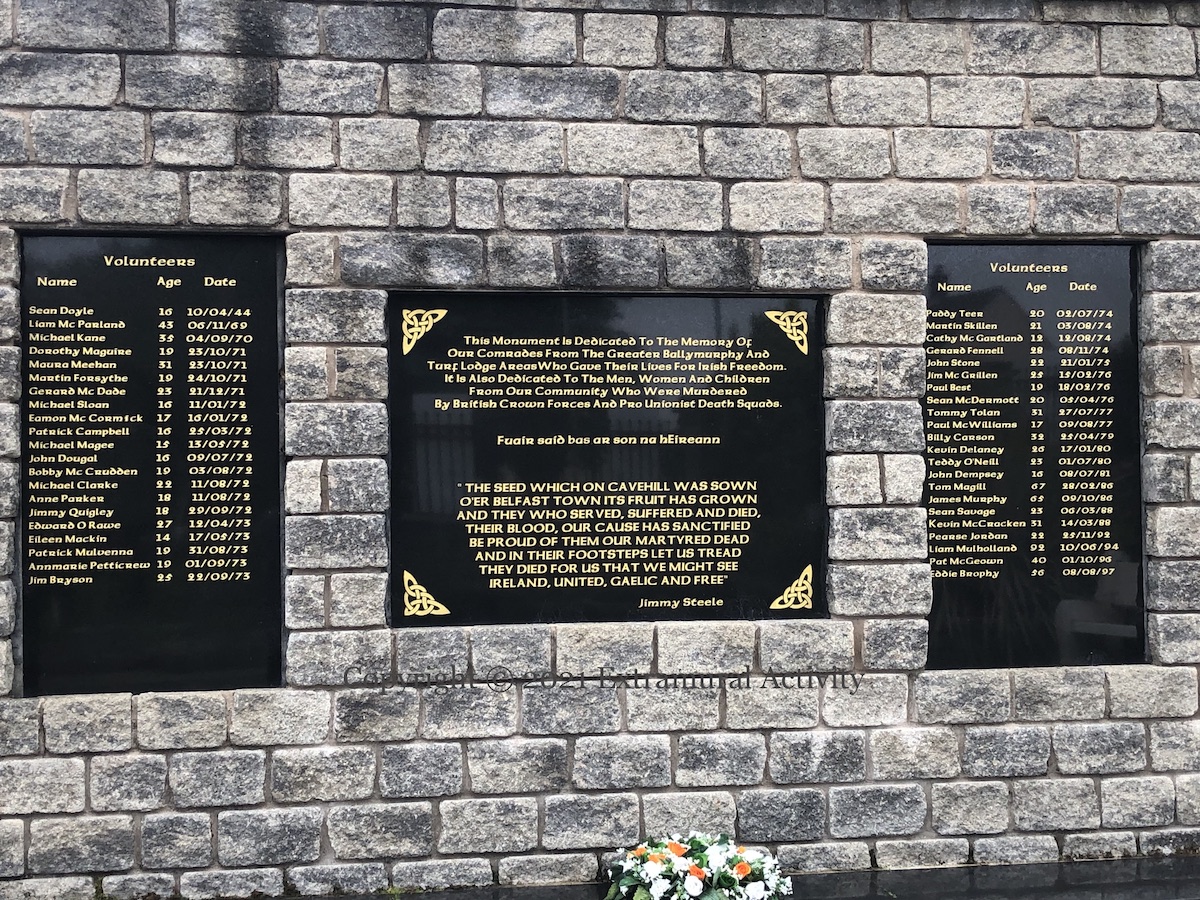
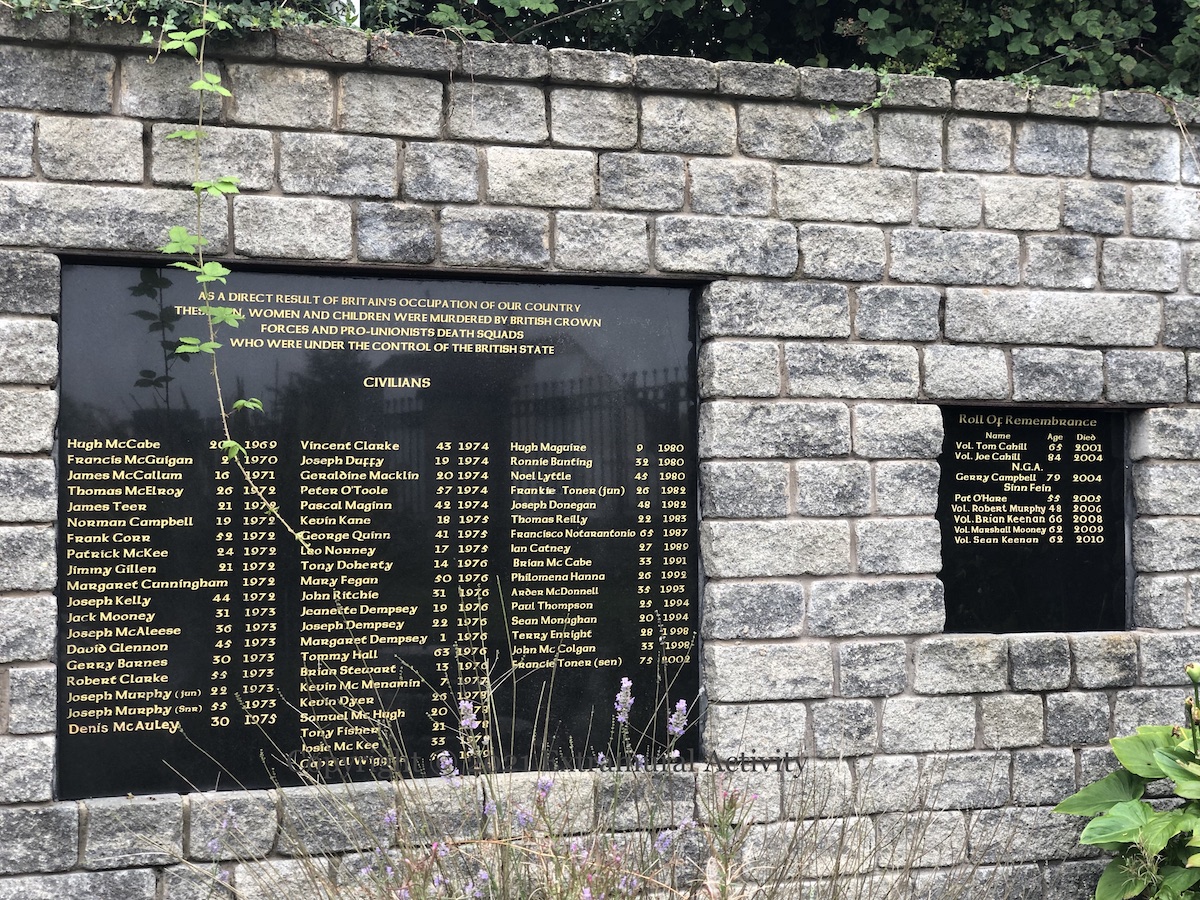
For the 40th anniversary of the 1981 Hunger Strike, portraits of the deceased ten (plus Frank Stagg and Michael Gaughan from the 1970s) were placed on the railings of the Ballymurphy memorial garden. There is a new (compared to 2006 and 2008) set of plaques, erected in 2017:
“A Letter To The 22: You have not gone away, you are in the hearts and on the lips of your people. The old speak of you with knowing tongue. The middle aged, as those who worked beside you. The young men and women with a passion not unlike your own. Your names can be heard on the wind taken from the mouths of men who tend their flocks on Slieve Gullion, Cnoc Phadraıg, Glenshane. They echo in the small graveyards in Cork, Kerry, Galway, Mayo, Tyrone, Antrim, Derry and Armagh. They are heard among your people at the mass gate on Sunday in the crowd at the hurling game, around the hearth when the bottle is cracked and song is sung. Your image can be seen on the faces of happy smiling children for whose freedom you gave your all. You are in our prayers you have not gone away, you never will. Mıse le meas Colm Mac Gıolla Bheın 2006. This monument was erected by the Ballymurphy Ex POWs in memory of the 22 hunger strikers who died for the cause of Irish freedom. It was unveiled on the hundredth anniversary of Thomas Ash[e] who was the first republican to die on hunger strike in 1917. He died after five days while being force fed. Thomas Ash[e] an these 21 brave Irish men stood by their beliefs and refused to be criminalised. Fuaır sıad bás ar son shaoırse na hÉıreann. I measc laochra na nGael go raıbh sıad.”